
How to Use This Report
This report describes, for Congress and the American public, the United States (U.S.) Government Accountability Office’s (GAO) performance measures, results, and accountability practices for fiscal year (FY) 2026 (October 1, 2025, through September 30, 2026). In assessing our performance, we compared actual results against targets and goals set in our annual performance plan and performance budget, which were developed to carry out our Strategic Plan. Our complete set of strategic planning and performance and accountability reports is available on our website.
This report includes a snapshot of our FY 2026 performance, a letter from the Acting Comptroller General, and five parts, as follows:
Part I: Management’s Discussion and Analysis
This section includes a statement attesting to the completeness and reliability of the performance and financial data in this report and the effectiveness of our internal control over financial reporting; a summary of our mission, organizational structure, strategies we use to achieve our goals, and processes for measuring our performance; a discussion of our FY 2026 agencywide performance results and use of resources; and information on management challenges, external factors that affect our performance, and the nation’s future challenges and priorities.
Part II: Performance Information
This section includes details on our FY 2026 performance results by strategic goal and our FY 2027 targets.
Part III: Financial Information
This section includes details on our FY 2026 finances, including a letter from our Chief Financial Officer (CFO), audited financial statements and notes, and reports from our Audit Advisory Committee and external auditor. This section also includes an explanation of the information each of our financial statements conveys.
Part IV: Inspector General’s (IG) View of GAO’s Management Challenges
This section includes our IG’s perspective of our agency’s management challenges.
Part V: Appendixes
This section provides the report’s abbreviations and describes how we ensure the completeness and reliability of the data for each of our performance measures.
Awards
The Association of Government Accountants (AGA) awarded GAO its 25th Certificate of Excellence in Accountability Reporting (CEAR) in recognition of its outstanding effort in preparing our FY 2025 Performance and Accountability Report (PAR). We also received a special “Best-in-Class” award for conveying performance information in a creative way. Additionally, Graphic Design USA awarded GAO the American Inhouse Design award for our FY 2025 PAR. The award recognizes design excellence.
|
|
|
|
|

A FY 2026 Performance and Financial Snapshot for the American Public
|
|
Government Accountability Office |
|
Who We Are: Created in 1921, GAO is an independent, nonpartisan professional services agency in the legislative branch of the federal government. What We Do: Commonly known as the investigative arm of Congress or the “congressional watchdog,” we examine how taxpayer dollars are spent and assess the efficiency and effectiveness of government. We develop nonpartisan, objective, and reliable information to advise lawmakers and agency heads on ways to make government work better. Our Results: Since 2002, GAO’s work has resulted in about $1.58 trillion in financial benefits and 34,232 program and operational benefits that helped change laws, improve public safety and other services, and promote better management throughout the government. Dollars invested in GAO since 2002 equal almost $15.2 billion. Looking back over the last 5 years, we have had an average annual return on investment (ROI) of about $74 for every dollar invested in GAO. Additionally, we estimate that implementation of open GAO recommendations to Congress, which we refer to as matters for congressional consideration, and recommendations to executive branch agencies could result in hundreds of billions of additional future financial benefits. |
|

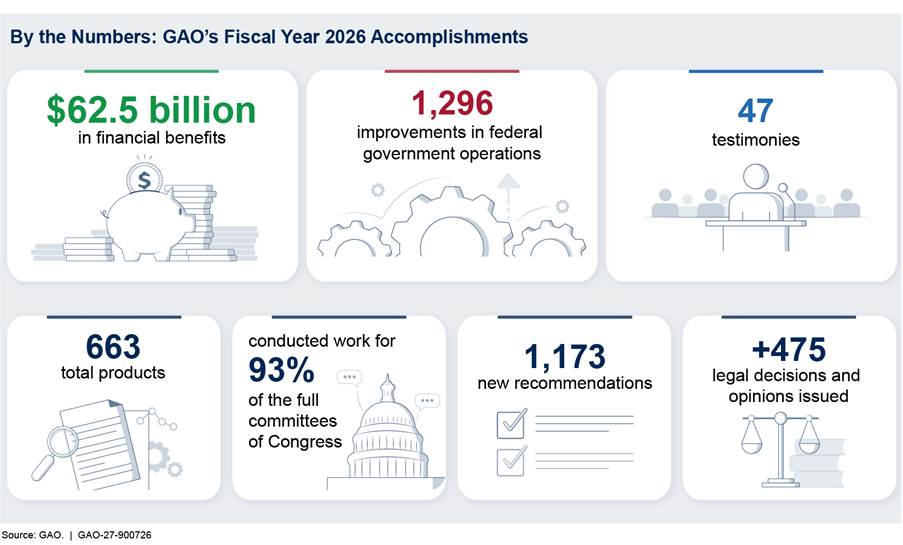

Figure 1: Financial Benefits GAO Recorded
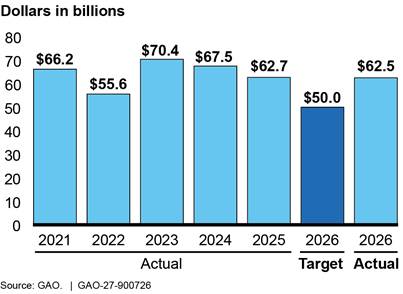
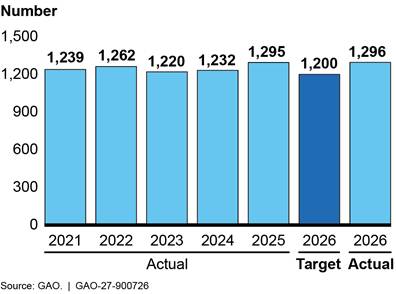
Figure 3: Percentage of Past Recommendations Implemented
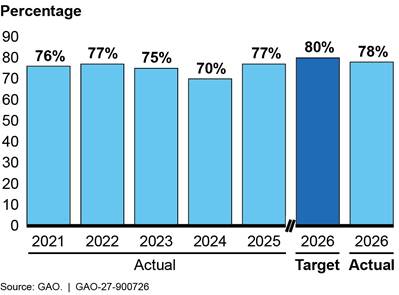
Note: Starting in fiscal year 2025, GAO used a 5-year implementation rate to calculate the percentage of past recommendations implemented.
Figure 4: Percentage of New Products with Recommendations
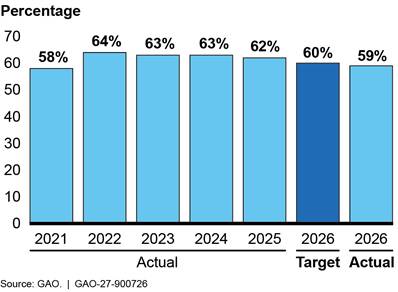
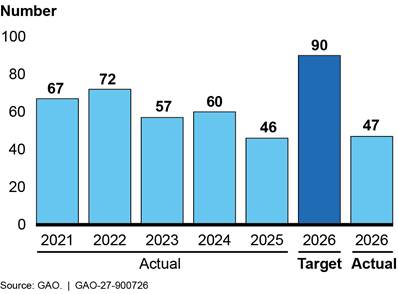
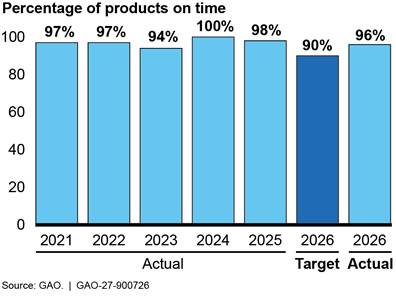
Table 1: GAO Reporting Summary
|
GAO REPORTING SUMMARY |
FY 2026 |
FY 2025 |
|
Clean opinion on financial statements |
Yes |
Yes |
|
Clean opinion on internal control over financial reporting |
Yes |
Yes |
|
Timely and accurate Treasury reporting |
Yes |
Yes |
|
Material weaknesses in internal control |
None |
None |
|
Significant internal control deficiencies |
None |
None |
Source: GAO. | GAO-27-900726
Figure 7: Use of FY 2026 Funds by Category
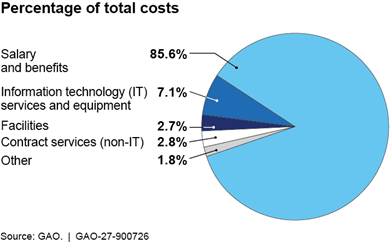
Table 2: GAO’s Financial Summary
|
GAO’S FINANCIAL SUMMARY (Dollars in millions) |
FY 2026 |
FY 2025 |
|
Total Assets |
$267.4 |
$290.1 |
|
Total Liabilities |
$109.6 |
$107.7 |
|
Total Net Position |
$157.8 |
$182.4 |
|
Net Cost of Operations by Goal |
|
|
|
Goal 1: Well-Being/ Financial Security of American People |
$309.0 |
$374.9 |
|
Goal 2: Changing Security Threats/Challenges of Global Interdependence |
271.4 |
212.3 |
|
Goal 3: Help Transform the Federal Government to Address National Challenges |
247.5 |
284.5 |
|
Goal 4: Maximize the Value of GAO |
12.4 |
13.4 |
|
Other Costs in Support of Congress |
76.4 |
67.2 |
|
Costs Not Assigned to Programs |
1.2 |
3.1 |
|
Reimbursable services not attributable to above cost categories |
(22.5) |
(15.8) |
|
Total Net Cost of Operations |
$895.4 |
$939.6 |
|
Actual full-time equivalents |
3,325 |
3,556 |
Source: GAO. | GAO-27-900726
More information on GAO’s performance is included in Part I and Part II of this report. Detailed information on GAO’s financials is included in Part III. Part IV includes information on the IG’s view of GAO’s management challenges. Part V describes how we set and calculate our performance measures.
The Nation’s Unsustainable Fiscal Future
The federal government faces an unsustainable long-term fiscal future that poses serious challenges. The federal government’s level of debt—and the annual interest it pays on the debt—are quickly approaching unprecedented levels relative to the size of the economy. In June 2026, we reported that debt held by the public will reach 106 percent of gross domestic product in 2029. GAO continues to recommend that Congress develop a strategy to address the government’s fiscal outlook and promote fiscal sustainability. Our work will continue to examine the federal government’s fiscal condition and the components of an effective long-term strategy.
Impacts of Evolving Science and Technology
GAO continues to serve as a crucial resource to help Congress understand the promise and risks of a range of science and technology (S&T) innovations, such as artificial intelligence (AI). GAO’s work has included assessments of the benefits and challenges of technologies, such as those to clean up waste using engineered microbes; and two-page Science & Tech Spotlights explaining the latest trends, including the malicious use of generative AI, among others. Additionally, we developed a framework to assess U.S. AI competitiveness relative to other nations. Our work will continue to address a range of science and technology topics, such as protecting sensitive biological data, reviewing AI chatbot safety measures, and examining federal support for small and medium-sized manufacturers.
Cybersecurity of Systems, Critical Infrastructure, and Sensitive Data
Escalating threats, including new and more destructive attacks from around the globe, highlight the critical and persistent need for effective cybersecurity. Our work will continue to assess federal agencies’ efforts to secure information systems, including the detection, prevention, and response to security incidents, and efforts to protect sensitive data.
Persistent Challenges in Addressing Fraud, Improper Payments, Waste, and Abuse in Federal Programs
Fraud, improper payments, waste, and abuse remain persistent challenges across the federal government. For example, in September 2026, we reported that annual federal tax fraud loss is between $116 billion and $304 billion based on data and information from 2018 through 2024. Our work will continue to examine fraud, improper payments, waste, and abuse in federal programs and help Congress identify vulnerabilities and strengthen its oversight of government programs.
Challenges Maintaining Readiness and Improving Other Defense Functions
The Department of Defense’s (DOD) mission to deter war and ensure the nation’s security is supported by almost half of the federal government’s discretionary spending. DOD faces key challenges, such as maintaining readiness, reforming business operations, and improving its health care system. Our work will continue to assess DOD’s business systems, financial management, weapon systems acquisitions, and operational efficiency.
Health Care Challenges
Health care spending now accounts for around 30 percent of the federal budget and is one of the fastest-growing federal expenditures. Our work will continue to examine the sustainability of Medicare and Medicaid; assess health care delivery through other federal programs; and examine trends and costs in the private health insurance market.
See The Nation’s Future Challenges and Priorities for more information.
From the Acting Comptroller General
November 16, 2026
I am pleased to present GAO’s FY 2026 PAR. This year’s report reflects the dedication of our staff and the continued importance of GAO’s mission—to support Congress in meeting its constitutional responsibilities and to help improve the performance and ensure the accountability of the federal government for the benefit of the American people.
GAO’s work continues to play a central role in congressional oversight and policymaking. We prioritize congressional needs by providing numerous services to Members of Congress. In FY 2026, we conducted work in response to mandates and requests from 93 percent of the full committees and 42 percent of the subcommittees of Congress. We also issued 663 products and made 1,173 new recommendations. Our work supported congressional deliberations on national security, health care, flood risks, cybersecurity, financial management, and disaster assistance. Additionally, we testified 47 times before 29 percent of the full committees and 10 percent of the subcommittees of Congress, continuing our track record of being one of the top agencies requested to testify. We testified on a range of topics, such as reducing fraud and improper payments, improving veterans’ health and benefits, strengthening military readiness, and enhancing federal oversight of critical infrastructure. Additionally, our work was cited by Members of Congress and witnesses in over 190 hearings beyond those at which we testified.
Throughout FY 2026, GAO’s work spanned the full scope and breadth of the federal government’s responsibilities. This report is a comprehensive accounting of the resources entrusted to us and how they were used to support our mission and achieve results for Congress and the American people. GAO remained focused on delivering high-quality, nonpartisan, and objective work that informs congressional decision-making and strengthens federal programs.
Supporting Congressional Priorities
GAO’s work is driven by, and supports, congressional priorities.
GAO’s work helped inform legislative decisions. In FY 2026, Congress relied on GAO’s work to inform key legislative decisions. For example:
■ The National Defense Authorization Act for FY 2026 and accompanying documents contain over 60 directives to agencies consistent with GAO’s findings and recommendations across important areas, including requiring DOD to take actions related to improving the poor conditions at military barracks that undermined service members’ quality of life and readiness and authorizing federal entities to mitigate threats posed by drones to the safety and security of various events and facilities (including at airports).
■ The FY 2026 spending bills and accompanying documents contain over 30 provisions consistent with GAO’s findings and recommendations—including requiring the Federal Aviation Administration (FAA) to provide Congress with more information about its air traffic control modernization effort and maintaining improvements related to how information about cyber threats is shared among federal and nonfederal entities.
Additionally, GAO’s findings and recommendations informed enacted legislation related to strengthening federal financial oversight and addressing the housing needs of homeowners and renters.
GAO’s recommendations also assisted Congress in the development of proposed legislation on various topics. For example, Congress is considering legislation to strengthen reporting on veterans’ employment outcomes and to improve the accuracy of student financial aid reporting.
GAO’s work generated about $62.5 billion in financial benefits. In FY 2026, GAO’s work generated about $62.5 billion in measurable financial benefits—consistent with our 5-year average ($63.7 billion). These financial benefits produced a return of about $71 for every dollar invested in us and stem from actions taken by Congress and agencies based on our recommendations. For example, as a result of our work
■ the Department of Health and Human Services (HHS) made a policy change in 2022 that better aligns states’ estimates of the cost of Medicaid demonstrations with recent cost data. We have recommended since 2002 that HHS ensure that states use valid methods to demonstrate budget neutrality for their Medicaid demonstrations. In June 2026, we calculated that this policy change saved $16.1 billion in FY 2025;
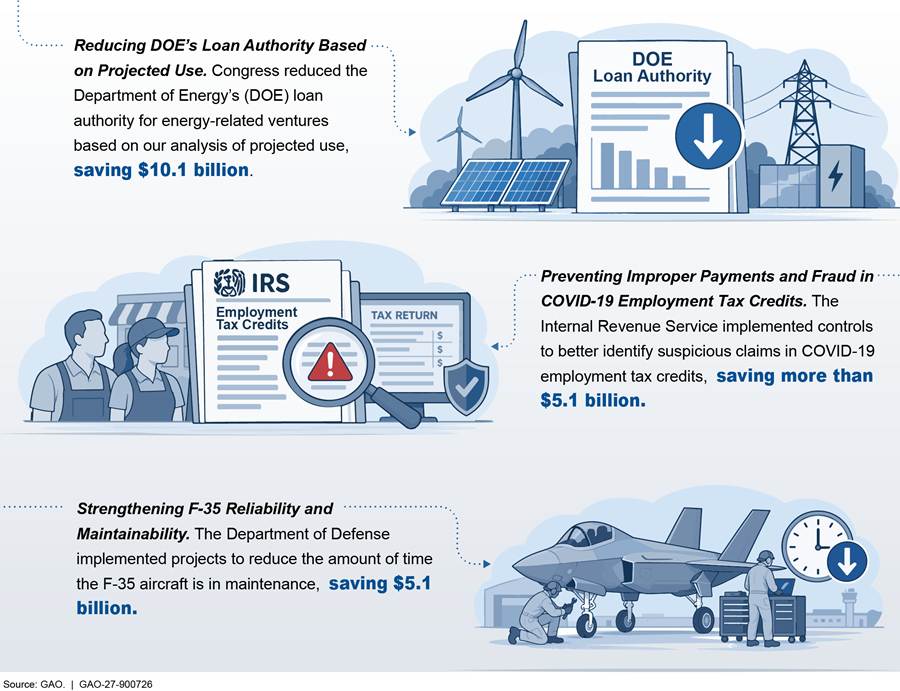
■ Congress rescinded funds previously provided for Department of Energy (DOE) loan programs that exceeded the agency’s projected use, which saved $10.1 billion; and
■ the Internal Revenue Service (IRS) implemented additional controls to identify suspicious claims in COVID-19 employment tax credits, which has saved $5.1 billion since 2023.
■ Further, as of October 2026, we estimated that implementation of open GAO matters for congressional consideration and recommendations to executive branch agencies could result in $145 billion to $264 billion in measurable future financial benefits.
GAO’s work produced 1,296 program improvements government-wide. Beyond measurable financial benefits, GAO’s work in FY 2026 produced 1,296 operational and program improvements across the government. Agencies enhanced fraud prevention and financial stewardship, improved protections for vulnerable populations, strengthened oversight of national security and international assistance, and modernized critical technology and digital systems. For example, our work led the Department of Veterans Affairs (VA) to improve the Veterans Crisis Line to better ensure that callers in crisis receive the help they need. Our work also prompted selected federal agencies to enhance their efforts to secure internet-connected devices, including those used in critical infrastructure, by strengthening their oversight of these devices and better securing their systems from cyberattacks.
GAO continued to provide numerous services to Congress. We continued to provide several types of services to Members of Congress. For example, in FY 2026, we provided 905 instances of technical assistance at the request of Members of Congress, including briefings on various program and policy topics by GAO experts, data analysis, white papers, and comments on legislative bills. Additionally, we continued to hold events for congressional staff in our dedicated space at the Longworth House Office Building. We offered information sessions each week on appropriations law and science and technology. We also hosted 16 events covering various topics, including semiconductors and export controls, critical minerals, and duplication and cost savings in the federal government. Additionally, we continued to support Congress’s constitutional and oversight powers by issuing decisions on appropriations law issues. In FY 2026, our Office of General Counsel (OGC) published over 475 legal decisions and opinions. OGC handled 1,600 bid protest cases and issued 412 decisions on the merits.
GAO continued to build bodies of work to support congressional oversight and priorities. We continued to focus our resources on congressional priorities in conducting key bodies of work. For example, in May 2026, we issued our 16th Annual Report on the federal government’s opportunities to reduce duplication, overlap, and fragmentation. We also continued to bring attention to existing High Risk areas. In June 2026, we issued a new product that applies High Risk List criteria to inform agency efforts to help reduce improper payments and save taxpayer dollars. Across our bodies of work, we continued to support Congress’s constitutional powers, including its power of the purse.
■ Fraud, Waste, and Abuse. We continued to build our body of work on addressing fraud, waste, and abuse across the federal government. In April 2024, we estimated the federal government lost between $233 billion and $521 billion annually due to fraud (based on FYs 2018-2022 data). Further, in September 2026, we reported that annual federal tax fraud loss is between $116 billion and $304 billion based on data and information from 2018 through 2024. As of August 2026, we have made about 230 recommendations to Congress and agencies to better manage their fraud risks. Of these, 58 percent have been implemented. We will continue to work with Congress and the agencies to address the remaining open recommendations.
Science and Technology. GAO continues to serve as a crucial resource to help Congress understand the promise and risks of a range of science and technology innovations. In FY 2026, we continued to advance our science and technology body of work, providing Congress with timely insights into emerging technologies—including AI, wearable technologies used in clinical decision-making, biotechnology, and critical minerals. We issued four Technology Assessments and eight Science & Tech Spotlights that helped policymakers understand the benefits, implications, and policy options of rapidly evolving technologies. We also issued the second annual edition of our S&T trends report, where we examined three emerging technologies with transformative potential—neural implants for human augmentation, general purpose robots, and technologies to remove “space junk.” Further, we launched an external network of experts to strengthen the S&T expertise available to support Congress.
■ National Security. Our national security body of work included a range of areas, such as military readiness, weapon system acquisition and modernization, and space and cyber operations. For example, in March 2026, we testified before Congress on DOD’s progress in addressing over 100 of our recommendations to improve military readiness and address persistent challenges across air, sea, ground, and space domains. Additionally, in April 2026, we reported on DOD’s efforts to modernize its financial management systems. Since 2002, we have closed over 8,500 recommendations to DOD. As of October 2026, there were over 1,500 open GAO recommendations, and we will continue to monitor DOD’s progress toward addressing them.
■ Cybersecurity Threats. We continued to build our body of work evaluating cybersecurity risks to federal agencies, as well as the nation’s critical infrastructure. For example, in May 2026, we testified on the cybersecurity of drinking water and wastewater systems. Since 2010, we have made over 4,900 recommendations to federal agencies to address cybersecurity issues. As of August 2026, federal agencies have implemented about 84 percent of these recommendations. We will continue to monitor agencies’ progress toward addressing our remaining open recommendations.
■ Health Care Spending. Our body of work continued to help improve the delivery of health care, while reducing costs. Health care spending now accounts for around 30 percent of the federal budget, and federal health programs are highly vulnerable to fraud, waste, abuse, and mismanagement due to their size and complexity. In FY 2026, we documented over $17 billion in savings from agencies acting on our recommendations about health care spending. Our work has also focused on certain drivers of health care spending, including consolidation of providers, health plans, and related entities. Specifically, we have a long-standing recommendation that Congress address incentives in the Medicare program for hospitals to acquire physician practices—a practice known as vertical consolidation—because it leads to higher program spending. While some actions have been taken to address these “site neutral” payment concerns in Medicare, including in FY 2026, additional actions are warranted. We will continue to examine anticompetitive incentives and practices as part of our broader body of work on health care spending.
Ensuring Organizational Readiness
We have identified five priorities to strengthen our organizational agility, efficiency, and effectiveness: (1) improving and evolving our existing technology; (2) fortifying our relationships with our clients and improving our responsiveness to meet their timelines and informational needs; (3) refreshing our internal training to equip our staff with skills needed to audit in today’s environment; (4) streamlining and modernizing our processes, products, and services; and (5) maintaining direct, transparent, and open communications with our staff.
As we continue to meet the demands for our work, we must also ensure that our internal operations remain strong, resilient, and aligned with our mission. In FY 2026, we continued to address internal management challenges related to change management, with particular emphasis on (1) leveraging our reduced workforce, (2) evolving our technology and data capabilities, and (3) managing our real property in a constrained budget environment.
Leveraging Our Workforce. Our workforce remains our greatest asset. With staffing levels lower than in prior years, we focused on evaluating our organizational alignment and identifying ways to more effectively leverage staff expertise and capacity. This included assessing how work is distributed across mission teams, strengthening leadership coordination, and ensuring that staff have the tools and support needed to deliver high-quality work efficiently. We implemented a nationwide resource network to enable our teams to leverage our geographically distributed workforce to support mission delivery, while reducing travel costs.
We continued to meet or exceed targets for key people measures—including retention, staff development, and organizational climate—which reflects GAO’s commitment to maintaining a high-performing, engaged workforce, even amid resource constraints.
Evolving Technology and Data Capabilities. Rapid advancements in technology and data analytics continue to shape our work and the federal landscape. In FY 2026, we advanced several major IT initiatives designed to strengthen security, improve productivity, and support our ability to deliver timely, data-driven insights to Congress. For example, we continued implementing modern cloud-based systems, enhancing cybersecurity protections, and improving enterprise content management. Further, we focused on better aligning our leadership team around information technology and data, ensuring that decision-making reflects enterprise needs and long-term priorities. For example, in FY 2026, we appointed an Acting Chief Technology Officer—who is responsible for developing the agency’s long-term enterprise technology roadmap and evaluating emerging capabilities, among other things. Additionally, we issued our first AI Strategy, which provides a roadmap for how we will advance our use of AI in mission delivery and operations. We also advanced multiple AI use cases, including tools to summarize GAO work and to help staff organize and synthesize audit documentation.
Managing Real Property. We continued our efforts to optimize the use of our Washington, D.C., headquarters building and manage our field office footprint. In FY 2026, we took steps to enhance our capabilities to manage real property more strategically by balancing mission needs and budget constraints. Additionally, we continued reducing leased space in field locations and pursued opportunities to increase utilization of headquarters space through strategic leasing arrangements. We anticipate that restructuring will reduce our footprint in the field by at least 80 percent. These efforts help ensure that our real property portfolio remains efficient, cost-effective, and aligned with our operational needs.
Maintaining Stewardship and Accountability
We remain committed to strong financial management and stewardship of taxpayer resources. For FY 2026, we again received an unmodified—or “clean”—audit opinion on our financial statements from independent auditors. We also had no reportable noncompliance with internal control over financial reporting or applicable laws, regulations, contracts, or grant agreements tested. This clean opinion reflects our continued commitment to transparency, accuracy, and reliability in our financial reporting. We maintain rigorous internal controls and ensure that the detailed performance and financial information in this report meets the highest standards of quality. Our financial management practices support our ability to deliver timely, objective, and impactful work for Congress.
In October 2026, we issued our Strategic Plan for FYs 2027 through 2032. This plan will guide our work over the next several years, ensuring that we remain focused on congressional priorities, emerging risks, and opportunities to strengthen federal programs.
As we look ahead, GAO remains committed to fulfilling its mission, serving Congress and the public, and improving the performance of the federal government on issues affecting the lives of all Americans.

Orice Williams Brown
Acting Comptroller General
Of the United States
Part I: Management’s Discussion and Analysis
November 16, 2026
Assurance Statement on Internal Control over Operations, Reporting, and Compliance
GAO management is responsible for managing risks and maintaining effective internal control to meet the objectives of the Federal Managers’ Financial Integrity Act of 1982 (FMFIA). These are objectives that we set for ourselves even though, as part of the legislative branch of the federal government, GAO is not subject to FMFIA. GAO conducted its assessment of risk and internal control consistent with Office of Management and Budget (OMB) Circular No. A-123, Management’s Responsibility for Internal Control. Based on the results of the assessment, GAO can provide reasonable assurance that internal control over operations, reporting, and compliance as of September 30, 2026, was operating effectively and that no material weaknesses were found in the design or operation of internal control.
Assurance Statement on Internal Control Over Financial Reporting
GAO’s internal control over financial reporting is a process effected by those charged with governance, management, and other personnel, the objectives of which are to provide reasonable assurance that transactions are (1) properly recorded, processed, and summarized to permit the preparation of financial statements in accordance with U.S. generally accepted accounting principles and assets are safeguarded against loss from unauthorized acquisition, use, or disposition; and (2) executed in accordance with provisions of applicable laws (including laws governing the use of budget authority), regulations, contracts, and grant agreements, noncompliance with which could have a material effect on the financial statements.
GAO management is responsible for designing, implementing, and maintaining effective internal control over financial reporting. GAO conducted its assessment of the effectiveness of internal control over financial reporting according to the criteria established under FMFIA and OMB Circular No. A-123. Based on the results of the assessment, GAO can provide reasonable assurance that its internal control over financial reporting as of September 30, 2026, was operating effectively and that no material weaknesses were found in the design or operation of internal control over financial reporting.
Assurance Statement on Financial Management Systems
GAO conducted reviews of its financial management systems consistent with Appendix D of OMB Circular No. A-123, Management of Financial Management Systems – Risk and Compliance, which contains guidance for determining compliance with the Federal Financial Management Improvement Act of 1996 (FFMIA). We conduct these reviews even though, as part of the legislative branch of the federal government, GAO is not subject to FFMIA. Based on the results of these reviews, GAO can provide reasonable assurance that it has implemented and maintained financial management systems that comply substantially with federal financial management systems requirements; applicable federal accounting standards; and the U.S. Government Standard General Ledger at the transaction level, consistent with the requirements of FFMIA.
Orice Williams Brown, Acting Comptroller General of the United States //SIGNED//
William White, Chief Administrative and Financial Officer //SIGNED//
A. Nicole Clowers, Acting Chief Operating Officer //SIGNED//
Kimberly Bassett-Nelson, Controller //SIGNED//
Edda Emmanuelli Perez, General Counsel //SIGNED//
GAO is an independent, nonpartisan agency in the legislative branch of the federal government. Commonly known as the investigative arm of Congress, or the “congressional watchdog,” we examine how taxpayer dollars are spent and advise policymakers and agency heads on ways to make government work more efficiently.
GAO also manages FraudNet, which is our online system created for the public to report to GAO allegations of fraud, waste, abuse, or mismanagement of federal funds.
As a legislative branch agency, we are exempt from many laws that apply to executive branch agencies. However, we generally hold ourselves to the spirit of many such laws, including FMFIA; the Government Performance and Results Act of 1993 (GPRA), GPRA Modernization Act of 2010 (GPRAMA); and the Federal Information Security Modernization Act of 2014 (FISMA).[1] Additionally, in FY 2026, we implemented the Federal Accounting Standards Advisory Board’s Statement of Federal Financial Accounting Standards 64: Management’s Discussion and Analysis, Rescinding and Replacing SFFAS 15. Accordingly, the FY 2026 PAR provides information on GAO’s work, which we consider comparable to that reported by executive branch agencies that choose to prepare annual PARs in lieu of separate Agency Financial Reports.
See our website for additional information on our history and what we do.
Mission
Our mission is to support Congress in meeting its constitutional responsibilities and to help improve the performance and ensure the accountability of the federal government for the benefit of the American people.
Core Values
Our three core mission values—accountability, integrity, and reliability—form the basis for all of our work, regardless of its origin. These core mission values work in concert with our three core people values—that our staff are valued, respected, and treated fairly—to create a synergy that is essential for us to achieve our mission. (See the inside front cover of this report for more detail, along with our scope of work.)
Strategic Goals
Information presented in this PAR is aligned with the three externally focused strategic goals (Goals 1, 2, and 3) and one internally focused goal (Goal 4) described in the Strategic Plan we issued in 2022, which was in effect in FY 2026. We issued an updated Strategic Plan in October 2026 for FYs 2027-2032.[2] For additional information, see Part II of this report.
■ Goal 1: Address Current and Emerging Challenges to the Well-Being and Financial Security of the American People
■ Goal 2: Help Congress Respond to Changing Security Threats and the Challenges of Global Interdependence
■ Goal 3: Help Transform the Federal Government to Address National Challenges
■ Goal 4: Maximize the Value of GAO by Enabling Quality, Timely Service to Congress, and by Being a Leading Practice Federal Agency
Organizational Structure
Orice W. Brown is the Acting Comptroller General of the United States and head of GAO. Her term began on December 30, 2025, when Comptroller General Gene Dodaro’s term ended. Under the law, the outgoing Comptroller General designates an interim successor from within GAO before vacating the position. Ms. Brown will continue to serve as Acting Comptroller General until a new Comptroller General is confirmed by the Senate. Additional details on the role of, and the process for, selecting the Comptroller General can be found on our website.
Three other executives join the Acting Comptroller General to form our Executive Committee: Acting Chief Operating Officer A. Nicole Clowers, Chief Administrative and Financial Officer William White, and General Counsel Edda Emmanuelli Perez.
We have 15 teams of analysts, financial auditors, and specialists to support our three external strategic goals—with several of the teams supporting more than one strategic goal. We also have 16 operations and staff offices that execute the agency’s mission by supporting the teams and the Executive Committee, Congress, and the American people. For more information on our organizational structure and teams, see our website.
As of the end of FY 2026, we maintained a workforce of 3,325 full-time equivalents (FTE), which is a decrease of 231 FTEs (7 percent) since the end of FY 2025. Our offices are located in Washington, D.C., and 11 locations nationwide, to help carry out our mission. Our employees have expertise in many disciplines, including accounting, law, engineering, public and business administration, economics, physical and social sciences, and IT.
Additional information on our office locations can be found on our website.
Strategic Planning
We publish a Strategic Plan that describes our goals and strategies for supporting Congress. The plan is informed by ongoing engagement with congressional stakeholders and outlines the areas in which we expect to conduct audits, analyses, investigations, and evaluations to meet our clients’ needs. Revisions to our Strategic Plan or resource allocations are reported in our annual performance plan.
In 2026, we issued our updated Strategic Plan—which covers FYs 2027-2032. The updated plan presents GAO’s work and operations under three goals. Goals 1 and 2 are externally focused, covering the audit, investigative, and analytical work GAO conducts on behalf of Congress. Goal 3 is internally focused, covering how GAO operates at the highest level of quality, timeliness, and accountability.
Strategic Foresight
Foresight and continuous environmental scanning inform how we prepare and plan our ongoing and future work for Congress. Insights from GAO’s Center for Strategic Foresight, trend analysis, and discussions with Congress help identify major emerging issues and long-term risks facing the federal government. This information enables us to remain an agile agency that provides Congress with expertise, analysis, and forward-looking products.
In FY 2026, GAO’s Center for Strategic Foresight leveraged internal GAO expertise and advanced our foresight capacity through the following efforts: (1) conducting horizon scanning to inform mission portfolio planning and agency priority setting, (2) providing technical assistance and support to GAO teams to help strengthen and increase the use of foresight tools and methodologies in their work, (3) providing training in strategic planning and foresight for Fellows in the International Auditor Fellowship Program cohort, and (4) supporting GAO’s AI Council.
Partnerships and Capacity Building
GAO builds relationships, shares knowledge, and strengthens the capacity of domestic and international accountability partners to advance U.S. interests and oversight of federal resources across the country and worldwide. The Strategic Planning and External Liaison (SPEL) office leads these initiatives with external partner organizations.
We engage with inspectors general and auditors at the federal, state, and local levels, as well as other groups who provide GAO and our auditors with critical information; contacts; or expertise, as appropriate. These relationships allow us to quickly connect GAO auditors with contacts and expertise that can enhance their engagement work for Congress.
In June and August 2026, we convened meetings of the Comptroller General’s Domestic Working Group and Educators Advisory Panel, respectively. These meetings provided a platform to explore high-priority audit issues across the federal, state, and local audit community and discuss our workforce needs and development.
GAO made substantial contributions to the international accountability community through its leadership role in the International Organization of Supreme Audit Institutions (INTOSAI), including as a member of its governing board and as the chair or vice chair of six INTOSAI bodies. INTOSAI is an umbrella organization for the international government auditing community to share knowledge and improve government auditing around the world.
In FY 2026, GAO continued its International Auditor Fellowship Program, which now has 679 graduates from 111 countries. The program enhances the effectiveness of U.S. public funds by helping other national audit offices build capacity for strengthening financial transparency, reducing corruption, and fostering stable economic environments that benefit American financial assistance, trade, and investment.
In 2014, Congress authorized GAO to establish the Center for Audit Excellence (CAE) to provide training and technical assistance to domestic and international accountability organizations. CAE is authorized to charge fees for its services, which it uses to recover most of its costs. In FY 2026, CAE provided over 70 training sessions to about 1,755 participants from 72 domestic accountability community clients, such as inspectors general and state and local audit offices. CAE also provided technical assistance to several domestic inspector general offices to help them enhance their auditing capacity. The training courses focused on a variety of auditing topics—such as audit planning and execution and writing effective audit reports and recommendations.
In FY 2025, GAO ended most of CAE’s international work, as international clients could no longer obtain sources of funding. Given that and other changes in the operating environment, we paused signing new client agreements as of June 2026 so that we can assess options for continuing CAE’s mission with a modified operating plan for FY 2027.
GAO’s Strategic Plan emphasizes achieving our goals by (1) providing Congress and the public with information from our work and (2) continuing to strengthen our human capital and internal operations.
Additionally, we emphasize the importance of working with other organizations on cross-cutting issues, effectively addressing challenges to achieving our agency’s goals, and recognizing the internal and external factors that could impair our performance. With this approach, we plan to achieve the level of performance needed to meet our performance measures. We also have a mechanism in place to monitor progress toward meeting our goals.
Attaining our strategic goals and their related objectives rests on providing Congress with the objective, fact-based, nonpartisan, and balanced information it needs to execute its constitutional responsibilities. We do so in several ways, including
■ monitoring and evaluations of federal policies, programs, and activities, and the performance of agencies;
■ oversight of government operations through financial and other management audits to determine whether public funds are spent efficiently, effectively, and in accordance with applicable laws;
■ investigations to assess whether illegal or improper activities are occurring;
■ analyses of the financing for government activities;
■ legal decisions that determine whether agencies are in compliance with applicable laws and regulations;
■ policy analyses to assess needed actions and the implications of proposed actions; and
■ additional assistance to Congress in support of its oversight and decision-making responsibilities.
We conduct specific engagements as a result of requests from congressional committees; individual Members; and mandates written into statutes, resolutions, and committee reports. In FY 2026, we devoted 97 percent of our engagement resources to work requested, or mandated, by Congress. We also provide frequent technical assistance to congressional staff and committees.
We devoted the remaining 3 percent of engagement resources to work initiated under the Comptroller General’s authority. Much of the work conducted under the Comptroller General’s authority addressed various challenges that are of broad-based interest to Congress.
Our reviews of government programs and operations have identified programs that are at high risk for fraud, waste, abuse, and mismanagement. These reviews help support our biennial High Risk Report, which we last updated in 2025. By making recommendations to improve the accountability, operations, and services of government agencies, we contribute to increasing the effectiveness of federal spending and enhancing the taxpayers’ trust and confidence in their government.
Our staff are responsible for following high standards for gathering, documenting, and supporting the information we collect and analyze. Government Auditing Standards, developed under the direction of the Comptroller General, together with the GAO policies that we apply in conducting our audits, are consistent with the auditing principles of the International Standards of Supreme Audit Institutions.
Our work is usually presented in products that are publicly available. In some cases, we develop products that contain classified or sensitive information that cannot be made publicly available. In FY 2026, we issued 663 total products (including classified or sensitive products). Over the past 5 years, we have issued, on average, 676 products annually. Additionally, we published more than 475 legal decisions and opinions in FY 2026, the vast majority of which are bid protest decisions. Our products include
■ reports and written correspondence, including Science & Tech Spotlights and Snapshots, which are short and concise products tailored for busy readers to share fact-based knowledge on important current issues facing Congress and the nation;
■ financial audits of the federal government’s consolidated financial statements (since 1997), as well as several agency financial statements;
■ testimonies and statements for the record, where the former are delivered orally by one or more of our senior executives at a congressional hearing, and the latter are provided for inclusion in the Congressional Record;
■ briefings, which are usually given directly to members of Congress or their staff; and
■ legal decisions and opinions resolving bid protests and addressing issues of appropriations law.
We also produce special publications, such as our reports on America’s fiscal future and bid protests.[3] Our publication, Principles of Federal Appropriations Law, is viewed both within and outside of the government as the primary resource on federal law related to the availability, use, and control of federal funds.[4]
Additionally, we maintain the government’s repository of reports on Antideficiency Act violations and publish information extracted from those reports on our website. These publications are valuable because they highlight important decisions and management issues facing policymakers.
We also achieve our goals by examining the impact of our past work and using that information to shape future work. Consequently, we evaluate actions taken by federal agencies and Congress in response to our past recommendations. The results are reported in terms of financial benefits and other benefits. We establish priority recommendations and actively monitor the status of open recommendations—those that remain valid but have not yet been fully implemented—and post our findings to our recommendations database.
To attain our internal goal and its related objectives, we engage in activities to address the key efforts of our Strategic Plan. Additionally, we obtain feedback from our congressional clients and internal customers on our products, processes, and services—to identify ways to improve them. We also perform internal management studies and evaluations.
To help us determine how well we are meeting the needs of Congress and maximizing our value as a leading practices federal agency, we assess our performance annually using a balanced set of quantitative and qualitative performance measures that focus on four key areas—results, client, people, and internal operations.
|
|
To assess our results, we measure financial benefits, other benefits, the percentage of past recommendations implemented, and the percentage of new products with recommendations. |
|
|
■ Financial benefits (generally an estimated cost reduction, cost avoidance, or increase in revenue) and other benefits (such as better services to the public that cannot be estimated in dollar terms and efficiency gains) typically occur when a recommendation is implemented by a congressional or agency action. We report financial benefits as net benefits, or estimates of benefits less costs associated with taking the action. (Note, financial benefits are not related to GAO’s financial information as reported in Part III.) We generally limit the number of years for which we can claim a financial benefit to 5 fiscal years. |
|
|
■ To claim a financial benefit or other benefit, we prepare an accomplishment report. This documents, among other things, (1) a cause-and-effect relationship between the benefits reported and our work and (2) that the action taken by Congress or an agency has been substantially completed. Estimates of financial benefits are based on information generally obtained from non-GAO sources, such as CBO. Staff can prepare accomplishment reports within 2 fiscal years of the action(s) being taken by Congress or an agency. As a result of these policies, benefits can be reported years after recommendations are made. We generally follow up with federal agencies and update the status of our recommendations at least once yearly.[5] |
|
|
■ As an illustrative example, we made a recommendation to improve an agency’s operations in 2022. The agency agreed with the recommendation and took actions to implement the recommendation. We obtained documentary evidence to review the steps the agency took and determined that the agency changed a business practice in FY 2026. We also determined that the change was permanent and caused a net reduction in program costs beginning in FY 2026. As a result, we can claim net financial benefits for up to 5 consecutive years, from FYs 2026 to 2030. |
|
|
■ The percentage of new products with recommendations includes reports and correspondences issued within a fiscal year that included at least one recommendation. This measure recognizes that our products do not always include recommendations. |
|
|
To measure how well we are serving our client, we capture our timeliness in delivering products to Congress and the number of times our senior executives were asked to present expert testimony at congressional hearings. We use a client feedback survey to collect quantitative and qualitative data and information on the services we provide to our congressional clients. |
|
|
As our most important asset, our people define our character and capacity to perform our work. A variety of data sources, including an internal survey, provide information to help us measure how well we are attracting and retaining highly qualified staff and how well we are developing, supporting, utilizing, and leading staff. |
|
|
GAO’s ability to execute its mission and retain a skilled and talented workforce is supported by our administrative services (e.g., IT, infrastructure operations, human capital, and financial management). Beginning in 2022, we administered an internal Customer Satisfaction Survey to better gauge the effectiveness of these services, among other things. We deferred administration of the survey in 2026 and initiated a redesign of the survey instrument to align it with our updated Strategic Plan and the way services are currently provided. We plan to administer the redesigned survey instrument and resume reporting on internal operations performance in FY 2027. |


To establish targets for all of our measures, we consider our past performance, including recent patterns and 4-year rolling averages. We use 4-year rolling averages to help us examine trends over time because this calculation minimizes the effect of an atypical result in any given year. We also consider other factors, such as known upcoming events and external factors that influence our work (see Mitigating External Factors). Some external factors are beyond our control, such as the pace at which agencies implement our recommendations and the number of hearings at which we are asked to testify (see Other Measures of Our Results and Focusing on Our Client).
Based on this information, the teams and offices directly engaged in the work discuss their views with our senior executives about what we planned to accomplish in the Strategic Plan and what they think they can accomplish in the upcoming fiscal year. Our Executive Committee then establishes targets for the performance measures.
Once approved by the Acting Comptroller General, the targets become final. We present the targets in our annual PAR, performance plan, and budget. We may adjust targets when our expected future work or level of funding warrants doing so. We include any revised targets and the rationale for the changes in the PAR and other documents, as appropriate.
We set targets for some measures agencywide and some by goal. For financial benefits and other benefits, we first set targets for the agency as a whole, and then we set targets for each of our externally focused strategic goals. Financial benefits and other benefits for our externally focused strategic goals do not add up to the total agencywide target, as we have left a portion of the targets unassigned.
On the basis of our experience, we think that we can meet the agencywide target, but we cannot always accurately predict under which goals. We anticipate fluctuation by goal in these measures due to factors such as variation in audited agency, priority issues, and congressional interest.
We use several factors to set our agencywide testimony target—the number of times we anticipate our senior executives will be asked to testify at congressional hearings. These factors include the cyclical nature of the congressional calendar, our 4-year rolling averages, and our past performance. We set this target at the agencywide level and then assign a portion of these testimonies as a target for each of our external goals based on that goal’s expected contribution to the agencywide total.
For these measures (financial benefits, other benefits, and testimonies), we also track our performance by strategic goal to understand why we met or did not meet the agencywide target. We also use this information to provide feedback to our teams on the extent to which they are contributing to the overall target and to help them identify areas for improvement.
For past recommendations implemented, percentage of products with recommendations, and timeliness, we set targets and report on performance for the agency as a whole, because we want to maintain consistent performance across goals. Additionally, we set agencywide targets for our people and internal operations measures to promote consistency across the organization.
On the pages that follow, we assess our performance for FY 2026 against our previously established performance targets. For detailed information on all of our measures, see appendix II.
In FY 2026, we received 421 requests for work, including congressional requests and mandates.[6] The results of our work reflect our positive performance in FY 2026 and continued commitment to serve Congress and the American people.
Results
We exceeded our targets for financial benefits and other benefits. We fell short of our targets for past recommendations implemented and new products with recommendations. (See table 3).
Table 3: Agencywide Summary of Results Performance Measures and Targets
|
RESULTS |
2021 (actual) |
2022 (actual) |
2023 (actual) |
2024 (actual) |
2025 (actual) |
2026 (target) |
2026 (actual) |
Met/ not met |
2027 (target) |
|
Financial benefits (dollars in billions) |
$66.2 |
$55.6 |
$70.4 |
$67.5 |
$62.7 |
$50 |
$62.5 |
ü |
$55 |
|
Other benefits |
1,239 |
1,262 |
1,220 |
1,232 |
1,295 |
1,200 |
1,296 |
ü |
1,200 |
|
Past recommendations implementeda |
76% |
77% |
75% |
70% |
77% |
80% |
78% |
û |
80% |
|
New products with recommendations |
58% |
64% |
63% |
63% |
62% |
60% |
59% |
û |
60% |
Source: GAO. | GAO-27-900726
aStarting in fiscal 4year 2025, we used a 5-year implementation rate to calculate the percentage of past recommendations implemented.
Our findings and recommendations produce measurable financial benefits for the federal government after Congress or agencies act on them and government expenditures are reduced, or funds are reallocated to other areas. For example, financial benefits can be the result of changes in business operations and activities; the restructuring of federal programs; or modifications to entitlements, taxes, or user fees. To calculate financial benefits, we rely primarily on estimates from non-GAO sources—such as the agency that acted on our work, a congressional committee, or CBO. For more information on financial benefits, see Measuring Our Performance and appendix II.
In FY 2026, our work generated about $62.5 billion in financial benefits. We exceeded our target of $50 billion by about $12.5 billion. Our performance in delivering financial benefits has been consistent over the past 5 years, and the level produced in FY 2026 is consistent with the 5-year average ($63.7 billion).
As shown in figure 8, in FY 2026, we categorized financial benefits resulting from our work into six areas. This year, most of the financial benefits were in the areas of public safety and security (32 percent), public insurance and benefits (29 percent), and acquisition and contract management (15 percent).
Figure 8: Fiscal Year 2026 Financial Benefits Resulting from GAO’s Work, by Area
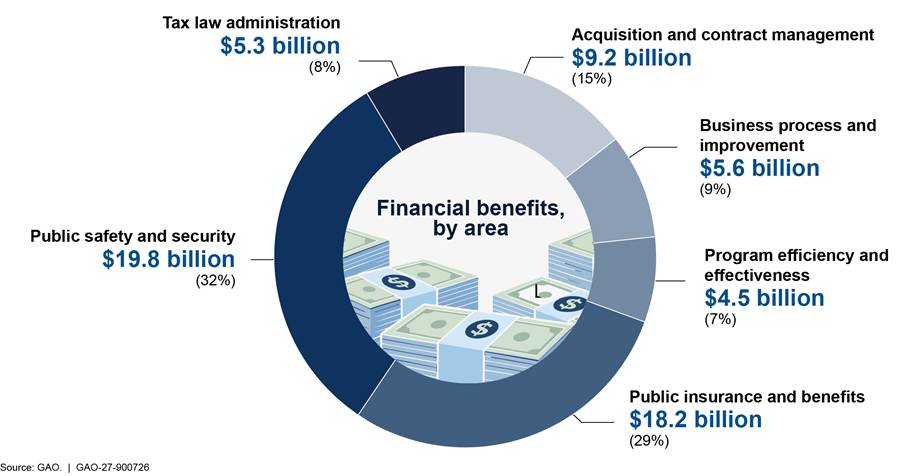
Examples of programs included in the six areas in figure 8 include the following:
■ Acquisition and contract management. DOD weapon systems acquisitions, the National Aeronautics and Space Administration (NASA) acquisition management, and government-wide and interagency contract management.
■ Business process and improvement. Financial reporting; information systems; real property; human capital management; and DOD business transformation, business systems modernization, financial management, support infrastructure management, and supply chain management.
■ Program efficiency and effectiveness. Preventing fraud, waste, and abuse; U.S. financial regulatory system; federal oil and gas resources; U.S. Postal Service (USPS); transportation funding; and telecommunications funding.
■ Public insurance and benefits. Medicare, Medicaid, VA and DOD health care, disability programs, food assistance, education programs, housing programs, national flood insurance, federal deposit insurance, and other insurance programs.
■ Public safety and security. Homeland security and justice programs; critical infrastructure, including information security; critical technologies; food safety; transportation safety; telecommunications safety; international food assistance; public health; consumer protection; environmental issues; national defense; foreign policy; international trade; and the intelligence community.
■ Tax law administration. IRS business systems modernization, tax policy, and enforcement of tax laws.
See figure 9 for examples of major new financial benefits reported in FY 2026 and Part II for additional examples of financial benefits.
Figure 9: Examples of GAO’s Fiscal Year 2026 Major New Financial Benefits
Additionally, we calculate our ROI—the ratio between financial benefits and dollars invested. For the past several years, we have produced financial benefits that exceed the amount that has been invested in our agency to perform our work, as shown in table 4. Looking back over the last 5 years, we have had an average annual ROI of about $74 for every dollar invested in GAO.
Table 4: Return on Investment Data
|
RETURN ON INVESTMENT |
2022 |
2023 |
2024 |
2025 |
2026 |
|
Financial benefits (dollars in billions) |
$55.6 |
$70.4 |
$67.5 |
$62.7 |
$62.5 |
|
Dollars invested (dollars in billions)a |
$0.75 |
$0.84 |
$0.89 |
$0.93 |
$0.89 |
|
Return on investment (per dollar invested) |
$74 |
$84 |
$76 |
$68 |
$71 |
Source: GAO. | GAO-27-900726
aDollars invested is defined as total new obligations against GAO’s unexpired accounts for the fiscal year, as reported in the Department of the Treasury and Office of Management and Budget systems.
In light of (1) our performance in FY 2026; and (2) expected future financial benefits based on our past, ongoing, and expected work, we have increased our 2027 target for financial benefits from $50 billion to $55 billion. This 10 percent increase also accounts for our analysis of trends in inflation and federal spending over the past decade that can affect the monetary value of future financial benefits.
Many of the benefits that result from our work cannot be measured in dollars, so we refer to them as “other benefits.” Other benefits can result in better services to the public, changes to statutes or regulations, or improved government business operations.
During FY 2026, we recorded a total of 1,296 other benefits. We exceeded our target by 96 benefits. Our performance in delivering other benefits in FY 2026 is consistent with the 5-year average (1,261 benefits).
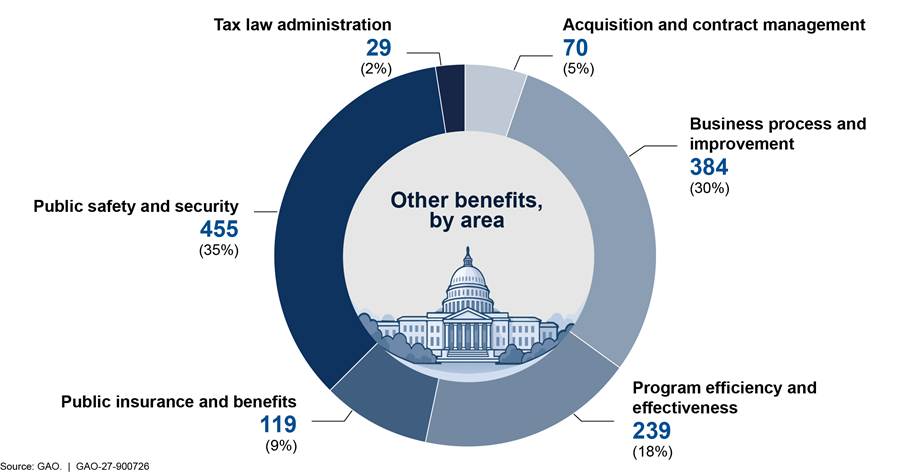
This year, most of the other benefits resulting from our work were in the areas of public safety and security (35 percent), business process and improvement (30 percent), and program efficiency and effectiveness (18 percent), as shown in figure 10. We claim these benefits generally within 2 fiscal years of the action taken.
Figure 10: Fiscal Year 2026 Other Benefits Resulting from GAO’s Work, by Area
See figure 11 and Part II of this report for examples of other benefits reported in FY 2026.
Figure 11: Examples
of GAO’s Other Benefits Reported in Fiscal Year 2026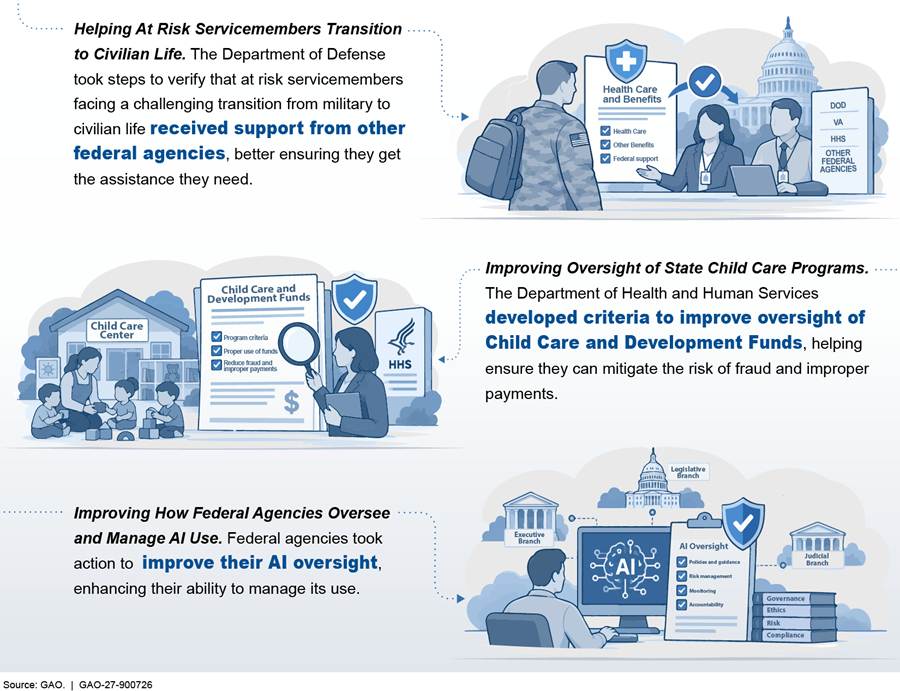
We have set our 2027 target for these other benefits at 1,200 again, given our past, ongoing, and expected work.
Past Recommendations Implemented
One way we measure our effect on improving the government’s accountability, operations, and services is tracking the percentage of recommendations that were implemented. Putting these recommendations into practice generates tangible benefits for the nation.
We achieved a 78 percent implementation rate for FY 2026. We fell below our target of 80 percent by 2 percentage points. In recent years, the problems facing government have become increasingly complex and often involve multiple agencies, which results in increased time for agencies to implement our recommendations. The percentage of past recommendations implemented is consistent with the percentages that we have reported for the past 5 years (between 70-78 percent).[7] We have redoubled our efforts to help agencies reduce their implementation time, for example, by meeting with agency officials to identify causes for delayed action on recommendations. We will continue these efforts in FY 2027.
As shown in figure 12, most of the recommendations in FY 2021 reports that agencies implemented by the end of FY 2026 related to public safety and security (56 percent), business process and improvement (14 percent), and public insurance and benefits (13 percent).
Figure 12: Number of GAO Recommendations in Fiscal Year 2021 Reports That Agencies Implemented, by Area
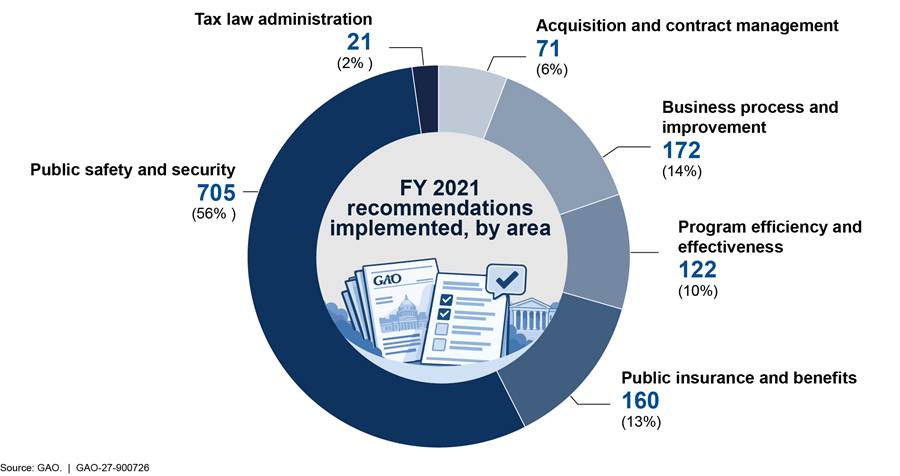
Note: The figure shows the number of recommendations in fiscal year (FY) 2021 reports that agencies implemented by the end of FY 2026, by area. Beginning in FY 2025, we started using a 5-year reporting window for past recommendations implemented. Total percentages do not equal 100 percent due to rounding.
In FY 2026, we continued to highlight the status of key recommendations in our annual duplication, overlap, and fragmentation work—including progress made and the benefits of full implementation. We also continued to send letters to the heads of many federal departments and agencies—31 in 2026—recognizing their progress in implementing our priority recommendations and calling their attention to those still requiring action. Addressing these recommendations and issues could improve congressional or executive branch decision-making on major issues and eliminate mismanagement, fraud, and abuse across the government.
The percentage of past recommendations implemented is an important indicator to us of whether agencies put our recommendations into practice, which results in improvements to government services and operations. Therefore, we are retaining our target of 80 percent for FY 2027.
New Products Containing Recommendations
In FY 2026, about 59 percent of the reports we issued contained recommendations. We track the percentage of new products with recommendations because many of these recommendations are intended to save money and enhance revenue. Many more are to strengthen national security, enhance public health and safety, and improve the efficiency and effectiveness of government programs and operations. The percentage of FY 2026 products containing recommendations is consistent with the 5-year average (62 percent).
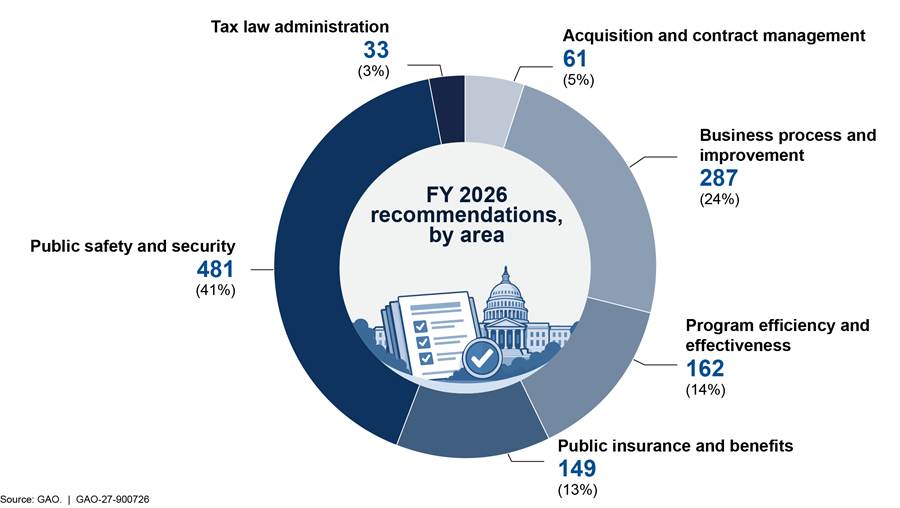
This year, most of the new products containing recommendations were in the areas of public safety and security (41 percent), business process and improvement (24 percent), and program efficiency and effectiveness (14 percent). (See fig. 13.)
Figure 13: Fiscal Year 2026 Recommendations Resulting from GAO’s Work, by Area
We are maintaining the 60 percent target for 2027 because we recognize that including recommendations in our products is not always warranted, and Congress and agencies find informational reports as useful as those that contain recommendations. Our informational reports have the same analytical rigor and meet the same quality standards as those with recommendations and, similarly, can help to bring about substantial financial and other key benefits.
We did not meet our target for testimonies but exceeded our target for delivering products to Congress in a timely manner. (See table 5.)
Table 5: Agencywide Summary of Client Performance Measures and Targets
|
CLIENTS |
2021 (actual) |
2022 (actual) |
2023 (actual) |
2024 (actual) |
2025 (actual) |
2026 (target) |
2026 (actual) |
Met/ not met |
2027 (target) |
|
Testimonies |
67 |
72 |
57 |
60 |
46 |
90 |
47 |
û |
4%a |
|
Timeliness |
97% |
97% |
94% |
100% |
98% |
90% |
96% |
ü |
90% |
Source: GAO. | GAO-27-900726
aFor fiscal year 2027, we set an agencywide percentage-based testimony target of applicable congressional hearings to better account for the types of hearings Congress holds at which GAO is typically asked to testify.
Testimonies
Our clients often invite us to testify on our current and past work as it relates to issues that committees are examining through the congressional hearing process. During FY 2026, our senior executives were asked to testify 47 times, falling 43 testimonies short of our FY 2026 target of 90.
Our senior executives testified before 30 separate committees and subcommittees—on topics spanning most federal agencies (see Part II). This year, most of our testimonies were in the areas of public safety and security (28 percent), public insurance and benefits (26 percent), and program efficiency and effectiveness (19 percent), as shown in figure 14. For example, we testified on topics such as reducing fraud and improper payments, improving veterans’ health and benefits, strengthening military readiness, and enhancing federal oversight of critical infrastructure.
Figure 14: Fiscal Year 2026 Testimonies Related to GAO’s Work, by Area
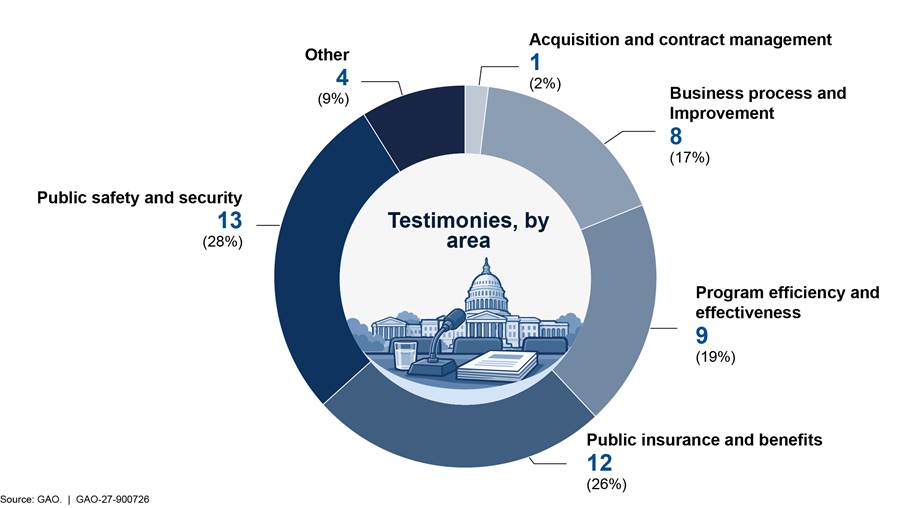
This measure is client driven, based on invitations to testify. The number of opportunities we had to testify this year was lower than our 5-year average (56 testimonies). The 47 testimonies that our senior executives delivered in FY 2026 covered the scope of our mission areas. Additionally, 51 percent of the testimonies that our senior executives delivered were related to our High Risk areas and programs. See GAO’s High Risk List.
Although we did not meet our target, we continued our track record of being one of the top agencies requested to testify. For FY 2027, we have set an agencywide percentage-based testimony target of 4 percent of applicable congressional hearings, which equates to about 57 testimonies based on the average number of applicable hearings Congress held during the past 6 years. This approach better accounts for the types of hearings Congress holds at which GAO is typically asked to testify and the support we provide to Congress.
Other Ways We Support Our Client
Over time, the nature of how we support our client has evolved to reflect changes in congressional demands for our work. In addition to requests for written products, we have also responded to a growing demand from Congress for technical assistance—work that could include briefings on various programs and policy topics by GAO experts, data analysis, or comments on legislative bills. We continued to analyze data on technical assistance provided to congressional staff and Members to review trends over time and strengthen internal tracking and reporting of such assistance. In FY 2026, we provided 905 instances of technical assistance to congressional staff and Members.
We also delivered 16 Member briefings; were asked to submit one Statement for the Record in lieu of testifying; and provided responses to 28 sets of Questions for the Record, which became part of the official hearing records. Moreover, GAO’s work was cited by Members of Congress and witnesses in over 190 hearings beyond those at which we testified.
Our senior executives also participated in 12 roundtables sponsored by congressional committees. The roundtables covered topics such as veterans’ data privacy, duplication and cost savings across the government, veterans’ electronic health record modernization, and IT management across government.
Timeliness
To be useful to Congress, our products must be available when our clients need them, and the client feedback survey is one of multiple methods we use to solicit feedback regarding our products and services. In FY 2026, we exceeded our timeliness target of 90 percent by 6 percentage points, and this level is consistent with the percentages we have reported for the past 5 years (between 94 percent and 100 percent). We reach out directly to our clients through several means, including an electronic feedback survey. As in prior years, we use the results of our client feedback survey as a primary source and barometer for whether we are getting our products to our congressional clients when they need the information.
To calculate this result, we tally responses from the client survey we send to key congressional staff working for the requesters of our nonlegal products. Because our products usually have multiple requesters, we often send forms to more than one congressional staff person per testimony or product. One of the questions on the survey asks the client whether they “agree” or “disagree” that the product was delivered on time. In FY 2026, 100 percent of congressional staff who completed the survey responded to our question on timeliness. Of those respondents, 96 percent agreed that our products were delivered on time.
We have consistently set a high target for timeliness because it is important for us to meet congressional needs when they occur. We have again set our FY 2027 target at 90 percent because we believe that this is realistic, given current staffing levels and workload demands.
See Part V for detailed information on data sources that we use to assess each performance measure, as well as the steps we take to verify and validate the data.
We met or exceeded the targets for six of the seven GAO people measures (see table 6).
Table 6: Agencywide Summary of People Performance Measures and Targets
|
PEOPLE |
2021 (actual) |
2022 (actual) |
2023 (actual) |
2024 (actual) |
2025 (actual) |
2026 (target) |
2026 (actual) |
Met / Not Met |
2027 (target) |
|
New hire rate |
80% |
76% |
81% |
83% |
89% |
80% |
64% |
û |
80% |
|
Retention rate |
|
|
|
|
|
|
|
|
|
|
With retirements |
96% |
93% |
95% |
95% |
96% |
92% |
93% |
ü |
92% |
|
Without retirements |
98% |
97% |
96% |
97% |
98% |
96% |
98% |
ü |
96% |
|
Staff development |
82% |
82% |
79% |
81% |
84% |
80% |
80% |
ü |
80% |
|
Staff utilization |
85% |
84% |
86% |
85% |
87% |
80% |
83% |
ü |
80% |
|
Experience with supervisors |
91% |
90% |
90% |
91% |
90% |
82% |
89% |
ü |
82% |
|
Organizational climate |
87% |
86% |
86% |
86% |
88% |
80% |
86% |
ü |
80% |
Source: GAO. | GAO-27-900726
Note: Certain portions of our web-based survey are used to develop these four measures (see app. II).
Our professional and multidisciplinary staff were critical to our FY 2026 performance. Our ability to hire, develop, retain, and lead staff is key to fulfilling our mission of serving Congress and the American people. Over the last several fiscal years, we have refined our processes for measuring how well we manage our human capital. In FY 2026, we met or exceeded the targets for six of the seven people measures.
These measures are directly linked to our Goal 4 strategic objective of being a leading practices federal agency. For more information about our people measures, see appendix II, People Measures, of this report.
New Hire Rate
Our new hire rate is the number of new staff hired who came on board by the end of the fiscal year, divided by the number of new hires estimated to come onboard by the end of the fiscal year in our operating plan. In FY 2026, we fell short of our new hire rate target of 80 percent by 16 percentage points, at 64 percent. However, the new hire rate was based on 11 planned hires, making it highly sensitive to small changes.
GAO’s annual workforce planning process helps to identify the human capital resource requirements needed to accomplish its mission. It is the key tool to put strategic goals into human capital actions that are needed to respond to changing work environments. The workforce plan takes into account strategic goals; projected workload requirements; and other changes, such as retirements, attrition, promotions, and skill gaps. It specifies the number of planned hires for the upcoming year. Adjustments to the plan are made throughout the year, if necessary, to respond immediately to the most pressing issues for congressional oversight and decision-making.
Retention Rate
We continuously strive to make GAO a place where people want to work. Once we have made an investment in hiring and training people, we would like them to stay with us. This measure is one indicator of whether we are attaining this objective.
For retention rate with retirements, we exceeded our target of 92 percent by 1 percentage point, at 93 percent. We exceeded our target rate of 96 percent for retention rate without retirements, by 2 percentage points, at 98 percent.
We calculate this measure by taking 100 percent minus the attrition rate, where attrition rate is defined as the number of separations divided by the average onboard strength. We calculate this measure with and without retirements.
Staff Development and Utilization, Experience with Supervisors, and Organizational Climate
One way that we measure how well we are supporting our staff and providing an environment for professional growth is through our annual Employee Experience Survey (EES). This confidential, web-based survey is administered to all of our employees once a year, and certain portions of the survey are used to develop the related people measures.
Through the survey, we encourage our staff to indicate what they think about our overall operations, work environment and organizational culture, and how they rate their experience with supervisors. (See app. II, People Measures, for additional information.)
■ In FY 2026, approximately 74 percent of GAO employees completed the EES, and we met or exceeded all the related people-measure targets.
■ For staff development, we met our target of 80 percent.
■ For staff utilization, we exceeded our target of 80 percent by 3 percentage points, at 83 percent.
■ For experience with supervisors, we exceeded our target of 82 percent by 7 percentage points, at 89 percent.
■ For organizational climate, we exceeded our target of 80 percent by 6 percentage points, at 86 percent.
For FY 2027, we have decided to retain the same targets for our people measures.
Our mission and people are supported by a range of administrative services—including information technology, infrastructure operations, human capital, and financial management. In 2022, we administered a new survey instrument—our annual Customer Satisfaction Survey—to better gauge the effectiveness of these services, set performance targets, and report on internal customer experience with administrative services.
We administered the survey each January, covering the prior calendar year. As we updated our Strategic Plan and made changes to how our administrative services are organized and delivered, we determined that the existing survey instrument would not yield comparable measures that accurately reflect how these services operate now. We, therefore, deferred administration of the survey in 2026 and initiated a redesign of the survey instrument to align it with our updated Strategic Plan and the way services are currently provided. That redesign is underway.
Because we did not administer the survey in calendar year 2026, data supporting our FY 2025 internal operations performance measures are not available, and we did not establish targets for these measures for FY 2026. We plan to administer the redesigned survey instrument and resume reporting on internal operations performance in FY 2027. Because the redesigned survey instrument differs from its predecessor, results may not be directly comparable to prior-year data.
GAO’s High Risk List
Our High Risk List has served to identify and help resolve serious weaknesses in areas that involve substantial resources and provide critical services to the public. Congress and executive agencies have made substantial progress addressing high risk issues in recent years. Since we started the High Risk List in 1990, progress has been sufficient enough for us to remove the High Risk designation for 29 areas. Currently, the High Risk List highlights 38 areas across the federal government that are seriously vulnerable to waste, fraud, abuse, and mismanagement, or that need transformation.
In 2026, we continued to bring attention to existing High Risk areas. For example, in June 2026, we issued a new product that applies High Risk List criteria to inform agency efforts to reduce improper payments and save taxpayer dollars. Executive branch agencies have reported cumulative improper payment estimates of $3 trillion since fiscal year 2003. To help save taxpayer dollars, it is imperative that agencies prioritize reducing their improper payments and timely report on their efforts to do so. Our list has led to significant financial benefits for the country and taxpayers. Overall, efforts to address High Risk areas have contributed to hundreds of billions of dollars saved. Additionally, progress on these areas has resulted in many other benefits that cannot be measured in dollar terms, such as improved service to the public and enhanced ability to achieve agency missions.
Over the past 21 years (FYs 2006-2026), the resulting financial benefits from our high risk work totaled nearly $844.7 billion. (We began collecting data on high risk benefits in 2006.) In FY 2026, our high risk work yielded 181 reports, 24 testimonies, $33.2 billion in financial benefits, and 642 other benefits.
Further progress on the 38 areas remaining on the High Risk List can help save billions more dollars and increase government performance and accountability. Our next update will be in 2027.
Additional details of these areas can be found on our High Risk List website.
Opportunities to Reduce Duplication, Overlap, and Fragmentation and Achieve Other Financial Benefits
In May 2026, we released our 16th Annual Report highlighting opportunities to reduce or better manage duplication, overlap, and fragmentation in federal programs—as well as opportunities to save money and increase revenue.
We identified 97 new matters for congressional consideration and recommendations in 38 new topic areas for Congress or federal agencies to improve the efficiency and effectiveness of government.
As of March 2026, Congress and federal agencies had fully or partially addressed 1,662 (77 percent) of the 2,148 matters and recommendations we have made since 2011. These actions have resulted in financial and other benefits—including improving agencies’ coordination efforts, as well as reducing fraud, waste, abuse, and mismanagement. In particular, these efforts have cumulatively resulted in about $774.3 billion in financial benefits, an increase of about $49 billion from our last report on this topic.
Further steps are needed to fully address the matters for congressional consideration and recommendations we identified from 2011 to 2026. Addressing these remaining matters and recommendations could save $100 billion or more and improve government services. For example, Congress could save $156.9 billion over 10 years, if it took steps to direct the Secretary of Health and Human Services to equalize payment rates between settings (e.g., physician offices and hospital outpatient departments) for all hospital outpatient departments, regardless of whether they are deemed on- or off-campus, for evaluation and management office visits and other services that the Secretary deems appropriate.
Policymakers and the public can track the status of congressional and federal agency efforts to address the issues we have previously identified on GAO’s Duplication and Cost Savings website. The website includes a downloadable spreadsheet containing all matters for congressional consideration and recommendations related to our duplication and cost-savings body of work.
Recommendations to Congress and Agencies Could Produce Billions in Future Financial Benefits
In May 2026, we reported on open matters for congressional consideration. Action to address these open matters for congressional consideration can produce tens of billions of dollars in future financial savings or improve the effectiveness of federal agencies.
Since 2000, we have recommended that Congress consider more than 1,150 matters for congressional consideration, and nearly 80 percent of them have closed. As of April 2026, 277 matters for congressional consideration remained open. Bills introduced in the 118th or 119th Congress would partially or fully address about one-third of those. The open matters for congressional consideration span a wide range of topics and involve many parts of the federal government, as shown in figure 15.
Figure 15: Open Recommendations for Congress by Topic, as of April 2026
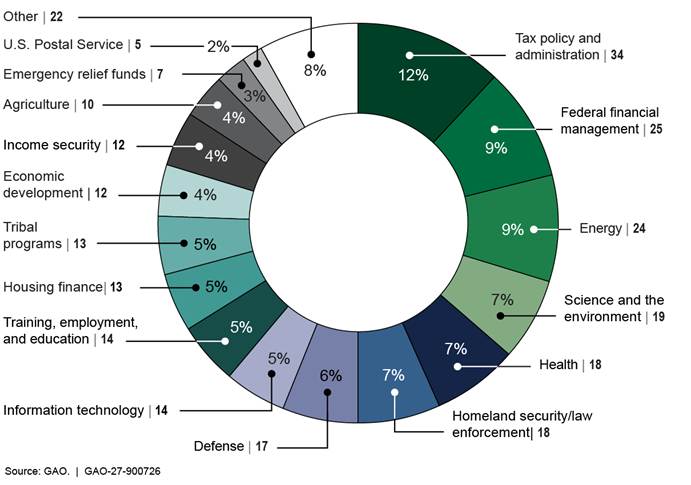
As of October 2026, 5,903 GAO recommendations were open, including matters for congressional consideration and recommendations to executive agencies. These open matters for congressional consideration and recommendations span the federal government and include several different areas. We estimate that implementation of these recommendations could result in $145 billion to $264 billion of measurable future financial benefits.
These estimates are from a model that integrates information on these open recommendations with GAO’s extensive data on realized financial benefits over more than 2 decades. The estimates have a median simulated value of approximately $199 billion, and the range reflects the middle 80 percent of simulated values (see fig. 16).
Figure 16: Potential Benefits of Open GAO Recommendations, as of October 2026
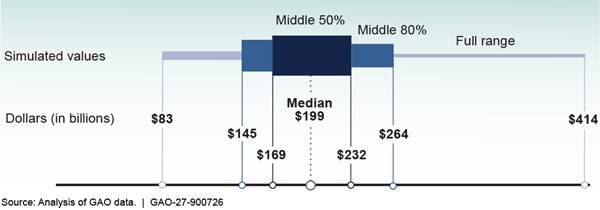
Note: Our report provides additional details on the methodology we used to develop estimates of the potential financial benefits that could result from implementation of all GAO recommendations.
General Counsel Decisions
In FY 2026, we issued more than 475 legal decisions and opinions, including bid protest decisions, Contract Appeals Board decisions, appropriations law decisions and opinions, Congressional Review Act decisions, and Federal Vacancies Reform Act decisions.
Bid Protests. In FY 2026, we handled 1,600 bid protest cases.[8] The bid protest process was authorized by law, as part of the Competition in Contracting Act of 1984, to provide an administrative forum to challenge the award, or solicitation for the award, of a federal contract. See our webpage for more information on the Bid Protest Process.
Additionally, we issued 412 decisions on the merits, which are accessible on our Bid Protest Decisions web page. These decisions addressed a wide range of issues involving compliance with, and the interpretation of, procurement statutes and regulations.
Many of our FY 2026 protests were resolved without a written decision on the merits because the federal agency involved voluntarily took corrective action to address the protest, in some cases after GAO used Alternative Dispute Resolution techniques. The remaining protests were decided on the merits, dismissed for procedural deficiencies, or withdrawn by the protester. The Comptroller General is also required by the Competition in Contracting Act to report annually to Congress on federal agencies that do not fully implement a recommendation made by GAO in connection with a bid protest decided in the prior fiscal year.
Contract Appeals Board. During FY 2026, our Contract Appeals Board opened three new appeals and closed two appeals. Established by law in 2007, the Contract Appeals Board hears and decides the appeals of contracting officer decisions with respect to contract disputes involving all legislative branch agencies. To adjudicate contract appeals, the board uses Alternative Dispute Resolution procedures and issues formal decisions, as necessary. At the end of FY 2026, the board had three pending appeals on its docket, one more than at the end of FY 2025. The current number of appeals is consistent with the average for the past 5 years. Decisions issued by the Contract Appeals Board appear on our website.
Appropriations Law. In FY 2026, we published nine appropriations law decisions and testified at one congressional hearing. This work includes issuing decisions on matters such as compliance with the Antideficiency Act, the bona fide needs statute, and the Purpose Statute. Some examples of the appropriations law issues our decisions addressed include the application of the Recording Statute and bona fide needs statute to the end-of-year purchase of supplies;[9] the application of the Purpose Statute and Antideficiency Act to the use of funds under a continuing resolution;[10] and the restrictions applicable to grantee expenditures.[11] These decisions are available on our Appropriations Law Decisions web page.
Congressional Review Act. GAO may also be asked to issue decisions on whether agency actions constitute rules under the Congressional Review Act, which are subject to the act’s submission requirements. We issued 14 Congressional Review Act decisions in FY 2026. We also continued to issue reports on major rules to both Chambers of Congress, as required by the act. We issued 85 reports for rules received in FY 2026. They are available on our Congressional Review Act webpage.
Some examples of the agency actions we reviewed in our Congressional Review Act decisions include
■ a Department of Commerce press release concerning an AI diffusion rule;[12]
■ a Bureau of Land Management record of decision and approved resource management plan for the Grand Staircase-Escalante National Monument;[13] and
■ the National Credit Union Administration’s withdrawal of fee reporting requirements.[14]
Federal Vacancies Reform Act. In FY 2026, we also issued one decision and two violation letters under the Federal Vacancies Reform Act of 1998.[15] As required by the act, we track vacancies in executive positions that require presidential appointment with Senate confirmation and report to the President, Congress, and the Office of Personnel Management (OPM) when officials act in excess of the period the act prescribes. Additionally, we issue decisions regarding agency compliance with the Federal Vacancies Reform Act, pursuant to requests from Congress. These decisions are available on our Federal Vacancies Reform Act web page.
Other Legal Work
We provided ongoing appropriations law assistance to various congressional committees and federal agencies on diverse topics, such as the Impoundment Control Act of 1974, continuing resolution issues, shutdown issues, and the Antideficiency Act and other appropriations law issues.
We also continued to provide appropriations law guidance to the entire federal community. GAO’s Principles of Federal Appropriations Law, commonly known as the Red Book, continued to be the primary resource for appropriations law guidance in the federal community. We also hosted our annual Appropriations Law Forum in June 2026 with over 200 attendees from across the executive branch.
Appropriations law attorneys continued to provide training on appropriations law, including through in-person 2 ½ -day courses and shorter seminars. We held 11 classes across five agencies. Additionally, we provided 14 appropriations law seminars and briefings for committee and Member congressional offices, as well as legislative branch agencies. To facilitate congressional access to our services, we continued holding weekly office hours at the Agency Connection Center in the Longworth House Office Building. Our attorneys also discussed our appropriations law work at one external conference.
For FY 2026, we issued our Fiscal Year 2025 Antideficiency Act Reports Compilation.[16] We maintain an official repository of Antideficiency Act reports and, from FY 2005 through FY 2026, we have received over 300 reports.
Legal Services
In FY 2026, our attorneys analyzed a wide range of GAO’s federal employment and labor relations issues, as well as privacy and document disclosure matters. Our attorneys also continued to advise agency management on a wide range of complex employment and labor issues, such as those related to reasonable accommodations and the certification of an additional employee bargaining unit.
Additionally, attorneys represented GAO and its officials in various ongoing litigation pending before the federal courts and administrative boards and served as management representatives in union bargaining sessions and grievances. Our attorneys also continued to advise management on the development and administration of internal agency policy documents and orders.
As in prior years, our attorneys were also an active stakeholder in ensuring that GAO’s acquisition practices and procedures comply with all legal requirements and best practices.
Ethics
The Ethics team helped to assure that GAO upholds the highest standards of ethical conduct, safeguarding its reputation for independent and nonpartisan assessments of federal programs. Beyond providing daily counsel on avoiding conflicts of interest and independence threats, the ethics team provided expert counsel on ethics-related engagements, developed and deployed an updated communications policy to further protect GAO’s neutrality, and improved financial disclosure reporting and review procedures.
Resources Used to Achieve Our FY 2026 Performance Goals
Sikich CPA LLC, our independent auditor, issued an unmodified opinion on our financial statements for the fiscal year ended September 30, 2026, concluding that they present fairly, in all material respects, our financial position and results in accordance with accounting principles generally accepted in the United States. The auditor also determined that our internal controls over financial reporting were effective, identifying no material weaknesses or significant deficiencies, and reported substantial compliance with the applicable financial systems requirements of FFMIA. In addition, the auditor identified no instances of noncompliance with the laws and regulations tested. See the independent auditor’s report, financial statements, and accompanying notes for additional information. Table 7 summarizes key data.
Table 7: GAO’s Financial Summary (dollars in millions)
|
GAO’s Financial Summary (dollars in millions) |
FY 2026 |
FY 2025 |
|
Total Assets |
$267.4 |
$290.1 |
|
Total Liabilities |
$109.6 |
$107.7 |
|
Total Net Position |
$157.8 |
$182.4 |
|
Net Cost of Operations by Goal |
|
|
|
Goal 1: Well-Being/Financial Security of American People |
$309.0 |
$374.9 |
|
Goal 2: Changing Security Threats/Challenges of Global Interdependence |
271.4 |
212.3 |
|
Goal 3: Help Transform the Federal Government to Address National Challenges |
247.5 |
284.5 |
|
Goal 4: Maximize the Value of GAO |
12.4 |
13.4 |
|
Other Costs in Support of Congress |
76.4 |
67.2 |
|
Costs Not Assigned to Programs |
1.2 |
3.1 |
|
Reimbursable services not attributable to above cost categories |
(22.5) |
(15.8) |
|
Total Net Cost of Operations |
$895.4 |
$939.6 |
|
Actual full-time equivalents |
3,325 |
3,556 |
Source: GAO. | GAO-27-900726
Compared with those of large, complex executive branch departments, our financial statements reflect the relatively straightforward operations of a small legislative branch agency with a critical mission.
Our financial activity centers on executing our congressionally approved budget, with most resources supporting the people who carry out our mission.
In FY 2026, our budgetary resources included $811.9 million of appropriations and supplemental funding as well as $33.3 million in spending authority from offsetting collections, primarily from the lease of space in our headquarters building and certain audits of agency financial statements. Our total budgetary resources, including prior year unobligated balances, in FY 2026 were $977.9 million.
Total assets at the end of FY 2026 were $267.4 million, consisting mostly of fund balance with Department of the Treasury and property and equipment (including the GAO headquarters building, improvements, and computer equipment and software). This represents a $22.7 million decrease from the total assets at the end of FY 2025 of $290.1 million, primarily a result of a decrease in fund balance with Treasury of $23.7 million due to net outlays exceeding appropriations received. Total liabilities were $109.6 million and primarily consist of amounts earned and not yet paid for; employees’ salaries and benefits; as well as amounts owed to other government agencies and nongovernmental entities for products and services rendered to GAO. This is similar to total liabilities at the end of FY 2025, which were $107.7 million.
Figure 17 shows how our FY 2026 costs break down by category.
Figure 17: Use of Fiscal Year 2026 Funds by Category
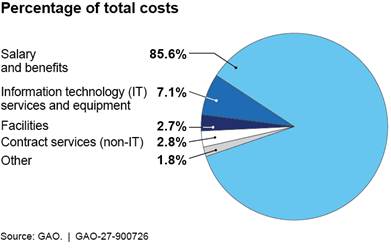
Limitation on Financial Statements
Responsibility for the integrity and objectivity of the financial information presented in the financial statements in this report rests with management. The financial statements were prepared to report our financial position and results of operations, consistent with the requirements applicable to executive agencies under the Chief Financial Officers Act of 1990, as amended (31 U.S.C. § 3515(b)). The statements were prepared from our financial records in accordance with federal Generally Accepted Accounting Principles. These financial statements differ from the financial reports used to monitor and control our budgetary resources. However, both were prepared from the same financial records.
Our financial statements should be read with the understanding that as an agency of a sovereign entity, the U.S. government, we cannot liquidate certain liabilities (e.g., accrued annual leave) without legislation that provides resources to do so. Although future appropriations to fund these liabilities are likely and anticipated, they are not certain.
Summary of Financial Systems Strategies and Framework
GAO uses the Legislative Branch Financial Management System (LBFMS), which operates CGI Federal, Inc.’s Momentum Enterprise Suite, as its integrated financial management system. LBFMS transaction processing is hosted in a secure environment compliant with the Federal Risk and Authorization Management Program. LBFMS also utilizes Treasury’s Invoice Processing Platform, which allows nonfederal vendors to submit electronic invoices. Once approved by GAO, these invoices are loaded into LBFMS for payment processing. This improves internal controls over invoice processing, reduces data entry errors, and increases the efficiency and timeliness of payments.
In the third quarter of FY 2025 the Library of Congress completed the upgrade of LBFMS from Momentum version 7.8 to version 8.1. During FY 2026, GAO continued working with the General Services Administration (GSA) and Library of Congress to implement GO.gov, including financial management connectivity and integration activities in preparation for system integration testing. GAO also began developing requirements for a GO.gov to Momentum Financial Reconciliation report to validate information interfaced from GO.gov to Momentum. GAO will continue working with GSA and the Library of Congress to implement the new travel system by April 2027.
Internal Controls
As a leading practices agency, GAO recognizes the importance of accountability, integrity, and reliability as essential practices. To achieve a high level of quality and ensure we achieve planned goals and objectives, GAO’s governance framework includes risk management activities at the agency and program levels; includes fraud risk management and internal control activities; and seeks advice and evaluations from both internal and external sources to help manage opportunities, challenges, and risks. As a legislative branch agency, we are exempt from many laws that apply to executive branch agencies; however, we generally hold ourselves to the spirit of many laws and guidance and voluntarily comply with them, including FMFIA and OMB Circular No. A-123, Management’s Responsibility for Internal Control.
Our internal controls are designed to safeguard GAO’s assets against loss from unauthorized acquisition, use, or disposition and provide reasonable assurance that transactions are properly recorded, processed, and summarized accurately in our financial statements. Further, our controls provide reasonable assurance that transactions are executed in accordance with the laws governing the use of budget authority and regulations that could have a direct and material effect on the financial statements.
As part of our review efforts, we performed a risk-based assessment and identified, analyzed, and tested the controls for key business processes. Based on the results of the assessment, we have reasonable assurance that controls over operations, reporting, and compliance as of September 30, 2026, were operating effectively and that no material weaknesses were found in the design or operation of internal control. Further, our independent auditor found that we maintained effective internal control over financial reporting and compliance with selected laws and regulations. The external auditor also found no material weaknesses or significant deficiencies.
In addition, we met the objectives of FFMIA and believe we have implemented and maintained financial systems that comply substantially with federal financial management systems requirements, applicable federal accounting standards, and the U.S. Standard General Ledger at the transaction level as of September 30, 2026. We made this assessment based on criteria established under FFMIA and guidance issued by OMB. Also see Management Assurance Statements.
While not subject to the Payment Integrity Information Act of 2019 (PIIA), we complied with the spirit of it. PIIA requires that agencies periodically review programs that may be susceptible to significant improper payments, estimate the amount of improper payments in such programs, report these estimates, and implement a plan to reduce them. We have identified only de minimis improper payments, finding no GAO programs that may be susceptible to significant improper payments. Accordingly, we have implemented and maintained internal control procedures to monitor the disbursement of federal funds for valid obligations.
Our Audit Advisory Committee assists the Acting Comptroller General in overseeing the effectiveness of our financial reporting and audit processes, internal control over financial reporting, and processes that ensure compliance with laws and regulations relevant to our financial operations. The committee is composed of individuals who are independent of GAO and have outstanding reputations in public service or business with financial or legal expertise.
For FY 2026, the members of the committee were
■ Kathleen S. Tighe (Chair), former Inspector General of Education, also served as counsel to the Inspector General at GSA and as the Deputy Inspector General of the U.S. Department of Agriculture (USDA). She has also served on the Digital Accountability and Transparency Act of 2014 Interagency Advisory Committee and chaired the Recovery Accountability and Transparency Board;
■ The Honorable Leslye M. Fraser, former Environmental Appeals Judge – Environmental Protection Agency (EPA); previously served as Director of Regulations, Policy and Social Sciences at one of the Food and Drug Administration’s (FDA) Centers; life member and executive committee member of the Board of Directors for the Massachusetts Institute of Technology; member of the Massachusetts Institute of Technology Dean of Engineering’s Advisory Council; past President of the African American Federal Executive Association;
■ David Mader, former Director at the Partnership for Public Service, a nonprofit, nonpartisan good-government organization; previously Civilian Sector Chief Strategy Officer, Deloitte Consulting; Controller, Office of Federal Financial Management, U.S. Office of Management and Budget; Assistant Deputy Commissioner, IRS; Senior Vice President, Strategy and Organization, Booz Allen Hamilton; Managing Director, Sirota Survey Intelligence LLC; and
■ Frank W. Crawford, President, Crawford & Associates P.C.; Chairman of the Oklahoma Society’s Governmental Accounting and Auditing Committee; Chairman of the Oklahoma Accountancy Board’s Regional Peer Review Oversight Committee; former Chairman of the American Institute of Certified Public Accountants (AICPA) Government Expert Panel; former Chairman of the AICPA’s Governmental Accounting and Auditing Committee; and, longstanding contributor to the AICPA’s and the Governmental Accounting Standards Board’s initiatives.
See Audit Advisory Committee’s report.
Planned Resources to Achieve Our FY 2027 Performance Goals
In February 2026, GAO submitted a FY 2027 appropriation request of $860.1 million, an increase of $48.2 million, or 5.9 percent over the FY 2026 appropriation of $811.9 million. We plan to supplement our FY 2027 requested appropriation with $50.2 million in offsets and supplemental appropriations. The funds requested for FY 2027 are projected to result in a decrease in FTEs from 3,325 in FY 2026 to 3,210 and will also limit our ability to cover inflationary increases in our infrastructure operations and information technology programs. These pressures are exacerbated by pay and benefit cost increases, as well as the reduced availability of authorized offsets and supplemental funding from prior fiscal years. We entered the fiscal year under a continuing resolution at the FY 2026 funding level of $811.9 million, while deliberations over our FY 2027 appropriation continue in Congress.
The absence of increases in GAO’s direct appropriation for the past 3 fiscal years has necessitated that GAO remain highly proactive in the budgetary areas we can manage. Over the past year, we utilized our Voluntary Early Retirement Authority and Voluntary Separation Incentive Program (VSIP), through which over 160 staff left GAO. To counter our reduced staffing levels and help shorten the time required to deliver results to our clients, we will continue to focus on the use of emerging technologies, including AI, to support audits, analytics, and internal operations.
We have also accelerated efforts to restructure our field office and headquarters space. We anticipate reducing our field office footprint by at least 80 percent, generating an estimated annual savings of $5 million by FY 2030. During FY 2026 we increased leasable space in our headquarters building to 750,000 square feet and signed leases with three new tenants. In FY 2027 we expect our lease revenue to be approximately $23 million higher annually than in FY 2025. This additional revenue is critical to help GAO manage ongoing budgetary pressures. However, statutory caps on offsetting collections and restrictions on the use of lease revenue limit our ability to apply these funds directly to critical staffing and IT needs.
GAO will continue to strengthen its fiscal position and improve operational efficiency while delivering the unparalleled results Congress and the American people expect and rely on. However, sustained flat or reduced funding will erode our capacity to deliver timely results and jeopardize our ability to attract and retain top talent, invest in essential technology, and maintain our aging physical assets.
The Acting Comptroller General, the Executive Committee, and other senior executives identify the agency’s internal management challenges through the agency’s risk management, strategic planning, internal controls, and budgetary processes. In FY 2026, we identified five priorities to strengthen our organizational agility, efficiency, and effectiveness:
1. Improve and evolve our technology.
2. Fortify our relationships with our clients and improve our responsiveness.
3. Refresh our training.
4. Streamline and modernize our processes, products, and services.
5. Maintain direct, transparent, and open communications with all GAO staff.
We monitor our progress in addressing these challenges through our performance and accountability processes, while leveraging our Strategic Plan. Our Inspector General provides comments on these challenges as part of the annual reporting process (see Part IV).
In FY 2026, we continued to address internal management challenges in the overarching area of change management, with particular emphasis on leveraging our reduced workforce, evolving our technology and data capabilities, and managing our real property in a constrained budget environment (see fig.18). This included evaluating our organizational alignment, identifying ways to more effectively leverage our workforce, evolving our information technology and data by better aligning our leadership team, and taking steps to enhance our capabilities to manage our real property.
Figure 18: Internal Management Challenges
|
Internal Management Challenges ■ Managing enterprise change ■ Managing a reduced workforce ■ Evolving technology and data capabilities ■ Managing our real property |
Source: GAO. | GAO-27-900726
Reflecting on prior observations from the IG, managing a reduced workforce is reframed and presented as a discrete management challenge—whereas it was previously listed under change management. Additionally, improving the efficiency of engagements and operations continues to be integrated across the management challenges, recognizing that operational efficiency is fundamental to successfully addressing each area.
CHALLENGE: Managing Enterprise Change
GAO faces increasing pressure to deliver timely, high-quality outcomes, while operating under resource constraints and budget uncertainty. Flat or reduced funding levels, combined with growing or shifting operational demands, call for us to become more agile in aligning resources, reviewing organizational approaches, providing services, and executing strategic direction. At the same time, changing client needs requires the agency to remain responsive; strengthen stakeholder relationships; and evolve, while continuously evaluating whether programs and services are aligned with mission priorities. Reducing unnecessary administrative burden and improving internal processes remain important to ensure resources are directed toward mission-critical activities, while maintaining appropriate oversight and quality standards.
|
How We Are Managing Enterprise Change ■ Established a Nationwide Resource Network to enhance coordination of a distributed workforce ■ Established a task team to streamline and modernize the engagement process ■ Modernized GAO’s Enterprise Risk Management Program to provide leaders with more actionable, data-driven insights for identifying, assessing, and mitigating organizational risks |
GAO’s operating environment will continue to evolve as congressional priorities, technology, workforce expectations, and the complexity of the agency’s work continue to change. Successfully managing enterprise change requires more than responding to individual issues. It requires ensuring that the agency’s governance, business processes, and enterprise services evolve in ways that enable employees to work efficiently and effectively, while continuing to deliver high-quality service to Congress.
During FY 2026, GAO continued preparing the agency for the future by strengthening enterprise coordination and identifying ways to improve the way work is managed across the organization, including the establishment of a Chief Transformation Officer role. The agency expanded networks that promote collaboration across mission teams and administrative offices, strengthened enterprise project and information management practices, and adopted new approaches for communicating information and sharing knowledge across the agency. These efforts supported more consistent business practices, improved collaboration, and positioned GAO to implement its new Strategic Plan and respond to evolving organizational needs.
Managing enterprise change is an ongoing responsibility rather than a one-time initiative. As the agency implements its new Strategic Plan, GAO will continue evaluating opportunities to improve organizational effectiveness, streamline operations, and ensure that enterprise services remain aligned with mission priorities and the needs of Congress.
CHALLENGE: Managing a Reduced Workforce
The organization faces sustained workforce and operational pressures as mission demands continue to evolve within constrained staffing and resource environments. Institutional knowledge retention and knowledge transfer, as well as workload and mission demands, may affect continuity of operations and the agency’s ability to maintain optimal mission delivery. Ensuring that employees have access to professional development—such as training and cross-training for surge capacity—remains critical to supporting workforce readiness and organizational agility. Absent continued attention to workforce planning, strategically leveraging talent across organizational boundaries, professional development, and clear organizational communication, the agency may face increased risk to continuity of operations, service delivery, and long-term mission effectiveness.
|
How We Are Managing a Reduced Workforce ■ Offered two rounds of Voluntary Early Retirement/Voluntary Separation Incentive Payment opportunities to reduce GAO’s staffing levels through voluntary means ■ Evaluated portfolio alignment by examining trends in workload demands and shifting client priorities ■ Expanded our Learning Center capabilities to promote cross-training and build a more agile workforce |
Like many federal agencies, GAO must balance increasing demand for its work with the realities of operating under constrained resources. Successfully managing a reduced workforce requires more than maintaining staffing levels. It requires strategically recruiting and developing employees, preserving institutional knowledge, and ensuring the agency has the skills and flexibility needed to address increasingly complex issues facing Congress.
Throughout FY 2026, GAO focused on identifying ways to strengthen workforce capability rather than simply replacing staff. The agency continued developing new analysts through its professional development program; expanded learning opportunities by enhancing resources available through the Learning Center, with an emphasis on developing new courses on AI literacy; and aligned workforce planning efforts with evolving organizational priorities. GAO also implemented workforce restructuring initiatives to better position the agency for future mission needs, while preserving critical expertise and supporting long-term workforce sustainability.
The agency recognizes that its people remain its greatest asset. By continuing to invest in employee development, knowledge transfer, and strategic workforce planning, GAO is working to ensure it can continue providing Congress with objective, nonpartisan, timely, and high-quality analysis, despite an increasingly challenging workforce environment.
CHALLENGE: Evolving Technology and Data
GAO faces ongoing challenges in evolving technology systems and strengthening cybersecurity, while maintaining stable, uninterrupted network operations. Reliance on legacy systems and staggered technology rollouts may limit efficiency, reduce operational agility, and hinder timely access to information needed to support mission delivery. At the same time, the increasing use of digital tools and emerging technologies, including AI, introduces both opportunities and risks that require effective data management, governance, workforce readiness, and appropriate safeguards. Failure to advance and stabilize technology infrastructure and strengthen cybersecurity protections could increase operational vulnerabilities and impede the organization’s ability to meet evolving mission and stakeholder expectations.
|
How We Are Managing Evolving Technology and Data ■ Stabilized and evolved GAO’s IT infrastructure to improve reliability, resilience, and support for evolving mission needs ■ Strengthened cybersecurity capabilities to better protect GAO’s systems, data, and information from evolving threats ■ Established an AI strategy to guide the responsible use of AI in mission delivery |
Technology is central to every aspect of GAO’s work— from protecting sensitive information and supporting a mobile workforce to enhancing the agency’s analytical capabilities and improving collaboration across the enterprise. As technology evolves rapidly and cybersecurity threats become increasingly sophisticated, GAO must continually evolve its systems, while ensuring that new capabilities are implemented securely and responsibly.
During FY 2026, GAO continued strengthening its technology and data capabilities through a coordinated series of modernization initiatives. We transitioned to an integrated leadership model to manage our information technology and related areas. The leadership team includes the Chief Information Officer (CIO), Chief Data and Analytics Officer, Chief Technology Officer, and Chief Information Security Officer. While each leader is responsible for a distinct domain, together they form an integrated leadership team that is responsible for our enterprise IT and data operating environment. This model recognizes that technology has become too critical to be viewed through a single lens. With this model, there will be clear accountability, while ensuring we continue to operate as “One GAO”— which is our commitment to operate as a unified agency to advance our shared mission of serving Congress.
We advanced implementation of Zero Trust principles, strengthened identity and access management, enhanced enterprise data governance, and continued modernizing end-user computing and cloud services. GAO also established governance for the responsible use of AI and expanded secure capabilities supporting classified work—ensuring that employees have access to modern tools, while protecting sensitive government information.
These efforts reflect GAO’s commitment to maintaining a secure, resilient, and modern technology environment that supports mission delivery today, while preparing the agency to respond to future technological advances and emerging risks.
CHALLENGE: Managing Our Real Property
As leased occupancy expands within the GAO headquarters building, continued attention to and support of property stewardship, facility maintenance, and long-term planning is necessary to ensure space remains safe, secure, functional, and responsive to both agency and tenant requirements. Maintaining reliable and secure building services and responsive facility support is important to sustaining productive work environments and positive tenant relationships. To be able to continue balancing facility needs, operational demands, and resource constraints, while maintaining quality services and infrastructure, remains an important management priority that will require ongoing support.
|
How We Are Managing Our Real Property ■ Optimized use of GAO’s headquarters building through space consolidation and expanded leasing opportunities, improving utilization of federal space and supporting more efficient use of agency resources ■ Continued rightsizing GAO’s field office footprint to better align space with workforce needs and reduce real property costs ■ Expanded secure classified work capabilities and increased access to facilities supporting defense and intelligence-related work |
GAO’s facilities must support the agency’s mission, while reflecting changing workplace practices, evolving operational requirements, and the responsible stewardship of taxpayer resources. Managing the agency’s real property portfolio requires balancing current mission needs with long-term cost-effectiveness, security requirements, and opportunities to use government resources more efficiently.
During FY 2026, GAO continued implementing a long-term strategy to optimize its real property portfolio. The agency consolidated office space; expanded leasing opportunities for underutilized facilities; and continued reducing its physical footprint, while maintaining the operational capabilities needed to support headquarters and field staff. GAO also expanded secure classified work capabilities through additional Sensitive Compartmentalized Information Facility capacity and increased access to facilities supporting defense and intelligence-related work.
By aligning its facilities and the way the agency operates today, GAO is improving operational efficiency, reducing long-term costs, and ensuring that its real property investments continue to support mission delivery, while demonstrating sound stewardship of public resources.
Mitigating External Factors
In FY 2026, GAO produced substantial benefits for every dollar invested in us and supported congressional oversight across a wide array of government programs and operations. We did so while navigating the following five external factors, some of which will likely remain relevant in the coming years (see fig. 19).
|
External Factors ■ Managing the amount and complexity of the work requested of us ■ Ensuring our work meets evolving congressional priorities ■ Supporting all Members of Congress ■ Managing agency reviews and comments on GAO draft products ■ Accessing agency information |
Source: GAO. | GAO-27-900726
Managing the Amount and Complexity of the Work Requested of Us
In FY 2026, GAO received 421 requests for work, including committee, subcommittee, and Member requests and mandates in laws, congressional resolutions, and conference and committee reports.[17] We give highest priority to congressional mandates, followed by requests from committee and subcommittee leadership.
The issues that we are asked to examine are often complex, nuanced, involve multiple agencies, and require cross-cutting staff expertise. For example, we conducted work and issued reports on health care, flood risks, cybersecurity, financial management, and disaster assistance.
The volume and complexity of the work, combined with the time it can take to complete objective, balanced, and rigorous analyses that meet government auditing standards, means that it may take months before we are able to begin new work.
To meet real-time information needs, we provide short-term technical assistance to Congress, such as white papers, data analysis, and comments on proposed legislation. In FY 2026, we provided 905 instances of technical assistance. We continue to analyze congressional contact data to understand the nature and extent of these services.
To manage the demand for our services, we continuously communicate with congressional clients to understand their priorities, sequence and scope work to meet those priorities, and provide them with regular updates on our work.
Ensuring Our Work Meets Evolving Congressional Priorities
Notably, Congress’s priorities for our work can change. Due to our track record of quickly responding to changes in congressional priorities and needs—and providing real-time, high-quality, and fact-based information—Congress regularly relies on us in times of emergencies or significant federal government action. For example, in response to heightened congressional attention to fraud in federally funded, state-administered programs, GAO quickly produced a comprehensive review of how 20 of the largest programs are administered and identified how to mitigate fraud risks in each program. To ensure our work supports legislative and oversight priorities, the Acting Comptroller General, our Congressional Relations (CR) staff, and other senior officials regularly communicate with our congressional clients about their priorities and update them on ongoing and planned work.
After we complete our work, we survey congressional staffers on the usefulness and timeliness of our products. We ask for this feedback for every product that we issue. While we have refined survey questions and the delivery platform to make it quicker and easier for staffers to respond on their mobile devices, the survey response rate remains low. Nevertheless, we believe that providing congressional staff the opportunity to share their views is important for gauging how we meet congressional demand, including changing priorities.
This year, GAO also began providing quarterly updates to congressional committees with information on work requested by the committee that was recently issued or was soon to be issued, as well as work GAO is doing for other committees that may be of interest.
Supporting All Members of Congress
While GAO accepts requests from all Members of Congress, the volume of work from mandates and committee requests leaves no resources for us to conduct audits and prepare formal reports requested by individual Members. Recognizing this gap, GAO has taken several steps to better meet the information and oversight needs of individual Members and to provide staffers with onsite assistance and outreach.
GAO staff are available 5 days a week in the Agency Connection Center, located in the Longworth House Office Building, to answer impromptu questions or connect congressional staff to GAO’s subject-matter experts. GAO’s Chief Scientist and appropriations lawyers also hold weekly office hours in Longworth, during which any congressional staff can meet with them. GAO holds knowledge-transfer events and offers just-in-time assistance to share knowledge and expertise. In FY 2026, GAO held 16 events in the Longworth space intended to provide technical expertise on selected topics, such as events on semiconductors and export controls, critical minerals, and duplication and cost savings in the federal government.
Managing Agency Reviews and Comments on GAO Draft Products
Given the scope and complexity of our work, formal comments from audited agencies are an important step in our audit process. Through the agency comment step, agencies can provide feedback on our draft reports to help ensure their accuracy and the feasibility of implementing GAO’s recommendations. In FY 2026, we continued to experience delays in agencies providing us with comments, which affects our ability to respond to Congress’s need for information.
Additionally, draft products potentially containing controlled unclassified information or classified information are required to undergo agency sensitivity and security reviews. GAO relies on these agency reviews, as they help ensure that this information is appropriately protected—while enabling GAO to provide robust reports to Congress. However, these reviews can sometimes take several months, affecting GAO’s ability to provide information to Congress in a timely manner.
With respect to the intelligence community, as in previous years, the Office of the Director of National Intelligence (ODNI) has generally not provided formal comments on GAO draft products. However, ODNI has made improvements that have helped to shorten timelines for sensitivity and security reviews.
We will continue to monitor these issues and work with both DOD and the intelligence community to maintain improvements in the years to come, as well as to make improvements regarding the submission of agency comments to the extent possible.
Accessing Agency Information
Access to information also plays an essential role in our ability to report on issues important to Congress and the American people. In support of GAO’s audit authorities, GAO has a broad right of access to agency information under 31 U.S.C. § 716. In place since 1921, GAO’s access authority reflects Congress’s view that effective oversight requires access to agency information.
We have typically reported that federal departments and agencies have generally cooperated in providing us with access to requested information or in working toward mutually acceptable accommodations. In FY 2026, we were able to obtain sufficient information to complete our work in most cases. However, as we reported for FY 2025, we continued to experience a marked change in our access to information that affected our ability to deliver timely products to a range of congressional requesters in both the majority and minority.
In FY 2026, we similarly encountered a higher volume of access issues and greater difficulty obtaining information that we have routinely obtained in the past. Given the challenges we are experiencing, we regularly advised requesters in both the majority and the minority, as well as GAO’s appropriations and oversight committees, regarding issues raised with our audit and access authority. We are also seeking appropriations-related legislation that would affirm our access rights, refuting agency interpretations that restrict GAO’s access.
Some of the access issues we faced in FY 2026 required intervention by a member of GAO’s Executive Committee—specifically, one or more of the General Counsel, Chief Operating Officer, or Acting Comptroller General. These—and other—access issues led to impacts on our time frames and the depth and coverage of our work. Such access issues occurred across our mandated and requested work. During FY 2026, there were 43 engagements involving 17 departments and agencies that required such senior-level intervention due to access issues. For FY 2025, this number was 14 engagements involving 11 departments and agencies. While this number is small compared with the total number of active engagements in FY 2026, these engagements required a notable expenditure of resources leading up to, and including, outreach by Executive Committee members. In addition, this number exceeds the number of access issues that required Executive Committee intervention in FY 2024 and FY 2023, which were eight and six, respectively. GAO also experienced access issues on engagements that did not rise to the level of requiring Executive Committee intervention, generally because GAO was able to resolve them at a lower level.
In some cases, GAO’s difficulty obtaining information for specific engagements reflected broader challenges. GAO experienced pervasive access challenges with OMB, the Department of Commerce, the Securities and Exchange Commission (SEC), and the U.S. Agency for International Development (USAID).
OMB. In FY 2026, OMB did not provide GAO with requested information for, nor did it make staff available for interviews to support, about 18 engagements, as had been routine in the past. At congressional hearings, Members of Congress in both the majority and minority parties pressed OMB to cooperate with GAO, emphasizing GAO’s role in conducting independent oversight for Congress and combatting fraud, waste, and abuse. Despite this pressure, OMB persisted in not cooperating with GAO.
Commerce and SEC. Commerce and SEC declined to participate in over 20 engagements requested by ranking Members in FY 2026. Both agencies asserted that GAO lacked the authority to conduct such work under 31 U.S.C. § 717(b). Other agencies, including the Small Business Administration (SBA), Nuclear Regulatory Commission, and USDA, similarly objected to GAO’s work in response to ranking-Member requests, yet they continued to work with GAO on certain of these engagements.
Commerce and SEC’s positions are not consistent with section 717(b). Congress created a distinct source of authority in that section that empowers GAO to conduct work even when not asked by Houses of Congress or congressional committees of jurisdiction to do so, including when requested by ranking or individual Members, as well as without any explicit expression of congressional interest. GAO’s exercise of its authority under section 717(b)(1) to conduct such work on its own initiative reflects a longstanding interpretation of that provision, and GAO has initiated work when asked by ranking Members for decades. This practice reflects GAO’s long-standing commitment to nonpartisan support of Congress, a practice regularly endorsed by Members of both the majority and minority parties in Congress and long accepted by agencies across the executive branch and across multiple administrations.
USAID. Since December 2025, USAID has not responded to GAO’s requests for information. USAID officials told GAO then that USAID leadership was highly focused on operations related to reducing the agency’s footprint and terminating awards. Subsequently, USAID refused to provide information, stating that doing so would impair the agency’s ongoing litigation defense. GAO offered accommodations to USAID’s Chief Legal Officer and asked to discuss their feasibility, similar to how we have routinely overcome litigation concerns raised by other agencies. However, USAID refused to provide the information or engage with GAO. Since USAID ceased implementing foreign assistance programs in July 2025, the vast majority of USAID staff were separated from the agency, leaving few officials with whom to engage to obtain information. GAO has sought information from the Department of State on USAID programs that were absorbed by State. According to State officials, however, State generally does not have USAID program information from before the transfer of those programs.
Other agencies. GAO also faced difficulties obtaining engagement-specific information at other agencies. For example, though some issues described in our FY 2025 report were resolved, GAO continued to have difficulty obtaining standard information about IT systems and the protection of data for engagements concerning agencies’ management and disclosure of sensitive personal, financial, and other information. The Department of Education, Department of Health and Human Services, and Department of Labor exemplified our difficulty, failing to provide information that GAO has routinely obtained in the past. Similarly, GAO was unable to obtain timely information for a body of work related to agency reorganizations and workforce. For example, the Consumer Financial Protection Bureau did not provide information in response to our requests, citing pending litigation. The Department of Housing and Urban Development did not respond to repeated requests for such information, and USDA declined to respond to questions specifically related to its workforce.
In FY 2026, we were able to obtain sufficient information to complete our work in many cases. Where we encountered difficulties obtaining information, we sought to resolve them through accommodations that would allow our work to move forward. For example, in some circumstances GAO can complete its work with information received in a format different from what was originally requested. This approach is consistent with the federal courts’ expectation that branches of government resolve disputes over the sharing of information through a dynamic process that reflects their different roles.[18] It is also consistent with the “workable government” the U.S. Supreme Court envisions in adopting the flexible understanding of the separation of powers.[19]
The development of mutually acceptable accommodations requires the active engagement of senior leadership officials at both GAO and audited agencies. This approach has long been a hallmark of GAO’s work and it was a key determinant of meaningful progress on access issues in FY 2026. GAO remains committed to such a process to facilitate our access to the critical information needed to support Congress in its legislative, appropriations, and investigative functions.
Office of the Inspector General
Organizational Structure
Established as a statutory office by the Government Accountability Office Act of 2008, GAO’s Office of Inspector General (OIG) independently conducts audits, evaluations, inspections, and other reviews of GAO programs and operations and investigates allegations regarding violations of statutes, regulations, policies, or orders involving GAO employees, contractors, programs, and operations. The OIG makes recommendations to promote economy, efficiency, and effectiveness at GAO and keeps the Comptroller General and Congress fully informed of fraud and other serious problems relating to the administration of GAO programs and operations.
Office of Inspector General
The OIG independently conducts audits, evaluations, inspections, and investigations involving GAO programs, operations, contractors, and employees. In FY 2026, the OIG initiated seven GAO-related investigations and closed nine GAO-related investigations. In addition, the OIG manages a contractor-run hotline for use by employees, contractors, and the public. The hotline is one of the primary sources of complaints or information for identifying suspected fraud and other problems, abuses, and deficiencies relating to GAO programs and operations.
Separate from FraudNet, which supports accountability across the federal government, complainants can access the OIG hotline online or by telephone at 1-866-680-7963. Individuals may remain anonymous and are protected from retaliation. The OIG investigates complaints that contain credible allegations of the possible violation of law, order, policy, or regulation involving GAO operations or employees. These investigations can substantiate an allegation; find the allegation to be unsubstantiated, or conclude that insufficient evidence exists for criminal, civil, or administrative action.
The OIG has self-initiated certain inquiries focusing on potential areas of vulnerability. Using data analysis, the OIG locates outliers or areas of concern that require targeted investigative methods. In FY 2026, the OIG worked on two self-initiated inquiries and closed one of them.
During FY 2026, the OIG published three engagement reports. In evaluation report OIG-26-1, the OIG assessed the timeliness of GAO’s hiring process. In audit report OIG-26-2, the OIG assessed GAO’s progress implementing its IT modernization plan. Finally, in audit report OIG-26-3, the OIG assessed time-and-materials orders issued under GAO’s commercial facility maintenance blanket purchase agreement issued in January 2019. These reports and other OIG publications are available on the OIG’s website and Oversight.gov.
In August 2026, the OIG issued its Biennial Work Plan for Fiscal Years 2027 and 2028 to GAO. It details planned audits, inspections, evaluations, and potential reviews with a focus on those that could result in monetary benefits or significant impacts on GAO operations. The plan reflects a risk-based assessment. The plan also provides an overview of the OIG’s Office of Investigations and other activities. The OIG consults the plan when developing new engagements but may also adjust its work to reflect emerging issues and priorities.
Finally, in September 2026, the OIG completed its peer review of the audit function of the International Development Finance Corporation OIG. The results of the OIG’s work and actions taken by GAO to address OIG recommendations are highlighted in the OIG’s Semiannual Reports to Congress. They are also available at Oversight.gov.
OIG Recommendations
The OIG made 12 recommendations in FY2026: four to strengthen GAO’s hiring process, six to improve GAO’s acquisition processes, and two to better document significant decisions and track costs for future IT efforts. GAO is taking steps to address these recommendations, and the OIG has closed two of them. See table 8 for additional information on these recommendations. For further information, see OIG-26-1, OIG-26-2, and OIG-26-3.
Table 8: GAO Office of the Inspector General (OIG) Recommendations
|
OIG report |
Recommendation |
GAO’s summary of actions planned or taken in response to the recommendation |
|
Time to Hire: Using More Reliable Data Could
Help GAO Monitor the Length of Its Hiring Process |
Develop and document a strategy for periodically reviewing the length of hiring actions and mitigating systemic inefficiencies. |
GAO is updating its existing time-to-hire documentation to include potential actions in response to delays at various points, with estimated completion by April 1, 2027. |
|
Define the types of hiring actions which should be included in time-to-hire calculations and implement controls to ensure all hiring actions within the defined scope are included in its calculations. |
GAO’s estimated completion date is April 1, 2027. |
|
|
Establish controls to consistently document and record the start of hiring actions. |
GAO’s estimated completion date is April 1, 2027. |
|
|
Evaluate the target hiring time frame, document the rationale, and update all internal documents to reflect the established time frame. |
GAO’s estimated completion date is April 1, 2027. |
|
|
Information Technology Modernization:
Enhanced Controls Could Help GAO Ensure Decisions Are Documented and
Stakeholders Are Fully Informed |
Enhance controls to ensure that significant decisions, such as alterations to major information technology projects, are appropriately documented. |
In June 2026, GAO chartered the Technology and Data Governance Board that will serve as the governance structure for all internal matters. GAO is in the process of incorporating internal controls as key requirements in standard operating procedures and strategic planning documents, with estimated completion in December 2026. |
|
Design controls to ensure that costs for major future information technology projects are fully tracked and can be reported to key stakeholders. |
GAO’s Technology and Data Governance Board plans to establish a new structured budget review process by December 2026. GAO anticipates that the appropriate level of cost tracking and a plan for implementing the tracking will be determined by February 2027. |
|
|
Acquisition Management: Opportunities Exist
for GAO to Strengthen Its Policies and Procedures |
Strengthen oversight processes to ensure any necessary modifications of labor rates are made before payment for all contracts, including blanket purchase agreements and associated orders. |
GAO will provide appropriate training and update or develop standard operating procedures to ensure that labor rates are accurate and properly supported before payments are approved, with estimated completion by March 2027. |
|
Strengthen the invoice review process to ensure billed rates are correct before approving payments. |
GAO will provide appropriate training for the related standard operating procedure to address this issue, with estimated completion by March 2027. |
|
|
Demonstrate that the May 2023 blanket purchase agreement modification adjusted the labor rates for contract line item numbers 0213 and 0217 and, if not, take appropriate action. |
GAO modified the blanket purchase agreement to include the adjusted labor rates for the two contract line item numbers. (Closed September 2026) |
|
|
Verify all orders under the commercial facility maintenance blanket purchase agreement awarded in 2019 include the appropriate labor rates. |
GAO will fully address this recommendation following the selection and entrance of a new Acquisition Management Director. The agency estimated completion by March 2027. |
|
|
Update policies and procedures to address subcontracting and the potential for excessive pass-through charges. |
GAO created a standard operating procedure for subcontracting procurements. (Closed September 2026) |
|
|
Update policies and procedures to clarify requirements related to the process for procurements made using the General Services Administration schedule. |
GAO is in the process of updating GAO Order 0625.1, with estimated publication by January 29, 2027. |
Source: GAO, based on GAO OIG reports. | GAO-27-900726
For the Inspector General’s comments regarding GAO’s management challenges assessment, see Part IV of this report.
Nonmonetary Benefits
The OIG promotes economy, efficiency, and effectiveness at GAO. While monetary benefits are important, the OIG’s work can also result in other benefits to the agency. The OIG reports four types of nonmonetary benefits: (1) process, program, policy, or operational improvements; (2) enhanced accuracy and data integrity; (3) safety and security; and (4) workforce integrity. Table 9 shows the nonmonetary benefits that were implemented in this reporting period.
Table 9: GAO Office of the Inspector (OIG) Nonmonetary Benefits
|
Category |
Description |
|
Safety and Security |
Enhanced Safeguarding of Personally Identifiable Information GAO enhanced document sensitivity labeling and permission-sharing capabilities and is in the process of implementing a software application tool to automatically identify sensitive information. The agency will train employees on how to use this tool. (26-0091)a |
|
Process, Program, Policy, or Operational Improvements |
Reduced Risk of Paying Excessive Pass-through Charges GAO created a standard operating procedure that provides guidance for acquisition officials on how to reduce the agency’s risk of paying excessive pass-through charges when subcontracting. (OIG-26-3) |
|
Process, Program, Policy, or Operational Improvements |
Strengthened Employee Departure Procedures GAO will start providing an autoreply with an alternate point of contact to internal senders after an employee’s separation. (26-0193)b |
Source: GAO OIG analysis. | GAO-27-900726
aGAO provided this information in response to an OIG management referral.
bGAO provided this information in response to a management memo issued in a proactive investigation.
The nation and the federal government face multiple current and future challenges. For decades, GAO has engaged in strategic foresight to help identify issues of greatest national importance for Congress and to guide our work. In 2018, GAO established the Center for Strategic Foresight to identify major emerging issues, challenges, and opportunities in making government more efficient, effective, and responsive.
With support from the Center for Strategic Foresight, GAO identified trend themes to inform the agency’s new Strategic Plan. The federal government faces multiple current and future challenges, several of which we highlight below.
The Nation’s Unsustainable Fiscal Future
The federal government faces an unsustainable fiscal future. In June 2026, we released our Annual Report on the nation’s fiscal health.
Federal debt held will continue to grow faster than the economy, which is unsustainable (see fig. 20). This unsustainable fiscal outlook poses serious economic, national security, and societal challenges, potentially including lower wage growth, higher prices, and higher interest rates for household and business loans.
Figure 20: Federal Debt Held by the Public as a Percentage of Gross Domestic Product—Past, Present, and Future
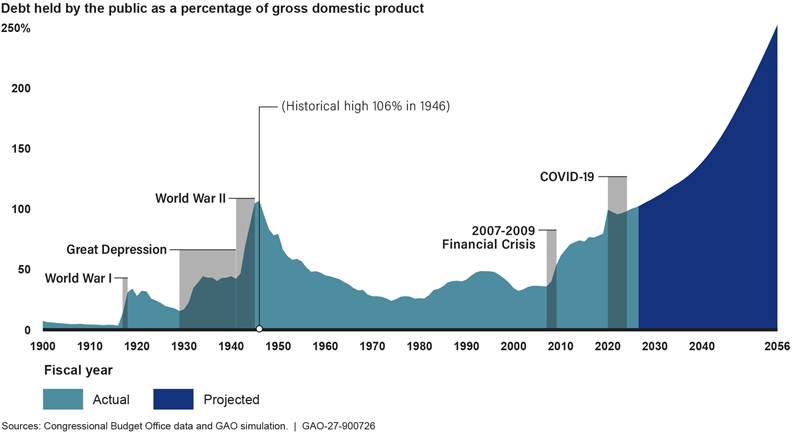
Historically, debt has decreased during peacetime and periods of economic growth. But this pattern has changed in recent decades. Nearly every year this century, the government has spent more than it collected in revenue. To finance these deficits, the government has had to borrow by issuing debt, which is accumulating at a faster rate than the economy is growing.
Our 2026 annual report noted that under current spending and revenue policies
■ debt held by the public (the total amount of money the federal government borrows from other sources, such as banks and investors) is projected to grow more than twice as fast as the economy over the next 10 years. We project that debt held by the public will reach 251 percent of the size of the economy by 2056;
■ in FY 2025, the government spent more on net interest than on national defense and nearly as much as on Medicare. Large and growing interest costs can be a signal that the government’s debt burden is becoming unsustainable; and
■ Social Security and Medicare trust funds will be insolvent in 2032 and 2033, respectively, after which there will not be funds to pay beneficiaries all of what they are owed.
For nearly a decade, we have recommended that Congress develop a strategy to inform the difficult policy choices needed to place the country on a sustainable fiscal path. Congress and the administration will need to make difficult budgetary and policy decisions to address the key drivers of debt and to improve the government’s fiscal outlook.
Our work will continue to examine the federal government’s fiscal condition and the components of an effective long-term strategy to help Congress address this critical challenge.
See our America’s Fiscal Future website for more information.
Impacts of Evolving Science and Technology
GAO continues to serve as a crucial resource to help Congress understand the promise and risks of a range of science and technology innovations, such as AI. A key part of this effort since its establishment in 2019, the Science, Technology Assessment, and Analytics (STAA) team’s growing portfolio of work includes
■ assessments of the benefits and challenges of technologies to produce, transport, store, and use hydrogen, as well as to clean up waste using engineered microbes;
■ performance audits of strategic planning to guide federal quantum computing efforts, and of agency efforts to ensure public access to federally funded research results; and
■ two-page Science & Tech Spotlights explaining the latest trends, including the malicious use of generative AI, and issues associated with the prevalence of microplastics in the environment.
Additionally, we developed a framework to assess U.S. AI capabilities, capacity, and competitiveness relative to other nations. We also extended our series of science and technology trend papers that explore developments that may become impactful to society over the next decade.
GAO continues to prioritize using a multifaceted approach to meet Congress’s needs for science and technology support. For example, we launched an external network of subject matter experts and provided or supported approximately 70 instances of technical assistance to congressional staff across a range of science and technology topics. These include the use of critical minerals in pharmaceuticals and other aspects of health care. We conducted outreach with a wide range of congressional staff to discuss their science and technology priorities and ways we can assist. For example, we assisted committee staff in support of their efforts to prepare for hearings on science and technology topics, such as the semiconductor ecosystem, by briefing them on our related work.
We also led an AI bootcamp for two committees, providing them with information on AI, including agencies’ AI efforts based on GAO’s prior work. Additionally, our Chief Scientist continued to provide real-time assistance through regular office hours and technology events at the Longworth Agency Connection Center to discuss topics such as AI, critical minerals, and semiconductors.
Further, GAO continues to apply a hands-on approach to explore data science and emerging technology solutions in service of its mission to support Congress, including through the efforts of the Innovation Lab and the Analytics Foundry. For example, in FY 2026, the Innovation Lab provided new AI tools for pilot use within GAO and expanded engagement with GAO’s AI Council to strengthen alignment between its work and agencywide AI governance. In support of GAO’s AI governance efforts, the Innovation Lab and Analytics Foundry delivered dashboards to help evaluate the use and cost of AI tools. GAO also developed an AI strategy to guide how AI is incorporated into engagement and business processes by focusing on five key decision-making pillars, such as strengthening governance and establishing continuous monitoring.
Our work will continue to address a range of science and technology topics, such as protecting sensitive biological data, reviewing AI chatbot safety measures, and examining federal support for small and medium-sized manufacturers.
Cybersecurity of Systems, Critical Infrastructure, and Sensitive Data
Escalating cyber threats, including new and more destructive attacks from around the globe, highlight the critical and persistent need for effective cybersecurity. Our work will continue to assess
■ the execution of a comprehensive national cybersecurity strategy and the establishment of leadership needed to perform effective oversight;
■ federal agencies’ efforts to secure information systems, including the detection, prevention, and response to security incidents;
■ the cybersecurity of critical infrastructure, such as federal agencies’ efforts to help enhance the security of information systems owned by entities in both the public and private sectors; and
■ efforts being taken by the federal government to protect privacy and sensitive data, including personally identifiable information.
Persistent Challenges in Addressing Fraud, Improper Payments, Waste, and Abuse in Federal Programs
Fraud, improper payments, waste, and abuse remain persistent challenges across the federal government. GAO identifies government operations with serious vulnerabilities to fraud, improper payments, waste, abuse, and mismanagement, or in need of transformation.
While GAO does not prosecute fraud, we do identify fraud trends and risks across the government. We have estimated that the federal government loses between $233 billion and $521 billion annually to fraud, based on data from fiscal years 2018 through 2022. The range reflects the different risk environments during this period. Further, in September 2026, we reported that annual federal tax fraud loss is between $116 billion and $304 billion based on data and information from 2018 through 2024.
Additionally, federal improper payment estimates have totaled about $2.8 trillion since 2003—and the actual amount may be higher, because agencies have not reported estimates for some programs, as required. In fiscal year 2025, federal agencies’ estimated improper payments totaled about $186 billion, an increase of about $24 billion from the prior fiscal year. Most of these improper payments were a result of overpayments. Additional information on our work examining these issues can be found on our fraud and improper payments website.
GAO has created tools that can help fight fraud. For example, we maintain the FraudNet hotline to support accountability across the federal government. We have identified leading practices for managing fraud risks and organized them into a conceptual Fraud Risk Management Framework.
Additionally, we have identified opportunities to reduce fraud, waste, and abuse through our work on duplication, overlap, and fragmentation in federal programs. As part of this work, we also identify additional opportunities for greater efficiency and effectiveness that result in cost savings or enhanced revenue collection.
Our work will continue to examine fraud, improper payments, waste, and abuse in federal programs and help Congress identify vulnerabilities and strengthen its oversight of government programs.
Challenges Maintaining Readiness and Improving Other Defense Functions
DOD’s mission to deter war and ensure the nation’s security is supported by almost half of the federal government’s discretionary spending. The department faces key challenges in certain areas, such as maintaining readiness, reforming business operations, and improving its health care system.
Our work will continue to assess DOD’s business systems, financial management, and operational efficiency. We will assess military health system changes, quality-of-life issues for DOD military and civilians, the functioning of the military justice system, and facilities management. We will also assess DOD’s efforts to reform its weapon acquisition processes, revitalize the defense industrial base, leverage commercial technology, and reduce the regulatory burden on the private sector.
Our work will evaluate DOD’s ability to operate in a contested environment against near-peer adversaries and the military’s efforts to staff, equip, train, and sustain forces and capabilities to meet national security needs.
We will evaluate DOD’s cyberspace operations, electromagnetic spectrum operations and management, the structure and efficiency of the nuclear deterrent forces, DOD’s AI efforts, and space operations. We will also continue to assess DOD’s and the intelligence community’s vetting of individuals for security clearances.
Health Care Challenges
Health care spending now accounts for around 30 percent of the federal budget and is one of the fastest-growing federal expenditures. The aging of the population and increasing health care spending per person are the projected drivers of future growth.
The demands to meet Americans’ health needs are growing in volume and complexity. Effectively and efficiently managing federal health care programs (such as Medicare; Medicaid; and programs for veterans, military servicemembers and their families, and citizens of Tribes) is becoming more challenging. The recent pandemic underscored the importance of preparing for, responding to, and recovering from public health emergencies.
To address these challenges, we will continue to assist Congress with (1) examining the sustainability of Medicare and Medicaid; (2) assessing health care at the VA, DOD, and Indian Health Service; (3) assessing federal efforts to promote and ensure public health; and (4) examining trends and costs in the private health insurance market.
Part II: Performance Information
The information presented in this PAR is aligned with the four strategic goals and related objectives that were in effect in FY 2026. In the following sections, we discuss how each of our four strategic goals contributed to our FY 2026 performance results. For Goals 1, 2, and 3—our external goals—we present performance results for the three annual measures that we assess at the goal level. We also provide examples of accomplishments for each goal and many of the strategic objectives. Agencywide measures are discussed in Part I of this report. For Goal 4—our internal goal—we present selected work and accomplishments for that goal’s strategic objectives. There were no changes in how we measured financial benefits, other benefits, and testimony measures during FY 2026.
We issued an updated Strategic Plan in October 2026 for FYs 2027-2032, in which we established three strategic goals, better aligning with our cross-cutting approach. The first two goals focus on our oversight and foresight mission, covering the entire range of issues for our congressional clients. Our third goal focuses on how we will continue to improve our internal operations and increase efficiency by describing the skills, technology, human capital, and resources needed to achieve these goals.
Strategic Goal 1: Address Current and Emerging Challenges to the Well-being and Financial Security of the American People
Our first strategic goal upholds our mission to support Congress in carrying out its constitutional responsibilities by focusing on work that helps address the current and emerging challenges affecting the well-being and financial security of the
American people. Our multiyear (FYs 2022-2027) strategic objectives under this goal are to provide information that will help address
■ health care needs;
■ lifelong learning;
■ benefits and protections for workers, families, and children;
■ the financial security and well-being of an aging population;
■ a fair, responsive, and effective system of justice;
■ housing finance and viable communities;
■ a stable financial system and sufficient consumer protection;
■ stewardship of natural resources and the environment;
■ a viable, safe, secure, and accessible national physical infrastructure; and
■ the federal government’s responsibilities to Tribes, their members, and individual descendants.
These objectives, along with the performance goals and key efforts that support them, are discussed fully in our Strategic Plan.[20]
The work supporting these objectives is led primarily by our staff in the following teams: Education, Workforce, and Income Security; Financial Markets and Community Investment; Health Care; Homeland Security and Justice; Natural Resources and Environment; and Physical Infrastructure.
|
Example of Work Under Goal 1 Improving Management of Fraud Risks and Addressing Improper Payments in SBA Programs. Since spring 2020, SBA has made or guaranteed more than $1 trillion in loans and grants and assisted more than 10 million businesses adversely affected by the COVID-19 pandemic, primarily through the Paycheck Protection Program and the COVID-19 Economic Injury Disaster Loan program. We have made dozens of recommendations to help SBA better manage fraud risks, improve its estimates of improper payments, and oversee its contracting programs. In December 2025, we testified on SBA’s efforts to address our recommendations, including further actions the agency needs to take to advance its fraud prevention and detection efforts. (GAO-26-108820) |
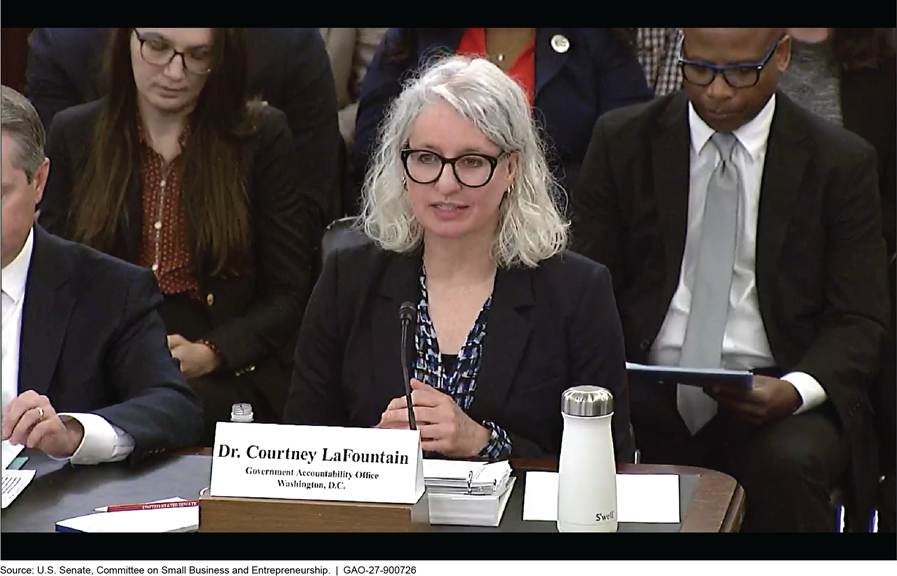
Courtney LaFountain, Director, testified on addressing fraud risks and improper payments in SBA programs (view full hearing).
To accomplish our work under these strategic objectives in FY 2026, we conducted engagements, audits, analyses, and evaluations of programs at major federal agencies. As shown in table 10, we exceeded our Goal 1 targets for financial and other benefits and fell short of our target for testimonies.
Table 10: Strategic Goal 1’s Annual Performance Results
|
PERFORMANCE MEASURE |
2021 (actual) |
2022 (actual) |
2023 (actual) |
2024 (actual) |
2025 (actual) |
2026 (target) |
2026 (actual) |
Met / not met |
|
Financial benefits (dollars in billions) |
$48.0 |
$10.3 |
$13.6 |
$45 |
$42.8 |
$16 |
$35.1 |
ü |
|
Other benefits |
320 |
307 |
314 |
338 |
313 |
276 |
301 |
ü |
|
Testimonies |
33 |
30 |
21 |
26 |
14 |
39 |
17 |
û |
Source: GAO. | GAO-27-900726
Note: Goals 1 through 3 do not sum to the total agencywide targets, as we have left a portion of the targets unassigned. Prior years’ experience indicates we can meet the agencywide targets, but we cannot always accurately predict under which goals.
The following sections describe our performance under Goal 1 for each of our quantitative performance measures and the targets for FY 2027. To set our targets, we consider many factors, including trends in our past performance and rolling 4-year averages, as described in Part I. We set our FY 2027 Goal 1 targets to align with our updated Strategic Plan. The plan consolidates selected strategic objectives from Goals 1 through Goal 3 and establishes new strategic objectives to support our oversight and foresight mission.
Financial Benefits
The financial benefits reported for this goal in FY 2026 totaled $35.1 billion, exceeding our $16 billion target by $19.1 billion. Financial benefits contributing to this total included reducing costs to dispose of unused nuclear facilities, which in FY 2026 we calculated will save nearly $3 billion from 2023 to 2031, and recovering improper payments of COVID-19 relief funds, saving $489.6 million. We set our FY 2027 target at $29.5 billion based on recent performance and discussions with the relevant teams on what they think can be achieved based on past, ongoing, and expected work. The target also accounts for our analysis of trends in inflation and federal spending over the prior decade that can affect the monetary value of future financial benefits.
|
Example of Goal 1’s Financial Benefits Better Estimating the Costs of Medicaid Demonstrations. Medicaid demonstrations allow states to test new ways to deliver health care services to their populations. HHS requires that these be budget neutral— not raise costs for the federal government. For decades, we have reported that HHS did not ensure that demonstrations were budget neutral. Since 2002, we have recommended that HHS better ensure that states use valid methods—such as recent cost data—to estimate costs and ensure budget neutrality. In 2022, HHS made a policy change that better aligns states’ estimates with recent costs. In June 2026, we calculated that this saved $16.1 billion in FY 2025. (GAO-25-107445, GAO-13-384, GAO-08-87, GAO-02-817) |
Other Benefits
Other benefits reported for Goal 1 in FY 2026 totaled 301, exceeding our target of 276 by 25 benefits. Goal 1’s other benefits were primarily in the areas of public safety and security and public insurance and benefits. We set our FY 2027 target at 778 other benefits, based on recent performance and discussions with the relevant teams on what they think can be achieved based on past, ongoing, and expected work.
|
Example of Goal 1’s Other Benefits Reducing Underutilized Federal Buildings. Federal agencies have struggled to identify and reduce underutilized property. In 2023, we found that federal buildings were underutilized and recommended that OMB develop a benchmark for measuring building utilization because one did not exist. Enacted in 2025 partly in response to our recommendation, the USE IT Act established a new benchmark for selected agencies to measure and report building utilization. The benchmark will be used to identify and dispose of underutilized buildings. In 2026, agencies started reporting building utilization data, which will help them assess, and only retain, needed space and reduce costs. (GAO-24-107006) |
 Testimonies
Our senior executives testified 17 times on our Goal 1 work in FY 2026, which fell short of the target of 39 by 22 testimonies. In addition to the testimonies described below, we testified on actions Congress and federal agencies could take to better manage federal real property and additional steps VA must take for the disability compensation program to be removed from the High Risk List, among others. For FY 2027, we have set an agencywide percentage-based testimony target of 4 percent of applicable congressional hearings. This approach better accounts for the support we provide Congress and the types of hearings Congress holds at which GAO is typically asked to testify. We set our FY 2027 numerical target for Goal 1 testimonies at 49 based on experience in recent years and to help track performance toward achieving the agencywide percentage-based target.
|
Example of Goal 1’s Testimonies Improving the Financial Condition of the U.S. Postal Service. The U.S. Postal Service’s financial viability has been on our High Risk List since 2009, as rising costs and lower mail volumes have made its business model unsustainable. In March 2026, we testified on USPS’s financial condition and service performance, as well as actions Congress and USPS have taken to address USPS’s financial condition. We discussed additional actions that Congress and USPS can take to address USPS’s unsustainable business model, consistent with our prior recommendations. (GAO-26-109008) |
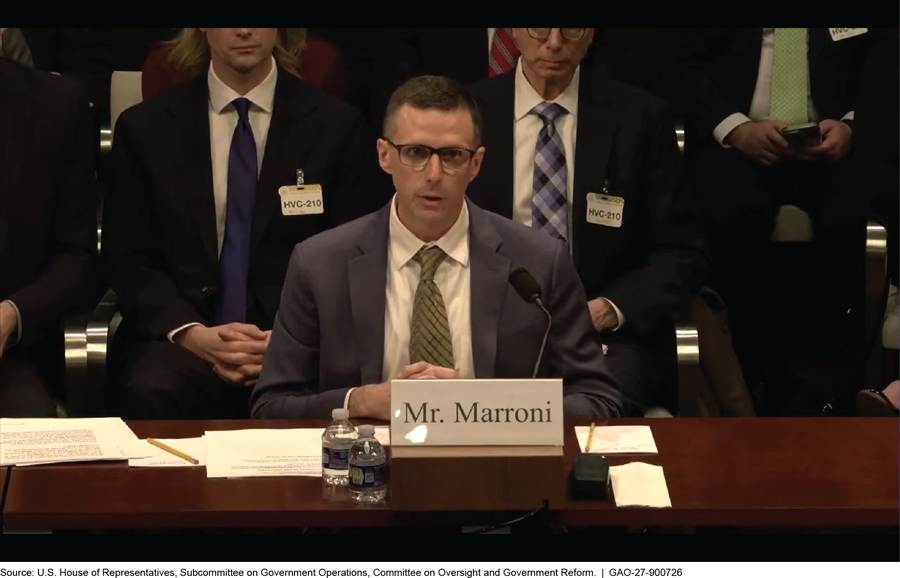
David Marroni, Director, testified on the financial condition of the U.S. Postal Service (view full hearing).
|
Example of Goal 1’s Testimonies Strengthening Higher Education Accountability. In FY 2025, about 10.5 million students received over $131 billion in federal student aid to help them pursue higher education. In March 2026, we testified on how the Department of Education can strengthen accountability over student loans and colleges. We highlighted seven recommendations made since 2016 to improve the department’s oversight of student loan servicers, verification of borrower information for certain repayment plans, and measurement of colleges’ financial conditions. Taking further action to fully implement these recommendations would improve accountability, help borrowers, and potentially lead to financial savings. (GAO-26-109069) |
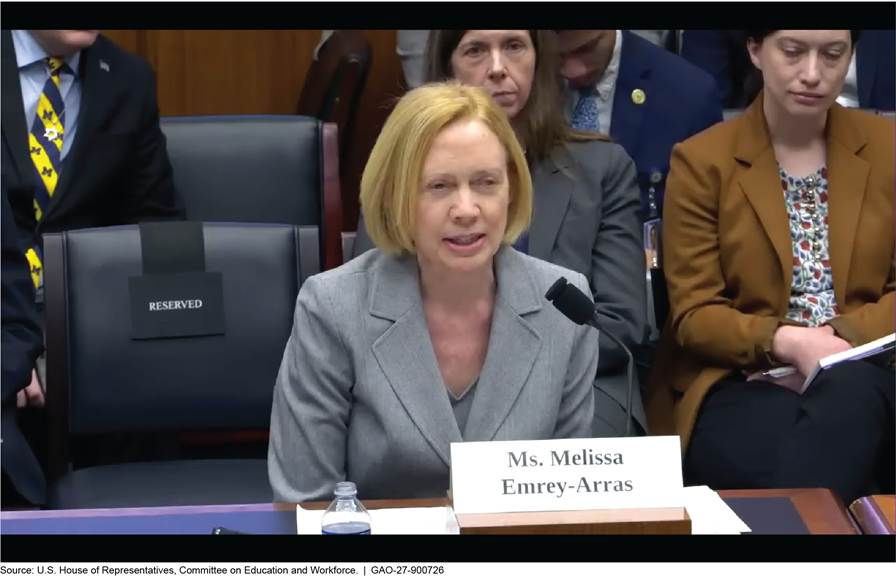
Melissa Emrey-Arras, Director, testified on higher education accountability (view full hearing).
Table 11 contains examples of Goal 1 accomplishments, which include both financial and other benefits.
Table 11: Examples of Goal 1’s Accomplishments
|
Health Care Needs |
||||
|
Identifying and Mitigating Drug Shortages |
The Food and Drug Administration is responsible for tracking and addressing drug shortages, which can adversely affect patient care. In 2014, we found that FDA did not routinely analyze its data to prevent and resolve drug shortages and recommended that the agency regularly assess its data to identify risk factors for drug shortages. In January 2026, FDA implemented a new data system that provides monthly forecasts of supply disruptions that can lead to drug shortages, enhancing its ability to prevent and mitigate drug shortages and ensure that people get the medications they need. (GAO-14-194) |
|||
|
Improving the Veterans Crisis Line |
Suicides occur among veterans at twice the rate of nonveterans. The Department of Veterans Affairs runs the Veterans Crisis Line to support veterans and their family and friends. In 2025, we identified challenges facing the crisis line, including callers with complex needs being routed to staff who lacked specialized training, and potential staff burnout from overwhelming interactions. We recommended that VA assess the risks associated with current crisis line procedures and make changes, as needed. In January 2026, VA implemented this recommendation, better ensuring that veterans in crisis and callers receive the timely help they need. (GAO-25-107182) |
|||
|
Recovering Payments from the Provider Relief Fund |
The Provider Relief Fund was established to reimburse health care providers for expenses or lost revenue due to COVID-19. HHS’s Health Resources and Services Administration (HRSA) oversaw this fund. In 2021, we found that HRSA had not ensured that payments went to eligible providers and recovered overpayments or unused funds. We recommended that HRSA finalize procedures and implement post payment recovery of funds and, in 2023, HRSA did so. In May 2026, we calculated that this saved $489.6 million for FY 2024. (GAO-22-105051) |
|||
Lifelong Learning to Enhance U.S. Competitiveness |
||||
|
Helping Ensure That Department of Defense Schools Overseas Meet Students’ Needs |
In April 2025, we found that special education services to children with disabilities in overseas Department of Defense Education Activity (DODEA) schools were often limited or unavailable. Our recommendations included that DODEA ensure that students obtain specialized reading interventions and staff receive crisis training and guidance on providing services. The National Defense Authorization Act for FY 2026 required DODEA to implement these recommendations. In 2026, DODEA launched a crisis training initiative; issued instructions on providing services; and began a new reading intervention strategy, improving special education services to children with disabilities to better meet their needs. (GAO-25-107053) |
|||
|
Benefits and Protections for Workers, Families, and Children |
||||
|
Improving Oversight of Disability Compensation Program Reforms |
The Veterans Benefits Administration (VBA) provides disability compensation to millions of veterans. In 2022, we found that VBA did not follow key practices for effective reforms to the disability compensation program and had no way to oversee them. We recommended that VBA develop a policy and designate a leadership team to oversee the reforms. In 2026, VBA implemented a policy to better plan, monitor, and assess reforms. VBA also established a leadership team to oversee reforms across VBA, including the disability compensation program. These actions will position VBA to effectively implement reforms and improve disability claims processing and help ensure that disability compensation is provided to veterans. (GAO-22-104488) |
|||
|
Fair, Responsive, and Effective System of Justice |
||||
|
Improving DOJ’s Handling of Whistleblower Retaliation Complaints |
The Department of Justice (DOJ) has a process to handle Federal Bureau of Investigation whistleblower retaliation complaints. In 2024, we found that DOJ missed deadlines for acknowledging complaints and that its mandatory training lacked information on addressing some types of complaints. We recommended that DOJ identify and address issues with meeting deadlines and update its training. In response, in April 2025, DOJ implemented a daily complaint tracker and, in November 2025, updated training to include an additional process for seeking corrective action. In FY 2026, we determined that DOJ was using the tracker and providing the training, which improved its handling of complaints and how they are addressed. (GAO-25-107794, GAO-25-106547) |
|||
|
Housing Finance and Viable Communities |
||||
|
Ensuring RHS’s Real Estate Program Supports Low-Income Households |
The Department of Agriculture’s Rural Housing Service (RHS) makes direct home loans to eligible borrowers in rural areas. If the home goes into foreclosure, RHS maintains the property for possible sale. RHS aims to provide low- and moderate-income rural households with opportunities to purchase these properties. But in 2021, we found that it lacked a way to measure such sales. We recommended that RHS use metrics to track the purchases. In April 2026, we verified that RHS had developed a report to identify the type of buyer who purchases a property, enabling it to track such sales and potentially market to low-income rural households. (GAO-21-219) |
|||
|
Stable Financial System and Sufficient Consumer Protection |
||||
|
Improving Federal Oversight of Large Banks |
Federal banking regulators, such as the Federal Deposit Insurance Corporation (FDIC), examine banks for safety and soundness. The 2023 bank failures prompted federal action to avoid widespread customer withdrawals and raised questions about regulator supervision. In November 2024, we found that FDIC lacked a formal process to ensure that FDIC managers consulted with large bank examination teams before making substantive decisions on examination findings, including those related to escalation. We recommended that FDIC establish such procedures and, in February 2026, FDIC reported that it had. This helps ensure that escalation decisions at larger banks are independent and evidence based so FDIC can make informed decisions. (GAO-25-106771) |
|||
|
Stewardship of Natural Resources and the Environment |
||||
|
Improving EPA’s Prioritization of Water Cleanup Efforts |
Poor water quality has contributed to salmon population decline in Washington’s Puget Sound region. States are required to develop impaired water lists—which identify water bodies that do not meet quality standards—and the Environmental Protection Agency approves these lists to help prioritize cleanup efforts. In November 2023, we found that Washington state and EPA had missed deadlines for developing and approving the lists, respectively, and recommended they develop a plan to meet these deadlines. In FY 2026, we verified that EPA and Washington state’s July 2025 partnership agreement committed both parties to improving the lists’ timeliness, which helps inform decisions to improve the water quality for these impaired water bodies. (GAO-24-105687) |
|||
|
Reducing Costs of DOE Nuclear Facility Disposition |
The Department of Energy started taking a programmatic view of nuclear facility disposition—the safe cleanup and closure of facilities no longer in use—by integrating efforts across its offices in response to our March 2015 recommendation. In May 2026, we reported that two DOE offices had made progress executing an agreement to conduct large-scale nuclear facility disposition at certain DOE sites to address liabilities in a more cost-effective manner. As of February 2026, DOE had completed substantial disposition work of three nuclear prototypes at a facility in Idaho. As a result, in March 2026, we estimated that DOE will save $2.9 billion from 2023 to 2031. (GAO-26-108056, GAO-15-272) |
|||
|
Viable, Safe, Secure, and Accessible National Physical Infrastructure |
||||
|
Improving Commercial Space Launch Safety |
The Federal Aviation Administration oversees aspects of commercial space launch safety. In 2023, we found that when mishaps such as launch failures occur, FAA often authorizes the launch operator to lead the investigation with FAA oversight rather than conducting the investigation itself. While FAA had taken steps to improve mishap investigations, it had not evaluated the process’s effectiveness. We recommended that FAA do so. We confirmed in 2026 that FAA had completed an evaluation and made improvements such as updated procedures and software to track mishaps, which should help ensure the safety of commercial space launches and protect public safety. (GAO-24-105561) |
|||
|
Combating Fraud Risk in Broadband Grant Programs |
The National Telecommunications and Information Administration (NTIA) has allocated over $3 billion through two of its broadband grant programs since 2021. In 2023, we reported that these programs were vulnerable to fraud because NTIA had not designated a single entity to lead its fraud risk management efforts or conducted fraud risk assessments for its two programs. We made 12 recommendations to improve NTIA’s fraud risk management. By 2026, we confirmed that NTIA had implemented the recommendations, which should enhance its ability to combat fraud in these broadband grant programs. (GAO-23-105426) |
|||
|
Federal Government’s Responsibilities to Tribes, Their Members, and Individual Descendents |
||||
|
Improving Alaska Native Villages’ Access to Federal Assistance for Critical Infrastructure |
Federal agencies such as the Bureau of Indian Affairs (BIA) have assistance programs to help mitigate erosion, flooding, and thawing permafrost that can threaten lives and damage infrastructure in Alaska Native villages. However, in May 2022, we found that most programs are hard for Native villages to access and recommended that BIA remove obstacles to Native villages’ obtaining assistance. In FY 2026, we verified that BIA had simplified its process for awards made in January 2025 by creating a grant application form. This better positions Native villages to obtain assistance to help mitigate environmental threats such as erosion and flooding and relocate critical community infrastructure. (GAO-22-104241) |
|||
Source: GAO. | GAO-27-900726
Note: It can take several years for our recommendations to result in an accomplishment. We generally claim an accomplishment within 2 fiscal years of the action taken. For financial benefits, we can generally claim up to 5 years of new benefits based on a single agency or congressional action. For more information, see app. II.
Strategic Goal 2: Help Congress Respond to Changing Security Threats and the Challenges of Global Interdependence
The United States faces increasingly complex threats and challenges to securing the homeland. Given the importance of these issues, our second strategic goal focuses on helping Congress and the federal government in their responses to changing security threats and the challenges of global interdependence. Our multiyear (FYs 2022-2027) strategic objectives under this goal support congressional and agency efforts related to
■ protect and secure the homeland from threats and disasters;
■ military capabilities and readiness;
■ foreign policy and international economic interests;
■ the intelligence community’s management and integration; and
■ the cybersecurity of the nation.
These objectives, along with the performance goals and key efforts that support them, are discussed fully in our Strategic Plan.[21]
The work supporting these objectives is led primarily by our staff in the following teams: Contracting and National Security Acquisitions; Defense Capabilities and Management; Homeland Security and Justice; International Affairs and Trade; and Information Technology and Cybersecurity.
|
Example of Work Under Goal 2 Addressing Cybersecurity Threats to Critical Infrastructure. Recent cyber incidents and security alerts highlight the vulnerability of the close to 170,000 water and wastewater systems that make up the U.S. water and wastewater sector. In May 2026, we testified on the cybersecurity challenges facing the water sector and EPA’s actions to address the sector’s cybersecurity risks. We also discussed how implementing our prior recommendations would help ensure that the sector is better prepared for any future cyberattacks. (GAO-26-109159) |

David Hinchman, Director, testified on water sector cybersecurity (view full hearing).
To accomplish our work in FY 2026 under these strategic objectives, we conducted engagements that involved work related to international and domestic programs. As shown in table 12, we exceeded our Goal 2 targets for financial and other benefits and fell short of our target for testimonies.
Table 12: Strategic Goal 2’s Annual Performance Results
|
PERFORMANCE MEASURE |
2021 (actual) |
2022 (actual) |
2023 (actual) |
2024 (actual) |
2025 (actual) |
2026 (target) |
2026 (actual) |
Met/ not met |
|
Financial benefits (dollars in billions) |
$11.9 |
$3.2 |
$4.8 |
$16 |
$12.3 |
$11.4 |
$17.5 |
ü |
|
Other benefits |
442 |
497 |
462 |
449 |
609 |
382 |
468 |
ü |
|
Testimonies |
16 |
20 |
14 |
15 |
14 |
17 |
14 |
û |
Source: GAO. | GAO-27-900726
Note: Goals 1 through 3 do not sum to the total agencywide targets, as we have left a portion of the targets unassigned. Prior years’ experience indicates we can meet the agencywide targets, but we cannot always accurately predict under which goals.
The following sections describe our performance under Goal 2 for each of our quantitative performance measures and the targets for FY 2027. To set our targets, we consider many factors, including trends in our past performance and rolling 4-year averages, as described in Part I. We set our FY 2027 Goal 2 targets to align with our updated Strategic Plan. The plan consolidates selected strategic objectives from Goals 3 and 4 and establishes new strategic objectives to support our oversight and foresight mission.
Financial Benefits
The financial benefits reported for this goal in FY 2026 totaled $17.5 billion, which was above our target of $11.4 billion by about $6.1 billion. Financial benefits contributing to this total include reducing borrowing from Treasury for the National Flood Insurance Program, saving $721 million; and reducing planned spending for two Coast Guard ships, saving $377 million. We set our FY 2027 target of $7.2 billion based on our recent performance and discussions with the relevant teams on what they think can be achieved based on past, ongoing, and expected work. The target also accounts for our analysis of trends in inflation and federal spending over the prior decade that can affect the monetary value of future financial benefits.
|
Example of Goal 2’s Financial Benefits Reducing Unused Funds for DOD Activities. DOD Operation and Maintenance funds and Military Personnel funds support a wide range of activities—such as buying fuel and spare parts and paying salaries. DOD requests hundreds of billions of dollars for these activities each fiscal year. However, we found in 2025 that DOD did not use all the funds it received in FY 2024 and that unused funds were returned to Treasury from prior fiscal years. Congress reduced DOD’s FY 2026 appropriated amounts for some of these activities from the amount DOD requested, including $3.75 billion, based partly on our analysis. (Budget Justification Reviews) |
Other Benefits
Other benefits reported for Goal 2 in FY 2026 totaled 468, exceeding our target of 382 by 86 benefits. Many of Goal 2’s other benefits were in the areas of public safety and security and business process and improvement. We set our FY 2027 target at 242, based on recent performance and discussions with the relevant teams on what they think can be achieved based on past, ongoing, and expected work.
|
Example of Goal 2’s Other Benefits Improving Coast Guard Personnel Tsunami Preparedness. The Coast Guard conducts maritime search and rescue and deploys its personnel to coastal units in the Pacific Northwest region, which is prone to earthquakes and tsunamis. In September 2022, we found that over half of the coastal units in that region did not have an evacuation plan in the event of a tsunami and that those with plans did not regularly exercise them. We recommended that the Coast Guard address these issues and, in FY 2026, we confirmed that the units had established evacuation plans with requirements to exercise them. This will help ensure that the coastal units and personnel are better prepared for an emergency tsunami evacuation. (GAO-22-105220) |
Testimonies
Our senior executives testified 14 times in FY 2026 on our Goal 2 work, which fell short of the target of 17 by three testimonies. In addition to the testimonies described below, we testified on DOD military readiness challenges and improving the Coast Guard’s modernization efforts. For FY 2027, we have set an agencywide percentage-based testimony target of 4 percent of applicable congressional hearings. This approach better accounts for the support we provide Congress and the types of hearings Congress holds at which GAO is typically asked to testify. We set our FY 2027 numerical target for Goal 2 testimonies at 8 based on experience in recent years and to help track performance toward achieving the agencywide percentage-based target.
|
Example of Goal 2’s Testimonies Enhancing Osprey Aircraft Safety Efforts. The Osprey tiltrotor aircraft combines characteristics of a helicopter and a turboprop aircraft and performs military missions that would normally require both types of aircraft. The novel design of the Osprey has contributed to long-standing operational, technical, and safety challenges, which have resulted in fatal aircraft accidents. In February 2026, we testified on trends in Osprey aircraft accidents and described actions DOD should take to implement our recommendations to improve Osprey safety. (GAO-26-108905) |
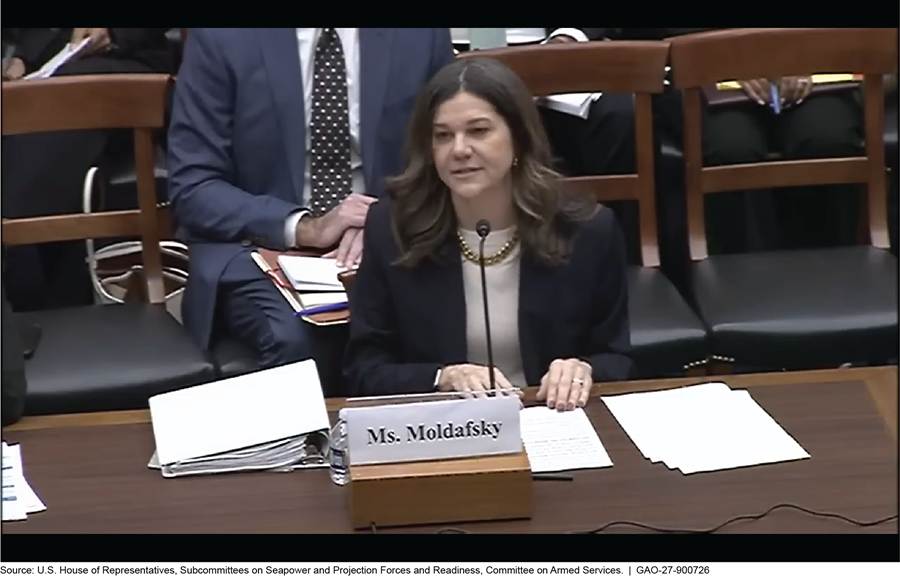
Diana Moldafsky, Director, testified on Osprey aircraft safety (view full hearing).
|
Example of Goal 2’s Testimonies Addressing Fraud Risks in Foreign Assistance. Foreign assistance is used to support U.S. foreign policy, but the complex environments in which U.S. foreign assistance is often delivered have inherent risks for fraud, waste, and abuse. In March 2026, we testified on fraud risk management in foreign assistance. Since July 2016, we have made dozens of recommendations to support the management of fraud and other risks for agencies delivering foreign assistance. Federal agencies have addressed some of our recommendations but can take further actions to improve risk management and better enable agencies to prevent fraud, waste, and abuse. (GAO-26-108945) |
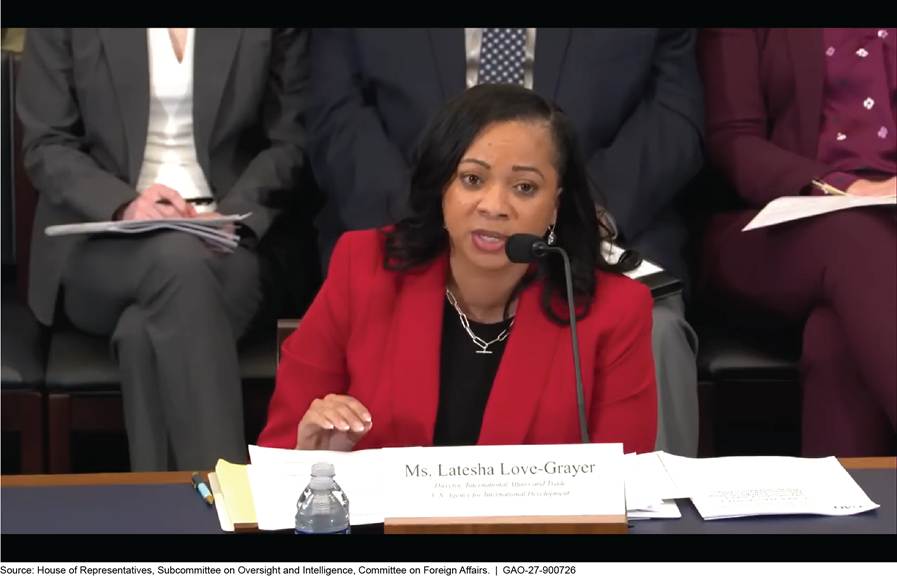
Latesha Love-Grayer, Director, testified on fraud risk management in foreign assistance (view full hearing).
Table 13 contains examples of Goal 2 accomplishments, which include both financial and other benefits.
Table 13: Examples of Goal 2’s Accomplishments
|
Protect and Secure the Homeland from Threats and Disasters |
|||
|
Improving Staffing Decisions at Temporary Immigration Custody Facilities |
U.S. Customs and Border Protection (CBP) obligated over $4 billion between FYs 2019 and 2024 on contracts for temporary facilities to process and hold people it apprehended along the southwest border. In 2024, we found that CBP did not have a standard method for determining the number of contractor staff it needed to perform certain services at these facilities. In response, in August 2024, CBP implemented a standardized formula, which enabled it to better determine its staffing needs. In FY 2026, we calculated that CBP had saved nearly $19 million from August 2024 to March 2025 by implementing the formula that reduced its staffing needs. (GAO-25-107346) |
||
|
Eliminating Spending on Coast Guard Ships with Significant Construction Delays |
The Coast Guard urgently needs Offshore Patrol Cutters to conduct law enforcement and search and rescue operations. Since October 2020, we have made recommendations to the Coast Guard to address cost and schedule risks with building these ships, including finishing the design before starting construction. In May 2025, we found that the Coast Guard had not formally reassessed one of its contracts, despite the shipbuilder’s continued lack of progress. Subsequently, in July 2025, Coast Guard officials reassessed the contract and terminated for default two of the four ships. In FY 2026, we calculated this saved the Coast Guard $377 million. (GAO-26-107583, GAO-23-105805, GAO-21-9) |
||
|
Reducing FEMA’s Borrowing for The National Flood Insurance Program |
Until recently, National Flood Insurance premium rates did not reflect the true risk of loss from flood damage. Since 2005, the Federal Emergency Management Agency (FEMA) has borrowed $38 billion from Treasury to pay the claims on insured properties. In 2009 and 2013, we reported that FEMA lacked the data to accurately calculate potential claims. We recommended that FEMA ensure that it can pay potential claims based on National Flood Insurance Program rates. FEMA adopted a new rating model that uses the data to calculate full-risk rates for all policies and fully implemented its new pricing in 2023. In 2026, we estimated that higher 2026 premiums will reduce FEMA’s future borrowing by $721 million. (GAO-13-607, GAO-09-12) |
||
|
Strengthening USCIS Workforce Planning |
U.S. Citizenship and Immigration Services’ (USCIS) Fraud Detection and National Security Directorate (FDNS) leads efforts to combat fraud and detect national security and public safety threats posed by applicants. In 2022, we found that USCIS’s staffing model did not reflect operating conditions because it had not identified factors that drive FDNS’s workload. We recommended that USCIS identify those factors, and it did so in 2025. In February 2026, USCIS revised the staffing model, which will help the agency make data-informed decisions about its workforce needs and better ensure program operations. (GAO-22-105328) |
||
|
Military Capabilities and Readiness |
|||
|
Improving Budget Forecasts for DOD Service Contracts |
DOD obligates hundreds of billions on contracts each year for services such as administrative and technical support. DOD is required, by law, to forecast the amount of money needed for service contracts in its annual budget submissions. However, in September 2023, we found that DOD had not provided timely guidance on how to forecast its service contract budget needs, and we recommended that DOD do so. In response, DOD issued additional budget guidance, and we determined in FY 2026 that DOD had included service contract forecasts in its budget submissions. These actions will help DOD and Congress make more informed budget decisions. (GAO-23-106123) |
||
|
Improving Military Aircraft Readiness |
The Air Force and Navy must complete aircraft maintenance to maintain military readiness. However, in 2022, we found that readiness rates for some Air Force and Navy aircraft had worsened since fiscal year 2015 but that these services had not completed plans to remedy a variety of maintenance challenges or mitigate related risks. We recommended that Congress consider requiring the Air Force and Navy to submit such plans. In response, Congress included a provision in the National Defense Authorization Act for FY 2026 requiring them to do so. As a result, the Air Force and Navy are better positioned to strengthen aircraft readiness for military training and operations. (GAO-22-104533) |
||
|
Improving Decisions about Civilian Workforce Reductions |
DOD’s civilian workforce plays an essential role in DOD’s success. Prior to making workforce reduction decisions, DOD is required by law to analyze the effects on elements such as readiness. However, in FY 2026, we found that DOD did not consistently conduct such analysis because its guidance was incomplete. We provided options to Congress to address this issue, and the National Defense Authorization Act for FY 2026 required DOD to provide additional guidance related to analyzing civilian workforce reductions. Implementing this guidance will help ensure that DOD mitigates potential challenges we identified in future civilian workforce reduction decisions. (GAO-26-108100) |
||
|
Reducing Military Aircraft Acquisitions |
U.S. Special Operations Command (SOCOM) plans to invest over $2 billion through FY 2029 to acquire a new aircraft called Armed Overwatch (now known as Skyraider II). In 2023, we reviewed SOCOM’s plans and found that SOCOM had not assessed the number of aircraft it needed. We recommended that SOCOM limit the acquisition of these aircraft until it analyzed its operational needs, which SOCOM subsequently did. Based on our work, SOCOM modified the number of aircraft it planned to acquire in FY 2025 and 2026 by 14 aircraft. In FY 2026, we calculated that this reduction had resulted in cost savings of approximately $338.9 million for those 2 years. (GAO-24-106283) |
||
|
Foreign Policy and International Economic Interests |
|||
|
Strengthening Oversight of U.S. Assistance to Ukraine |
The Department of State has a contract to help it monitor and evaluate over $4 billion of nonhumanitarian, nonmilitary U.S. assistance to Ukraine—such as assistance for ensuring safe nuclear facilities. However, in January 2026, we found that State had not used the information produced under this contract, as expected, because challenges, like the difficulty of monitoring during wartime, have limited data availability. In response to our review, State took steps to improve the usability of available data by including target information in contractor reports, which we determined in FY 2026 will better inform State’s oversight and decision-making regarding U.S assistance to Ukraine. (GAO-26-107860) |
||
|
Improving Efforts to Protect Human Rights in Programs That Combat Wildlife Trafficking |
U.S. funding can be used to support park rangers overseas to combat wildlife trafficking. In July 2024, we found that State lacked clear requirements directing partner organizations to report any allegations of human rights abuse by these rangers in a timely manner. Beginning in September 2024, State required partners to report grievances or human rights abuse allegations to State in a timely manner. In FY 2026, we reviewed copies of new partnership agreements that State provided to us and confirmed they included the reporting requirements, which improved the notification process of abuse allegations and better equips State to address potential human rights abuse risks. (GAO-24-106553) |
||
|
Improving CBP’s Ability to Collect Unpaid Duties |
In July 2023, we reported that U.S. Customs and Border Protection could not prevent importers from claiming more of certain tariff exclusions than approved, or recover the duties they were owed. Importers owed additional duties, if they claimed more exclusions than had been approved. We recommended that CBP implement more effective controls to prevent importers from overclaiming exclusions or promptly assess duties owed on any overages. In response, in April 2024, CBP developed and implemented controls to collect duties owed. These controls help CBP ensure that importers pay their duties, which increased revenue by $44.5 million, as of November 2025. (GAO-23-105148) |
||
|
|||
|
Strengthening Federal Efforts to Secure Internet-Connected Devices Against Cyber Threats |
Cyber threats to internet-connected devices represent a significant national security challenge. In 2022 and 2024, we found that many agencies had not met requirements to inventory and assess the risk of these devices, including those used in critical infrastructure. We made 20 recommendations to 13 agencies to enhance the accountability and risk management of these devices. As of FY 2026, 10 agencies had implemented 12 of our recommendations, taking steps to better secure the nation’s internet-connected devices. As a result, these agencies will strengthen their oversight of these devices and better secure their systems from cyberattacks. (GAO-25-107179, GAO-23-105327) |
||
Source: GAO. | GAO-27-900726
Note: It can take several years for our recommendations to result in an accomplishment. We generally claim an accomplishment within 2 fiscal years of the action taken. For financial benefits, we can generally claim up to 5 years of new benefits based on a single agency or congressional action. For more information, see app. II.
Our third strategic goal focuses on the collaborative and integrated elements needed for the federal government to achieve results. The work under this goal highlights the intergovernmental relationships that are necessary to address national challenges. Our multiyear (FYs 2022-2027) strategic objectives under this goal are
■ the government’s fiscal condition and opportunities to strengthen management of federal finances;
■ fraud, waste, and abuse and needed improvements in internal controls;
■ cross-cutting issues, major management challenges, and program risks; and
■ science and technology issues.
These objectives, along with the performance goals and key efforts that support them, are discussed fully in our Strategic Plan.[22]
The work supporting these objectives is led primarily by our staff in the following teams: Applied Research and Methods; Financial Management and Assurance; Forensic Audits and Investigative Service; Information Technology and Cybersecurity; STAA; and Strategic Issues. This goal also includes our bid protest and appropriations law work, which is performed by staff in OGC.
|
Example of Work Under Goal 3 Addressing Risks to VA Medical Facility Security. The VA is responsible for securing its facilities. In May 2026, we testified on security challenges at VA medical facilities, such as staff failing to detect prohibited weapons in any of the 30 selected facilities we tested. We have made five recommendations to help VA address challenges related to securing its facilities. Taking actions to address our recommendations would better provide VA with information it needs to make informed decisions, allocate resources effectively, and prioritize security efforts to create a safe environment for veterans and VA staff. (GAO-26-109020) |
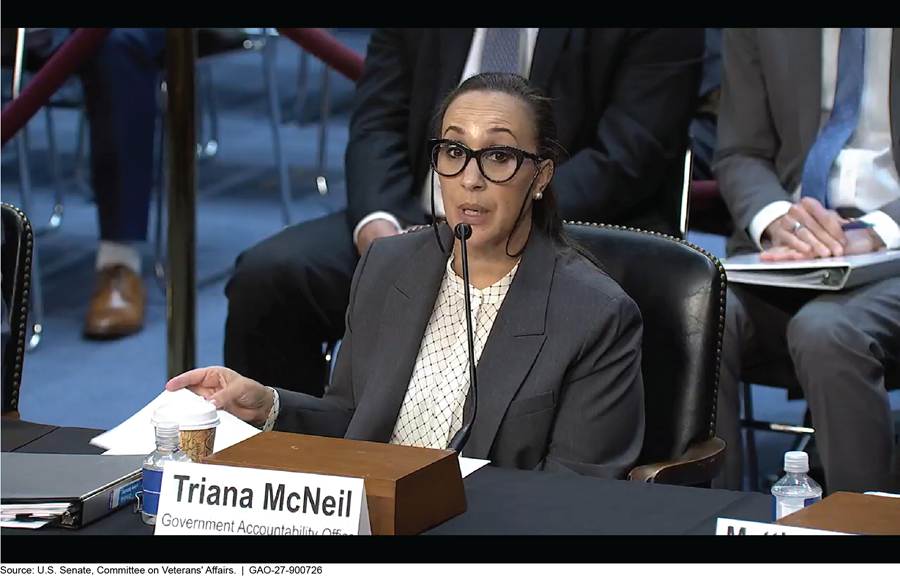
Triana McNeil, Director, testified on VA medical facility security challenges (view full hearing).
To accomplish our work in FY 2026 under these strategic objectives, we conducted foresight work (e.g., examining the nation’s long-term fiscal and management challenges) and insight work focusing on federal programs at high risk for fraud, waste, abuse, and mismanagement. As shown in table 14, we exceeded our Goal 3 targets for financial and other benefits and fell short of our target for testimonies.
Table 14: Strategic Goal 3’s Annual Performance Results
|
PERFORMANCE MEASURE |
2021 (actual) |
2022 (actual) |
2023 (actual) |
2024 (actual) |
2025 (actual) |
2026 (target) |
2026 (actual) |
Met/ not met |
|
Financial benefits (dollars in billions) |
$6.4 |
$42.1 |
$52.0 |
$6.5 |
$7.6 |
$5.9 |
$9.9 |
ü |
|
Other benefits |
477 |
458 |
444 |
445 |
373 |
380 |
527 |
ü |
|
Testimonies |
15 |
22 |
22 |
19 |
18 |
22 |
16 |
û |
Source: GAO. | GAO-27-900726
Note: Goals 1 through 3 do not sum to the total agencywide targets, as we have left a portion of the targets unassigned. Prior years’ experience indicates we can meet the agencywide targets, but we cannot always accurately predict under which goals.
The following sections describe our performance under Goal 3 for each of our quantitative performance measures and the targets for FY 2027. To set our targets, we consider many factors, including trends in our past performance and rolling 4-year averages, as described in Part I. We set our FY 2027 targets to align with our updated Strategic Plan. The plan consolidates Goal 3 strategic objectives under the new Goals 1 and 2 and establishes new strategic objectives to support our oversight and foresight mission, as previously discussed. Therefore, the related targets are set under the new Goals 1 and 2.[23]
Financial Benefits
The financial benefits reported for this goal in FY 2026 totaled $9.9 billion, which was $4 billion above our $5.9 billion target. Financial benefits contributing to this total include DOD’s efforts to identify and prevent potential improper payments, which helped the agency avoid paying $806 million across FYs 2023 through 2025.
|
Example of Goal 3’s Financial Benefits Assessing Biological Threat Detection Technology Improvements. The Department of Homeland Security (DHS) began using technologies to detect an aerosolized biological weapon in response to the 2001 anthrax attack. Biological Detection for the 21st Century (BD21) was a DHS effort to improve these technologies. However, in May 2021, we found that it faced challenges for use in biodetection. We reported that DHS had not fully incorporated best practices in assessing technologies’ readiness and recommended it do so. In response, DHS conducted additional analyses that led to a March 2024 agency decision to discontinue BD21. In March 2026, we estimated that discontinuing BD21 saved DHS $644 million. (GAO-21-292) |
Other Benefits
Other benefits reported for Goal 3 in FY 2026 totaled 527, exceeding our target of 380 by 147 benefits. Goal 3’s benefits were primarily in the areas of business process and improvement and program efficiency and effectiveness.
|
Example of Goal 3’s Other Benefits Enhancing Fraud Controls for Small Business Program Funds. Federal agencies awarded small businesses about $4.5 billion in FY 2023 to research, develop, and commercialize technologies. In 2021, we found that the Department of the Navy and USDA had not fully met all requirements to prevent fraud, waste, and abuse of these funds. We recommended they implement additional fraud controls. In FY 2026, we determined that in response, the Navy began tracking fraud, waste, and abuse referrals, and USDA updated how awardees certify business ownership. By taking these steps, the Navy and USDA are better able to mitigate fraud risks to their small business programs and ensure that funds are only provided to eligible small businesses. (GAO-21-413) |
Testimonies
Our senior executives testified 16 times in FY 2026 on our Goal 3 work, which fell short of the target of 22 by six testimonies. In addition to the testimonies described below, we testified on topics such as the need to improve DOD’s financial management, as well as to address fraud risks in federally funded, state-administered programs.
|
Example of Goal 3’s Testimonies Implementing a Government-wide Strategy to Counter Scams. Scams, a method of committing fraud, involve the use of deception or manipulation intended to achieve financial gain. Scams are a growing and evolving threat affecting consumers through a variety of methods, yet federal efforts to address them remain fragmented across at least 13 agencies. In March 2026, we testified on federal agencies’ activities to (1) prevent and respond to scams and the need for a comprehensive, government-wide strategy to guide their efforts; and (2) compile scam-related consumer-complaint data and estimate the total number of scams and related financial losses. We have made recommendations to address these issues, and two agencies have outlined various concerns, such as differing authorities and mandates among agencies. However, we maintain that these recommendations remain valid. (GAO-26-109023) |
Seto J. Bagdoyan, Director, testified on federal efforts to counter scams (view full hearing).
|
Example of Goal 3’s Testimonies Improving Federal Information Transparency and Program Integrity. Congress and the executive branch have taken steps to improve the transparency of information on federal spending and programs. In March 2026, we testified on progress that agencies have made to improve the quality, transparency, and accessibility of information on federal programs and spending. However, we have found that challenges remain in various areas, and we made recommendations to federal agencies and Congress to help address them. Improving the transparency of information on federal programs and spending is foundational for increasing the efficiency and effectiveness of the federal government and addressing persistent management challenges, such as preventing fraud and reducing improper payments. (GAO-26-109034) |
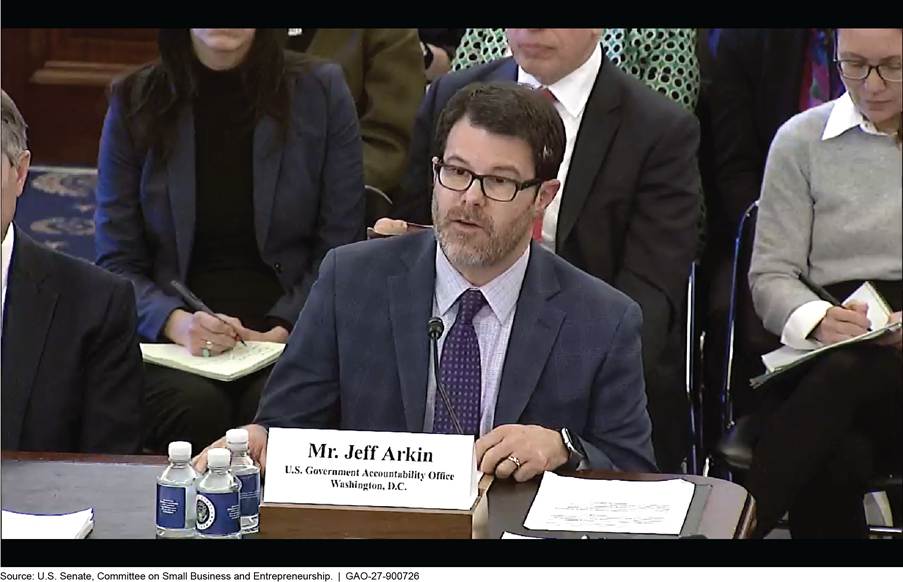
Jeff Arkin, Director, testified on ongoing challenges in federal information transparency and program integrity (view full hearing).
Table 15 contains examples of Goal 3 accomplishments, which include both financial and other benefits.
Table 15: Examples of Goal 3’s Accomplishments
|
Government’s Fiscal Condition and Opportunities to Strengthen Management of Federal Finances |
||
|
Improving Online Submission of Referrals of Suspected Tax Fraud |
Reports from the public about suspected tax fraud can help the Internal Revenue Service identify millions of dollars that would otherwise go uncollected. In 2016, we reported that individuals trying to make such reports could be confused due to fragmentation and overlap in IRS’s tax fraud referral program, and we recommended that IRS consolidate the process for online submissions. In October 2025, IRS launched a new webpage on IRS.gov that consolidates online referrals for several types of suspected tax fraud, making it easier for users to find the correct forms and submit external referrals and better positions IRS to review tax fraud claims. (GAO-16-155) |
|
|
Fraud, Waste, and Abuse, and Needed Improvements in Internal Controls |
||
|
Verifying Federal Employees Health Benefits Program Eligibility |
The Federal Employees Health Benefits (FEHB) Program is the country’s largest employer-sponsored health insurance program. In 2022, we reported that the Office of Personnel Management had no plans to identify and remove ineligible family members covered by FEHB and, in 2025, that OPM had not met leading anti-fraud practices, such as documenting anti-fraud responsibilities. We recommended that OPM monitor verification of family member eligibility and improve its anti-fraud efforts. In 2026, OPM required new verification reporting and specified the role of its anti-fraud entity, which will help mitigate the risks we identified and help ensure that ineligible family members are identified and removed from the program. (GAO-25-106885, GAO-23-105222) |
|
|
Preventing DOD Improper Payments |
DOD annual outlays make DOD’s efforts to identify and prevent payments it should not make very significant. In 2013, we reported that DOD improper payment estimates were unreliable because of the way DOD calculated them. We recommended that DOD strengthen its processes to ensure that its estimates were complete and accurate. In response, DOD began using a new system to identify its transactions in 2017 and, by 2020, to identify and prevent potential improper payments. In 2026, we found that this approach helped DOD avoid paying $806 million in improper payments across FYs 2023 through 2025. (GAO-13-227) |
|
|
Improving Federal Grant Oversight |
The federal government awards about $1 trillion in grants each year. Grantees that spend at least $1 million of that money in a year generally must undergo an audit covering that spending. The General Services Administration keeps a database of these audits, but in 2024, we found that limitations of the database impaired federal agencies’ ability to monitor how grantees use the funds. We recommended that GSA make this database more reliable and useful to agencies. In 2026, GSA put new processes in place to improve the accuracy of the data and added features based on what users said they needed, which will help improve grant oversight and monitoring of federal spending. (GAO-24-106173) |
|
|
Cross-Cutting Issues, Major Management Challenges, and Program Risks |
||
|
Improving Transparency and Accountability of Federal Spending |
USAspending.gov is the official source of federal spending data, including contracts, grants, and loans. In 2022 and 2023, we reported that gaps in the completeness and quality of the data limited the website’s usefulness and could undermine transparency and accountability of federal spending. We made four recommendations for Congress to strengthen data oversight and completeness. In September 2026, Congress enacted legislation implementing the recommendations, prompting agencies to improve the transparency and quality of data on USAspending.gov. This will strengthen Congress’s and the public’s ability to track and oversee federal spending. (GAO-24-106214, GAO-22-105715) |
|
|
Improving the Reliability of Paid Administrative Leave Data |
Administrative leave is excused paid time off. The Administrative Leave Act of 2016 created new leave categories for investigations and weather- and safety-related situations. Related congressional committee reports cited our findings that the data on the use of administrative leave were inaccurate and inconsistent. We had previously recommended that OPM provide agencies with guidance on recording this leave. In response, OPM issued guidance directing agencies to record and report the new leave categories. In FY 2026, we determined that OPM’s efforts will help improve the reliability of administrative leave data and promote consistent use of the leave categories across the government. (GAO-17-127, GAO-15-79) |
|
|
Reducing Biometric Identity System Costs and Risks |
The Department of Homeland Security is replacing its outdated biometric identity system, which matches facial features and fingerprints, to support national security activities like visa issuances. In 2023, we found that the new system called Homeland Advanced Recognition Technology (HART), would cost more than estimated and had privacy risks that might affect hundreds of millions of individuals. We recommended that DHS improve cost estimates and address HART’s privacy risks. In response, DHS implemented four of our recommendations in FY 2026, better positioning DHS to effectively manage HART’s costs and appropriately protect individuals’ personal data. (GAO-23-105959) |
|
|
Science and Technology Issues |
||
|
Better Protecting Human Genomic Data |
Research on the human genome—the complete set of a person’s DNA—has potential benefits, but intelligence agencies warn that misuse of the data could threaten national security. In April 2025, we found that the National Institutes of Health (NIH) lacked fully developed and implemented procedures to monitor researchers’ compliance with human genomic data management and security requirements. We recommended that NIH address these issues. In response, NIH required new security and operational standards and monitoring processes for its data storage systems and their users by February 2026—which will help reduce genomic data security risks and better protect the data. (GAO-25-107377) |
|
|
Determining Potential Benefits and Drawbacks of Sustainable Building Technologies |
Sustainable building technologies—such as solar panels and energy-efficient windows—can improve resilience during events such as water shortages. However, as we reported in February 2025, estimates of the technologies’ future cost savings and benefits may be uncertain because some technologies have not been widely used. In response to our work, the National Defense Authorization Act for FY 2026 directed DOD to use at least three sustainable building technologies we identified in military construction projects for a pilot program. This could help determine the potential benefits and drawbacks of these technologies in reducing energy use, costs, and emissions. (GAO-25-107931) |
|
Source: GAO. | GAO-27-900726
Note: It can take several years for our recommendations to result in an accomplishment. We generally claim an accomplishment within 2 fiscal years of the action taken. For financial benefits, we can generally claim up to 5 years of new benefits based on a single agency or congressional action. For more information, see app. II.
Strategic Goal 4: Maximize the Value of GAO by Enabling Quality, Timely Service to Congress and by Being a Leading Practice Federal Agency
Our fourth strategic goal embraces the spirit of continuous and focused improvement in order to sustain high-quality, timely service to Congress, while also implementing leading practices in our internal operations. Activities carried out under this goal also address our internal management challenges.
The multiyear (FYs 2022-2027) strategic objectives under this goal are to
■ empower GAO’s diverse workforce to continue to excel in mission delivery through strategic talent management;
■ refine GAO’s processes to deliver high-quality results and products and promote knowledge sharing, government standards, and strategic solutions; and
■ provide modern integrated tools and systems in a secure, collaborative, and flexible environment.
These objectives, along with the performance goals and key efforts that support them, are discussed fully in our Strategic Plan.[24]
The work supporting these objectives is performed under the direction of the Chief Administrative and Financial Officer, through the following offices: the Controller, Financial Management and Business Operations, Human Capital, Information Systems and Technology Services, Infrastructure Operations, the Learning Center, the Professional Development Program, and Field Operations. Assistance on specific key efforts is provided by the Applied Research and Methods, STAA, and Financial Management and Assurance mission teams; and the Audit Policy and Quality Assurance (APQA), CR, Continuous Process Improvement, OGC, Office of Public Affairs, and SPEL staff offices.
To accomplish our work under these three objectives, we performed internal studies and completed projects that further the strategic goal.
|
Examples of Work Under Goal 4 Strengthening the Tools, Processes, and Communications That Support Our Mission. In FY 2026, we advanced several initiatives to strengthen how we conduct our work and share our results. We completed a multiyear transition to the Enterprise Infrastructure Solutions contract, helping ensure the continuity and modernization of critical network connectivity services. We also enhanced coordination between engagement teams and our acquisition office to support the timely procurement of external data for analysis and products for Congress. Additionally, we streamlined the process we use to highlight published products—making it easier for engagement teams to use plain language to communicate our findings and extend the reach of our work. Additional examples of Goal 4 achievements are included in this section and are also discussed in Part I (Internal Management Challenges). |
Table 16 provides examples of Goal 4 accomplishments and contributions.
Table 16: Examples of Goal 4’s Accomplishments and Contributions
|
Empower GAO’s Workforce to Excel in Mission Delivery Through Strategic Talent Management |
||
|
Attract, Hire, and Retain a Diverse, Multidisciplinary Workforce |
■ Successfully managed a year-round professional development program supporting 94 analysts and operations interns, and student volunteers to meet agency workforce needs. ■ Effectively integrated 63 entry-level analysts into GAO’s workforce, strengthening capacity in critical areas, such as national security, health care, and science and technology. |
|
|
Provide Training and Development Programs to Enhance Employee Skills |
■ Published a comprehensive eLearning course catalog that consolidated all course offerings into a single, easy-to-navigate resource, expanding employee access to professional development opportunities and helping managers identify training to support employee development and mission delivery. ■ Launched a plain language writing course for staff to strengthen written communication skills and improve the clarity and readability of GAO products. ■ Updated the eLearning course on Standards for Internal Control in the Federal Government to incorporate key changes based on the 2025 revision. ■ Published an updated version of GAO’s Guide for Developing and Assessing Strategic Training and Development Efforts in the Federal Government, which provides agencies and oversight bodies with an enhanced resource for evaluating whether training aligns with priorities, is implemented effectively, and improves workforce performance. |
|
|
Maintain Effective Relationships with GAO’s Internal Employee Organizations |
■ Worked with the GAO Employees Organization, International Federation of Professional and Technical Engineers Local 1921, to negotiate on a variety of initiatives, including improving agency efficiency and agility by aligning compensation, workforce deployment, organizational structures, and headquarters space with current mission and resource needs. |
|
|
Refine GAO’s Processes to Deliver Quality Results and Products and Promote Knowledge Sharing |
||
|
Continue to Enhance Outreach to Congress and Audited Entities |
■ Expanded short-term technical assistance by over 40 percent to congressional staff and strengthened the systematic review of internal technical assistance data, improving the reliability of tracking and categorization. ■ Completed the launch of GAO’s network of external experts to provide greater depth of science and technology knowledge to support Congress. ■ Contributed GAO staff contact information to the House-sponsored web-based platform, enabling congressional staff to more quickly identify and connect with subject matter experts and key points of contact. |
|
|
Enhance GAO’s Foresight and Strategic Planning Capacity |
■ Issued GAO’s Strategic Plan for fiscal years 2027-2032, with an innovative design and structure to streamline the plan and enhance its communication of GAO’s goals and impact. ■ Provided training to 13 International Fellows on GAO’s standard strategic planning methods and practices. ■ Streamlined the annual process that our mission teams use to update GAO’s Executive Committee on planned work to address congressional priorities. |
|
|
Enhance Information Sharing for the Domestic and International Accountability Community |
■ Led events for 11 Intergovernmental Audit Forums, including seven webinars on federal grants management; auditing programs at a high risk of fraud, waste, abuse or mismanagement; and the use of AI by audit teams—with cumulative attendance of nearly 7,000 accountability professionals nationwide. ■ Expanded access to GAO’s audit expertise by delivering over 70 training sessions to approximately 1,755 participants across the domestic accountability community through flexible open-enrollment and customized client offerings. The Center for Audit Excellence also provided targeted technical assistance to inspector general offices, extending its impact beyond training to strengthen institutional audit capacity. ■ Convened the Comptroller General’s Domestic Working Group and Educators Advisory Panel to facilitate dialogue on high-priority issues facing the federal, state, and local audit community and the educational needs and constraints of students entering the auditing profession. ■ Strengthened connections with inspectors general and federal, state, and local auditors, providing our engagement teams with access to key contacts and information, while promoting knowledge sharing and audit quality across the domestic accountability community. ■ Expanded international information sharing and capacity-building through relationships with international Supreme Audit Institutions and other accountability partners through our leadership roles and participation in 24 International Organization of Supreme Audit Institutions groups, including the INTOSAI Working Group on Financial and Economic Stability. |
|
|
Leverage Data, Technology, Staff, and Process Improvements to Enhance GAO’s Communications, Processes, and Programs |
■ Developed peer-to-peer and advisor networks to enhance the adoption of new tools and standardize work practices to strengthen GAO’s processes. ■ Launched AI@Work, an internal resource that provides GAO staff with centralized guidance, tools, and resources for the effective and responsible use of AI. ■ Developed the Nationwide Resource Network, enabling engagement teams to leverage GAO’s geographically distributed workforce to support mission delivery, while reducing travel costs. ■ Introduced interactive digital storytelling formats featuring scroll-driven narratives and graphics to enhance how users access and engage with GAO content and information. ■ Developed an AI strategy to guide how GAO incorporates AI into engagement and business processes by focusing on five key decision-making pillars, such as strengthening governance and establishing continuous monitoring. |
|
|
Provide Modern Integrated Tools and Systems in a Secure Environment |
||
|
Ensure a Secure, Cost-Effective Physical and Technological Infrastructure |
■ Delivered key modernization improvements by implementing Personal Identity Verification (PIV) card authentication to strengthen organizational identity and access capabilities and by deploying an integrated scanning solution for network drives and databases, enabling clearer identification of sensitive data and improving overall protection and compliance. ■ Completed application cloud migrations, strengthening authentication and securing our applications. ■ Completed the transition to the Enterprise Infrastructure Solutions contract, ensuring the continuity and modernization of our network connectivity services. ■ Continued field office space-optimization efforts to reduce our physical footprint to support GAO’s long-term field office strategy. |
|
|
Empower Staff with Collaborative, Integrated tools |
■ Expanded our capacity to conduct highly classified work by building a new headquarters Sensitive Compartmentalized Information Facility and establishing access to facilities to conduct classified work near our field offices, enhancing operational flexibility and support of defense and intelligence-related work for Congress. |
|
|
Enhance Tools That Integrate Cross-Cutting Enterprise Data to Facilitate Decision-making |
■ Delivered dashboards to help our executives, the Innovation Lab, and Analytics Foundry evaluate the use and costs of GAO’s Knowledge Management Platform, which connects AI tools to common data and infrastructure. |
|
Source: GAO. | GAO-27-900726
Part III: Financial Information
November 16, 2026
In FY 2026, GAO continued to deliver on its mission to support Congress in meeting its constitutional responsibilities and improving the performance and accountability of the federal government, while operating in a constrained budget environment. We remain committed to setting the standard for excellence in government financial management.
I am proud to report that GAO’s financial statements, an integral part of our Performance and Accountability Report, again received an unmodified “clean” opinion. Our independent auditors found that GAO maintained, in all material aspects, effective internal control over financial reporting, identified no reportable instances of non-compliance with laws and regulations during limited testing, and determined that our financial management systems substantially complied with Federal Financial Management Improvement Act of 1996 requirements. Although not required, we consider the independent auditor’s opinion on internal controls and systems’ compliance with FFMIA to be a leading practice.
Our commitment to transparency and accountability was also recognized externally as our FY 2025 PAR report received AGA’s CEAR award, our 25th consecutive award since we first applied in FY 2001. In addition, we were honored with AGA’s Best-in-Class award for “conveying performance information in a creative way.”
GAO’s enacted FY 2026 budget remained flat at $811.9 million, the same annual appropriation as in FY 2024 and FY 2025. We incurred a decrease of 231 FTE, or 7 percent of the workforce, while funding constraints limited the ability to backfill many critical positions. The losses occurred even though we utilized authority to spend offsetting collections. Supplemental funding allowed us to carry out specific engagements related to the Infrastructure Investment and Jobs Act, the Inflation Reduction Act, and funding provided in FY 2025 for emergency disaster response. Working within the resources provided, we delivered on our mission to support Congress. For example, our work produced $62.5 billion in financial benefits in FY 2026.
We also continued to identify opportunities to strengthen financial sustainability and reduce operating costs. Our ongoing space optimization efforts generated additional rental income by leasing available headquarters space to three new federal tenant agencies in FY 2026. In FY 2027 we expect our lease revenue to be approximately $23 million higher annually than in FY 2025. The rental income can only be used for headquarters building repairs, initiatives, and security. We continue our efforts to optimize space and reduce costs by further decreasing our physical footprint at both our headquarters building and at our field offices. We are executing additional reductions in field office space, with the goal of decreasing field office square footage by at least 80 percent and an anticipated cost avoidance of approximately $5 million annually by FY 2030.
In FY 2026, we achieved technology advances by strengthening cybersecurity controls through agency PIV adoption, network and application enhancements, and Windows 11 deployment. These changes expanded zero-trust by deploying modern identity and access capabilities within the cloud, applications, and device access. Additionally, we launched multiple AI pilots to support our business needs in meaningful ways. We are also continuing our technology evolution through our Enterprise Content Management capabilities and data analytics efforts.
These accomplishments underscore our continued commitment to strong financial stewardship, operational efficiency, and responsible resource management. Despite significant fiscal and workforce constraints, we maintained sound financial management practices, while advancing key operational and modernization priorities in support of our mission. Looking ahead, we will remain focused on ensuring the effective and efficient use of resources to sustain the agency’s ability to serve Congress and the American people.
//SIGNED//
William (Bill) White
Chief Administrative and Financial Officer
November 6, 2026
The Audit Advisory Committee assists the Comptroller General in overseeing the U.S. GAO’s financial operations. As part of that responsibility, the Committee meets with agency management, its Inspector General, and its external auditors to review and discuss GAO’s external financial audit coverage, the effectiveness of GAO’s internal controls over its financial operations, and its compliance with certain laws and regulations that could materially impact GAO’s financial statements. GAO’s external auditors are responsible for expressing an opinion on the conformity of GAO’s audited financial statements with accounting principles generally accepted in the United States of America. The Committee reviews the findings of the Inspector General and external auditors, and GAO’s responses to those findings, to assure itself that GAO’s plan for corrective action includes appropriate and timely follow-up measures. In addition, the Committee reviews the draft Performance and Accountability Report, including its financial statements, and provides comments to management who have responsibility for the Performance and Accountability Report. The Committee met three times with respect to its responsibilities as described above. During these sessions, the Committee met with the Inspector General and external auditors without GAO management being present and discussed with the external auditors the matters that are required to be discussed by generally accepted auditing standards. Based on procedures performed as outlined above, the Committee recommends that GAO’s audited financial statements, notes, and required supplementary information be included in the 2026 Performance and Accountability Report.
//SIGNED//
Kathleen S. Tighe
Chair
Audit Advisory Committee
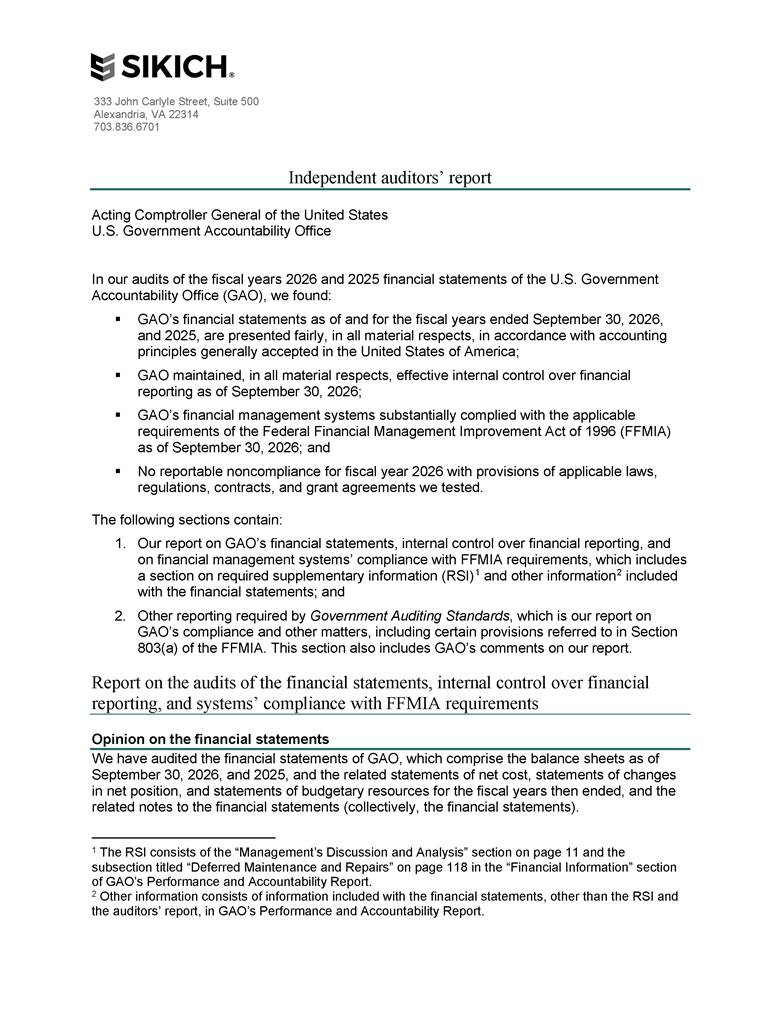
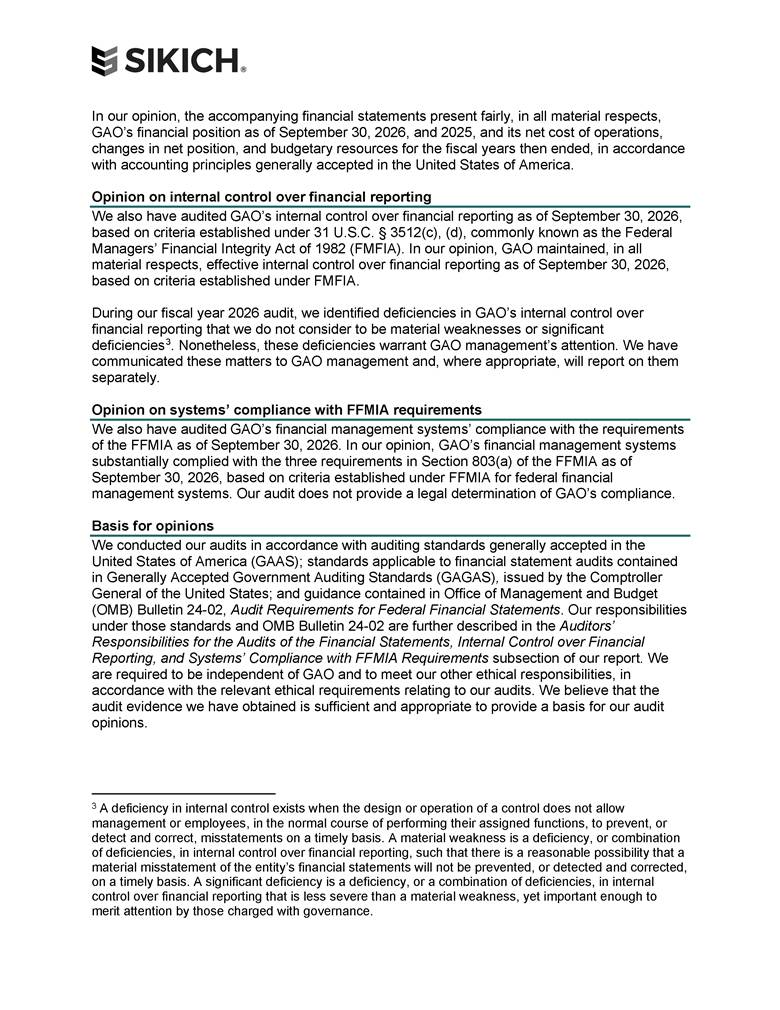
The financial statements on the following pages are the:
■ Balance Sheets, which present the amounts we had available to use (assets) versus the amounts we owed (liabilities) and the residual amounts after liabilities were subtracted from assets (net position).
■ Statements of Net Cost, which present the annual cost of our operations. The gross costs, less any offsetting revenue earned from our activities, is used to arrive at the net cost of work performed under our four strategic goals and other costs in support of Congress.
■ Statements of Changes in Net Position, which present the accounting items that caused the net position section of the balance sheets to change from the beginning to the end of the fiscal years displayed.
■ Statements of Budgetary Resources, which present how budgetary resources were made available to us during the fiscal year and the status of those resources at the end of the fiscal year.
■ Notes to financial statements present information that is essential to a user’s understanding of the basic financial statements. This includes:
o Relevant information integral to understanding line items of accrual basis financial statements
o Context or background information regarding the reporting entity and its activities
o Past events, current conditions, and circumstances not previously recognized but that may affect operating performance
o Other information users may need to assess accountability
o Note 12 presents a reconciliation of net operating costs to net outlays noting the key differences.
■ Required supplementary information presents certain unaudited information required by Government Accounting Standards which does not appear elsewhere.
Financial Statements
U.S. Government Accountability Office
Balance Sheets
As of September 30, 2026 and 2025
(Dollars in thousands)
|
|
2026 |
|
2025 |
|
Assets |
|
|
|
|
Intragovernmental Assets (Note 2) |
|
|
|
|
Fund Balance with Treasury |
$210,666 |
|
$234,348 |
|
Accounts receivable |
2,515 |
|
2,955 |
|
Advances and prepayments |
3,601 |
|
2,602 |
|
Total Intragovernmental Assets |
216,782 |
|
239,905 |
|
|
|
|
|
|
Assets With the Public |
|
|
|
|
Property, plant, and equipment, net (Note 3) |
50,389 |
|
50,024 |
|
Other assets |
238 |
|
202 |
|
Total Assets With the Public |
50,627 |
|
50,226 |
|
|
|
|
|
|
Total Assets |
$267,409 |
|
$290,131 |
|
Land (Note 3)
|
|
|
|
|
Liabilities (Note 4) |
|
|
|
|
Intragovernmental Liabilities |
|
|
|
|
Employer contributions and payroll taxes payable (Note 5) |
$5,149 |
|
$4,648 |
|
Other liabilities (Note 8) |
3,016 |
|
3,269 |
|
Total Intragovernmental Liabilities |
8,165 |
|
7,917 |
|
|
|
|
|
|
Liabilities With the Public |
|
|
|
|
Accounts payable |
10,153 |
|
2,953 |
|
Federal employee salary, leave and benefits payable (Note 6) |
68,435 |
|
68,179 |
|
Pension and post-employment benefits payable (Note 7) |
12,267 |
|
16,292 |
|
Other liabilities (Note 8) |
10,624 |
|
12,369 |
|
Total Liabilities With the Public |
101,479 |
|
99,793 |
|
|
|
|
|
|
Total Liabilities |
109,644 |
|
107,710 |
|
|
|
|
|
|
|
|
|
|
|
Net Position |
|
|
|
|
Unexpended appropriations |
123,772 |
|
119,892 |
|
Cumulative results of operations |
33,993 |
|
62,529 |
|
Total Net Position (Note 13) |
157,765 |
|
182,421 |
|
Total Liabilities and Net Position |
$267,409 |
|
$290,131 |
The accompanying notes are an integral part of these financial statements.
Financial Statements
U.S. Government Accountability Office
Statements of Net Cost
For the FYs Ended September 30, 2026 and 2025
(Dollars in thousands)
|
|
2026 |
|
2025 |
|
Net Costs by Goal |
|
|
|
|
Goal 1: Well-being / Financial Security of American People |
|
|
|
|
Gross costs |
$309,334 |
|
$375,516 |
|
Less: reimbursable services |
(320) |
|
(577) |
|
Net goal costs |
309,014 |
|
374,939 |
|
|
|
|
|
|
Goal 2: Changing Security
Threats / Challenges of Global |
|
|
|
|
Gross costs |
271,433 |
|
212,281 |
|
Less: reimbursable services |
- |
|
- |
|
Net goal costs |
271,433 |
|
212,281 |
|
|
|
|
|
|
Goal 3: Transforming the Federal Government’s Role |
|
|
|
|
Gross costs |
261,445 |
|
299,353 |
|
Less: reimbursable services |
(13,956) |
|
(14,864) |
|
Net goal costs |
247,489 |
|
284,489 |
|
|
|
|
|
|
Goal 4: Maximize the Value of GAO |
|
|
|
|
Gross costs |
12,433 |
|
13,367 |
|
Less: reimbursable services |
- |
|
- |
|
Net goal costs |
12,433 |
|
13,367 |
|
|
|
|
|
|
Other Costs in Support of Congress |
|
|
|
|
Gross costs |
78,758 |
|
69,737 |
|
Less: reimbursable services |
(2,409) |
|
(2,504) |
|
Net costs |
76,349 |
|
67,233 |
|
|
|
|
|
|
Costs Not Assigned to Programs |
1,200 |
|
3,050 |
|
Less: Reimbursable services not attributable to above cost categories |
(22,540) |
|
(15,773) |
|
Net Cost of Operations (Note 10) |
$895,378 |
|
$939,586 |
The accompanying notes are an integral part of these financial statements.
Financial Statements
U.S. Government Accountability Office
Statements of Changes in Net Position
For the FYs Ended September 30, 2026 and 2025
(Dollars in thousands)
|
|
2026 |
|
2025 |
|
Unexpended Appropriations: |
|
|
|
|
Unexpended Appropriations, beginning of fiscal year |
$119,892 |
|
$122,852 |
|
Appropriations received |
811,894 |
|
821,894 |
|
Other adjustments |
(5) |
|
(5) |
|
Appropriations used |
(808,009) |
|
(824,849) |
|
Net Change in Unexpended Appropriations |
3,880 |
|
(2,960) |
|
|
|
|
|
|
Unexpended Appropriations, end of fiscal year |
$123,772 |
|
$119,892 |
|
|
|
|
|
|
Cumulative Results of Operations: |
|
|
|
|
Cumulative Results of Operations, beginning of fiscal year |
$62,529 |
|
$104,870 |
|
Adjustment – Change in accounting principle (Note 1) |
(1,191) |
|
- |
|
Cumulative Results of Operations, beginning of fiscal year, as adjusted |
61,338 |
|
104,870 |
|
Appropriations used |
808,009 |
|
824,849 |
|
Imputed financing - cost imputed to GAO (Note 5) |
60,020 |
|
72,397 |
|
Transfers in/(out) and other |
4 |
|
(1) |
|
Net cost of operations |
(895,378) |
|
(939,586) |
|
Net Change in Cumulative Results of Operations |
(27,345) |
|
(42,341) |
|
|
|
|
|
|
Cumulative Results of Operations, end of fiscal year |
$33,993 |
|
$62,529 |
|
Net Position |
$157,765 |
|
$182,421 |
The accompanying notes are an integral part of these financial statements.
Financial Statements
U.S. Government Accountability Office
Statements of Budgetary Resources
For the FYs Ended September 30, 2026 and 2025
(Dollars in thousands)
|
|
2026 |
|
2025 |
|
Budgetary Resources (Note 11) |
|
|
|
|
Unobligated balance from prior year budget authority, net |
$132,772 |
|
$203,703 |
|
Appropriations |
811,894 |
|
821,894 |
|
Spending authority from offsetting collections |
33,273 |
|
31,716 |
|
Total Budgetary Resources |
$977,939 |
|
$1,057,313 |
|
|
|
|
|
|
Status of Budgetary Resources |
|
|
|
|
New obligations and upward adjustments |
$893,151 |
|
$942,745 |
|
Unobligated balance, end of year: |
|
|
|
|
Apportioned, unexpired account |
7,788 |
|
7,852 |
|
Unapportioned, unexpired accounts |
55,920 |
|
93,425 |
|
Unexpired unobligated balance, end of year |
63,708 |
|
101,277 |
|
Expired unobligated balance, end of year |
21,080 |
|
13,291 |
|
Total unobligated balance, end of year |
84,788 |
|
114,568 |
|
Total Budgetary Resources |
$977,939 |
|
$1,057,313 |
|
|
|
|
|
|
Outlays, Net |
|
|
|
|
Outlays, net |
$835,571 |
|
$874,101 |
|
Distributed offsetting receipts |
(9) |
|
(22) |
|
Agency Outlays, Net |
$835,562 |
|
$874,079 |
The accompanying notes are an integral part of these financial statements.
Note 1. Summary of Significant Accounting Policies
Reporting Entity
GAO, an agency in the legislative branch of the federal government, supports Congress in carrying out its constitutional responsibilities. GAO carries out its mission primarily by conducting audits, evaluations, analyses, research, and investigations and providing the information from that work to Congress and the public in a variety of forms. The financial activity presented relates primarily to the execution of GAO’s statutorily enacted budget. GAO’s budget consists of annual and supplemental appropriations covering salaries and expenses as well as revenue from reimbursable audit services and rental income. The revenue from audit services and rental income is presented as “reimbursable services” on the statements of net cost and included as part of “spending authority from offsetting collections” on the statements of budgetary resources. Revenue from audit services is recognized when earned.
Certain goods and services are received from other federal entities at no cost or at a cost less than the full cost to the providing federal entity. Consistent with accounting standards, certain costs of the providing entity that are not fully reimbursed by the component reporting entity are recognized as imputed cost in the Statements of Net Cost, and as imputed financing sources in the Statements of Changes in Net Position. Such imputed costs and financing sources relate to employee benefits.
However, unreimbursed costs of goods and services other than those identified above are not included in our financial statements. The reporting entity is a component of the U.S. Government. By accounting convention, intragovernmental assets and liabilities are eliminated in the consolidation process for the U.S. Government’s consolidated financial statements. These financial statements should be read with the realization that they are for a component of the U.S. government, a sovereign entity.
Basis of Accounting and Reporting
GAO’s financial statements have been prepared on the accrual basis and the budgetary basis of accounting in conformity with generally accepted accounting principles for the federal government. Accordingly, on the accrual basis, revenues are recognized when earned and expenses are recognized when incurred, without regard to the receipt or payment of cash. These principles differ from budgetary reporting principles used to prepare the statements of budgetary resources. The differences relate primarily to the capitalization and depreciation of property, plant and equipment, as well as the recognition of other long-term assets and liabilities. See Note 12, Reconciliation of Net Operating Costs to Net Outlays, for more information.
Leases
Intragovernmental lease expense and lease income are recognized based on (i) the payment provisions of the contract or agreement and (ii) standards regarding recognition of accounts payable/receivable and other related amounts.
Intragovernmental Assets
Intragovernmental assets are those assets that arise from transactions with other federal entities. Fund Balance with Treasury comprise the majority of intragovernmental assets on GAO’s balance sheets.
Fund Balance with Treasury
Treasury processes GAO’s receipts and disbursements. Fund Balance with Treasury represents appropriated funds from which GAO is authorized to pay liabilities and make other expenditures.
Accounts Receivable
GAO’s accounts receivable are due principally from federal entities for reimbursable services. GAO does not recognize any allowance for loss on intragovernmental accounts receivable as they are considered fully collectible.
Property, Plant, and Equipment (PP&E), Net
The GAO headquarters building qualifies as a multi-use heritage asset. It is GAO’s only heritage asset and is reported as part of PP&E on the balance sheets. The building’s designation as a multi-use heritage asset is a result of both being listed in the National Register of Historic Places and being used in general government operations. SFFAS 29 requires accounting for multi-use heritage assets as general PP&E to be included in the balance sheet and depreciated. The building was depreciated on a straight-line basis over 25 years and is fully depreciated. In accordance with SFFAS 59, Accounting and Reporting of Government Land, land is no longer recognized as an asset on the balance sheet effective in FY 2026 and the estimated land acreage and predominant use are disclosed.
Generally, PP&E individually costing more than $15,000, and a minimum expected life of 2 years, are capitalized at cost. Building improvements and leasehold improvements are capitalized when the cost is $25,000 or greater. Bulk purchases of lesser-value items that aggregate more than $150,000 are also capitalized at cost. Assets are depreciated on a straight-line basis over the estimated useful life of the property as follows: building improvements, 10 years; equipment and software, ranging from 3 to 20 years; and leasehold improvements, the shorter of 5 years or the term of the lease. GAO’s PP&E have no restrictions as to use or convertibility except for the restrictions related to the GAO headquarters building being registered in the National Register of Historic Places.
Liabilities
Liabilities represent amounts that will be paid by GAO as a result of transactions that have already occurred. Intragovernmental liabilities are those liabilities that arise from transactions with other federal entities.
Accounts Payable
Accounts payable consists of amounts owed to commercial vendors for goods and services received.
Federal Employee Benefits
GAO recognizes its share of the cost of providing future pension benefits to eligible employees over the period that they render services to GAO. The pension expense recognized in the financial statements equals the current service cost for GAO’s employees for the accounting period, less the amount contributed by the employees. OPM, the administrator of the plan, supplies GAO with factors to apply in the calculation of the service cost. These factors are derived through actuarial cost methods and assumptions. The liabilities associated with these pension costs are reported by OPM, who ultimately pays the pension benefits. The excess of the recognized pension expense over the amount contributed by GAO and employees represents the amount being financed directly through the government-wide Civil Service Retirement and Disability Fund administered by OPM. This amount is considered imputed financing to GAO (see Note 5).
Federal Employees’ Compensation Act (FECA) provides income and medical cost protection to covered federal civilian employees injured on the job, employees who have incurred a work-related occupational disease, and beneficiaries of employees whose deaths are attributable to job-related injury or occupational disease. Claims incurred for benefits for GAO employees under FECA are administered by DOL and are paid, ultimately, by GAO (see Notes 7 and 8).
GAO recognizes a current-period expense for the future cost of post-employment health benefits and life insurance for its employees while they are still working. GAO accounts for and reports this expense in its financial statements in a manner similar to that used for pensions, with the exception that employees and GAO do not make current contributions to fund these future benefits. Federal employee benefit costs incurred by OPM and imputed to GAO are reported as a financing source on the statements of changes in net position and included as a component of net cost by goal on the statements of net cost.
Annual, Sick, and Other Leave
Annual leave is recognized as an expense and a liability as it is earned; the liability is reduced as leave is taken. The accrued leave liability is principally long term in nature. Sick leave and other types of leave are expensed as leave is taken. For budgetary purposes, all leave is funded when taken (see Note 6).
Contingencies
GAO has certain claims and litigation pending against it. GAO recognizes a contingent liability in the financial statements for any losses considered probable and reasonably estimable. Management believes that the likelihood of losses from such claims and litigation is remote and, therefore, no provision for losses or disclosure is included in the financial statements.
Estimates
Management has made certain estimates and assumptions when reporting assets, liabilities, revenue, expenses, and note disclosures. Actual results could differ from these estimates. Estimates used include certain liability balances, such as actuarial estimates for FECA liabilities and unbilled payables based on historical data.
Change in Accounting Principle
In accordance with the implementation of SFFAS 59, the cost of land and permanent land rights is not capitalized on the balance sheet beginning in FY 2026, and the estimated land acreage and predominant use are disclosed. The change in accounting principle resulted in a $1,191 thousand de-recognition of land, which is reflected as an adjustment to the FY 2026 beginning cumulative results of operations balance on the Statement of Changes in Net Position. See Note 3.
Classified Activities
Accounting standards require all reporting entities to disclose that accounting standards allow certain presentations and disclosures to be modified, if needed, to prevent the disclosure of classified information.
Note 2. Intragovernmental Assets
Fund Balance with Treasury
GAO’s Fund Balance with Treasury consists of only appropriated funds. The status of these funds as of September 30, 2026, and September 30, 2025, is as follows:
Dollars in Thousands
|
Fund Balance with Treasury |
2026 |
2025 |
|
Status of Fund Balance with Treasury |
|
|
|
Unobligated balance |
$74,408 |
$96,404 |
|
Obligated balance not yet disbursed |
136,258 |
137,944 |
|
Total Fund Balance with Treasury |
$210,666 |
$234,348 |
Accounts Receivable
The majority of the balance of intragovernmental accounts receivable consists of billings for certain program and financial audits of federal entities performed by GAO.
Advances and Prepayments
GAO’s advances and prepayments consist primarily of a prepaid interagency agreement with the National Institutes of Health for the development of software.
Note 3. Property, Plant, and Equipment, Net
The composition of PP&E as of September 30, 2026, is as follows:
Dollars in Thousands
|
Classes of PP&E |
Acquisition value |
Accumulated depreciation |
Book value |
|
Land |
-- |
– |
-- |
|
Building and improvements |
$153,292 |
$114,612 |
$38,680 |
|
Equipment and software |
48,109 |
36,423 |
11,686 |
|
Leasehold improvements |
2,057 |
2,034 |
23 |
|
Total PP&E |
$203,458 |
$153,069 |
$50,389 |
Depreciation expense for PP&E for FY 2026 is $6,877,000.
The composition of PP&E as of September 30, 2025, is as follows:
Dollars in Thousands
|
Classes of PP&E |
Acquisition value |
Accumulated depreciation |
Book value |
|
Land |
$1,191 |
– |
$1,191 |
|
Building and improvements |
147,695 |
$110,266 |
37,429 |
|
Equipment and software |
64,020 |
52,763 |
11,257 |
|
Leasehold improvements |
2,285 |
2,138 |
147 |
|
Total PP&E |
$215,191 |
$165,167 |
$50,024 |
Depreciation expense for PP&E for FY 2025 is $6,017,000.
In accordance with SFFAS 59, land was derecognized as an asset on the Balance Sheet effective FY 2026. GAO owns a single 6.4 acre parcel of land in Washington, DC where its headquarters is located. The land’s predominant use is for operational purposes. Information concerning deferred maintenance and repairs is discussed in the unaudited required supplementary information.
Note 4. Liabilities Not Covered by Budgetary Resources
The liabilities on GAO’s balance sheets include liabilities not covered by budgetary resources. Although future appropriations to fund these liabilities are likely and anticipated, it is not certain that appropriations will be enacted to fund these liabilities. The composition of liabilities not covered by budgetary resources as of September 30, 2026, and September 30, 2025, is as follows:
Dollars in Thousands
|
Liabilities |
2026 |
2025 |
|
Intragovernmental liabilities—FECA liability* |
$1,696 |
$1,549 |
|
Liabilities With the Public-Federal employee benefits payable |
|
|
|
Comptrollers’ General retirement plan* |
3,237 |
3,407 |
|
Accrued leave** |
50,728 |
50,662 |
|
Actuarial FECA liability* |
9,030 |
9,835 |
|
Total liabilities not covered by budgetary resources |
64,691 |
65,453 |
|
Total liabilities not requiring budgetary resources |
83 |
87 |
|
Total liabilities covered by budgetary resources |
44,870 |
42,170 |
|
Total liabilities |
$109,644 |
$107,710 |
* See Notes 7 and 8 for further discussion of FECA liabilities and Comptrollers’ General retirement plan.
** See Note 6 for further discussion of Accrued leave.
Note 5. Employer Contributions and Payroll Taxes Payable
All permanent employees participate in either the contributory Civil Service Retirement System (CSRS) or the Federal Employees’ Retirement System (FERS). Temporary employees and employees participating in FERS are covered under the Federal Insurance Contributions Act (FICA). To the extent that employees are covered by FICA, the taxes they pay to the program and the benefits they will eventually receive are not recognized in GAO’s financial statements. GAO makes contributions for CSRS and FERS to the Office of Personnel Management (OPM) and for FICA to the IRS. These payments are recognized as operating expenses.
Amounts due to the IRS and OPM as of September 30, 2026, and September 30, 2025, are $5,149,000, and $4,648,000, respectively, for Federal Employees’ Health Benefits Program (FEHBP), Federal Employees’ Group Life Insurance (FEGLI), FICA, FERS, and CSRS contributions and are shown on the balance sheets as intragovernmental employer contributions and payroll taxes payable. The composition of employer contributions and payroll taxes payable is as follows:
Dollars in Thousands
|
Employer Contributions and Payroll Taxes Payable |
2026 |
2025 |
|
Employer Tax Contributions to IRS |
$1,148 |
$1,048 |
|
Employer Contributions to OPM: |
|
|
|
Retirement |
2,798 |
2,562 |
|
Health Insurance |
1,175 |
1,013 |
|
Life Insurance |
28 |
25 |
|
Total Employer Contributions and Payroll Taxes Payable |
$5,149 |
$4,648 |
In addition, all permanent employees are eligible to participate in the contributory FEHBP and the FEGLI Program and may continue to participate after retirement. GAO makes contributions through OPM to FEHBP and FEGLI for active employees to pay for their current benefits. GAO’s contributions for active employees are recognized as operating expenses. Using the cost factors supplied by OPM, GAO has also recognized an expense in its financial statements for the estimated future cost of post-employment health benefits and life insurance for its employees. These costs are financed by OPM and imputed to GAO.
Details of the major components of GAO’s federal employee benefit costs for the fiscal years ended September 30, 2026, and September 30, 2025, are as follows:
Dollars in Thousands
|
Federal Employee Benefits Costs |
2026 |
2025 |
|
Imputed financing - cost imputed to GAO relating to retirement benefits: |
|
|
|
Estimated future pension costs (CSRS/FERS) |
$27,439 |
$39,079 |
|
Estimated future post-employment health and life insurance (FEHBP/FEGLI) |
32,581 |
33,318 |
|
Total |
$60,020 |
$72,397 |
|
Pension expenses (CSRS/FERS) not including imputed benefit costs |
$92,815 |
$95,563 |
|
Health and life insurance expenses (FEHBP/FEGLI) not including imputed benefit costs |
$39,230 |
$37,973 |
|
FICA and Medicare payments made by GAO |
$38,496 |
$39,487 |
Note 6. Federal Employee Salary, Leave, and Benefits Payable
Accrued funded payroll and leave is the amount earned by, but not yet paid out to employees based on the number of days at the end of the accounting period. Unfunded annual leave is the balance of unused annual leave earned by employees. This leave is unfunded until it is used by employees. Other unfunded is composed of credit hours and compensatory time earned by employees. GAO matches certain contributions to the Thrift Savings Plan component of the FERS. The agency contributes 1 percent of employees’ salary automatically, and up to an additional 4 percent as a matching contribution if the employee contributes as well. Details of the composition of Federal Employee Salary, Leave, and Benefits Payable as of September 30, 2026, and September 30, 2025, are as follows:
Dollars in Thousands
|
Federal Employee Salary, Leave, and Benefits Payable |
2026 |
2025 |
|
Accrued funded payroll and leave |
$16,948 |
$16,824 |
|
Unfunded leave liability |
|
|
|
Unfunded annual leave |
50,212 |
50,131 |
|
Other unfunded leave |
516 |
532 |
|
Employer Thrift Savings Plan contribution liability |
759 |
692 |
|
Total Federal employee salary, leave, and benefits payable |
$68,435 |
$68,179 |
Note 7. Pension and Post-employment Benefits Payable
GAO utilizes the services of an independent actuarial firm to calculate its actuarial FECA liability for claims incurred but not reported as of September 30, 2026, and September 30, 2025, which is expected to be paid in future periods. This estimated liability, along with the Comptrollers General retirement plan (further described in the table below) and the Voluntary Separation Incentive Program (VSIP), are reported on GAO’s balance sheets as components of pension and post-employment benefits payable. In FY 2026 and FY 2025, GAO offered VSIP to those employees eligible for regular retirement as well as those eligible and approved for early retirement.
Dollars in Thousands
|
Pension and Post-Employment Benefits Payable |
2026 |
2025 |
|
Actuarial FECA liability |
$9,030 |
$9,835 |
|
Comptrollers General Retirement liability |
3,237 |
3,407 |
|
Voluntary Separation Incentive Program* |
0 |
3,050 |
|
Total Pension and Post-Employment benefits payable |
$12,267 |
$16,292 |
*VSIP costs in FY 2026 were $1,200,000 with no liability at September 30, 2026.
Comptrollers General and their surviving beneficiaries who qualify and elect to participate are paid retirement benefits by GAO under a separate retirement plan. These benefits are paid from current year appropriations. Because GAO is responsible for future payments under this plan, the estimated present value of accumulated plan benefits are $3,237,000 as of September 30, 2026, and $3,407,000 as of September 30, 2025. The following table summarizes the changes in actuarial liability for the current plan year:
Dollars in Thousands
|
Actuarial liability as of September 30, 2025 |
$3,407 |
|
Expense: |
|
|
Normal cost |
0 |
|
Interest on the liability balance |
93 |
|
Actuarial loss |
|
|
From experience |
(4) |
|
From assumption changes |
(25) |
|
Total expense |
64 |
|
Less benefits paid |
(234) |
|
Actuarial liability as of September 30, 2026 |
$3,237 |
Note 8. Other Liabilities
The components of other liabilities as of September 30, 2026, and September 30, 2025, are as follows:
Dollars in Thousands
|
Other Liabilities |
2026 |
2025 |
|
Intragovernmental Other Liabilities |
|
|
|
Other liabilities with related budgetary obligations |
$1,237 |
$1,633 |
|
Liability to the General Fund of the U.S. Government for custodial |
|
|
|
and other non-entity assets |
83 |
87 |
|
Unfunded FECA liability |
1,696 |
1,549 |
|
Total Intragovernmental Other Liabilities |
3,016 |
3,269 |
|
Other Liabilities with the Public |
|
|
|
Other liabilities with related budgetary obligations |
10,612 |
12,357 |
|
Other deferred revenue |
12 |
12 |
|
Total Other Liabilities with the Public |
10,624 |
12,369 |
|
Total Other Liabilities |
$13,640 |
$15,638 |
Other liabilities with related budgetary obligations, both intragovernmental and with the public, present accrued liability estimated against budgetary obligations based on historical payment data, performance periods, and relevant financial information that are expected to be paid in the following fiscal year. Unfunded FECA liability represents a recorded liability for amounts paid to claimants by DOL.
Note 9. lntragovernmental Leases
Lessor
GAO leases part of its headquarters building to other federal agencies. GAO has lease agreements with the Federal Trade Commission and the Department of Veterans Affairs OIG through 2035, with the U.S. Army Corps of Engineers through 2030 and with the Department of Justice through 2029 and 2032. GAO entered into a lease with the US Consumer Product Safety Commission that begins at the start of FY 2027 through FY 2036 and is included in future lease payment calculations.
Rental revenue from space leased at the GAO headquarters building for FY 2026 and FY 2025 was $21,649,000 and $12,849,000, respectively. These intragovernmental leases are cancelable annually. These amounts are included on the Statements of Net Cost as a major component of “Reimbursable services not attributable to above cost categories.” Future lease payments through the end of these leases are as follows:
Dollars in Thousands
|
FY ending September 30 |
|
|
2027 |
$36,122 |
|
2028 |
37,060 |
|
2029 |
38,029 |
|
2030 |
35,991 |
|
2031 |
28,572 |
|
2032 and thereafter |
117,883 |
|
Total |
$293,657 |
Future lease payments if options to renew are exercised.
Lessee
GAO leases field office space from GSA with terms ranging from 1 to 8 years. Lease costs for this space for FYs 2026 and 2025 amounted to approximately $4,966,000 and $6,114,000, respectively. Annual lease costs are included as components of net cost in the Statements of Net Cost.
Note 10. Net Cost of Operations
GAO’s total gross cost of operations for FY 2026, and FY 2025, amounted to $934,603,000 and $973,304,000, respectively. The Statements of Net Cost show revenues from reimbursable services of $39,225,000 in FY 2026, and $33,718,000 in FY 2025, as a reduction of the total costs by goal to arrive at net costs of $895,378,000 and $939,586,000 for FYs 2026 and 2025, respectively. Earned revenues that cannot be associated with a major goal or other cost category are shown in total as “Reimbursable services not attributable to above cost categories,” the largest component of which is rental revenue from the lease of space in the GAO headquarters building.
The largest cost item for GAO is salary and benefits expense. This expense includes post-employment benefit costs paid by OPM and imputed to GAO. The salary and benefits expense funding breakout for FYs ending September 30, 2026, and 2025, is as follows:
Dollars in Thousands
|
Salary and Benefits Expense Funding |
2026 |
Percent of total costs of operations |
2025 |
Percent of total costs of operations |
|
GAO salary and benefits |
$740,244 |
79.2% |
$754,146 |
77.5% |
|
Benefits incurred by OPM |
60,020 |
6.4% |
72,397 |
7.4% |
|
Total salary and benefits expense |
$800,264 |
85.6% |
$826,543 |
84.9% |
Other costs in support of Congress represent the cost of work that directly supports Congress - the fulfillment of GAO’s statutory responsibilities that are not engagement specific. Examples of this work include support of the Federal Accounting Standards Advisory Board, General Counsel statutory bid protest decision writing function, recommendation follow-up work, and other direct support to Congress.
Net cost by goal on the Statement of Net Cost includes $78,102,000 representing salaries and benefit costs for employees furloughed during the government shutdown in October and November 2025.
Costs not assigned to programs are made up of non-recurring VSIP costs that are considered other postemployment benefit and non-production costs.
The net cost of operations represents GAO’s operating costs that must be funded by financing sources other than revenues earned from reimbursable services. These financing sources are presented in the Statements of Changes in Net Position.
Note 11. Budgetary Resources
Budgetary resources available to GAO during FY 2026, and FY 2025, included current year appropriations, appropriations from the Inflation Reduction Act of 2022 (PL 117-169) and the Infrastructure Investment and Jobs Act (PL 117-58) to support the oversight of those acts, and funding provided for disaster relief emergency assistance. Unobligated balances from prior fiscal years are also available in certain circumstances as well as reimbursements earned by GAO from providing goods and services to other federal entities (reimbursable services), and cost-sharing arrangements with other federal entities.
Reimbursements earned consist primarily of rent collected from U.S. Army Corps of Engineers, DOJ, Federal Trade Commission, and VA-OIG for lease of space and related services in the GAO headquarters building, fees collected for training and technical assistance services provided by the CAE and OGC, bid protest fees collected through GAO’s Electronic Protest Docketing System, as well as certain program and financial audits of federal entities, including components of the Treasury, SEC, FDIC, Consumer Financial Protection Bureau, and Federal Housing Finance Agency.
Reimbursements earned from GAO building rent are available until expended, subject to annual obligation limits provided in appropriations acts, and must be used to offset the cost of operating and maintaining the GAO headquarters building. CAE and EPDS collections are used to offset those particular program costs. Reimbursements from program and financial audits are available for authorized purposes and subject to annual obligation limits. GAO’s policy for reimbursable services is to seek reimbursement for actual costs incurred, including any associated overhead costs, consistent with applicable law.
A comparison of GAO’s FY 2025 Statement of Budgetary Resources with the corresponding information presented in the FY 2027 President’s Budget, is as follows:
Dollars in Thousands
|
|
Budgetary resources |
Obligations incurred |
Net outlays |
|
FY 2025 Statement of Budgetary Resources |
$1,057,313 |
$942,745 |
$874,101 |
|
Obligation adjustments, expired accounts |
- |
(18,231) |
- |
|
Unobligated balances, beginning of year (funds activity, expired accounts) |
(10,137) |
- |
- |
|
Recoveries of prior year unpaid obligations |
(16,688) |
- |
- |
|
Permanently not available |
5 |
- |
- |
|
Recoveries of prior year paid obligations (expired accounts) |
(4,763) |
- |
- |
|
Other – rounding in President’s Budget |
270 |
1,486 |
(1,101) |
|
FY 2027 President’s Budget – FY 2025, actual |
$1,026,000 |
$926,000 |
$873,000 |
As the FY 2028 President’s Budget will not be published until February 2027, a comparison between the FY 2026 data reflected on the statement of budgetary resources and FY 2026 data in the President’s Budget cannot be performed; however, we expect similar differences will exist. The FY 2028 President’s Budget will be available on the OMB’s website and directly from the U.S. Government Publishing Office.
Budgetary resources obligated for undelivered orders at the end of FY 2026 and FY 2025 totaled $95,002,000 and $97,365,000, respectively. For FY 2026, undelivered orders consist of $7,829,000 unpaid and $3,601,000 paid with federal trading partners and $83,572,000 unpaid and $0 prepaid with the public. For FY 2025, undelivered orders consist of $7,197,000 unpaid and $2,602,000 paid with federal trading partners and $87,566,000 unpaid and $0 prepaid with the public.
The Statements of Budgetary Resources ending unobligated balance for the prior year is adjusted for recoveries to arrive at the beginning unobligated balance for the current year. This is shown in the current year column of the table below:
Dollars in Thousands
|
Unobligated Balance – Roll Forward |
2026 |
2025 |
|
Total unobligated balance, end of (prior) year |
$114,568 |
$166,030 |
|
Adjustments to budgetary resources made during current year: |
|
|
|
Recoveries of prior year unpaid obligations |
10,494 |
17,851 |
|
Recoveries of prior year paid obligations |
7,710 |
19,822 |
|
Unobligated balance from prior year budget authority, net |
$132,772 |
$203,703 |
Note 12. Reconciliation of Net Operating Costs to Net Outlays
Budgetary and financial accounting information differ. Budgetary accounting is used for planning and control purposes and relates to both the receipt and use of cash, as well as reporting the federal deficit. Financial accounting is intended to provide a picture of the federal government’s financial operations and financial position, so it presents information on an accrual basis. The accrual basis includes information about costs arising from the consumption of assets and the incurrence of liabilities. The reconciliation of net outlays, presented on a budgetary basis, and the net cost, presented on an accrual basis, provides an explanation of the relationship between budgetary and accrual information. The reconciliation below lists the key differences between net cost and net outlays. Details of the relationship between net costs of operations and net outlays for the fiscal years ending September 30, 2026, and September 30, 2025, are as follows:
Dollars in Thousands
|
Reconciliation of Net Operating Costs to Net Outlays |
2026 |
2025 |
|
Net Operating Cost |
$895,378 |
$939,586 |
|
Components of Net Operating Cost Not Part of the Net Outlays |
|
|
|
PP&E depreciation, disposal and revaluation |
(7,392) |
(6,079) |
|
Increase/(decrease) in assets: |
|
|
|
Accounts receivable |
(440) |
(243) |
|
Advances and prepayments |
999 |
(2,229) |
|
Other assets |
(28) |
(140) |
|
(Increase)/decrease in liabilities not affecting net outlays: |
|
|
|
Accounts payable |
(7,203) |
6,130 |
|
Payroll benefits and liabilities |
3,245 |
(4,846) |
|
Other liabilities |
2,022 |
(1,891) |
|
Other financing sources: Imputed financing - cost imputed to GAO relating to retirement benefits* |
(60,020) |
(72,397) |
|
Other |
(4) |
2 |
|
Total Components of Net Operating Cost Not Part of Net Outlays |
(68,821) |
(81,693) |
|
Components of the Net Outlays That Are Not Part of Net Operating Cost |
|
|
|
Acquisition of capital assets |
8,949 |
16,052 |
|
Acquisition of inventory |
65 |
156 |
|
Distributed offsetting receipts |
(9) |
(22) |
|
Total Components of the Net Outlays That Are Not Part of Net Operating Cost |
9,005 |
16,186 |
|
Agency Outlays, Net |
$835,562 |
$874,079 |
*See table in Note 5 for breakdown.
Note 13. Net Position
Net position on the balance sheets comprises unexpended appropriations and cumulative results of operations. Unexpended appropriations are the sum of the total unobligated appropriations and undelivered goods and services for funds directly appropriated to GAO. Cumulative results of operations represent the difference between financing sources and expenses since inception. Details of the components of GAO’s cumulative results of operations for the fiscal years ended September 30, 2026, and 2025, are as follows:
Dollars in Thousands
|
Cumulative Results of Operations |
2026 |
2025 |
|
Investment in PP&E, net |
$50,389 |
$50,024 |
|
Net reimbursable funds activity |
48,140 |
77,843 |
|
Supplies inventory and accounts receivable with the public |
238 |
202 |
|
Liabilities not covered by, nor requiring, budgetary resources* |
(64,774) |
(65,540) |
|
Cumulative results of operations |
$33,993 |
$62,529 |
*See Note 4 for components.
Required Supplementary Information (Unaudited)
Deferred Maintenance and Repairs
SFFAS 42, Deferred Maintenance and Repairs: Amending SFFAS 6,14, 29, and 32, defines deferred maintenance and repairs as maintenance and repairs that were not performed when they should have been or were scheduled to be and are put off or delayed for a future period. SFFAS No. 42 requires disclosure of deferred maintenance details as required supplementary information for all general PP&E.
GAO operates and maintains an approximately 2 million square foot headquarters facility and approximately 6.4 acres of associated land in downtown Washington, DC. The headquarters facility is predominantly used for office space. GAO is responsible for ensuring that the facilities entrusted to its care remain in a safe and suitable condition for the current and future needs of the agency and tenant organizations. GAO defines its acceptable level of condition of PP&E to be "poor to fair" based on the Facility Condition Index (FCI). The FCI is based on GAO facility condition assessments, which are updated every 3 to 5 years and identify deferred maintenance. PP&E in less than "fair" condition increases risk to continuity of operations and often requires significantly more maintenance than PP&E in better condition.
GAO’s deferred maintenance and repairs relate to capitalized general PP&E and to non-capitalized or fully depreciated general PP&E.[25] Maintenance and repair needs are first prioritized based on health, safety, and regulatory considerations. Once this is accomplished, needs are then ranked based on the condition ratings and condition category ratings obtained during the condition assessment site survey. Rankings are generally adjusted to consider current capital improvement efforts underway, future capital improvement plans, asset disposal plans, and budgetary funding outlook.
GAO’s latest and formal Facility Condition Assessment (FCA) was completed in FY 2023, which included architectural, structural, and electrical items - along with infrastructure elements. Facilities management staff continue to perform data validation of the information provided by an architectural engineering firm. GAO facilities staff and their contractors assess the building on a continuous basis to modernize and create energy-efficient spaces. The architectural engineering firm’s facility assessment and GAO’s continuous assessment has determined that additional deferred maintenance amount is needed for several areas, including interior finishes, windows upgrade, electrical upgrades, and heating, ventilation, and air conditioning (HVAC) upgrades. GAO is in the process of procuring the design phases of our electrical upgrades and restroom restoration.
In FY 2026, GAO continued to refresh several of the building interiors to include office and meeting spaces and is continuing to replace and modernize the Mechanical and Architectural systems. GAO is executing the construction phase of several other HVAC projects and is scheduled to complete them in FY 2027, assuming there are no delays or unforeseen conditions.
GAO’s updated estimate of the amount of accumulated deferred maintenance and repair work required to bring facilities to a "fair" condition, based on the latest FCA, ongoing cost validation, inflation, limited funding, and in-house assessments, is approximately $75.6 million, as of the fiscal year that ended on September 30, 2026.
Dollars in Thousands
|
Deferred Maintenance and Repair Costs September 30, 2026 |
September 30, 2025 |
|
General PP&E $75,562 |
$80,787 |
Part IV: Inspector General’s View of GAO’s Management Challenges
Part V: Appendixes
|
AGA |
Association of Government Accountants |
|
AI |
Artificial Intelligence |
|
AICPA |
American Institute of Certified Public Accountants |
|
APQA |
Audit Policy and Quality Assurance |
|
BIA |
Bureau of Indian Affairs |
|
BD21 |
Biological Detection for the 21st Century |
|
CAE |
Center for Audit Excellence |
|
CAO |
Chief Administrative Office |
|
CBO |
Congressional Budget Office |
|
CBP |
Customs and Border Protection |
|
CEAR |
Certificate of Excellence in Accountability Reporting |
|
CFO |
Chief Financial Officer |
|
CIO |
Chief Information Officer |
|
CR |
Congressional Relations |
|
CSRS |
Civil Service Retirement System |
|
DHS |
Department of Homeland Security |
|
DOD |
Department of Defense |
|
DODEA |
Department of Defense Education Activity |
|
DOE |
Department of Energy |
|
DOJ |
Department of Justice |
|
DOL |
Department of Labor |
|
DPM |
Designated Performance Manager |
|
EES |
Employee Experience Survey |
|
EPA |
Environmental Protection Agency |
|
FAA |
Federal Aviation Administration |
|
FCA |
Facility Condition Assessment |
|
FCI |
Facility Condition Index |
|
FDA |
Food and Drug Administration |
|
FDIC |
Federal Deposit Insurance Corporation |
|
FDNS |
Fraud Detection and National Security Directorate |
|
FECA |
Federal Employees’ Compensation Act |
|
FEGLI |
Federal Employees’ Group Life Insurance Program |
|
FEHB |
Federal Employees Health Benefits |
|
FEHBP |
Federal Employees’ Health Benefits Program |
|
FEMA |
Federal Emergency Management Agency |
|
FERS |
Federal Employees’ Retirement System |
|
FFMIA |
Federal Financial Management Improvement Act of 1996 |
|
FICA |
Federal Insurance Contributions Act |
|
FISMA |
Federal Information Security Modernization Act of 2014 |
|
FMFIA |
Federal Managers’ Financial Integrity Act of 1982 |
|
FTE |
full-time equivalents |
|
FY |
fiscal year |
|
GAO |
Government Accountability Office |
|
GPRA |
Government Performance and Results Act of 1993 |
|
GPRAMA |
GPRA Modernization Act of 2010 |
|
GSA |
General Services Administration |
|
HART |
Homeland Advanced Recognition Technology |
|
HHS |
Department of Health and Human Services |
|
HRSA |
Health Resources and Services Administration |
|
HVAC |
heating, ventilation, and air conditioning |
|
IG |
Inspector General |
|
INTOSAI |
International Organization of Supreme Audit Institutions |
|
IRS |
Internal Revenue Service |
|
IT |
Information Technology |
|
LBFMS |
Legislative Branch Financial Management System |
|
NASA |
National Aeronautics and Space Administration |
|
NFC |
National Finance Center |
|
NIH |
National Institutes of Health |
|
NTIA |
National Telecommunications and Information Administration |
|
ODNI |
Office of the Director of National Intelligence |
|
OGC |
Office of the General Counsel |
|
OIG |
Office of Inspector General |
|
OMB |
Office of Management and Budget |
|
OPM |
Office of Personnel Management |
|
PAR |
Performance and Accountability Report |
|
PIIA |
Payment Integrity Information Act |
|
PIV |
Personal Identity Verification |
|
PP&E |
Property, Plant, and Equipment |
|
RHS |
Rural Housing Service |
|
ROI |
return on investment |
|
RPS-AM |
Results Phase System—Accomplishments Module |
|
S&T |
Science and Technology |
|
SBA |
Small Business Administration |
|
SEC |
Securities and Exchange Commission |
|
SOCOM |
U.S. Special Operations Command |
|
SPEL |
Strategic Planning and External Liaison |
|
STAA |
Science, Technology Assessment, and Analytics |
|
TSP |
Thrift Savings Plan |
|
U.S. |
United States |
|
U.S.C. |
United States Code |
|
USAID |
U.S. Agency for International Development |
|
USCIS |
U.S. Citizenship and immigration Services |
|
USDA |
U.S. Department of Agriculture |
|
USPS |
U.S. Postal Service |
|
VA |
Department of Veterans Affairs |
|
VBA |
Veterans Benefits Administration |
|
VSIP |
Voluntary Separation Incentive Program |
Verifying and Validating Performance Data
Each year, we measure our performance in four areas: (1) the results of our work, (2) client service, (3) people measures, and (4) internal operations. To assess our performance, we use actual, rather than projected, data for almost all of our performance measures. We believe the data are complete and reliable based on our verification and validation procedures to ensure quality. The specific sources of the data for our annual performance measures, procedures for independently verifying and validating these data, and the limitations of these data are described in table 17. (See Setting Performance Targets for related information.)
Table 17: How We Ensure Data Quality for Our Annual Performance Measures
|
Results measures |
|||
|
Financial benefits |
|||
|
Definition and background |
Our work—including our findings and recommendations—may produce benefits to the federal government that can be estimated in dollar terms. A financial benefit is an estimate of the federal cost reduction of agency or congressional actions. These financial benefits generally result from work that we completed over the past several years. The estimated benefit is based on actions taken in response to our work, such as reducing government expenditures, increasing revenues, or reallocating funds to other areas. Financial benefits included in our performance measures are net benefits—that is, estimates of financial benefits that have been reduced by the costs associated with taking the action that we recommended. For financial benefits covering one or more years, we convert all estimates involving past and future years to their net present value and use actual dollars to represent estimates involving only the current year. In some cases, we can claim financial benefits over multiple years based on a single agency or congressional action. Financial benefits are linked to specific recommendations, or other work. To claim that financial benefits have been achieved, our staff must file an accomplishment report documenting that (1) the actions taken as a result of our work have been completed or substantially completed, (2) the actions generally were taken within 2 fiscal years prior to the filing of the accomplishment report, (3) a cause-and-effect relationship exists between the benefits reported and our recommendation or work performed, and (4) estimates of financial benefits were based on information generally obtained from non-GAO sources. To help ensure conservative estimates of net financial benefits, (1) reductions in operating costs are typically limited to 2 years of accrued reductions, but up to 5 fiscal years of financial benefits can be claimed if the reductions are sustained over a period longer than 2 years; (2) changes in tax laws, program terminations, or sales of government assets are limited to 5 years; and (3) multiyear reductions in long-term projects are generally limited to 5 years, unless total benefits are known. For financial benefits involving events that occur on a regular, but infrequent, basis—such as the decennial census—we may extend the measurement period until the event occurs to compute the associated financial benefits, using our present value calculator. Managing directors decide when their staff can claim financial benefits. A Managing Director may choose to claim a financial benefit all in one year or over several years, if the benefit spans future years and the Managing Director wants greater precision as to the amount of the benefit. |
||
|
Data sources |
Our Results Phase System-Accomplishments Module (RPS-AM) provides the data for this measure. Teams use this web-based data system to prepare, review, and approve accomplishments and forward them to our APQA office for review. Once accomplishment reports are approved, they are loaded into our data warehouse, which feeds official reports in our Business Intelligence Analytics. |
||
|
Verification and validation |
Our policies and procedures require us to use RPS-AM to record the financial benefits that result from our work. They also provide guidance on estimating those financial benefits. The team identifies when a financial benefit has occurred as a result of our work. The team develops estimates based on non-GAO sources, such as the agency that acted on our work, a congressional committee, or the Congressional Budget Office, and files accomplishment reports based on those estimates. When non-GAO estimates are not readily available, GAO estimates—developed in consultation with our experts, such as the Chief Economist, Chief Actuary, or Director for the Center for Economics—are corroborated with a knowledgeable program official from the executive agency involved. The estimates are reduced by significant identifiable offsetting costs. The team develops documentation to support accomplishments with evidence that meets our evidence standard, supervisors review the documentation, and an independent person within GAO reviews the accomplishment report. For all financial accomplishment reports, the Managing Director prepares a memorandum addressed to the Chief Quality Officer attesting that the accomplishment report meets our standards for accomplishment reporting. The memorandum specifically (1) addresses how linkage to GAO is established and (2) attests that the financial benefits are claimed in accordance with our procedures. Beginning in FY 2010, teams are also required to consult with our Center for Economics on the calculation for financial benefits of $500 million or more. For each of the financial accomplishment reports, an economist reviews and approves the methodology for calculating the proposed financial benefit. The assessment results are documented in the accomplishment’s supporting documentation and provided to the reviewers. The team’s Managing Director is authorized to approve financial accomplishment reports with benefits of less than $100 million. The team forwards the report to APQA, which reviews all accomplishment reports and approves accomplishment reports claiming benefits of about $100 million or more. In FY 2026, APQA approved accomplishment reports covering over 99 percent of the dollar value of financial benefits we reported. In FY 2026, accomplishments of $500 million or more were also reviewed by independent second and third reviewers (reemployed GAO annuitants), who have substantial experience and knowledge of our accomplishment reporting policies and procedures. Our total for FY 2026 reported financial benefits reflects the views of the independent reviewers. |
||
|
Data limitations |
Not every financial benefit from our work can be readily estimated or documented as attributable to our work. As a result, the amount of financial benefits is a conservative estimate. Estimates are based primarily on information from non-GAO sources and are based on both objective and subjective data. As a result, professional judgment is required in reviewing accomplishment reports. We believe that the verification and validation steps that we take minimize any adverse impact from this limitation. |
||
|
Other benefits |
|||
|
Definition and background |
Our work—including our findings and recommendations—may produce benefits to the government that cannot be estimated in dollar terms. These other benefits can result in better services to the public, changes to statutes or regulations, or improved government business operations. Other benefits generally result from past work that we completed. Other benefits are linked to specific recommendations or other work that we completed over several years. To claim that other benefits have been achieved, staff must file an accomplishment report that documents that (1) the actions taken as a result of our work have been completed or substantially completed, (2) the actions generally were taken within the past 2 fiscal years of filing the accomplishment report, and (3) a cause-and-effect relationship exists between the benefits reported and our recommendation or work performed. |
||
|
Data sources |
Our RPS-AM provides the data for this measure. Teams use this automated system to prepare, review, and approve accomplishments and forward them to APQA for review. Once accomplishment reports are approved, they are loaded into our data warehouse, which feeds official reports in our Business Intelligence Analytics. |
||
|
Verification and validation |
We use RPS-AM to record the other benefits that result from our findings and recommendations. Staff in the team file accomplishment reports to claim benefits resulting from our work. The team develops documentation to support accomplishments with evidence that meets our standards. Supervisors review the documentation; an independent staff person checks the facts of the accomplishment report; and the team’s Managing Director, Director, or both approve the accomplishment report to ensure its appropriateness, including attribution to our work. The team forwards the report to APQA, where it is reviewed for appropriateness. APQA provides summary data on other benefits to team managers, who check the data on a regular basis to make sure that approved accomplishments from their staff have been accurately recorded. |
||
|
Data limitations |
The data may be underreported because we cannot always document a direct cause-and-effect relationship between our work and the resulting benefits. Therefore, the data represent a conservative measure of our overall contribution toward improving government. |
||
|
Percentage of products with recommendations |
|||
|
Definition and background |
We measure the percentage of our written reports and numbered correspondence issued in the fiscal year that included at least one recommendation. We make recommendations that specify actions that can be taken to improve federal operations or programs. We strive to ensure that recommendations are directed at resolving the cause of identified problems; that they are addressed to parties who have the authority to act; and that they are specific, feasible, and cost effective. Some of our products are informational and do not contain recommendations. We track the percentage of these products that are issued during the fiscal year and contain recommendations. This indicator recognizes that our products do not always include recommendations. |
||
|
Data sources |
Our Publications Database incorporates recommendations from products as they are issued. The database is updated daily. |
||
|
Verification and validation |
Our Information Management team enters data on recommendations into a “staging” system, where they are reviewed for accuracy and completeness. Once reviewed, the data are posted to the Publications Database. We provide our managers with reports on the recommendations being tracked to help ensure that all recommendations have been captured and that each recommendation has been completely and accurately stated. |
||
|
Data limitations |
This measure is a conservative estimate of the extent to which we assist Congress and federal agencies, because not all products and services we provide lead to recommendations. For example, Congress may request information on federal programs that is purely descriptive or analytical and does not lend itself to recommendations. |
||
|
Past recommendations implemented |
|||
|
Definition and background |
We make recommendations designed to improve the operations of the federal government. For our work to produce financial or other benefits, federal agencies must implement these recommendations. As part of our audit responsibilities under generally accepted government auditing standards, we follow up on recommendations we have made and report to Congress on their status. Experience has shown that it takes time for some recommendations to be implemented. To provide a more accurate picture of the extent to which our recommendations are being implemented, we modified our measure to include an additional year to reflect the time required for implementation in the current environment. Beginning in FY 2025, we used 5 years (instead of 4 years) to calculate the percentage of recommendations implemented. Based on historical data, we find that agencies are continuing their efforts to address our recommendations from year 4 to year 5. Therefore, the measure is the percentage rate of implementation for recommendations made 5 years prior to a given fiscal year (e.g., the FY 2026 implementation rate is the percentage of recommendations made in FY 2021 products that were implemented by the end of FY 2026). |
||
|
Data sources |
Our Publications Database incorporates recommendations as products are issued. The database is updated daily. As our staff monitor implementation of recommendations, they submit updated information to the database. |
||
|
Verification and validation |
Our policies and procedures specify that our staff must verify and document that an agency’s reported actions are adequately being implemented. Staff update the status of the recommendations at least once a year by September 30. To accomplish this, our staff may interview agency officials, obtain agency documents, access agency databases, or obtain information from an agency’s IG. Recommendations that are reported as implemented are reviewed by a senior executive in the team and by APQA. Summary data are provided to the teams that issued the recommendations. The teams check the data regularly to make sure that the recommendations they have reported as implemented have been accurately recorded. We also provide Congress and general public with access to a database with the status of open recommendations, which is updated daily. |
||
|
Data limitations |
These data may be underreported because we only count cases where actions are completed to fully implement a recommendation and do not count cases in which a recommendation is partially implemented. Therefore, the data represent a conservative measure of our overall contribution toward improving government. |
||
|
Client measures |
|||
|
Testimonies |
|
||
|
Definition and background |
Congress asks GAO’s senior executives to provide expert testimony at hearings on various issues, and these testimonies are the basis for this measure. For purposes of this performance measure, we define senior executives as those above the GS-15 or equivalent level. Delivering testimonies is an important form of communication with Congress. The number of testimonies that we are asked to deliver reflects the importance and value of our institutional knowledge in assisting congressional decision-making. When multiple senior executives are asked to testify on different aspects of GAO’s work and deliver their own separate written testimony statements at a single hearing, we will count each testimony in the total count for the fiscal year. However, we do not count statements (1) as separate when two GAO teams provide a joint statement and (2) for the record when our witness does not appear. |
||
|
Data sources |
The data on testimonies are compiled in our Engagement Management System managed by staff in our mission teams. |
||
|
Verification and validation |
The team responding to a request for a testimony is responsible for entering data into the Engagement Management System. After a team has testified at a hearing, the team records the date the hearing took place in the Engagement Management System. CR provides weekly status reports to unit managers, who check to make sure that the data are complete and accurate. |
||
|
Data limitations |
This measure does not include statements for the record that we prepare for congressional hearings. Also, this measure may be influenced by factors other than the quality of our performance in any specific fiscal year. The number of times that our senior executives are asked to testify at congressional hearings each year depends on Congress’s agenda, and the number of times we are asked to testify may reflect congressional interest in work in progress, as well as work completed that year or the previous fiscal year. To mitigate this limitation, we may adjust our target to reflect cyclical changes in the congressional schedule. We also reach out to our clients on a continuing basis to increase their awareness of our readiness to testify at congressional hearings. |
||
|
Timeliness |
|
||
|
Definition and background |
Timeliness enhances the likelihood that Congress and agencies will use our products. To determine whether our products are timely, we send an electronic survey to solicit feedback from our clients. With few exceptions, we send a survey for products with congressional addressees. We do not send surveys for some products, including (1) management letters, (2) legal products, (3) public versions of previously released classified or sensitive reports, (4) priority recommendation letters, (5) supplemental material issued on our website, and (6) oral briefings that do not have a public written product. A CR advisor may also determine that it is not appropriate to send a survey based on congressional staff preferences and interest. |
||
|
Data sources |
GAO’s Client Feedback survey system uses our Product Distribution System and a commercial survey platform, called Qualtrics, to send surveys and store responses. Engagement teams identify which congressional staff should receive a survey and enter that information in the system for distributing products. Engagement teams may consult with a CR advisor when identifying the appropriate survey recipients. When reviewing products scheduled for issuance, CR advisors ensure that eligible products include at least one appropriate survey recipient. The survey system uses these data to automatically generate and send an email with a link to the designated recipients of the respective products. The email message contains a unique client identifier to ensure that a recipient is linked with the appropriate response. The survey system creates a record for each survey invitation we send and captures electronically the responses for each completed survey we receive. |
||
|
Verification and validation |
We generate reports to ensure surveys were sent for the applicable products. In instances where surveys were not sent, our CR office works with engagement teams to ensure that the surveys are sent. |
||
|
Data limitations |
Increasing our survey to include all GAO products issued to Congress (except those mentioned above) decreased our overall response rate. This was expected as the population of survey recipients grew. The response rate for the FY 2026 survey was about 3 percent, and 100 percent of those who responded answered the timeliness question. We received at least one survey response for about 12 percent of the products for which we sent a form in FY 2026. The client feedback survey is only one of multiple methods we use to solicit feedback from our clients regarding our products and services. While the combined information from these methods provides a reasonable basis for our assessment of timeliness, we continue to explore ways to improve the response rate on our electronic survey. |
||
|
New hire rate |
|
||
|
Definition and background |
This performance measure is the ratio of the number of people hired to the number we planned to hire. Annually, we develop a workforce plan that takes into account our strategic goals; projected workload changes; and other changes such as retirements, other attrition, promotions, and skill gaps. The workforce plan for the upcoming year specifies the number of planned hires. The Chief Operating Officer, Chief Administrative and Financial Officer, Deputy Chief Administrative Officer, Chief Human Capital Officer, and Controller meet monthly to monitor progress toward achieving the workforce plan. Adjustments to the workforce plan are made throughout the year, if necessary, to reflect changing needs and conditions. |
||
|
Data sources |
The Executive Committee approves the workforce plan. The workforce plan is coordinated and maintained by the Chief Administrative Office (CAO). Data on accessions—that is, new hires coming on board—are taken from a database that contains employee data from the USDA’s National Finance Center (NFC) database, which handles payroll and personnel data for us and other agencies. |
||
|
Verification and validation |
CAO maintains a database that monitors and tracks all our hiring offers, declinations, and accessions. In coordination with our Human Capital Office, our CAO staff enter workforce information supporting this measure into the CAO database. While the database is updated on a daily basis, CAO staff provide monthly reports to the Chief Operating Officer and the Chief Administrative and Financial Officer, which allows them to monitor progress by unit in achieving workforce plan hiring targets. CAO staff continually monitors and reviews accessions maintained in the NFC database against its database to ensure consistency and to resolve discrepancies. |
||
|
There is a lag of one to two pay periods (up to 4 weeks) before the NFC database reflects actual data. We generally allow sufficient time before requesting data for this measure to ensure that we get accurate results. |
|||
|
Retention rate |
|
||
|
Definition and background |
We continuously strive to make GAO a place where people want to work. Once we have made an investment in hiring and training people, we would like to retain them. This measure is one indicator that we are attaining that objective and is the complement of attrition. We calculate this measure by taking 100 percent minus the attrition rate, where attrition rate is defined as the number of separations divided by the average onboard strength. We calculate this measure with and without retirements. |
||
|
Data sources |
Data on retention—that is, people who are on board at the beginning of the fiscal year and people on board at the end of the fiscal year—are taken from a CAO database that contains some data from the NFC database, which handles payroll and personnel data for us and other agencies. |
||
|
Verification and validation |
CAO staff continually monitor and review accessions and attritions against their database that contains NFC data and follow up on any discrepancies. In FY 2009, we developed standard operating procedures, which are still in effect, to document how we calculate and ensure quality control over data relevant to this measure. |
||
|
Data limitations |
|||
|
Staff development |
|||
|
Definition |
The Staff Development index reflects staff perceptions of two aspects of development: their access to the training needed to perform their jobs, and the job-related usefulness of the formal and informal development opportunities they received or participated in, including on-the-job training, Learning Center courses, team-led training or knowledge-sharing events, and external training or conferences. |
||
|
Data sources |
The Staff Development index score is based on staff’s favorable responses to five Employee Experience Survey items about staff development. Staff are asked to indicate the extent to which they agree or disagree with various statements about staff development on a 5-point scale, ranging from strongly agree to strongly disagree. Favorable responses include the two most positive response categories—strongly agree and agree. The staff development items include the following: (1) I felt like I had access to the training I needed to do my job well, (2) I felt like the on-the-job training that I received helped me do my job well, (3) I felt like the Learning Center courses that I took (excluding the Annual Mandatory eLearning training curriculum) helped me do my job well, (4) I felt like the team-led training or knowledge-sharing events I participated in helped me do my job well, and (5) I felt like the external training(s) or conference(s) I attended helped me do my job well. Item 1 asks about perceived access to needed training and was answered by all respondents. Items 2 through 5 ask about the perceived job-related usefulness of specific development activities and were answered only by staff who reported receiving or participating in that type of development. We calculated the index score for each individual as the percentage of questions they answered with a positive response. Group index scores were calculated by averaging individuals’ index scores. |
|
|
|
The EES gathers staff’s opinions on a variety of workplace topics. Staff are provided with a unique survey link and access code. The EES instrument—including all questions and instructions, as well as the web-based design and navigation—was pretested in FY 2020 with staff across the agency to help ensure that the survey was clear, logical, effective, and provided a positive user experience. Where needed, questions, instructions, and design were refined through an iterative process to improve the survey quality. Pretesting informed improvements in question clarity, instructions, and administration. In FY 2026, approximately 74 percent of GAO employees completed the EES (2,395 respondents). A response rate at this level reflects substantial workforce participation and reduces, but does not eliminate, the risk that results differ from the views of the full workforce. |
|||
|
EES results reflect staff’s self-reported perceptions of their workplace experiences, collected under conditions of confidentiality. These perceptions are not themselves direct measures of workplace conditions. Responses reflect employees’ recollection of experiences during the survey’s reference period and may be influenced by organizational events or conditions near the time of administration. The four people measures are GAO-defined indices whose items and calculation method differ from those of OPM’s Federal Employee Viewpoint Survey indices, so GAO’s scores are not directly comparable with government-wide Federal Employee Viewpoint Survey index scores. |
|||
|
Staff utilization |
|||
|
Definition |
The Staff Utilization index reflects staff perceptions of how well their talents are used in the workplace, how clearly they understand the connection between their work and GAO’s goals, the importance of their work, the reasonableness of their workload, and how effectively they are utilized overall. |
||
|
Data sources |
The Staff Utilization index score is based on staff’s favorable responses to five EES items about staff utilization. Staff are asked to indicate the extent to which they agree or disagree with various statements about staff utilization on a 5-point scale, ranging from strongly agree to strongly disagree. Favorable responses include the two most positive response categories—strongly agree and agree. The Staff Utilization items include the following: (1) I felt like my talents were used well in the workplace; (2) I felt like I knew how my work relates to GAO’s goals; (3) I felt like the work I did was important; (4) I felt like my workload was reasonable; and (5) I felt like I was utilized effectively, in general. We calculated the index score for each individual as the percentage of questions they answered with a positive response. Group index scores were calculated by averaging individuals’ index scores. |
||
|
Verification and validation |
|||
|
Data limitations |
|||
|
Experience with supervisors |
|||
|
Definition and background |
The Experience with Supervisors index reflects staff perceptions of their designated performance manager (DPM), the official supervisor assigned to every GAO employee except the Acting Comptroller General, who does not have a higher-level rating official.. Because nearly all employee has a DPM, the index provides a consistent, agencywide basis for understanding staff experiences with this key supervisory role. The index covers perceived fairness, seeking out and valuing staff perspectives, demonstration of GAO’s core values, listening, respect, clarity of goals and priorities, actionable feedback, overall trust and confidence in the DPM, and overall assessment of the DPM’s performance. Two categories of EES questions are excluded from the index: a separate overall DPM evaluation question, which uses a different response scale, and questions about an additional supervisor who directs day-to-day work, which apply only to some staff. The question asking staff to evaluate their DPMs was excluded from the index because it uses a different scale, and the items comprising the index collectively provide a robust evaluation of DPMs. The EES additionally provides staff who may have another person directing their day-to-day work an opportunity to respond about their additional supervisor. As these questions were not applicable for all staff, they are excluded from the index. |
||
|
Data sources |
The Experience with Supervisors index score is based on staff’s favorable responses to nine EES items about their experiences with their DPM. Staff are asked to indicate the extent to which they agree or disagree with various statements about their DPM on a 5-point scale, ranging from strongly agree to strongly disagree. Favorable responses include the two most positive response categories—strongly agree and agree. The Experience with Supervisors items include the following: (1) I felt like my DPM treated me fairly; (2) I felt like my DPM made sufficient effort to seek out and value my perspective; (3) I felt like my DPM demonstrated GAO’s core values of accountability, integrity, and reliability; (4) I felt like my DPM listened to what I have to say; (5) I felt like my DPM treated me with respect; (6) I felt like my DPM set clear goals and priorities for me; (7) I felt like my DPM gave me actionable feedback on a regular basis; (8) Overall, I had trust and confidence in my DPM; and (9) Overall, I felt like my DPM did a good job. We calculated the index score for each individual as the percentage of questions they answered with a positive response. Group index scores were calculated by averaging individuals’ index scores. |
||
|
Verification and validation |
|||
|
Data limitations |
|||
|
Organizational climate |
|||
|
Definition and background |
The Organizational Climate index reflects staff perceptions in two areas. The first is interpersonal and communication dynamics within their work units, including respect, fair treatment, efforts to seek out and value each person’s perspectives, ease of collaboration, and effective communication. The second is their experience of work at GAO, including understanding what is needed to succeed in their roles, encouragement to come up with new and better ways of doing things, a sense of personal accomplishment, and clarity about what is expected of them on the job. The work-unit items addressing respect, fairness, and seeking out each person’s perspectives align with GAO’s People Values of valuing, respecting, and treating staff fairly. |
||
|
Data sources |
The Organizational Climate index score is based on staff’s favorable responses to nine EES items about the organizational climate within their work unit and at GAO more generally. Staff are asked to indicate the extent to which they agree or disagree with various statements about organizational climate on a 5-point scale, ranging from strongly agree to strongly disagree. Favorable responses include the two most positive response categories—strongly agree and agree. The Organizational Climate items include the following: (1) In my work unit, I felt respected by the people I work with; (2) In my work unit, others treated me fairly; (3) In my work unit, sufficient effort was made to seek out and value each person’s perspectives; (4) In my work, unit it was easy to collaborate with others; (5) In my work unit, communication was effective; (6) At GAO, I knew what I needed to do to be successful in my role; (7) At GAO, I felt encouraged to come up with new and better ways of doing things; (8) At GAO, my work gave me a feeling of personal accomplishment; and (9) At GAO, I knew what was expected of me on the job. We calculated the index score for each individual as the percentage of questions they answered with a positive response. Group index scores were calculated by averaging individuals’ index scores. |
||
|
Verification and validation |
|||
|
Data limitations |
|||
Image Sources
This section contains credit and copyright information for images and graphics in this product, as appropriate, when that information was not listed adjacent to the image or graphic.
Front cover: Rix Pix/stock.adobe.com | GAO-27-900726
Providing Comments on This Report
To provide comments for improving this report, please contact our Chief Quality Officer, who can be reached at gamblerr@gao.gov or at the following address:
U.S. Government Accountability Office
441 G Street NW Washington, D.C. 20548
Obtaining Copies of GAO Documents
The fastest and easiest way to obtain copies of GAO documents at no cost is through GAO’s website (www.gao.gov). Each weekday afternoon, GAO posts on its website newly released reports, testimonies, and correspondence. To have GAO e-mail you a list of newly posted products, go to www.gao.gov and enter your email address in the footer of the website.
However, you can also order GAO documents by phone. The price of each GAO publication reflects GAO’s actual cost of production and distribution and depends on the number of pages in the publication and whether the publication is printed in color or black and white. Pricing and ordering information is posted on GAO’s website.
Place orders by calling (202) 512-6000, toll free (866) 801-7077, or TDD (202) 512-2537.
Orders may be paid for using American Express, Discover Card, MasterCard, Visa, check, or money order. Call for additional information.
Connect with GAO
Connect with GAO on Facebook, Twitter, LinkedIn, Instagram, and YouTube.
Subscribe to our RSS Feeds or E-mail Updates. Listen to our Podcasts. Visit GAO on the web at www.gao.gov.
[1]FMFIA requires executive branch agencies to establish systems of internal accounting and administrative controls consistent with standards for internal control in the federal government issued by the Comptroller General and to evaluate such systems annually. Pub. L. No. 97-255 (1982), codified at 31 U.S.C. § 3512(c)-(d). GPRAMA, Pub. L. No. 111-352 (2011) updated GPRA, Pub. L. No. 103-62 (1993), and requires executive branch agencies to prepare strategic plans, annual performance plans, and annual performance reports, among other things. FISMA, Pub. L. No. 113-283 (2014), codified at 44 U.S.C. §§ 3551-3558, largely superseded the very similar Federal Information Security Management Act of 2002, Pub. L. No. 107-347, title III (2002), setting requirements for federal agencies to implement policies and procedures to cost-effectively reduce IT risks.
[2]As discussed in Part II, we established three strategic goals in our updated Strategic Plan, better aligning with our cross-cutting approach. The first two goals focus on our oversight and foresight mission, and our third goal focuses on improving our internal operations.
[3]GAO, Bid Protest Annual Report to Congress for Fiscal Year 2025, GAO-26-900695 (Washington, D.C.: Dec. 12, 2025).
[4]Principles of Federal Appropriations Law, also known as the Red Book, is a multivolume treatise concerning federal fiscal law. GAO-17-797SP (Washington, D.C.: Sept. 14, 2017); GAO-16-463SP (Washington, D.C.: Mar. 10, 2016); GAO-16-464SP (Washington, D.C.: Mar. 10, 2016); GAO-15-303SP (Washington, D.C.: Mar. 12, 2015); GAO-08-978SP (Washington, D.C.: Sept. 1, 2008); GAO-06-382SP (Washington, D.C.: Feb. 1, 2006); and GAO-04-261SP (Washington, D.C.: Jan. 1, 2004).
[5]In FY 2025, to provide a more accurate picture of the extent to which our recommendations are implemented, we modified our measure for percentage of past recommendations implemented to include an additional year to reflect the time needed for implementation in the current environment (5-year implementation rate).
[6]In FY 2026, we refined the criteria for counting requests received to only include congressional requests, congressional testimonies, and nonstatutory and statutory mandates (both recurring and one time). In prior fiscal years, we included other request subtypes—such as co-request, technical assistance, and Questions for the Record.
[7]Beginning in FY 2025, we used a 5-year reporting window (instead of 4 years) to calculate the percentage of recommendations implemented. We changed the reporting window because, based on historical data, we found that agencies continued their efforts to address our recommendations from year 4 to year 5.
[8]The number of filings each fiscal year is included in GAO’s bid protest annual report, which is required to be filed with Congress not later than January 31 of the next calendar year. The requirement for the annual report is in 31 U.S.C. § 3554(e)(2). The number of filings in the last 3 years are as follows: 1,688 filings in fiscal year 2025; 1,803 filings in fiscal year 2024; and 2,025 filings in fiscal year 2023.
[9]B-336373 (Apr. 8, 2026).
[10]B-337838 (June 4, 2026).
[11]B-336635 (May 28, 2026).
[12]B-337935 (May 12, 2026).
[13]B-337705 (Jan. 15, 2026).
[14]B-337673 (Jan. 16, 2026).
[15]B-337082 (May 28, 2026).
[16]B-337853 (Apr. 30, 2026).
[17]In FY 2026, we refined the criteria for counting requests received to only include congressional requests, congressional testimony, and nonstatutory and statutory mandates (both recurring and one time). In prior fiscal years, we included other request subtypes—such as co-request, technical assistance, and Questions for the Record.
[18]See, for example, United States v. AT&T, 567 F.2d 121, 127 (D.C. Cir. 1977).
[19]See Mistretta v. United States, 488 U.S. 361, 381 (1989) (“While the Constitution diffuses power the better to secure liberty, it also contemplates that practice will integrate the dispersed powers into a workable government.” (quoting Youngstown Sheet & Tube Co. v. Sawyer, 343 U.S. 579, 635 (1952) (Jackson, J., concurring)).
[20]As discussed earlier in this report, we issued an updated Strategic Plan in October 2026. Information presented in this PAR is aligned with the strategic goals and objectives that were in effect in FY 2026.
[21]As discussed earlier in this report, we issued an updated Strategic Plan in October 2026. Information presented in this PAR is aligned with the strategic goals and objectives that were in effect in FY 2026.
[22]As discussed earlier in this report, we issued an updated Strategic Plan in October 2026. Information presented in this PAR is aligned with the strategic goals and objectives that were in effect in FY 2026.
[23]Based on the updated Strategic Plan, the new Goal 3 consolidates Goal 4 strategic objectives from our previous Strategic Plan and establishes new strategic objectives to support our internal operations.
[24]As discussed earlier in this report, we issued an updated Strategic Plan in October 2026. Information presented in this PAR is aligned with the strategic goals and objectives that were in effect in FY 2026. Based on the updated Strategic Plan, the new Goal 3 consolidates Goal 4 strategic objectives from our previous Strategic Plan and establishes new strategic objectives to support our internal operations.
[25]For IT assets, GAO has a fully funded technology maintenance contract and manages the maintenance requirements annually through the budget process, reviewing all maintenance requirements to ensure that all assets are covered for the new fiscal year. For IT assets, an acceptable asset condition is met by a vendor-supported version that is no more than two versions behind.