
Report to Congressional Requesters
United States Government Accountability Office
A report to congressional requesters
Contact: Frank Rusco at RuscoF@gao.gov
What GAO Found
The Strategic Petroleum Reserve (SPR) met increasingly frequent and large drawdown directives. Since 1985, the Department of Energy (DOE) has released more than 500 million barrels of crude oil from the SPR. More than half of the amount released through 2025 was for emergencies—such as wars—and nearly 70 percent of all releases occurred from 2014 through 2025. A 180-million-barrel emergency release in 2022 after Russia invaded Ukraine tested the SPR’s capabilities, as it was both the largest drawdown ever and occurred in the context of an extended backlog of deferred maintenance. In March 2026, DOE began a 172-million-barrel emergency release planned in response to the war in Iran.
The SPR’s operational capability to meet mission demands is at risk. DOE has completed some life extension work, triaged major maintenance needs, and continued to monitor and assess risks to the SPR. However, investments in the SPR are again not keeping pace with the aging reserve’s needs, resulting in a growing backlog and looming operational limitations—as in 2014 when DOE last identified the need to invest in a life extension project. DOE has identified concerns that significant remaining issues with aging SPR infrastructure will increasingly limit the SPR’s capability to meet fill or drawdown directives.
Congress and DOE lack a unified long-term plan for the SPR. DOE last completed a long-term strategic review of the SPR in 2016, after Congress directed it to do so. Since then, DOE has drafted but not completed several similar reviews. Congress has not mandated a timeline or requirements for the next long-term plan or set a target SPR size. Without an updated long-term plan or target size for the SPR, DOE and Congress are making operational and investment decisions amidst uncertainty about what the SPR is capable of at present, what it should be capable of in the future to meet changing U.S. needs and obligations, and what investments and other actions may be required to bridge any gaps. Relatedly, DOE has not reassessed the technical and performance criteria that establish the SPR’s operational requirements for drawdown and fill rates to reflect significant changes in crude oil markets over the last three decades. Doing so would inform congressional and DOE strategic planning and investment decisions for the SPR to better ensure it can meet U.S. energy security needs and obligations.
Why GAO Did This Study
In the aftermath of international oil embargoes, Congress authorized DOE to create the SPR in 1975 to reduce the impact of disruptions in petroleum supplies. Members of Congress, GAO, and others have long raised questions about the SPR’s optimal size and configuration to meet evolving energy security needs and international obligations. Additionally, in 2015 Congress directed DOE to begin a large project to extend the operational life of the aging SPR infrastructure, after DOE found in 2014 that a large portion of it required replacement.
GAO was asked to review DOE’s management of the SPR. This report assesses the extent to which (1) the SPR has met mission demands, (2) DOE has ensured its operational capability, and (3) DOE has completed long-term plans in consultation with Congress. GAO reviewed legal and policy requirements, analyzed DOE data and documents, interviewed agency officials and contractors, and visited SPR sites in Texas and Louisiana.
What GAO Recommends
GAO is making three matters for congressional consideration, including mandating a timeline and requirements for DOE to complete long-term SPR plans. GAO previously recommended in 2018 that Congress identify a target SPR size (GAO-18-477). GAO is also making four new recommendations to DOE, including reassessing the SPR’s technical and performance criteria and revising them as appropriate. DOE concurred with our recommendations.
|
Abbreviations |
|
DOE Department of Energy |
|
ESIM Energy Security and Infrastructure Modernization |
|
FFPO Fluor Federal Petroleum Operations |
|
IEA International Energy Agency |
|
LE2 Life Extension Phase 2 |
|
M&O management and operating |
|
OIG Office of Inspector General |
|
OBBBA One Big Beautiful Bill Act |
|
OPR Office of Petroleum Reserves |
|
PMO Project Management Office |
|
Sandia Sandia National Laboratories |
|
SPR Strategic Petroleum Reserve |
This is a work of the U.S. government and is not subject to copyright protection in the United States. The published product may be reproduced and distributed in its entirety without further permission from GAO. However, because this work may contain copyrighted images or other material, permission from the copyright holder may be necessary if you wish to reproduce this material separately.
May 29, 2026
The Honorable Brett Guthrie
Chairman
Committee on Energy and Commerce
House of Representatives
The Honorable John Barrasso, M.D.
United States Senate
In the aftermath of international embargoes in the 1970s, Congress authorized the Department of Energy (DOE) to create the Strategic Petroleum Reserve (SPR) in 1975 to reduce the impact of disruptions in petroleum supplies.[1] Since then, the President, Congress, and DOE have increasingly drawn on this crude oil reserve to respond to domestic and international market disruptions caused by hurricanes, wars, and energy infrastructure outages, as well as to raise funds to update the SPR and support other federal priorities. Most recently, in March 2026 DOE announced plans to release 172 million barrels from the SPR after the war in Iran and the broader Middle East majorly disrupted global oil flows.
However, members of Congress, we,[2] and others have long raised questions about the SPR’s optimal size and configuration to meet evolving energy security needs and international obligations. Additionally, in 2014, DOE found that a large portion of the SPR’s infrastructure had reached or exceeded its design life and required replacement to maintain the reserve’s operational capability. Over the last decade, DOE worked toward updating the aging SPR with a $1.4 billion Life Extension Phase 2 (LE2) project intended to extend the operational life of the reserve’s four storage sites for another 25 years.
You asked us to review DOE’s management of the SPR. This report examines DOE’s efforts to maintain the SPR’s operational capability and plan for its future in the context of aging infrastructure, changing markets, increasing use, and emerging plans to refill it. Specifically, it assesses the extent to which (1) the SPR has met mission demands, (2) DOE has ensured the SPR’s operational capability, and (3) DOE has completed long-term plans for the SPR in consultation with Congress.
For all objectives, we reviewed (1) laws, orders, and policies on SPR authorities, purposes, and operational requirements; (2) prior GAO and DOE Office of Inspector General (OIG) work with relevant recommendations; and (3) DOE documentation and data regarding SPR plans, performance, management, and operations from 2014 to 2026.[3] We also interviewed DOE officials and contractors who manage and operate the SPR,[4] including during site visits for each of the four SPR storage sites in Louisiana and Texas (three in person and one virtually due to ongoing construction). We then evaluated this information against DOE requirements for SPR performance and operations as well as GAO criteria for managing risks and reexamining federal programs to meet changing needs and challenges.[5]
To assess the extent to which the SPR has met mission demands, we analyzed DOE data and documentation on how, when, and why the SPR has been used since its first test sale in 1985. We compared data and documentation on drawdown directives and the extent to which the SPR met these directives and how they compared to the peak rates specified in its technical and performance criteria.
To assess the extent to which DOE has ensured the SPR’s operational capability, we reviewed the reserve’s operational requirements as specified in its technical and performance criteria. We also reviewed documentation regarding the SPR’s needs for recapitalization of end-of-life infrastructure and major maintenance. We collected data and documentation on DOE actions to manage risks to the SPR’s operational capability and to address infrastructure needs and compared the SPR’s current status and capabilities against the requirements and needs identified by the department.
To assess the extent to which DOE has completed long-term plans for the SPR in consultation with Congress, we gathered information on the status, scope, and results of any updated DOE analyses or recommendations on the SPR’s size and configuration since 2016[6] as well as any relevant congressional directives since 2015.[7]
We conducted this performance audit from February 2024 to May 2026 in accordance with generally accepted government auditing standards. Those standards require that we plan and perform the audit to obtain sufficient, appropriate evidence to provide a reasonable basis for our findings and conclusions based on our audit objectives. We believe that the evidence obtained provides a reasonable basis for our findings and conclusions based on our audit objectives.
Background
Why the SPR Was Created
The purpose of the SPR is to provide energy security through emergency stocks of crude oil. In the aftermath of damaging international embargoes in the 1970s—a time when the United States was heavily dependent on crude oil imports—Congress authorized DOE to create a reserve in 1975 with the aim of reducing the impact of severe disruptions in the supply of petroleum products and carrying out the nation’s obligations under the international energy program. According to DOE, the mission of the resulting SPR is to protect domestic markets from severe supply interruptions and to meet obligations for collective action under the international energy program. Essentially, the SPR serves as an insurance policy against market disruptions caused, for example, by natural disasters, sabotage, or international geopolitical instability.
The 1977 SPR plan stated that a reserve would help stabilize the domestic and international petroleum situation by (1) providing credible evidence that the United States has the will to insulate its energy economy from major supply disruptions; (2) avoiding undue pressure on either our domestic or foreign policy, as well as contributing to international stability through the International Energy Agency (IEA); and (3) reducing the economic impact of an interruption if one occurs.[8]
Domestic. The SPR helps the United States limit harmful effects on domestic energy markets. When the SPR was created, U.S. production was declining, consumption was increasing, and the price of crude oil was controlled within the U.S. market. In this context, the goal of the SPR was to avoid physical supply shortages. However, substantial changes in market conditions since then have implications for how the SPR fulfills its protective purpose. For example, U.S. petroleum imports peaked in 2005 and in 2020 the United States became a net exporter of petroleum for the first time since 1949. The United States is projected to remain a net exporter of petroleum products through 2050, according to the U.S. Energy Information Administration.[9] Crude oil and petroleum product markets have also become increasingly global. As a result of these changes, the United States is less vulnerable to physical supply disruptions but remains exposed to price fluctuations on the global market, as domestic crude oil and refined product prices remain closely linked to global benchmark prices. Thus, global supply disruptions can still transmit to U.S. consumers through price effects even when physical supply is not interrupted. Therefore, part of the SPR’s modern mission is to mitigate the effects of price shocks. Releasing SPR crude oil during a supply disruption is intended to mitigate damage to the economy by replacing disrupted crude oil supplies, thereby limiting price increases.
International. The SPR also helps the United States meet international obligations as a member of the IEA. The IEA is a forum of 32 member countries established in 1974 to respond collectively to major energy supply disruptions. To become an IEA member, a country must, among other things, have crude oil or petroleum product reserves—public or private—of a size equivalent to 90 days of the previous year’s net imports. IEA members must also have measures in place to ensure they can contribute their share of a collective action if one is initiated in response to a significant global supply disruption. As a net exporter, the United States is no longer subject to the 90-day import-based reserve requirement for the foreseeable future but would still be asked to contribute to any IEA collective releases. The U.S. percentage share of an IEA collective action release is currently set at just over 40 percent.
How the SPR Works
The SPR is composed of crude oil and above- and below-ground equipment and infrastructure to receive, store, and distribute it through commercial distribution networks when required. To do so, the SPR relies on a complex system of salt caverns, wells, pumps, pipelines, storage tanks and ponds, and heat exchangers, as well as electrical, fire suppression, physical security, and cybersecurity systems.
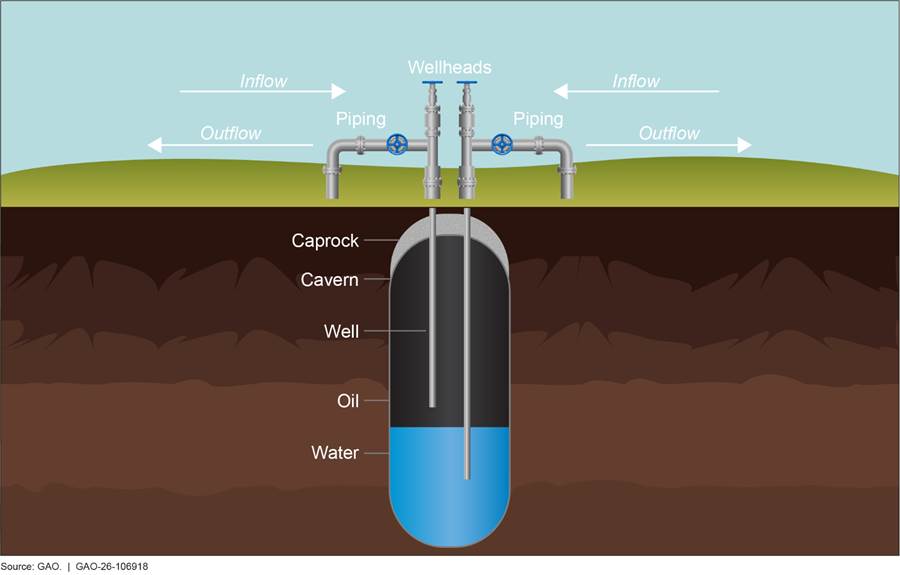
Configuration and operations. At present, the SPR includes 60 active storage caverns that were solution-mined out of naturally occurring underground salt domes at four storage sites located in coastal Texas and Louisiana. These caverns are located thousands of feet underground and accessed from the surface through one to three injection and withdrawal wells per cavern. Crude oil is released from the SPR by pumping in raw water (e.g., fresh water from nearby rivers or lakes) to the bottom of a cavern—this displaces the crude oil, which is pumped out through the well and then through pipelines. To fill the SPR, crude oil is pumped through pipelines, then into a well, displacing brine (i.e., salt water), which is then disposed of deep underground or off the Gulf Coast (see fig. 1).
The SPR was designed to prioritize rapid drawdown capability—specifically, to release crude oil about six times faster than it can be filled. When crude oil is released from the SPR into the market, it is distributed through commercial pipelines or on waterborne vessels to refineries, where it is converted into gasoline and other petroleum products, and then transported to distribution centers for sale to the public.
Management. The crude oil and infrastructure that make up the SPR are owned by the federal government, managed by DOE’s Office of Petroleum Reserves (OPR), and maintained by a management and operating (M&O) contractor whose work is overseen by the SPR Project Management Office (PMO) in the field. Fluor Federal Petroleum Operations, LLC (FFPO) managed and operated the SPR from April 2014 through September 2025. DOE issued a solicitation for new bids for the contract in January 2024 and awarded the contract to a different contractor in April 2025. After an unsuccessful bid protest,[10] the newly selected contractor—Strategic Storage Partners, LLC—completed a transition period in October and November 2025 and assumed management and operation of the SPR. Throughout the LE2 project, DOE’s Office of Project Management has advised OPR in accordance with DOE Order 413.3B on capital asset management. The goal of this order is to complete projects on schedule, within budget, and fully capable of meeting mission requirements.[11] Additionally, Sandia National Laboratories (Sandia) has been the geotechnical advisor for the SPR for decades, including by monitoring and assessing the SPR’s wells, caverns, and crude oil.
Release criteria. The President has discretion to decide when and how much crude oil to release from the SPR in response to domestic and international events that interrupt energy supplies under specific conditions prescribed by the Energy Policy and Conservation Act, as amended.[12] Presidentially directed releases may be limited (i.e., partial) or full drawdowns of the reserve depending on the severity of the energy supply interruption and other findings about its circumstances. Congress can also direct DOE to sell crude oil from the SPR to raise revenue to fund federal priorities. Additionally, the Secretary of Energy may release crude oil through exchanges—where an entity borrows crude oil and later replaces it in full along with an additional quantity as a premium—or through test sales to evaluate the SPR’s drawdown and sale procedures. When the SPR is not completing either fill or drawdown operations, it is required to maintain a state of operational readiness in which it can be activated within 13 days’ notice.[13]
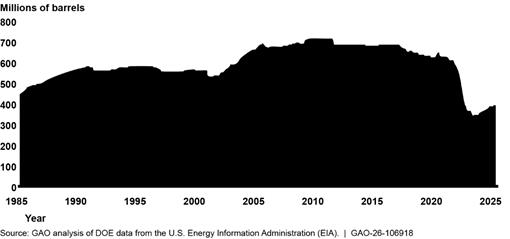
Size. Over time, the SPR’s inventory size has varied from the net effect of purchases, releases, and exchanges initiated by the President, Congress, and DOE. In 1975, Congress authorized an SPR with a capacity of up to 1 billion barrels and set an initial target inventory size of 500 million barrels. After reaching its initial target size of 500 million barrels in the 1980s, the SPR’s size remained relatively steady through the 1990s and then increased to around 700 million barrels in the 2000s. It remained near that level before decreasing by about 300 million barrels beginning in 2017, largely due to congressionally mandated sales followed by the largest emergency release to date in 2022 after Russia’s invasion of Ukraine (see fig. 2).
The SPR held just over 413 million barrels of crude oil as of December 2025. However, in early March 2026, IEA member countries decided to collectively release 400 million barrels of oil onto the market after the war in Iran and the broader Middle East majorly disrupted global oil flows. By late March 2026 the United States had started releasing the first of its planned 172-million-barrel share. The full timing and implications of this ongoing situation for global markets, U.S. energy security, and the inventory size of the SPR are not yet known as of May 2026.
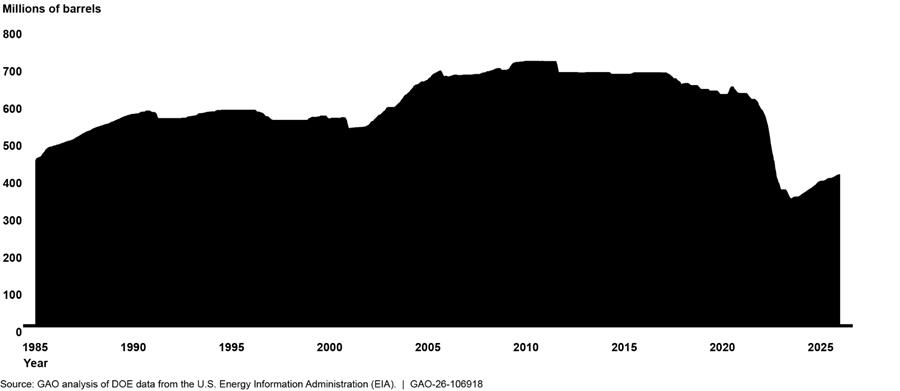
Note: The volume of crude oil held in the Strategic Petroleum Reserve decreased by about 300 million barrels beginning in 2017, largely due to congressionally mandated sales followed by the largest emergency release to date in 2022 after Russia’s invasion of Ukraine.
The SPR Met Increasingly Frequent and Large-Scale Drawdown Directives, but DOE Has Not Evaluated Lessons about Capability and Limitations
Since the first test sale in 1985, the President, Congress, and DOE have drawn on the SPR to respond to domestic and international emergencies and also to raise federal funds. DOE successfully met directives to carry out increasingly frequent and large-scale drawdowns from the SPR over the last decade. Of the more than 500 million barrels released to date, nearly 70 percent were released from 2014 through 2025 (see fig. 3). The 180-million-barrel emergency release in 2022, following Russia’s invasion of Ukraine, was the largest sustained drawdown from the SPR to date and served as an unplanned stress test of the reserve’s operational capabilities. Though historically fast, large, and operationally challenging, the 2022 directive was still well below what the SPR was designed to be capable of in terms of speed and scale. However, DOE has not formally evaluated challenges, successes, risks, or lessons learned about the SPR’s current and future capability and limitations that the unplanned stress test may have revealed.
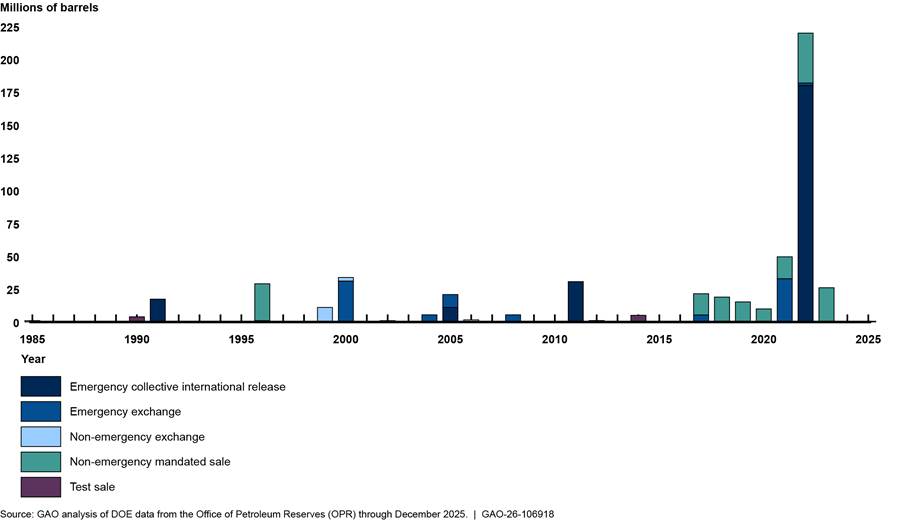
Notes: An emergency collective international release is when the International Energy Agency (IEA) decides to initiate a collective action in response to a market disruption, and each member country releases crude oil on the global market or otherwise contributes in proportion to its share of total consumption among IEA member countries. The United States carried out four emergency releases of crude oil from the SPR in coordination with other IEA member countries through 2025, including in 2022 following Russia’s invasion of Ukraine.
An exchange is when an entity borrows crude oil and later replaces it in full, along with an additional quantity as a premium. In 2021, DOE completed a reverse exchange, in which DOE stored 32 million barrels of crude oil in the SPR beginning in 2020 and then returned 29.5 million barrels in 2021.
DOE records congressionally mandated sales by fiscal year and all other release events by calendar year. For consistency in illustrating release events over time, we recorded all non-emergency mandated sales in the calendar year that aligns with the fiscal year in which they took place, as sales may span calendar or fiscal years.
The SPR Has Been Used to Respond to Domestic and International Emergencies as Well as to Raise Funds
DOE released more than 500 million barrels of crude oil from the SPR across more than three dozen release events from 1985 to 2025. From the first test sale in 1985 to the most recent emergency exchange, the President, Congress, and DOE have drawn on the SPR to respond to domestic and international market disruptions—caused by hurricanes, wars, and infrastructure outages—and also to raise funds to update the SPR’s infrastructure and fund other federal priorities. Prior to 2017, the SPR was often in standby mode because it was used infrequently, and most releases were prompted by emergencies or the need to evaluate the reserve’s operational procedures. SPR drawdown directives have become increasingly frequent and large-scale in recent years, with nearly 70 percent of crude oil released to date occurring since 2014.
Emergency releases and exchanges. Emergency releases and exchanges for domestic and international events account for more than half of the barrels of crude oil released from the SPR through 2025. The United States carried out four emergency releases in coordination with other IEA member countries through 2025, totaling nearly 239 million barrels:
(1) during Operation Desert Storm in 1991 (17.3 million barrels),
(2) after Hurricane Katrina in 2005 (11.0 million barrels),
(3) in response to crude oil supply disruptions driven by hostilities in Libya in 2011 (30.6 million barrels), and
(4) in response to crude oil price disruptions after Russia invaded Ukraine in 2022 (180.0 million barrels—the largest single sustained release event to date).
Additionally, in early March 2026, IEA member countries decided to collectively release 400 million barrels of oil onto the market after the war in Iran and the broader Middle East majorly disrupted global oil flows. This would be the largest ever IEA collective action, though the United States’ planned share—172 million barrels—is comparable to the 180 million barrels it ultimately released in 2022.
DOE also carried out more than a dozen exchanges in response to U.S. domestic emergencies that did not result in international collective actions, most frequently in response to severe hurricanes or energy infrastructure outages. For example, DOE completed an emergency exchange of 1.8 million barrels in response to the temporary shutdown of the leaking Keystone pipeline in 2022. DOE also completed a relatively large reverse emergency exchange in response to market disruptions during the COVID-19 pandemic, in which the SPR stored 32 million barrels beginning in 2020 and returned 29.5 million barrels in 2021.
Non-emergency mandated sales. Congress began directing DOE to regularly sell crude oil from the SPR beginning in fiscal year 2017 to help manage the federal budget and modernize the SPR. DOE carried out non-emergency mandated sales every year from fiscal year 2017 through 2023 to raise funds for the second SPR infrastructure life extension project (21.8 million barrels) and to fund other federal priorities (119.1 million barrels). In total, DOE has sold nearly 170 million barrels of crude oil from the SPR to date in response to congressional mandates, including a few sales in the 1990s to fund decommissioning for one SPR site and to raise revenue to help reduce the federal budget deficit (28.1 million barrels).
Congress canceled 140 million barrels in planned sales after the large-scale 2022 emergency release, rescinding $10.4 billion in revenue earned from those 2022 sales from the SPR Petroleum Account.[14] Congress subsequently canceled 7 million barrels more in planned sales.[15] After these cancellations, an additional 92.6 million barrels of mandated sales to raise federal revenue remained planned through 2031, as of May 2026.
The SPR Successfully Met Increasingly Frequent and Large-Scale Drawdown Directives
DOE met presidential and congressional directives to carry out increasingly frequent and large-scale drawdowns from the SPR over the last decade, successfully meeting volume and timeliness requirements as directed. DOE did so despite challenges associated with triaging repairs to aging infrastructure, managing ongoing major construction, and adapting to commercial capacity limitations. In 2014, DOE carried out a 5-million-barrel test sale to confirm the SPR’s operability given significant market changes, and identified some challenges and lessons learned related to commercial pipeline, storage, and distribution capacity. As the SPR transitioned to a more active operating posture, DOE carried out congressionally mandated sales every year from 2017 through 2023 in addition to large-scale emergency sales and exchanges.
The emergency release in 2022, after Russia invaded Ukraine, was the largest sustained drawdown from the SPR to date and served as an unplanned stress test of the SPR’s operational capabilities. In March 2022, the President directed DOE to release about 1 million barrels of crude oil per day for 6 months across the reserve’s four sites. DOE successfully met this directive, releasing a total of 180 million barrels in addition to 38 million barrels for a non-emergency congressional mandate and just less than 2 million barrels for an emergency exchange that same year.
While historically fast and large relative to the smaller releases the SPR has typically been used for, the 2022 drawdown was still well below what the SPR was designed to be capable of in terms of speed and scale. Drawdown operations caused some wear and tear on the SPR but in the manner and level expected, according to DOE officials and Sandia experts. The SPR, as originally envisioned, would release as much crude oil as technically feasible for up to 90 days until fully drawn down (up to 90 percent of site inventory). Consequently, the SPR is designed and required to be able to sustain a drawdown of 4.4 million barrels per day for up to 90 days, and to begin releasing crude oil within 13 days of being directed to do so, though actual market impact may depend on available commercial pipeline, storage, and refinery capacity. The 2022 drawdown required the SPR to achieve just more than 20 percent of its designed maximum drawdown rate (about 1 million barrels per day) and to release about 31 percent (about 180 million barrels) of the SPR’s inventory (about 580 million barrels at the time).
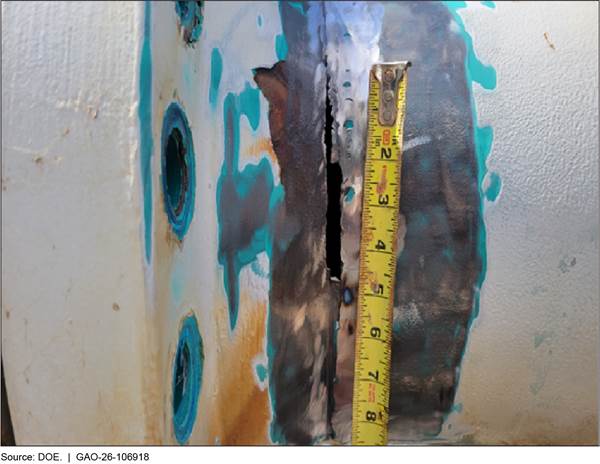
Though DOE met the directive without major equipment failures or crude oil spills, doing so was operationally challenging. According to DOE documentation and officials, the drawdown required repeated triaging of emergency repairs (e.g., due to leaking water pumps or pipes—see fig. 4), significant logistical maneuvering and delays to planned major construction, surge time by SPR staff, and negotiations with commercial terminals to accommodate the extra flows of crude oil. It also highlighted risks to the SPR’s capability to repeat a drawdown of similar speed and scale to the 2022 drawdown if directed to do so in the near future, DOE officials told us. Though it did not push the SPR to its peak design capability, it was the most intense test of the SPR to date.
However, DOE has not formally evaluated the 2022 drawdown—as it has in the past for much smaller sales to test the SPR’s operational capability—to identify and document challenges, successes, risks, or lessons learned about the SPR’s effective capability and limitations. DOE officials acknowledged that it would be useful to document what the unplanned stress test revealed about the SPR’s current and future performance capability and limitations. They told us they have not yet done so due to other competing priorities and operational demands. Assessing and acting on this information by incorporating it into any long-term plans or capability assessments would better inform ongoing DOE efforts to make strategic plans and operational decisions for the reserve.
Figure 4: Leaking Raw Water Pipe Requiring Repair During 2022 Drawdown at the West Hackberry Strategic Petroleum Reserve Site
Despite Completing Some Updates and Monitoring Risks, Aging Infrastructure Will Increasingly Limit the SPR’s Capability
DOE has completed some life extension work, triaged major maintenance needs, and continued to monitor and assess risks to the SPR. However, investments in the SPR are again not keeping pace with the aging reserve’s needs, resulting in a growing backlog and looming operational limitations—as in 2014 when DOE last identified the need to invest in a life extension project. DOE has identified concerns that significant remaining issues with aging SPR infrastructure will increasingly limit the SPR’s capability to meet fill or drawdown directives. These issues include end-of-life infrastructure not addressed by recent investments and aging, breaking, and single-entry wells. As a result, the SPR’s operational capability is at risk.
DOE Managed Periodic and Ongoing SPR Investments to Complete Some Life Extension Work and Triage Major Maintenance, but Investments Are Again Not Keeping Pace with Needs
DOE has been working to sustain the SPR’s operational capability through periodic (e.g., large-scale life extension projects) and ongoing (e.g., major maintenance projects) investments to maintain and replace its aging surface and sub-surface infrastructure and related systems.[16] Due to myriad challenges and repeated scope reductions, DOE’s decade-long effort to update the aging SPR infrastructure through LE2 is taking much longer than expected and accomplishing significantly less than needed to meet its goal. Also, though DOE continued to prioritize and triage other major maintenance needs outside of LE2 within available annual funding, the SPR again has a growing backlog of unaddressed major maintenance, as it did in 2014 when DOE identified the need to invest in a life extension project.
Surface infrastructure Life Extension Phase 2 (LE2) project. Over the last decade, DOE has worked toward updating the aging SPR with a $1.4 billion life extension project intended to extend the operational life of the reserve’s four storage sites for another 25 years.[17] DOE found in 2014 that a large portion of the SPR’s infrastructure had reached or exceeded its 25-year design life, and that investment had not kept pace with needs as DOE deferred maintenance over the prior 15 years due to constrained budgets.[18] DOE concluded that continuing to defer maintenance created an unacceptably high level of risk to the SPR’s operational capability, and that significant investment to replace end-of-life infrastructure was critical for ensuring that the SPR could continue to meet its energy security mission. Accordingly, DOE approved plans to begin a major infrastructure life extension project in October 2015.
In November 2015, Congress found that the age and condition of the SPR had diminished its value as a federal energy security asset. In response, Congress directed DOE to establish a program to modernize the SPR and extend the useful life of its surface and subsurface infrastructure. To this end, Congress authorized the sale of up to $2 billion worth of crude oil, the proceeds of which would be deposited into an Energy Security and Infrastructure Modernization (ESIM) fund to provide for the construction, maintenance, repair, and replacement of SPR facilities.[19] DOE reiterated in its 2016 long-term strategic review of the SPR that a challenging budget environment, increase in the number and severity of equipment failures, and escalating costs had caused project deferrals, resulting in an extensive major maintenance backlog.[20] According to the review, these factors had contributed to several equipment failures that impacted the SPR’s operational capability until repairs could be made.
The 2016 review informed initial plans for LE2’s scope—aiming to close identified gaps between the design delivery rate and actual effective operational capability. The resulting project was intended to extend the life of key SPR infrastructure and reestablish its capability to reach the required peak drawdown rate of 4.4 million barrels per day. The planned scope prioritized replacing surface infrastructure and systems that support the SPR’s drawdown capability at all four sites within a budget of $1.4 billion. It generally did not include work on the SPR’s subsurface or fill infrastructure or systems.
Much of the ultimate project scope is typical of major maintenance activities—making LE2 essentially a bundle of major maintenance projects large enough to require capital asset management under DOE Order 413.3B. This project involves replacing materials and equipment for existing facilities, meaning the work largely entails replacement-in-kind (e.g., replacing existing pumping and piping, tanks, and pipelines) with some design changes (e.g., elevating piping).
More than a decade after planning began, DOE’s effort to update the SPR’s aging infrastructure through LE2 is taking much longer than expected and accomplishing significantly less than needed to meet its goal. When DOE approved LE2’s cost and schedule range in December 2016, it expected the project to cost between $750 million and $1.4 billion and be completed between fiscal year 2022 and 2024. When DOE approved start of construction nearly 5 years later in June 2021, DOE expected to complete work at three of the four sites—Bayou Choctaw, Bryan Mound, and Big Hill—by May 2025. Planning for the fourth site—West Hackberry—had lagged behind the others and was not approved to move forward at the time, but DOE still planned to approve work at that location later.
By February 2023, LE2 was projected to exceed its approved cost and schedule parameters, leading DOE to further revise the planned schedule and scope to keep the project within the authorized budget cap of $1.4 billion. To do so, DOE elected to defer most physical security updates at Bayou Choctaw and Bryan Mound and the planned degasification plant, and to continue deferring all work at West Hackberry, pending the availability of any additional funding.
As of May 2026, DOE aimed to complete a significantly reduced scope of LE2 work at three of four sites by early 2028 (see table 1). Most of the remaining planned scope of work has been completed and is expected to improve the operational capability of the SPR, in alignment with the project’s goal. However, it is currently uncertain when DOE will be able to close out the LE2 project and how much it will ultimately be able to accomplish relative to the SPR’s needs due to cascading scope reductions, continuing delays and cost growth, and work quality and other performance issues with the prior M&O contractor.
|
Bayou Choctaw (Louisiana) |
Bryan Mound (Texas) |
Big Hill (Texas) |
|
Status: Construction complete, awaiting closeout (completion date uncertain due to pending resolution of work quality issues, but expected late 2026). |
Status: Construction complete, awaiting closeout (completion date uncertain due to pending resolution of work quality issues, but expected mid 2027). |
Status: Work ongoing with significant scope cuts pending (expected completion date early 2028). |
|
Scope: The revised scope of LE2 work at this site included replacing fire water and raw water injection pumps, several thousand feet of raw water and crude oil piping and supports (some now elevated), and some electrical system components. It also included three bridges (one replaced, one new, and one modified), as well as adding one new microseismic observation well. |
Scope: The revised scope of LE2 work at this site included replacing crude oil injection pumps and fire water pumps, several thousand feet of fire water and crude oil piping, and two raw water intake pipelines. It also included tearing down and replacing one crude oil tank and refurbishing one brine tank, as well as adding one new microseismic observation well. |
Scope: The ultimate scope of LE2 work at this site is uncertain at this time, but was expected to include replacing several pumps across raw water, crude oil, brine disposal, and other systems; replacing several thousand feet of raw water and crude oil piping; replacing several miles of brine disposal and raw water pipeline; making some physical protection updates; and replacing some electrical system components. |
Source: GAO analysis of DOE documentation as of May 2026. | GAO‑26‑106918
Note: The fourth Strategic Petroleum Reserve site—West Hackberry (Louisiana)—was descoped entirely from LE2.
· Bayou Choctaw. According to DOE, it has not yet accepted closeout of LE2 work at Bayou Choctaw pending unresolved work quality issues. After readjusting plans in September 2023, DOE had expected to close out LE2 at Bayou Choctaw by March 2025 and most construction was complete by that date. However, DOE identified some major quality issues with some of the work done under the prior M&O contractor.[21] DOE officials told us that the site is functional, but they are still working to resolve these issues before signing off on its completion. For example, DOE officials showed us that some valve actuators were installed too high to be manually accessed without a ladder and some of the elevated vertical piping supports are bending to the side (see fig. 5). DOE identified other work quality issues earlier in the project that DOE has since addressed in coordination with the prior M&O contractor but that created additional costs and delays. For example, DOE noted that the contractor modified the threading to install dozens of valve actuators—inadvertently voiding their warranty—and had to reinstall new ones to ensure they were in compliance.
· Bryan Mound. According to DOE, it has not yet accepted closeout of LE2 work at Bryan Mound pending unresolved work quality issues, though construction is complete and the site is operational. DOE had expected to close out LE2 at Bryan Mound by late 2025 after readjusting plans in September 2023. However, DOE also identified some major work quality and process issues at this site under the prior contractor. Most notably, DOE flagged issues related to transparency on outage timing and work progress, delays and cost overruns resulting from hundreds of change orders, and a large claim related to significant issues the prior contractor had in completing large-scale excavations to replace underground piping, which together may cause this site to exceed its total project cost. DOE identified other work quality issues earlier in the project that DOE has since addressed in coordination with the prior M&O contractor but that created additional costs and delays. For example, the prior contractor painted the interior of a very large brine disposal tank with a paint unsuitable for that purpose, resulting in substantial repainting work.
· Big Hill. Work is ongoing at Big Hill, with significant scope cuts pending in part due to cost overruns at Bryan Mound. The revised expected completion date for this location is in early 2028, though DOE expects construction to be complete and the site operational sometime in 2026. DOE is still finalizing decisions about further descoping at this site but has already identified the offsite brine disposal and raw water pipeline as well as the crude oil pipeline and crude oil distribution system upgrades for deferral. Completion of the offsite portions of the project had been complicated and delayed by long-running and as yet unresolved land right-of-way issues. According to DOE, the prior M&O contractor also had issues completing large-scale excavations at this site and filed a large claim, as yet unresolved, as it did similarly at Bryan Mound.
· West Hackberry. West Hackberry was descoped entirely, so no LE2 work has been completed or is planned to be completed there. Initially, LE2 work at this site was expected to include secondary cavern access wells and updates to several systems including brine disposal (new brine disposal wells and an additional pump), raw water, crude oil, and fire protection. Some of this work has since been funded outside of LE2 but has not yet been completed, according to DOE.
Figure 5: Life Extension Phase 2 (LE2) Project Work Quality Issues at the Bayou Choctaw Strategic Petroleum Reserve Site
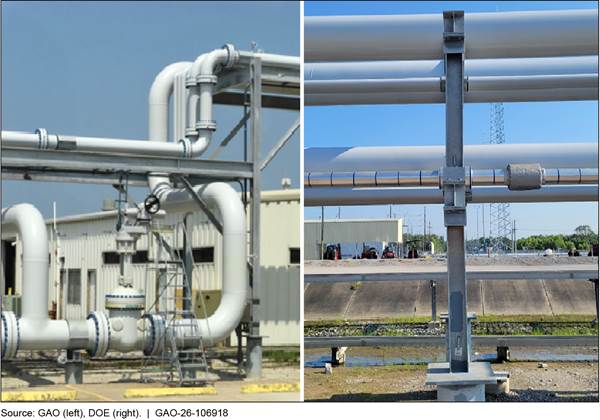
Notes: These photographs show (left) new valve actuators that were designed and installed too high to reach and use manually without the use of a temporary step ladder, and (right) elevated vertical supports for newly replaced piping that are bending to the side.
There are additional risks to LE2’s schedule, costs, and outcomes with the remaining scope of work to close out over the next few years, pending issues with work done under the prior M&O contractor, and the new M&O contractor assuming management of the SPR. The new M&O contractor completed the transition period in conjunction with the prior M&O contractor and assumed operational control in late November 2025. Identification of any further work quality issues, uncertain outcomes of any contractor disputes, or other unforeseen challenges may exacerbate these risks.
DOE officials told us they anticipate further delays, scope reductions, and challenges in finishing LE2 based on progress and challenges to date, some of which may be very difficult to course-correct at this late stage. DOE is currently preparing to revise the planned schedule again to reflect status realities and to cut additional work from the scope to keep LE2 within its authorized $1.4 billion budget cap. According to DOE, this is due to compounding effects of various challenges to date, but in part due to cost and schedule overruns at Bryan Mound that necessitated corresponding schedule delays and scope reductions at Big Hill—the last site to have LE2 work done.
DOE has identified a risk that LE2 may exceed its approved budget despite further descoping, because estimates of costs already set in motion may exceed the remaining funding available. As of May 2026, about $50 million in LE2 funding remained unobligated. Further, pending claims and litigation over disputes with the prior M&O contractor may take years to resolve, with uncertain outcomes and cost implications for the SPR even if settled outside of the LE2 project.
Many factors contributed to the myriad challenges LE2 has faced, according to our analysis of DOE documentation and interviews with DOE officials and contractors. Some challenges were caused by unavoidable external factors (e.g., the COVID-19 pandemic and large-scale 2022 drawdown). However, others may have been avoided or mitigated with better planning, decisions, or oversight at various stages of the project. Some of the challenges stem from issues with planning and decisions that occurred early in the project and may only be mitigated now rather than avoided (e.g., design quality issues).
DOE has made some efforts to identify and respond to these challenges throughout LE2, somewhat mitigating potential impacts to the project, according to DOE documentation and officials. For example, as DOE identified issues with work progress, it made some changes along the way to increase oversight and improve communication and accountability (e.g., increasing high-level management coordination meetings between federal and contractor staff, and using available tools such as withholding the contractor’s fee in response to performance issues). DOE also adapted to external factors that significantly complicated LE2’s execution—most notably the COVID-19 pandemic and large-scale 2022 emergency drawdown—to balance immediate operational directives with long-term project goals. DOE staff we interviewed in the Project Management Office and at the storage sites told us they had documented and shared concerns and challenges about LE2 with SPR leadership and took steps to address issues throughout the project. They also drafted some preliminary site-specific lessons learned from Bayou Choctaw.
Further, DOE’s Office of Project Management identified significant issues through its reviews at various stages of the project.[22] DOE responsively worked to address these issues with mixed success (e.g., qualification of federal project director, sufficiency of contracting officer support, and accuracy and clarity of project progress data), according to our assessment of DOE documentation and interviews.
Moreover, a DOE-contracted audit of the prior M&O contractor questioned over $2.5 million in (1) direct labor costs associated with unallowable recruitment costs for a seconded employee (i.e., an employee temporarily transferred to another role), unreasonable labor costs, and overtime premiums unallowable per contract terms; (2) travel costs associated with relocation and per diem expenses; and (3) other direct costs associated with home office expenses that were unallowable per contract terms.[23]
However, DOE has not comprehensively assessed challenges or lessons learned across the LE2 project. DOE Order 413.3B requires DOE staff and contractors to identify and document lessons learned throughout large capital improvement projects and after they have been completed, as described in DOE Order 210.2A.[24] DOE Order 210.2A requires DOE managers and employees to share and use good practices and lessons learned from their operating experience, highlighting the potential to help avoid adverse operating incidents, improve performance, and save costs.
DOE SPR leadership told us that they are keenly aware of the need to identify and incorporate lessons learned into future planning and operations and had intended to do so previously. They told us they had not yet done so due to competing and frequently changing planning and operational demands as well as staffing and leadership changes.
There have already been negative impacts on the success of the LE2 project to date, and assessing and acting on challenges and lessons learned now may help DOE limit further negative impacts in LE2’s remaining years and as management and operations of the SPR transition to a new contractor. Most notably, these impacts include less work completed in more time than expected and funds spent that did not ultimately go directly toward the project’s goals (e.g., tens of millions of dollars in federal property procured for work that is now descoped and that DOE is also paying to store, hundreds of change orders to fix design and planning issues, and expensive and time-consuming models and project progress tracking systems of limited or uncertain value).
Prior to completing LE2, DOE is already making plans to spend additional non-LE2 funds on large capital improvements to continue its work to extend the life of SPR infrastructure—this time with an emphasis on fill capability. Promptly assessing what contributed to the successes and failures of the ongoing life extension project and incorporating that information into any long-term or more immediate actions plans would help DOE plan and complete the next phase of this work more efficiently, effectively, and successfully.
We identified some examples of LE2 challenges in the course of our work that DOE could consider as it moves forward with its own assessment of lessons learned. These include the following, based on our review of DOE documentation and interviews with DOE officials and M&O contractors:
· Clarity on needs, objectives, priorities, and scope—including inconsistency across leaders over time, limited incorporation of input from site-level experts on specific site needs, misalignment of priorities and scope, and limited incorporation of any changes in needs over time into long-term plans.
· Federal staffing levels and experience—including insufficient levels of contracting staffing, limited staff experience in overseeing large-scale construction projects, and high turnover rates for key leadership and staff roles.
· Federal oversight—e.g., difficulty in ensuring M&O contractor accountability with available tools, balancing operational pressure with M&O contractor accountability.
· Contract structure—e.g., design, construction, and quality assurance within the same entity may create conflicts of interest and lead to negative outcomes for design quality, timely progress, and work quality.
· Contractor planning, communication, performance, and accountability issues—e.g., long-running and contentious deficiencies with the prior M&O contractor’s system for providing timely, accurate, and complete information on the project’s status.
· Land rights and real estate—e.g., lack of early planning and sufficient support to address intractable land right-of-way issues that block initiation of planned offsite work.
· Unexpected external factors—most notably COVID-19-related labor and supply challenges beginning in 2020, which significantly increased costs, paired with the 2022 drawdown, which significantly impacted planned schedules.
· Extreme weather—e.g., hurricanes caused schedule impacts for LE2 work at both Bayou Choctaw and Bryan Mound in the summer and early fall of 2024, and extreme heat in the summer months significantly limited the pace of construction.
Major maintenance backlog. Outside of LE2, DOE continued to prioritize and triage other major maintenance needs within available annual funding. According to DOE, ongoing drawdown operations require consistent preventive, predictive, and corrective maintenance to prevent or address failures of the SPR’s surface and sub-surface infrastructure and related systems. The SPR’s maintenance program is supposed to ensure that the backlog is controlled to assure the capability to complete any essential maintenance on all drawdown-critical equipment for the maximum rates within 15 days’ notice.[25] To manage the backlog, DOE and the SPR M&O contractor identify and prioritize maintenance tasks to plan how to spend available funds over several years, and then triage emergency repairs or shift priorities as needed. According to DOE officials, operationally necessary major maintenance projects outside of LE2 have proceeded much more smoothly from a management and construction perspective than work completed through LE2.
Nonetheless, the SPR again has a growing backlog of unaddressed major maintenance at each of the four sites. Even the original LE2 scope—before being reduced over time—did not address all aging systems and equipment that support the SPR’s drawdown and fill capability. It generally prioritized certain drawdown-critical surface infrastructure. Then, LE2’s scope was repeatedly diminished over the last decade, with deferred work previously identified as a priority added to the major maintenance queue or otherwise remaining undone pending other additional funding. Over that same period, major maintenance needs continued to grow at a faster rate than DOE’s ongoing investments to address them at a time when the SPR was increasingly active—causing some additional wear and tear and revealing additional issues through ongoing operations.
DOE officials—from the SPR sites, Project Management Office, and Office of Petroleum Reserves—told us that it is challenging to effectively address the SPR’s major maintenance needs within available annual funding. Specifically, they explained that funding is frequently uncertain due to irregular budget cycles and provided at levels requiring DOE to triage identified needs. As a result, they told us that they are operating in a continuous cycle of triage in which they are chasing emergency repairs to maintain operational capability. As of December 2025, the SPR’s major maintenance backlog was of a similar scale as it was in 2014 when DOE last identified the need to invest in a life extension project, according to DOE. At that time, DOE found that investment had not kept pace with needs as DOE deferred maintenance over the prior 15 years due to constrained budgets, at considerable risk to the SPR’s operational capability.
At present, major maintenance is the primary funding vehicle DOE has to address larger updates or repairs to the SPR’s aging infrastructure and systems outside of the Energy Security and Infrastructure Modernization fund associated with LE2.[26] According to DOE, outside of LE2, it obligated an average of slightly more than $11 million per year for major maintenance projects from fiscal year 2014 through fiscal year 2025. DOE estimates that the SPR’s current major maintenance backlog would cost approximately $230 million to address, as of December 2025, though this does not reflect the full scope of the reserve’s needs. In alignment with expected funding levels, DOE identified and prioritized about $10 million in required major maintenance for fiscal year 2025 and about $20 million for each future year from 2026 through 2030 (totaling about $110 million and averaging about $18 million per year). DOE requested a notable increase in major maintenance funding to total just over $30 million in its fiscal year 2027 budget request.
In general, DOE officials from OPR told us that major equipment failures and emergency repairs are a predictable outcome of limited investment in preventive maintenance over time, and that addressing emergency issues as they arise is a costly and inefficient way to manage known issues with the SPR’s aging infrastructure. In addition to issues requiring smaller-scale emergency repairs, the SPR has experienced 16 major equipment failures since 2013, including raw water piping failures, brine disposal piping failures, and the failure of a crude oil storage tank internal floating roof. In January 2026, nearly 170 barrels of crude oil spilled at Bryan Mound due to a split in a crude oil pipe that was not replaced during LE2. DOE and the M&O contractor were able to recover about 100 barrels of the oil and completed a temporary repair, pending more long-term mitigation.
DOE officials consistently told us that DOE and the M&O contractor are holding the SPR infrastructure together with “Band-Aids,” and that it is uncertain how long they will hold. This includes key infrastructure like pipelines and brine disposal systems, as well as less obvious but still critical systems like fire suppression, without which they cannot carry out operations (see figs. 6 and 7).
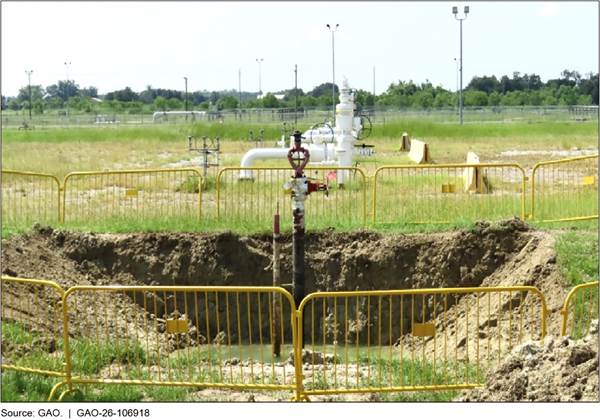
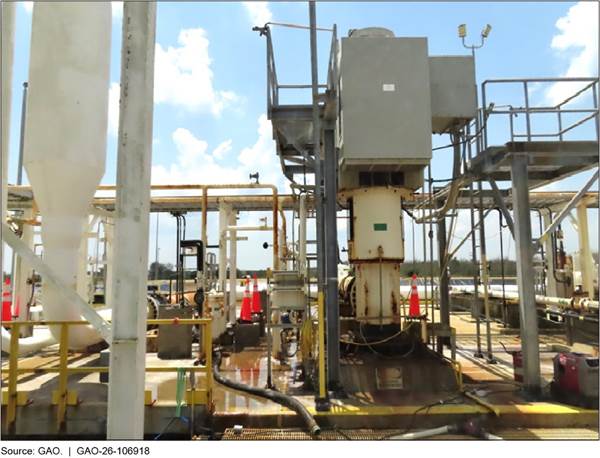
DOE Continued to Monitor and Assess Risks to the SPR’s Caverns, Wells, and Oil and Has Flagged Concerns About Well Condition and Vapor Pressure That May Limit Access and Deliverability
In addition to ongoing and periodic investments to replace parts of the SPR’s aging infrastructure, DOE continued to monitor and assess risks to the SPR’s caverns, wells, and crude oil in coordination with Sandia.[27] DOE has found that the SPR’s caverns are generally in good condition and the majority have at least four remaining available drawdowns—meaning they require continued monitoring and assessment but are not an imminent operational concern. However, DOE is concerned about the integrity of the SPR’s wells due to a combination of aging, breaking, and single-entry wells that may limit access to the SPR’s crude oil at some sites. Sandia found in 2024 that well deformations are outpacing DOE’s ability to adequately reduce the risk of potential well failures with corrective actions at current resource levels. DOE has also flagged unmitigated high vapor pressure—which may seasonally limit the deliverability of the SPR’s crude oil—as a potential concern and is exploring the feasibility of various possible strategies to address this issue. Additionally, DOE also manages other ongoing risks to the SPR, including from physical security or cybersecurity threats and from major climate events (e.g., hurricanes).
Cavern integrity and availability. The SPR caverns that were built by DOE were designed to be geomechanically stable for up to five full drawdowns. Repeated partial drawdowns followed by refill can leach a single part of a cavern repeatedly, leading to undesirable shapes. After Congress directed DOE to begin conducting regular non-emergency mandated sales from the SPR starting in 2017 to help manage the federal budget, DOE tasked Sandia to provide a yearly update on the number of drawdowns each cavern had remaining since the caverns were being used regularly to withdraw crude oil. In May 2025, Sandia reported that the majority of the SPR’s caverns (47 of 60—about 78 percent) had at least four remaining available drawdowns as of the end of calendar year 2024, and all but one cavern had at least one remaining available drawdown.[28]
In its assessment of the impact of the 2022 drawdown, Sandia found that it impacted the SPR’s caverns in the expected way (e.g., expended drawdowns and cavern volume increase) and left the majority of the caverns in very good condition. Further, Sandia experts told us that the large-scale 2022 drawdown improved the shape of some caverns (e.g., by removing some salt bridges) that had only experienced partial drawdowns before then. However, every drawdown cycle expands cavern volume and reduces the spacing between caverns within the salt dome, which ultimately reduces their long-term viability.
Some SPR caverns have potential issues that Sandia has identified and is actively monitoring. Most notably, at Bayou Choctaw, three of the six caverns have only one expected remaining drawdown available and two may have developed a pathway between them that could limit their safe use. DOE told us it is currently working on potential chemical and engineering solutions to move oil in and out of these caverns safely. In addition, the other three caverns with five expected drawdowns available may be negatively impacted by the stability of a nearby cavern that has been decommissioned.
Well condition and integrity. The SPR’s cavern access wells are like the straws that allow DOE to draw down and fill the SPR along with its pumps and pipelines. DOE developed a Casing Inspection and Cavern Remediation Program in 2010 to address any anomalies in the SPR caverns’ well casings. After identifying signs of compromised well casings from wellhead pressure monitoring, DOE asked Sandia and the M&O contractor to develop an annual evaluation system to help prioritize monitoring and remediation for the SPR’s wells beginning in 2013.
DOE, Sandia, and the contractor developed a system to regularly assess and grade the cavern access wells to help prioritize monitoring and remediation (e.g., based on cavern pressure and well history, cavern geometry, survey and simulation results, and site geology).[29] According to Sandia experts, well integrity is currently a bigger concern than cavern integrity due to aging, breaking, and single-entry wells. Specifically, in November 2024, Sandia concluded that the number and frequency of subsurface well deformations and failures were outpacing the program’s ability at current resource levels to maintain storage and drawdown capacity.
LE2 did not include well work because it generally focused on surface infrastructure, while well remediation is typically done through annually appropriated funding. According to its fiscal year 2025 budget justification, DOE planned to do one remediation and several cavern wellbore workovers that year but flagged that unanticipated cavern access issues may require reprioritization of projects to fund emergency repairs.[30] DOE’s fiscal year 2026 budget justification reaffirmed the necessity of remediations and workovers to maintain the SPR’s required level of operational capability, but indicated plans to do no remediations and several workovers while requesting about $1.7 million less than the $38.2 million enacted for this purpose the prior year. Most recently in fiscal year 2027 DOE indicated plans to do 12 remediations and 8 workovers and requested nearly twice the level of funding it had in fiscal year 2026.
· Aging wells. The vast majority of the SPR’s wells are far past the average design life of 20 to 30 years for oil and gas wells. According to Sandia, the second-newest SPR well is 38 years old.
· Breaking wells. After flagging significant concerns about the integrity of the wells at Big Hill, Sandia began gathering and comprehensively reviewing observed data to provide insight into ongoing casing deformation issues. Big Hill has experienced numerous instances of well deformation and hydraulic failures, with the first indications coming from a loss of pressure integrity for some wells starting in 2006. DOE installed liners in each affected Big Hill well (12 out of 28), and the wells subsequently passed pressure testing. DOE started monitoring and assessing these issues with an initial multi-arm caliper survey in 2010—a tool used to measure the inside diameter of a well casing. These assessments are scheduled to take place every 5 to 10 years, depending on the deformation history of the well.
The assessment results from 2023 indicated that more than 70 percent of the wells at Big Hill have moderate to severe casing deformation. For those wells that have already been lined once, a second liner would limit their hydraulic capacity. Many of the at-risk wells at Big Hill may remain intact for another 50 years unless the rates of deformation increase, according to Sandia, but there is uncertainty about the cause of the deformation. Sandia has concluded that the deformation of the wells at this site is related to the thickness of the caprock, though the dynamics are not fully understood.
Sandia has also identified concerns with the integrity of Bryan Mound’s wells. This site is located in a historical sulfur mining zone within the caprock, which puts some stress on wells. One of Bryan Mound’s wells experienced an unexpected failure in May 2024 with no previous warning signs. DOE, Sandia, and the prior M&O contractor estimated that as much as 400,000 barrels of crude oil were lost as a result of this failure. They assessed the cause of this well failure—finding that the well casing had ruptured, likely due to the collapse of one or more underground voids—and are assessing the risk to other wells at this site.
· Single-entry wells. Most of the caverns at one of the sites—West Hackberry—only have single-entry wells, so if those wells fail DOE cannot access the crude oil in those caverns without a secondary well. DOE initially planned to add secondary wells at West Hackberry as part of LE2, but as discussed above, all work at this site was descoped to keep the overall project within the approved budget cap and enable work to continue at the other three sites.
Vapor pressure. As crude oil held in the SPR caverns heats up over time, corresponding increases in vapor pressure create toxic and flammable gases. Therefore, SPR crude oil is generally degassed (i.e., volatile gases separated and incinerated), chilled (i.e., mechanically cooled), or blended with degassed crude oil (i.e., blendstock) to meet environmental and safety requirements for delivery, particularly during hotter months. DOE works with Sandia and the M&O contractor to monitor and mitigate vapor pressure for SPR crude oil through the Vapor Pressure Committee.[31] This committee found in 2025 that unmitigated vapor pressure issues currently limit the deliverability of some SPR crude oil and will become increasingly problematic in the future as the SPR continues to be refilled with high-vapor-pressure oil. However, there is uncertainty among various SPR decision-makers about the level of risk vapor pressure issues pose to the deliverability of SPR crude oil.
The Vapor Pressure Committee highlighted significant concerns about crude oil deliverability to SPR management throughout 2024 because recent drawdowns depleted blendstock and ongoing fill receipts are relatively high vapor pressure. The committee concluded that degasification is critical for future deliverability and strongly recommended that DOE restart plans to construct a new degasification plant immediately. DOE originally planned to build a new degasification plant as part of LE2 but descoped it to help keep the project within budget, after parts were already procured.[32]
Specifically, the committee found that Bayou Choctaw crude oil will be largely undeliverable during the warm months until chillers are installed. Bryan Mound and Big Hill crude oil also have some delivery limitations, though some blendstock is still available. West Hackberry is expected to have some delivery limitations as well if it receives new high-pressure fill. West Hackberry was the site most recently degassed with the SPR’s prior degasification plant in 2018, before that plant was dismantled after reaching the end of its useful life. Taken together, the committee found in 2023 that seven of the eight SPR delivery streams (i.e., sweet and sour crude oil for each of the four sites)[33] would be unable to meet their required maximum drawdown rates due to either vapor pressure issues or low inventory.
However, DOE officials told us there is some uncertainty among SPR management and other subject-matter experts about how essential a degasification plant is and the potential feasibility of other options for ensuring deliverability. DOE has no confirmed plans or funding to restart construction of a new degasification plant and is relying on other measures to manage vapor pressure concerns pending any further decisions. The feasibility of relying on a combination of these other options instead of a new degasification plant to sufficiently manage vapor pressure issues for large drawdowns remains unsettled. These other options include:
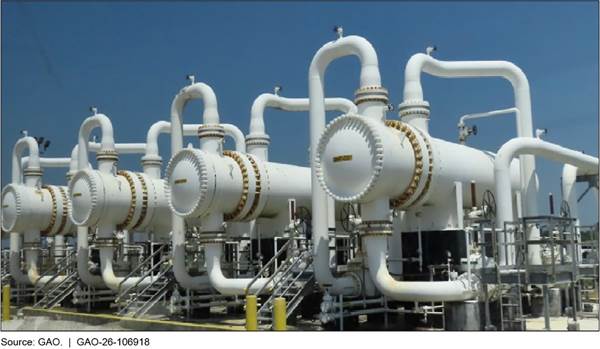
· Heat exchangers. Each of the four sites already has heat exchangers that help mechanically cool crude oil temperature at the time of drawdown to some extent, though their efficacy depends on delivery rates and seasonal temperatures (see fig. 8).
· Chemical additive. DOE has also used a chemical additive—hydrogen sulfide (H2S) scavenger—as another strategy for reducing emissions from crude oil with high vapor pressure during delivery. However, recent attempts to do so during the 2022 emergency drawdown revealed significant industry concerns about accepting crude oil deliveries that have been treated with scavenger products due to its impact on refinery operations.
· Change in delivery criteria. After a new degasification plant was descoped from LE2, DOE directed the Vapor Pressure Committee to study whether the vapor pressure delivery criteria could be relaxed. For example, according to DOE officials, industry has been making advances in its ability to safely accept high-vapor-pressure oil. The committee is still finalizing the results of its criteria study, so it remains uncertain whether vapor pressure concerns can be addressed by revising the existing criteria.
· Chillers. DOE also asked the Vapor Pressure Committee to assess whether other lower-volume mitigation strategies like chillers may be an adequate substitute for degasification. The committee advised that chillers would not be sufficient to facilitate large-scale drawdowns at maximum rates across the SPR. Bayou Choctaw is likely the only site where it is feasible to rely on chillers at maximum drawdown rates because it has a low rate relative to the other sites. After reviewing different design options, DOE initiated plans to install air-cooled chillers at Bayou Choctaw, but these plans have not yet been funded.
· Strategic cavern selection. Finally, DOE works with the M&O contractor to strategically select which caverns to draw down or to fill to help ensure deliverability and avoid exacerbating vapor pressure issues.
Other risks. In addition to managing the operational capability of the SPR’s infrastructure and systems, DOE also manages other risks to the SPR’s ability to fulfill its mission, including those from physical security threats, cybersecurity threats, and impacts from major climate events (e.g., hurricanes).
· Physical security. The SPR storage sites are in remote locations but contain critical infrastructure, and thus they maintain robust physical security systems and personnel. According to the SPR’s Level I Technical and Performance Criteria, DOE is required to maintain a security program in accordance with DOE Order 470.4B, which is designed to protect SPR personnel and assets.[34] DOE had identified the need to upgrade some older support systems (e.g., cameras and fences) and some had also been damaged or destroyed at certain sites during recent hurricanes. DOE originally expected to address some of the identified issues through LE2 but much of this work was deprioritized and descoped relative to mission-critical systems when DOE had to adjust the scope to stay within the authorized budget cap.
· Cybersecurity. DOE actively manages risks to its information and control systems through monitoring, assessment, and testing. In August 2022, the DOE Office of Enterprise Assessments conducted an independent programmatic and technical assessment of the SPR’s cybersecurity programs. This assessment determined that the programs had implemented several positive cybersecurity practices, including automated tools for event correlation, alerting, and attack prevention; an email infrastructure protecting from malicious email; and a robust continuity of operations program. However, the assessment also identified several deficiencies and opportunities for improvement, including not applying the most up-to-date security controls and considering installation of patches on certain systems, respectively. In its January 2023 after-action report in response to the assessment, the Project Management Office and M&O contractor identified mitigating actions in response to each of the deficiencies and opportunities for improvement. All of these actions were subsequently completed, according to DOE.
· Climate. Each of the four SPR storage sites are at risk of operational impacts from climate stressors due to their location along the Gulf Coast. Extreme heat can lead to construction limitations and impede DOE’s ability to deliver SPR oil to market by exacerbating high-vapor pressure oil issues—for example, increasing raw water temperatures limit crude oil cooling capabilities. Intense storm events can damage or destroy SPR buildings or infrastructure and have done so multiple times over the past decade. According to DOE, these climate stressors compound with pre-existing risks related to aging and failing infrastructure and have the potential to directly affect the SPR’s ability to continue and sustain operations. However, since the SPR’s crude oil is primarily stored deep in underground salt caverns, many climate stressors have limited impact on the inventory itself.[35] DOE has managed climate risks by assessing specific vulnerabilities to the SPR sites, repairing or replacing damaged structures as needed (e.g., after Hurricane Laura caused more than $35 million in damages to the West Hackberry site in 2020), and making some design changes to increase the resilience of its infrastructure when replacing it (e.g., elevating piping at Bayou Choctaw during LE2 to limit potential damage during flooding). DOE also maintains a continuity of operations program for the SPR to minimize any operational outages during or immediately after storm events. This includes the ability to remotely operate the SPR’s infrastructure, on-site equipment (e.g., boats that facilitate access during flooding), and an alternate emergency operations center, to be used as needed.
The SPR’s Operational Capability Is at Risk
Though the SPR has successfully met drawdown directives to date—and DOE has completed some life extension work, triaged major maintenance, and continued to monitor and address risks—the SPR’s operational capability is at risk. The SPR’s drawdown, distribution, and fill capabilities are currently limited and are at risk going forward due to longstanding issues with aging infrastructure compounded with ongoing major construction intended to address them. As of December 2025, DOE estimated that the SPR’s current effective drawdown and fill capabilities were at 61 and 56 percent of their design rates, respectively. DOE attributed this rate to a combination of construction outages, unaddressed issues with aging infrastructure, and low volumes of inventory (see table 2).
|
Site Location Year operational |
Bayou Choctaw Louisiana 1987 |
Bryan Mound Texas 1986 |
Big Hill Texas 1991 |
West Hackberry Louisiana 1988 |
Overall |
|
|
Storage capacity filled current volume / authorized capacity (millions of barrels) |
67% 51.0 / 76.0 |
74% 184.0 / 247.1 |
53% 90.0 / 170.0 |
40% 88.0 / 220.4 |
58% 413.0 / 713.5 |
|
|
Fill capability current effective rate / design rate (million barrels/day) |
95% 0.105 / 0.110 Some limitations because of brine disposal rate. |
100% 0.225 / 0.225 |
0% 0.000 / 0.225 Currently no fill capability because of construction outage. |
49% 0.110 / 0.225 Significant limitations because of brine disposal rate. |
56% 0.440 / 0.785 |
|
|
Drawdown capability current effective rate / design rate (million barrels/day) |
87% 0.450 / 0.515 Some limitations because of low cavern inventory. |
100% 1.500 / 1.500 |
0% 0.000 / 1.100 Currently no drawdown capability because of construction outage. |
58% 0.750 / 1.300 Some limitations because of low cavern inventory. |
61% 2.700 / 4.415 |
|
|
Distribution capability Current effective rate / design rate (million barrels/day) |
72% 0.445 / 0.620 Some limitations because of refinery closures and a pipeline reversal. |
44% 1.003 / 2.290 Significant limitations because of pipeline and refinery congestion from domestic production. |
55%a 1.904 / 3.448 Some limitations because of reduced refinery demand.
|
53% 3.352 / 6.358 |
||
|
Caverns |
6 Significant integrity concerns. |
19 Some integrity and availability concerns. |
14 No immediate concerns. |
21 No immediate integrity concerns, but some availability concerns. |
60 Some concerns |
|
|
Wells |
No immediate concerns. |
Significant condition and integrity concerns. |
Significant condition and integrity concerns. |
Some condition and integrity concerns, exacerbated by single-well access to caverns. |
Significant concerns |
|
|
Vapor pressure |
Potential deliverability concerns due to high-vapor-pressure inventory with no blendstock. |
Potential deliverability concerns due to high-vapor-pressure inventory, though some blendstock is available. |
Potential deliverability concerns due to high-vapor-pressure inventory, though some blendstock is available. |
No immediate deliverability concerns. |
Potential concerns |
|
Source: GAO analysis of DOE data and documentation from the Office of Petroleum Reserves (OPR). | GAO‑26‑106918
Notes: The effective rates reflect DOE estimates at points in time. The data included here for effective fill, drawdown, and distribution rates are current as of December 2025, and for volume are current as of January 2026.
Though the authorized storage capacity of the reserve is 713.5 million barrels, DOE estimates that it can only effectively hold approximately 680 million barrels.
“Cavern availability” refers to the remaining estimated number of drawdowns available from a particular cavern without compromising its stability.
aBig Hill and West Hackberry share a distribution system.
Specifically, Big Hill is not currently operational due to ongoing LE2 construction, and fill capability is limited by brine disposal issues at Bayou Choctaw and even more severely at West Hackberry. Drawdown capability is also limited due to the construction at Big Hill and due to low cavern inventory at Bayou Choctaw and West Hackberry. More than a quarter of the SPR’s crude oil inventory was not available for drawdown due to a combination of construction outages and cavern outages, as of December 2025.
Existing drawdown limitations would be exacerbated by any additional inventory declines from congressionally mandated sales through 2031 or further emergency releases. Additionally, there are effective limits on the rate at which the SPR can distribute crude oil without an actual physical supply shortage because the commercial sector now operates with very little spare capacity in its own pipelines and storage tanks, which may constrain the incremental market impact of SPR releases. Further, beyond these effective rates, access to and the deliverability of the SPR’s oil may potentially be limited by issues related to the integrity of the reserve’s wells or caverns and unmitigated high vapor pressure, as discussed above.
DOE has identified concerns that significant remaining issues with aging SPR infrastructure will increasingly limit the SPR’s capability to safely and reliably meet fill or drawdown directives, which could reduce the rate at which crude oil can be released during a disruption. DOE acknowledged in June 2014 that aging SPR infrastructure above- and below-ground presented significant challenges for meeting the reserve’s operational performance criteria and long-term sustainability. Since then, DOE has started but not successfully completed work to address issues stemming from aging SPR infrastructure.
The limited success of LE2 in meeting its goals in combination with major maintenance deferrals continues to imperil the SPR’s operational capability, as was the case when DOE and Congress identified the need for major life extension investments more than a decade ago. Investments in the SPR are again not keeping pace with the aging reserve’s needs, resulting in a growing backlog and looming operational limitations. As a result, the SPR’s future operational capability and performance reliability are highly uncertain absent further planning and investment.
Congress and DOE Lack a Unified Long-Term Plan for the SPR
Congress and DOE are making decisions about SPR operations and investments without a unified long-term plan to guide them. DOE has not completed an updated long-term strategic plan that identifies a target size and capabilities to meet changing U.S. needs and obligations. DOE also has not fully identified the resources required to maintain the SPR’s operational capability through ongoing and periodic investments.
In 2015, Congress found that maximizing the SPR’s energy security value required a modernized infrastructure and directed DOE to establish a modernization program, which we discuss earlier in this report. Since then, it has repeatedly asked DOE—through committee reports—for additional information to inform congressional decisions and has expressed support for DOE’s recent efforts to refill the SPR. However, Congress has not identified a long-term target size for the SPR, decided to authorize full funding in support of the administration’s emerging plan to refill the reserve to peak capacity, or otherwise provided specific direction on its priorities.
The lack of a unified plan, paired with shifting administration priorities and uncertain congressional priorities, has resulted in DOE navigating concurrent and sometimes conflicting directives to update the aging SPR infrastructure while alternating between drawdown and fill directives. Consequently, DOE efforts to effectively make and carry out plans to sustain the SPR’s capability are complicated by continued uncertainty—about the long-term size and requirements of the SPR, the potential for additional congressionally mandated sales, and the availability of resources to support peak refill or further work to extend the operational life of the reserve.
Long-term plan to inform operational and investment decisions. DOE last completed a long-term strategic review of the SPR in 2016, after Congress directed it to do so. Since then, DOE has drafted but not completed several forms of a long-term strategic review or similar assessment, and still plans to do so, according to DOE officials. DOE initially planned to complete the next iteration of a long-term strategic review in 2021, targeting a 5-year interval between assessments. DOE officials told us that their efforts to complete such a plan across the last several years have been hampered by unanticipated changes in market conditions and differing leadership perspectives over time—both in what priorities for the reserve should be and what any long-term plan should include.
We previously found that federal programs should be reexamined if there have been significant changes that relate to the reason for initiating the program.[36] Given changing market conditions and future projections, we recommended in 2018 that DOE take actions to ensure it periodically conducts and provides to Congress a strategic review of the SPR that, among other things, accounts for changes in crude oil and petroleum product market conditions and contains additional analysis as appropriate.[37]
For example, risks to energy markets may have changed, as increased domestic production of crude oil and petroleum products have changed the United States from a net importer of petroleum to a net exporter. Prior to the large-scale 2022 drawdown after Russia invaded Ukraine, DOE had started carrying out congressionally mandated sales each year, as directed. At that time, DOE was considering options for the excess storage capacity that a reduced SPR inventory size would create at the conclusion of those planned sales.
We have previously highlighted the importance of agencies analyzing risks and considering a range of alternatives to ensure that programs are forward looking and effective.[38] DOE has not completed an updated plan or supporting analyses in nearly a decade. Without an updated long-term plan for the SPR, DOE and Congress are making operational and investment decisions amidst uncertainty about what the SPR is capable of at present, what it should be capable of in the future to meet changing U.S. needs and obligations, and what investments and other actions may be required to bridge any gaps.
When DOE most recently provided a strategic review of the SPR to Congress in August 2016, it did so within 9 months of a congressional directive in the Bipartisan Budget Act of 2015.[39] Congress has since repeatedly requested, in explanatory statements accompanying appropriations legislation, that DOE provide the next such SPR report expeditiously. However, DOE has not submitted the next report and Congress has not mandated a timeline for doing so.
Congress would facilitate more strategic management of the SPR by again mandating a specific timeline and requirements for DOE’s next long-term strategic plan for the reserve. Such a mandate could spur DOE actions to complete a timely plan that contains whatever information or analysis Congress would find most useful to support its priorities. For example, Congress could direct DOE to complete a long-term strategic plan within several months and every 5 years thereafter. It could also require DOE to include information about the current condition of the SPR’s infrastructure and its operational capability and limitations, a brief assessment of market changes relevant to the SPR’s purpose or capability, and estimates of the resources required to sustainably maintain and operate the SPR. Having a current, unified long-term plan that reflects congressional priorities and DOE analysis would help inform any congressional decisions to align SPR priorities and investments as well as help ensure DOE planning and operational decisions reflect long-term priorities.
Target size to meet changing needs and obligations. Neither DOE nor Congress has completed plans or analyses that identify a long-term target SPR size to meet changing U.S. needs and obligations. Barring further changes to mandated sales, additional funding to refill the reserve, or emergency drawdowns, DOE had previously estimated that the SPR would reach between 430 and 440 million barrels after outstanding exchange returns and contracted purchases were delivered.[40] The reserve was then expected to decrease to a historical minimum of between 330 and 340 million barrels—half of its capacity—after the remaining 92.6 million barrels of congressionally mandated sales are completed at the end of fiscal year 2031. However, in March 2026, DOE announced plans to release an additional 172 million barrels from the SPR in coordination with IEA after the war in Iran majorly disrupted global oil flows. DOE plans to complete this release through emergency exchanges, but, as of May 2026, the full timing and implications of this large-scale emergency release are not yet realized.
We reported in 1979 that determining the optimal size of the SPR was extremely difficult given the many unknowns, assumptions, variables, and political factors.[41] Congress authorized an SPR with a capacity of up to 1 billion barrels in 1975 and set an initial target inventory size of 500 million barrels. This target reflected DOE plans and analyses for a range of scenarios and market factors, including how much crude oil was imported into the United States during the three highest consecutive import months—about 500 million barrels at the time.
Since then, Congress has influenced the SPR’s size by mandating purchases or sales and by establishing and amending its minimum allowable size. In the early 2000s, the President directed an expansion to 700 million barrels due to energy security concerns after the September 11 attacks in 2001. The SPR reached an all-time maximum of nearly 727 million barrels in 2010. Subsequently, the President directed large-scale releases in 2022—through which the SPR reached a post-fill minimum of 347 million barrels in July 2023—and then DOE prioritized refill operations with available funding. The SPR’s current inventory size is low compared to historical levels and total capacity. However, when it was refilled to 405 million barrels in September 2025, it was the same size DOE had projected it would be following planned sales that Congress had mandated through fiscal year 2027, as we reported in May 2018.[42]
We previously found that DOE had not periodically re-examined the appropriate or optimal size of the SPR and recommended that it do so given changes in market conditions. Determining an optimal size involves balancing expected economic losses from severe disruptions against the fiscal and infrastructure costs of maintaining inventory. We reported in August 2006 that many factors that influence the SPR’s ideal size are likely to change over time and recommended that the Secretary of Energy periodically reassess the ideal size of the SPR in light of changing oil market conditions.[43] Similarly, we reported in September 2014 that changing market conditions have implications for the size, location, and composition of the SPR—in particular, increased domestic crude oil production and falling net imports—and recommended that the Secretary reexamine the appropriate size of the SPR in light of current and expected future market conditions.[44] DOE’s Office of Inspector General also recommended in July 2014 that DOE define a size the SPR can reliably maintain, considering budgetary constraints, ongoing and future maintenance requirements, and historic utilization.[45]
DOE examined a range of SPR sizes in its 2016 long-term strategic review but did not identify an optimal size, as we reported in May 2018.[46] We emphasized that ongoing uncertainty about the SPR’s long-term size and configuration have made it extremely difficult for DOE to effectively make any mid-to-long-range plans to modernize the SPR’s infrastructure, including major maintenance projects. We recommended that Congress address this uncertainty by identifying a long-range target for the size of the SPR—either by volume or in terms tied to factors that affect energy security needs and international obligations (e.g., consumption or net import protection).
Congress has not set a target SPR inventory size as of May 2026. However, following the large-scale 2022 drawdown, Congress expressed concern in committee reports that the SPR’s inventory size was historically low, stated support for DOE’s refill efforts, and continued to request additional information from DOE to inform congressional decisions. This included directing DOE to provide a report assessing the levels of crude oil stocks in the SPR that are necessary to ensure domestic energy security and national security and to meet U.S. obligations under the international energy program. DOE told us it plans to request the National Petroleum Council conduct a study on priorities for the SPR that identifies a target size and capabilities to meet changing U.S. needs and obligations.[47]
Beginning in January 2025, the new administration indicated emerging plans to fill the SPR to its peak storage capacity—currently 680 million barrels, according to DOE. DOE estimated that it would take approximately $20 billion to purchase the 250 million barrels of oil needed to refill the SPR to peak capacity when prices were around $80 per barrel, and Congress appropriated $171 million towards this purpose under OBBBA.[48] These funds would buy approximately 2 million barrels at a price of about $85 per barrel, and as of May 2026, DOE had awarded one contract to purchase 1 million barrels of crude oil for the SPR with them.
As of yet, Congress has not indicated the extent to which it will prioritize support for the proposed peak fill policy with additional appropriations or further cancellation of congressionally mandated sales currently planned for future years. However, Congress directed DOE, in the joint explanatory statement for a fiscal year 2026 appropriations act, to work with American producers and international partners to design a plan to restock the reserve, and to provide a report to Congress outlining this plan with specific refill timelines within 90 days of enactment.[49]
In the absence of a long-term target, DOE and congressional actions may be working at cross-purposes by making plans both to acquire more crude oil to further refill the reserve at the President’s direction—pending additional funding or authority to do so—and also to sell nearly 100 million barrels of oil from the reserve to meet congressional mandates. This uncertainty complicates efficient long-term capital planning and investment prioritization. Both drawdown and fill operations degrade the reserve’s infrastructure and complicate maintenance planning, and it takes several times longer to fill the reserve as it does to draw from it.
We continue to believe that DOE would be better positioned to efficiently and effectively manage how federal funds are spent on the SPR if Congress addressed uncertainty about plans and priorities by identifying a long-term target size for the SPR. Congress could request that DOE include any additional information or analyses it needs to make an informed decision in the next long-term strategic plan. Additionally, further canceling or delaying mandated sales or otherwise temporarily limiting drawdown authorities except in case of emergencies may help facilitate DOE’s timely and cost-effective completion of ongoing infrastructure projects or fill operations. DOE told us it is currently developing recommendations on codified triggers for SPR releases.
Updated criteria for operational capability. Taken together, current limitations and future risks to the SPR’s drawdown, fill, and distribution capabilities may limit the reserve’s effectiveness in fulfilling its energy security purpose, depending on how market changes may have changed U.S. needs and obligations. The SPR’s maximum drawdown rate—4.4 million barrels per day—and other operational capability requirements were established decades ago and thus do not clearly reflect significantly changed crude oil markets.
We previously found that federal programs should be reexamined if there have been significant changes in the country or the world that related to the reason for initiating the program.[50] In 2014, DOE’s OIG found that despite significant changes in U.S. reliance on imports, DOE had not reevaluated the effectiveness of its drawdown rate, reassessed its expectations for the reserve, or determined what an acceptable range of performance would be. Market conditions and the condition of the SPR’s infrastructure have continued to change since then, and these changes have implications for the reserve’s energy security role and effective capabilities.
However, DOE’s technical and performance criteria that establish operational capability requirements for the SPR have generally not been updated in response to these changes. For example, the maximum drawdown rate of 4.4 million barrels per day was established in 1996. In 2024, DOE added criteria for emergency exchanges and made some technical changes, including for crude oil specifications, distribution rates, and storage capacity (from 727 to 713.5 MMbbl). But it has not made any substantive adjustments to the fill or drawdown rates. Thus, they do not reflect any updated analysis or decisions on what the SPR is currently capable of or what it needs to be capable of to meet its purpose.
DOE officials acknowledged that it may be appropriate to update the SPR’s technical and performance capability criteria given changes in oil markets over the last 30 years. DOE officials also acknowledged that identifying lessons learned from the unplanned stress test of the 2022 drawdown may provide relevant information about the SPR’s effective capability relative to the existing criteria. They told us they have not yet done so due to other competing operational and planning priorities. Assessing the need to update these criteria, and doing so as deemed appropriate, would help inform strategic planning and investment decisions for Congress or DOE stakeholders—who may not have full and current information on what the SPR is capable of and what it needs to be capable of to meet U.S. needs and obligations.
Resources required to maintain long-term sustainability and operational capability. DOE communicates with Congress about the SPR’s needs through the annual budget process and otherwise as requested and has completed work to address some operational risks within available resources. However, DOE has not fully identified the resources required to maintain the SPR’s operational capability through ongoing and periodic investments. As a result, there is room for more transparency and clarity on the full scope of the SPR’s needs and required resources.
In 2015, Congress directed DOE to include as part of its long-term strategic review an estimate of the resources required to attain and maintain the long-term sustainability and operational effectiveness of the SPR. The resulting 2016 review discussed negative impacts of deferred maintenance, the costs and benefits of different SPR sizes, and funding requirements for LE2. The SPR has many outstanding needs beyond LE2—because of the scale of planned work that has been descoped from it, the work that was needed but not included, and the additional work that has become necessary since then in the intervening decade.
However, DOE does not currently have a complete, unified list of the SPR’s infrastructure needs and corresponding estimated costs. These needs would include any descoped LE2 work that is still deemed high priority, anything currently listed in the major maintenance backlog, and any other significant needs that support operational capability for fill or drawdown. DOE officials told us they are currently prioritizing completion of such a list. If it were to prioritize facilitating maximum fill operations, DOE estimates that repairs and updates in support of that priority alone would take approximately $650 million. DOE plans to address some key pieces of this fill priority with the $218 million provided by OBBBA in July 2025 for maintenance and repair to SPR facilities. In addition, DOE estimates that it would take more than $200 million to address the current major maintenance backlog. However, these siloed estimates do not fully reflect DOE estimates of the resources required to sustain the SPR. As a result, Congress does not have sufficiently clear information about the resources required to sustain the SPR if it wishes to ensure the reserve retains its value as an energy security asset.
Furthermore, as discussed above, DOE officials told us that it is challenging to effectively address the SPR’s major maintenance needs within available annual funding, which is frequently uncertain due to irregular budget cycles and provided at levels below identified needs. As a result, they told us that they are operating in a continuous cycle of triage in which they are chasing emergency repairs to maintain operational capability. This cycle can create operational inefficiencies—for example, less preventive maintenance predictably leads to more failures and thus the need for more emergency repairs, which are typically more costly than planned repairs. Alternatively, costs may be incurred to repair infrastructure to maintain operability even when it is planned for upcoming replacement.
Additionally, DOE has not fully identified the level and type of staffing resources needed to support effective management of the SPR and oversight of the M&O contractor. The DOE offices that manage the SPR reported high rates of turnover among key staff and leadership over the last year, and DOE has repeatedly identified the need for more contracting support over the last several years. OPR leadership has changed over multiple times since January 2025 and is currently in the process of being reorganized under a different DOE leadership structure, with uncertain implications for further leadership or staffing changes.[51] There have also been high rates of staff departures in key roles—including the federal project director for LE2, chief counsel, head of maintenance and operations, site-specific engineering and safety specialists, and contracting staff. The DOE offices that manage the SPR have lost approximately 25 percent of their 120 staff positions since January 2025, though DOE has not provided complete information at this time, citing pending decisions as part of the ongoing reorganization. DOE’s Office of Project Management and OPR leadership have also repeatedly highlighted the need for additional contracting staff to effectively manage competing and significant work demands related to LE2, contractor oversight, and crude oil movements. Low levels of staffing relative to mission needs, frequently changing leadership, and the loss of institutional knowledge may impede DOE’s ability to effectively manage the SPR and provide oversight of the M&O contractor.
Having a more consistent funding mechanism that aligns with Congress’s long-term plans for the SPR might facilitate DOE’s more efficient, cost-effective, and forward-looking planning of ongoing and periodic investments to maintain the SPR. It is far less costly to fully address maintenance of individual systems and infrastructure as the needs arise rather than waiting until multiple large projects reach the point of unacceptable risk of failure. If DOE were authorized to invest more proactively and consistently in major maintenance and other ongoing or periodic needs, the need for large life extension projects, such as LE2, to address large backlogs could be minimized over time. This could be additional budget authority to periodically conduct sales and direct a portion of the revenues inward to the Energy Security Infrastructure Modernization fund. It could also take the shape of budget authority for DOE to collect a portion of the revenues from any sales or from leased assets and retain it for the purpose of covering ongoing or periodic costs to maintain the SPR’s operational capability, among other options.[52]
Conclusions
Congress authorized DOE to create the SPR in 1975 to reduce the impact of disruptions in petroleum supplies and it remains an important energy security asset, though the United States is now less vulnerable to crude oil supply shortages after becoming a net petroleum exporter in 2020. DOE has successfully released more than 500 million barrels of crude oil from the SPR to date, as drawdown directives became increasingly frequent and large over the last decade. However, there are long-running and yet unaddressed questions about the SPR’s optimal size, configuration, and use to meet evolving energy security needs and international obligations. Additionally, there are ongoing risks to the SPR’s operational capability.
DOE has completed some needed work through a $1.4 billion Life Extension Phase 2 (LE2) project, triaged additional major maintenance needs within available funding, and continued to monitor and assess operational risks. However, LE2 is taking much longer than expected and accomplishing significantly less than needed due to myriad challenges, and regular major maintenance investments are again not keeping pace with needs. As a result, the SPR again faces a growing backlog and looming operational limitations absent further planning and investment—as in 2014 when DOE last identified the need to invest in life extension for the aging reserve.
Meanwhile, Congress and DOE are making decisions about SPR operations and investments without a unified long-term plan to guide them. Without completing a long-term strategic plan and identifying the resources and actions needed to operationalize this plan, there will remain significant uncertainty about what the SPR is capable of at present, what it should be capable of in the future, and what investments and other actions may be required to bridge that gap. DOE and Congress can help ensure this energy security asset is being managed and maintained in an efficient, cost-effective, and strategic manner by aligning their respective priorities and actions.
Specifically, DOE would be better positioned to make informed operational and strategic decisions for the SPR if it expeditiously assessed relevant and timely information from recent events and then incorporated that information into plans and actions. Notably, the 180-million-barrel emergency release in 2022 after Russia invaded Ukraine was the largest to date and served as an unplanned stress test, but DOE has not yet evaluated resulting lessons about capability and limitations. Any such lessons along with other analysis as needed—for example, on significant market changes—could inform a DOE assessment of the need to update the SPR’s technical and performance criteria to better reflect current information about what the SPR is capable of and what it needs to be to meet still evolving U.S. needs and obligations. Additionally, as DOE works to complete a diminished scope of LE2 work while simultaneously beginning to plan additional work to update the aging reserve, it has not yet comprehensively assessed what contributed to the successes and failures of the ongoing project. Doing so promptly may help ensure DOE completes the next phase of this work more efficiently, effectively, and successfully.
Congress could help ensure it has full and timely information to inform its oversight and investment decisions, and that DOE moves beyond triaging to making strategic forward-looking plans, by requiring DOE to complete an updated long-term strategic plan for the SPR within a specific timeframe, as it previously did in 2015, and with periodic updates. Congress could specify that the long-term strategic plan should include the information that it needs—about condition, costs, capability, risks, and plans—to inform its decisions about this energy security asset. Congress could also facilitate more effective DOE management of the SPR by reducing uncertainty about its own plans and priorities for the reserve—including by setting a long-term target size (as we have previously recommended), potentially limiting non-emergency sales temporarily to avoid operational inefficiencies, and determining the extent to which it intends to support peak refill plans or further life extension work.[53]
To the extent that sustaining the SPR’s operational capability remains a priority, Congress could consider authorizing a funding mechanism that aligns with long-term plans to facilitate DOE’s long-term planning of ongoing and periodic investments. Such a mechanism could facilitate more efficient, cost-effective, and forward-looking planning by smoothing investment cycles, reducing reliance on more costly emergency repairs, and aligning long-term plans and energy security objectives with investments. DOE could support any such congressional decision by providing more complete information on the full scope of ongoing and periodic costs and staffing needs to sustainably maintain and operate the SPR, as well as the current condition of the aging reserve infrastructure and the scope of work required to restore its operational capability.
Matters for Congressional Consideration
We are recommending the following three matters for congressional consideration:
To the extent that Congress wants additional and more timely information to inform its oversight of the SPR, Congress should consider mandating a timeline and requirements for DOE to complete periodic long-term plans for the SPR. (Matter for Consideration 1)
To the extent that Congress wants to limit further SPR size decreases or avoid operational inefficiencies, including strain on aging infrastructure during ongoing capital projects, Congress should consider temporarily limiting non-emergency sales—such as by further canceling or delaying mandated sales or temporarily limiting drawdown authorities except in case of emergencies. (Matter for Consideration 2)
To the extent that Congress wants to prioritize sustaining the SPR’s operational capability, it should consider authorizing a funding mechanism that aligns with long-term plans to facilitate DOE’s cost-effective management of investments to maintain the SPR—such as budget authority for DOE to collect and retain a portion of the revenues from any sales or leased assets for the purpose of covering ongoing or periodic costs. (Matter for Consideration 3)
Recommendations for Executive Action
We are making the following four recommendations to DOE:
The SPR Project Management Office in coordination with the Office of Petroleum Reserves should assess lessons learned from the 2022 drawdown—including on the SPR’s effective operational capability and limitations—and incorporate those lessons into any long-term plans or capability assessments. (Recommendation 1)
The SPR Project Management Office in coordination with the Office of Petroleum Reserves should assess lessons learned from the LE2 project—including on scoping, staffing, and contractor oversight—and incorporate those lessons into any long-term or more immediate action plans for further infrastructure projects. (Recommendation 2)
The Office of Petroleum Reserves in coordination with the SPR Project Management Office should assess the need to update the SPR’s technical and performance criteria and revise them as deemed appropriate. (Recommendation 3)
The Secretary of Energy in coordination with the Office of Petroleum Reserves should provide Congress with more complete information on the ongoing and periodic costs to sustainably maintain and operate the SPR, including the scope of work required to restore the SPR’s operational capability. (Recommendation 4)
Agency Comments
We provided a draft of this report to DOE for review and comment. In its written comments, reproduced in appendix I, DOE generally agreed with our findings and concurred with our recommendations. DOE also provided technical comments, which we incorporated as appropriate.
As agreed with your offices, unless you publicly announce the contents of this report earlier, we plan no further distribution until 30 days from the report date. At that time, we will send copies of this report to the appropriate congressional committees, the Secretary of Energy, and other interested parties. In addition, the report will be available at no charge on the GAO website at https://www.gao.gov.
If you or your staff have any questions about this report, please contact me at RuscoF@gao.gov. Contact points for our Offices of Congressional Relations and Media Relations may be found on the last page of this report. GAO staff who made key contributions to this report are listed in appendix II.
Frank Rusco
Director, Natural Resources and Environment
Frank Rusco, RuscoF@gao.gov
In addition to the contact named above, Matthew Tabbert (Assistant Director), Elise Vaughan Winfrey (Analyst in Charge), Adrian Apodaca, Rebecca Conway, Quindi Franco, Cindy Gilbert, Holly Halifax, Dawn J. Locke, Joe Maher, Tricia Moye, Terry Richardson, and Caitlin Scoville made significant contributions to this report.
The Government Accountability Office, the audit, evaluation, and investigative arm of Congress, exists to support Congress in meeting its constitutional responsibilities and to help improve the performance and accountability of the federal government for the American people. GAO examines the use of public funds; evaluates federal programs and policies; and provides analyses, recommendations, and other assistance to help Congress make informed oversight, policy, and funding decisions. GAO’s commitment to good government is reflected in its core values of accountability, integrity, and reliability.
Obtaining Copies of GAO Reports and Testimony
The fastest and easiest way to obtain copies of GAO documents at no cost is through our website. Each weekday afternoon, GAO posts on its website newly released reports, testimony, and correspondence. You can also subscribe to GAO’s email updates to receive notification of newly posted products.
Order by Phone
The price of each GAO publication reflects GAO’s actual cost of production and distribution and depends on the number of pages in the publication and whether the publication is printed in color or black and white. Pricing and ordering information is posted on GAO’s website, https://www.gao.gov/ordering.htm.
Place orders by calling (202) 512-6000, toll free (866) 801-7077,
or
TDD (202) 512-2537.
Orders may be paid for using American Express, Discover Card, MasterCard, Visa, check, or money order. Call for additional information.
Connect with GAO
Connect with GAO on X,
LinkedIn, Instagram, and YouTube.
Subscribe to our Email Updates. Listen to our Podcasts.
Visit GAO on the web at https://www.gao.gov.
To Report Fraud, Waste, and Abuse in Federal Programs
Contact FraudNet:
Website: https://www.gao.gov/about/what-gao-does/fraudnet
Automated answering system: (800) 424-5454
Media Relations
Sarah Kaczmarek, Managing Director, Media@gao.gov
Congressional Relations
David A. Powner, Acting Managing Director, CongRel@gao.gov
General Inquiries
[1]Energy Policy and Conservation Act, Pub. L. No. 94-163, §§ 151(b), 154(a), 89 Stat. 871, 881-82 (1975) (codified as amended at 42 U.S.C. §§ 6231(b), 6234(a)).
[2]We have been reporting on the SPR since it was first created. For example, see GAO, Factors Influencing the Size of the U.S. Strategic Petroleum Reserve, GAO‑ID‑79-8 (Washington, D.C.: Jun. 15, 1979); Strategic Petroleum Reserve: Available Oil Can Provide Significant Benefits, but Many Factors Should Influence Future Decisions about Fill, Use, and Expansion, GAO‑06‑872 (Washington, D.C.: Aug. 24, 2006); Changing Crude Oil Markets: Allowing Exports Could Reduce Consumer Fuel Prices, and the Size of the Strategic Reserves Should Be Reexamined, GAO‑14‑807 (Washington, D.C.: Sept. 30, 2014); and, most recently, Strategic Petroleum Reserve: DOE Needs to Strengthen Its Approach to Planning the Future of the Emergency Stockpile, GAO‑18‑477 (Washington, D.C.: May 30, 2018).
[3]We assessed the reliability of DOE data on the SPR’s historical volume and budget by performing electronic and manual testing, reviewing documentation about these data and the systems that produced them, and discussing how these data are collected and managed with knowledgeable agency officials. We determined they were sufficiently reliable for the purposes of reporting trends in SPR volume over time as well as summarizing funding levels as contextual information in our report.
[4]For the purposes of this report, we refer to SPR personnel from the Office of Petroleum Reserves, the Project Management Office, and each of the four SPR sites as “DOE officials” unless otherwise noted.
[5]GAO, 21st Century Challenges: Reexamining the Base of the Federal Government, GAO‑05‑325SP (Washington, D.C.: Feb. 1, 2005), Enterprise Risk Management: Selected Agencies’ Experiences Illustrate Good Practices in Managing Risk, GAO‑17‑63 (Washington, D.C.: Dec. 1, 2016).
[6]Department of Energy, Long-Term Strategic Review of the U.S. Strategic Petroleum Reserve: Report to Congress (Washington, D.C.: Aug. 2016).
[7]See, e.g., Bipartisan Budget Act of 2015, Pub. L. No. 114-74, § 402, 129 Stat. 584, 589.
[8]Energy Publication No. 95-2, Strategic Petroleum Reserve Plan, January 1977, as amended.
[9]The U.S. Energy Information Administration is a statistical and analytical agency within DOE.
[10]The bid protest was filed by National Energy Security Operations, LLC (National Energy), which is owned by the same company as FFPO. In evaluating the proposals, DOE’s source selection authority found that National Energy’s proposal failed to demonstrate specifics necessary to substantiate an improved approach, in part because National Energy intended to use the same general contractor as the incumbent FFPO but did not propose sufficient methods to mitigate ongoing issues. According to the bid protest decision, the general contractor had struggled with complex work scopes and other unforeseen conditions, resulting in a cure notice to the subcontractor. DOE also noted that while National Energy’s incumbent entity, FFPO, generally did well in managing the SPR during COVID-19 and had notable accomplishments in releasing oil in response to federal requirements, there had been a “recent downward trend” in FFPO’s performance. See National Energy Security Operations, LLC v. United States, 179 Fed. Cl. 461 (2025).
[11]Department of Energy, Program and Project Management for the Acquisition of Capital Assets, DOE Order 413.3B (Change 7) (Washington, D.C.: updated Jun. 21, 2023).
[12]Pub. L. No. 94-163, § 161, 89 Stat. 871, 888 (1975) (codified as amended at 42 U.S.C. § 6241). The statute provides for a drawdown of the reserve upon a finding by the President that drawdown and sale are required by a “severe energy supply interruption” as defined by statute or by obligations under the international energy program. 42 U.S.C. § 6241(d). Limited drawdowns may be conducted if the President finds that an event is, or is likely to become, an energy supply shortage “of significant scope or duration,” subject to other specified conditions. 42 U.S.C. § 6241(h). Limited drawdowns may not be conducted below a certain minimum level of inventory in the SPR—this level has changed over time but as of May 2026 any limited drawdowns may not decrease the SPR’s volume below 252 million barrels. 42 U.S.C. § 6241(h)(2)(D).
[13]Under DOE’s Level I Technical and Performance Criteria for the SPR, the reserve is required to begin the flow of crude oil within the first 13 days and to achieve maximum rates—if directed to—within the first 15 days of a presidential decision to use the SPR. Department of Energy, Strategic Petroleum Reserve Technical and Performance Criteria Level I, November 2024.
[14]The Consolidated Appropriations Act, 2023 amended the Bipartisan Budget Act of 2015 and the Fixing America’s Surface Transportation Act to cancel the mandated sales for FY 2024 and FY 2025. It also canceled the mandated sales of 35 million barrels each fiscal year during FY 2026 and FY 2027 under the Bipartisan Budget Act of 2018. Pub. L. No. 117-328, div. M, tit. III, § 1301(b), 136 Stat. 4459, 5194 (2022).
[15]In July 2025, Public Law 119-21—commonly known as the One Big Beautiful Bill Act (OBBBA)—canceled a mandated sale of 7 million barrels from FY 2026 through FY 2027 under Public Law 115-97 (commonly known as the Tax Cuts and Jobs Act of 2017). Pub. L. No. 119-21, § 50401(c), 139 Stat. 72, 152 (2025).
[16]DOE’s SPR technical and performance criteria stipulate that the SPR must ensure reliability and maintainability of operations to ensure SPR availability objectives are achieved. Department of Energy, Strategic Petroleum Reserve Technical and Performance Criteria Level I, November 2024.
[17]The first SPR life extension project (LE1) was initiated in 1993 and completed in 2000—on schedule and below original cost estimates, according to DOE. LE1 generally focused on improving system efficiency and did not address replacement needs for much of the SPR’s equipment or infrastructure given budget constraints at the time.
[18]Additionally, DOE’s OIG found in July 2014 that the SPR was generally maintained in a manner to ensure operational readiness but was not fully successful in meeting all of its operational performance criteria. Department of Energy, Office of Inspector General, Office of Audits and Inspections, The Strategic Petroleum Reserve’s Drawdown Readiness, DOE/IG-0916 (Washington, D.C.: July 2014). According to the DOE OIG, this was in part due to maintenance deferrals and suspensions in response to budget cuts, including suspension of degasification operations, which limited the availability of the SPR’s crude oil for distribution. DOE’s 2015 Quadrennial Energy Review also highlighted that the SPR facilities were aging, and that investment had not kept pace with need. It found that life-extension investments would be needed in the near future to ensure the SPR’s reliability for the next several decades. Department of Energy, Quadrennial Energy Review: Energy Transmission, Storage, and Distribution Infrastructure (Quadrennial Energy Review of 2015), April 2015.
[19]Bipartisan Budget Act of 2015, Pub. L. No. 114-74, § 404, 129 Stat. 584, 591. Specifically, the act authorized, to the extent provided in advance in appropriation acts, the drawdown and sale of SPR crude oil in an amount up to $2 billion between fiscal years 2017 and 2020 but did not specify the number of barrels to be sold. The Coronavirus Aid, Relief, and Economic Security Act (CARES Act) later amended the act to extend this authority through FY 2022. Pub. L. No. 116-136, § 14002(a), 134 Stat. 281, 526 (2020). DOE initially estimated that $1.4 billion was sufficient to fund LE2, and completed sales under appropriations acts that authorized sales up to approximately that amount. Congress has not authorized DOE to raise any additional funds for LE2, and thus the LE2 project budget is capped at the $1.4 billion DOE raised through sales within the authorized period.
[20]Department of Energy, Long-Term Strategic Review of the U.S. Strategic Petroleum Reserve: Report to Congress (Washington, D.C.: Aug. 2016).
[21]For the purposes of this report, we do not distinguish between work completed by an M&O contractor and work completed by a subcontractor. According to a 2019 DOE OIG report on subcontract management at the SPR under the prior contractor, subcontracts constitute a significant portion of costs—for example, in fiscal year 2016, subcontracts accounted for more than half of the prior contractor’s total incurred costs. Following its review, the DOE OIG recommended that DOE ensure that the contractor updates its policies and procedures to include specific guidance for all subcontract types and expand training opportunities. Department of Energy, Office of Inspector General, Office of Audits and Inspections, Subcontract Management at the Strategic Petroleum Reserve, DOE-OIG-20-13 (Washington, D.C.: Nov. 2019). M&O contractors are responsible for administering subcontracts in accordance with established Federal and Department of Energy Acquisition Regulations.
[22]In accordance with DOE Order 413.3B, DOE’s Office of Project Management performs detailed project reviews throughout large capital asset projects to review progress, identify lessons learned, and assess whether the project can be executed within its proposed scope, schedule, and cost while fulfilling its mission need. For example, see Department of Energy, Office of Project Management, Independent Cost Review and External Independent Review of the Strategic Petroleum Reserve Life Extension Phase 2 Project, Baseline Change Proposal-01, September 2023; Project Peer Review of the Strategic Petroleum Reserve Life Extension Phase 2 Project, August 2024; Project Peer Review of the Strategic Petroleum Reserve Life Extension Phase 2 Project, August 2022; and Project Peer Review of the Strategic Petroleum Reserve Life Extension Phase 2 Project, March 2018.
[23]The DOE Office of Inspector General contracted with the Defense Contract Audit Agency to audit the prior M&O contractor’s costs incurred and claimed for fiscal years 2022 and 2023 for both the base program and LE2. DOE-IG-26-13 (Sept. 30, 2025).
[24]Department of Energy, DOE Corporate Operating Experience Program, DOE Order 210.2A (Apr. 8, 2011).
[25]DOE’s SPR technical and performance criteria stipulate that the SPR must ensure reliability and maintainability of operations to ensure SPR availability objectives are achieved. Department of Energy, Strategic Petroleum Reserve Technical and Performance Criteria Level I, November 2024.
[26]DOE also receives annual funding for regular, smaller-scale maintenance and cavern integrity activities. According to DOE, it obligated an average of about $28 million for maintenance and $15 million for cavern integrity per year from fiscal year 2014 through fiscal year 2025.
[27]Sandia National Laboratories has been the geotechnical advisor for the SPR for decades, including by monitoring and assessing the SPR’s wells, caverns, and oil.
[28]Department of Energy, Sandia National Laboratories, Hart, D.B., SAND2025-05853, Annual Report of Available Drawdowns for Each Oil Storage Cavern in the Strategic Petroleum Reserve, May 2025. Even though one of the West Hackberry caverns (WH9) is currently assessed as being unavailable for drawdown, the overall capacity at this site is not diminished because leaching that occurred during the 2022 drawdown increased the size of the remaining caverns.
[29]Generally, drawdowns from the SPR do not impact the wells—most stress on wells is due to geology or drops in cavern pressure during workover maintenance.
[30]DOE previously flagged concerns about well integrity in its 2016 long-term strategic review of the SPR. According to the review at the time, issues associated with wells will result in the continued unavailability of a percentage of the SPR’s inventory at any given time. DOE concluded that this should inform any decision regarding future SPR inventory levels, as well as the potential impacts on operational capabilities.
[31]The SPR Vapor Pressure Committee was formed in 2007 to help ensure compliance with environmental and safety requirements related to vapor pressure, with members from DOE, the SPR M&O contractor, and Sandia National Laboratories. Generally, crude oil held in the SPR’s caverns will remain at an acceptable level of vapor pressure for about 10 years after being degassed.
[32]The SPR has had two previous degasification programs—the descoped degasification plant would have been the third.
[33]Crude oils with relatively low sulfur content are known as sweet, while crude oils with higher sulfur content are known as sour.
[34]Department of Energy, Strategic Petroleum Reserve Technical and Performance Criteria Level I, November 2024. DOE Order 470.4B was superseded by DOE Order 470.4C in December 2024. Department of Energy, Safeguards and Security Planning, DOE Order 470.4C (Washington, D.C.: Dec. 18, 2024).
[35]The SPR’s Level I Technical and Performance Criteria require DOE to maintain a recovery program to assure the SPR can recover from damage resulting from natural events (or certain deliberate acts). The criteria specify this to mean the ability to restore all drawdown-critical systems at a single site to more than 85 percent of that site’s full drawdown capability within 15 days of the event, and at two sites to more than 65 percent within 30 days. Department of Energy, Strategic Petroleum Reserve Technical and Performance Criteria Level I, November 2024.
[36]GAO, 21st Century Challenges: Reexamining the Base of the Federal Government, GAO‑05‑325SP (Washington, D.C.: Feb. 1, 2005).
[38]Enterprise Risk Management is a forward-looking management approach to help agencies assess threats and opportunities related to achieving their goals, including by regularly considering risk and selecting appropriate risk responses. See GAO, Enterprise Risk Management: Selected Agencies’ Experiences Illustrate Good Practices in Managing Risk, GAO‑17‑63 (Washington, D.C.: Dec. 1, 2016). Analysis of Alternatives compares the operational effectiveness, costs, and risks of a number of potential alternatives to address valid needs and shortfalls in operational capability for the future environment. This process helps ensure that the best alternative that satisfies the mission need is chosen on the basis of the selection criteria, such as safety, cost, or schedule. See app. XI of GAO, Cost Estimating and Assessment Guide: Best Practices for Developing and Managing Program Costs, GAO‑20‑195G (Washington, D.C.: Mar. 12, 2020).
[39]In November 2015, Congress directed DOE—not later than 180 days after enactment of the act—to complete a long-range strategic review of the SPR and develop and submit to Congress a proposed action plan, including a proposed implementation schedule, that among other things specified near- and long-term roles of the SPR relative to the energy and economic security goals and objectives of the United States; identifies the configuration and performance capabilities of the SPR and recommends an action plan to achieve the optimal capacity, location, and composition of petroleum products in the SPR and storage and distributional capabilities; and estimates the resources required to attain and maintain the long-term sustainability and operational effectiveness of the SPR. Pub. L. No. 114-74 § 402, 129 Stat. 584, 589 (2015).
[40]As of November 2025, DOE had about 600,000 more purchased barrels scheduled for delivery through the fall of 2026—the last of the refill effort using proceeds from the 2022 emergency drawdown—and about 23 million barrels in exchange returns expected through spring 2027.
[45]Department of Energy, Office of Inspector General, Office of Audits and Inspections, The Strategic Petroleum Reserve’s Drawdown Readiness, DOE/IG-0916 (Washington, D.C.: July 2014).
[47]The purpose of the National Petroleum Council is to advise the Secretary of Energy on matters related to oil or natural gas and related industries.
[48]Pub. L. No. 119-21, § 50401(b)(2), 139 Stat. 72, 152 (2025).
[49]172 Cong. Rec. H395 (January 8, 2026). The explanatory statement accompanied the Commerce, Justice, Science; Energy and Water Development; and Interior and Environment Appropriations Act, 2026, Pub. L. No. 119-74, which was signed into law on January 23, 2026.
[50]GAO, 21st Century Challenges: Reexamining the Base of the Federal Government, GAO‑05‑325SP (Washington, D.C.: Feb. 1, 2005).
[51]OPR was previously under the Office of Cybersecurity, Energy Security, and Emergency Response (CESER) and will now be under the Hydrocarbons and Geothermal Energy Office (HGEO).
[52]In between periods of emergency use, the SPR’s infrastructure is underutilized. The SPR has commercialized underutilized crude oil distribution facilities by, for example, leasing three crude oil pipelines and a marine terminal to private industry. Receipts from these leases currently go to the U.S. Treasury.
[53]We recommended in 2018 that Congress address this uncertainty by identifying a long-range target SPR size—either by volume or in terms tied to factors that affect energy security needs and international obligations (e.g., consumption or net import protection). GAO‑18‑477. Congress has not set a target SPR inventory size as of May 2026.