
Report to Congressional Committees
United States Government Accountability Office
A report to congressional committees.
For more information, contact: Courtney LaFountain at lafountainc@gao.gov.
What GAO Found
The Economic Development Administration’s (EDA) role in disaster recovery involves awarding grants and coordinating federal agencies through the Economic Recovery Support Function (RSF). In fiscal years 2014–2024, EDA awarded about $2.1 billion in disaster recovery grants, which primarily funded infrastructure and construction projects, such as mitigating flood risks to commercial and industrial areas. In 2013–2025, EDA also coordinated 45 Economic RSF missions following severe storms, floods, and other disasters.
EDA Awarded $2.1 Billion in Disaster Recovery Grants (Fiscal Years 2014–2024) and Coordinated 45 Economic Recovery Missions (2013–2025)
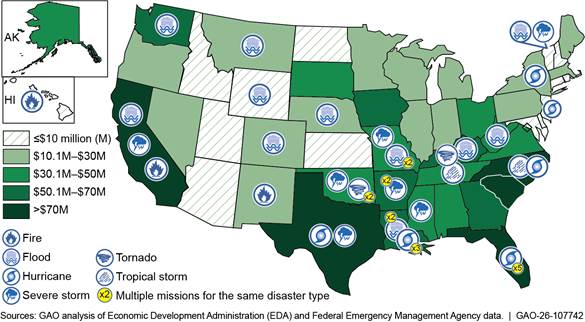
EDA has incorporated several leading practices for interagency collaboration to coordinate the Economic RSF, including having clear roles and responsibilities. Stakeholders in disaster-affected communities highlighted the value and recent performance of the Economic RSF but noted challenges in its capacity to provide assistance. EDA is implementing a required disaster recovery office and team that can help address this challenge. However, EDA has not developed a way for the RSF to ensure accountability by monitoring and communicating progress toward its strategic outcomes, such as increasing the capacity of local stakeholders to implement economic recovery strategies. Fully adopting the leading practices would enhance accountability and help demonstrate progress.
EDA’s 26 performance measures incorporated several key attributes of successful measures but could not be used to assess whether its disaster recovery work accomplished its intended outcomes. Using measures that better assess the performance of its disaster recovery work would help EDA determine if it has achieved the outcomes Congress intended, such as mitigating flood risk. In addition, the reliability of the measures is unknown because EDA suspended the steps it previously took to validate grantee-reported data on job creation or retention. By resuming procedures to validate these data, EDA would improve confidence that its reported outcomes accurately reflect progress toward agency goals and provide useful information for decision-making.
Why GAO Did This Study
EDA, part of the Department of Commerce, has taken on an increasingly important role in disaster recovery. In fiscal years 2018–2025, Congress provided EDA with $3.2 billion in disaster supplemental appropriations. Senate Report 118-62 includes a provision for GAO to evaluate EDA’s role in disaster recovery.
Among its objectives, this report examines the extent to which EDA’s coordination of the Economic RSF has incorporated leading practices for interagency collaboration, how EDA has invested in disaster-affected communities, and the extent to which EDA’s performance measures incorporated key attributes of successful measures.
GAO analyzed EDA documentation, performance measures, and data on appropriations, grant awards, disbursements, and RSF missions generally in 2013–2025, as available; interviewed officials from EDA and five other federal agencies; and conducted site visits to seven EDA grant projects. GAO interviewed stakeholders from state and local governments and regional economic development organizations in three disaster-affected communities (Florida, Hawaii, and Oklahoma), selected to reflect variation in disaster type and region.
What GAO Recommends
GAO is making four recommendations, including that EDA implement a way to assess the Economic RSF’s outcomes, implement disaster recovery performance measures, and implement procedures to validate grantee-reported performance data. EDA generally agreed with the recommendations.
|
Abbreviations |
|
|
|
|
|
EDA |
Economic Development Administration |
|
FEMA |
Federal Emergency Management Agency |
|
RSF |
Recovery Support Function |
|
SBA |
Small Business Administration |
This is a work of the U.S. government and is not subject to copyright protection in the United States. The published product may be reproduced and distributed in its entirety without further permission from GAO. However, because this work may contain copyrighted images or other material, permission from the copyright holder may be necessary if you wish to reproduce this material separately.
July 2, 2026
The Honorable Jerry Moran
Chair
The Honorable Chris Van Hollen
Ranking Member
Subcommittee on Commerce, Justice, Science, and Related Agencies
Committee on Appropriations
United States Senate
The Honorable Hal Rogers
Chairman
The Honorable Grace Meng
Ranking Member
Subcommittee on Commerce, Justice, Science, and Related Agencies
Committee on Appropriations
House of Representatives
Natural disasters can cause severe distress to local economies by damaging infrastructure and natural resources and reducing economic activity, employment, and investment. In 2024, the National Oceanic and Atmospheric Administration estimated there were 27 disasters with at least $1 billion in economic damages.[1] As natural disasters have become more costly and frequent, they have increasingly required federal support.
To support local recovery efforts, the federal government relies on an interagency approach articulated in the National Disaster Recovery Framework. Under this framework, the Economic Development Administration (EDA) leads the Economic Recovery Support Function (RSF), an interagency mechanism for coordinating federal resources to support economic recovery in communities affected by disasters.[2] In addition, from fiscal years 2018 through 2025, EDA received a total of $3.2 billion in supplemental appropriations for disaster recovery. In 2025, we added improving the delivery of federal disaster assistance to our High-Risk List.[3] As EDA’s role in disaster recovery has expanded, it has become increasingly important to examine how EDA delivers and coordinates economic recovery assistance to affected communities.
Senate Report 118-62 includes a provision for us to evaluate EDA’s role in disaster recovery, including its coordination of the Economic RSF and the measures it uses to assess its performance in carrying out its disaster recovery responsibilities.[4] The American Relief Act, 2025, also includes a provision for us to conduct audits and investigations related to disasters declared in 2023 and 2024.[5] This report examines (1) the extent to which EDA’s coordination of the Economic RSF has incorporated leading practices for interagency collaboration, as well as stakeholder views on the Economic RSF; (2) the amount EDA has awarded from disaster supplemental appropriations for fiscal years 2018 through 2025; (3) how EDA has invested in economic recovery and resilience projects in disaster-affected communities; and (4) the extent to which EDA’s most recent performance measures for disaster recovery grants incorporated key attributes of successful performance measures.
For our first objective, we identified Economic RSF missions and key activities using documentation and data provided by EDA and the Federal Emergency Management Agency (FEMA).[6] We assessed EDA’s coordination of the Economic RSF against leading practices for interagency collaboration we identified in prior work.[7] We also held three discussion groups in three selected disaster-affected communities with representatives of a nongeneralizable group of 16 stakeholders—including state and local governments and regional economic development organizations—to obtain their views on EDA’s coordination of the Economic RSF.
For our second and third objectives, we analyzed EDA data on the rates at which EDA obligated and disbursed funds from disaster supplemental appropriations for fiscal years 2018 through 2025, as well as data on disaster recovery grants awarded in fiscal years 2014 through 2024.[8] We also visited seven EDA-funded infrastructure projects that generally received awards of more than $1 million in the states where we held discussion groups.
For our fourth objective, we identified EDA’s performance measures and assessed them against key attributes for successful performance measures identified in our prior work.[9] We also reviewed the performance outcomes of infrastructure grants.[10] Appendix I provides additional details on our objectives, scope, and methodology.
We conducted this performance audit from August 2024 to July 2026 in accordance with generally accepted government auditing standards. Those standards require that we plan and perform the audit to obtain sufficient, appropriate evidence to provide a reasonable basis for our findings and conclusions based on our audit objectives. We believe the evidence obtained provides a reasonable basis for our findings and conclusions based on our audit objectives.
Background
Disaster Recovery and Resilience
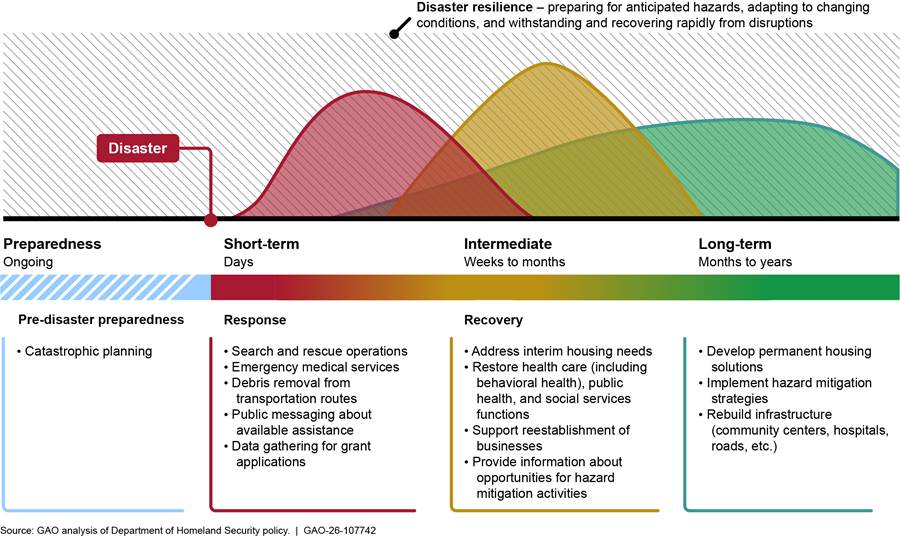
Recovery from natural disasters can take years and occurs along a continuum that includes preparedness, response, recovery, and resilience. The recovery phase occurs in the weeks to years after a disaster and can include intermediate goals, such as supporting the reestablishment of businesses, and long-term goals, such as rebuilding roads. Resilience is an ongoing process that involves preparing for anticipated hazards and adapting to changing conditions (see fig. 1).
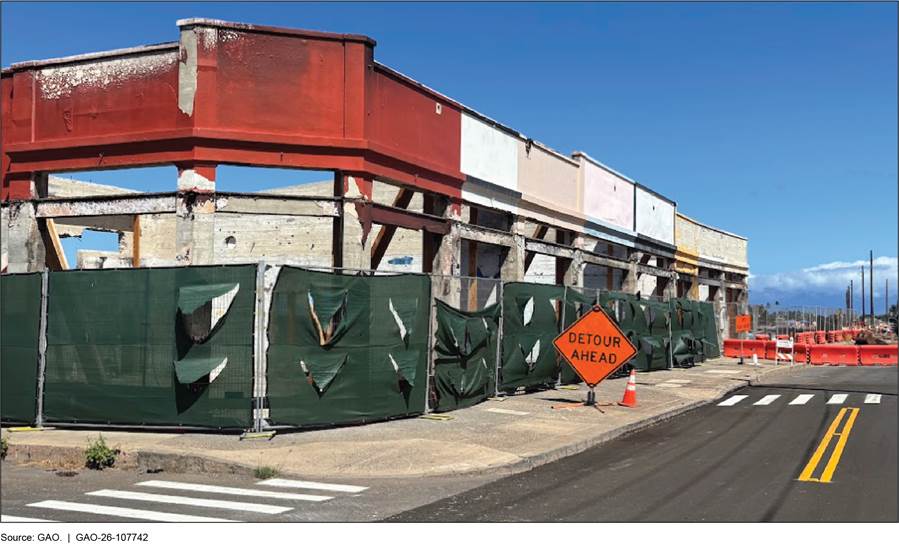
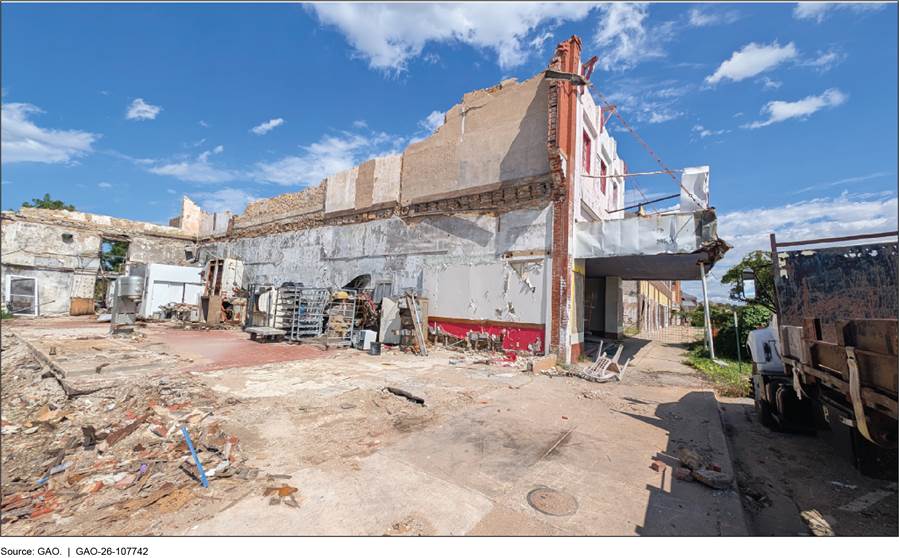
Economic recovery is a key component of disaster recovery that focuses on sustaining and rebuilding businesses, revitalizing employment, and developing economic opportunities that make communities more resilient to future disasters. Economic recovery can take years or decades to achieve. For instance, businesses destroyed by the 2023 Hawaii wildfires (fig. 2) and 2024 Oklahoma tornados (fig. 3) were still undergoing cleanup in late 2025.
Figure 2: Damaged Businesses on Front Street in Lahaina, Maui, About 2 Years After the 2023 Hawaii Wildfires
Federal Support for Disaster Recovery
Disaster recovery is initiated and led by state, territorial, tribal, and local governments with support from the federal government. States, territories, and Tribes can request a major disaster declaration from the President, which authorizes a wide range of federal assistance programs for individuals and public infrastructure. FEMA, within the Department of Homeland Security, leads federal recovery efforts, which are outlined in the National Disaster Recovery Framework.[11]
According to the framework, the federal government may activate Recovery Support Functions (RSF) to serve as the coordinating structure for federal assistance when expertise is needed outside of emergency management. RSFs are activated based on the requests of disaster-affected communities. RSFs are organized across six capabilities: community assistance; economic; health, education, and human services; housing; infrastructure systems; and natural and cultural resources. Each RSF has a unique mission aligned with its focus area and includes a federal coordinating agency and other participating agencies. Federal agencies are deployed to coordinate and participate in RSF activities after they receive a mission assignment from FEMA.
Multiple federal agencies support economic recovery after major disasters by providing financial assistance to rebuild public infrastructure, stabilize businesses, and develop and implement long-term projects. EDA’s disaster recovery program is generally smaller compared with these programs. For example:
· FEMA’s Public Assistance is the largest disaster recovery grant program established under the Robert T. Stafford Disaster Relief and Emergency Assistance Act. The program provides grants to governments and nonprofits in affected areas to restore roads, water control facilities, and other public infrastructure. In fiscal year 2025, FEMA obligated $34 billion in public assistance.[12]
· The Department of Housing and Urban Development’s Community Development Block Grant Disaster Recovery Program provides grants to the most impacted and distressed areas for disaster relief, long-term recovery, restoration of infrastructure and housing, economic revitalization, and mitigation. In fiscal year 2025, Congress provided about $12 billion for this program.[13]
· The Small Business Administration’s (SBA) Business Physical Disaster Loans and Economic Injury Disaster Loans provide loans to businesses to repair damaged property and meet operating expenses. In fiscal year 2025, Congress provided about $2.7 billion for these programs.[14]
· The Department of Agriculture’s Supplemental Disaster Relief Program provides payments to agricultural producers who suffer revenue, quality, or production losses because of major disasters. In fiscal year 2025, Congress provided about $31 billion for this program.[15]
· EDA’s disaster recovery grants provide funding to affected communities and regions for a wide range of activities that support long-term economic recovery, such as planning and construction of public infrastructure. In fiscal year 2025, Congress provided about $1.448 billion for these grants.[16]
Economic Development Administration
EDA is a bureau of the Department of Commerce led by the Assistant Secretary of Commerce for Economic Development. It was established in 1965 to help state and local stakeholders develop the conditions and amenities needed to grow business, create jobs, and expand investment in economically distressed areas. EDA was reauthorized in the Thomas R. Carper Water Resources Development Act of 2024.[17]
EDA has offices in Washington, D.C., and six regions, as well as economic development representatives who manage grants and provide technical assistance in each state and U.S. territory. As of April 2026, EDA had 185 employees. EDA’s programs are generally funded through annual appropriations that remain available until expended for grants. In fiscal year 2026, Congress appropriated $466 million to EDA.[18] For fiscal year 2027, the administration has proposed eliminating funding for EDA and requested $20 million for ongoing administration, oversight, and monitoring of grants and loans previously awarded.[19]
EDA’s grant programs are designed to increase the capacity of eligible entities to implement economic development projects. Funded activities can include infrastructure, planning, workforce development, and business incubation programs. Eligible entities generally are state and local governments, Tribes, nonprofits, regional economic development organizations (known as economic development districts), public-private partnerships, and institutions of higher education.[20] Grantees must fund a portion of project costs for most EDA grants with nonfederal dollars, but cost-sharing requirements may vary based on the program, determination of special need, or applicant type. EDA uses a competitive application process to ensure grants align with its investment priorities.
EDA’s investment priorities are critical infrastructure, workforce, innovation and entrepreneurship, economic recovery resilience, and manufacturing.[21] Its disaster recovery activities are primarily associated with the economic recovery resilience priority. This priority includes economic development planning or implementation projects that enhance an area’s ability to withstand and recover from adverse short- or long-term changes in economic conditions, including those resulting from industry contractions or natural disasters.
EDA’s disaster recovery portfolio primarily includes grantmaking and coordinating federal economic recovery support after major disasters.[22] EDA awards grants for disaster recovery and resilience primarily through supplemental appropriations. From fiscal years 2018 through 2025, it received an additional $3.2 billion.[23] After Congress authorizes these funds, EDA develops notices of funding opportunity and awards the grants through its Economic Adjustment Assistance program.
In addition, EDA can use its Public Works and other programs to fund disaster recovery and resilience projects. Economic Adjustment Assistance funds can support a wide range of technical, planning, and public works and infrastructure projects in regions experiencing adverse economic changes, such as plant closures. The Public Works program provides grants to distressed communities to revitalize, expand, and upgrade their physical infrastructure.
EDA also is the coordinating agency for the Economic RSF, which is intended to coordinate federal resources for economic recovery after major disasters. EDA employs a Director of Economic Development Integration and Disaster Recovery and a national coordinator that manage its disaster recovery work and the Economic RSF. Regional staff generally lead Economic RSF missions.
The mission of the Economic RSF is to integrate the expertise of the federal government to help state, local, tribal, and territorial governments and their partners in sustaining and rebuilding businesses, revitalizing employment, and developing economic opportunities that result in economically resilient communities after large-scale or catastrophic incidents. In addition to EDA, the Economic RSF includes 13 participating agencies that EDA can call on as needed, including AmeriCorps; the Departments of Agriculture, Energy, Health and Human Services, Housing and Urban Development, the Interior, Labor, Homeland Security, the Treasury, and Transportation; the Environmental Protection Agency; FEMA; and SBA.
EDA Incorporated Several Leading Practices for Collaboration to Coordinate the Economic RSF, but Further Action Is Needed
EDA coordinated 45 Economic RSF missions from 2013 through 2025 that focused on assessing recovery needs and providing technical assistance to affected communities. In coordinating the Economic RSF, EDA generally incorporated several leading practices for interagency collaboration, including having clear roles and responsibilities. However, further actions are needed to ensure accountability and update guidance.
EDA Coordinated 45 Economic RSF Missions After Major Disasters in 2013–2025
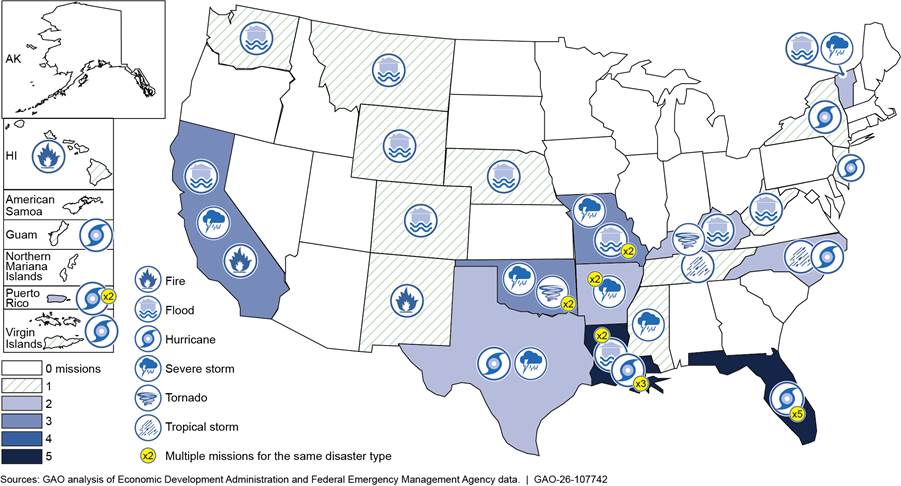
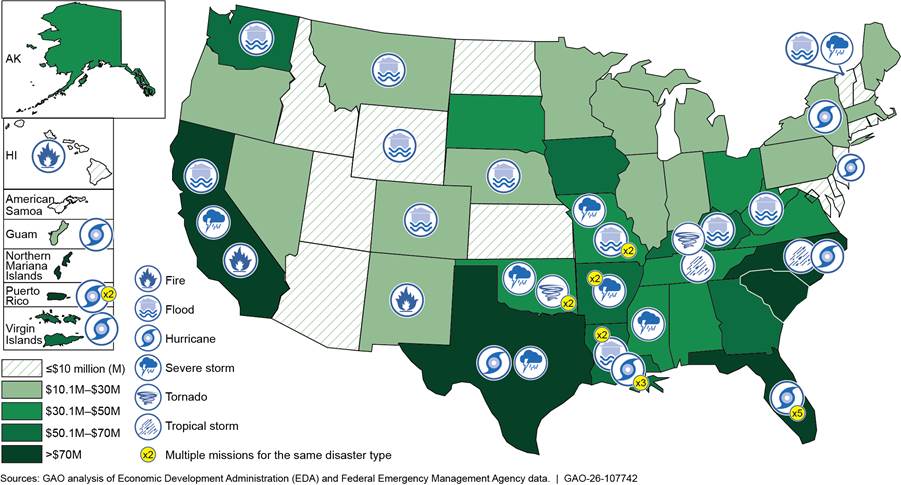
From 2013 through 2025, Economic RSF missions primarily took place in areas affected by floods, hurricanes, and tropical or severe storms and focused on five key activities, including identifying recovery needs and strategies. During this period, EDA coordinated 45 Economic RSF mission assignments (see fig. 4). About half were in response to severe storms and flooding, and about 40 percent were in response to hurricanes and tropical storms. The Economic RSF also provided support following fires and tornadoes. More than half of the missions were in the South, where hurricanes and tropical storms are most prevalent. The median mission length was about 5 months.
Figure 4: Missions of Economic Recovery Support Function, by Disaster Type and State or Territory, 2013–2025
According to reports prepared by EDA at the end of each mission (end-of-mission reports), interviews with EDA and stakeholders in disaster-affected communities, and FEMA statements of work, the Economic RSF concentrated on five key activities:
· Assessing recovery needs. The Economic RSF has helped develop recovery needs assessments, which are systematic evaluations developed by all RSFs to identify and prioritize community needs following a disaster. To develop these assessments, EDA and participating agencies may interview local stakeholders, conduct listening sessions or focus groups, and analyze news reports and economic and administrative data.
· Creating and implementing recovery strategies. The Economic RSF has helped stakeholders create and implement strategies to promote economic recovery and resilience, which have been communicated through FEMA integrated strategic plans. For example, during the response to the 2023 Hawaii wildfires, SBA established centers to assist small businesses, and EDA worked with local officials to develop a long-term recovery plan.
· Exchanging information with stakeholders. The Economic RSF has facilitated information sharing, relationship building, and project development opportunities with local stakeholders through in-person discussions and publications. For example, it coordinated workshops (known as federal interagency resource exchanges) in disaster-impacted communities in which participating agencies met with local government officials and businesses to discuss recovery projects and share information on potential federal funding sources. In addition, the Economic RSF has developed guides to summarize federal grants and other resources for local officials.
Stakeholders in all three discussion groups said EDA effectively coordinated information sharing.[24] For example, stakeholders in Florida said EDA organized meetings and biweekly calls that promoted collaboration among local, state, and federal partners. According to these stakeholders, EDA provided sustained leadership during the recovery process and was supportive of their efforts. For example, stakeholders in Oklahoma said they appreciated that EDA’s representatives were consistently present and responsive to questions.
· Providing technical assistance. The Economic RSF has provided technical assistance to help local stakeholders assess recovery needs, develop projects, and navigate federal resources.
Stakeholders we interviewed said EDA provided timely, useful, and responsive technical assistance. Stakeholders in the three discussion groups said EDA arrived quickly after disasters to identify local community recovery needs. For example, stakeholders in Oklahoma said EDA worked to provide funding for a recovery coordinator within 3 months after the disaster. Stakeholders also reported that EDA provided useful assistance during the early stages of recovery. For example, stakeholders in Hawaii said EDA developed economic recovery and workforce development reports to help guide local recovery efforts. According to these stakeholders, EDA offered a level of support that was unmatched by other federal agencies.
· Coordinating and delivering financial assistance. EDA and other participating agencies in the Economic RSF have coordinated and awarded federal assistance to support economic recovery. For example, during the 2024 North Carolina floods caused by Hurricane Helene, EDA led coordination among participating agencies to identify economic recovery projects and determine the most appropriate federal funding source to help avoid duplication of benefits, according to EDA officials.[25]
EDA Incorporated Leading Practices and Is Addressing Capacity Concerns but Could Improve Efforts to Ensure Accountability and Update Guidance
EDA’s coordination of the Economic RSF generally incorporated five of eight leading practices for interagency collaboration and partially incorporated three, as of February 2026 (see table 1).[26]
Table 1: EDA Generally Incorporated Five of Eight Leading Practices for Interagency Collaboration in the Economic Recovery Support Function, as of December 2025
|
Leading practice |
Key considerations |
Extent to which EDA incorporated leading practice |
|
Define common outcomes |
· Have the crosscutting challenges or opportunities been identified? · Have the short- and long-term outcomes been clearly defined? · Have the outcomes been reassessed and updated, as needed? |
● |
|
Ensure accountability |
· Have collaboration-related competencies or performance standards been established against which individual performance can be evaluated? · Have the means to recognize and reward accomplishments related to collaboration been established? · What are the ways to monitor, assess, and communicate progress toward the short- and long-term outcomes? |
◑ |
|
Bridge organizational cultures |
· Have strategies to build trust among participants been developed? · Have participating agencies established compatible policies, procedures, and other means to operate across agency boundaries? · Have participating agencies agreed on common terminology and definitions? |
● |
|
Identify and sustain leadership |
· Has a lead agency or individual been identified? · How will leadership be sustained over the long term? |
● |
|
Clarify roles and responsibilities |
· Have the roles and responsibilities of the participants been clarified? · Has a process for making decisions been agreed upon? |
● |
|
Include relevant participants |
· Have all relevant participants been included? · Do the participants have the appropriate knowledge, skills, and abilities to contribute? · Do participants represent diverse perspectives and expertise? |
● |
|
Leverage resources and information |
· How will the collaboration be resourced through funding? (If interagency funding is needed, is it permitted?) · Are methods, tools, or technologies to share relevant data and information being used? · How will the collaboration be resourced through staffing? |
◑ |
|
Develop and update written guidance and agreements |
· If appropriate, have agreements regarding the collaboration been documented? · Have ways to continually update or monitor written agreements been developed? |
◑ |
● = Generally incorporated ◑ = Partially incorporated ○ = Not incorporated
Sources: GAO‑23‑105520 and GAO analysis of Economic Development Administration (EDA) and Federal Emergency Management Agency (FEMA) documentation and interviews with the Departments of Agriculture, Housing and Urban Development, and Labor; EDA; FEMA; and the Small Business Administration. | GAO‑26‑107742
Define Common Outcomes
EDA and FEMA have generally defined common outcomes, including by identifying crosscutting challenges and opportunities, defining short- and long-term outcomes, and reassessing outcomes. EDA and participating agencies identify specific outcomes in the FEMA integrated strategic plan for each Economic RSF mission. In addition, EDA and FEMA identify strategic outcomes for the Economic RSF in the National Disaster Recovery Framework. EDA periodically reassesses these common outcomes in coordination with FEMA and other participating agencies during updates to the National Disaster Recovery Framework.
Ensure Accountability
EDA has partially ensured accountability because it does not have a way to monitor, assess, and communicate progress toward its strategic outcomes. Ensuring accountability includes having (1) collaboration-related competencies to evaluate individual performance, (2) a means to recognize accomplishments, and (3) ways to assess progress toward outcomes. According to EDA officials, staff assigned to manage the Economic RSF have competencies related to interagency coordination and collaboration. In addition, EDA recognizes accomplishments related to collaboration through end-of-mission reports and its public website.
EDA also assesses progress toward the RSF’s short-term outcomes during missions through FEMA reporting. For example, FEMA’s integrated strategic plan tracks the administration of SBA loans, small business development centers, and recovery planning. EDA also tracks some outputs of the Economic RSF related to key activities, such as stakeholder coordination, technical assistance, and access to funding, which are communicated through nonpublic end-of-mission reports.
However, EDA does not have a way to assess and communicate progress toward the Economic RSF’s four strategic outcomes, which are the following:
· Disaster-affected businesses are rapidly stabilized and receive the assistance needed to maintain operations and cover workforce payroll expenses.
· Local governments and business and industry can effectively navigate and leverage federal economic recovery resources to support priority recovery projects.
· Local governments, business and industry, and nongovernmental partners have increased capacity to develop and implement comprehensive economic recovery strategies that guide investment in new economic opportunities and enhance economic resilience.
· Communities have a greater understanding of future risks and vulnerabilities to consider in their economic planning.
FEMA officials said evaluating the success of RSFs in achieving their strategic outcomes is the responsibility of each RSF’s coordinating agency. However, we found that EDA does not consistently track and report on the Economic RSF’s progress toward achieving its strategic outcomes.
EDA officials described several challenges to measuring the outcomes of the Economic RSF. Specifically, attributing broad economic outcomes to the Economic RSF is challenging because areas more susceptible to disasters may be supported by frequent Economic RSF missions and may receive an influx of financial assistance from multiple sources. These multiple sources of assistance make it difficult to attribute outcomes to a particular effort. In addition, economic outcomes are often delayed. FEMA officials acknowledged these challenges and said they continue to work with EDA to develop an approach to measuring the outcomes of the RSFs that focuses on providing technical and financial assistance and capacity-building rather than attributing broad measures of economic recovery to the RSFs, such as changes in rates of unemployment.
Nonetheless, if agencies do not use performance information to assess progress toward outcomes, they may be at risk of failing to achieve them.[27] EDA can help the Economic RSF monitor, assess, and communicate its success in achieving its strategic outcomes by leveraging available reporting frameworks. For example, agencies can reinforce accountability for collaborative efforts by using strategic and annual performance plans and reports to account for results.[28] In lieu of direct measurement, EDA could use its annual performance report to describe how the Economic RSF’s activities have contributed to achieving its strategic outcomes.
Such reporting could include indicators of economic recovery in areas supported by Economic RSF missions. Tracking indicators, even if imperfect, could help EDA identify communities that are not recovering and investigate further. EDA could also consider periodically conducting after-action assessments to evaluate whether the Economic RSF’s activities supported its strategic outcomes and where changes may be needed. EDA already prepares nonpublic end-of-mission reports with similar information.
By implementing a way to periodically monitor, assess, and communicate progress toward its strategic outcomes, EDA can provide Congress, taxpayers, and those impacted by disasters with a better understanding of how the Economic RSF’s activities have helped communities achieve economic recovery and where the RSF may still need to make progress.
Bridge Organizational Cultures
EDA has generally bridged organizational cultures, which includes having strategies to build trust among participants, establishing compatible policies and procedures to operate across agencies, and agreeing on common terminology and definitions. EDA coordinates periodic meetings of participating agencies to share information and collaborate outside of disaster recovery missions. Selected participating agencies said they find these meetings useful for building trust. EDA also coordinates regular meetings with participating agencies during Economic RSF missions. EDA and selected participating agencies said they have been able to function effectively during Economic RSF missions without modifying their policies and procedures. In addition, FEMA’s National Disaster Recovery Framework and Economic RSF operating documents provide common terminology and definitions.[29]
Identify and Sustain Leadership
EDA and FEMA have generally identified and sustained leadership, which includes identifying a lead agency and determining how leadership will be sustained over the long term. The National Disaster Recovery Framework identifies EDA as the coordinating agency of the Economic RSF.[30] EDA employs a national coordinator to manage the Economic RSF and assigns a field coordinator to lead each Economic RSF mission.
Clarify Roles and Responsibilities
EDA and FEMA have generally clarified roles and responsibilities, which includes defining and agreeing on agencies’ respective roles and responsibilities and having a process for making decisions. The National Disaster Recovery Framework defines general roles and responsibilities of coordinating and participating agencies for all RSFs, as well as specific responsibilities for the Economic RSF. EDA further defines its responsibilities and those of participating agencies in its operating documents. For example, the framework clarifies that EDA is to designate a senior-level principal to serve as the RSF’s national coordinator, provide significant engagement and management for the RSF, and encourage ongoing communication and coordination among interagency partners.
The roles and responsibilities of participating agencies are flexible, and the framework clarifies that the coordinating agency is to work with participating agencies as needed to address specific recovery needs. According to selected participating agencies, decisions are made through regular interagency meetings and discussions.
EDA has also taken steps to respond to concerns about the effectiveness of its working relationship with FEMA. Specifically, stakeholders in two discussion groups expressed concerns about EDA’s autonomy during Economic RSF missions. Stakeholders in Hawaii said EDA seemed to have limited authority to take action without FEMA’s approval, such as securing meeting space with local officials. Stakeholders in Oklahoma said FEMA arrived with a large staff presence that overwhelmed local officials, overshadowed EDA, and hindered the Economic RSF’s effectiveness.
In response to these concerns, EDA officials said they had provided feedback to FEMA and were waiting for changes that could stem from ongoing reviews of FEMA and the National Disaster Recovery Framework.[31] A presidentially appointed review of FEMA by federal, state, and local officials (collectively, the FEMA Review Council) issued its final report in May 2026. The report’s recommendations do not discuss specific changes to the framework or EDA’s roles and responsibilities.[32]
Include Relevant Participants
EDA and FEMA have generally included relevant participants, which means ensuring that participants represent diverse perspectives and expertise and possess appropriate knowledge, skills, and attributes. In addition to EDA, the Economic RSF has 13 participating agencies with a wide range of expertise. In December 2024, EDA and FEMA reviewed and updated the participating agencies in the Economic RSF to ensure they could provide consistent and relevant support.[33] Economic RSF operating documents also include a training plan to help ensure field coordinators and other assigned staff have the required knowledge and skills.
Leverage Resources and Information
EDA has partially leveraged resources and information because it has experienced readiness challenges that limited its capacity to support mission assignments. Leveraging resources and information includes (1) determining how interagency collaboration activities will be funded; (2) using methods, tools, and technologies to share data and information; and (3) determining how the interagency collaboration will be resourced through staffing.
EDA and selected participating agencies said funding mechanisms for the Economic RSF were clear. Deployed agencies receive a mission assignment or other agreement from FEMA, which generally funds operational travel, overtime, and contract support. EDA and participating agencies use their own resources to support pre-disaster coordination. In addition, EDA and participating agencies use several means to share data and information, including FEMA’s TRAX system.[34] Selected participating agencies said these methods were useful, effective, and flexible enough to meet the unique needs of each disaster.
However, the Economic RSF has experienced readiness challenges that have limited its ability to staff missions. According to an internal July 2025 assessment by FEMA, the Economic RSF has limited readiness capacity—the lowest among the six RSFs.[35] According to the assessment, EDA did not have staff available for missions and faced administrative challenges.[36] EDA has limited disaster recovery staff, which limits the support it can offer to states and communities, according to EDA officials. In April 2026, EDA officials said they had paused certain disaster recovery activities while awaiting the administration’s review of FEMA and updated guidance on EDA’s disaster recovery role, including the Economic RSF. As of April 2026, EDA did not have any active Economic RSF missions and had declined at least one request from FEMA to coordinate the RSF following the 2025 California wildfires. Because of its limited capacity, EDA officials said they were developing a process to more rigorously review mission requests.
Stakeholders in disaster-affected communities highlighted the value of EDA and other federal agencies in supporting economic recovery but noted recent capacity challenges.[37] For example, stakeholders in Hawaii highlighted the value of EDA’s regional representative and said he was consistently available to provide technical assistance, understood local needs, and helped them overcome challenges in applying for EDA grants. At the same time, they noted recent declines in the number of staff who are available to provide technical assistance.
EDA is in the process of establishing an Office of Disaster Recovery and Resilience and disaster team, which are intended to enhance its capacity to coordinate the Economic RSF. The Thomas R. Carper Water Resources Development Act of 2024 requires EDA to establish this new office and disaster team to carry out its disaster recovery responsibilities.[38] The new office is to direct and implement EDA’s post-disaster economic recovery responsibilities, including providing financial and technical assistance to disaster-affected communities. The new disaster team can include staff from EDA and other federal agencies and is to deploy to disaster-affected communities to support Economic RSF missions. The law directs EDA to establish the new office and team as soon as practicable.
In April 2026, EDA officials said they were developing a department organizational order with Commerce to define the organization and responsibilities of the new office. Officials said developing the order is complex and involves reorganizing multiple EDA offices. This is a positive step toward fully establishing the new office and team, which are critical for enhancing EDA’s readiness to assist disaster-affected communities—especially given that natural disasters have increased in frequency and necessitate a coordinated federal response. The Secretary of Commerce must submit a report to Congress by July 1, 2026, describing the activities and staffing of the new office.[39]
Develop and Update Written Guidance and Agreements
EDA has partially implemented the leading practice of developing and updating written guidance and agreements. Specifically, it maintains operating documents for the Economic RSF but has not updated them to reflect recent significant changes. Operating agreements are included in FEMA’s National Disaster Recovery Framework and the Economic RSF’s operating documents. In June 2021, EDA developed operating documents that describe its concept of operations, field operations, training approach, and partnership and communication strategy. For example, the Economic RSF Field Operations Manual details how EDA and participating agencies are expected to collaborate on key processes during a mission.
However, EDA has not updated its operating documents to reflect significant recent changes to the framework and its own operating procedures. In December 2024, FEMA published a new edition of the framework that updated the list of participating agencies in the Economic RSF. For example, the Departments of Energy and Transportation are now participating agencies, but the Economic RSF’s operating documents do not discuss coordination with them.
EDA officials also said they were revising how they review FEMA requests for Economic RSF mission assignments and testing a new staffing approach with SBA and FEMA. Using this approach, SBA would lead the Economic RSF during the initial economic stabilization period after a major disaster until local stakeholders are prepared to focus on long-term recovery. The Economic RSF used this approach to supplement its capacity during the response to Hurricane Helene in North Carolina in 2025. However, these changes are not reflected in the Economic RSF’s operating documents. EDA officials said they were consolidating and updating these documents but planned to finish them after external reviews of FEMA and the National Disaster Recovery Framework were completed. As discussed, the May 2026 report by the FEMA Review Council did not mention specific changes that would clearly affect the operating documents.
While these reviews may affect the content of the operating documents, they do not preclude EDA from updating key procedures and roles based on changes already implemented. As we have previously reported, updated written guidance and agreements can help provide consistency over time, particularly when leadership changes.[40] By updating its operating documents in a timely manner, EDA can provide participating agencies in the Economic RSF with a consistent understanding of their roles and responsibilities and better position them to support future Economic RSF missions.
EDA Has Awarded Most Prior Disaster Funds and Has Begun Awarding 2025 Funds, Generally Separately from Economic RSF Missions
EDA disaster recovery grants are primarily funded through supplemental appropriations. As of February 2026, EDA had obligated about 94 percent of the $1.7 billion Congress provided in fiscal years 2018–2023 and about 3 percent of the $1.448 billion provided for grants in fiscal year 2025. Disaster supplemental funds may not be immediately available to affected communities, and EDA generally awarded these grants separately from Economic RSF missions.
EDA Has Obligated Most 2018–2023 Disaster Recovery Funds and Started Awarding 2025 Funds
In fiscal years 2018 through 2025, Congress provided EDA with a total of $3.2 billion in disaster supplemental appropriations.[41] As of February 2026, EDA had obligated about 94 percent of the $1.7 billion it received for awards in fiscal years 2018, 2019, and 2023. In addition, EDA had made initial awards of about $38 million (3 percent) of the $1.448 billion it received for awards in fiscal year 2025. EDA officials said they awarded some fiscal year 2025 funds to address urgent needs and planned to make additional awards on a rolling basis.[42] EDA had disbursed a smaller portion of these funds to grantees (see table 2).
Table 2: Obligations and Disbursements of EDA Supplemental Appropriations for Disaster Recovery in Fiscal Years 2018–2025, as of February 2026
|
Appropriations act |
Amount appropriated for grants ($ millions) |
Percent obligated |
Percent disbursed |
|
Bipartisan Budget Act of 2018 |
$587 |
97% |
96% |
|
Additional Supplemental Appropriations for Disaster Relief, 2019 |
$587 |
99% |
42% |
|
Consolidated Appropriations Act, 2023 |
$483 |
87% |
16% |
|
American Relief Act, 2025 |
$1,448 |
3% |
0% |
Source: GAO analysis of legislation and Economic Development Administration (EDA) data. | GAO‑26‑107742
According to EDA officials, supplemental appropriations from 2018, 2019, and 2023 have not been fully obligated because funds are continually deobligated—for example, if a project is canceled or its costs change. Deobligated funds can be obligated again for other applicable projects. A significant portion of the funds had not been disbursed to grantees—particularly for fiscal year 2023 funds—because EDA awards are generally disbursed to grantees as reimbursements after they incur allowable costs, and infrastructure and construction projects can take years to complete.
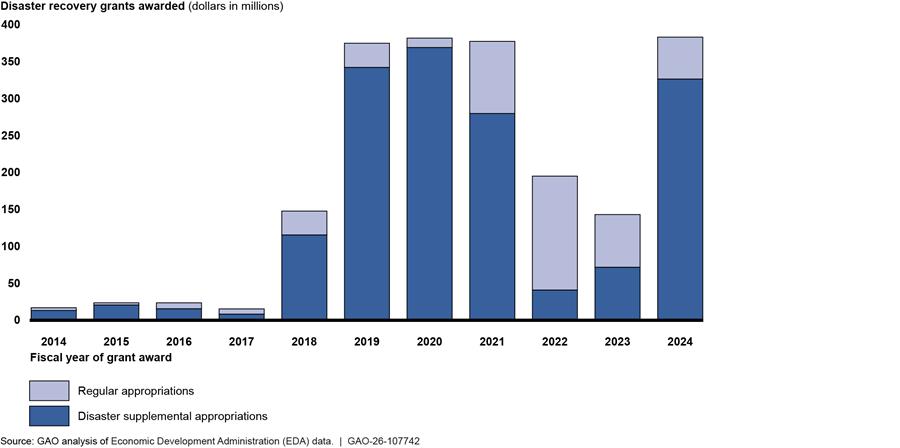
In total, EDA awarded about $2.1 billion for disaster recovery grants from its regular and supplemental appropriations in fiscal years 2014–2024, according to our analysis of EDA grant data.[43] About 77 percent of EDA’s disaster recovery grants were funded through supplemental appropriations and 23 percent through its regular appropriations, although these shares varied by year (see fig. 5).
Figure 5: Supplemental Appropriations Funded Most EDA Disaster Recovery Grants Awarded in Fiscal Years 2014–2024
EDA generally awarded disaster recovery funds through its Economic Adjustment Assistance program.[44] This program is EDA’s most flexible and allows regions experiencing adverse economic changes to use funds for technical assistance, planning, and public works and infrastructure projects. On average, EDA funded about 72 percent of the total cost of all disaster recovery projects.[45]
EDA Generally Awards Disaster Recovery Grants Separately from Economic RSF Missions
EDA’s disaster recovery grantmaking generally occurs outside of Economic RSF missions because these grants are generally funded through supplemental appropriations. EDA uses these funds to award grants in affected areas regardless of whether they were supported by an Economic RSF mission. Supplemental appropriations are typically provided through emergency legislation following major disasters, often requiring coordination between federal agencies and Congress. After funds are authorized, additional time is needed for EDA to develop notices of funding opportunity and review applications. As a result, EDA’s disaster recovery funds may not become available to grantees for more than a year after a major disaster.
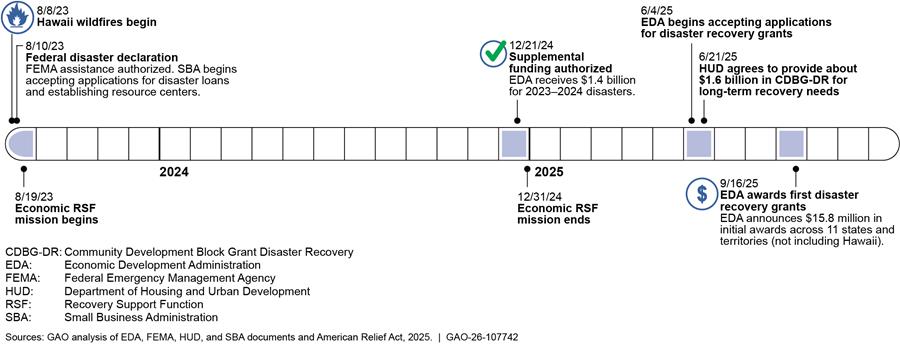
For example, the Economic RSF’s mission following the 2023 Hawaii wildfires began about 10 days after the disaster (Aug. 19, 2023). During the mission, EDA worked with stakeholders to identify recovery needs and strategies and made few grants. On December 21, 2024, Congress provided EDA with about $1.448 billion in supplemental funding for declared disasters in 2023 and 2024. The Economic RSF mission assignment concluded on December 31, 2024. EDA began accepting applications for its supplemental funds in June 2025 and made its first awards in September 2025—about 2 years after the wildfires. As of June 2026, EDA had not announced any awards for Hawaiian grantees from the funds.
Other participating agencies in the Economic RSF were able to provide more timely financial assistance for economic recovery. FEMA was authorized to fund disaster assistance immediately after the wildfires. SBA also began accepting applications for disaster loans to assist businesses and others within days. Further, in June 2025, the Department of Housing and Urban Development signed an agreement to provide about $1.6 billion in Community Development Block Grant Disaster Recovery funding for long-term recovery needs, according to officials (see fig. 6).
Figure 6: EDA Began Awarding Grants from the Fiscal Year 2025 Disaster Supplement About 2 Years After the 2023 Hawaii Wildfires
Stakeholders in two of the three discussion groups said EDA had limited funding to support economic recovery projects during Economic RSF missions. Stakeholders in Hawaii said economic recovery planning and project implementation suffered because Congress authorized supplemental funds for economic recovery about 2 years after the disaster. In response to these concerns, EDA officials said its funding is subject to congressional appropriations and the administration’s priorities. Officials also said EDA can use its annual appropriations to address urgent needs immediately after a disaster, such as hiring a disaster recovery coordinator in an affected community.
We have previously reported that state and local officials have experienced challenges planning recovery efforts because disaster recovery funding and application time frames vary across federal programs.[46] In light of this and other challenges, we recommended that Congress consider establishing an independent commission to recommend reforms to the federal approach to disaster recovery. As of February 2026, Congress had not passed legislation that would address this matter.
Disaster Recovery Grants Primarily Funded Infrastructure and Varied in Their Approach to Addressing Economic Recovery
EDA’s disaster recovery grants primarily funded infrastructure and construction projects. Local governments received most of these funds, which were concentrated in the South. Selected projects we reviewed focused on enhancing resilience to future disasters and varied in how they addressed economic recovery and resilience.
Disaster Recovery Grants Primarily Funded Infrastructure and Construction Projects
In fiscal years 2014–2024, EDA primarily awarded disaster recovery grants to infrastructure and construction projects. Nearly half (45 percent) of the award dollars funded utilities, roadways, and other public infrastructure (see fig. 7).[47] Another 36 percent funded construction of business, medical, training, and other facilities. These infrastructure and construction projects accounted for 70 percent or more of EDA’s disaster recovery funding awarded in each fiscal year except 2018.[48]
Figure 7: EDA Disaster Recovery Grants in Fiscal Years 2014–2024 Primarily Funded Public Infrastructure and Construction Projects
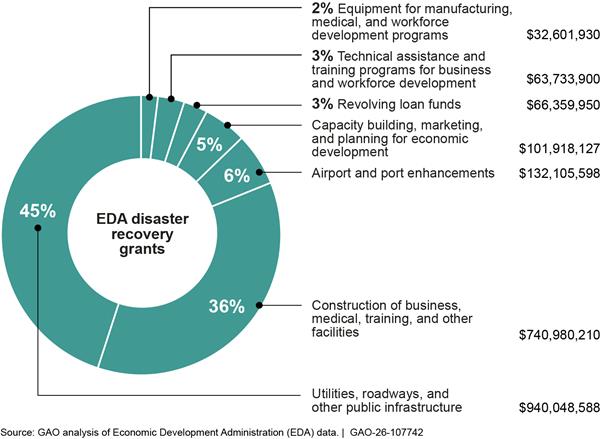
EDA also awarded disaster recovery grants for non-infrastructure projects. For example, about 5 percent of the amount awarded for disaster recovery in fiscal years 2014–2024 funded capacity building, marketing, and planning for economic development, such as developing a comprehensive economic development strategy for a region.
More than half of grantees (58 percent) were local governments, such as cities or counties. About 16 percent were educational institutions, such as universities and technical colleges, and 12 percent were nonprofit organizations.[49] The types of grantees that received EDA disaster recovery awards changed somewhat from 2014 through 2024, but local governments received the largest share of awards in all fiscal years except 2015.[50]
Disaster Recovery Grants Were Concentrated in the South
EDA disaster recovery funding awarded in 2014–2024 was concentrated in the South (see fig. 8). Southern states received about 51 percent of the funds, compared with about 15 percent among Western states, 14 percent among Midwestern states, 14 percent among U.S. territories, and 6 percent among Northeastern states. This allocation aligns somewhat with prior Economic RSF missions—more than half of the missions in 2013–2025 were in the South. The average amount awarded in Southern states and territories was significantly greater than in other regions. Total disaster recovery awards by state and territory in 2014–2024 ranged from $100,000 in Utah to $180 million in South Carolina.
Figure 8: Economic Recovery Support Function Missions (2013–2025) and EDA Disaster Recovery Awards (2014–2024)
About 19 percent of disaster recovery projects were located in opportunity zones, according to our review of EDA data. Opportunity zones are economically distressed communities in which private investment may be incentivized through preferential tax treatment.
Stakeholders in the three discussion groups said smaller communities faced challenges accessing EDA grants because they did not have resources and experience with federal grants.[51] For example, stakeholders in Florida said small communities in their state did not apply for EDA or other federal grants because they did not have experienced grant writers or staff to manage compliance requirements. In addition, stakeholders in Oklahoma said many communities did not have sufficient funds to meet EDA’s cost-sharing requirement. Stakeholders in two of the three discussion groups said economic development districts helped communities apply for and manage EDA grants, which mitigated challenges in accessing federal resources.
EDA officials said they were aware of these challenges and have tried to mitigate them. Specifically, they said EDA assigns economic development representatives to provide technical assistance to smaller communities. In addition, EDA can reduce cost-sharing requirements to improve the feasibility of projects. However, it does so on a limited basis because cost-sharing helps ensure that grantees remain invested in their projects. In addition, officials said EDA works with economic development districts to provide training and increase awareness of EDA resources. According to EDA officials, economic development districts play an important role in connecting small communities to federal resources but can vary considerably in capacity and the services they provide.
Selected Infrastructure Projects Varied in How They Addressed Economic Recovery
Selected infrastructure and construction projects we reviewed varied in how they addressed economic recovery and resilience. We observed seven projects in Florida, Hawaii, and Oklahoma that received or have begun using awards from EDA’s supplemental appropriations to promote economic recovery and resilience.[52] Projects we observed generally were designed to enhance resilience to future disasters and were not designed to directly restore damaged infrastructure. Specifically, three projects were designed to mitigate flood risk and promote economic development or business continuity. The other four were designed to create jobs or diversify job types in local economies, making them more resilient to future economic shocks.
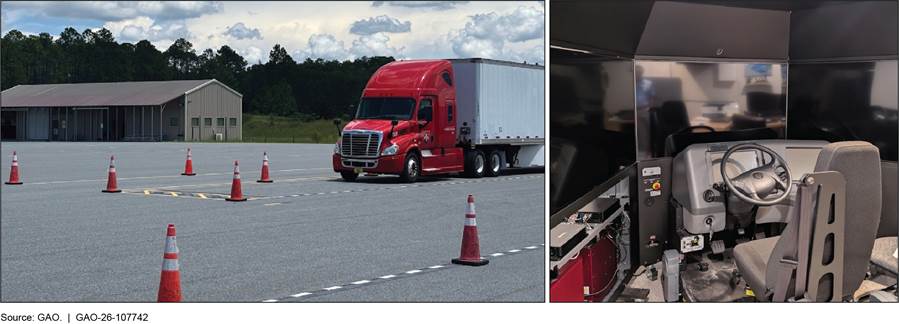
Training facility for commercial vehicle operators. In fiscal year 2019, EDA awarded $2.4 million from its fiscal year 2018 supplemental appropriation to Florida Gateway College in Lake City, Florida, to develop a training facility for commercial vehicle drivers (see fig. 9). The county experienced a hurricane in 2017. The facility includes a classroom, simulator, maintenance garage, and driving course to help students qualify for a commercial driver’s license. The project is designed to expand access to higher-paying employment in the region.
Figure 9: Driving Course and Simulator at Training Facility for Commercial Vehicle Operators in Lake City, Florida
Business incubator for technology companies. In fiscal year 2015, EDA awarded $8.1 million from its fiscal year 2008 supplemental appropriation to the University of Florida Board of Trustees to expand a business incubator in Gainesville, Florida (see fig. 10). The county experienced a tropical storm in 2008. The facility provides space for technology companies to develop and expand their businesses. The project is designed to diversify the economy and create jobs in innovative industries, such as advanced manufacturing.

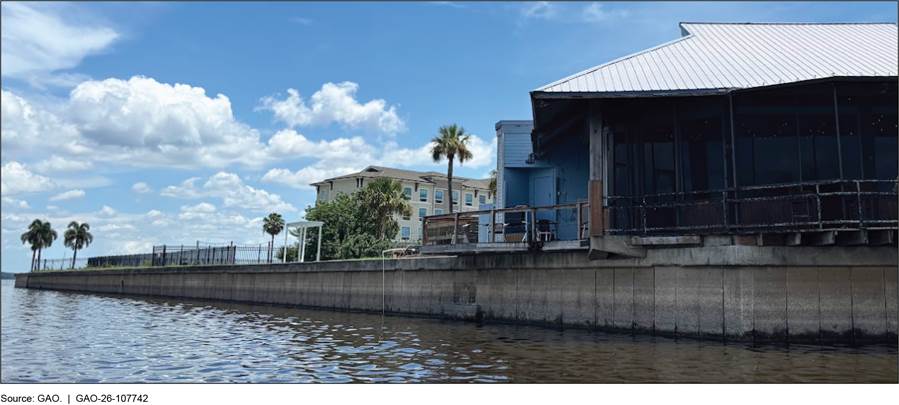
Elevated seawall around commercial area. In fiscal year 2024, EDA awarded $5 million from its fiscal year 2023 supplemental appropriation to the City of Sanford, Florida, to elevate the seawall around its downtown marina and commercial area (see fig. 11). The county experienced a hurricane in 2022. The project is designed to protect an underutilized commercial area from flooding and allow for redevelopment. As of July 2025, construction had not started on the project.
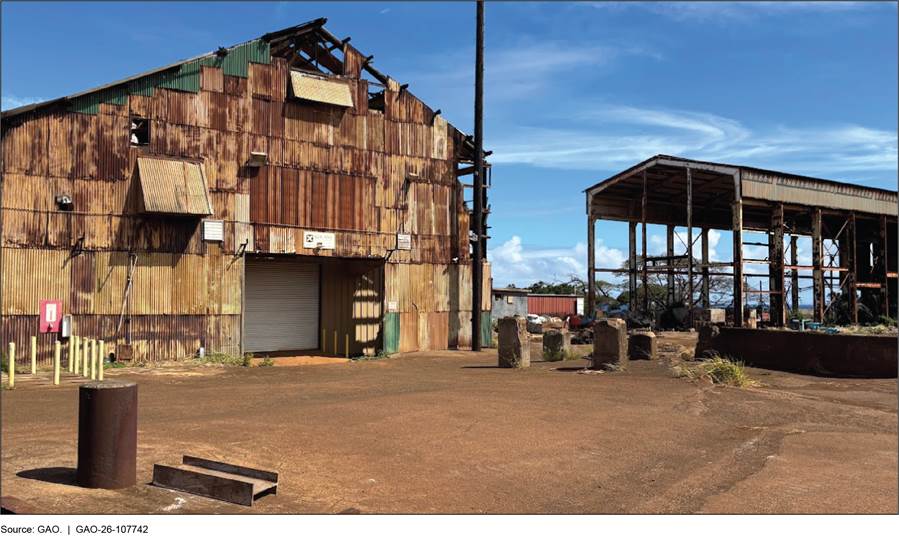
Advanced manufacturing partnership at former sugar mill. In fiscal year 2025, EDA awarded $600,000 from its fiscal year 2023 supplemental appropriation to the Maui Economic Development Board to help develop an advanced manufacturing partnership program in Paia, Hawaii (see fig. 12). The county experienced wildfires in 2023 but was eligible for the grant through a 2021 disaster declaration for severe storms and flooding. The grant is designed to create jobs by funding the development of an advanced manufacturing program. The grantees plan to redevelop a former sugar mill to attract and provide workspace for advanced manufacturing companies.
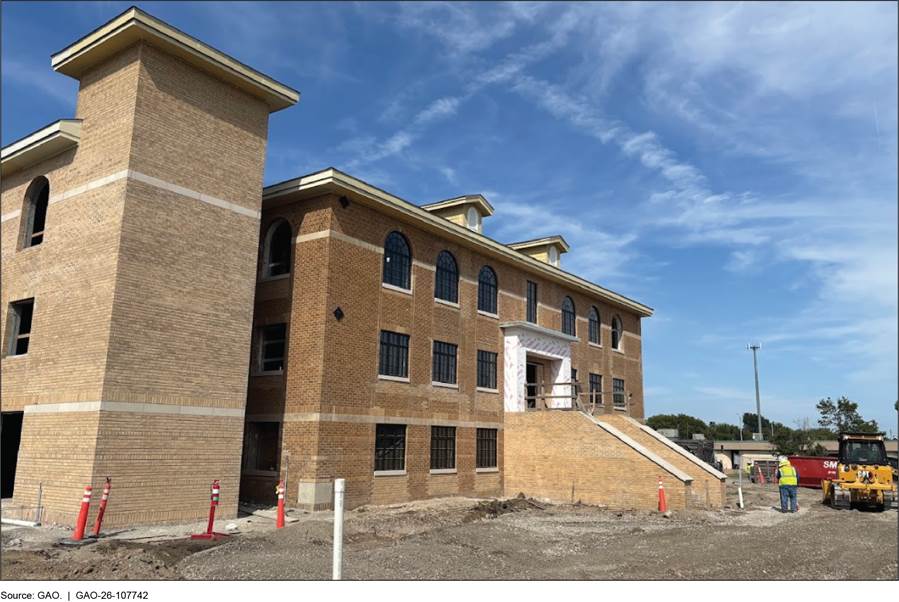
Business resource center for entrepreneurs. In fiscal year 2024, EDA awarded $3 million from its fiscal year 2023 supplemental appropriation to the Tulsa Economic Development Corporation to convert a former hospital in Tulsa, Oklahoma, to a business resource center for entrepreneurs (see fig. 13). The county experienced severe storms, tornadoes, and flooding in 2022. The center is designed to support entrepreneurs by providing business services, training, and spaces to meet and work.
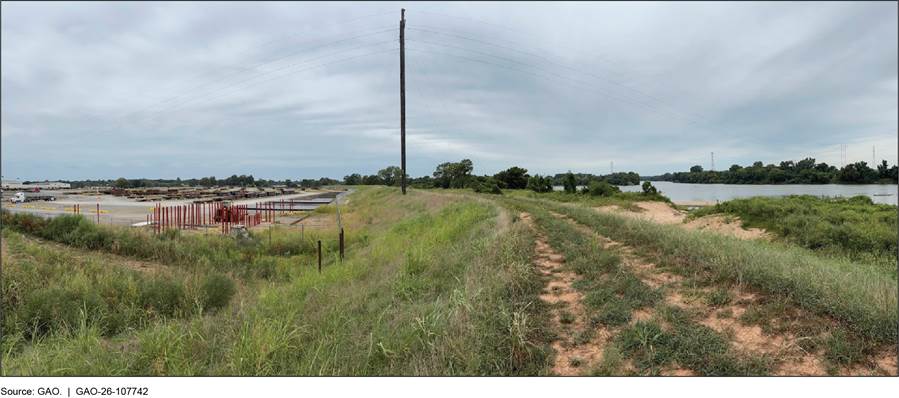
Levee at inland port. In fiscal year 2020, EDA awarded $4.9 million from its fiscal year 2019 supplemental appropriation to the Muskogee City-County Port Authority to build a levee and raise the elevation of two undeveloped sites (see fig. 14). The county experienced severe storms and flooding in 2019. The project is designed to mitigate future flood risk and protect infrastructure.
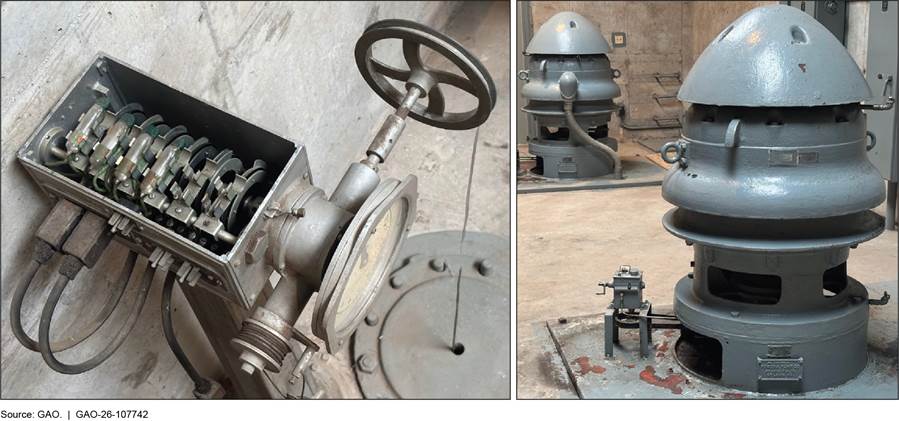
Outdated equipment in pump stations. In fiscal year 2020, EDA provided $3 million from its fiscal year 2019 supplemental appropriation to Tulsa County to replace equipment in two pump stations along the Arkansas River in Tulsa, Oklahoma (see fig. 15). The county experienced severe storms and flooding in 2019.[53] The project is designed to mitigate flood risk and protect businesses. According to project representatives, the equipment in the pump stations is about 80 years old and outdated. For example, one station operates using a glass bottle on a string and mercury-filled switches to activate the pumps as floodwaters rise. As of August 2025, the equipment had not been replaced.
EDA’s Most Recent Performance Measures Did Not Assess Disaster Recovery, and EDA Did Not Validate Key Performance Data
EDA used 26 key performance indicators (performance measures) to assess its performance in fiscal year 2024. These measures relied on administrative and grantee-reported data, and EDA has taken steps in recent years to enhance its data collection. EDA’s measures incorporated some attributes of successful performance measures but did not assess its disaster recovery work. In addition, the reliability of EDA’s performance measures is unknown because EDA does not validate grantee-reported data.
EDA Used 26 Performance Measures That Relied on Grantee-Reported Data and Recently Enhanced Data Collection
EDA used 26 performance measures for fiscal year 2024 (the most recent available at the time of our review) to assess its progress toward its strategic goals and investment priorities.[54] These measures included jobs created, jobs retained, private investment leveraged, and the number and dollar amount of EDA grants awarded across some of EDA’s investment priorities and programs (see table 3). EDA officials said they developed these performance measures in collaboration with Commerce’s Performance Excellence Council, primarily by reviewing whether quality data were available to assess EDA’s goals and priorities.[55]
Table 3: EDA’s Fiscal Year 2024 Performance Measures
|
Jobs created and retained |
|
Jobs created and retained · 3-year totals · 6-year totals · 9-year totals |
|
Number of jobs created and retained · for investments to support entrepreneurship · for grants made in communities and regions to support the travel and tourism sector · for grants made in underserved populations and geographies · for grants made to communities and regions to support workforce development |
|
Private investment leveraged |
|
Private investment leveraged · 3-year totals · 6-year totals · 9-year totals |
|
Total sum of funding secured by entrepreneurs as a result of activities sponsored by EDA investments |
|
Dollar amount of private investment leveraged · from investments to support entrepreneurship · from grants supporting environmentally sustainable development · from grants made to support the travel and tourism sector · from grants made in underserved populations and geographies · from grants made to communities and regions to support workforce development |
|
Dollar amount of grants awarded |
|
Dollar amount of economic development grants made to communities and regions to help build capacity · to support export-related activities and needs of businesses · to attract foreign direct investment · to support the innovation-related activities and needs of businesses · to support the manufacturing-related activities and needs of businesses |
|
Number or percentage of grants awarded |
|
Number of economic development grants made · to support environmentally sustainable investments · to communities and regions to help build the capacity to support the export-related activities and needs of businesses · to communities and regions to help build the capacity to attract foreign direct investment · to communities and regions to help build the capacity to support the innovation-related activities and needs of businesses · to communities and regions to help build the capacity to support the manufacturing-related activities and needs of businesses |
|
Percentage of EDA awards that support entrepreneurship in underserved communities and regions |
Source: GAO presentation of Economic Development Administration (EDA) information from the Department of Commerce. | GAO‑26‑107742
In addition to administrative data, EDA calculated its performance measures using grantee-reported data, which varied by project type.[56] For infrastructure awards, grantees were to report private investment leveraged, jobs created, and jobs retained as a result of EDA’s investments for 3, 6, and 9 years after the award. For non-infrastructure awards, grantees were to annually report program outputs, such as the number of events held, and outcomes, such as increased organizational capacity. EDA used some of these data to calculate its performance measures.
Since 2018, EDA has taken steps to enhance its performance data collection for all grants. For example, EDA began requiring disaster recovery grantees to report performance data for grants awarded using its fiscal year 2018 disaster supplemental appropriations. In June 2020, EDA also introduced new data collection procedures for non-infrastructure awards, including requirements for grantees to report on program outputs and capacity outcomes. As a result of these changes, grantees that receive disaster recovery awards are now required to report the same performance data as other EDA grantees. According to EDA officials, EDA took these steps in response to increasing supplemental appropriations for disaster recovery and an external study by SRI International.[57]
EDA’s Performance Measures Were Clear and Measurable but Did Not Assess Disaster Recovery
EDA’s performance measures generally incorporated several attributes of successful performance measures but did not assess EDA’s disaster recovery work. Specifically, the fiscal year 2024 performance measures—the most recent available—generally incorporated four of the nine attributes and partially incorporated five, according to our review of EDA and Commerce documentation and interviews with EDA officials (see table 4).[58]
Table 4: Comparison of EDA’s Performance Measures with GAO’s Key Attributes of Successful Performance Measures
|
Attribute |
Definition |
EDA alignment with attribute |
|
Linkage |
Measures are aligned with division and agencywide goals and mission and clearly communicated throughout the organization. |
◑ |
|
Clarity |
Measures are clearly stated, and the name and definition are consistent with the methodology used to calculate them. |
● |
|
Measurable target |
Measures have a numerical goal. |
● |
|
Objectivity |
Measures are reasonably free from significant bias or manipulation. |
● |
|
Reliability |
Measures produce the same result under similar conditions. |
◑ |
|
Core program activities |
Measures cover the activities that an entity is expected to perform to support the intent of the program. |
◑ |
|
Limited overlap |
Measures should provide new information beyond that provided by other measures. |
● |
|
Balance |
Balance exists when a suite of measures ensures that an organization’s various priorities are covered. |
◑ |
|
Government-wide priorities |
Each measure should cover a priority, such as quality, timeliness, and cost of service. |
◑ |
● = Generally incorporated ◑ = Partially incorporated ○ = Not incorporated
Source: GAO and GAO analysis of Economic Development Administration (EDA) fiscal year 2024 performance measures. | GAO‑26‑107742
EDA’s performance measures generally were clear and objective and had measurable targets and limited overlap.
· Clarity. EDA’s performance measures were clear. The names and definitions were clearly stated and aligned with EDA’s methods for calculating them.
· Measurable targets. EDA’s performance measures had measurable targets. They provided numerical targets and actual results for fiscal year 2024, including whether a target was exceeded, met, or not met.
· Objectivity. EDA’s performance measures were objective. Their names and definitions clearly indicated the activities to be measured (such as dollar amount of grants), conditions for those activities (such as grants to build capacity to attract foreign direct investment), and the time frame for the measurements (such as fiscal year 2024). The names and definitions of the measures were also free of opinion or judgment.
· Limited overlap. EDA’s performance measures did not overlap. They focused on distinct investment priorities, such as exports and foreign direct investment; program activities, such as travel and tourism; and time frames, such as 3-year and 6-year totals.
EDA’s performance measures partially incorporated the remaining five attributes of successful performance measures. For four attributes—linkage, core program activities, balance, and government-wide priorities—our assessment identified limitations in EDA’s ability to demonstrate how its disaster recovery work contributes to economic recovery and resilience. We address the fifth attribute (reliability) later in this section.
· Linkage. EDA’s performance measures partially aligned with its goals. Specifically, the measures aligned with three of five goals in Commerce’s 2022–2026 strategic plan. However, Commerce discontinued this plan in 2025. In December 2025, EDA officials said Commerce was developing a new strategic plan, which could take a year to complete.
· Core program activities. EDA’s performance measures covered some but not all of its core program activities. None of the measures assessed disaster recovery, which is a core EDA activity. The measures also did not assess key activities EDA has identified as central to its disaster recovery work: awarding disaster recovery grants, coordinating the Economic RSF, and supporting development of economic recovery strategies. By contrast, the measures did assess grantmaking for other EDA programs. For example, EDA had measures specific to its Travel, Tourism, and Outdoor Recreation program.[59]
· Balance. EDA’s performance measures partially met the balance attribute—that is, they covered some but not all of EDA’s priorities. They addressed all fiscal year 2024 investment priorities except recovery and resilience. After EDA’s investment priorities were updated by law in January 2025, EDA stopped using five measures related to equity and environmentally sustainable development. Of the remaining 21 measures, 12 did not address the updated investment priorities, including economic recovery resilience.
· Government-wide priorities. EDA’s performance measures partially addressed government-wide priorities. The measures focused exclusively on tracking outputs, such as the number of grants made, and outcomes, such as the number of jobs created. However, they did not assess other government-wide priorities, such as quality and timeliness in delivering assistance.
EDA’s performance measures may not fully capture the range of intended outcomes of its disaster recovery grants. According to EDA officials, disaster recovery projects are intended to support economic recovery and resilience and are not necessarily intended to directly create or retain jobs or generate private investment. For example, the fiscal year 2023 supplemental appropriation provided EDA with disaster recovery funding for flood mitigation, disaster relief, long-term recovery, and restoration of infrastructure. However, whether EDA’s grants achieved these or other intended outcomes is not known because EDA does not collect such information.
A portion of disaster recovery grantees reported gradual achievement of EDA’s measures for infrastructure grants but provided no insight into other intended outcomes.[60] We analyzed 292 disaster recovery grants for construction projects and revolving loan funds that EDA awarded from fiscal years 2014 through 2022, and for which performance data were available. We found that 55 percent of grantees reported that their projects did not create or retain jobs or generate private investment after 3 years. After 6 years, about 31 percent of grantees continued to report no job creation, job retention, or private investment.[61] In the absence of additional performance measures for disaster recovery grants, it is unclear how these projects achieved economic recovery and resilience.
In November 2024, EDA officials acknowledged the importance of using performance measures specific to disaster recovery grants, given the growing intensity and frequency of disasters in recent years. In December 2025, officials said they were developing a proposal to modify EDA’s performance measures, including a process to assess the outcomes of disaster recovery grants. However, according to EDA officials, accomplishing this work is challenging for several reasons:
· Performance measures do not reflect program-specific goals. EDA’s process for collecting performance data is designed to accommodate multiple types of grants and does not incorporate the goals of specific EDA programs. For example, recipients of disaster recovery infrastructure awards are not required to report how projects aided economic recovery and resilience beyond job creation, job retention, and private investment leveraged. Non-infrastructure grantees can respond to voluntary questions about such contributions, but EDA does not use these data because response rates are low.[62]
· Disaster recovery outcomes are difficult to measure. EDA officials said isolating the economic impact of EDA grants is challenging. Disaster-affected communities generally receive assistance from multiple agencies, and it is difficult to determine what would have occurred in the absence of EDA funding. We previously reported that limited research exists on the relationship between federal programs and recovery outcomes, which further complicates efforts to determine their effects.[63]
· EDA’s capacity to update its performance measures is limited. Officials said they had planned to refine the performance measurement process following a June 2020 update. However, they instead needed to prioritize other efforts, such as developing new data collection requirements for grants funded under supplemental appropriations in the CARES Act and American Rescue Plan Act of 2021. EDA’s ability to update its performance measures may be further limited by recent decreases in staffing levels.
Although isolating the economic effects of disaster recovery grants can be challenging, agencies can still develop performance measures that track key outputs, intended outcomes, or other priorities, such as timeliness in delivering assistance. Such measures do not need to establish the causal impact of EDA funding or determine what would have occurred in the absence of the grants but can track progress toward recovery goals.
EDA could also limit staff burden by building on its existing data collection systems to develop such measures. For example, EDA could create measures similar to those it uses for other investment priorities, such as the number of jobs created or retained by disaster recovery grants. EDA could also develop measures that more directly assess intended outcomes, such as flood mitigation or infrastructure restoration.
In addition, EDA could assess other government-wide priorities beyond outcomes. For example, EDA could assess its timeliness in providing assistance to communities. Improving the delivery of federal disaster assistance remains a key challenge across the federal government, and EDA officials said disaster-affected communities need timely capacity-building assistance to help them develop competitive applications.[64]
Developing performance measures specific to its disaster recovery work would allow EDA to track and assess how its assistance helps communities recover economically and become more resilient to disasters. Such measures would also help EDA to determine whether it has achieved the outcomes Congress intended, such as mitigating flood risk.
Reliability of Performance Measures Is Unknown Because EDA Does Not Validate Key Performance Data
The reliability of EDA’s performance measures is unknown because EDA does not validate grantee-reported data. Agencies are required to have verification and validation procedures in place to help ensure the accuracy and reliability of performance data.[65] We have previously reported that such procedures can improve data reliability—for example, by identifying significant errors through formal evaluation or audit.[66]
EDA’s measures related to job creation and retention and private investment rely on grantee-reported data. Grantees are required to report accurate and verifiable data on project outcomes and retain related records.[67] However, EDA officials said these data may have limitations, including potential bias.
EDA has taken some steps to help improve the quality of grantee-reported data. EDA provided guidance in its performance data collection forms to help grantees calculate and report consistent data on job creation. EDA also funded third-party program evaluations that used EDA administrative data and other federal and nonfederal data sources. According to EDA officials, these evaluations helped confirm the outcomes of EDA’s programs and provided a counterbalance to grantee-reported data. In addition, EDA staff said they review data submitted by non-infrastructure grantees to ensure the data are logical.
However, EDA currently does not validate data reported by infrastructure grantees, such as by requesting supporting documentation or reviewing grantee records. Officials said EDA previously conducted randomized site visits in two regions annually to validate a sample of grantee-reported data. During these visits, EDA selected seven infrastructure grants and met with grantees to validate the quality of reported data on jobs created or retained and private investment. EDA suspended these procedures during the COVID-19 pandemic and, as of December 2025, had not resumed them. Officials said resuming these procedures and validating grantee-reported data were challenging because of limited staff.
Nonetheless, validating performance data is a required and critical step to ensure that EDA’s performance measures are based on reliable information. Procedures designed to validate outcomes reported by infrastructure grantees could include periodically reviewing a sample of grantee performance records or requiring grantees to provide supporting documentation with performance reports. For example, the Appalachian Regional Commission generally requires grantees to provide letters from employers that verify the number of jobs created or retained by a grant project. By resuming such procedures, EDA would improve confidence that its reported outcomes accurately reflect progress toward its goals and provide useful information for decision-making.
Conclusions
EDA’s role after major disasters has significantly expanded in recent years to include delivering billions of dollars in financial assistance and coordinating federal support for economic recovery. At the same time, EDA’s staffing levels have decreased, returning to those of 2015–2018. As EDA works to rebalance its resources to meet these responsibilities, it can take steps to strengthen oversight and improve the delivery of disaster assistance to affected communities—a key challenge across the federal government.
· By implementing a way to periodically assess the Economic RSF’s progress in meeting its strategic outcomes, EDA could better understand and communicate whether the interagency effort is achieving its intended results.
· Updating operating documents for the Economic RSF would provide participating agencies with a consistent understanding of their responsibilities and better position them to support future Economic RSF missions.
· Developing and implementing performance measures that assess its disaster recovery work would enable EDA and policymakers to better understand how disaster recovery grants contribute to economic recovery and resilience and inform decision-making.
· Resuming procedures for validating grantee-reported data would improve confidence in reported outcomes and help EDA better assess the performance of its disaster recovery grants.
Recommendations for Executive Action
We are making the following four recommendations to EDA:
The Secretary of Commerce should ensure that EDA, in coordination with Economic RSF participating agencies, implements a way to periodically monitor, assess, and report on progress toward the Economic RSF’s strategic outcomes. (Recommendation 1)
The Secretary of Commerce should ensure that EDA, in coordination with Economic RSF participating agencies, updates the Economic RSF operating documents in a timely manner. (Recommendation 2)
The Secretary of Commerce should ensure that EDA implements performance measures that specifically address its disaster recovery work and intended outcomes. (Recommendation 3)
The Secretary of Commerce should ensure that EDA resumes procedures for validating grantee-reported performance data. (Recommendation 4)
Agency Comments
We provided a draft of this report to the Department of Agriculture, the Department of Commerce, the Department of Homeland Security, the Department of Labor, the Department of Housing and Urban Development, and SBA for review and comment.
The Department of Agriculture and the Department of Housing and Urban Development did not provide comments. The Department of Labor and SBA informed us that they did not have comments.
EDA provided comments via email and generally agreed with our recommendations.
· Regarding our first recommendation, EDA said implementing the recommendation will require coordination with FEMA and other participating agencies in the Economic RSF and that therefore the timing will be outside EDA’s sole control. EDA also said implementing this recommendation is dependent on developing performance measures to satisfy our third recommendation. However, implementing our first recommendation does not necessarily require EDA to develop new performance measures and could include nonquantitative procedures, such as annually reporting on the Economic RSF’s activities and achievements related to its strategic outcomes.
· Regarding our second recommendation, EDA said finalizing the Economic RSF’s operating documents will require FEMA to implement recommendations from the FEMA Review Council and obtain approval from FEMA and participating agencies.
· Regarding our third recommendation, EDA said it has started researching options but does not yet have a timeline for implementing defensible and rigorous performance measures for its disaster recovery grants.
· Regarding our fourth recommendation, EDA said adopting procedures to validate grantee-reported data is dependent on resources, which are finite and determined by congressional appropriations.
EDA and the Department of Homeland Security also provided technical comments, which we incorporated as appropriate.
We are sending copies of this report to the appropriate congressional committees, Secretary of Commerce, Secretary of Agriculture, Acting Secretary of Labor, Secretary of Homeland Security, Secretary of Housing and Urban Development, and Administrator of the Small Business Administration. In addition, the report is available at no charge on the GAO website at https://www.gao.gov.
If you or your staff have any questions about this report, please contact me at lafountainc@gao.gov. Contact points for our Offices of Congressional Relations and Media Relations may be found on the last page of this report. GAO staff who made key contributions to this report are listed in appendix II.

Courtney LaFountain
Director, Financial Markets and Community Investment
This report examines (1) the extent to which the Economic Development Administration’s (EDA) coordination of the Economic Recovery Support Function (RSF) has incorporated leading practices for interagency collaboration, as well as stakeholder views on the Economic RSF; (2) the amount EDA has awarded from supplemental appropriations for fiscal years 2018 through 2025; (3) how EDA has invested in economic recovery and resilience projects in disaster-affected communities; and (4) the extent to which EDA’s most recent performance measures for disaster recovery grants incorporated key attributes of successful performance measures.
Coordinating Federal Support for Economic Recovery
For our first objective, we analyzed data on Economic RSF missions from 2013 through 2025. We developed a list of missions and their characteristics using end-of-mission reports provided by EDA and the Federal Emergency Management Agency’s (FEMA) public data on mission assignments.[68] We assessed the reliability of FEMA’s data by reviewing technical documentation and testing the data for errors. We found that FEMA’s data were sufficiently reliable for identifying additional Economic RSF mission assignments, although potential errors may limit the data’s completeness and accuracy. EDA officials confirmed the accuracy of our list.
We reviewed the Economic RSF’s statements of work and end-of-mission reports to identify key activities and other characteristics of its missions. We assessed the extent to which EDA’s coordination of the Economic RSF incorporated leading practices for interagency collaboration.
To do so, we identified relevant leading practices and key considerations in our prior work.[69] We reviewed FEMA’s National Disaster Recovery Framework and the Economic RSF’s operating documents.[70] We also interviewed officials from EDA and selected participating agencies about key considerations for interagency collaboration. We selected participating agencies that were most frequently discussed in end-of-mission reports: the Department of Agriculture, the Department of Housing and Urban Development, the Department of Labor, FEMA, and the Small Business Administration. We used this information to determine whether EDA generally incorporated, partially incorporated, or did not incorporate the key considerations for each leading practice.
In addition, we evaluated EDA’s implementation of its Office of Disaster Recovery and Resilience. We interviewed EDA officials and reviewed documentation regarding the office. We compared the status of these efforts against requirements in the Thomas R. Carper Water Resources Development Act of 2024.[71] Specifically, we evaluated whether EDA had established the office by appointing personnel and designating an interagency disaster team.
Stakeholder Views on the Economic RSF
We held three discussion groups with selected stakeholders in disaster-affected communities to collect their views on the role of the Economic RSF. To select the communities, we first reviewed EDA and FEMA data to determine the three regions with the most Economic RSF missions since 2013 (Atlanta, Austin, Seattle). Next, we determined the most frequently occurring incident types in those regions (hurricane, flood, and severe storm). We selected recent Economic RSF missions to increase the likelihood that local stakeholders could provide complete feedback on their experiences with EDA and the Economic RSF and excluded ongoing missions to avoid burdening local officials involved in ongoing disaster recovery.
We then selected recent disasters in the three regions to reflect common disaster types and provide variation across disaster types. In the Atlanta region, we selected Hurricane Idalia, which affected Florida in 2023. In the Austin region, we selected the disaster designated as “Oklahoma severe storms, straight-line winds, tornadoes, and flooding,” which affected Oklahoma in 2024. In the Seattle region, we selected the Hawaii wildfires that affected Maui in 2023.
To identify stakeholders in these communities, we used EDA end-of-mission reports and recommendations from EDA regional staff regarding key stakeholders with whom they coordinated during associated Economic RSF missions, including state and local governments and regional economic development organizations.[72] We conducted one discussion group in each state, with four to seven stakeholders per group. We held the discussion groups from July through August 2025 and compared the results to identify common themes. Views expressed during the discussion groups may not be generalizable to all stakeholders in disaster-affected communities.
Disaster Recovery Grants
For our second and third objectives, we reviewed EDA data on disaster recovery grants awarded in fiscal years 2014–2024. The data included two types of funding streams: (1) grants funded through a supplemental appropriation for disaster recovery and (2) grants funded through regular appropriations that were labelled as funding disaster recovery projects. We assessed the reliability of the data by interviewing EDA officials responsible for managing the data, reviewing technical documentation, and testing the data for errors.
We found the data to be sufficiently reliable for describing the characteristics of EDA’s awards for disaster recovery grants. However, EDA could not efficiently reconcile its grant award data with the Department of Commerce’s data on disbursements to grantees and was unsure how completely and accurately regional staff performed such reconciliations. Given that awards are disbursed over time as reimbursements, project costs can change, and projects can be canceled, we determined that the data were not sufficiently reliable for describing EDA’s actual disbursements to grantees.
To describe the types of projects EDA funded, we grouped each grant by project type using labels we developed. To develop the labels, we reviewed EDA’s notices of funding opportunity and project descriptions to develop a set of exclusive categories. We then reviewed the project description for each grant and assigned it to the most appropriate of seven project types.[73] A separate member of the audit team reviewed the labels to confirm their appropriateness and reconcile differences. We merged these data with EDA’s grant and performance data, standardized the combined dataset, and calculated summary statistics.
We also reviewed the rate at which EDA obligated and disbursed funds from supplemental appropriations provided in fiscal years 2018, 2019, 2023, and 2025. We reviewed applicable laws to determine the amount of each appropriation available for disaster recovery awards. We calculated obligation and disbursement rates by comparing total obligations and disbursements with the amounts available, using data EDA provided in May 2026.
Lastly, we visited and photographed seven infrastructure projects to provide examples of how grantees used EDA’s supplemental appropriations for disaster recovery. We generally selected infrastructure projects that (1) received an award from a supplemental appropriation in fiscal years 2014–2024; (2) were located near the sites of the discussion groups in Florida, Hawaii, and Oklahoma; and (3) received an EDA award of more than $1 million. We prioritized projects located closest to the site of each discussion group.
Measuring the Performance of Disaster Recovery Grants
For our fourth objective, we assessed the extent to which EDA’s performance measures for its disaster recovery grants incorporated key attributes of successful performance measures we previously identified.[74] We identified EDA’s most recent performance measures using its performance reporting dashboard.[75] We compared the performance measures against our key attributes and determined whether each measure generally incorporated, partially incorporated, or did not incorporate the key attributes.
We interviewed EDA officials about the development of EDA’s performance measures and data collection procedures to determine whether appropriate controls existed to help ensure data quality. We also reviewed EDA’s documentation on performance measurement and data collection and the Department of Commerce’s strategic plan for fiscal years 2022–2026.[76]
We also summarized the performance of EDA disaster recovery grants using EDA grant data. Specifically, we examined the distribution of total jobs created and retained by infrastructure and construction projects that received awards from EDA’s fiscal year 2018 or 2019 disaster supplemental appropriation and reported performance data.
We assessed the reliability of these data by interviewing officials responsible for managing them and by testing the data for errors. Because the data are reported by grantees without additional validation by EDA, we identified limitations in their reliability. We determined that these data were sufficiently reliable for describing outcomes reported by recipients of infrastructure grants funded by the 2018 and 2019 supplemental appropriations, but not reliable for describing the economic effects of EDA’s disaster recovery grants. We interviewed EDA officials to obtain additional context about the distribution of the data.
We also interviewed representatives of three economic development organizations: the International Economic Development Council, National Association of Counties, and the National Association of Development Organizations.
We conducted this performance audit from August 2024 to July 2026 in accordance with generally accepted government auditing standards. Those standards require that we plan and perform the audit to obtain sufficient, appropriate evidence to provide a reasonable basis for our findings and conclusions based on our audit objectives. We believe the evidence obtained provides a reasonable basis for our findings and conclusions based on our audit objectives.
GAO Contact
Courtney LaFountain, lafountainc@gao.gov
Staff Acknowledgments
In addition to the contact above, Lisa Moore (Assistant Director), Allison M. Abrams (Assistant Director), Brandon Kruse (Analyst in Charge), Aditi S. Archer, Xiang Bi, Angélica Castillo, Jill N. Lacey, Elizabeth A. Leibinger, Alberto Lopez, Marc W. Molino, Erin T. Murphy, Barbara M. Roesmann, and Jennifer W. Schwartz made key contributions to this report.
The Government Accountability Office, the audit, evaluation, and investigative arm of Congress, exists to support Congress in meeting its constitutional responsibilities and to help improve the performance and accountability of the federal government for the American people. GAO examines the use of public funds; evaluates federal programs and policies; and provides analyses, recommendations, and other assistance to help Congress make informed oversight, policy, and funding decisions. GAO’s commitment to good government is reflected in its core values of accountability, integrity, and reliability.
Obtaining Copies of GAO Reports and Testimony
The fastest and easiest way to obtain copies of GAO documents at no cost is through our website. Each weekday afternoon, GAO posts on its website newly released reports, testimony, and correspondence. You can also subscribe to GAO’s email updates to receive notification of newly posted products.
Order by Phone
The price of each GAO publication reflects GAO’s actual cost of production and distribution and depends on the number of pages in the publication and whether the publication is printed in color or black and white. Pricing and ordering information is posted on GAO’s website, https://www.gao.gov/ordering.htm.
Place orders by calling (202) 512-6000, toll free (866) 801-7077,
or
TDD (202) 512-2537.
Orders may be paid for using American Express, Discover Card, MasterCard, Visa, check, or money order. Call for additional information.
Connect with GAO
Connect with GAO on X,
LinkedIn, Instagram, and YouTube.
Subscribe to our Email Updates. Listen to our Podcasts.
Visit GAO on the web at https://www.gao.gov.
To Report Fraud, Waste, and Abuse in Federal Programs
Contact FraudNet:
Website: https://www.gao.gov/about/what-gao-does/fraudnet
Automated answering system: (800) 424-5454
Media Relations
Sarah Kaczmarek, Managing Director, Media@gao.gov
Congressional Relations
David A. Powner, Acting Managing Director, CongRel@gao.gov
General Inquiries
[1]National Oceanic and Atmospheric Administration, “Billion-Dollar Weather and Climate Disasters,” accessed Mar. 9, 2026, https://www.ncei.noaa.gov/access/billions/time-series.
[2]EDA is a bureau within the Department of Commerce that focuses on economic development. Under its relevant disaster authorities, it awards grants to local communities and regions for planning, technical assistance, and infrastructure construction.
[3]GAO, High-Risk Series: Heightened Attention Could Save Billions More and Improve Government Efficiency and Effectiveness, GAO‑25‑107743 (Washington, D.C.: Feb. 25, 2025).
[4]S. Rep. No. 118-62, at 15 (2023), report accompanying S. 2321, Departments of Commerce and Justice, Science, and Related Agencies Appropriation Bill, 2024.
[5]Pub. L. No. 118-158, 138 Stat. 1723, 1754 (2024).
[6]We assessed the reliability of FEMA data by reviewing technical documentation and testing the data for errors. We found FEMA’s data to be sufficiently reliable for identifying additional Economic RSF mission assignments.
[7]GAO, Government Performance Management: Leading Practices to Enhance Interagency Collaboration and Address Crosscutting Challenges, GAO‑23‑105520 (Washington, D.C.: May 24, 2023).
[8]We assessed the reliability of EDA’s disaster recovery grant data by interviewing officials responsible for managing the data, reviewing technical documentation, and testing the data for errors. We found the data to be sufficiently reliable for describing the characteristics of EDA’s disaster recovery grant awards.
[9]GAO, Tax Administration: IRS Needs to Further Refine Its Tax Filing Season Performance Measures, GAO‑03‑143 (Washington, D.C.: Nov. 22, 2002).
[10]We assessed the reliability of EDA’s performance data by interviewing officials responsible for managing the data and testing the data for errors. As discussed later, we identified reliability concerns because the data are reported by grantees without additional validation by EDA. We determined that the data were sufficiently reliable for describing reported outcomes for recipients of infrastructure grants funded by the 2018 and 2019 supplemental appropriations, but not for describing the economic effects of EDA’s disaster recovery grants.
[11]Department of Homeland Security, National Disaster Recovery Framework, 3rd ed. (Dec.10, 2024).
[12]Federal Emergency Management Agency, Disaster Relief Fund: Monthly Report as of September 30, 2025 (Oct. 22, 2025).
[13]American Relief Act, 2025, Pub. L. No. 118-158, div. B, tit. XII, 138 Stat. 1722, 1758 (2024).
[14]Pub. L. No. 118-158, div. B, tit. V, 138 Stat. 1722, 1744 and the Full-Year Continuing Appropriations and Extensions Act, 2025, Pub. L. No. 119-4, div. A, tit. VI § 1604, 139 Stat. 9, 27.
[15]Pub. L. No. 118-158, div. B, tit. I, 138 Stat. 1722, 1726 (2024).
[16]Pub. L. No. 118-158, div. B, tit. II, 138 Stat. 1722, 1734 (2004). Congress provided $1.51 billion. Of this amount, $1.448 billion is available for grants because the act required EDA to transfer $10 million to the Delta Regional Authority and $7 million to Commerce’s Office of Inspector General, and made up to 3 percent available for salaries and expenses.
[17]Pub. L. No. 118-272, tit. II, 138 Stat. 2992, 3176.
[18]EDA’s appropriation included $400 million for grants and $66 million for salaries and expenses. Pub. L. No. 119-74, div. A, tit. I, 140 Stat. 5, 7.
[19]Office of Management and Budget, Budget of the U.S. Government, Appendix (Washington, D.C.: April 2026).
[20]Economic development districts are EDA-designated multijurisdictional entities (commonly consisting of multiple counties) that coordinate regional economic development.
[21]EDA’s investment priorities were previously determined by each administration. The current priorities were codified in law in January 2025. Pub. L. No. 118-272, § 2218, 138 Stat. 2992, 3182 (2024) (codified at 42 U.S.C. § 3148).
[22]EDA’s disaster recovery activities also include helping communities develop economic recovery strategies. EDA’s Economic Adjustment Assistance and Public Works programs require communities to develop an EDA-approved plan for regional economic development, known as a comprehensive economic development strategy, which is to include a section on economic resilience.
[23]This amount excludes about $4.5 billion that EDA received through two pandemic-related supplemental appropriations.
[24]We held discussion groups with government, nonprofit, and industry stakeholders in Florida, Hawaii, and Oklahoma from July through August 2025. The selected stakeholders discussed their experiences with Economic RSF missions following Hurricane Idalia in Florida in 2023, the Hawaii wildfires in 2023, and severe storms, straight-line winds, tornadoes, and flooding in Oklahoma in 2024. Views expressed by stakeholders during the discussion groups may not be generalizable to all stakeholders in disaster-affected communities. For more information on the discussion groups, see app. I.
[25]The majority of EDA’s disaster recovery grants are funded with supplemental appropriations and may not be immediately available after a disaster. Programs administered by other participating agencies can provide more immediate financial assistance to support the early stage of economic recovery, known as economic stabilization.
[26]Interagency collaboration involves collaboration or coordination between two or more federal entities that is intended to produce more public value than could be achieved when the entities act alone. In prior work, we identified eight leading practices that can help enhance interagency collaboration. In 2012, we identified these practices by interviewing academic and practitioner experts in the field of collaboration and reviewing their work and prior GAO reports. In 2023, we validated these practices through similar methods. See GAO‑23‑105520.
[27]GAO, Evidence-Based Policymaking: Survey Results Suggest Increased Use of Performance Information Across the Federal Government, GAO‑22‑103910 (Washington, D.C.: Nov. 3, 2021); Evidence-Based Policymaking: Survey Data Identify Opportunities to Strengthen Capacity Across Federal Agencies, GAO‑21‑536 (Washington, D.C.: July 27, 2021); and Managing for Results: Implementation Approaches Used to Enhance Collaboration in Interagency Groups, GAO‑14‑220 (Washington, D.C.: Feb. 14, 2014).
[28]GAO, Results-Oriented Government: Practices That Can Help Enhance and Sustain Collaboration Among Federal Agencies, GAO‑06‑15 (Washington, D.C.: Oct. 21, 2005).
[29]EDA developed several operating documents through FEMA’s Capability Enhancement Project in 2021, including the Economic RSF Field Operations Manual, Economic RSF Concept of Operations, Economic RSF Partnership and Communication Strategy, and Economic RSF Training Approach.
[30]The third edition of the National Disaster Recovery Framework identifies “Commerce/EDA” as the coordinating agency for the Economic RSF.
[31]Executive Order 14180 created a council to assess the role of FEMA in disaster recovery and provide recommendations to improve it. Exec. Order No. 14180, Council To Assess the Federal Emergency Management Agency, 90 Fed. Reg. 8743 (Jan. 31, 2025). In addition, Executive Order 14239 requires the Secretary of Homeland Security to review and propose changes to FEMA’s national frameworks (including the National Disaster Recovery Framework and current RSF structure) by March 18, 2026. Exec. Order No. 14239, Achieving Efficiency Through State and Local Preparedness, 90 Fed. Reg. 13267 (Mar. 21, 2025). This review had not been completed as of April 8, 2026.
[32]The President’s Council to Assess the Federal Emergency Management Agency, Final Report (May 7, 2026).
[33]In December 2024, FEMA published the third edition of the National Disaster Recovery Framework, which updated the list of participating agencies in the Economic RSF.
[34]FEMA’s TRAX is a collaborative online platform to manage disaster recovery missions across partners from state, local, tribal, and territorial governments and other federal agencies.
[35]Federal Emergency Management Agency, “RSF Readiness Summary” (July 23, 2025).
[36]EDA employs a Director of Economic Development Integration and Disaster Recovery and a national coordinator, who manage EDA’s disaster recovery work and the Economic RSF. Headquarters and regional staff support Economic RSF missions as needed. In April 2026, EDA’s workforce had decreased to 185 employees, comparable to fiscal years 2015–2018 but a reduction from 324 employees in fiscal year 2023. EDA officials said these reductions did not limit its disaster recovery capacity and were appropriate given congressional appropriations and the administration’s priorities. They also said EDA had retrained staff to address challenges identified in the FEMA assessment and had hired 17 temporary staff to manage grants funded by the fiscal year 2025 supplemental appropriation.
[37]Stakeholders in all three discussion groups said EDA’s regional staff were critical to the success of their recovery efforts. Stakeholders in two discussion groups identified capacity challenges.
[38]Pub. L. No. 118-272, § 2228, 138 Stat. 2992, 3192 (2025) (codified at 42 U.S.C. § 3199).
[39]42 U.S.C. § 3199(d). The Secretary of Commerce must also continue to submit such a report yearly.
[41]Each supplemental appropriation specified an amount available for salaries and expenses for administration and oversight, investigations and audits by the Office of Inspector General, and other purposes.
[42]Applications for the large-scale projects, known as industry transformation grants, were due in March 2026. According to EDA officials, recent changes require that all awards be approved by the Secretary of Commerce or their delegee. EDA officials said this review was intended to comply with Executive Order 14222. Exec. Order No. 14222, Implementing the President’s “Department of Government Efficiency” Cost Efficiency Initiative, 90 Fed. Reg. 11095 (Mar. 3, 2025). The executive order requires agencies to, among other things, create a system to track every payment, and the system must have the capability to allow the Secretary (or delegee) to pause and review a payment. It also requires agencies to review all contracting policies and procedures.
[43]The data we analyzed included all awards from supplemental appropriations, as well as awards from EDA’s regular appropriations that supported disaster response or mitigation. According to EDA officials, some grants funded through regular appropriations may have been excluded because staff may not have categorized them as being disaster related. In addition, the grant data we analyzed describe EDA’s obligations and do not necessarily describe EDA’s disbursement of funds to grantees. EDA’s grants are generally disbursed to grantees as reimbursements after they incur allowable costs. Some grantees may not have started or completed their projects and therefore have not received the full amount of funds awarded. In addition, grantees can cancel projects or modify project costs after funds are awarded. EDA officials said they cannot efficiently reconcile the data they maintain on grant awards with Commerce’s records on disbursements and did not know how completely and accurately regional staff manually updated key fields, such as the status of the grant. We have ongoing work on EDA that will discuss these data issues further.
[44]EDA awarded 86 percent of disaster recovery funds through Economic Adjustment Assistance, 12 percent through the Public Works program, and 1 percent through planning, technical assistance, and other programs.
[45]The share of each project that EDA funded varied from 57 percent in fiscal year 2015 to 75 percent in fiscal years 2020 and 2024. EDA’s maximum investment rate is 60 percent. EDA is permitted to increase this rate to 90 percent based on relative needs, and up to 100 percent in certain circumstances. 13 C.F.R. § 301.4. Grantees can match EDA’s award from different sources, including state or local funds and in-kind contributions.
[46]GAO, Disaster Recovery: Actions Needed to Improve the Federal Approach, GAO‑23‑104956 (Washington, D.C.: Nov. 15, 2022).
[47]The data we reviewed describe EDA’s obligations and do not necessarily describe the amount that EDA has or will disburse to grantees. See app. I for more information.
[48]In fiscal year 2018, revolving loan funds made up a significantly larger share of EDA’s awards because of a $40 million grant to the Florida Department of Economic Opportunity after Hurricane Irma.
[49]In addition, about 8 percent of grantees were state governments, 3 percent were tribal governments, 3 percent were regional economic development organizations, and 2 percent were other types of organizations.
[50]In fiscal year 2015, educational institutions received half of the funding awarded because of an $8.1 million grant to the University of Florida Board of Trustees for a business incubator. In addition, the share of funds awarded to regional economic development organizations decreased over the review period.
[51]We have ongoing work examining EDA’s policies and regulations that could create challenges for smaller communities in accessing EDA grants.
[52]We conducted discussion groups with stakeholders in communities affected by major disasters in Florida, Hawaii, and Oklahoma, which we selected to be representative of prior Economic RSF missions in terms of EDA region and disaster type. We selected grant projects to observe by considering their proximity to these communities and the amount of their EDA award.
[53]Pump stations remove stormwater from flooded areas near rivers and other bodies of water.
[54]Commerce’s strategic goals for fiscal years 2022–2026 include (1) drive U.S. innovation and global competitiveness, (2) foster inclusive capitalism and equitable economic growth, and (3) address the climate crisis through mitigation, adaptation, and resilience efforts. According to EDA officials, Commerce has been developing a new strategic plan but did not provide a timeline for its completion. As discussed, EDA has five investment priorities (critical infrastructure, workforce, innovation and entrepreneurship, economic recovery resilience, and manufacturing), which were established by law in January 2025. The performance measures we reviewed were based on EDA’s prior investment priorities established in April 2021 (equity, recovery and resilience, workforce development, manufacturing, technology-based economic development, environmentally sustainable development, and exports and foreign direct investment).
[55]The council is a component of Commerce’s Office of Performance Excellence, which is responsible for the department’s performance management.
[56]Grantees are required to provide accurate and verifiable information, maintain records, and use independent sources when possible to report on the effectiveness of EDA’s grants in fulfilling their projects’ purposes and goals, including creating and retaining jobs and generating private investment. 13 C.F.R. § 302.16 and Economic Development Administration, “Standard Terms and Conditions for Construction Projects” (Washington, D.C.: March 2021).
[57]EDA funded and contributed to this study. SRI International, Innovative Metrics for Economic Development: Final Report (Nov. 17, 2017).
[58]Organizations should have performance measures that demonstrate results, are limited to the vital few, cover multiple priorities, and provide useful information for decision-making to track how programs and activities can contribute to attaining an organization’s goals and mission. We identified nine attributes of successful performance measures. See GAO‑03‑143.
[59]The American Rescue Plan Act of 2021 provided funding that was used to establish this program. Pub. L. No. 117-2, § 6001, 135 Stat. 4, 93.
[60]As discussed, EDA tracks jobs created, jobs retained, and private investment leveraged for its infrastructure grants.
[61]EDA officials told us they consider data reported at 6 and 9 years to be more useful for assessing the performance of construction projects because they may not be complete after 3 years. Of the 292 grants with performance data, 55 reported outcomes after 6 years. In addition, 18 reported outcomes after 9 years. Of these, all but two reported that their grants created or retained jobs or generated private investment.
[62]Officials said EDA had a performance measure related to resilience but discontinued it because it was too broad and included most of EDA’s grants.
[63]GAO, Disaster Recovery: Additional Actions Needed to Identify and Address Potential Recovery Barriers, GAO‑22‑104039 (Washington, D.C.: Dec. 15, 2021).
[65]Office of Management and Budget, Preparation, Submission, and Execution of the Budget, OMB Circular No. A-11 (Washington, D.C.: Aug. 29, 2025).
[67]13 C.F.R. § 302.16.
[68]OpenFEMA Dataset: Mission Assignments - v2, last modified Mar. 26, 2026, https://www.fema.gov/openfema‑data‑page/mission‑assignments‑v2.
[69]GAO, Government Performance Management: Leading Practices to Enhance Interagency Collaboration and Address Crosscutting Challenges, GAO‑23‑105520 (Washington, D.C.: May 24, 2023).
[70]Federal Emergency Management Agency, National Disaster Recovery Framework, 3rd ed. (Dec.10, 2024). Also see Economic Development Administration, “Economic Recovery Support Function (RSF) Training Approach” (June 2021); “Economic Recovery Support Function (RSF) Partnership and Communications Strategy” (June 2021); “Economic Recovery Support Function (RSF) Concept of Operations Plan (CONOPS)” (June 2021); and “Economic Recovery Support Function (RSF) Field Operations Manual” (June 2021).
[71]Pub. L. No. 118–272, § 2228, 138 Stat. 2992, 3192 (2025), (codified at 42 U.S.C. § 3199).
[72]In Florida, the discussion group had representatives from CareerSource Citrus Levy Marion, the City of Cedar Key, the Florida Department of Commerce, Florida Sea Grant, and the North Central Florida Regional Planning Council. In Hawaii, the discussion group had representatives from the Hawaii Department of Business, Economic Development and Tourism; Hawaii Office of Planning and Sustainable Development; Maui Advanced Manufacturing Alliance; Maui Economic Development Board; Maui County Office of Economic Development; One Shared Future; and SR Partners LLC. In Oklahoma, the discussion group had representatives from the City of Marietta, City of Sulphur, Indian Nations Council of Governments, and the Southern Oklahoma Development Association.
[73]The seven project types we identified were (1) utilities, roadways, and other public infrastructure; (2) construction of business, medical, training, and other facilities; (3) airport and port enhancements; (4) capacity building, marketing, and planning for economic development; (5) revolving loan funds; (6) technical assistance and training programs for business and workforce development; and (7) equipment for manufacturing, medical, and workforce development programs.
[74]GAO, Tax Administration: IRS Needs to Further Refine Its Tax Filing Season Performance Measures, GAO‑03‑143 (Washington, D.C.: Nov. 22, 2002).
[75]Department of Commerce, EDA Performance Dashboard, last modified Sept. 30, 2024, https://performance.commerce.gov/stories/s/EDA-Performance-Dashboard/yffr-pn4z/.
[76]Department of Commerce, Strategic Plan 2022–2026 (Washington, D.C.: Mar. 22, 2022).