
Report to the Ranking Member Committee on Natural Resources
House of Representatives
United States Government Accountability Office
A report to the Ranking Member, Committee on Natural Resources, House of Representatives
For more information, contact: Janet McKelvey at mckelveyj@gao.gov
What GAO Found
The Department of Homeland Security’s (DHS) Federal Emergency Management Agency (FEMA), the Department of Housing and Urban Development (HUD), and the Department of Energy (DOE) have obligated about $14 billion for Puerto Rico’s grid recovery and modernization since 2017, but limited funding has been disbursed. About $2.7 billion of about $11.1 billion obligated by FEMA has been disbursed since 2017, largely for equipment and materials and architecture and engineering. In addition to FEMA, HUD and DOE obligated about $2.3 billion and $937 million respectively. However, most of these funds have not been disbursed. Moreover, DOE has reallotted or canceled about $715 million originally for community and low-income households’ solar projects to address grid stability and other needs yet to be determined.
Limited progress has been made toward grid stability in key areas using federal assistance, with nine large FEMA projects complete. Key areas include repairing select transmission lines; modernizing operations; and clearing vegetation from transmission and distribution lines. Stakeholders cited clearing vegetation as an urgent priority; however, as of February 2026, about 400 miles had been cleared using federal funds out of 16,000 miles planned for vegetation clearing.
According to stakeholders GAO interviewed, several factors are hindering progress, including project review processes, staff turnover, the complexity of project funding, the Puerto Rico Electric Power Authority’s (PREPA) financial condition, and uncertainty around entities involved in recovery. Subsequent disasters and compounding events have also complicated the recovery. However, opportunities exist to improve federal assistance. For example, FEMA’s review process involves conducting required environmental and historic preservation reviews that some stakeholders said can extend the review process by months or years. FEMA has taken steps to streamline the process, such as by adopting categorical exclusions, but it has not updated guidance to reflect these flexibilities. Also, objectives, and roles and responsibilities of key entities are not fully documented, and a formal coordination mechanism that includes all relevant Puerto Rico and federal entities does not exist. Given the complexity of funding and the numerous stakeholders involved, documenting roles and responsibilities, and establishing a coordination mechanism could help enhance efficiency.
Why GAO Did This Study
In 2017, hurricanes knocked out Puerto Rico's electricity grid, causing an 11-month blackout. Since 2017, a series of disasters—including earthquakes in 2019 and 2020 and Hurricane Fiona in 2022—have disrupted the recovery of Puerto Rico’s electricity grid. In recent years, power outages have become more frequent, including a total blackout in April 2025, that lasted almost 2 days.
The federal government has appropriated billions of dollars to support Puerto Rico’s grid recovery and modernization. FEMA, HUD, and DOE support Puerto Rico’s grid recovery by providing financial assistance. GAO was asked to examine federal efforts to support Puerto Rico’s grid recovery and modernization. This report examines (1) the financial assistance that FEMA, HUD, and DOE have provided to support Puerto Rico’s grid recovery since 2017; and (2) how FEMA, HUD, and DOE financial assistance has supported Puerto Rico’s grid recovery and modernization, and any factors hindering progress.
GAO analyzed relevant documents and data; conducted a site visit; and interviewed federal and Puerto Rico officials as well as representatives from contractors operating and maintaining PREPA facilities and assets, including LUMA Energy and Genera PR.
What GAO Recommends
GAO is making five recommendations— three to FEMA, and two to DOE— including that FEMA update guidance to reflect any flexibilities, such as categorical exclusions. GAO is also recommending that DOE, in coordination with other entities, clarify objectives, roles, and responsibilities; and establish a mechanism for collaboration. DHS and DOE agreed with GAO’s recommendations.
|
Abbreviations |
|
|
|
|
|
CDBG |
Community Development Block Grant |
|
CDBG-DR |
Community Development Block Grant-Disaster Recovery |
|
CDBG-MIT |
Community Development Block Grant-Mitigation |
|
COR3 |
Central Office for Recovery, Reconstruction, and Resiliency |
|
DOE |
Department of Energy |
|
DHS |
Department of Homeland Security |
|
ER1 |
Energy Grid Rehabilitation and Reconstruction Cost-Share Program |
|
ER2 |
Electrical Power Reliability and Resilience Program |
|
FAASt |
FEMA Accelerated Awards Strategy |
|
FEMA |
Federal Emergency Management Agency |
|
FOMB |
Financial Oversight and Management Board for Puerto Rico |
|
HUD |
Department of Housing and Urban Development |
|
NEPA |
National Environmental Policy Act |
|
PRDOH |
Puerto Rico Department of Housing |
|
PREB |
Puerto Rico Energy Bureau |
|
PR-ERF |
Puerto Rico Energy Resilience Fund |
|
PREPA |
Puerto Rico Electric Power Authority |
|
Stafford Act |
Robert T. Stafford Disaster Relief and Emergency Assistance Act |
This is a work of the U.S. government and is not subject to copyright protection in the United States. The published product may be reproduced and distributed in its entirety without further permission from GAO. However, because this work may contain copyrighted images or other material, permission from the copyright holder may be necessary if you wish to reproduce this material separately.
June 2, 2026
The Honorable Jared Huffman
Ranking Member
Committee on Natural Resources
House of Representatives
Dear Ranking Member Huffman:
In 2017, hurricanes knocked out Puerto Rico’s electricity grid and caused an 11-month blackout—the longest in U.S. history. The electricity grid was in poor condition prior to the 2017 hurricanes, largely because of the Puerto Rico Electric Power Authority’s (PREPA) underinvestment and poor maintenance practices.[1] Furthermore, PREPA was approximately $9 billion in debt prior to Hurricane Maria.
Since 2017, a series of natural disasters—including earthquakes in 2019 and 2020 and Hurricane Fiona in 2022—have disrupted the recovery of Puerto Rico’s electricity grid. In recent years, power outages have become more frequent, including a total blackout in April 2025 that lasted almost 2 days. Furthermore, residents in Puerto Rico lose power more often than residents in any state,[2] and electricity continues to be relatively expensive.[3]
The federal government has appropriated billions of dollars to support Puerto Rico’s grid recovery and modernization. The Department of Homeland Security’s (DHS) Federal Emergency Management Agency (FEMA), the Department of Housing and Urban Development (HUD), and the Department of Energy (DOE) play a significant role in supporting Puerto Rico’s electricity grid recovery by providing financial assistance.
Several Puerto Rican entities also play a role. For example, PREPA is the public electric utility and owner of Puerto Rico’s energy assets. The Puerto Rico Energy Bureau (PREB) is the independent utility commission that regulates, monitors, and enforces Puerto Rico’s energy policy, including approving electricity rates. Additionally, Puerto Rico created the Central Office for Recovery, Reconstruction, and Resiliency (COR3) in 2017, which receives FEMA funding (i.e., is the recipient), and, in turn, provides funds to subrecipients such as PREPA.
We have previously reported on Puerto Rico’s disaster recovery efforts. For example, in October 2019, we identified several challenges that hindered grid recovery efforts, and we made several recommendations to FEMA and HUD that the agencies addressed.[4]
You asked us to examine federal efforts to support Puerto Rico’s grid recovery and modernization.[5] This report examines (1) the financial assistance that FEMA, HUD, and DOE have provided to support Puerto Rico’s grid recovery since 2017; and (2) how FEMA, HUD, and DOE financial assistance has supported Puerto Rico’s grid recovery and modernization, and any factors hindering progress.
To address both objectives, we analyzed funding data from FEMA, HUD, DOE, and the Puerto Rico Department of Housing, for relevant programs such as FEMA’s Public Assistance and Hazard Mitigation Grant Program, HUD’s Community Development Block Grant (CDBG), and DOE’s Puerto Rico Energy Resilience Fund (PR-ERF).[6] We also analyzed project completion data for large projects from COR3.[7] We assessed the reliability of the funding data by (1) reviewing existing information about the data and the systems that produced them, and (2) interviewing agency officials knowledgeable about the data. We determined that the data were sufficiently reliable for reporting the status of financial assistance that FEMA, HUD, and DOE provided to support Puerto Rico’s grid since 2017. We also reviewed documentation on financial and technical assistance, such as interagency reimbursable work agreements between FEMA and DOE.
In addition, we reviewed multiple reports and interviewed federal officials from FEMA, HUD, and DOE.[8] We also interviewed Puerto Rico government officials from COR3, PREB, the Puerto Rico Public-Private Partnerships Authority, PREPA, and the Puerto Rico Department of Housing. In addition, we interviewed officials from the Financial Oversight and Management Board for Puerto Rico, Puerto Rico’s Office of the Energy Czar, and from LUMA Energy—the contractor operating and maintaining PREPA’s facilities including the transmission and distribution system. Finally, we interviewed officials from Genera PR—the contractor operating and maintaining PREPA’s generation assets.[9] For the purposes of this report, unless named, we refer to all non-federal officials as stakeholders. We identified factors hindering progress through our interviews with federal officials and stakeholders. We compared factors identified by the stakeholders to relevant criteria, including the Disaster Resilience Framework and Standards for Internal Control in the Federal Government relating to documenting responsibilities through policies and establishing structure, responsibility, and authority, and consideration of excessive pressures.[10]
Finally, we conducted a site visit to Puerto Rico in February 2025 to observe federally funded projects.[11] For additional details regarding our objectives, scope, and methodology, see appendix I.
We conducted this performance audit from August 2024 to June 2026 in accordance with generally accepted government auditing standards. Those standards require that we plan and perform the audit to obtain sufficient, appropriate evidence to provide a reasonable basis for our findings and conclusions based on our audit objectives. We believe that the evidence obtained provides a reasonable basis for our findings and conclusions based on our audit objectives.
Background
Puerto Rico’s Electricity Grid
Puerto Rico’s electricity grid serves about 1.5 million customers, according to the Energy Information Administration. Puerto Rico’s grid is complex, isolated, reliant on imported fuels, and vulnerable to extreme weather events and other natural hazards.[12] Puerto Rico relies heavily on fossil fuel-fired power plants to generate most of its electricity, but it established a goal to meet 100 percent of its electricity needs with renewable energy by 2050.[13] Puerto Rico’s largest and most significant generating facilities are in the south and provide power to major population centers in the north.[14] Power is transmitted through the grid’s network of transmission lines.
Since June 2021, LUMA Energy has operated Puerto Rico’s electricity transmission and distribution system, which includes more than 400 substations and 1,100 distribution feeders across over 16,000 miles of overhead and underground distribution lines.[15] Genera PR has operated generation assets across Puerto Rico since July 2023.
Puerto Rico Entities and Grid Recovery Plans
Several Puerto Rico entities are involved in Puerto Rico’s grid recovery and modernization as shown in table 1.
|
Entity/purpose |
Description |
|
Electric Utility and Operators |
|
|
Puerto Rico Electric Power Authority (PREPA) |
Public electric utility that owns Puerto Rico’s energy assets and dams. Subrecipient of Federal Emergency Management Agency funds. It was about $9 billion in debt prior to Hurricane Maria. |
|
LUMA Energy |
Operates PREPA’s transmission, distribution and communication systems and facilities, since June 1, 2021. Also operates customer interface and billing. |
|
Genera PR |
Operates PREPA’s legacy asset generation, since July 1, 2023. Also, responsible for maintaining and eventually decommissioning aging generation assets.a |
|
Conduct Oversight of PREPA and Operators |
|
|
Financial Oversight and Management Board for Puerto Rico |
Oversees Puerto Rico’s fiscal and financial recovery by certifying PREPA’s fiscal plans and budgets, and leading the restructuring of its debt.b Also responsible for reviewing contracts above $10 million to ensure they promote market competition and are consistent with approved fiscal plans.c |
|
Puerto Rico Energy Bureau |
Established in 2014. Independent utility commission that regulates, monitors, and enforces Puerto Rico’s energy public policy, including approving electricity rates. Also approves the Integrated Resource Plan. Evaluates projects proposed by operators and PREPA for alignment with the Integrated Resource Plan. |
|
Puerto Rico’s Office of the Energy Czard |
Established in January 2025 by the Governor of Puerto Rico to achieve efficiency, goal alignment, supervision of operators, and acceleration of the energy system’s recovery. |
|
Puerto Rico Public-Private Partnerships Authority |
Established in 2009 as a public corporation to facilitate economic development by establishing partnerships between the government and private entities.e Oversees the LUMA Energy and Genera PR contracts. |
|
Administer Federal Funding |
|
|
Central Office for Recovery, Reconstruction, and Resiliency |
Established in 2017 to administer federal funding for grid projects and provide funds to subrecipients such as the Puerto Rico Electric Power Authority. Amendment 5 to the President’s disaster declaration imposed several grant conditions, including that Puerto Rico establish an oversight authority supported by third-party experts. This authority acts as the grant recipient for all FEMA Public Assistance and hazard mitigation funding to ensure sound project management and enhanced, centralized oversight over FEMA grant distributions.f |
|
Puerto Rico Department of Housing |
Administers the U.S. Department of Housing and Urban Development’s Community Development Block Grant Disaster Recovery and Mitigation funds to support Puerto Rico’s grid recovery and modernization, seeking to ensure compliance with federal requirements and prioritizing benefits for low and moderate-income populations. |
Source: GAO analysis of reports and documents from GAO, the Department of Energy, the Department of Housing and Urban Development, the Federal Emergency Management Agency (FEMA) and Puerto Rico entities. | GAO‑26‑107772
aPREPA is responsible for dams and hydropower. Other electricity generation sources, like emergency FEMA generators, are not legacy assets but are part of Genera PR’s operations.
bAccording to the Financial Oversight and Management Board for Puerto Rico, the goal of restructuring the debt is to provide the financial stability necessary to invest in a modern, resilient, and reliable energy system for Puerto Rico.
cAccording to Financial Oversight and Management Board for Puerto Rico (FOMB) officials, FOMB, at its sole discretion, could select contracts below the $10 million threshold, to ensure that they promote market competition and are not inconsistent with the fiscal plan.
dGobierno de Puerto Rico. Orden Ejecutiva de la Gobernadora de Puerto Rico para Establecer La Oficina del Zar de Energía, OE‑2025‑005 (La Fortaleza, San Juan, Puerto Rico: Jan. 9, 2025). As of April 2026, the Energy Czar is also the Director of Puerto Rico’s Public-Private Partnerships Authority.
ePublic-Private Partnership Authority Act, 2009 P.R. Laws 29.
fPuerto Rico; Amendment No. 5 to Notice of a Major Disaster Declaration, 82 Fed. Reg. 53,514 (Nov. 16, 2017).
Federal and Puerto Rico entities have developed several recovery and modernization plans and reports over the years. In March 2025, PREB issued an electric system stabilization plan, which compiles and summarizes the individual plans that PREPA, LUMA Energy, and Genera PR developed and submitted to PREB in 2024.[16] The plan covers projects needed to stabilize the grid for the next 2 years. See appendix II for descriptions of Puerto Rico grid recovery plans and other relevant reports.
Federal Funding and Support for Puerto Rico’s Grid Recovery and Modernization
FEMA, HUD, and DOE operate programs that can support Puerto Rico’s grid recovery and modernization.[17]
FEMA
FEMA’s Public Assistance program is the primary source of federal support for Puerto Rico’s grid recovery and modernization. Public Assistance includes assistance for efforts to repair, restore, reconstruct, or replace certain disaster-damaged facilities.[18] FEMA also funds hazard mitigation measures to improve the resilience of Puerto Rico’s electricity infrastructure through (1) the Public Assistance Program, authorized under Section 406 of the Robert T. Stafford Disaster Relief and Emergency Assistance Act (Stafford Act);[19] and (2) the Hazard Mitigation Grant Program (authorized under Section 404 of the Stafford Act).[20] Public Assistance Hazard Mitigation can fund hazard mitigation measures in conjunction with the repair of disaster-damaged facilities receiving Public Assistance funds. FEMA’s Hazard Mitigation Grant Program makes post-disaster mitigation funding available to state, local, tribal, and territorial governments that have experienced a presidentially declared disaster.
Before FEMA can release any funds to carry out projects, the agency must conduct an environmental and historic preservation review to examine the potential effects on the environment and historic properties.[21] As part of the review process, FEMA may consult with the U.S. Fish and Wildlife Service, the National Marine Fisheries Service, and Puerto Rico’s State Historic Preservation Office.
Public Assistance Procedures in Puerto Rico. FEMA authorized Public Assistance funding through a major disaster declaration signed by the President on September 20, 2017. This included funding for debris removal and emergency protective measures for all 78 municipalities within Puerto Rico. In November of that year, the declaration was amended to add permanent work for all 78 municipalities and to specify that all large permanent work funding was to be obligated through alternative procedures (i.e., Section 428).[22]
Under the Alternative Procedures for Public Assistance (Section 428), FEMA uses a fixed-cost subaward to fund the work to repair, restore, or replace the disaster-damaged facility. The recipient or subrecipient is responsible for any project costs that exceed the agreed-upon estimated costs of the project, and if actual costs are less than the fixed-cost subaward, the recipient or subrecipient may expend all or part of excess funds for other eligible purposes. Under the standard procedures for Public Assistance (Section 406), FEMA reimburses the actual cost of permanent work projects and will increase or reduce the amount of funding based on the cost of completed eligible work.
The Bipartisan Budget Act of 2018 authorized FEMA, when using alternative procedures, to help fund the replacement or restoration of certain disaster-damaged infrastructure to industry standard without regard to pre-disaster condition.[23] It also allowed, when necessary, for restoration or replacement of components that were not damaged by the disaster to ensure that the entire system works properly and meets industry standards.[24]
In addition, in 2019 and early 2020, FEMA developed an
Accelerated Awards Strategy, known as FAASt, designed to expedite Public
Assistance grants in Puerto Rico. Under the strategy, FEMA estimated the cost
to repair PREPA’s damaged facilities from Hurricane Maria using a sample
(rather than conducting individual inspections and estimates) and extrapolating
results to develop a cost estimate for all assets.[25] This single fixed cost award serves
as a budget to plan for the recovery of the electricity grid but does not
include potential hazard mitigation projects and funds available to PREPA.
Following FEMA’s award to COR3 for the consolidated project, a subrecipient,
such as PREPA, must submit scopes of work for its projects for FEMA’s review
and approval before the recipient—COR3—can access and expend funds.[26] FEMA issued standard operating
procedures for FAASt post-award requirements to guide the applicants through
this process.[27]
According to FEMA officials, the procedures specify the information needed to
evaluate projects prior to beginning construction. Public Assistance projects
obligated through FAASt require FEMA’s review of information for compliance
with environmental and historic preservation regulations, and the scope of work
and cost for hazard mitigation measures, if applicable.
HUD
HUD makes funding available to support Puerto Rico’s grid recovery and modernization through two block grant programs: HUD’s Community Development Block Grant-Disaster Recovery (CDBG-DR) and Community Development Block Grant-Mitigation (CDBG-MIT). According to HUD, the Puerto Rico Department of Housing (PRDOH) is responsible for selecting and implementing projects, in compliance with CDBG-DR and CDBG-MIT requirements.
DOE
DOE makes funding available to support Puerto Rico’s grid recovery and modernization through several initiatives including the Puerto Rico Energy Resilience Fund (PR-ERF), the Grid Resilience State and Tribal Formula Grant, and the Puerto Rico Energy Resilience Hubs. DOE also issued emergency orders directing PREPA to address problems with the grid and prevent power outages. In addition, DOE provides energy-related expertise to FEMA, interagency partners, and the administration as part of DOE’s emergency response activities under the National Response Framework, its recovery activities under the National Disaster Recovery Framework, and as the Sector-Specific Agency for Energy under National Security Memorandum on Critical Infrastructure Security and Resilience.[28] As the lead for Emergency Support Function #12 - Energy, DOE is responsible for providing information and analysis about energy disruptions and helping facilitate the restoration of damaged energy infrastructure. In addition to its role in emergency response, DOE is a participating agency for the Infrastructure Systems Recovery Support Function under the National Disaster Recovery Framework.
FEMA, HUD, and DOE Have Obligated About $14 Billion for Puerto Rico’s Grid Recovery and Modernization but Limited Funds Have Been Disbursed
FEMA, HUD, and DOE have obligated about $14 billion to support various aspects of Puerto Rico’s grid recovery and modernization. However, most funds—about 75 percent—have not been disbursed.[29] Specifically, FEMA has obligated about $11.1 billion of $13.2 billion to support Puerto Rico’s grid recovery and modernization. However, most FEMA funds—about 75 percent—have not been disbursed from the recipient—COR3—to the subrecipient—PREPA. See appendix III for details on FEMA Public Assistance funding by disaster and program since 2017. In addition, HUD and DOE have obligated about $2.3 billion and $937 million for grid recovery and modernization, respectively. However, most of the HUD and DOE funds, about 74 and 73 percent respectively, have not been disbursed. See table 2 below for summary information on federal funding for Puerto Rico grid recovery and modernization by agency. See appendix IV for details on HUD, and appendix V for DOE.
|
Agency |
Allotted |
Obligated |
Disbursed |
Undisbursed |
Percent of obligations undisbursed |
|
Federal Emergency Management Agency (FEMA)a |
$13.2 |
$11.1 |
$2.7 |
$8.4 |
75% |
|
U.S. Department of Housing and Urban Development (HUD)b |
$2.9 |
$2.3 |
$0.6 |
$1.7 |
74% |
|
Department of Energy (DOE)c |
$1.0 |
$0.9 |
$0.3 |
$0.7 |
73% |
|
Total |
$17.1 |
$14.3 |
$3.6 |
$10.7 |
75% |
Source: GAO analysis of FEMA, Puerto Rico Department of Housing, and DOE data. | GAO‑26‑107772
Notes: Totals may not sum due to rounding. The Office of Management and Budget apportions, or distributes, the funds to executive branch agencies prior to obligation. Agencies then allot the apportioned funds for program offices or subunits. Once the funds have been allotted, the program or subunit can begin the process of making funds available to recipients by obligating the funds and then outlaying them. An obligation is a definite commitment that creates a legal liability on the part of the federal government for the payment of goods and services ordered or received, or a legal duty on the part of the United States that could mature into a legal liability by virtue of actions on the part of the other party beyond the control of the United States. Payment may be made immediately or in the future. Disbursements (i.e., outlays) occur, for example, upon the issuance of checks, disbursement of cash, or electronic transfer of funds made to liquidate a federal obligation. Undisbursed funding is funding the federal government has obligated through a grant agreement, but which the grantee (or recipient in this case) has not entirely spent.
aFEMA programs include Public Assistance and Public Assistance Hazard Mitigation. It also includes management costs (i.e., category Z) for all three disasters. According to FEMA officials, COR3 disburses funding, not FEMA. The data includes Working Capital Advance funds, which provide start-up funds for projects that have not begun construction. Data as of December 2025. In addition to the $13.2 billion, there are $7.6 billion in maximum potential benefits that the Puerto Rico Electric Power Authority (PREPA) may access under FEMA’s Public Assistance Hazard Mitigation Program, according to FEMA officials. These officials told us that FEMA has already obligated about $661 million of the $7.6 billion of potential hazard mitigation funds, and FEMA is working with PREPA to access the remaining potential benefits before they expire in September 2027.
bHUD provided the Puerto Rico Department of Housing (PRDOH) with $2.9 billion through the Community Development Block Grant-Disaster Recovery and Community Development Block Grant-Mitigation programs. PRDOH has obligated $2.3 billion to several programs and disbursed about $589 million. Data as of February 2026.
cPuerto Rico Energy Resilience Fund, Grid Resilience State and Tribal Formula Grant, and Grid Resilience Hubs. Data as of February 2026. In January 2026, DOE canceled up to $350 million in grants under the Puerto Rico Energy Resilience Fund for the Solar Access Program, but officials said that DOE will reallot these funds to address other needs that have yet to be determined.
All three of the agencies have provided technical assistance to various entities in Puerto Rico to support grid recovery and modernization. See appendix VI for examples of the technical assistance provided.
FEMA Has Obligated About $11.1 Billion for Puerto Rico’s Grid and COR3 Has Disbursed About $2.7 Billion
FEMA has obligated about $11.1 billion of $13.2 billion since 2017 to support Puerto Rico’s grid recovery and modernization.[30] COR3 has disbursed about $2.7 billion of these funds to PREPA. FEMA has obligated most of the funding through FAASt, which is a single fixed-cost award for about $9.5 billion that serves as a budget to plan for the recovery of the electricity grid. To access these funds, subrecipients must obtain FEMA review and approval for individual projects. Of the $9.5 billion, as of December 2025, PREPA has allocated about $6.5 billion to 254 FAASt projects, of which COR3 has disbursed about $2.4 billion.[31] In addition, FEMA also obligated $1.6 billion through management costs and Public Assistance; including about $640 million in management costs for all three disasters, about $13 million for projects related to the earthquakes, $335 million for projects related to Hurricane Maria (outside of FAASt) and about $662 million for mitigation measures for 174 of 254 FAASt projects and two projects under the earthquakes.[32] Figure 1 shows the status of FEMA funding for FAASt projects by category. See appendix VII for more detailed descriptions of all project categories.
Figure 1: Federal Emergency Management Administration (FEMA) Accelerated Awards Strategy (FAASt) Project Funding for Grid Recovery Projects by Category as of December 2025
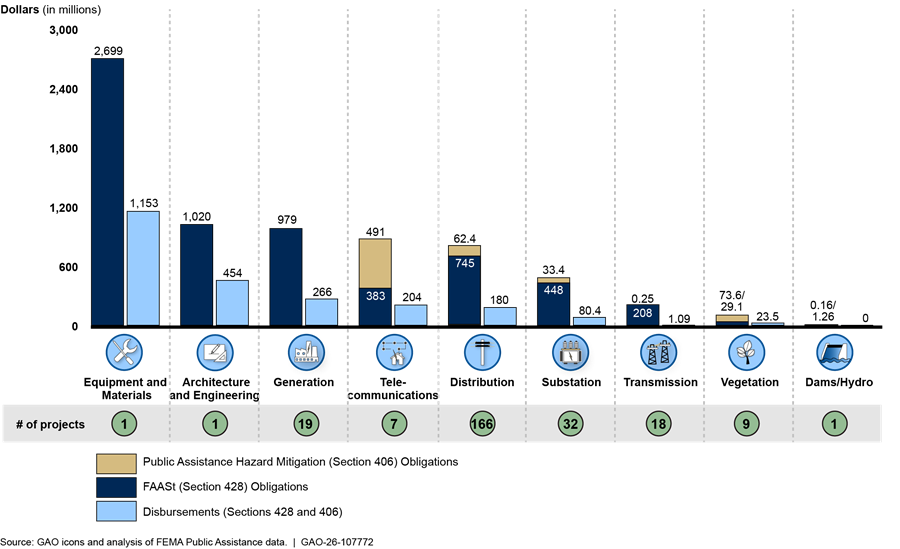
Note: PREPA has allocated about $6.5 billion of the $9.5 billion in FAASt funding to 254 projects. FEMA has also obligated about $661 million in Public Assistance Hazard Mitigation funds for mitigation measures for 174 of the 254 FAASt projects. COR3 has disbursed about $2.4 billion of these funds. The data includes Working Capital Advance funds, which are start-up funds for projects that have not begun construction. Dollar amounts do not sum because of rounding.
Most (about 79 percent) of the $2.4 billion COR3 disbursed through FAASt is for permanent work in three categories:
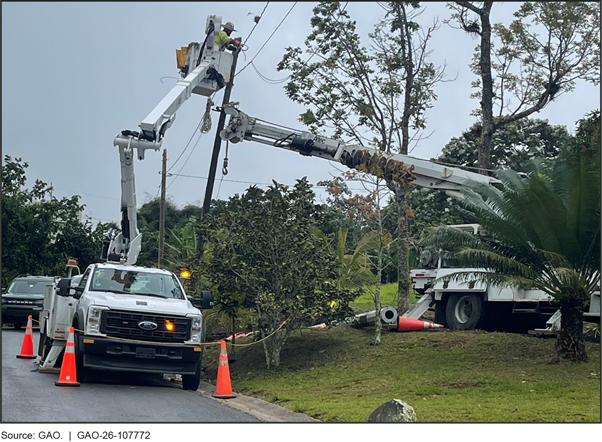
· equipment and materials (about $1.2 billion)—for procuring equipment and material for projects such as streetlight and pole repairs (see fig.2);
· architecture and engineering design costs ($454 million); and
· generation ($266 million) for repairing or replacing damaged equipment, components, buildings, and infrastructure at PREPA generation facilities.
Figure 2 shows a FEMA-funded pole replacement and streetlight repair project in Coamo, Puerto Rico.
Figure 2: FEMA-funded Pole Replacement and Streetlight Repair Project in Coamo, Puerto Rico (February 2025)
In addition to the 254 FAASt projects with FEMA funding obligated, over 100 additional projects are undergoing FEMA review for approval for obligations. Most of these projects are concentrated in three main categories: distribution (33 projects), vegetation (25 projects) and dams/hydro (23 projects).[33] In February 2026, FEMA officials told us that this set of projects could change based on evolving local priorities.
In addition to Public Assistance funding, FEMA obligated Hazard Mitigation Grant Program funds (Section 404) to several projects. However, one of the projects—the Palo Seco generation plant—was withdrawn after obtaining the result of the initial feasibility analysis. According to FEMA officials, about $1.8 million was disbursed to cover Phase I activities for that project, including the detailed project scope and feasibility studies. In addition, according to FEMA officials, a microgrid project for Culebra and Vieques will be funded under FAASt instead.[34]
HUD Allotted About $2.9 Billion for Puerto Rico’s Grid Recovery and Modernization but Limited Funding Has Been Disbursed
HUD allotted $2.9 billion in CDBG-DR and CDBG-MIT funds to the Puerto Rico Department of Housing to support Puerto Rico’s grid recovery and modernization. However, limited funds have been disbursed—about $589 million as of February 2026.[35] PRDOH has obligated funding to several programs, including its Energy Grid Rehabilitation and Reconstruction Cost Share Program (ER1), which aims to help cover the 10 percent non-federal cost-share requirement for FAASt projects.[36] As of February 2026, PRDOH had disbursed about $89 million of the $500 million.[37]
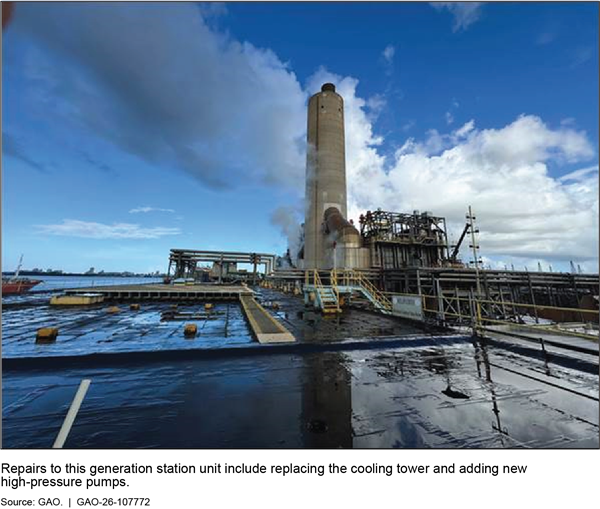
Figure 3 shows a FEMA Public Assistance project eligible for CDBG-DR funds to help cover the 10 percent non-federal cost share.[38]
Figure 3: Federal Emergency Management Agency Public Assistance Project Eligible to Receive Community Development Block Grant Funds to Help Cover Cost Share: San Juan Central Generation Station
PRDOH obligated about $1.8 billion of CDBG-DR and CDBG-MIT funds to six programs that support residential and community solar and related projects. For example, PRDOH obligated about $1.1 billion of CDBG-DR funds to its Electrical Power Reliability and Resilience Program (ER2), which aims to support projects that enhance electricity grid reliability and may include projects such as microgrids, renewable energy generation, and battery back-up systems. PRDOH has disbursed about $499 million for projects under these programs. In addition, PRDOH obligated about $1.5 million to administrative and planning expenses. See table 3 for information on PRDOH programs using HUD CDBG-DR and CDBG-MIT funds to support Puerto Rico’s grid recovery and modernization. Appendix IV provides additional details by program.
Table 3: Puerto Rico Department of Housing (PRDOH) Programs Using U.S. Department of Housing and Urban Development (HUD) Funds for Puerto Rico’s Grid Recovery and Modernization, as of February 2026 (in millions)
|
Description |
Allotted |
Obligated |
Disbursed |
|||
|
Support for Electricity Grid Recovery |
||||||
|
HUD’s Community Development Block Grant – Disaster Recovery (CDBG-DR) Funds |
$500 |
$500 |
$89a |
|||
|
The Puerto Rico Department of Housing’s Energy Grid Rehabilitation and Reconstruction Cost Share Program (ER1) uses CDBG-DR funds to help cover the 10 percent cost-share for certain Federal Emergency Management Agency (FEMA) Accelerated Awards Strategy (FAASt) projects in Puerto Rico under FEMA’s Public Assistance Program. |
||||||
|
Support for Residential and Community Solar and Related Projects |
||||||
|
HUD’s CDBG-DR and Community Development Block Grant – Mitigation (CDBG-MIT) Funds |
$2,246 |
$1,764 |
$499 |
|||
|
CDBG-DR funds the PRDOH Electrical Power Reliability and Resilience Program (ER2), which supports projects that enhance electrical system reliability, such as through microgrids and distributed energy sources; and the Community Energy and Water Resilience Installations Program which supports the installation of photovoltaic generation, battery back-up systems, and water storage systems. CDBG-MIT funds four PRDOH programs that aim to provide support to targeted communities or individual homeowners to install photovoltaic generation and battery back-up systems. These include: the New Energy, Solar Incentive, Community Installations, and the Farm and Energy Resilience programs. |
||||||
|
Administrative Expenses |
||||||
|
HUD’s CDBG-DR |
$116 |
$1.5 |
$1.5 |
|||
|
CDBG-DR funds include Electrical System Enhancement Administration and Planning, which support activities to administer CDBG-DR energy programs. |
||||||
|
Total |
|
$2,862 |
$2,266 |
$589 |
||
Source: GAO analysis of HUD and PRDOH data. | GAO‑26‑107772
Note: Totals may not sum due to rounding.
aIn May 2026, PRDOH officials told us that the amount disbursed was $140 million as of April 2026.
DOE Has Obligated About $1 Billion for Puerto Rico’s Grid Recovery and Modernization but Limited Funding Has Been Disbursed
DOE has obligated about $1 billion for Puerto Rico’s grid recovery and modernization but has disbursed about 27 percent ($255 million). Specifically, DOE has obligated about $925 million from the Puerto Rico Energy Resilience Fund, including $539 million for the Solar Access Program, $365 million for Electric Grid and Stabilization, $7.5 million for the Solar Ambassador Prize, and about $13 million for other activities.[39] The $365 million for Electric Grid and Stabilization was originally allotted to the Resilient Communities Program for community-level resilience investments, including energy storage for community healthcare facilities and public housing and privately owned subsidized multi-family properties—but has now been obligated to address more immediate needs for grid reliability, according to DOE officials.[40] In addition, in January 2026, DOE canceled up to $350 million in grants under the Solar Access Program and officials said that DOE will reallot these funds to address other needs that have yet to be determined. See table 4 for more detail on status of DOE funding.
Table 4: Department of Energy Funding for Puerto Rico’s Grid Recovery and Modernization as of February 2026 (in millions)
|
Program name/description |
Allotted |
Obligated |
Disbursed |
|||
|
Puerto Rico Energy Resilience Funda |
$1,000 |
$925 |
$254 |
|||
|
To improve the resilience of Puerto Rico’s electric grid, including grants for low-and moderate-income households and households that include individuals with disabilities for the purchase and installation of renewable energy, energy storage, and other grid technologies. |
||||||
|
Grid Resilience State and Tribal Formula Grant |
$11 |
$11 |
$ - |
|||
|
To improve the resilience of electric grids and strengthen and modernize against wildfires, extreme weather, and other natural disasters. |
||||||
|
Puerto Rico Energy Resilience Hubs |
$1 |
$1 |
$1 |
|||
|
Aim to equip community-serving facilities with distributed solar energy and storage resources that provide Puerto Rico’s most vulnerable communities with access to electricity before, during, or after an extreme weather event or other grid-related disasters. The program funded 10 energy resilience hubs through a cooperative agreement with the Interstate Renewable Energy Council and the University of Puerto Rico-Mayagüez. |
||||||
|
Total |
|
$1,012 |
$937 |
$255 |
||
Source: GAO analysis of data provided by DOE. | GAO‑26‑107772
Note: All numbers are rounded to the nearest million. Totals may not sum due to rounding.
aThe Consolidated Appropriations Act, 2023 appropriated $1 billion to the Secretary of Energy to carry out activities to improve the resilience of Puerto Rico’s electricity grid. Pub. L. No. 117-328, 136 Stat. 4459, 5212 (2022). The Department of Energy’s (DOE) Puerto Rico Energy Resilience Fund was established with these funds. Programs under the fund include the Solar Access Program, and the Solar Ambassador Prize, a competitive funding opportunity for organizations in Puerto Rico to help identify, engage, and assist with the intake processing of qualifying households for residential solar and battery installations. In addition, DOE originally allotted about $365 million of the $1 billion to the Resilient Communities Program for community-level resilience investments, including energy storage for community healthcare facilities and public housing and privately owned subsidized multi-family properties. However, in May 2025, DOE announced it was reallotting this funding to address more immediate needs for grid reliability. In December 2025, DOE officials provided a statement of project objectives, a document that describes proposed activities designed to address vulnerabilities across generation, distribution, and transmission systems. In January 2026, DOE canceled up to $350 million in grants from its Solar Access Program but, as of January 2026, had yet to determine how those funds will be reallotted. Remaining funds from the Puerto Rico Energy Resilience Fund may cover administration expenses to manage the program or planning.
DOE officials we interviewed said they worked with FEMA, LUMA Energy, Genera PR, and Puerto Rico’s Energy Czar to identify priority projects and that the funding reallotted from the Resilient Communities Program will now support practical fixes and emergency repairs. In December 2025, DOE provided a statement of project objectives, a document that describes activities designed to address vulnerabilities across generation, distribution, and transmission systems in Puerto Rico.[41] For example, the document lists improvements and repairs to generation facilities and the construction of a natural gas pipeline.[42] LUMA Energy officials told us that DOE allotted about $158 million from the $365 million for several projects, including about $24 million to repair customer metering equipment, about $56 million to install six transformers, and about $16 million to repair five “out of service” transmission lines.[43]
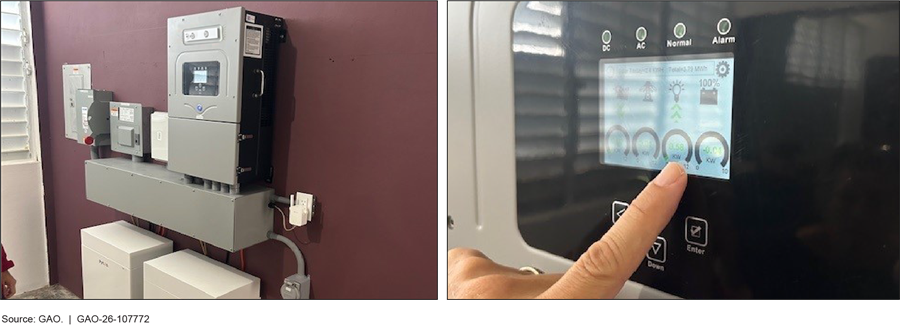
As of September 2025, DOE had obligated about $12 million to two other initiatives— the Puerto Rico Grid Resilience Hubs and the Grid Resilience State and Tribal Formula Grant. DOE disbursed all funding obligated to the Grid Resilience Hubs—about $1.2 million. These hubs aim to provide Puerto Rico’s most vulnerable communities with access to electricity before, during, or after an extreme weather event or other grid-related disasters. See figure 4 for an example of a grid resilience hub at a community center we visited in Yabucoa, Puerto Rico.
Figure 4: Solar and Battery Storage System at Grid Resilience Hub in Yabucoa, Puerto Rico (February 2025)
While DOE had not disbursed any funding to recipients of the Grid Resilience State and Tribal Formula Grant as of February 2026, DOE officials told us that there are several projects that may receive grant funds. This includes a Community Energy Resilience Hub project to install 1.85 megawatt hours of distributed battery storage capacity across five municipalities in Puerto Rico.[44] In addition, another project—the Customer Battery Energy Sharing pilot project—aims to expand LUMA Energy’s virtual power plant by integrating residential battery systems from program participants in Puerto Rico.
Limited Progress Has Been Made in Key Areas for Grid Stabilization, but Opportunities Exist to Improve Federal Assistance
Limited progress has been made using FEMA, HUD, and DOE financial assistance to support key areas for grid stabilization. Stakeholders we interviewed cited several factors hindering progress, including the FEMA project review process and federal and local staff capacity, but opportunities exist to improve federal assistance.
Limited Progress Has Been Made in Key Areas for Grid Stabilization
Few large FEMA-funded projects were completed as of December 2025, according to COR3’s Public Assistance Program Quarterly Progress Report.[45] Specifically, as of December 2025, nine FEMA-funded permanent projects had been completed overall (mostly generation projects), 116 were more than 75 percent complete (mostly distribution projects), with the remaining 133 projects at different stages of completion.
According to our review of documents, we identified 12 grid recovery and modernization efforts that fall under three categories: (1) generation and storage, (2) transmission and distribution, and (3) operations and other infrastructure. Furthermore, we identified eight key areas for grid stabilization through interviews with key stakeholders, such as: repairing, replacing, and hardening existing generation assets; increasing non-renewable and renewable generation capacity and battery storage;[46] clearing and managing vegetation; repairing, rebuilding, and hardening substations and transmission lines; deploying automated technologies and upgrading the energy management system and control centers. Table 5 outlines the grid recovery and modernization efforts and key areas for grid stabilization identified through our review of documents and interviews with key stakeholders.
Table 5: Grid Recovery and Modernization Efforts and Key Areas for Grid Stabilization for Puerto Rico’s Grid
|
Category |
Recovery or modernization effort |
Key area for grid stabilizationa |
|
Generation and storage |
|
|
|
|
Repair, replace, or harden existing generation assetsb |
|
|
Increase generation capacity, including non-renewable sources such as emergency generators, and renewable and distributed energy sources |
|
|
|
Increase fuel supply and efficiencyc |
|
|
|
Increase adoption of battery energy storage |
|
|
|
Transmission and distribution |
|
|
|
|
Vegetation clearing and managementd |
|
|
Repair, rebuild, and harden distribution lines and poles |
|
|
|
Repair, rebuild, and harden substations |
|
|
|
Repair, rebuild, and harden transmission lines |
|
|
|
Rebuild or underground distribution feeders |
|
|
|
Operations and other infrastructure |
|
|
|
|
Deploy automated technologies like advanced metering and distribution automation |
|
|
Upgrade energy management system and control center |
|
|
|
Develop microgrids |
|
|


Source: GAO analysis of federal and Puerto Rico reports and interviews. | GAO‑26‑107772
aThe key area for grid stabilization column indicates grid recovery and modernization efforts that have been identified as key or high priority due to their potential impact on grid stability. We identified key areas through interviews with federal and local officials and review of projects listed in the Puerto Rico Energy Bureau’s Electric System Priority Stabilization Plan.
bOne stakeholder said that generation repairs must meaningfully reduce the likelihood of repeat failures to improve system stability. If the underlying causes are not addressed, the system will fall into a continuous repair cycle, and the dependability of those plants will not materially improve, according to this stakeholder.
cOne stakeholder said that fuel supply and logistics is a critical aspect of the modernization effort.
dVegetation clearing is a one-time effort while vegetation management involves maintenance to clear vegetation that LUMA Energy is responsible for conducting on an ongoing basis. As we reported in 2019, Puerto Rico’s electric power infrastructure was in poor condition before the 2017 hurricane season, largely because of Puerto Rico Electric Power Authority’s (PREPA) underinvestment and poor maintenance practices. For example, PREPA canceled its vegetation management program because of its financial situation; this contributed to the destruction of transmission and distribution lines when the hurricane arrived, according to Federal Emergency Management Agency officials we interviewed at that time. GAO, 2017 Hurricane Season: Federal Support for Electricity Grid Restoration in the U.S. Virgin Islands and Puerto Rico, GAO‑19‑296 (Washington D.C.: Apr. 18, 2019).
Generation and storage. According to several stakeholders we interviewed, increasing electricity generation and storage is key to improving grid stability.[47] Genera PR has reported that the 2017 hurricanes and 2020 earthquake damaged PREPA-owned generation assets. Furthermore, according to Genera PR officials, generation fell by 46 percent below installed capacity.[48] Stakeholders indicated that new generation and storage is needed to increase capacity on the island.[49] In April 2025, the Governor of Puerto Rico declared a state of emergency because there was not sufficient generation capacity, leading to frequent power outages.
In addition, in May 2025, DOE issued an emergency order directing PREPA to run several generating units to maintain grid reliability.[50] In December 2025, working with PREPA, DOE also identified generation repair as a key emergency activity eligible for DOE funding.[51] DOE identified a list of generation repair projects that it may fund using the $365 million reallotted within the Puerto Rico Energy Resilience Fund.[52]
FEMA and HUD funding for existing generation assets. FEMA and HUD funding has been obligated to support the repair, replacement, or hardening of existing generation assets. For example, as of December 2025, FEMA obligated about $1.3 billion to 24 generation projects, seven of which are complete.[53] Six of the completed projects helped repair damage to the Costa Sur, Mayagüez, Palo Seco, and San Juan power plants. Of the remaining FEMA-obligated projects, 12 are more than 50 percent complete, according to COR3’s Public Assistance Program Quarterly Progress Report. In addition, as of September 2025, PRDOH had obligated about $24 million of HUD CDBG-DR funds to help cover the 10 percent cost-share for 12 FEMA-funded generation projects.
The Puerto Rico Energy Bureau’s Electric System Priority Stabilization Plan states that repairs are urgently needed at four generation units and recommended that the repairs be completed before the start of the 2025 hurricane season.[54] Specifically, the report states that short-term repairs at Costa Sur unit 5 are critical and recommended repairs be completed by April 2025 to ensure full generation capacity is available. All four of the generation units have projects underway, with funding obligated under FEMA’s Public Assistance program. As of December 2025, COR3 reported that Costa Sur unit 5 repairs were 58 percent complete.
Some stakeholders reported that one challenge they face conducting repairs is that they often must take generation capacity offline to perform repair work. Given the limited generation capacity available on the island, taking generation assets offline may result in planned power outages for island residents. In addition, some stakeholders reported that due to the age of the island’s generation assets, finding replacement parts may require reverse engineering or long wait times, sometimes up to 2 years. FEMA officials told us that the FAASt equipment and materials project is designed to mitigate delays and ensure funding for timely acquisition of equipment and materials. FEMA officials added that about $2.7 billion has been obligated to this project, which was developed beginning in 2022 so that PREPA and its operators (i.e., LUMA Energy and Genera PR) can minimize long delays of specific equipment and materials.
Federal support for backup generation, distributed renewable generation, and storage. FEMA, HUD and DOE funds have also been obligated to support backup generation and battery energy storage adoption. FEMA’s support for backup generation primarily focuses on temporary power, such as mobile generators.[55] In February 2024, FEMA obligated $335 million of Public Assistance funding for 17 temporary portable generation units that provided 350 megawatts to support the Palo Seco and San Juan power plants.[56] In addition, FEMA obligated $579 million to support the installation of battery energy storage systems at six power plants: Aguirre, Cambalache, Costa Sur, Palo Seco, Vega Baja, and Yabucoa.[57]
DOE and HUD funding for generation and storage have primarily focused on distributed renewable generation and storage. Although DOE is reallotting a significant portion of the Puerto Rico Energy Resilience Fund that was previously allotted for renewable generation and energy storage projects to grid stabilization projects, DOE funded 10 energy resilience hubs, which were installed in 2024 and 2025. These hubs provide vulnerable communities with solar and battery storage for access to electricity before, during, or after an extreme weather event or other grid-related disasters. Furthermore, using HUD CDBG-DR funds, PRDOH obligated about $1 billion for renewable energy generation and battery energy storage systems projects under its Electrical Power Reliability and Resilience Program (ER2). For example, a community solar and storage project in the Salinas municipality aims to provide an estimated 88 megawatts of solar generation and 35 megawatts of storage capacity.[58]
Transmission and distribution. According to several stakeholders we interviewed, vegetation clearing and management, and repairing, rebuilding, and hardening substations and certain transmission lines are key to improving grid stability.
Vegetation clearing and management. Stakeholders we interviewed cited vegetation clearing as an urgent priority for improving grid stability. Approximately 50 percent of the island’s outage events are caused by vegetation growing too close to transmission and distribution lines, which can damage power lines during high wind and rain events, according to our interviews with stakeholders and review of agencies’ documents. Several stakeholders reported that insufficient vegetation management near designated rights of way around transmission and distribution lines was a problem prior to the 2017 hurricanes and has exacerbated the frequency and duration of outages since then.[59]
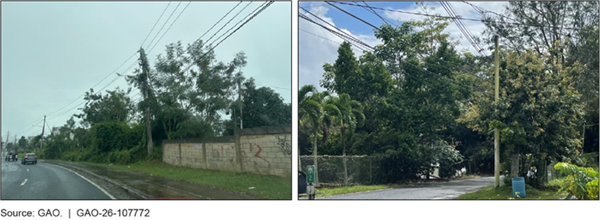
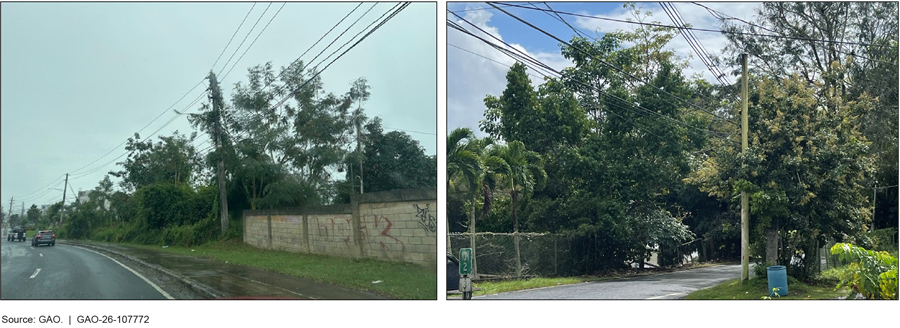
LUMA Energy estimated that $1.2 billion is needed for vegetation clearing around transmission and distribution lines, substations, and facility access roads.[60] As of December 2025, 34 vegetation clearing projects had been submitted to FEMA for review, and FEMA had obligated about $103 million to nine of these projects, most of which were less than 50 percent complete at that time, according to COR3’s Public Assistance Program Quarterly Progress Report.[61] According to LUMA’s Vegetation Management Progress Report, as of February 2026, LUMA Energy cleared 2,793 miles of transmission and distribution lines in fiscal year 2025 and the first two quarters of fiscal year 2026, of which 392 miles were supported by federal funds (mostly distribution lines). LUMA Energy started this vegetation clearing initiative in 2023 and plans to clear vegetation from 16,000 miles of transmission and distribution lines by the end of fiscal year 2027.[62] Figure 5 shows examples of overgrown vegetation and power lines in Puerto Rico.
Several challenges affect progress on clearing vegetation around transmission and distribution lines, according to stakeholders we interviewed. Specifically, FEMA has not approved LUMA’s project cost estimates for vegetation clearing in some cases.[63] Without funding, LUMA Energy halted federally funded vegetation clearing efforts in the San Juan region.[64] Nevertheless, according to FEMA officials, FEMA has approved 21 vegetation clearing projects, for which funding was obligated as of March 2026, according to these officials. The Puerto Rico Energy Bureau’s Electric System Priority Stabilization Plan states that due to the urgent need to conduct vegetation clearing, LUMA Energy should develop vegetation clearing plans that do not rely on federal funding.[65]
In addition, some stakeholders said that FEMA’s environmental reviews, which are required by statute, regulation, and executive order, were lengthy and were delaying vegetation clearing projects. Further, some stakeholders said that such reviews are unnecessary because the clearing is on existing rights of way. However, even if the rights of way are established, their overgrown state or the nature of a given project may raise environmental questions. For example, FEMA officials told us that the potential use of herbicides raised concerns about certain projects.
In 2025, DOE issued an emergency order directing PREPA to perform necessary vegetation management activities to areas at risk of vegetation-related outages.[66] DOE has extended the order four times since then.[67] According to stakeholders, the order reinforced the critical nature of vegetation clearing efforts. However, questions have been raised about the extent to which the emergency orders allow vegetation management activities to proceed without following otherwise applicable laws and regulations. DOE has stated that the National Environmental Policy Act does not apply to its issuance of the emergency order.[68] However, the U.S. Army Corps of Engineers has stated that the order does not exempt LUMA Energy or PREPA from obtaining any necessary environmental permits.[69]
LUMA Energy has asked DOE to confirm how its order affects otherwise applicable environmental and historic preservation laws and coordination requirements. According to LUMA Energy officials, FEMA has obligated funds for four transmission projects using DOE’s emergency order, and LUMA Energy had cleared about 2 miles out of 27 miles for these four projects, as of February 2026. Furthermore, since October 2023, DHS has adopted 51 categorical exclusions from other federal entities that, according to FEMA officials, are available for FEMA to apply to FEMA-funded projects.[70] For example, DHS adopted DOE categorical exclusions for upgrading and rebuilding existing power lines and for the construction or modification of substations. As of December 2025, FEMA had used categorical exclusions for five low density vegetation projects in Puerto Rico, according to FEMA officials.[71]
LUMA Energy also faces challenges clearing vegetation from power lines in residential areas and areas with difficult terrain. For example, according to LUMA Energy officials, accessing distribution lines in residential areas may require permission from individual homeowners to access their property. These officials added that if transmission and distribution lines pass through difficult terrain, such as steep hillsides or remote areas, the additional time and safety considerations may delay clearing efforts.
Substation repair, rebuilding, and hardening.[72] LUMA officials that we interviewed identified substations as a key area for grid stability, but one of 32 substation projects for which FEMA obligated almost $482 million is complete. The 32 substation projects are at varying levels of completion; one project is complete, nine are more than 50 percent complete, and the remaining 22 are less than 50 percent complete. In addition to incurring damage from previous disasters, many substations are located in flood zones and are at risk of failing in future disasters. Of the almost $482 million that FEMA has obligated, $33 million has been obligated to hazard mitigation activities such as relocating substation structures outside of flood zones. Some stakeholders told us that substation projects can take longer to complete because acquiring equipment for substations, such as transformers and breakers, can take several years due to limited global supply.[73] Additionally, LUMA Energy officials told us that DOE recently allotted about $19 million to upgrade various substations and repair 15 transmission structures.
Transmission lines. Several officials we interviewed identified select transmission lines as vital or “no regrets” projects that are key for grid stability. Existing transmission infrastructure is outdated and repairing or replacing select lines would help mitigate power outages, according to documents we reviewed. For example, according to the March 2025 Electric System Priority Stabilization Plan, there is an urgent need to repair and harden 51 transmission line segments.[74] This includes replacing deteriorated poles and towers and ensuring that all critical components on these lines are repaired or replaced. Documents we reviewed identified transmission lines that are particularly susceptible to damage from high wind events. Additionally, a resilient and complete transmission network is necessary to connect new generation capacity, especially from new renewable generation and storage assets, according to documents we reviewed.
As of December 2025, LUMA Energy had submitted 30 transmission projects to FEMA for review, and FEMA obligated about $208 million for 18 of these projects. According to COR3’s Public Assistance Program Quarterly Progress Report, seven of the projects were over 75 percent complete as of December 2025. In addition, LUMA Energy officials told us that DOE has recently allotted about $16 million to repair five “out of service” transmission lines.
Stakeholders identified several challenges affecting the progress of transmission line repairs, including the structure of FEMA programs and the length of time and scope of FEMA’s review processes. Some stakeholders said that the process to apply for FEMA funding does not allow for holistic, grid-wide solutions, and instead incentivizes applicants to propose individual projects that compartmentalize grid recovery. In February 2025, DOE officials stated that the structure of FEMA’s programs cause applicants to compete against each other for funding and does not necessarily promote the best overall solutions for the grid. However, in December 2025, these same officials stated that this is no longer the case since the Puerto Rico Energy Czar’s Office has taken steps to prioritize projects.[75] Nevertheless, the process may incentivize applicants to propose projects that may gain faster approval rather than projects that would most greatly impact grid reliability. For example, COR3 officials told us that projects repairing streetlights have progressed through the process because these are easier to gain approval for than some high priority transmission line projects.
Modernizing operations and other infrastructure. Modernizing grid operations, which includes improving Puerto Rico’s energy management system and deploying select automation technologies, would enable LUMA Energy to isolate the cause of power outages and immediately improve grid stability, according to several stakeholders we interviewed and documents we reviewed.
Upgrading energy management system and control center. LUMA Energy officials told us that the energy management system is the primary tool used to monitor grid operations and detect and address reliability issues. Staff reported that the current system is composed of obsolete hardware and software, and that replacing the system is one of the most urgent and critical elements for grid stability.
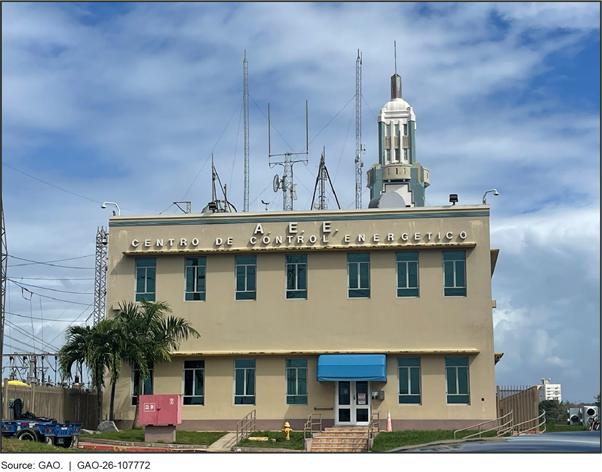
FEMA has obligated $44 million for a project to upgrade Puerto Rico’s energy management system, which is 65 percent complete, according to COR3’s Public Assistance Program Quarterly Progress Report.[76] Another project to update the primary control center that houses the energy management system and other telecommunications equipment has been submitted to FEMA but is in the scope and costing phase of the review process. One stakeholder said that these projects face delays due to lengthy FEMA review processes. For example, while the energy management system is under development, the primary control center—one of the buildings that houses the energy management system—does not currently meet industry standards and progress is delayed because the Monacillos Campus, where the control center would be located, has been potentially designated as a historic district according to LUMA Energy officials, adding steps to the review process.[77] Figure 6 shows the current Monacillos primary control center.
Deploying automated technologies like advanced metering and distribution automation. Lastly, LUMA Energy officials also said that automation technologies could immediately improve grid stability. We previously reported that automated technologies, such as distribution automation and advanced metering, can help isolate power outages and provide quick restoration of electric service to enhance resilience.[78] FEMA has also obligated almost $30 million for 18 distribution automation projects to enhance operational capacity. Six projects are over 50 percent complete, according to COR3’s Public Assistance Program Quarterly Progress Report. FEMA has also obligated about $789 million to an advanced metering project, which is one of the largest FEMA-funded projects to enhance grid operations.[79] According to COR3’s Public Assistance Program Quarterly Progress Report, the project is in the design phase but some funding has been disbursed through the Working Capital Advance. However, according to COR3’s report, the project is zero percent complete as of December 2025. LUMA Energy officials said that some automation projects face delays because FEMA has questioned the justification for certain automation tools. In addition, officials said that they currently have equipment ready to install but are unable to deploy the technology until FEMA approves the project. Additionally, LUMA Energy officials told us that DOE has recently allotted about $24 million to repair customer metering equipment, and about $20 million to install distribution automation devices.
Stakeholders Identified Several Factors That Hinder Progress on Puerto Rico Grid Recovery
Stakeholders we interviewed identified several factors hindering progress on Puerto Rico’s grid recovery, and opportunities exist to improve federal assistance. Specifically, stakeholders identified the following factors: project review processes, federal and local agency staff capacity and turnover, the complexity of project funding, PREPA’s financial condition, and uncertainty around entities involved in recovery.[80] However, opportunities exist to improve federal assistance. For example, documenting roles and responsibilities, and establishing a coordination mechanism that includes Puerto Rico and federal stakeholders, could help enhance efficiency.
Project review processes. According to stakeholders we interviewed, the project review process is onerous with numerous Puerto Rico and federal entities involved. For example, the Puerto Rico Energy Bureau must ensure that projects align with Puerto Rico’s Integrated Resource Plan, and the Financial Oversight and Management Board for Puerto Rico (FOMB) must review projects involving a contract greater than $10 million.[81]
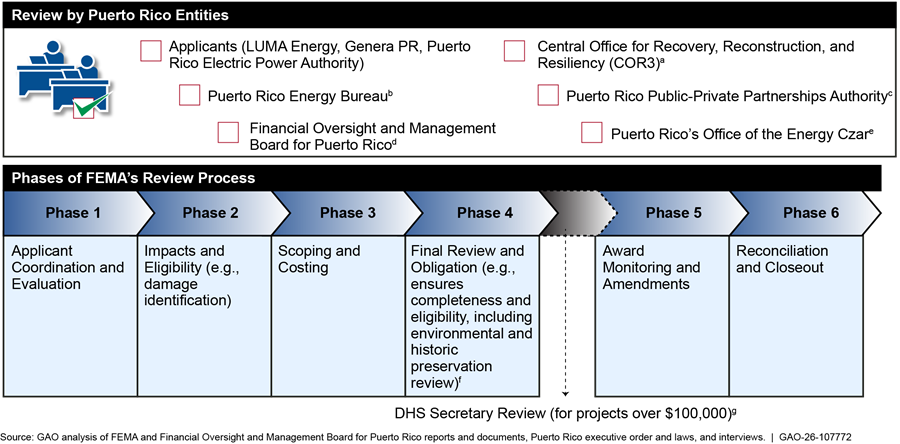
FEMA’s review process involves several steps, including conducting an environmental and historic preservation review, which is required by statute, regulation, and executive order, and is often under Phase 4—Final Review and Obligation. This step includes determining whether a project may affect natural, cultural, or historic resources. If required as part of the environmental and historic preservation compliance review, FEMA will consult with other agencies during this step. For example, it must consult with the U.S. Fish and Wildlife Service, or the National Marine Fisheries Service before funding any activities that have the potential to affect endangered species or their critical habitat. FEMA must also consult with Puerto Rico’s State Historic Preservation Office if a project could have an impact on historic properties.
Several stakeholders told us that this step of the process can extend the project review process by months or years. Furthermore, in June 2025, the Secretary of Homeland Security announced plans to review all grant awards over $100,000, adding another layer of review. In December 2025, FEMA officials told us that once FEMA has approved projects for obligation, they are submitted to the Secretary on a weekly basis for review and approval.[82] See figure 7 for the Puerto Rico entities responsible for reviewing projects and the FEMA project review process.
Figure 7: Puerto Rico Entities Responsible for Reviewing Projects and Federal Emergency Management Agency’s (FEMA) Project Review Process
aEstablished in 2017 to administer federal funding for projects and provide funds to subrecipients such as the Puerto Rico Electric Power Authority.
bMust ensure that projects align with Puerto Rico’s Integrated Resource Plan.
cOversees the LUMA Energy and Genera PR contracts. The current Director of the Puerto Rico Public-Private Partnerships Authority is also Puerto Rico’s Energy Czar.
dReviews projects involving a contract greater than $10 million. Also reviews and approves the Puerto Rico Electric Power Authority’s fiscal plans and budgets. According to Financial Oversight and Management Board for Puerto Rico (FOMB) officials, FOMB, at its sole discretion, could select contracts below the $10 million threshold, to ensure that they promote market competition and are not inconsistent with the fiscal plan.
eEstablished in January 2025, and plays a role in achieving efficiency, goal alignment, supervision of operators, and acceleration of the energy system’s recovery.
fThis phase often includes determining whether a project may affect natural, cultural, or historic resources. If required as part of the environmental and historic preservation compliance review, FEMA must consult with other agencies during this step. For example, it must consult with the U.S. Fish and Wildlife Service or the National Marine Fisheries Service before funding any activities that have the potential to affect endangered species or their critical habitat, and with Puerto Rico’s State Historic Preservation Office if a project could have an impact on historic properties.
gAccording to FEMA officials, in April 2026, the Secretary of Homeland Security rescinded this requirement.
FEMA has taken some steps to streamline the environmental and historic preservation review process for eligible projects, for example,
· In December 2025, FEMA officials told us that staff have been instructed to use categorical exclusions, when appropriate.[83] As mentioned previously, since October 2023, DHS has adopted 51 categorical exclusions from other federal entities and FEMA used one of the categorical exclusions for five low density vegetation projects in Puerto Rico.
· In 2024, FEMA and the U.S. Fish and Wildlife developed an Interagency Reimbursable Work Agreement to further support environmental compliance, technical assistance and consultation under section 7 of the Endangered Species Act for FEMA-funded energy projects.[84]
FEMA has issued internal and external guidance that describes how it determines the level of environmental review required for projects. For example, in August 2025, FEMA updated internal guidance that provides policy direction for implementation of the National Environmental Policy Act (NEPA) and other environmental and historic preservation requirements across FEMA. In addition, FEMA has issued external guidance for applicants. Specifically, in 2019, FEMA issued its Environmental Considerations Greensheet, which states that the level of NEPA review required for projects funded under Hurricane Maria and Irma depends on the scope of work and any environmental and historic laws, regulations, and executive orders that may apply.[85] The location of the project and the complexity of the work also determine the level of review required, according to the document.
However, the guidance does not include information on flexibilities that could be used to help streamline the process. Specifically, FEMA has not updated this guidance to reflect the recently adopted categorical exclusions, and how they could be used to streamline the process for certain projects. LUMA Energy officials told us that it is not always clear how FEMA determines the level of environmental review for each project and added that there have been several changes to categorical exclusions and environmental reviews at the federal level, but they were not sure how FEMA would implement the changes. One stakeholder told us that it is not clear what criteria FEMA is using and would like clarity on the level of information they must provide.
Standards for Internal Control in the Federal Government state that agencies should externally communicate the necessary quality information to achieve their objectives.[86] Fully communicating what potential flexibilities exist to streamline the process (e.g., categorical exclusions) by updating its guidance would better position FEMA to help improve applicants’ ability to more efficiently navigate the process.
Federal and local agency staff capacity and turnover. FEMA’s capacity to review and approve projects may be limited due to staffing capacity and turnover, according to data we reviewed and some stakeholders we interviewed. As of July 2025, all 14 FEMA staff conducting environmental and historic preservation reviews for grid recovery projects were temporary employees and turnover among these staff has increased in recent years (up from 3 percent in 2021 to 19 percent in 2024).[87] In addition, some stakeholders we interviewed stated that FEMA staff turnover and continuity is a challenge. According to one stakeholder, this is because they work with FEMA staff on project specifics but then must revisit project details when different staff are assigned. In contrast, FEMA officials told us that turnover in Puerto Rico’s government, including new managers and management teams, is also a challenge to FEMA’s continuous interactions with recipients.
FEMA officials told us that they did not expect staffing losses to affect their ability to support Puerto Rico. FEMA has taken some steps to ensure sufficient and consistent staffing, including requesting additional staff to review and approve grid recovery projects in Puerto Rico. However, as of February 2026, DHS had not approved the request for additional staff because there is a hiring freeze, according to FEMA officials.[88] Moreover, the administration and Congress are considering reforms to FEMA’s organizational structure and grant programs, and it is unclear how any changes would affect grid recovery in Puerto Rico.[89]
Standards for Internal Control in the Federal Government state that agency management should establish an organizational structure, assign responsibility, and delegate authority to achieve the entity’s objectives.[90] In FEMA’s case, this could include rebalancing workloads or increasing resource levels in a given area, considering the responsibilities of external stakeholders, as appropriate. While FEMA has taken some actions, such as requesting additional staff, it has not taken steps—in the absence of DHS approval to hire additional staff—to help fully ensure sufficient and consistent resources are available to support the delivery of federal assistance for grid recovery. FEMA could do so by, for example, rebalancing workloads, shifting resources from other areas, or reprioritizing its workload to ensure that the most pressing projects identified by local entities make progress despite resource limitations. Spreading a reduced number of staff across the same workload could reduce the timeliness and efficiency of review of grid recovery projects. One stakeholder we interviewed told us that FEMA could shift some of the responsibilities contributing to the environmental review process to the applicant. One agency official stated that more responsibility should be on the applicant.[91] However, FEMA’s ability to delegate aspects of the process to the applicant is limited by environmental and historic preservation authorities.[92] It may also involve tradeoffs and require more extensive technical assistance for applicants.[93] Taking steps to help ensure sufficient and consistent resources, however, could help FEMA better support the delivery of federal assistance for grid recovery, and ensure timely and efficient review of grid recovery projects.
In addition, there has been staff turnover and uncertainty about management of relevant DOE programs because of staffing cuts and voluntary separations among staff who manage the programs. For example, in April 2025, five DOE staff members who worked on Puerto Rico issues left DOE. In August 2025, DOE officials told us the department had a period of reorganization after the staffing losses and that they are working to maintain a presence in Puerto Rico. DOE officials added that they have moved staff around and plan to relocate more staff to the island. For example, in December 2025, DOE officials told us that one full-time, bilingual contractor and one bilingual federal employee began work in Puerto Rico in October 2025. In addition, in March 2025, DOE created a Puerto Rico Strike Team composed of high-level officials and technical support from different DOE offices, according to DOE officials. According to these officials, the level of engagement between DOE and Puerto Rico has been enhanced with significant engagement between DOE officials and experts with counterparts in Puerto Rico.
Project funding complexity. The complexity of funding has also hindered progress on Puerto Ricos’s grid recovery. Specifically, according to several stakeholders we interviewed, and prior GAO work, it is cumbersome for local entities to navigate multiple funding sources for grid recovery projects. Some stakeholders we interviewed said that navigating various requirements is burdensome. In addition, FEMA funding is associated with multiple natural disasters and executing projects stemming from multiple disasters poses significant challenges, according to one stakeholder.
Moreover, there is an incentive for PREPA to use hazard mitigation to maximize overall funding, but this may contribute to longer timeframes for project review. Specifically, according to FEMA officials, FEMA may reimburse additional costs for scope of work additions that were not in the original proposal.[94] According to LUMA Energy officials, projects that include hazard mitigation measures typically take longer than other projects.[95] According to LUMA Energy officials, this is, in part, because FEMA needs a detailed scope of work before approving a hazard mitigation project for funding, which may require a significant upfront investment and pose financial risks to LUMA Energy.[96] In addition, according to LUMA Energy officials, in some cases, the project review process has been prolonged because of back and forth between LUMA Energy and FEMA on the sufficiency of detail included in the scope of work.[97] In May 2026, FEMA officials told us that hazard mitigation proposals require evaluation for eligibility as it pertains to the scope of work, technical feasibility and the level of protection it provides to the mitigated facility.
PREPA’s financial condition. PREPA’s financial condition is another factor hindering progress on the recovery of Puerto Rico’s grid, according to some stakeholders we interviewed. Specifically, financial challenges continue to limit PREPA’s ability to borrow funds for investment in grid infrastructure. As a result, PREPA is relying on federal funds for grid recovery. However, the poor condition of PREPA and the Puerto Rico energy system requires substantial expenditure for maintenance and repair well beyond funds made available by the federal government for disaster recovery, according to FOMB. Furthermore, according to COR3 officials, FEMA’s reimbursement model complicates matters. Specifically, subrecipients must provide, in most cases, the initial funding for the construction and seek reimbursements as work is completed.[98] However, PREPA filed for bankruptcy in 2017, and, as of March 2026, the bankruptcy remained unresolved.
According to FOMB, one of the primary goals of restructuring the bond debt and other legacy liabilities is to provide financial stability for investment to transform PREPA into modern, resilient, and reliable energy system for Puerto Rico.
Uncertainty around entities involved in recovery. Uncertainty regarding entities involved in Puerto Rico’s grid recovery could pose additional challenges. Specifically, LUMA is operating under a contract extension, that the territory has recently challenged in court as invalid. Further, the territory has indicated that it is considering securing a new grid operator.[99] It is unclear how this could affect projects proposed by LUMA for federal funding. According to one stakeholder, terminating the contract without a fully vetted, ready replacement would be highly disruptive and pose risks; setbacks in vegetation, storm hardening, and reliability programs; and additional transition costs and delays. Another stakeholder said that efforts to terminate the LUMA Energy contract could be detrimental to the implementation of Puerto Rico’s fiscal plan and materially delay PREPA’s debt restructuring process. In addition, LUMA Energy may be entitled to significant termination fees, which would reduce funds available to pay PREPA’s creditors, according to this same stakeholder. Furthermore, transitioning to a new operator could take years and dramatically slow the repair of the system, according to this stakeholder. Nevertheless, one stakeholder said that a transition from LUMA Energy is feasible, but that it should be implemented in a phased manner that maintains continuity of operations, rather than through an abrupt termination.
Opportunities Exist to Improve Federal Assistance
The roles and responsibilities of key entities involved in grid recovery are not fully documented and existing documentation of roles and responsibilities is outdated. Specifically, a February 2022 memorandum of understanding that outlines the roles and responsibilities among key entities—DOE, HUD, FEMA, the government of Puerto Rico, and entities involved in grid operations—is outdated and does not reflect current circumstances. For example, the memorandum notes federal climate change resilience priorities that were rescinded in 2025. The memorandum also does not address current DOE objectives, such as diversifying fuel sources, lowering energy costs, and enhancing the resilience of Puerto Rico’s northern power grid.[100] It also does not mention or describe the roles of key entities, including Genera PR and Puerto Rico’s Office of the Energy Czar, and key agency contacts are outdated. Moreover, according to DOE officials, DOE has recently expanded its role in Puerto Rico to include prompt resolution of intergovernmental technical issues.[101]
In August 2025, DOE officials we interviewed acknowledged that the memo needed to be updated. However, in December 2025, DOE officials told us that a decision had been made to seek termination of the memorandum of understanding. Our prior work found that agencies that articulate their agreements in formal documents can strengthen their commitment to working collaboratively.[102] We have also reported that written agreements are most effective when they are regularly updated and monitored. Finally, Standards for Internal Control in the Federal Government call for management to implement control activities; one way agencies can do so is by documenting responsibilities through policies.[103] A current and comprehensive memorandum could help ensure accountability and improve collaboration by clarifying objectives, and roles and responsibilities.
Moreover, a formal mechanism for coordination among all federal and Puerto Rico entities involved in Puerto Rico’s grid recovery does not exist. Specifically, DOE discontinued meetings for the Energy Technical Coordination Team in March 2025, and no future meetings have been scheduled.[104] According to DOE, they discontinued the meetings because of scheduling conflicts, but DOE has continued to meet with staff from federal and Puerto Rico entities. For example, DOE officials told us that the Recovery Support Function Leadership Group Energy Subgroup for the Caribbean—an interagency group consisting of FEMA, DOE, HUD, EPA, Interior, and Treasury—meets monthly. However, Puerto Rico officials are not formal members of the group. Furthermore, in December 2025, DOE officials said that meeting with federal and Puerto Rico entities on as-needed basis was more efficient than through a formal, recurring meeting. Nevertheless, one stakeholder told us the Energy Technical Coordination Team meetings provided visibility into what everyone was doing, and any pain points stakeholders were experiencing.
Additionally, another stakeholder told us that there is currently no mechanism fulfilling the coordination role, and that most interagency coordination is ad hoc. This stakeholder said that a mechanism, like the Energy Technical Coordination Team, could serve an important role if it is restructured to align with current reconstruction activities and FEMA and DOE funding streams. Such a mechanism could support communication and coordination at a time of change and uncertainty.[105]
Given the complexity of funding, the numerous players involved, and the various plans for grid recovery, extensive coordination across Puerto Rico and federal entities is vital for identifying priorities and appropriate funding sources to support Puerto Rico’s grid recovery efforts. As we have previously reported, to enhance collaboration and decision-making to achieve outcomes, collaborating agencies need to agree on roles, responsibilities, and steps for decision-making, and establish mutually reinforcing or joint strategies.[106] To that end, enhanced coordination and clearer roles and responsibilities could yield better guidance for Puerto Rico entities navigating these programs. For example, although in 2020, HUD and FEMA issued guidance on combining federal funds, in December 2025, one stakeholder told us that clearer guidance was needed on how different funding sources could be combined (e.g., FEMA’s Public Assistance, HUD’s CDBG-DR), including joint federal guidance on cost allowability, duplication of benefits, and reporting requirements.[107] In addition, DOE is reallotting funding that was previously allotted for renewable generation and energy storage projects to grid stabilization projects. Without better coordination among agencies funding grid recovery and stabilization projects, federal efforts could fail to ensure Puerto Rico entities maximize funding to meet the most critical priorities.
Finally, when multiple programs, activities, and funding streams are involved, there is a risk that the array of requirements will increase administrative complexity and burdens.[108] We have previously reported on challenges with FEMA and other federal agencies’ disaster assistance, including challenges state and local officials have raised with administrative burdens and timeliness of assistance.[109] We added Improving the Delivery of Disaster Assistance to GAO’s High-Risk list in February 2025 to highlight the recommendations we have made to improve federal disaster efforts.[110] Implementing our recommendations would help improve federal assistance to state and local governments after a disaster.[111] Moreover, broader reform of FEMA’s mission, structure, or operations may also address long-standing challenges with federal disaster efforts. These broader reforms will have implications for grid recovery in Puerto Rico.
Minimizing funding complexity could reduce inefficiency and resources required to navigate funding streams and expedite progress on grid recovery. To the extent that FEMA takes steps to improve federal disaster assistance more broadly and implement reforms at FEMA in the future, it will be best positioned to identify opportunities to streamline its implementation of programs in Puerto Rico consistent with broader reforms. Given challenges with sufficient and consistent staffing mentioned previously, it could take steps to identify opportunities for streamlining implementation of FEMA programs in Puerto Rico. Identifying these opportunities, including any trade-offs and limitations, such as statutory changes needed, would help inform Congress and other decisionmakers on how best to accelerate progress on grid recovery.
Conclusions
Since 2017, a series of disasters have disrupted the recovery of Puerto Rico’s electricity grid. The federal government has appropriated billions of dollars to support Puerto Rico’s grid recovery and modernization. However, limited progress has been made using federal assistance in key areas for grid stability, and few projects are complete. Several challenges are hindering progress, including project review processes, which is onerous with numerous Puerto Rico and federal entities involved, according to stakeholders. Moreover, several stakeholders told us that the environmental and historic preservation review stage of the process can extend the project review process by months or years. FEMA has taken steps to streamline the process, such as by adopting categorical exclusions, but it has not communicated how it plans to implement flexibilities. Updating guidance could help improve applicants’ ability to more efficiently navigate the process.
In addition, FEMA’s capacity to review and approve projects may be limited due to staffing capacity and turnover. While FEMA has requested additional staff, as of February 2026, this request had not been approved. Taking steps to help ensure sufficient and consistent staff to support the delivery of federal assistance for grid recovery, for example, by rebalancing or reprioritizing workloads, could help FEMA better support the delivery of federal assistance for grid recovery, and ensure timely and efficient review of grid recovery projects. In addition, to the extent that FEMA implements broader reforms, it could identify opportunities to streamline its programs funding grid recovery in Puerto Rico, including trade-offs and any statutory changes required. This would help inform Congress and other decisionmakers on how best to accelerate progress on grid recovery.
Moreover, there are numerous Puerto Rico and federal agencies involved in Puerto Rico’s grid recovery, with new entities and roles that have evolved. However, the current objectives, and roles and responsibilities of key entities involved in grid recovery are not fully documented. A 2022 memorandum of understanding on collaboration outlines roles and responsibilities among key federal and Puerto Rico entities, but DOE officials told us that a decision had been made to seek termination of the memorandum. Documenting current objectives and roles and responsibilities by, for example, updating the memorandum, could help ensure accountability and improve collaboration. Furthermore, while DOE continues to meet with staff from federal and Puerto Rico entities on an ad-hoc basis, establishing a formal coordination mechanism that includes all Puerto Rico and federal entities involved in grid recovery could support communication and coordination at a time of change and uncertainty.
Recommendations for Executive Action
We are making five recommendations, three to FEMA and two to DOE.
The Acting Administrator of FEMA should update its guidance to provide information on potential flexibilities that could be used to streamline the environmental and historic preservation review process, such as categorical exclusions. (Recommendation 1).
The Acting Administrator of FEMA should take steps to help ensure sufficient and consistent resources are available to conduct environmental and historic preservation reviews. (Recommendation 2).
The Acting Administrator of FEMA, to the extent that FEMA implements broader reforms to federal disaster assistance, should take steps to identify and communicate opportunities to streamline its programs funding grid recovery in Puerto Rico, including trade-offs and any statutory changes required. (Recommendation 3).
The Secretary of Energy, in coordination with FEMA, HUD, and the Government of Puerto Rico, should clarify objectives, roles, and responsibilities for collaboration by, for example, updating or establishing a new memorandum of understanding for collaboration among federal and Puerto Rico entities to reflect current roles, responsibilities, and objectives. (Recommendation 4).
The Secretary of Energy, in coordination with FEMA and HUD, should take steps to establish a mechanism to support coordination among federal and Puerto Rico entities involved in Puerto Rico’s grid recovery and modernization. (Recommendation 5).
Agency Comments, Third Party Views, and Our Evaluation
We provided a draft of this report to the Department of Homeland Security (DHS), the Federal Emergency Management Agency (FEMA), the Department of Housing and Urban Development (HUD), the Department of Energy (DOE), and Puerto Rico’s Central Office for Recovery, Reconstruction, and Resiliency (COR3) for review and comment. We also provided relevant sections of the draft report to third parties, including the Financial Oversight and Management Board for Puerto Rico (FOMB), Genera PR, LUMA Energy, Puerto Rico Electric Power Authority (PREPA), Puerto Rico Energy Bureau (PREB), Puerto Rico Department of Housing (PRDOH), Puerto Rico Public-Private Partnerships Authority, and Puerto Rico’s Office of the Energy Czar.
We received written comments from DHS, which have been reproduced in appendix VIII. We also received written comments from DOE, which have been reproduced in appendix IX, and from COR3, reproduced in appendix X. HUD responded via e-mail and stated that it did not have any comments. In addition, FEMA, DOE, and COR3 also provided technical comments, which we incorporated as appropriate. We also received technical comments from 7 of the 8 third-party entities: LUMA Energy, PREB, PRDOH, Puerto Rico’s Office of the Energy Czar, Puerto Rico Public-Private Partnerships Authority, Genera PR, and FOMB, which we incorporated as appropriate. PREPA did not provide any comments.
In its comments, DHS agreed with our three recommendations. Regarding our first recommendation that FEMA update its guidance to provide information on potential flexibilities that could be used to streamline the process, the letter states that FEMA will update the environmental and historic preservation guidance that is provided to applicants. Specifically, FEMA’s Region 2’s Environmental and Historical Preservation staff will update the FEMA 4336-DR-PR & 4339-DR-PR “Federal Emergency Management Agency Environmental Considerations Greensheet” from 2019 to reflect any changes to environmental and historic preservation compliance requirements, such as those resulting from rescinded executive orders. According to DHS, the estimated completion date for addressing the recommendation is September 30, 2026.
Regarding our second recommendation that FEMA takes steps to ensure sufficient and consistent resources are available to conduct environmental and historic preservation reviews, the letter states that, based on the most recent workload analysis conducted in August 2025, there is a shortage of eight positions. According to DHS, FEMA Region 2 and Puerto Rico Joint Recovery Office leadership will continue to work with FEMA Headquarters to undertake hiring actions in accordance with DHS and U.S. Office of Personnel Management hiring guidance. According to DHS, the estimated completion date for addressing the recommendation is December 31, 2026.
Finally, regarding our third recommendation that FEMA take steps to identify and communicate opportunities to streamline its programs funding grid recovery in Puerto Rico, the letter states that in the context of FEMA’s implementation of broader reforms, specifically with regard to recommendations from the President’s FEMA Review Council, the Recovery Directorate/PA Division will identify and communicate opportunities that should be taken to streamline its programs that fund grid recovery in Puerto Rico, including consideration of trade-offs and identification of statutory limitations. According to DHS, the estimated completion date for addressing the recommendation is May 31, 2027.
In its comments, DOE agreed with our two recommendations. Regarding our recommendation that DOE, in coordination with FEMA, HUD, and the Government of Puerto Rico, clarify objectives, roles and responsibilities for collaboration, the comment letter states that the agency is working with FEMA, HUD, and the Government of Puerto Rico to clarify shared objectives and delineate roles and responsibilities for collaboration on Puerto Rico grid recovery, including through an updated or new memorandum of understanding that reflects current authorities and programmatic responsibilities. According to the letter, this memorandum is currently being socialized among the relevant agencies, with implementation planned no later than December 31, 2026.
Regarding our recommendation that DOE, in coordination with FEMA and HUD, take steps to establish a mechanism to support coordination among federal and Puerto Rico entities involved in Puerto Rico’s grid recovery and modernization, DOE’s letter states that DOE, in coordination with FEMA and HUD, is taking steps to establish a durable mechanism to support ongoing coordination among federal and Puerto Rico entities involved in grid recovery and modernization, including a monthly technical working group to help ensure sustained coordination among participating entities, which will be delineated in the memorandum of understanding and is planned to be established by December 31, 2026. In parallel, according to the letter, DOE is coordinating with local stakeholders as well as HUD and FEMA to tailor priorities within the working group in a way that is responsive to on-the-ground implementation realities, while also accounting for current fiscal constraints that may affect staffing, meeting cadence, and the scope of support that can be provided in the near term.
As agreed with your office, unless you publicly announce the contents of this report earlier, we plan no further distribution until 30 days from the report date. At that time, we will send copies of this report to the appropriate congressional committees, the Secretary of Homeland Security, the Acting Administrator of the Federal Emergency Management Agency, the Secretary of Energy, the Secretary of Housing and Urban Development, and other interested parties. In addition, the report will be available at no charge on the GAO website at https://www.gao.gov.
If you or your staff have any questions about this report, please contact me at (202) 512-3841 or mckelveyj@gao.gov. Contact points for our Offices of Congressional Relations and Media Relations may be found on the last page of this report. GAO staff who made key contributions to this report are listed in appendix XI.
Sincerely,
Janet McKelvey
Acting Director, Natural Resources and Environment
This report examines (1) the financial assistance that FEMA, HUD, and DOE have provided to support Puerto Rico’s grid recovery since 2017; and (2) how FEMA, HUD, and DOE financial assistance has supported Puerto Rico’s grid recovery and modernization, and any factors hindering progress.
To address both objectives, we analyzed funding data from FEMA, HUD, DOE and the Puerto Rico Department of Housing, for relevant programs such as FEMA’s Public Assistance and Hazard Mitigation Grant Program, HUD’s Community Development Block Grant (CDBG), and DOE’s Puerto Rico Energy Resilience Fund (PR-ERF).[112] We also analyzed project completion data for large projects from Puerto Rico’s Central Office for Recovery, Reconstruction, and Resilience (COR3).[113] Specifically, we reviewed COR3’s Public Assistance Program Quarterly Progress Report covering the period from October 1, 2025, through December 31, 2025 (Quarter 1 of Fiscal Year 2026).[114] Data reflects funding for permanent projects associated with Hurricane Maria, Fiona, and the December 2019 and January 2020 earthquakes. It does not include Hurricane Irma or emergency work. We assessed the reliability of the funding data by (1) reviewing existing information about the data and the systems that produced them and (2) interviewing agency officials knowledgeable about the data. We determined that the data were sufficiently reliable for reporting the status of financial assistance that FEMA, HUD, and DOE provided to support Puerto Rico’s grid since 2017.
We also reviewed documentation on financial and technical assistance, such as interagency reimbursable work agreements between FEMA and DOE. We may not have identified every source of financial available to support Puerto Rico’s grid, but we provide information on key sources from documentary and testimonial evidence.[115]
Additionally, we interviewed federal officials from FEMA Headquarters and Region 2, HUD’s Office of Community Planning and Development and its Office of Disaster Recovery (Caribbean Region), and DOE (including from the National Energy Technology Laboratory). We also interviewed Puerto Rico government officials from COR3; PREB; the Puerto Rico Public-Private Partnerships Authority; PREPA; and the Puerto Rico Department of Housing. Finally, we interviewed officials from the Financial Oversight and Management Board for Puerto Rico, Puerto Rico’s Office of the Energy Czar, and utility operators from LUMA Energy—the contractor operating and maintaining PREPA’s facilities including the transmission and distribution system—and Genera PR—the contractor operating and maintaining PREPA’s generation assets.[116] For the purposes of this report, unless named, we refer to all non-federal officials as stakeholders. We identified these stakeholders through a review of prior GAO work and relevant reports.[117] We selected stakeholders based on their role and knowledge of Puerto Rico’s grid recovery and modernization. Finally, we conducted a site visit to Puerto Rico in February 2025 to observe federally funded projects.[118]
Throughout the report, we use the following categories to quantify statements identified by reports or stakeholders: “some,” which we define as two to four reports or stakeholders collectively and “several,” which we define as five to eight reports or stakeholders collectively. Findings from our selected stakeholders cannot be generalized to other similar stakeholders; rather, our interviews provide insights into how selected stakeholders viewed the various topics.
To assess how funding has supported Puerto Rico’s grid recovery and modernization, and identify factors hindering progress, we reviewed federal and local entity reports, such as the Puerto Rico Grid Resilience and Transitions to 100% Renewable Energy Study (PR100) and Puerto Rico’s Integrated Resilience Plan (draft).[119] We identified recovery and modernization efforts recommended in multiple reports and categorized them. We also identified key areas for grid stabilization through our review of documents and interviews with key stakeholders. These include prior GAO reports, and reports by Puerto Rico’s Central Office for Recovery, Reconstruction, and Resiliency (COR3); DOE; Genera PR; LUMA Energy; FEMA; the Office of the Governor of Puerto Rico; Puerto Rico Electric Power Authority (PREPA).
We reviewed DOE, FEMA, and HUD funding data to identify examples of projects and their status under each category. We also identified factors hindering progress through our interviews with stakeholders. We analyzed the information and identified themes from these interviews. Given our methodology, we may not have identified every factor hindering progress, but we provide key examples. We compared factors identified by the stakeholders to relevant criteria, including Disaster Resilience Framework, and Standards for Internal Control in the Federal Government relating to documenting responsibilities through policies and establishing structure, responsibility, and authority, and consideration of excessive pressures.[120]
We conducted this performance audit from August 2024 to June 2026 in accordance with generally accepted government auditing standards. Those standards require that we plan and perform the audit to obtain sufficient, appropriate evidence to provide a reasonable basis for our findings and conclusions based on our audit objectives. We believe that the evidence obtained provides a reasonable basis for our findings and conclusions based on our audit objectives.
Appendix II: Descriptions of Puerto Rico Grid Recovery Plans and Relevant Reports as of October 2025
|
Plan |
Source |
Date |
Description |
|
Build Back Better: Reimagining and Strengthening the Power Grid of Puerto Ricoa |
Puerto Rico Energy Resiliency Working Group |
Dec. 2017 |
Provides an assessment of the electric power system storm damage caused by Hurricanes Maria and Irma; describes a new system design basis; and proposes redesign and rebuild recommendations for strengthening the electricity grid of Puerto Rico. For example, the report recommends the use of increased renewable energy resources, such as wind and solar and incorporating new distributed energy resource technologies, such as energy storage and microgrids. |
|
Energy Resilience Solutions for the Puerto Rico Grid |
Department of Energy (DOE) |
June 2018 |
Contains resilience recommendations for the Government of Puerto Rico to consider for incorporation into its recovery plans and provides insights for the disbursement of any federal appropriations intended to rebuild or improve the energy infrastructure in the Commonwealth of Puerto Rico. |
|
Transformation and Innovation in the Wake of Devastation: An Economic and Disaster Recovery Plan for Puerto Rico |
Central Office for Recovery, Reconstruction, and Resiliency (COR3) and the Office of the Governor of Puerto Rico |
Aug. 2018 |
Lays out the Government of Puerto Rico’s strategic vision and goals and provides a detailed framework for achieving them. This plan was required by the Bipartisan Budget Act of 2018.b Section 21210 directed the Governor of Puerto Rico, in coordination with the Federal Emergency Management Agency (FEMA), to submit a report to Congress describing an economic and disaster recovery plan that is consistent with actions as may be necessary to mitigate vulnerabilities to future extreme weather events and natural disasters and increase community resilience. The plan was to define the priorities, goals, and expected outcomes of the recovery effort for the Commonwealth, including electric power systems and grid restoration. |
|
Grid Modernization Plan for Puerto Rico |
COR3 and the Puerto Rico Electric Power Authority (PREPA) |
Dec. 2019 |
Includes programs and initiatives for the fulfillment of key objectives in the Governor’s plan. It also includes a list of potential funding sources. |
|
2025 Integrated Resource Plan |
LUMA Energyc |
Oct. 2025 |
Considers all reasonable resources to satisfy the demand for electricity services over a 20-year planning horizon, including resources related to energy supply and demand. |
|
PREPA 10-year Infrastructure Plan |
PREPA |
Dec. 2020 |
Identifies principal unmet needs of Puerto Rico’s electrical system, including cost estimates by asset category and prioritized improvements for the short-, mid-, and long-term. |
|
Puerto Rico Disaster Recovery Action Plan for the Use
of CDBG-DR Funds for Electrical Systems Enhancements and Improvements |
Puerto Rico Department of Housing (PRDOH) |
Feb. 2024 (effective on Dec. 2024) |
Summarizes findings from prior reports, such as DOE’s Energy Resilience Solutions for the Puerto Rico Grid from June 2018 and then assesses unmet needs for communities that remain vulnerable to energy insecurity. The plan also describes objectives and eligibility for the two CDBG-DR Energy programs, the Energy Grid Rehabilitation and Reconstruction (ER1) Cost Share Program and the Electrical Power Reliability and Resilience Program (ER2). |
|
Puerto Rico Electric Power Authority Island Wide Benefit-Cost Analysis (IWBCA) |
Federal Emergency Management Agency (FEMA) |
Jan. 2023 |
Establishes the benefit-cost analysis methodology to support the government of Puerto Rico in developing cost effective system-based mitigation projects for the island’s electrical operators to avoid duplication. |
|
Puerto Rico Grid Resilience and Transitions to 100%
Renewable Energy Study (PR100) |
DOE |
Mar. 2024 |
Analyzes possible pathways for Puerto Rico to achieve 100 percent renewable energy by 2050. Considers variations in land use and energy demand. Includes implementation actions in the immediate, near, mid, and long term to achieve energy system goals. FEMA funded the report, and DOE national laboratories led the analysis. |
|
Puerto Rico Integrated Resilience Plan (draft) |
COR3 |
Mar. 2024 |
Articulates the resilience strategy for the Puerto Rico energy system through the mitigation measures of both the FEMA Hazard Mitigation Grant Program and Public Assistance Hazard Mitigation. COR3 developed the plan with input from PREPA, Genera PR, and LUMA Energy and it includes threats, vulnerabilities, calculated risk, and how funding allocations should be prioritized to increase resilience of the grid and other assets. |
|
FEMA 5-year Plan Fiscal Years 2024-2029 |
PREPA with LUMA Energy and Genera PR |
June 2024 |
Summarizes the infrastructure investment strategies developed by PREPA, LUMA Energy, and Genera PR, covering the three components of Puerto Rico’s power system—generation, transmission and distribution— and water assets. |
|
February 2025 Fiscal Plan for the Puerto Rico
Electric Power Authority |
Financial Oversight and Management Board for Puerto Rico |
Feb. 2025 |
PREPA’s Fiscal Plan provides a blueprint of the needed infrastructure modernization and fiscal measures to return PREPA to fiscal stability and accelerate PREPA’s trajectory and Puerto Rico’s energy sector towards a safe, reliable, clean, affordable, and efficient system. |
|
Electric System Priority Stabilization Pland |
Puerto Rico Energy Bureau (PREB) |
Mar. 2025 |
Compiles and summarizes individual plans developed by PREPA, LUMA Energy, and Genera PR, who were each ordered to develop an aggressive preliminary plan of improvements to the electric system for the next two years. |
Source: GAO summary of federal agency and Puerto Rico documents and reports. | GAO‑26‑107772
aThe working group included the New York Power Authority; Puerto Rico Electric Power Authority; Puerto Rico Energy Commission; Consolidated Edison Company of New York, Inc.; Edison International; Electric Power Research Institute; Long Island Power Authority; Smart Electric Power Alliance; the U.S. Department of Energy; Brookhaven National Laboratory; National Renewable Energy Laboratory (renamed National Laboratory of the Rockies in December 2025); Pacific Northwest National Laboratory; Grid Modernization Lab Consortium; and Public Service Electric and Gas Long Island.
bPub. L. No.115-123, § 21210, 132 Stat. 64, 108-109. For more information on this plan, see GAO, Puerto Rico Hurricanes: Status of FEMA Funding, Oversight, and Recovery Challenges, GAO‑19‑256 (Washington, D.C.: Mar. 14, 2019).
cAccording to LUMA officials, LUMA publishes several reports detailing the status, progress, and challenges of reconstruction projects. For example, find the federal funding quarterly report and the 90-day plan here: https://energia.pr.gov/expedientes/?docket=nepr-mi-2021-0002.
dIn December 2025, DOE officials told us that DOE’s Office of Electricity spearheaded an analysis of the Puerto Rico grid earlier in the year. The analysis provided DOE with needed information on the impact from the Puerto Rico Energy Bureau’s two-year Electric System Priority Stabilization Plan and a guide on necessary investments for the generation fleet. DOE officials added that the analysis will become part of the long-term plan DOE is developing in coordination with the government of Puerto Rico.
Table 7: Federal Emergency Management Agency (FEMA) Public Assistance Funding for Grid Recovery Allotted Since 2017 by Disaster and Program
|
|
Public Assistance |
|
|||||
|
Disaster (Year) |
Standard Procedures (non-FAASt) |
Alternative Procedures |
Alternative Procedures (FAASt) |
Hazard Mitigation (Section 406) |
Total |
||
|
Hurricane Maria (2017) |
- |
$955,262,598 |
$9,459,885,412 |
$716,143,033c |
$11,131,291,043 |
||
|
Earthquakes (2019 and 2020) |
$28,808,353 |
- |
- |
$512,017 |
$29,320,370 |
||
|
Hurricane Fiona (2022) |
$2,029,665,042 |
- |
- |
$34,346 |
$2,029,699,388 |
||
|
Total |
$2,058,473,395 |
$955,262,598 |
$9,459,885,412 |
$716,689,396 |
$13,190,310,801d |
||
Source: GAO analysis of Federal Emergency Management Agency (FEMA) data as of December 2025. | GAO‑26‑107772
aPublic Assistance Standard Procedures (Section 406) is the process by which Public Assistance permanent work projects are reimbursed based on actual costs. Therefore, this number could change, for example, because of inflation, depending on the final project costs.
bPublic Assistance Alternative Procedures (Section 428) use a fixed-cost estimate to fund the work to repair, restore, or replace the disaster-damaged facility.
cThere are $7.6 billion in maximum potential benefits that the Puerto Rico Electric Power Authority (PREPA) may access under FEMA’s Public Assistance Hazard Mitigation Program, according to FEMA officials. These officials told us that FEMA has already obligated about $661 million of the $7.6 billion. They added that they are working with PREPA to access the remaining potential benefits before they expire in September 2027. This funding can be used for a wide range of mitigation measures, including elevating or relocating buildings in flood prone areas and retrofitting structures to withstand earthquakes and hurricanes.
dThe total includes management costs. FEMA has obligated about $640 million since 2017 to management costs for all three disasters. For example, FEMA has not obligated any funding to permanent projects under Hurricane Fiona but has obligated about $4.4 million to management costs for this disaster.
Appendix IV: Puerto Rico Department of Housing Programs Using U.S. Department of Housing and Urban Development Funds
Table 8: Puerto Rico Department of Housing (PRDOH) Programs Using U.S. Department of Housing and Urban Development (HUD) Funds for Puerto Rico’s Grid Recovery and Modernization, as of February 2026 (in millions)
|
HUD/PRDOH Program |
Program purpose |
Allotment |
Obligation |
Disbursement |
Percent of Obligations Disbursedb |
||
|
HUD CDBG-DRa Funding for Electricity Grid Recovery |
|||||||
|
Energy Grid Rehabilitation and Reconstruction Cost Share Program (ER1)c |
To help cover the 10 percent non-federal cost-share requirement for Federal Emergency Management Agency (FEMA) Accelerated Awards Strategy (FAASt) projects. Eligible projects must meet FEMA eligibility and at least one HUD national objective. |
$500 |
$500 |
$89d |
18% |
||
|
HUD CDBG-DR and CDBG-MIT Funding for Residential and Community Solar and Related Projects |
|||||||
|
CDBG-DR |
|||||||
|
Electrical Power Reliability and Resilience Program (ER2) |
For projects that enhance electrical system reliability, affordability, and resiliency such as through the development of microgrids, distributed energy sources, renewable energy generation, and battery energy storage systems. Selected projects will receive a minimum award of $5 million. |
$1,316 |
$1,111 |
$9 |
1% |
||
|
CEWRI-DR Community Energy and Water Resilience Installations Program |
Provides energy and water efficiency solutions through eligible projects that promote resilience by installing photovoltaic systems with battery back-ups for critical loads and water storage systems. |
$355 |
$301 |
$204 |
68% |
||
|
CDBG-MIT |
|||||||
|
CEWRI-HERI New Energy Program |
For installation of photovoltaic systems and battery energy storage systems for low- to moderate-income households. |
$392 |
$282 |
$255 |
90% |
||
|
CEWRI-IP Solar Incentive Program |
For installation of photovoltaic systems and battery energy storage systems for households with an income of up to 200% of the area median family income. |
$59 |
$29 |
$22 |
77% |
||
|
CEWRI-CI Community Installations Program |
For energy efficiency and resilience improvements for single-family homeowners in targeted communities and the installation of photovoltaic generation, battery back-up, and water storage systems. |
$50 |
$33 |
$7 |
22% |
||
|
FER Farm and Energy Resilience Program |
To provide renewable energy solutions for agrobusinesses and farmers by reinforcing their ability to withstand energy instability and challenges. The program awards grants to eligible farmers for the design, acquisition, and installation of renewable solar energy projects to cover up to one hundred percent (100%) of their annual energy consumption. |
$75 |
$8 |
$2 |
22% |
||
|
Administrative Expenses |
|||||||
|
CDBG-DR |
|||||||
|
Electrical System Enhancement (Administration and Planning) |
To support activities related to the administration of CDBG-DR energy programs. |
$116 |
$1.5 |
$1.5 |
56% |
||
|
Totals for CDBG-DR and CDBG-MIT funding supporting grid recovery, residential and community solar and related projects, and administrative expenses |
$2,862 |
$2,266 |
$589 |
26% |
|||
Source: GAO analysis of information from HUD and Puerto Rico Department of Housing. | GAO‑26‑107772
Note: Totals may not sum due to rounding.
aHUD’s Community Development Block Grant-Disaster Recovery (CDBG-DR) supports Puerto Rico’s recovery from damages caused by Hurricanes Irma and María in 2017. CDBG-DR funds can be used for infrastructure projects beyond the electricity grid, such as housing and transportation, and PRDOH has developed several programs that specifically support the grid. For example, while there are more than 20 programs under CDBG-DR, there are four that specifically support the electricity grid: the Energy Grid Rehabilitation and Reconstruction Cost Share Program (ER1), the Electrical Power Reliability and Resilience Program (ER2), the CDBG-DR Electrical System Enhancement (Administration and Planning), and the CEWRI-DR Community Energy and Water Resilience Installations Program.
bPercent of disbursement from obligation.
cDisbursement of cost-share CDBG-DR funding allotted under the Energy Grid Rehabilitation and Reconstruction Cost Share Program is contingent on completion of FEMA funded work. As such, the financial status of these matching funds is highly contingent on significant progress being made by FEMA under the Public Assistance program. Other programs under the CDBG-DR and CDBG-MIT umbrella provide financial support directly to solar and battery projects.
dIn May 2026, PRDOH officials told us that the amount disbursed was $140 million as of April 2026.
Table 9: Department of Energy Funding for Puerto Rico’s Grid Recovery and Modernization, Including for Residential Solar Projects, as of February 2026 (in millions)
|
Program |
Description |
Allotted |
Obligation |
Disbursement |
|||
|
Puerto Rico Energy Resilience Fund To improve the resilience of Puerto Rico’s electric grid, including awards for low-and moderate-income households and households that include individuals with disabilities and the installation of renewable energy, energy storage, and other grid technologies. |
|||||||
|
Solar Access Programa |
Provides solar panels and battery storage systems to low-income households in Puerto Rico with zero upfront costs, as well as education and support on how to use and maintain the systems. |
$539 |
$539 |
$212 |
|||
|
Electric Grid and Stabilizationb |
Provides funds for grid stability, including: $24 million to repair customer metering equipment, about $56 million to install six transformers, and about $16 million to repair five “out of service” transmission lines, according to LUMA Energy. |
$365 |
$365 |
$26 |
|||
|
Solar Ambassador Prize |
A competitive funding opportunity for organizations in Puerto Rico to help identify, engage, and assist with the intake processing of qualifying households for residential solar and battery installations. |
$7 |
$7 |
$5 |
|||
|
Other |
This includes fellows, contract support, and program direction expenses. |
$88 |
$13 |
$11 |
|||
|
Total Puerto Rico Energy Resilience Fund |
$1,000 |
$925 |
$254 |
||||
|
Grid Resilience State and Tribal Formula Grant Provides non-competitive funding to states (including U.S. Territories) and Indian Tribes to improve the resilience of their electric grids against wildfires, extreme weather, and other natural disasters. Administered by the National Energy Technology Laboratory and authorized by section 40101 of the Infrastructure Investment and Jobs Act,c the program is designed to strengthen and modernize America’s power grid against wildfires, extreme weather, and other natural disasters. Puerto Rico is responsible for selecting projects and DOE reviews and approves project selections. |
|||||||
|
|
|
$11 |
$11 |
$ - |
|||
|
Puerto Rico Grid Resilience Hubsd To equip community-serving facilities with distributed solar energy and storage resources that provide Puerto Rico’s most vulnerable communities with access to electricity before, during, or after an extreme weather event or other grid-related disasters. |
|||||||
|
|
|
$1 |
$1 |
$1 |
|||
|
Total |
|
$1,012 |
$937 |
$255 |
|||
Source: GAO analysis of data provided by the Department of Energy (DOE). | GAO‑26‑107772
Note: All numbers rounded to the nearest million. Totals may not sum due to rounding.
aIn January 2026, DOE canceled up to $350 million in grants from its Solar Access Program. In March 2026, DOE officials told us that about $4 million were de-obligated from the Solar Access Program but did not provide any details regarding how those funds would be reallotted.
bPreviously, DOE made conditional awards of up to $365 million for the Resilient Communities Program for community-level resilience investments, including energy storage for community healthcare facilities and public housing and privately owned subsidized multi-family properties. However, in May 2025, DOE announced it was reallotting funding from this program to more immediate needs.
cPub. L. No. 117-58, 135 Stat. 429 (2021).
dDOE funds the grid resilience hubs through a cooperative agreement with the Interstate Renewable Energy Council and the University of Puerto Rico-Mayagüez. DOE funded 10 grid resilience hubs, and, as of March 2026, all 10 had been completed, according to DOE officials.
FEMA and HUD have provided some technical assistance to local entities, such as to Puerto Rico’s Central Office for Recovery, Reconstruction, and Resiliency and the Puerto Rico Department of Housing respectively.[121] In addition, according to FEMA officials, FEMA has also funded technical assistance efforts—about $38 million as of September 2025—through interagency agreements with DOE. For example, according to documents we reviewed, FEMA funded an effort to improve the models used in the PR100 study by collecting data on Hurricane Fiona’s impacts on the grid and the resilience value observed from emerging technologies such as residential rooftop and storage.[122] DOE has provided several types of technical assistance through its national laboratories.[123] See table 10 for examples of DOE technical assistance efforts.
|
Type of assistance |
Examples |
|
System planning and analysis |
· DOE, through its National Renewable Energy Laboratory, and other national laboratories, led the Puerto Rico Grid Resilience and Transitions to 100% Renewable Energy Study (PR100), a Federal Emergency Management Agency (FEMA)-funded study that analyzes possible pathways for Puerto Rico to achieve its renewable energy goals.a · Other efforts included providing technical assistance to identify siting opportunities for new generation projects and analyzing impacts and mitigation strategies for high penetration of distributed generation. |
|
Capacity building |
· Training for stakeholders on the PR100 results. · Other efforts included supporting disaster preparedness by enhancing usability of the Electrical Grid Resilience and Assessment System and the Recovery Simulator Analysis tool.b |
|
Technical review and guidance |
· DOE is supporting the effort to assess the Puerto Rico Integrated Resilience Plan.c · Other efforts include supporting the implementation of Community Development Block Grant funding for the grid. |
Source: GAO analysis of DOE and FEMA Interagency Reimbursable Work Agreements, and information from interviews and presentations. | GAO‑26‑107772
aThe National Renewable Energy Laboratory (renamed National Laboratory of the Rockies in December 2025); Sandia National Laboratories; Pacific Northwest National Laboratory; Lawrence Berkeley National Laboratory; Argonne National Laboratory; and Oak Ridge National Laboratory contributed to the study.
bAccording to the Pacific Northwest National Laboratory, the Electrical Grid Resilience and Assessment System helps emergency managers better characterize storm impacts by simulating historical storm paths for a variety of different wind intensity estimates. These exercises aim to help LUMA Energy managers plan ahead to repair transmission lines, substations, and other components in Puerto Rico.
cThe Integrated Resilience Plan is a plan jointly developed by Puerto Rico’s Central Office for Recovery Reconstruction and Resilience, the Puerto Rico Electric Power Authority, LUMA Energy and Genera PR, and submitted to FEMA. It is focused on ensuring the successful reconstruction of the electric power system in Puerto Rico in a resilient manner, based on the deployment of FEMA’s Public Assistance Program and Hazard Mitigation Grants Program funding.
|
Project Category |
Definition |
Planned Project Examples |
|
Dams and hydroa |
PREPA’s water system includes several dams, hydroelectric plants, irrigation channels, and other water conveyance infrastructure. |
Planned projects include minor and permanent repairs to dams, and reservoir dredging. It also includes repairs at the Boiling Nuclear Superheater Plant, a nuclear power plant that was decommissioned between 1969 and 1970 and was repurposed as a museum and educational center. |
|
Distribution |
PREPA’s distribution system is made up of distribution feeders including transformers and overhead and underground power lines. |
Planned distribution projects include streetlight, overhead conductor, distribution pole repairs and transformer replacements, along with installations of distribution automation technology, and other improvements. |
|
Equipment and materials |
Equipment and materials costs for grid recovery projects. |
To purchase and store selected materials and equipment to eliminate or minimize any potential construction schedule impacts (e.g., voltage regulators, breakers, insulators). |
|
Generation |
PREPA’s generation system consists of fossil fuel power plants. |
Planned projects include repairs to black start systems, along with replacements of damaged equipment, components, buildings and infrastructure across PREPA generation facilities. |
|
Architecture and engineering |
Architecture and engineering expenses. |
Architecture and engineering design cost for Hurricane Maria projects. |
|
Substations |
PREPA owns substations and transmission centers located in different facilities across the island. |
Repairs and component replacements to PREPA transmission centers and substations damaged by high winds, rain, flooding, and windblown debris. |
|
Telecommunications |
PREPA’s telecommunications handle communication between substations, transmission centers, power plants, control centers and administrative and customer service offices. |
Planned projects cover improvements to PREPA’s control center, telecommunication equipment, operations technology and software, and the installation of advanced metering infrastructure. |
|
Transmission |
PREPA’s transmission system consists of an interconnected, interdependent, island wide grid of complex lines. The transmission system includes overhead transmission lines, underground cables, and nearly 23 miles of underwater cable to the islands of Vieques and Culebra. |
Projects include replacements and repairs to transmission insulators and lines, conductor jumpers, and other components for overhead systems and ground wires. |
|
Vegetation |
A one-time FEMA funded effort to clear transmission and distribution systems of overgrown vegetation. |
Planned and ongoing vegetation clearing efforts in San Juan, Ponce, Caguas, Arecibo, and Mayagüez. |
Source: GAO analysis of Federal Emergency Management Agency (FEMA) and Puerto Rico reports and documents. | GAO‑26‑107772.
aAbout $1.3 billion of FEMA’s Accelerated Awards Strategy (FAASt) funds were originally allotted for dam rehabilitation and dredging. However, an October 2025 report by Puerto Rico Energy Bureau consultants found that prioritizing dam rehabilitation and dredging projects for FAASt funding displaced capital from projects to restore and improve the reliability of the electric supply, and that work on dam projects should be financed through other means; Puerto Rico’s hydroelectric fleet provides limited capacity.
GAO Contact
Janet McKelvey, mckelveyj@gao.gov
Staff Acknowledgments
In addition to the contact named above, the following individuals made key contributions to this report: Frank Rusco (Director), Janice Ceperich (Assistant Director), Celia Rosario Mendive (Analyst in Charge), Conrad Belknap, and Kirby Callaway. Also contributing to this report were Joel Aldape, Pedro Almoguera, Antoinette Capaccio, Joyee Dasgupta, John Delicath, Cindy Gilbert, Gina Hoover, Gabriel Jimenez-Barron, Patricia Moye, Kathleen Padulchick, Celia Sawyerr, Paige Smith, Wesley Sholtes, and Sara Sullivan.
The Government Accountability Office, the audit, evaluation, and investigative arm of Congress, exists to support Congress in meeting its constitutional responsibilities and to help improve the performance and accountability of the federal government for the American people. GAO examines the use of public funds; evaluates federal programs and policies; and provides analyses, recommendations, and other assistance to help Congress make informed oversight, policy, and funding decisions. GAO’s commitment to good government is reflected in its core values of accountability, integrity, and reliability.
Obtaining Copies of GAO Reports and Testimony
The fastest and easiest way to obtain copies of GAO documents at no cost is through our website. Each weekday afternoon, GAO posts on its website newly released reports, testimony, and correspondence. You can also subscribe to GAO’s email updates to receive notification of newly posted products.
Order by Phone
The price of each GAO publication reflects GAO’s actual cost of production and distribution and depends on the number of pages in the publication and whether the publication is printed in color or black and white. Pricing and ordering information is posted on GAO’s website, https://www.gao.gov/ordering.htm.
Place orders by calling (202) 512-6000, toll free (866) 801-7077,
or
TDD (202) 512-2537.
Orders may be paid for using American Express, Discover Card, MasterCard, Visa, check, or money order. Call for additional information.
Connect with GAO
Connect with GAO on X,
LinkedIn, Instagram, and YouTube.
Subscribe to our Email Updates. Listen to our Podcasts.
Visit GAO on the web at https://www.gao.gov.
To Report Fraud, Waste, and Abuse in Federal Programs
Contact FraudNet:
Website: https://www.gao.gov/about/what-gao-does/fraudnet
Automated answering system: (800) 424-5454
Media Relations
Sarah Kaczmarek, Managing Director, Media@gao.gov
Congressional Relations
David A. Powner, Acting Managing Director, CongRel@gao.gov
General Inquiries
[1]Congressional Research Service, Repair or Rebuild: Options for Electric Power in Puerto Rico, R45023 (Nov. 16, 2017). The Puerto Rico Electric Power Authority (PREPA) is the public electric utility and owner of Puerto Rico’s energy assets.
[2]Financial Oversight and Management Board for Puerto Rico, Annual Report 2024 (San Juan, PR: Jan. 22, 2025).
[3]According to the Energy Information Administration, in January 2025, the average price of electricity in Puerto Rico was about 29 cents per kilowatt hour, about 80 percent higher than the average price in the mainland United States.
[4]In 2019, we found that progress on grid recovery efforts in Puerto Rico was hindered, in part, because FEMA had not provided clear written information on what would be eligible for funding, and HUD had not established time frames or a plan for publication of the process and requirements for its Community Development Block Grant-Disaster Recovery (CDBG-DR) funds. We made recommendations to FEMA and HUD to address these issues, which the agencies addressed. GAO, Puerto Rico Electricity Grid Recovery: Better Information and Enhanced Coordination Is Needed to Address Challenges, GAO‑20‑141 (Washington, D.C.: Oct. 8, 2019).
[5]For the purposes of this report, we define modernization to include upgrades to the electricity grid and distributed energy resources such as residential and community solar projects that directly serve customers.
[6]We reviewed FEMA’s permanent work projects under Public Assistance but not funds for emergency work projects.
[7]According to FEMA officials, FEMA adjusts the threshold for large projects annually to reflect changes in the Department of Labor’s Consumer Price Index for Urban Consumers. The large project threshold for Hurricane Maria is $123,100; it is $131,100 for the earthquakes; and $1 million for Hurricane Fiona. Section 422 of the Stafford Act authorizes Simplified Procedures for Public Assistance projects that fall under the large project threshold. On August 3, 2022, FEMA published a final rule that increased the Simplified Procedures threshold to $1 million. See https://www.fema.gov/assistance/public/tools-resources/per-capita-impact-indicator.
[8]Throughout the report, we use the following categories to quantify statements identified by reports or stakeholders: “some,” which we define as two to four reports or stakeholders collectively, and “several,” which we define as five to eight reports or stakeholders collectively.
[9]We also interviewed staff from the Center for a New Economy, a think tank that focuses on Puerto Rico.
[10]GAO, Disaster Resilience Framework: Principles for Analyzing Federal Efforts to Facilitate and Promote Resilience to Natural Disasters, GAO‑20‑100SP (Washington, D.C.: Oct. 23, 2019). GAO, Standards for Internal Control in the Federal Government, GAO‑14‑704G (Washington, D.C.: Sept. 10, 2014).
[11]We observed projects in Coamo, Guayanilla, Quebradillas, Salinas, San Juan, Vega Baja, and Yabucoa.
[12]DOE, Puerto Rico Grid Resilience and Transitions to 100% Renewable Energy Study (Golden, CO: Mar. 2024).
[13]According to EIA, in 2025, petroleum-fired power plants provided 62 percent of Puerto Rico’s electricity generating capacity, followed by natural gas (23 percent), coal (8 percent), and renewables (6 percent). See https://www.eia.gov/states/RQ/overview. Last updated: May 21, 2026.
[14]The Aguirre and Costa Sur power plants, which generate roughly 70 percent of the island’s electricity, are in the south while 65 to 70 percent of the system’s energy demand is in the north, in and around the city of San Juan where most of Puerto Rico’s industry and population are located. Puerto Rico Department of Housing, Puerto Rico Mitigation Action Plan, Community Development Block Grant-Mitigation (CDBG-MIT), Incorporating Amendments 1-5, Effective on October 21, 2025 (Oct. 21, 2025).
[15]In December 2025, the Puerto Rico Public-Private Partnerships Authority and PREPA sued LUMA Energy, claiming that a contract extension given to the company in 2022 was invalid. Pub.-Private P’ships Auth., Puerto Rico Elec. Power Auth. v. Luma Energy, LLC, No. SJ2025CV11093 (P.R. Super., filed Dec. 11, 2025).
[16]PREB ordered these entities to develop an aggressive preliminary plan of electric system improvements, including a comprehensive transmission plan, and supporting studies to ensure grid reliability and integration of new resources. According to PREB officials, it also specifically directed short-term repairs to critical baseload generation units to increase available capacity and mitigate near-term reliability risks. See https://energia.pr.gov/wp-content/uploads/sites/7/2025/04/20250328-MI20240005-Resolution-and-Order.pdf.
[17]Additional federal support for Puerto Rico’s grid has included tax breaks, loan guarantees, and grants from other federal agencies.
[18]Public Assistance includes assistance for both short-term emergency work, such as emergency protective measures that must be conducted immediately to protect public health and safety, and long-term permanent work undertaken to recover from a major disaster. Emergency work is outside the scope of this review.
[19]42 U.S.C. § 5172. Public Assistance mitigation measures are authorized under Section 406 of the Stafford Act, with funding triggered by a major disaster or emergency declaration.
[20]42 U.S.C. § 5170c. The program is funded as a formula grant subject to a sliding scale based on a percentage of the estimated amount of disaster assistance.
[21]According to FEMA’s Environmental and Historic Preservation Guidance for Grant Applications, the review process considers a project’s potential effects on a wide variety of natural resources, including floodplains, wetlands, and protected coastal areas; and cultural resources such as archeological sites and historic buildings and structures.
[22]The Sandy Recovery Improvement Act of 2013 amended the Stafford Act by adding Section 428, which authorized FEMA to approve Public Assistance program projects under the alternative procedures provided by that section for any presidentially declared major disaster or emergency. Pub. L. No. 113-2, div. B § 1102(2), 127 Stat. 39, amending Pub. L. No. 93-288, tit. IV, § 428 (codified at 42 U.S.C. § 5189f). On January 23, 2020, FEMA made the use of Public Assistance alternative procedures optional for the repair of non-critical service facilities damaged by Hurricane Maria. Following this action, on January 1, 2022, FEMA issued updated guidance that made the use of Public Assistance alternative procedures optional for all Hurricane Maria permanent recovery work projects. FEMA. Public Assistance Alternative Procedures (Section 428): Guide for Permanent Work FEMA-4339-DR-PR (Washington, D.C.: Jan. 1, 2022).
[23]See Pub. L. No. 115-123, § 20601, 132 Stat. 64. Section 20601 applies only to assistance provided for the duration of the recovery from hurricanes Irma and Maria. The Additional Supplemental Appropriations for Disaster Relief Act of 2019 provides additional direction to FEMA in the implementation of Section 20601. Specifically, it directs FEMA to “include the costs associated with addressing pre-disaster condition, undamaged components, codes and standards, and industry standards in the cost of repair” when calculating whether a facility should be repaired or replaced. Pub. L. No. 116-20, tit. VI, § 601, 133 Stat. 871, 882 (2019).
[24]When applicants opt to use the standard Public Assistance procedures, they lose the flexibility that is authorized by the Bipartisan Budget Act of 2018. FEMA, Public Assistance Alternative Procedures (Section 428): Guide for Permanent Work FEMA-4339-DR-PR (Washington, D.C.: Jan. 1, 2022).
[25]In February 2024, we reported that the FEMA Accelerated Award Strategy intended to expedite awards of grant funds to three critical service providers: (1) Puerto Rico Electric Power Authority, (2) Puerto Rico Aqueduct and Sewer Authority, and (3) Puerto Rico Department of Education. FEMA focused the Accelerated Award Strategy on these subrecipients because they (1) had geographically dispersed systems in which similar components had like damages; (2) provided critical services across Puerto Rico; and (3) sustained significant, widespread damage from hurricanes Irma and Maria, which FEMA and COR3 estimated would take years to assess. GAO, Puerto Rico Disasters: Progress Made, but the Recovery Continues to Face Challenges, GAO-24-105557 (Washington, D.C.: Feb.13, 2024).
[26]COR3 is the recipient of FEMA funds, and, in turn, COR3 provides funds to subrecipients such as PREPA.
[27]In 2020, FEMA issued guidance (Post-Fixed Cost Estimate Obligation Course of Action Guide) defining the procedures to develop individual projects under the Accelerated Awards Strategy (FAASt). In August 2021, FEMA issued standard operating procedures for FAASt (Post-Fixed Cost Estimate Obligation for the Puerto Rico Electric Power Authority, Puerto Rico Aqueduct and Sewer Authority, and Puerto Rico Department of Education).
[28]In 2013, the President directed federal agencies to work with owners and operators of critical infrastructure and state, local, tribal, and territorial governments to take proactive steps to manage risk and strengthen the security and resilience of critical infrastructure from all hazards, including natural disasters, cyberattacks, and acts of terrorism. DOE was designated as the sector-specific agency for federal resilience efforts in the energy sector. Presidential Policy Directive/PPD-21. In this role, DOE is responsible for coordinating with the Department of Homeland Security, itself responsible for coordinating the overall federal effort to promote the security and resilience of the nation’s critical infrastructure. DOE is also responsible for coordinating with other relevant federal agencies and for collaborating with critical infrastructure owners and operators to prioritize and coordinate federal resilience efforts. PPD-21 was superseded by the National Security Memorandum on Critical Infrastructure and Resilience in April 2024, but reaffirmed the sectors and their leadership.
[29]An obligation is a definite commitment that creates a legal liability on the part of the federal government for the payment of goods and services ordered or received, or a legal duty on the part of the United States that could mature into a legal liability by virtue of actions on the part of the other party beyond the control of the United States. Payment may be made immediately or in the future. Disbursements (i.e., outlays) occur, for example, upon the issuance of checks, disbursement of cash, or electronic transfer of funds made to liquidate a federal obligation. Undisbursed funding is funding the federal government has obligated through a grant agreement, but which the grantee (or in this case the recipient) has not entirely spent. Grant disbursements follow the standard federal grant procedures in 2 C.F.R. § Part 200.305. According to FEMA, COR3 may choose to disburse payments as reimbursements, meaning funds are disbursed once PREPA has expended the money and requested reimbursement from the recipient, or as an advanced payment, provided they meet the 2 C.F.R. 200 standards for fund control and accountability.
[30]In addition, there are $7.6 billion in maximum potential benefits that PREPA may access under FEMA’s Public Assistance Hazard Mitigation Program for Hurricane Maria, according to FEMA officials. These officials told us that FEMA has already obligated about $661 million of the $7.6 billion. They added that they are working with PREPA to access the remaining potential benefits before they expire in September 2027. This funding can be used for a wide range of mitigation measures, including elevating or relocating buildings in flood prone areas and retrofitting structures to withstand earthquakes and hurricanes.
[31]The $2.4 billion includes Working Capital Advance funds which are start-up funds for projects that have not begun construction.
[32]FEMA obligated about $480,531 in Public Assistance Hazard Mitigation funds to two projects under the earthquake disaster declaration. These are not FAASt projects.
[33]About $1.3 billion of FAASt funds were originally allotted for dam rehabilitation and dredging. However, an October 2025 report by PREB consultants found that prioritizing dam rehabilitation and dredging projects for FAASt funding displaced capital from projects to restore and improve the reliability of the electric supply, and that work on dam projects should be financed through other means; Puerto Rico’s hydroelectric fleet provides limited capacity. See https://energia.pr.gov/wp-content/uploads/sites/7/2025/10/20251017-AP20230003-HE-order-on-PREB-expert-report-Ex-64-10-files-merged.pdf.
[34]According to FEMA officials, FEMA provided some funding for other projects such as the Patillas Dam and the island-wide early warning system projects but these are not supporting grid recovery.
[35]Disbursements (i.e., outlays) occur, for example, upon the issuance of checks, disbursement of cash, or electronic transfer of funds made to liquidate a federal obligation.
[36]FEMA requires a 10 percent cost-share for all permanent work projects, including FAASt projects, but cost-share funds are disbursed for completed work. Applicants must meet FEMA eligibility criteria and at least one HUD national objective.
[37]In May 2026, PRDOH officials told us that the amount disbursed was $140 million as of April 2026.
[38]As we reported in September 2025, Puerto Rico’s Department of Housing budgeted $7.5 million in CDBG-DR funds to help meet the cost-share requirement of a $75 million repair project at the San Juan Central Generation Station. Repairs include replacing the cooling tower and adding new high-pressure pumps. According to PRDOH officials, as of April 2026, about $378,000 had been disbursed for the project. GAO, Disaster Recovery: Use of HUD Block Grant Funds to Meet Cost-Share Requirements, GAO‑25‑107603 (Washington, D.C.: Sept.29, 2025). CDBG-DR funds are only disbursed for work completed under an Accelerated Awards Strategy project.
[39]According to DOE officials, additional funding for administrative expenses includes about $34 million for contract support and $50 million for program direction.
[40]For example, in May 2026, Genera PR officials told us that DOE is allocating about $170 million for generation-related stabilization, repair, and operational support activities associated with PREPA legacy generation assets.
[41]DOE officials said that DOE would be funding those projects in coordination with FEMA and other relevant entities.
[42]Regarding the natural gas pipeline, in May 2026, Genera PR officials told us that as the operator, Genera PR participates in design development, permitting, and operational coordination activities, and that the U.S. Army Corps of Engineers is expected to oversee construction.
[43]According to LUMA Energy officials, other projects funded include replacing switch gears (about $7 million); installing distribution automation devices (about $19.5 million); upgrading various substations and repairs to 15 transmission structures (about $19.4 million); and procuring equipment (about $1.5 million).
[44]According to DOE, this initiative involves 10 hubs, each including four to eight essential businesses supported by a shared battery energy storage system for backup during grid outages. The project specifically targets vulnerable municipalities that suffer from frequent outages and lack reliable power. As of December 2025, construction had not started.
[45]COR3’s quarterly progress reports track large FEMA Public Assistance projects. The large project threshold for Hurricane Maria is $123,100, it is $131,000 for the earthquakes, and $1 million for Hurricane Fiona. Subrecipients, such as PREPA, submit project completion data to COR3, and according to COR3 officials, COR3 conducts in-person validation for select projects. One hundred percent completion is based on the date on which all work associated with the scope of work is complete. It does not include administrative activities (e.g., submitting payments for claims). Completion percentages can change if, after review, it is determined that the project has not been completed as previously reported. COR3’s quarterly progress report for the first quarter of fiscal year 2026 covers October 1, 2025 through December 31, 2025. COR3 does not track the completion status for projects funded by DOE or HUD.
[46]According to DOE, introducing renewable energy behind the meter has caused system instability. Further, DOE officials added that expanding renewable generation behind the meter is likely to be detrimental and should not be part of grid recovery and modernization efforts. However, in 2022, DOE supported a multi-year study that began in 2022 and was completed in March 2024. The study analyzed possible pathways for Puerto Rico to achieve 100 percent renewable energy by 2050. The study concluded that the renewable energy resource potential assessed for Puerto Rico exceeded by more than tenfold what is required to meet the current and projected total annual loads through 2050. The study also found that achieving the 100 percent target would not require any technological breakthroughs. FEMA funded the study, and DOE national laboratories led the analysis.
[47]As we reported in 2018, storage can provide services that support resilience by helping the grid adapt to changing conditions and potentially disruptive events and, if a disruptive event occurs, to rapidly recover. Specifically, in the event of an outage during which power sources or power lines become unavailable, storage can respond quickly to provide backup power or black start services—the provision of the power necessary to restore a generation plant when power from the grid is unavailable during a major outage. In addition, storage can also support microgrids—systems that can connect and disconnect from the grid depending on operating conditions—that could maintain power for a small area independent of the grid. See GAO, Energy Storage: Information on Challenges to Deployment for Electricity Grid Operations and Efforts to Address Them, GAO‑18‑402 (Washington, D.C.: May 24, 2018).
[48]PREPA’s generation assets are managed by Genera PR and provide over 60 percent of the island’s total electricity. Most of the remaining generation comes from independent power producers. PREPA manages the hydroelectric assets which provide less than 1 percent of the island’s electricity.
[49]Genera PR estimates that completing all the repair projects will add 1,000 megawatts to the island’s generation capacity. For comparison, Puerto Rico’s largest power plant, Costa Sur, generates about 700 megawatts, according to Genera PR.
[50]In May 2026, DOE extended the order—Order No. 202-25-1D—through August 9, 2026. According to Genera PR officials, these orders have been critical in allowing generating units to continue operating under environmental waivers and without these orders, Puerto Rico would have suffered major blackouts or load shedding across the island.
[51]In December 2025, DOE provided us with a statement of project objectives that details a list of activities PREPA and DOE identified as needed to stabilize the grid. The document DOE provided includes project activity descriptions but does not include how much DOE plans to allot to each activity.
[52]DOE originally allotted up to $365 million from the Puerto Rico Energy Resilience Fund to the Resilient Communities Program for community-level resilience investments.
[53]The 24 generation projects FEMA obligated funds for under the Public Assistance program include 20 projects under Hurricane Maria, one of which is a non-FAASt project, and 19 are FAASt projects; and four projects under the earthquake’s disaster declaration.
[54]According to the Puerto Rico Energy Bureau’s Electric System Stabilization Plan, Puerto Rico’s electricity system is facing a critical shortage of generation resources, resulting in a worsening state of resource adequacy. Furthermore, in its July 16, 2025 Resolution and Order, the Puerto Rico Energy Bureau further found that the system’s inability to meet evening peak demand—exacerbated by insufficient storage to back up rooftop solar—highlights the grid’s fragility and supports the need for the emergency measures established under its Electric System Priority Stabilization Plan. Government of Puerto Rico Public Service Regulatory Board, Puerto Rico Energy Bureau, In Re: Electric System Priority Stabilization Plan, Case No. NEPR-MI-2024-0005 (July 16, 2025). See https://energia.pr.gov/wp-content/uploads/sites/7/2025/04/20250328-MI20240005-Resolution-and-Order.pdf.
[55]In September 2025, the U.S. District Court for Puerto Rico found that FEMA violated the National Environmental Policy Act of 1969 by failing to consider renewable, distributed alternatives when rebuilding Puerto Rico’s centralized grid. The court ordered FEMA to prepare an Environmental Impact Statement that analyzes these alternatives. As of May 2026, the matter is currently pending before the US Court of Appeals for the First Circuit.
[56]FEMA determined that purchasing the 17 generators was more cost effective than leasing them. As a result, FEMA extended the period of performance to December of 2027 and allowed using funding for the installation of pollution control devices, which are required for longer term use, according to FEMA officials.
[57]In May 2026, Genera PR officials told us that, as of May 19, 2026, FEMA had obligated about $939 million for the battery energy storage system project (including for architecture and engineering costs, equipment, and installation costs).
[58]The community solar and storage project is not a Genera PR project. According to Genera PR officials, ER2 funds have not been awarded to Genera PR.
[59]In April 2019, we reported that PREPA canceled its vegetation management program because of its difficult financial situation. This contributed to the destruction of transmission and distribution lines when the hurricane arrived, according to FEMA officials we interviewed at that time. GAO‑19‑296.
[60]In May 2026, LUMA Energy officials told us that there are currently two main vegetation-related initiatives. The first corresponds to the vegetation clearing program funded with federal dollars, which includes work associated with transmission line interventions ordered by DOE. The other corresponds to routine operation and maintenance work funded through the electricity rate, according to LUMA Energy officials.
[61]The obligated FEMA vegetation projects cover five regions: Arecibo, Caguas, Mayagüez, Ponce, and San Juan. In May 2026, LUMA Energy officials told us that they added Bayamón, for a total of six regions.
[62]In May 2026, LUMA Energy officials stated that funding for vegetation clearing had not been aligned with the original clearing plan, because some projects were reprioritized, and added that the scope of the project will have to be reviewed in the future.
[63]LUMA Energy officials said that staff from DOE’s national laboratories are helping determine the scope and reasonable cost of vegetation clearing efforts.
[64]LUMA exhausted funding from COR3’s Working Capital Advance, according to LUMA Energy officials, which provides start-up funds to projects that have not yet begun construction. In February 2025, LUMA officials told us that they have encountered challenges related to COR3’s Working Capital Advance Program. Specifically, officials said that a 25 percent cap on advances under the program hinders progress because when the initial amount runs out, LUMA is forced to stop any ongoing construction until it can get additional disbursements or other funding. This can lead to project delays, with up to 120-day pauses to construction work while they address the issue, and additional costs to mobilize and demobilize resources, according to LUMA officials.
[65]According to one stakeholder, some of the work can qualify for FEMA funding, but there is still a gap between available funds and actual needs. If federal funds are not used, costs may fall on customers, according to this stakeholder. In May 2026, LUMA officials told us that LUMA Energy made changes to the leadership responsible for vegetation programs, allowing for a strategic refocusing of efforts toward those facilities with the greatest impact on the reliability of the electrical system. In addition, LUMA officials stated that LUMA Energy has begun incorporating LiDAR (Light Detection and Ranging) technology, which uses laser sensors on aircraft or drones to identify vegetation near power lines and generate three-dimensional maps of the system. According to LUMA officials, this technology allows for faster and more accurate risk identification, reducing the time required to assess transmission lines which facilitates planning and accelerates execution of clearing work.
[66]Order No.202-25-2 (May 2025).
[67]In May 2026, DOE extended the emergency order—Order No. 202-25-2D—to August 9, 2026. The order permits vegetation management at specified transmission facilities.
[68]Specifically, DOE stated that NEPA review would conflict with the emergency provisions in the Federal Power Act that authorize the orders. DOE, National Environmental Policy Act (NEPA) Implementing Procedures (June 30, 2025).
[69]In a November 2025 letter to LUMA Energy, the U.S. Army Corps of Engineers stated that the emergency order does not exempt LUMA Energy or PREPA from obtaining any federal, state, or local permits required for certain projects, and specified that a permit from their agency may be required for any activity that involves discharges of dredged or fill material into the waters of the United States.
[70]These entities include the Bureau of Land Management, the Department of the Army, Department of Energy, Department of the Navy, U.S. Department of Housing and Urban Development, Natural Resources Conservation Service, Rural Development, Tennessee Valley Authority, and the United States Forest Service. Notice of Adoption of the Department of Energy Electric Vehicle Charging Stations Categorical Exclusion Pursuant to Section 109 of the National Environmental Policy Act, 88 Fed. Reg. 72,525 (Oct. 20, 2023); Notice of Adoption of Department of Energy Categorical Exclusions Pursuant to Section 109 of the National Environmental Policy Act, 89 Fed. Reg. 54,850 (July 2, 2024); Notice of Adoption of Categorical Exclusions Under Section 109 of the National Environmental Policy Act, 90 Fed. Reg. 25,350 (June 16, 2025); and Notice of Adoption of Categorical Exclusions Under Section 109 of the National Environmental Policy Act, 91 Fed. Reg. 14,863 (March 27, 2026).
[71]Specifically, FEMA used B4.13 Upgrading and Rebuilding Existing Powerlines for five FAASt transmission projects in Ponce, Bayamón, Caguas, Mayagüez, and Arecibo.
[72]Substations are a critical component of the grid and contain a variety of equipment designed to ensure the reliable flow of electricity through the grid, including transformers, circuit breakers, and sensors that allow a utility to monitor equipment. GAO, Electricity Grid: DOE Could Better Support Industry Efforts to Ensure Adequate Transformer Reserves, GAO-23-106180 (Washington, D.C.: Aug. 2, 2023).
[73]A LUMA Energy official told us that the lifetime of a substation is based on the number of failures it experiences. The official added that if a substation is replaced, but other infrastructure on the grid is not repaired or replaced in a timely manner, and faults and outages continue, it will degrade recently replaced infrastructure and reduce the effectiveness of grid recovery efforts.
[74]In March 2025, the Puerto Rico Energy Board released the Puerto Rico Energy Stabilization Plan that details priority projects for the next 2 years to improve grid stabilization. The report includes specific tasks, such as completing urgent repairs and hardening 51 targeted transmission line segments that historically cause frequent outages. The plan does not identify the 51 segments.
[75]In July 2025, LUMA Energy, Genera PR, and PREPA developed a consolidated priority projects list for Hurricane Maria’s Accelerated Awards Strategy and submitted it to FEMA. FEMA officials told us that that the consolidated list of projects is an effort to make the project review process more efficient. To develop the consolidated project list, PREPA projected the cost of all projects in the original list and then identified which projects are priority and can fit within the Accelerated Award Strategy funding budget. FEMA officials emphasized that this is a dynamic process, and while they do not expect this list to change regularly, they do expect to modify the list as project costs change (e.g., if a project costs less, then there may be an opportunity to add new projects). FEMA officials told us that FEMA treats all projects with urgency and emphasized that the recipient and applicant are the ones prioritizing projects, not FEMA.
[76]According to LUMA Energy officials, the Energy Management System project consists of two phases. The first phase—EMS deployment—was underway as of January 2026. The initial go-live date of December 9, 2025, was delayed, primarily due to setbacks in the vendor’s software development and configuration. The revised go-live date was under review by the project team. The second phase of the EMS project, which includes the advanced EMS applications to support renewables and the Advanced Distribution Management System (ADMS), was just getting started. As of January 2026, the project team was working on developing the Request for Proposal to procure the vendor who will develop and implement the ADMS solution. According to LUMA Energy officials, this project will not be completed for several years.
[77]FEMA must consult with Puerto Rico’s State Historic Preservation Office if a project could have an impact on historic properties.
[78]As we reported in March 2021, some automated technologies provide enhanced communication capabilities; monitor electrical systems to detect, locate, and repair sources of service disruptions; and continue service through part of the grid when the central grid experiences a service disruption. GAO, Electricity Grid: Opportunities Exist for DOE to Better Support Utilities in Improving Resilience to Hurricanes, GAO‑21‑274 (Washington, D.C.: Mar. 5, 2021).
[79]Advanced metering infrastructure (AMI) is an integrated system of smart meters, communications networks, and data management systems that enables two-way communication between utilities and customers. AMI can enhance grid resilience because it can improve a utility’s ability to identify and isolate outages, automatically and remotely measure electricity use, connect and disconnect service, detect tampering, and monitor power quality. Combined with customer technologies, such as in-home displays and programmable communicating thermostats, AMI also enables utilities to offer programs and incentives that help customers manage energy consumption and costs. GAO‑21‑274.
[80]In addition, subsequent disasters and compounding events have also complicated its recovery from the 2017 hurricanes. As we reported in February 2024, Puerto Rico experienced a series of earthquakes in December 2019 and January 2020 that added millions of dollars in damages. Recovery from this set of disasters was again impacted by subsequent events including the COVID-19 pandemic starting in March 2020 and Hurricane Fiona in September 2022. GAO‑24‑105557.
[81]According to Financial Oversight and Management Board for Puerto Rico (FOMB) officials, FOMB, at its sole discretion, could select contracts below the $10 million threshold, to ensure that they promote market competition and are not inconsistent with the fiscal plan.
[82]According to FEMA officials, in April 2026, the Secretary of Homeland Security rescinded this requirement.
[83]The Council on Environmental Quality defines a categorical exclusion as a class of actions that a federal agency has determined, after review by the Council, do not individually or cumulatively have a significant effect on the human environment and therefore, neither an environmental assessment nor an environmental impact statement is typically required. According to the Council, the use of categorical exclusions can reduce paperwork and save time and resources. Agencies may adopt and use other agencies categorical exclusions under section 109 of the National Environmental Policy Act (codified at 42 U.S.C. § 4336c).
[84]The Endangered Species Act directs all federal agencies to work to conserve endangered and threatened species and to use their authorities to further the purposes of the Act. Under section 7 of the Act, titled “Interagency Cooperation,” federal agencies are to consult to insure the actions they authorize, fund, or carry out do not jeopardize the existence of any endangered or threatened species. FEMA officials told us that in June 2019, FEMA developed a tool, in concert with the U.S. Fish and Wildlife Service, to help FEMA environmental specialists expedite compliance reviews on recovery projects with known scopes of work and pre-determined effects to species. The tool—Puerto Rico and US Virgin Islands Endangered Species Act Determinations Matrix—is a pre-populated determination table that gives section 7 determinations based on proposed project statements of work and listed species that may be present at or near the project site. For certain species where potential effects exist, the matrix contains conservation measures to help avoid or minimize effects.
[85]DHS, Federal Emergency Management Agency Environmental Considerations Greensheet, FEMA 4336-DR-PR & 4339-DR-PR (Revised Oct. 17, 2019).
[87]FEMA officials told us that the Puerto Rico Recovery Office began hiring temporary employees dedicated to Hurricane Maria recovery in late 2018 to early 2019. Cadres of on-call response/recovery employees are hired to work for a specific, limited period, between 2 to 4 years. These positions may be renewed if there is ongoing disaster work and funding is available.
[88]FEMA Region 2 officials told us that they requested an exemption from a hiring freeze to hire 16 staff to work on environmental and historic preservation reviews, which are highly technical positions. For example, the historic reviewer must evaluate a variety of sites managed by the Puerto Rico Cultural Institute. In addition, candidates with the academic qualifications and experience hired for these positions take about a year to be fully trained in environmental evaluations, according to FEMA’s Region 2 officials.
[89]For example, in January 2025, the President established the FEMA Reform Council to assess FEMA and the adequacy of various reforms that have been proposed for the agency. Exec. Order No. 14,180, 90 Fed. Reg. 8,743 (Jan. 24, 2025). In May 2026, the Council issued a report with several recommendations. Federal Emergency Management Agency Review Council, Final Report, The President’s Council to Assess the Federal Emergency Management Agency (May 7, 2026). Furthermore, bills have been introduced in Congress to address disaster response. For example, the Fixing Emergency Management for Americans Act of 2025 aims to improve FEMA and reform federal disaster mitigation preparedness, response, and recovery. H.R. 4669, 119th Cong.
[91]In its May 2026 report, the FEMA Review Council stated that the environmental and historical preservation reviews were a major bottleneck, delaying critical recovery projects. The report recommended streamlining the review to reduce delays in recovery projects and empower local governments to conduct them.
[92]Legislative options may be available to achieve such delegation. For example, federal law specifically authorizes the Secretary of Transportation to assign to a state the Secretary’s responsibilities under NEPA for highway projects within the state. 23 U.S.C. § 327(2)(A).
[93]U.S. Department of Homeland Security Office of Inspector General, FEMA Must Provide Additional Technical Assistance to Support the Timely Rebuilding of Puerto Rico’s Electrical Grid, OIG-25-39 (Washington, D.C.: Sept. 11, 2025).
[94]In contrast, FAASt projects are funded under FEMA’s alternative procedures which use a fixed-cost subaward to fund the work to repair, restore, or replace the disaster-damaged facility. FEMA, Public Assistance Alternative Procedures (Section 428) Guide for Permanent Work FEMA 4339-DR-PR (Jan. 1, 2022).
[95]In February 2021, we reported on challenges state and local officials faced when applying for FEMA hazard mitigation grants. State and local officials we interviewed for that report said that FEMA grant application processes were complex and lengthy. We found that FEMA officials had taken some initial steps to address this, such as augmenting guidance, and planned to do more, but did not have a documented plan for doing so. As a result, we recommended that FEMA establish a plan with time frames to assess several grant programs, including Public Assistance and the Hazard Mitigation Grant Program grant processes to identify and implement steps to reduce the complexity of and time required for grant applications. FEMA concurred with this recommendation and in July 2022 provided documentation of planned steps and timeframes. GAO, Disaster Resilience: FEMA Should Take Additional Steps to Streamline Hazard Mitigation Grants and Assess Program Effects, GAO‑21‑140 (Washington, D.C.: Feb. 2, 2021).
[96]Alternatively, LUMA Energy officials said that if they amend a FAASt project to incorporate hazard mitigation funds after FEMA approves it, this adds another step, and additional time, to the process and creates uncertainty about whether LUMA will be reimbursed, and whether projects will be funded with Public Assistance Hazard Mitigation funds. In May 2026, FEMA officials told us that, traditionally, a project is submitted for review along with the proposed hazard mitigation effort so that FEMA can review it holistically. However, FEMA is open to receiving and reviewing all mitigation plans submitted by the applicant, according to these officials.
[97]In September 2025, the DHS Inspector General found that many projects’ scopes of work had to be revised before approval and concluded that had FEMA provided more extensive technical assistance, it would have approved projects’ scope of work more quickly and without the need for multiple revisions. U.S. Department of Homeland Security Office of Inspector General, FEMA Must Provide Additional Technical Assistance to Support the Timely Rebuilding of Puerto Rico’s Electrical Grid, OIG-25-39 (Washington, D.C.: Sept. 11, 2025).
[98]As mentioned previously, in June 2022, FEMA and COR3 piloted the Working Capital Advance Program to provide start-up funds to projects that have not yet begun construction. Under this program, permanent work projects are eligible for a capital advance of 25 percent of the awarded amount for that project. Subrecipients can apply for an additional capital advance of 25 percent of a large permanent work project’s awarded amount once they have used the initial 25 percent advance in accordance with FEMA’s Public Assistance regulations and requirements. In February 2025, LUMA Energy officials told us that they have encountered challenges related to COR3’s Working Capital Advance Program. Specifically, officials said that the 25 percent cap hinders progress because when the initial amount runs out, LUMA is forced to stop any ongoing construction until LUMA can get additional disbursements or other funding. This can lead to up to 120 day pauses to construction work while they address the issue, according to these officials. They added that while project delays are a problem, the act of physically having to mobilize and demobilize resources is what is the most problematic and incurs additional costs to LUMA Energy. In May 2026, LUMA Energy officials told us that the lack of access to sufficient funds to maintain reserves and adequate operational cash flow continues to negatively impact the reliability of electric service. These limitations have reduced the capacity to carry out planned maintenance and essential preventive work, according to these officials.
[99]As mentioned previously, in December 2025, Puerto Rico sued LUMA Energy, claiming that the contract extension in 2022 was not valid.
[100]These objectives are documented in DOE’s statement of project objectives that details a list of activities DOE identified as needed to stabilize the grid. The executive orders mentioned in the memo were rescinded by Exec. Order 14,148, 90 Fed. Reg. 8,237 (Jan. 28, 2025) (Initial Rescissions of Harmful Executive Orders and Actions). The rescinded orders are: Exec. Order No.13,990, 86 Fed. Reg. 7,037 (Jan. 25. 2021) (Protecting Public Health and the Environment and Restoring Science To Tackle the Climate Crisis), and Exec. Order No.14,008, 86 Fed. Reg. 7619 (Feb. 1, 2021) (Tackling the Climate Crisis at Home and Abroad).
[101]In addition, in May 2025, DOE issued two agency emergency orders to address problems with Puerto Rico’s grid and prevent additional power outages. DOE’s first order—Order No. 202-25-1—directed PREPA to dispatch several generation units necessary to maintain grid reliability, attempting to close the gap in generation shortfall (in May 2026, DOE extended the order—Order No. 202-25-1D—through August 9, 2026). DOE’s second order—Order No. 202-25-2—directed PREPA to perform vegetation management activities to help ensure operational availability of certain transmission facilities. (DOE also extended this order—Order No. 202-25-2D—through August 9, 2026.)
[102]GAO, Managing for Results: Key Considerations for Implementing Interagency Collaborative Mechanisms, GAO‑12‑1022 (Washington, D.C.: Sept. 27, 2012) and Results-Oriented Government: Practices That Can Help Enhance and Sustain Collaboration among Federal Agencies, GAO‑06‑15 (Washington, D.C.: Oct. 21, 2005).
[103]Another way agencies can implement control activities is through the review of policies, procedures, and related control activities for continued relevance and effectiveness in achieving the entity’s objectives or addressing related risks. GAO‑14‑704G.
[104]The Energy Technical Coordination Team was comprised of federal, Puerto Rico, and other entities involved with Puerto Rico’s grid recovery, including FEMA and DOE. Past participants included: HUD, the U.S. Environmental Protection Agency, Genera PR, LUMA Energy, PRDOH, PREPA, and the Financial Oversight and Management Board for Puerto Rico. In May 2026, FOMB officials told us that they convene all stakeholders on a regular basis, to, among other things, discuss federal funds deployment and liquidity status.
[105]Another stakeholder said that the Energy Czar’s role was created, among other things, to coordinate and help expedite the reconstruction of the system. Nevertheless, in April 2025, Puerto Rico Resident Commissioner introduced the Puerto Rico Energy Generation Crisis Task Force Act. The bill would establish a dedicated task force of federal and Puerto Rican government entities, as well as representatives of the energy sector of Puerto Rico, to improve coordination and efficiency among groups working on issues relating to the challenges of energy generation in Puerto Rico’s energy system. As of May 2026, the bill had not become law. H.R. 2714, (119th Cong.) (2025).
[107]In October 2020, HUD and FEMA issued guidance—Implementation Guidance for Use of Community Development Block Grant Disaster Recovery Fund as Non-Federal Cost Share for Public Assistance Program. As we reported in September 2025, differing timelines and requirements can make it difficult for grantees to use CDBG-DR or CDBG-MIT funds for FEMA’s cost-share. GAO‑25‑107603. The Puerto Rico Department of Housing requested an extension to use CDBG-DR and CDBG-MIT funds until 2033, nearly 5 years after the original deadline. HUD Office of Inspector General, Status of Puerto Rico Electrical System Enhancement Efforts, 2024-FW-1004 (Aug. 9, 2024). We identified options for addressing these challenges, including aligning HUD and FEMA requirements or eliminating the cost-share requirement altogether. These options present trade-offs and may require statutory changes. For example, eliminating the cost-share requirement completely would require congressional action and could result in FEMA funding fewer projects.
[108]According to GAO’s Disaster Resilience Framework, streamlining complex or potentially confusing and burdensome requirements, and thereby, reducing administrative burdens where necessary and appropriate may help enhance resilience efforts. GAO‑20‑100SP.
[109]See, e.g., GAO, Tornadoes: Agencies Promote Resilience but Actions Needed to Improve Access to FEMA Assistance, GAO‑25‑107384 (Washington, D.C.: Sept. 2, 2025); GAO, Wildfires: Additional Actions Needed to Address FEMA Assistance Challenges, GAO-25-106862 (Washington, D.C.: Dec.18, 2024); Disaster Recovery: Additional Actions Needed to Identify and Address Potential Recovery Barriers, GAO‑22‑104039 (Washington, D.C.: Dec. 15, 2021); GAO‑21‑140.
[110]GAO, High-Risk Series: Heightened Attention Could Save Billions More and Improve Government Efficiency and Effectiveness, GAO‑25‑107743 (Washington, D.C.: Feb. 25, 2025).
[111]For example, in November 2022, we recommended that Congress should consider establishing an independent commission to recommend reforms to the federal approach to disaster recovery. GAO, Disaster Recovery: Actions Needed to Improve the Federal Approach, GAO‑23‑104956 (Washington, D.C.: Nov. 15, 2022). See GAO‑25‑107743 for more discussion of GAO’s past recommendations in this area. As mentioned previously, in January 2025, the President established the FEMA Reform Council to assess FEMA and the adequacy of various reforms that have been proposed for the agency. Exec. Order No. 14,180, 90 Fed. Reg. 8,743 (Jan. 24, 2025). In its May 2026 report, the FEMA Council recommended that FEMA simplify FEMA processes by streamlining disaster declarations, grant applications, and project reviews. Furthermore, bills have been introduced in Congress to address disaster response. For example, the Fixing Emergency Management for Americans Act of 2025 aims to improve FEMA and reform federal disaster mitigation preparedness, response, and recovery. H.R. 4669, 119th Cong.
[112]We reviewed FEMA’s permanent work projects under Public Assistance but not funds for emergency work projects.
[113]According to FEMA officials, FEMA adjusts the threshold annually to reflect changes in the Department of Labor’s Consumer Price Index for Urban Consumers. The large project threshold for Hurricane Maria is $123,100; for the earthquakes it is $131,100; and for Hurricane Fiona is $1 million. Section 422 of the Stafford Act authorizes Simplified Procedures for Public Assistance projects that fall under the large project threshold. On August 3, 2022, FEMA published a final rule that increased the Simplified Procedures threshold to $1 million. See https://www.fema.gov/assistance/public/tools-resources/per-capita-impact-indicator.
[114]COR3’s report tracks large FEMA Public Assistance projects. Subrecipients, such as the Puerto Rico Electric Power Authority (PREPA), submit project completion data to COR3. One hundred percent completion is based on the date on which all work associated with the scope of work is complete. It does not include administrative activities (e.g., submitting payments for claims). Completion percentages can change if, after review, it is determined that the project has not been completed as previously reported.
[115]Additional federal support for Puerto Rico’s grid has included tax breaks, loan guarantees, and grants from other federal agencies.
[116]We also interviewed staff from the Center for a New Economy, a think tank that focuses on Puerto Rico.
[117]E.g., GAO‑24‑105557. Financial Oversight and Management Board for Puerto Rico, February 2025 Fiscal Plan for the Puerto Rico Electric Power Authority (San Juan, PR: Feb. 6, 2025).
[118]We observed projects in Coamo, Guayanilla, Quebradillas, Salinas, San Juan, Vega Baja, and Yabucoa.
[119]DOE, Puerto Rico Grid Resilience and Transitions to 100% Renewable Energy Study (Golden, CO: Mar. 2024). Central Office for Recovery, Reconstruction and Resiliency, Puerto Rico Electric Power Authority, Genera PR, and LUMA Energy. Puerto Rico Integrated Resilience Plan: A Strategic Approach to Optimizing Puerto Rico Electrical Grid (March 7, 2024).
[120]GAO, Disaster Resilience Framework: Principles for Analyzing Federal Efforts to Facilitate and Promote Resilience to Natural Disasters, GAO‑20‑100SP (Washington, D.C.: Oct. 23, 2019). GAO, Standards for Internal Control in the Federal Government, GAO‑14‑704G (Washington, D.C.: Sept. 10, 2014).
[121]In September 2025, the DHS Office of Inspector General issued a report on FEMA’s technical assistance efforts. It found that FEMA did not provide enough technical assistance and guidance to the Puerto Rico Electric Power Authority (PREPA) to generate detailed statements of work and comprehensive work plans. U.S. Department of Homeland Security, FEMA Must Provide Additional Technical Assistance to Support the Timely Rebuilding of Puerto Rico’s Electrical Grid, OIG-25-39 (Sept. 11, 2025).
[122]Other technical assistance efforts include developing strategies for vegetation management and upgrading a microgrid design tool to inform future analyses. Additional funding for technical assistance was provided with funds from the Bipartisan Budget Act of 2018, Pub. L. No. 115-123, div. B, 132 Stat. 64, 65 and the Infrastructure Investment and Jobs Act, Pub. L. No. 117-58, 135 Stat. 429.
[123]According to a 2022 memo, DOE will leverage its network of national laboratories with advanced planning and modeling capabilities to support and augment planning and operational activities as well as capacity building for public entities in Puerto Rico.