
Report to Congressional Addressees
United States Government Accountability Office
A report to congressional addressees
For more information, contact: Chris Currie at curriec@gao.gov
What GAO Found
As of March 2025, the Department of Homeland Security’s (DHS) Federal Emergency Management Agency (FEMA) awarded 1,245 Building Resilient Infrastructure and Communities (BRIC) subgrants to communities over its first four grant cycles in fiscal years 2020 through 2023. These subgrants were for mitigation activities to address hazards, such as floods. FEMA allocated about $2.5 billion for these subgrants, half the $4.8 billion available. FEMA reimbursed $62 million, and 37 subgrants had completed work and initiated the closeout process. From April 2025 to March 2026, FEMA did not award subgrants nor obligate funds.
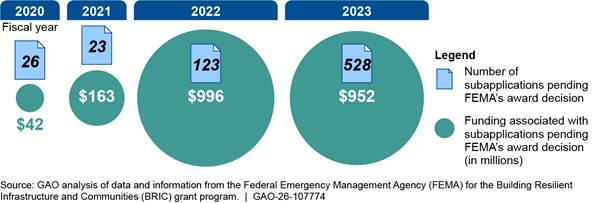
GAO found the median time for FEMA to finalize its review of subapplications and award BRIC subgrants was 7 to 9 months. As of March 2025, FEMA had not made award decisions for 700 subapplications because it had not completed the second of its two review stages. These subapplications were associated with about $2.2 billion of the $4.8 billion. Communities said these review timeframes could extend project timelines and increase costs. Identifying efficiencies to shorten FEMA’s review may enable communities to begin hazard mitigation activities sooner and minimize additional costs.
Number of BRIC Subapplications Pending FEMA’s Award Decision and BRIC Funds Associated with These Subapplications, Across Four Grant Cycles and as of March 2025
FEMA announced it was ending BRIC in April 2025, but it did not communicate key information internally and externally until March 2026 when it announced it was restarting BRIC. For example, FEMA did not clarify which subgrants would be terminated. Officials and stakeholders said the lack of actionable information from FEMA headquarters created challenges and delayed mitigation efforts. State officials told GAO that some subrecipients stopped work due to funding uncertainty, which may increase project costs. Moving forward, identifying and applying lessons learned from this period will help ensure FEMA communicates relevant, timely program information internally and externally.
FEMA established performance goals, but it did not consistently establish methods and targets to measure results. For example, one of FEMA’s goals in fiscal year 2023 included a goal to spread grants across the U.S. but FEMA did not set a target to determine if it had achieved its goal. FEMA officials also told GAO it did not use performance information to inform its announcement ending BRIC. By establishing results-oriented performance goals and generating annual performance information, FEMA could use this information to determine BRIC’s effectiveness and inform agency decision-making.
Why GAO Did This Study
Disasters caused by natural hazards have become costlier and more frequent in recent years. Independent research has found that investing in disaster resilience can reduce costs of future disasters. FEMA launched its BRIC grant program in 2020 to fund activities that enhance resilience and lower disaster costs. In April 2025, FEMA announced it was ending BRIC. In March 2026, FEMA announced it was restarting BRIC.
GAO was asked to review FEMA’s implementation of BRIC, and explanatory statement language includes a provision for GAO to conduct oversight of the Infrastructure Investment and Jobs Act, which made appropriations for BRIC. This report examines (1) communities that applied for and received grants and activities funded, (2) challenges that communities identified and the extent to which FEMA addressed them, (3) the extent to which FEMA communicated BRIC’s status and the impact of announcing its end, and (4) the extent to which FEMA measured the program’s performance and used this information to inform agency decisions.
GAO reviewed FEMA documentation, analyzed BRIC data from four grant cycles as of March 2025, interviewed a nongeneralizable selection of 6 states and 6 communities, and interviewed FEMA officials.
What GAO Recommends
GAO is making seven recommendations to FEMA, including to identify efficiencies in its subapplication review process, identify and apply lessons learned to improve internal and external communication, and establish effective performance goals and use performance information to determine program effectiveness. DHS concurred and identified actions it plans to take.
|
Abbreviations |
|
|
|
|
|
|
|
BRIC |
Building Resilient Infrastructure and Communities |
|
|
CDRZ |
community disaster resilience zone |
|
|
DHS |
Department of Homeland Security |
|
|
DTA |
direct technical assistance |
|
|
EDRC |
economically disadvantaged rural community |
|
|
EHP |
Environmental Planning and Historic Preservation |
|
|
FEMA |
Federal Emergency Management Agency |
|
|
NOFO |
notice of funding opportunity |
|
|
Stafford Act |
Robert T. Stafford Disaster Relief and Emergency Assistance Act |
|
This is a work of the U.S. government and is not subject to copyright protection in the United States. The published product may be reproduced and distributed in its entirety without further permission from GAO. However, because this work may contain copyrighted images or other material, permission from the copyright holder may be necessary if you wish to reproduce this material separately.
September 24, 2026
Congressional Addressees
Disasters caused by natural hazards have become costlier and more frequent in recent years. In 2024, there were 27 disasters with at least $1 billion in total economic damage, an increase from 14 such disasters in 2018. Those 27 disasters resulted, directly or indirectly, in at least 568 deaths.[1] Moreover, independent research has found that investing in disaster resilience can reduce the costs of future disasters. For example, a 2025 U.S. Chamber of Commerce report found that every dollar not invested in disaster resilience today can cost communities up to $33 in lost future economic activity, under various assumptions.[2]
We added “improving the delivery of federal disaster assistance” to our 2025 High Risk Report and identified “investing in resilience” as a key challenge in this area.[3] To address this high risk area, we reported that agencies should facilitate more significant reduction to the nation’s overall disaster risk. The Federal Emergency Management Agency (FEMA) leads the nation’s efforts to mitigate natural disasters and administers hazard mitigation assistance programs for communities to increase disaster resilience.[4]
The Robert T. Stafford Disaster Relief and Emergency Assistance Act (Stafford Act), as amended by the Disaster Recovery Reform Act of 2018, authorizes the President to set aside up to six percent of the estimated assistance for major disasters from the Disaster Relief Fund to provide technical and financial assistance to state and local governments as part of a pre-disaster hazard mitigation program.[5] In response, FEMA launched its Building Resilient Infrastructure and Communities (BRIC) program in fiscal year 2020. BRIC is a pre-disaster, hazard mitigation grant program that seeks to fund and prioritize projects and activities that enhance disaster resilience, including modernizing the nation’s infrastructure against disasters, and to reduce future losses to the Disaster Relief Fund.
FEMA set aside about $4.4 billion for BRIC during four grant cycles in fiscal year 2020 through fiscal year 2023. The Infrastructure Investment and Jobs Act also appropriated $1 billion over 5 fiscal years, 2022 through 2026, for BRIC.[6] However, in April 2025, FEMA announced it was ending the program and canceling all applications from fiscal year 2020 through fiscal year 2023. In July 2025, twenty states sued FEMA to reverse the program’s termination, and in December 2025, the U.S. district court ordered FEMA to reverse its termination of BRIC.[7] In March 2026, FEMA announced it was resuming the program and subsequently issued a combined Notice of Funding Opportunity (NOFO) for fiscal years 2024 & 2025.
You requested that we review FEMA’s implementation of the BRIC program. Additionally, the explanatory statement accompanying the Consolidated Appropriations Act, 2023, includes a provision for GAO to conduct oversight in support of the Infrastructure Investment and Jobs Act.[8] This report examines: (1) the communities that applied for and received BRIC grants and activities the grants funded, (2) challenges that communities identified with the BRIC program and the extent to which FEMA has addressed them, (3) the extent to which FEMA communicated the status of the BRIC program to stakeholders and the impact of the announcement ending the program, and (4) the extent to which FEMA measured the BRIC program’s performance and considered such information to inform agency decision-making.
To address these objectives, we obtained and analyzed FEMA record-level data on BRIC applications and grants for the four grant cycles, fiscal year 2020 through fiscal year 2023, as of March 24, 2025. We analyzed these data to describe the communities that applied for and received BRIC grants and the activities the grants funded, to determine median grant obligation timelines, and to identify the funding status of BRIC grants at the time of FEMA’s announcement ending the program. The data we analyzed are as of March 24, 2025, and do not exactly align with FEMA’s April 4, 2025, announcement ending the program; however, FEMA did not award new subgrants or obligate funding between April 2025 and early March 2026. As a result, we consider the data to be sufficient for our purposes and reflective of the program’s status as of March 2026 when FEMA announced it was resuming the program. To assess the reliability of these data, we conducted validity checks, including conducting electronic and manual data testing, reviewing agency documents, and interviewing agency officials. We determined that the data were sufficiently reliable for our purposes.
We interviewed hazard mitigation officials from a non-generalizable selection of six states and six communities across those states that received subgrants to discuss their experiences with the BRIC program and the impact of the announcement to end the program.[9] We also spoke with officials from three national emergency management organizations about their perspectives on the BRIC program and the announcement ending the program.[10]
We reviewed relevant agency guidance and strategy documents, as well as reports on and assessments of BRIC’s processes. We also reviewed FEMA’s performance management documentation, internal and external communications about the status of the program, and filings and court orders in the BRIC litigation. We interviewed officials from FEMA headquarters and three FEMA regions regarding BRIC’s development, implementation, and assessment, as well as the decision to announce BRIC’s end and efforts to restart the program.[11] See appendix I for additional details about our scope and methodology.
We conducted this performance audit from August 2024 to September 2026 in accordance with generally accepted government auditing standards. Those standards require that we plan and perform the audit to obtain sufficient, appropriate evidence to provide a reasonable basis for our findings and conclusions based on our audit objectives. We believe that the evidence obtained provides a reasonable basis for our findings and conclusions based on our audit objectives.
Background
FEMA’s Announcement to End BRIC and Related Litigation
On April 4, 2025, FEMA issued a public advisory announcing that it was ending the BRIC program and canceling all BRIC applications from fiscal year 2020 through fiscal year 2023.[12] It stated that if FEMA had not already distributed grant funds, then the funds would be immediately returned either to the Disaster Relief Fund or the U.S. Treasury. On April 16, 2025, FEMA issued an updated advisory on its planned actions to end BRIC.[13] It stated that only grants that had started construction would continue to receive funds. FEMA also announced that the fiscal year 2024 BRIC NOFO was canceled, no applications would be reviewed, and no grants would be awarded.[14] In addition, the advisory stated that FEMA was developing a new approach to hazard mitigation. See appendix II for copies of the April 2025 advisories. Moreover, from June 2025 through August 2025, FEMA publicly reported its plans to reverse the set-aside for BRIC from the Disaster Relief Fund.[15]
In July 2025, twenty states sued FEMA to reverse the termination of the BRIC program. In the complaint, the states asserted that FEMA’s actions to terminate BRIC violated the constitutional principle of the separation of powers and the Administrative Procedure Act and sought the restoration of the program.[16] In response, FEMA asserted the court did not have jurisdiction over the case because FEMA had not ended the BRIC program, among other things.[17] In December 2025, the court ordered FEMA to reverse its termination of BRIC and prohibited the agency from taking any further actions to cancel or suspend the program.[18] The court subsequently issued an order in March 2026 to enforce the December 2025 summary judgment order and set timelines for FEMA to take steps to restore BRIC, such as issuing a BRIC program NOFO for fiscal year 2024 within 21 days of the order.[19] On March 18, 2026, FEMA issued an advisory announcing it was resuming the BRIC program (see app. II).[20] It subsequently issued a combined NOFO for fiscal years 2024 & 2025 on March 25, 2026.[21] See appendix III for additional details on the NOFO for fiscal years 2024 & 2025 and key changes from the fiscal year 2023 cycle.
BRIC Statutory Requirements
The Stafford Act, as amended, authorizes FEMA to provide technical and financial assistance on a competitive basis to state, local, territorial and tribal governments to implement cost-effective pre-disaster hazard mitigation measures.[22] The assistance may also be used for: (1) supporting public-private hazard mitigation partnerships; (2) improving the assessment of a community’s vulnerability to natural hazards; (3) establishing hazard mitigation priorities and plans; and (4) implementing the latest building codes.[23] When determining whether to provide assistance under this program, FEMA is to take into account the extent and nature of the hazards to be mitigated and the extent to which the activity will increase the level of resiliency, among other criteria.[24]
BRIC Funding Categories
From fiscal year 2020 through fiscal year 2023, FEMA issued NOFOs that announced the availability of about $4.8 billion for BRIC subgrants to states, local communities, U.S. territories, and Tribes in four separate grant cycles.[25] These NOFOs provided that the largest portion of available funding was for a National Competition and totaled $4.2 billion over the four grant cycles.[26] The other portion was for a State/Territory Allocation and a Tribal Set-Aside (see fig. 1). During the 4-year period, the NOFOs provided that about $314 million was available for states and territories under the Allocation, and about $145 million was available for Tribes under the Set-Aside.[27] In the fiscal year 2023 cycle, FEMA added the Building Code Plus-Up, which was additional funding dedicated to building code adoption and enforcement activities, such as adopting codes that incorporate more current requirements or higher standards. The fiscal year 2023 NOFO provided that, under this Plus-Up, $112 million was available for states and territories and $25 million was available for Tribes.[28]
Figure 1: Funding FEMA Made Available for the BRIC Grant Program by Fiscal Year and Funding Category
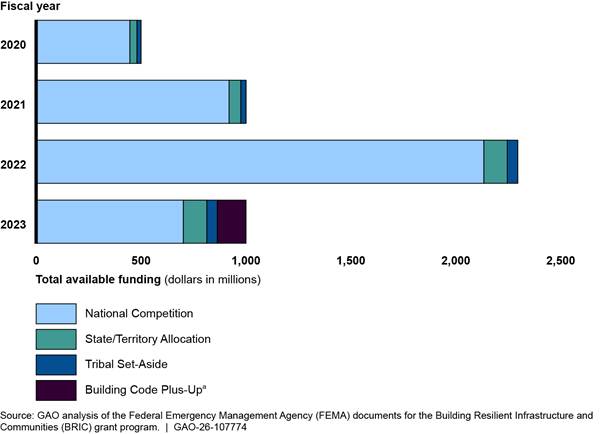
Note: There was a significant increase in funds set aside for BRIC in fiscal year 2022 due to an additional set-aside of about $1.8 billion based on the COVID-19 major disaster declarations.
aFEMA established the Building Code Plus-Up funding category in fiscal year 2023 and included $112 million for states and territories and $25 million for Tribes.
BRIC Hazard Mitigation Activities
Hazard mitigation generally involves sustainable actions that reduce or eliminate long-term risk to people and property from future disasters. During the four grant cycles from fiscal year 2020 through fiscal year 2023, BRIC funded three kinds of activities to support such hazard mitigation efforts.
Capability- and capacity-building. Generally, this includes activities that enhance the knowledge, skills, and expertise of the current workforce to expand or improve the administration of mitigation assistance. For example, it includes planning activities such as developing and updating hazard mitigation plans.[29] A hazard mitigation plan is a long-term strategy for communities to identify hazards and vulnerabilities, and outline actions to reduce risks and losses to people and property from future disasters. A community could use BRIC funds to update a plan based on new information, such as economic analyses and mapping, or to strengthen a mitigation strategy by incorporating actions to reduce vulnerabilities.[30] Planning activities also include efforts to engage partners and stakeholders to identify actions to improve community resilience. For example, communities could identify state, local, territorial, and tribal government policies that could be implemented to reduce risk and future losses from future hazard events.[31]
In addition, capability- and capacity-building includes project scoping activities such as developing hazard mitigation strategies and obtaining data to prioritize, select, develop, and complete applications for hazard mitigation projects. Project scoping may result in either an improvement in the capability to identify appropriate mitigation projects or in the development of an application-ready mitigation project.
Projects. Hazard mitigation projects are designed to increase resilience and public safety. Projects can include infrastructure projects, such as constructing safe rooms to protect against severe wind events, as well as non-construction projects, such as acquisition projects to purchase structures in flood zones for demolition (see fig. 2). In fiscal year 2020 through fiscal year 2023, communities could complete BRIC hazard mitigation projects in phases. For example, a complex project may have required technical or environmental data beyond what the subapplicant could provide. In this case, phase one of a project could have involved obtaining technical or environmental data for the project. Subsequently, if the results of phase one of the project indicated that phase two of the project met BRIC requirements, then phase two of the project could have involved actual construction. With a maximum subgrant amount of $50 million, BRIC allowed and promoted large and more complex infrastructure projects.[32]
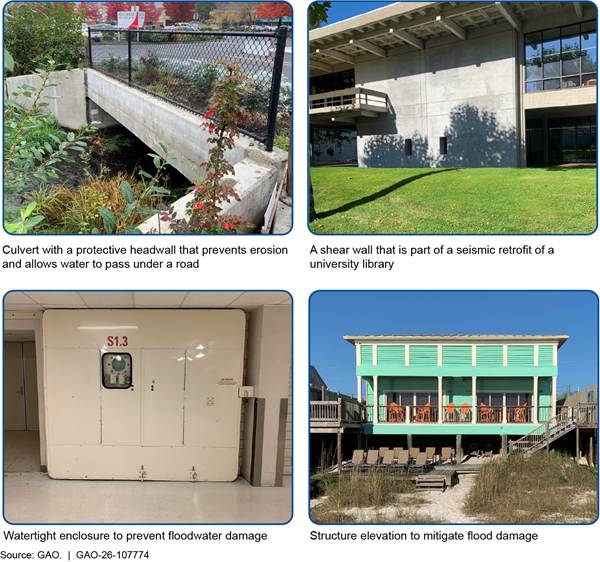
Note: These pictures are examples of hazard mitigation projects but are not Building Resilient Infrastructure and Communities (BRIC) program funded projects. However, these types of projects could be eligible for BRIC grants.
Management costs. Management costs are financial assistance to pay for eligible and reasonable indirect costs, direct administrative costs, and other administrative expenses associated with a specific hazard mitigation activity or project.
Steps and Processes to Award BRIC Subgrants
According to FEMA documentation, during the four grant cycles from fiscal year 2020 through fiscal year 2023, FEMA’s process generally included the following steps: (1) FEMA headquarters announcing the availability of funding and program requirements, (2) communities creating and submitting subapplications, (3) FEMA regions and headquarters reviewing and selecting submitted subapplications for further review, and (4) FEMA regions awarding BRIC subgrants (see fig. 3).[33]
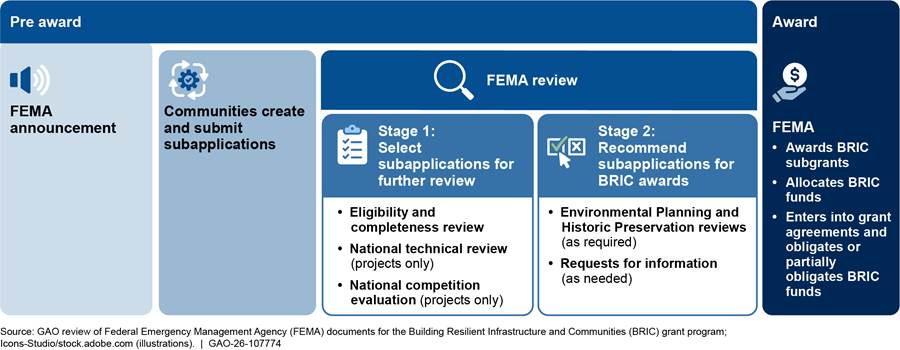
Note: For the purposes of this report, we define allocated funding as funding amounts, both obligated and unobligated, associated with awarded subgrants. The allocated funding amount is subject to change.
FEMA announcement. For the four BRIC cycles, FEMA announced the availability of BRIC funding and program requirements in a NOFO once a year. The grant cycle fell after the end of the fiscal year. For example, the application deadline for BRIC’s fiscal year 2023 cycle was February 2024, and applicants were selected for further review by July 2024.[34] The notices included information about the program, such as eligible applicants and activities, as well as content that must be included in subapplications. For example, all subapplications had to include a scope of work and proposed budget for the mitigation activity. FEMA also required subapplications for projects to include a benefit-cost analysis.[35] FEMA’s notices also described program requirements, such as cost- share requirements and the period of performance.[36]
|
BRIC Program Definitions · Applicants: States, District of Columbia, U.S. territories, and Tribes. · Subapplicants: Communities, including local governments, cities, townships, counties, special governmental districts, and Tribes. · Applications: Applicants submit one BRIC application each fiscal year grant cycle, comprised of an unlimited number of subapplications. · Subapplications: Submitted by subapplicants to be included in the application for the fiscal year grant cycle Source: Federal Emergency Management Agency documentation for the Building Resilient Infrastructure and Communities (BRIC) grant program. | GAO‑26‑107774 |
Communities created and submitted subapplications. FEMA required subapplicants (e.g., local governments, tribal governments) to complete and submit subapplications to an applicant (e.g., state), which reviewed and submitted an application to FEMA that was comprised of multiple subapplications. Applicants submitted required information via FEMA Grants Outcomes—FEMA’s grants management system that allows entities to apply for grants.
FEMA review. FEMA established a two-stage process to review subapplications—(1) selecting subapplications for further review and (2) further reviewing subapplications to recommend or not recommend them for award.
FEMA documentation outlines steps the agency took during the first stage review. Specifically, a program handbook directed FEMA staff to conduct multiple assessments to determine subapplication eligibility and completeness and the extent to which certain subapplications met technical and qualitative criteria.[37]
· Eligibility and completeness reviews. A program handbook directed FEMA staff to conduct initial assessments of all subapplications to determine if they were eligible and complete. Generally, FEMA regions determined if subapplicants and their proposed mitigation activities were eligible for the program and if subapplications contained all required elements, such as a complete scope of work and a line-item budget, among other elements.[38] FEMA regions also conducted specialty assessments of subapplications, when applicable. For example, a program handbook required FEMA staff to conduct mitigation plan assessments for all subapplications for mitigation projects.[39] In contrast, subapplications for mitigation planning were not subject to any specialty assessments.[40] For each assessment, FEMA regions determined if the subapplication was eligible or ineligible.[41] Regional staff provided their determinations to FEMA headquarters for review.[42]
· National technical review. FEMA reviewed subapplications for projects to determine their technical feasibility and cost-effectiveness. For example, hazard mitigation projects were reviewed to confirm that the project would achieve the expected level of protection as described in the project design and that the construction of the designed project was technically feasible. According to a program guide, only projects that were technically feasible and cost-effective could be selected for further review.
· National competition scoring. According to BRIC NOFOs, FEMA reviewed subapplications for projects submitted to the National Competition against technical and qualitative criteria. The technical evaluation was conducted by technical experts who determined the extent to which the subapplication included five elements valued by FEMA, such as if it proposed an infrastructure project and incorporated nature-based solutions.[43] This review resulted in a numerical score.[44] The qualitative evaluation was conducted by National Review Panels.[45] Panels were comprised of several roundtables, and each roundtable was comprised of six panelists and a panel lead. Panelists were government employees from local, state, federal, territorial, and tribal governments and were selected by FEMA.[46] During this review, panelists scored subapplications against six criteria, such as how the project would effectively reduce risk and increase resilience within the community and how project costs and schedule would be managed, according to BRIC NOFOs.[47] Similar to the technical evaluation, the qualitative evaluation resulted in a numerical score.[48]
After FEMA completed all applicable reviews, assessments, and evaluations, FEMA headquarters used the results to select subapplications for further review, according to program guides.[49] To select subapplications, FEMA ranked subapplications submitted to the National Competition, allocations for states and territories, set-aside for Tribes, and building code plus-ups separately. For example, for National Competition subapplications, FEMA headquarters used cumulative scores from the technical and qualitative evaluations to rank subapplications from highest to lowest. FEMA was able to select subapplications out of priority order, as determined by the total points scored, based on other factors important for FEMA and the program. FEMA then selected subapplications up to the available funding amount for the fiscal year. For the State/Territory Allocation, the Tribal Set-Aside, and the Building Code Plus-Up, applicants ranked their subapplications and FEMA selected eligible subapplications up to the available funding amount in each funding category for the fiscal year.
Once FEMA selected subapplications for further review, FEMA initiated its second stage review to finalize its decision to award the subgrant and allocate BRIC funds. According to a FEMA program handbook and guide, this stage included completing required Environmental Planning and Historic Preservation (EHP) compliance reviews resulting in an EHP compliance determination and FEMA requesting additional information from subapplicants, if required.
· EHP reviews. BRIC subapplications were required to comply with all applicable EHP statutes, regulations, and executive orders. For example, the National Environmental Policy Act requires federal agencies to assess the environmental effects of proposed major federal actions prior to making decisions.[50] Similarly, the National Historic Preservation Act requires an assessment of the impact on historic properties.[51] To ensure compliance, FEMA regional staff conducted required EHP reviews for selected BRIC subapplications.[52]
· Requests for additional information. To receive a BRIC subgrant, FEMA regional staff may have required subapplicants to provide additional information on their proposed mitigation activity. For example, regional staff may have requested information to resolve questions that were identified during the first stage review before recommending subapplications for a BRIC subgrant. In addition, regional staff may have requested information from subapplicants to draft EHP compliance review documentation and make the subsequent EHP compliance determinations.
According to FEMA documentation, once FEMA regional staff completed the EHP compliance review determinations and FEMA's request(s) for information were resolved FEMA regions recommended or did not recommend each subapplication for a BRIC subgrant.
|
BRIC Program Definitions · Recipient: States, District of Columbia, U.S. territories, and Tribes that receive a BRIC grant. · Subrecipient: Communities, including local governments, cities, townships, counties, special governmental districts, and Tribes, that receive a BRIC subgrant. · Grant: BRIC grants are awarded to recipients and comprise multiple subgrants. · Subgrant: BRIC subgrants are awarded to subrecipients to conduct their mitigation effort. Source: Federal Emergency Management Agency documentation for the Building Resilient Infrastructure and Communities (BRIC) grant program. | GAO‑26‑107774 |
FEMA awarded BRIC subgrants and allocated BRIC funds. Once FEMA regional staff recommended subapplications for BRIC subgrants, FEMA took steps to award BRIC subgrants and allocate BRIC funds, according to a program handbook.[53] For example, regional grants management staff reviewed the subapplications. Ultimately, regional staff approved the subapplications for award. Next, FEMA provided award packages to applicants. For example, FEMA sent applicants an award letter and terms and conditions of the award. Subsequently, applicants notified subapplicants that they were awarded a BRIC subgrant and then subapplicants either accepted or did not accept the subgrant. Subapplicants that accepted the subgrant transitioned to subrecipients, and applicants transitioned to recipients. There was no formal relationship between FEMA and subrecipients, according to BRIC NOFOs and a program guide. Recipients subsequently entered into their own sub-agreements with subrecipients.
After subrecipients and recipients accepted the subgrant, FEMA then obligated all or part of the BRIC funds allocated for the subgrant, according to BRIC NOFOs and a program guide. For example, for subgrants with phased projects, FEMA obligated BRIC funds at each phase of the project. In particular, FEMA obligated funds associated with the first phase of projects upon award of the subgrant. When subrecipients completed the first phase, FEMA then obligated funds for the second phase.[54] As a result, some BRIC subgrants could be partially obligated.
Post-Award Steps and Processes for BRIC Grants
According to BRIC NOFOs and program guides, during the four grant cycles from fiscal year 2020 through fiscal year 2023, FEMA’s post-award steps and processes for BRIC generally included (1) recipients and subrecipients beginning the activity, (2) FEMA monitoring the grant, (3) FEMA processing recipients’ requests for reimbursement, and (4) FEMA, recipients, and subrecipients closing out the grant agreement (see fig. 4).
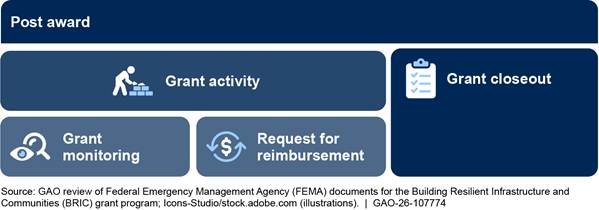
Once recipients and subrecipients began the grant activity, FEMA monitored the grant and subgrants, according to BRIC NOFOs and a program guide. For example, FEMA required recipients to submit performance progress reports on a quarterly basis. In addition, FEMA was authorized to make site visits or conduct desk reviews to review award progress.[55]
Generally, recipients requested reimbursement from FEMA after subrecipients incurred costs. Then, FEMA disbursed funds to recipients, who then disbursed funds to subrecipients. Subrecipients could request reimbursement from the recipient at any time after incurring costs. For example, subrecipients could request reimbursement immediately after incurring costs or could submit requests later—such as on a quarterly basis or upon completion of the mitigation activity.
According to a program guide, FEMA closed out BRIC subgrants when FEMA staff determined that recipients and subrecipients completed all required work and administrative actions. For example, recipients submitted a final progress report detailing all accomplishments throughout the period of performance.
FEMA Allocated About Half of Available Funding to Communities to Support Various Mitigation Activities as of March 2025
Over the four BRIC cycles, FEMA had awarded 1,245 subgrants, about one-third of the 3,820 BRIC subapplications it received as of March 2025.[56] FEMA allocated about half, $2.5 billion, of the almost $4.8 billion it announced as available for the program to these subgrants.[57] Almost half of these allocated funds were for natural hazard mitigation activities, such as flood control. Additionally, FEMA had selected for further review, but not completed its review to award, an additional 700 subapplications associated with a total of $2.2 billion, most of the remaining available funds. According to our analysis of FEMA data as of March 2025, FEMA had obligated about $1 billion of the $2.5 billion allocated to recipients and reimbursed $62 million, about 6 percent of the obligated amount. About three percent, 37 of the 1,245 subgrants, had both completed work and initiated or completed FEMA’s closeout process.[58] Between April 2025 and March 2026, FEMA did not award additional BRIC subgrants, nor obligate additional BRIC funds.
BRIC Subapplication Requests Exceeded Available Funding
Combined, over the four BRIC cycles, communities submitted 3,820 subapplications requesting about $16 billion in grant funds, or more than three times the almost $4.8 billion announced as available for BRIC (see fig. 5). In fiscal year 2023, communities requested more than five times the announced amount. Every state, five territories, and the District of Columbia submitted between 11 to 180 subapplications, requesting funding ranging from $4 million to $1.5 billion. See appendix IV for more information on the number of state and territory subapplications and requested funding.
Figure 5: Available BRIC Funding Compared to Requested Funding and Number of Subapplications in Fiscal Years 2020–2023
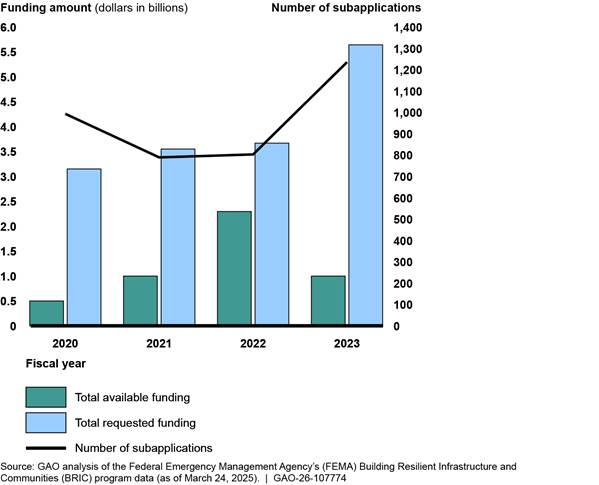
Note: Total requested funding is rounded to the nearest million. Total available funding and number of subapplications are not rounded.
National competition and state allocation. Over the four BRIC cycles, every state, territory, and the District of Columbia submitted at least one subapplication to both the National Competition and the State/Territory Allocation. About half of all 3,820 subapplications (1,987) were submitted to the National Competition and one-third (1,273) were submitted to the State/Territory Allocation.[59] However, not every state and territory submitted to both funding categories every cycle.
Subapplication activities and hazards. FEMA received BRIC subapplications that proposed 26 different primary activities to address 21 different primary hazard types over the four cycles. Flood control was the most common primary activity over the four cycles, proposed in 15 percent of BRIC subapplications (561). We grouped the 26 primary activities into eight broad categories, and we found that about one-quarter of subapplications (901) proposed primary activities under the utility and infrastructure protection category (see fig. 6).
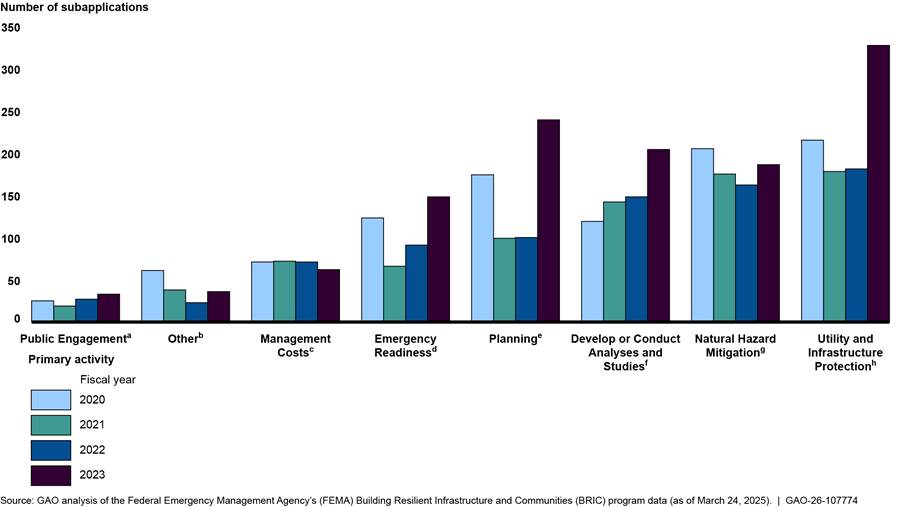
Notes: N=3,820. Subapplicants self-select the primary activity in their subapplication. We grouped FEMA’s primary activity subcategories into broader categories.
aPublic engagement activities include activities supporting development of applications, conduct meetings, outreach and coordination with subapplicants and community residents, education and awareness, and partnerships.
bOther activities include acquisition and instances when subapplicants identified “other” as the primary activity.
cManagement cost activities include management costs, which are administrative costs associated with administering projects.
dEmergency readiness activities include generator, saferoom/shelter, and warning system.
ePlanning activities include new plan, plan update, and planning related activities
fDevelop or conduct analyses and studies activities include develop or conduct engineering, environmental feasibility and/or benefit cost analyses, evaluate facilities to identify mitigation actions, and feasibility, engineering, and design studies.
gNatural hazard mitigation activities include flood control, stabilization and restoration, and wildfire management.
hUtility and infrastructure protection activities include codes and standards, elevation, floodproofing, mitigation reconstruction, relocation, retrofit, and utility and infrastructure protection.
Almost three-quarters of the 3,820 BRIC subapplications (2,765) proposed activities to mitigate against meteorological hazards, such as drought and tornadoes, over the four BRIC cycles (see fig. 7). Within this category, flooding was the most common hazard identified and accounted for almost half of all subapplications (1,792). See appendix V for additional information about subapplicants and subapplications.
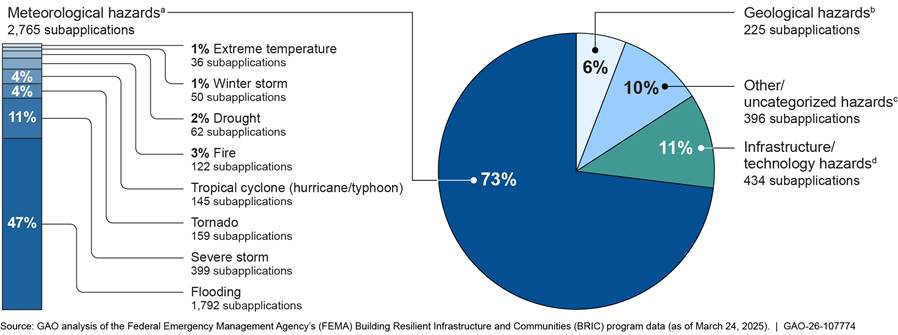
Notes: N=3,820. Subapplicants self-select the primary hazard in their subapplication. We grouped FEMA’s primary hazard subcategories into four broad categories.
aMeteorological hazards include drought, extreme temperature, fire, flooding, severe storm, tornado, tropical cyclone (hurricane/typhoon), and winter storm.
bGeological hazards include earthquake, landslide/debris flow, and tsunami.
cOther/Uncategorized hazards include biological incident, chemical incident, disease, radiological incident, hostile action, uncategorized, and blanks. Primary hazard is not a required field for management cost subapplications, and these 275 subapplications account for all blank responses.
dInfrastructure/technology hazards include cyber incident, dam/levee break, and infrastructure failure.
FEMA Allocated About Half of Available BRIC Funding
Over the four BRIC cycles, and as of March 2025, FEMA awarded 1,245 subgrants and allocated about $2.5 billion, approximately half of the about $4.8 billion available for the program.[60] In addition, FEMA had obligated about $1 billion of the allocated funding to recipients.[61] FEMA had also selected an additional 700 subapplications for further review—mostly from the fiscal year 2022 and fiscal year 2023 cycles—but had not finalized its review to award them subgrants. These 700 subapplications were associated with about $2.2 billion in grant funds, accounting for almost all the remaining funds available for the program (see fig. 8).
|
GAO Definitions for the Status of BRIC Subapplications, Subgrants, and Funding Subapplications and Subgrants: · Subapplications Selected for Further Review: Subapplications for which FEMA completed the first stage review and selected to continue to the second stage review. FEMA’s award determination is pending completion of the second stage review. · Awarded Subgrants: Subapplications for which FEMA completed the first and second stage reviews and awarded a subgrant. Awarded subgrants may be fully or partially obligated. Funding: · Funding Associated with Subapplications Selected for Further Review: Funding amounts associated with subapplications for which FEMA completed the first stage review and selected for further review (see above). · Allocated Funding: Funding amounts associated with awarded subgrants. Includes both: o Obligated Funding: Funding that FEMA obligated for a subgrant. Obligated funding may be for a fully obligated subgrant or the obligated portion of a partially obligated subgrant. o Unobligated Funding: The unobligated portion of a partially obligated subgrant. Source: GAO definitions based on Federal Emergency Management Agency (FEMA) documentation for the Building Resilient Infrastructure and Communities (BRIC) grant program. | GAO‑26‑107774 |
Figure 8: Available BRIC Funding Compared to Allocated Funding and Funding Associated with Subapplications Selected for Further Review, Fiscal Years 2020—2023
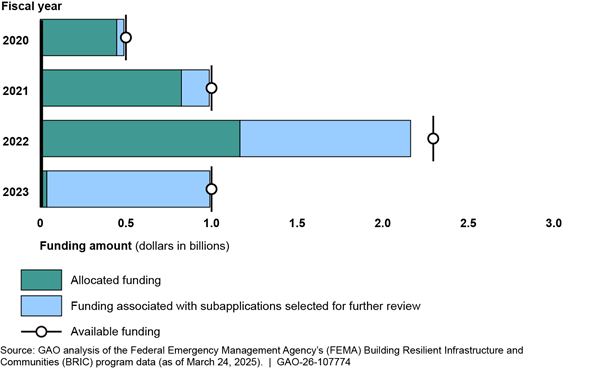
Notes: Allocated funding and funding associated with subapplications selected for further review are rounded to the nearest million. Available funding is not rounded.
Allocated funding means funding amounts, both obligated and unobligated, for awarded subgrants. The final obligated amount for partially obligated subgrants may change.
Funding associated with subapplications selected for further review means funding amounts associated with subapplications for which FEMA completed the first stage review and selected for further review but for which FEMA has not yet completed the second stage review.
State and territory awards. FEMA awarded every state, territory, and the District of Columbia at least one BRIC grant of varying amounts (see fig. 9).[62] On average, over the four cycles, FEMA awarded 22 subgrants per state/territory for an average allocated funding amount of $44 million per subgrant.[63] Across the recipients, these numbers ranged from one to 55 subgrants and $0.5 to $508 million per state/territory. FEMA awarded states/territories at an average award rate of 44 percent.[64] For example, although FEMA awarded the most subgrants and allocated the most funding to California over the four cycles, FEMA awarded 45 percent of California’s subapplications—an award rate aligned with the national average—and allocated 33 percent of the funds it requested. In addition, we found that a higher award rate did not necessarily correspond with higher levels of allocated funding, as each state and territory submitted a variable number of subapplications for different funding amounts. For example, New Hampshire had the highest award rate across the four cycles, with 83 percent of its subapplications receiving a subgrant, but FEMA allocated $2 million to these subgrants, or about half of funds requested. See appendix VI for additional information on state and territory subapplication outcomes, such as the number and percentage of ineligible subapplications.
Figure 9: Total Number of Awarded BRIC Subgrants, Award Rate, and Allocated Funding by State and Territory, Fiscal Years 2020—2023
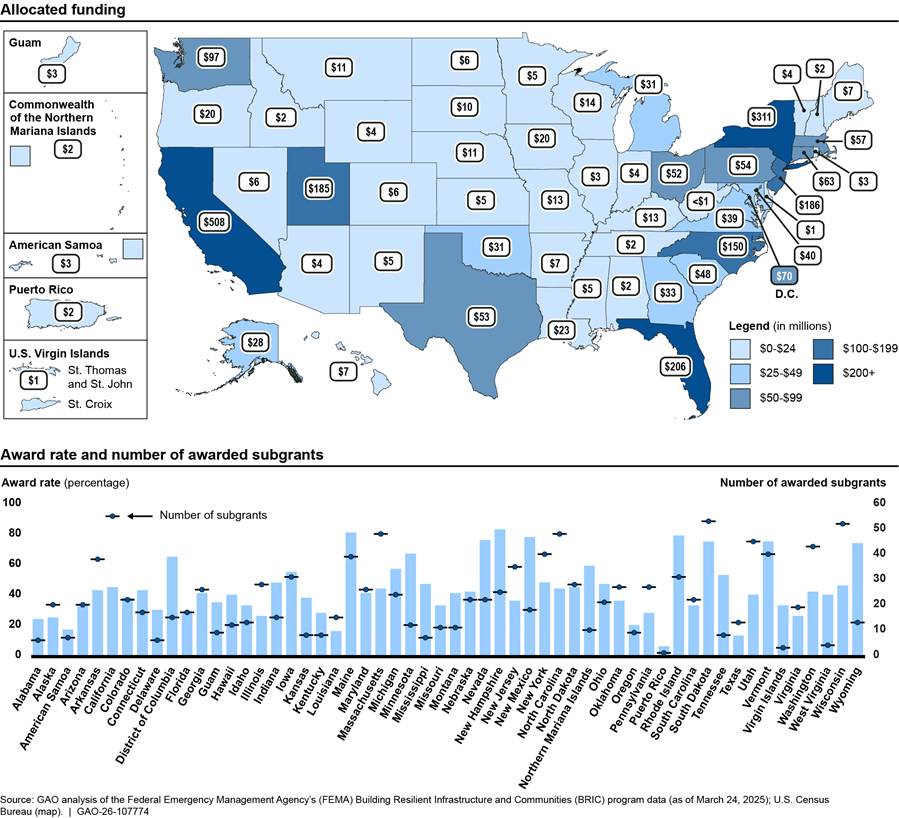
Notes: N=1,245. Allocated funding is rounded to the nearest million. Award rate is rounded to the nearest percent. Number of awarded subgrants is not rounded.
Allocated funding means funding amounts, both obligated and unobligated, for awarded subgrants. The final obligated amount for partially obligated subgrants may change.
We calculated award rates by dividing the number of awarded subgrants by the number of eligible subapplications. We included in our calculation all subapplications that met eligibility and completeness requirements regardless of if they moved to stage two review. We excluded subapplications that were identified as “did not meet HMA requirements,” an indicator of ineligibility, or were deemed ineligible. Over the four cycles, we identified 785 ineligible subapplications and 3,035 subapplications that met eligibility requirements. According to FEMA officials, in their calculations, subapplications must be selected for further review in order to receive an award, and FEMA would, therefore, calculate award rates by excluding both ineligible and “not selected” subapplications. Our award rate calculation differs from FEMA in that our intent is to show the breadth of eligible and complete subapplications received and awarded regardless of review stage. See appendix VI for complete information on the number of subapplications by status.
Tribal governments can apply to the BRIC program as either an applicant to the Tribal Set-Aside or a subapplicant under a state/territory to the State/Territory Allocation. Tribal government applicants are associated with an “applicant state” in FEMA’s data set. Therefore, we treat tribal government subapplications as if they were part of this “applicant state.”
National competition outcomes. FEMA did not award subgrants in the National Competition to 19 states and five territories.[65] Of the 31 states and the District of Columbia that FEMA awarded a subgrant in the National Competition, award rates varied from one to 60 percent, with an average award rate of about 13 percent. See appendix VII for more information on state and territory awards in the National Competition.
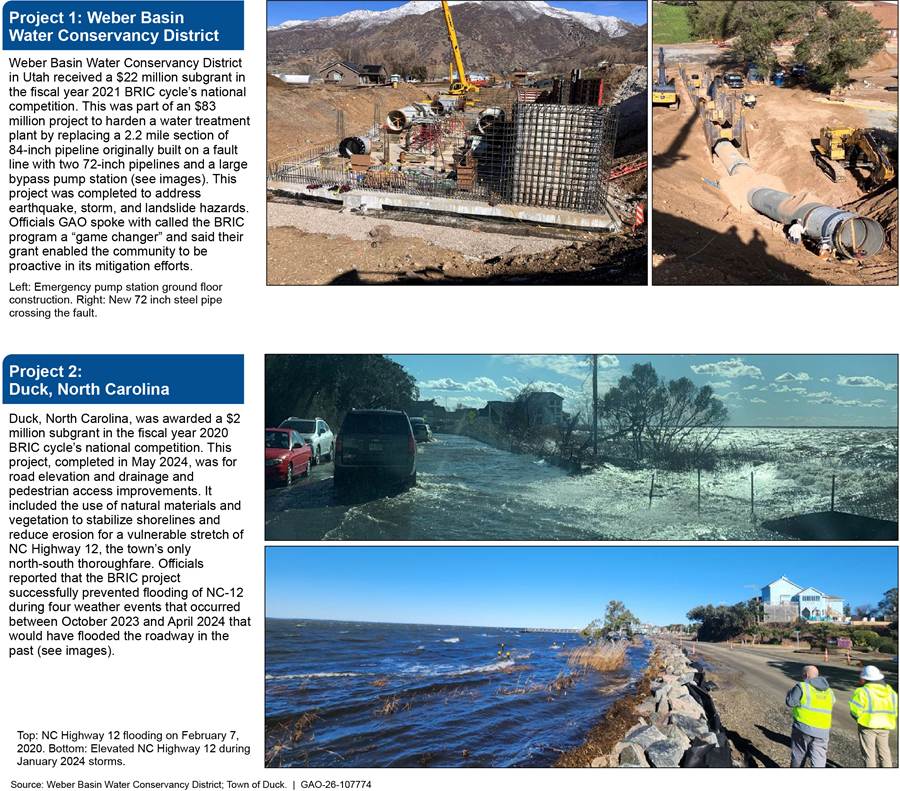
Subgrant activities and hazards. Over the four cycles, FEMA awarded more than half (59 percent) of all subgrants for planning activities and developing or conducting analyses and studies activities, though they represented 6 percent of total allocated funding (see fig. 10). In contrast, the award rate for natural hazard mitigation activities was the lowest at 13 percent, but these activities accounted for almost half of total allocated funding, about $1.2 billion. For two examples of BRIC projects, see figure 11.
Figure 10: Total Number of Awarded BRIC Subgrants, Award Rate, and Allocated Funding by Primary Activity Group, Fiscal Years 2020—2023
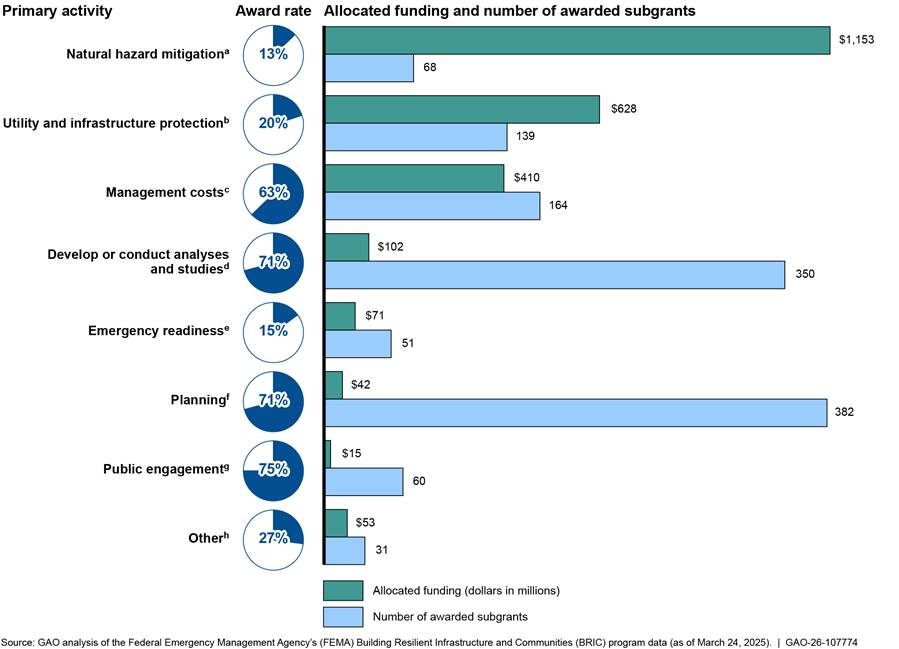
Notes: N=1,245. Allocated funding is rounded to the nearest million. Award rate is rounded to the nearest percent. Number of awarded subgrants is not rounded.
Allocated funding means funding amounts, both obligated and unobligated, for awarded subgrants. The final obligated amount for partially obligated subgrants may change.
We calculated award rates by dividing the number of awarded subgrants by the number of eligible subapplications. We included in our calculation all subapplications that met eligibility and completeness requirements regardless of if they moved to stage two review. We excluded subapplications that were identified as “did not meet HMA requirements,” an indicator of ineligibility, or were deemed ineligible. Over the four cycles, we identified 785 ineligible subapplications and 3,035 subapplications that met eligibility requirements. According to FEMA officials, in their calculations, subapplications must be selected for further review in order to receive an award, and FEMA would, therefore, calculate award rates by excluding both ineligible and “not selected” subapplications. Our award rate calculation differs from FEMA in that our intent is to show the breadth of eligible and complete subapplications received and awarded regardless of review stage. See appendix VI for complete information on the number of subapplications by status.
Subapplicants self-select the primary activity in their subapplication. We grouped FEMA’s primary activity subcategories into broader categories.
aNatural hazard mitigation activities include flood control, stabilization and restoration, and wildfire management.
bUtility and infrastructure protection activities include codes and standards, elevation, floodproofing, mitigation reconstruction, relocation, retrofit, and utility and infrastructure protection.
cManagement cost activities include management costs, which are administrative costs associated with administering projects.
dDevelop or conduct analyses and studies activities include develop or conduct engineering, environmental feasibility and/or benefit cost analyses, evaluate facilities to identify mitigation actions, and feasibility, engineering, and design studies.
eEmergency readiness activities include generator, saferoom/shelter, and warning system.
fPlanning activities include new plan, plan update, and planning related activities
gPublic engagement activities include activities supporting development of applications, conduct meetings, outreach and coordination with subapplicants and community residents, education and awareness, and partnerships.
hOther activities include acquisition and instances when subapplicants identified “other” as the primary activity.
Over the four cycles, FEMA awarded about two-thirds of BRIC subgrants and about 61 percent of total allocated funding to address meteorological hazards (see fig. 12). Of the $1.5 billion allocated to address these hazards, more than two-thirds ($1 billion) specifically addressed flooding. In contrast, awarded subgrants addressing all other hazard types combined were allocated about $953 million. See appendix V for additional information on subrecipients and subgrants.
Figure 12: Total Number of Awarded BRIC Subgrants, Award Rate, and Allocated Funding by Primary Hazard Group, Fiscal Years 2020—2023
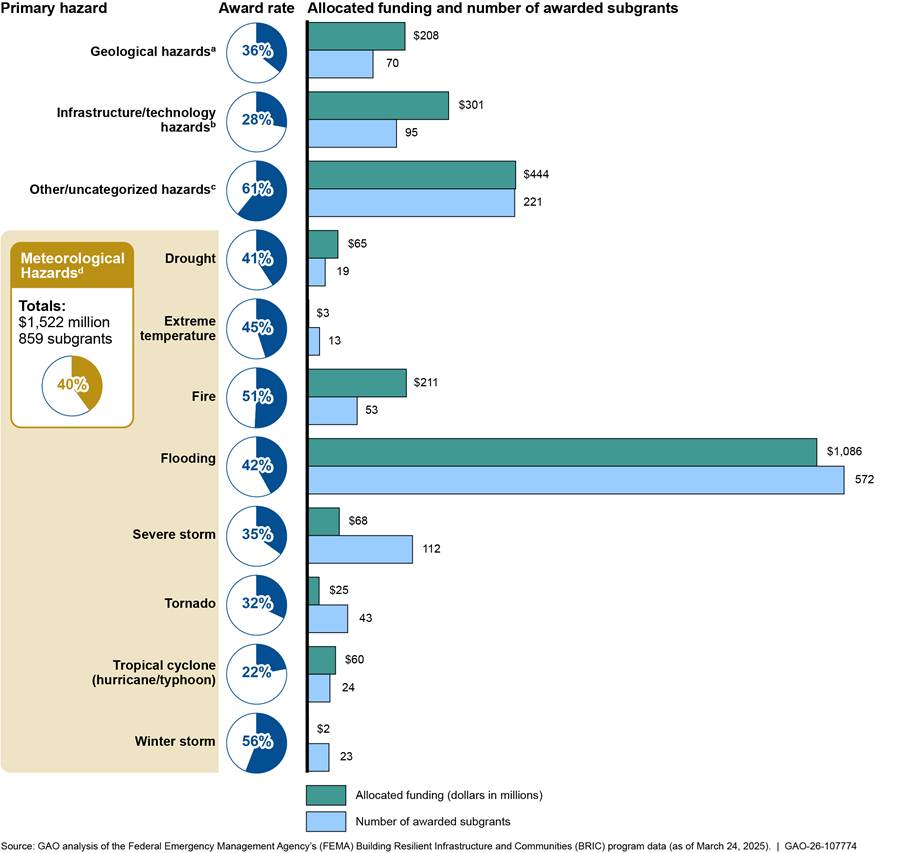
Notes: N=1,245. Allocated funding is rounded to the nearest million. Award rate is rounded to the nearest percent. Number of awarded subgrants is not rounded.
Allocated funding means funding amounts, both obligated and unobligated, for awarded subgrants. The final obligated amount for partially obligated subgrants may change.
We calculated award rates by dividing the number of awarded subgrants by the number of eligible subapplications. We included in our calculation all subapplications that met eligibility and completeness requirements regardless of if they moved to stage two review. We excluded subapplications that were identified as “did not meet HMA requirements,” an indicator of ineligibility, or were deemed ineligible. Over the four cycles, we identified 785 ineligible subapplications and 3,035 subapplications that met eligibility requirements. According to FEMA officials, in their calculations, subapplications must be selected for further review in order to receive an award, and FEMA would, therefore, calculate award rates by excluding both ineligible and “not selected” subapplications. Our award rate calculation differs from FEMA in that our intent is to show the breadth of eligible and complete subapplications received and awarded regardless of review stage. See appendix VI for complete information on the number of subapplications by status.
Subapplicants self-select the primary hazard in their subapplication. We grouped FEMA’s primary hazard subcategories into four broad categories.
aGeological hazards include earthquake, landslide/debris flow, and tsunami.
bInfrastructure/technology hazards include cyber incident, dam/levee break, and infrastructure failure.
cOther/Uncategorized hazards include biological incident, chemical incident, disease, radiological incident, hostile action, uncategorized, and blanks. Primary hazard is not a required field for management cost subapplications, and these awarded subapplications account for all 163 blank responses.
dMeteorological hazards include drought, extreme temperature, fire, flooding, severe storm, tornado, tropical cyclone (hurricane/typhoon), and winter storm.
Reimbursements. As of March 2025, FEMA had fully reimbursed 82 and partially reimbursed 359 subrecipients for a total of $62 million, about 6 percent of the $1 billion obligated. The 82 subrecipients who were fully reimbursed comprise about 7 percent of the 1,245 awarded subgrants. According to FEMA, as of June 2026, FEMA had reimbursed subrecipients a total of $326 million, about 13 percent of the almost $2.5 billion allocated and about 32 percent of the roughly $1 billion obligated. FEMA had fully reimbursed 207 subgrants, about 17 percent of the 1,245 awarded subgrants.
Closed subgrants. As of March 2025, FEMA had closed six subgrants in three states, all from the fiscal year 2020 cycle. FEMA had initiated closeout for an additional 31 subgrants across 12 states from the fiscal year 2020 through fiscal year 2022 cycles. FEMA reimbursed these 37 subrecipients a total of $1.8 million in BRIC funds, with 15 of them awaiting an additional $320 thousand. According to FEMA, as of June 2026, FEMA had closed 81 subgrants across 12 states and all fiscal year cycles. An additional 107 subgrants across 29 states had initiated close out from all fiscal year cycles. FEMA reimbursed these 188 subrecipients a total of $40 million in BRIC funds, with 73 of them awaiting an additional $4 million.
FEMA Addressed Some Challenges Communities Faced, but Lengthy FEMA Reviews Persisted
FEMA Addressed Community Concerns About the BRIC Application Process
Application requirements for BRIC caused communities to expend significant resources—time, staff, and money—according to FEMA’s 2023 Stakeholder Report and community officials we interviewed. FEMA’s 2023 Stakeholder Report noted that communities may need to hire external consultants to complete their subapplication, and that this may be inequitable for small, rural, and disadvantaged communities.[66] Officials from five of the six communities we spoke with told us they hired external consultants, including an engineering firm, to complete their subapplication and to assist with requirements like the benefit-cost analysis. In addition, officials from three of the six communities told us they worked for hundreds of hours to complete their subapplication. For example, a community reported that it assembled a team of five people who worked part-time for three months to complete their roughly 200-page BRIC subapplication.
FEMA’s 2023 Stakeholder Report also stated that stakeholders expressed a desire for more standardized resources to reduce the complexity of the application process. Ultimately, stakeholders recommended that FEMA create tools and resources to assist subapplicants, such as guides on how to complete each section and what types of documents and data were required.
FEMA took steps to better assist communities and states in completing and submitting their BRIC subapplications in fiscal year 2021 through fiscal year 2023, including providing additional resources for subapplicants and reducing some requirements.
Additional resources. In fiscal year 2021 through fiscal year 2023, FEMA provided online webinars to explain the NOFOs, including describing requirements—such as eligible subapplicants and activities. FEMA also developed and provided program support materials to communities to assist in their efforts to complete their subapplications. For example, these materials provided tips for submitting subapplications and detailed information on a range of topics related to BRIC subapplications—such as activity types (e.g., planning, project scoping, and projects), cost-effectiveness, building-codes, and tribal information. According to FEMA’s 2023 Stakeholder Report, some communities found FEMA’s webinars and training sessions helped them understand important components of the BRIC application. In addition, officials from one community we spoke with noted that FEMA’s webinars and program support materials greatly assisted its efforts to generate its BRIC subapplication.
Reduced requirements. FEMA also reduced some application requirements. For example, beginning in fiscal year 2022, FEMA’s NOFO no longer required vulnerable, underserved, or disadvantaged communities to include a benefit-cost analysis in their submission.[67] In these cases, according to the NOFO, FEMA reviewed the subapplication and, if it was otherwise eligible and competitive, FEMA would assist the subapplicant in developing a benefit-cost analysis. In addition, in 2023, FEMA allowed subapplicants to submit a cost-effectiveness narrative for projects requesting an award of less than $1 million instead of submitting a full benefit-cost analysis.
Lengthy FEMA Reviews Delayed Communities from Initiating Mitigation Activities and Could Increase Project Costs
Communities and states expressed concerns about the time it took FEMA to complete the second stage review and finalize its decisions to award BRIC subgrants. For example, state officials told us that EHP compliance reviews sometimes took years to complete. According to our analysis of FEMA data as of March 2025, it took several months to complete the second stage review and award BRIC subgrants to recipients across three grant cycles in fiscal years 2020 through 2022. Moreover, FEMA had not made award decisions for 700 subapplications as of March 2025. According to community officials we met with, long time periods between when FEMA selected a subapplication for further review and when it awarded the subgrant could have negative impacts, such as increased costs.
Stakeholders we interviewed expressed concerns about the time it took FEMA to complete the EHP compliance review and requests for additional information about the proposed mitigation activity in the subapplication.
EHP reviews. Officials from communities and states told us that FEMA’s EHP reviews could take years and may have required coordination with other stakeholders.[68] As part of FEMA’s second stage review, FEMA staff determined if EHP reviews were required and ensured they were completed. EHP reviews could involve coordination with other federal and state agencies, among others.[69] For example, officials from one community noted that its project to construct a hydroelectric power plant was subject to review by the Federal Energy Regulatory Commission. They expected the environmental review to take about 1 year, but it ultimately took nearly 4 and a half years. Officials from another community told us that they were required to complete two environmental reviews, one for the state and one for FEMA. They noted that that some elements of the two reviews were duplicative and that completing both reviews extended the time frame for FEMA to award the subgrant.
According to FEMA officials, EHP reviews may require coordination with subapplicants to request and obtain additional information to document compliance. These officials stated that response timeframes for these requests can lengthen the time it takes to complete the EHP review.
Requests for additional information. State officials told us that fulfilling FEMA’s requests for additional information could be a lengthy and burdensome process. As part of FEMA’s second stage review, FEMA regional staff could require subapplicants to provide additional information on their proposed mitigation activity. Officials from three communities we interviewed reported providing FEMA additional information. According to FEMA guidance, communities generally had 30 days to respond to FEMA’s requests for information, but FEMA did not impose internal deadlines for reviewing information and responding to communities. According to FEMA staff, some communities, especially those that were under-resourced, sometimes missed this deadline, which extended the process. Officials from four of the six states we spoke with noted that the request for information process could take several months to several years to complete and described it as tedious, complicated, cumbersome, and laborious.
Our analysis found the median time frames for FEMA to complete the second stage review to finalize its decisions to award BRIC subgrants took several months to complete and the time frames varied by subapplication type. As of March 2025, it took FEMA 7 to 9 months to complete the second stage review and award BRIC subgrants for individual years across three grant cycles in fiscal years 2020 through 2022 (see fig. 13).[70] However, FEMA awarded BRIC subgrants for plans in about 4 to 7 months for these individual cycle years compared to about 10 to 13 months for projects. Similarly, according to community officials we spoke with, the second stage review of their projects varied from 5 months to multiple years.
Figure 13: Median Number of Months Between the Date FEMA Selected a BRIC Subapplication for Further Review and the Date FEMA Initially Obligated Funds by Subgrant Type, Fiscal Years 2020—2022
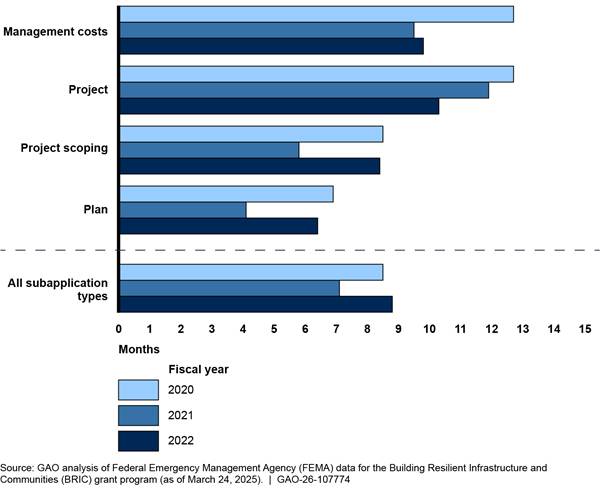
Note: N=1,057. Each fiscal year had a similar number of subapplications. Fiscal year 2020 included 356 subapplications, fiscal year 2021 included 327 subapplications, and fiscal year 2022 included 374 subapplications. Generally, each subapplication type had a similar number of subapplications. For example, for fiscal year 2020 through fiscal year 2022 there were 64, 78, and 109 project subapplications, respectively. During the same 3 fiscal years there were 138, 69, and 83 plan subapplications, respectively. The date of initial obligation is the date when a subgrant was first awarded, even if there were additional obligations later, such as when phase two of a phased project was awarded.
Moreover, FEMA did not consistently reduce the time it took to complete the second stage review and award BRIC subgrants.[71] Overall, the median amount of time it took FEMA to complete the second stage review and award BRIC subgrants increased by almost 2 months from fiscal year 2021 to fiscal year 2022.[72]
As of March 2025, FEMA had not completed the second stage review for 700 subapplications—about a third of the subapplications it selected for further review. These subapplications were associated with a total of $2.2 billion—about half of the available funds for the BRIC program from fiscal year 2020 through fiscal year 2023. About 50 of these subapplications had been awaiting an award decision for more than 2 years, as of March 2025 (see fig. 14).
Figure 14: Total Number of BRIC Subapplications Selected for Further Review, Associated Funding Amounts, and Time Elapsed Since FEMA Selected Them for Further Review in Fiscal Years 2020—2023 (as of March 2025)
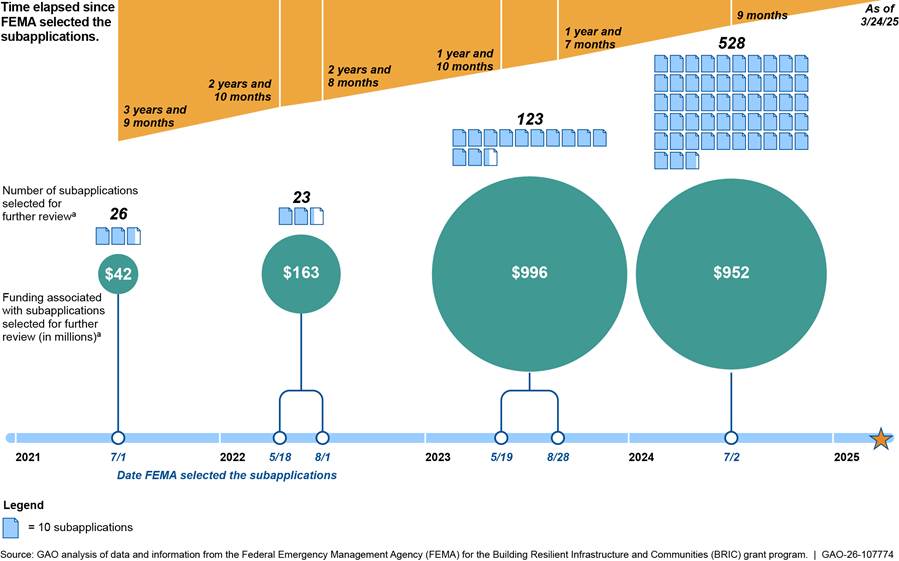
Note: N=700. Time elapsed is rounded to the nearest month. Funding associated with subapplications selected for further review is rounded to the nearest million. Number of subapplications is not rounded.
aAs of March 24, 2025.
Community officials told us that delays in award decisions could increase project costs. For example, officials from one community noted that the budget estimate of $40 million in the community’s fiscal year 2020 subapplication increased to more than $60 million due to inflation by the time FEMA awarded it in 2024. As a result, the community had to secure additional non-BRIC funds to address the cost increase, according to officials. Communities may have faced two distinct benefit losses: benefits that were expected during the waiting period were permanently foregone, and benefits that occurred after funding was received were worth less in present value terms because they arrived later than planned. In some cases, costs may have been irreversible and could not be recovered even after funding arrived.
Community officials also told us that delays in award decisions could create challenges meeting the period of performance for their hazard mitigation activity. Seemingly short delays in receiving an award could result in significantly longer delays to projects due to the limits that environmental regulations and tourism place on construction time frames, according to two communities. For example, one community noted that construction was limited to certain seasons due to the sensitive nature of the ecosystem and animal migration in their area. Therefore, a delay of a few weeks could result in a delay of up to 1 year and affect the community’s ability to meet its subgrant period of performance.
FEMA took steps to increase the timeliness of finalizing its decisions to award BRIC subgrants, however, the agency ended these efforts in 2024. Specifically, FEMA established a comprehensive plan that required continuous evaluation of BRIC’s subapplication review processes to improve timeliness for awarding subgrants. FEMA also initiated an expedited review process for more timely obligations for all hazard mitigation assistance applications, including BRIC.
Continuous evaluation. FEMA established a multiyear plan in 2019, including a framework to guide FEMA’s efforts to continuously review the program and identify ways to increase the timeliness of awarding BRIC subgrants. In particular, the plan included a milestone to increase the timeliness of awarding BRIC subgrants. To help achieve this, FEMA conducted analyses of the BRIC program. One analysis identified the EHP reviews and requests for information process, among other things, as contributing to the delays in obligations. This review led to recommendations for FEMA’s Hazard Mitigation Assistance Division to evaluate the effectiveness of the existing process for requesting information and whether timelines, number of requests, or methods to collect or correct information needed to be modified. As of May 2026, FEMA had no plans to consider the findings from this analysis nor implement the recommendations because the analysis did not reflect the program’s current goals or the current administration’s priorities, according to FEMA officials.
Expedited reviews. In January 2024, FEMA launched Hazard Mitigation Assistance Accelerate, a hazard mitigation-wide effort to reduce the average time between subapplication submission to FEMA and obligation, including for the BRIC program, according to FEMA officials. FEMA officials stated that the agency ended this effort at the end of 2024 because it was intended to be a one-time effort, not an indefinite effort. According to FEMA officials, this effort employed efficiencies from lessons learned from previous years’ experience and resulted in FEMA staff reviewing and obligating $578 million of BRIC funding in fiscal year 2024. According to agency officials, in March 2026, FEMA began to develop a process that would address the backlog of BRIC subapplications from fiscal year 2020 through fiscal year 2023 that the agency selected for further review but had not awarded and expedite reviews of these subapplications to award subgrants. However, the officials stated that this process was specifically for subapplications from previous BRIC cycles and did not provide information on whether the agency would develop a process to expedite reviews in future BRIC cycles.
FEMA’s multiyear plan directed it to continuously evaluate and identify ways to increase the timeliness of awarding BRIC subgrants when it first implemented BRIC. However, FEMA has not made plans to consider or implement recommendations to evaluate the effectiveness of its review process to award subgrants, such as improving the request for information process. Instead, FEMA has made changes to the fiscal years 2024 & 2025 grant cycle intended to expedite reviews of subapplications and obligation of funds. For example, for this grant cycle FEMA has disallowed phased projects and included new evaluation criteria for “project readiness.” However, it is uncertain if these changes will result in shorter timeframes for reviewing applications and obligating funds.
Shortened timelines for FEMA’s review process to finalize its decisions to award BRIC subgrants may enable communities to initiate their hazard mitigation activities sooner and minimize additional expenses due to cost increases. Additionally, by completing their projects sooner, communities would likely be more resilient to future hazards, reducing economic and human costs. As such, without assessing its process for reviewing subapplications to finalize its decisions to award BRIC subgrants, FEMA may miss opportunities to identify inefficiencies and apply lessons learned to award subgrants in a timely manner in future cycles. Further, FEMA’s hazard mitigation efforts will likely continue to yield higher costs and delay community resilience efforts.
FEMA’s Communication About BRIC Caused Confusion and Negative Impacts for Stakeholders
In April 2025, FEMA announced it was ending BRIC and working to develop a new approach to mitigation. However, for 11 months following this announcement, FEMA headquarters did not communicate additional, relevant, or actionable information to its regional staff and other stakeholders, including states, until March 2026 when it announced it was restarting BRIC. For example, FEMA headquarters did not provide regional staff with more detailed information that they could communicate to external stakeholders to address specific questions about the program ending. FEMA’s limited communication and resulting uncertainty about the program created challenges and potential missed opportunities for hazard mitigation across the country.
FEMA’s Limited Communication About BRIC Prevented Regions from Performing Key Functions
Following the initial announcement ending the BRIC program in April 2025 until the announcement restarting the program in March 2026, FEMA headquarters did not communicate actionable information to regional managers and staff, preventing them from performing key functions for 11 months. Officials from two FEMA regions we spoke with in mid-July 2025 told us that following the release of the April 2025 advisories, FEMA headquarters did not provide regions with finalized information about the BRIC program and the future of individual subapplications and subgrants, nor timelines for making such decisions.[73] Officials from one region added that they had regularly communicated with FEMA headquarters about BRIC following the April announcement, but since FEMA headquarters had not made final decisions on the program’s future, it was limited in what it could communicate to regions.
According to FEMA headquarters officials, they communicated more specific information internally to regional managers and staff at the end of July 2025. Specifically, they said FEMA headquarters provided verbal guidance and information to regions during routine and ad hoc meetings regarding the BRIC program between July 2025 and March 2026, when it announced it was restarting BRIC. However, they also told us FEMA headquarters did not issue formal written guidance to regions during this period and implemented restrictions on external communication that prevented regions from communicating information to stakeholders.[74] This lack of formal, actionable communication prevented regions from performing two of their key functions, including reviewing phased projects and communicating with external stakeholders.
Reviewing phased projects. FEMA did not approve any phased projects to move to the second phase between April 2025 and March 2026, and subrecipients could not make progress on these projects as a result. One of the April 2025 advisories stated that FEMA regions would coordinate with BRIC recipients to determine the best path forward for phased projects, such as ending the project after the completion of the first phase or at another appropriate stopping point. However, in July 2025, officials from one of the regions we spoke with said they did not know the plan for different types of grants. Officials from another region we interviewed told us that its state partners were particularly concerned about the future of their phased projects and the lack of answers FEMA could provide about them.
One community we spoke with submitted a request to begin the second phase of its project in December 2024, but as of July 2026, FEMA had not yet approved the request, and the community was unable to complete any work on the project, according to officials. As FEMA resumed BRIC, it estimated in court filings that it would take an additional 6 to 12 months to approve each phased project that had completed phase one to move to the second phase.
Delays in making determinations on phased projects for at least 11 months, including approving projects to begin phase two construction, and FEMA’s estimated timeline for reviewing phased projects may prevent subrecipients from making progress on their projects for potentially up to 2 years. As a result, subrecipients may face rising building costs that require them to find additional funding to complete the second phase of their project or end the project before its completion.
Communication with external stakeholders. For nearly a year, regional staff were unable to provide their state partners with updated information on the status of BRIC and individual subapplications and subgrants due to limited guidance and restrictions on external communications, according to FEMA officials. Regional staff told us they were limited to communicating information in the two public advisories. Officials from one region explained they did not want to speculate or share more information with state partners than they received from FEMA headquarters. In a November 2025 court filing, FEMA stated that it had fewer communications with states about BRIC projects after the April announcement ending the program.[75]
Further, regional officials told us they were unable to address specific questions and concerns their state partners raised to them following the announcement that the program was ending. Officials from both regions we spoke with in July 2025 said their state partners were frustrated with the lack of information, additional guidance, and answers from FEMA following issuance of the April 2025 advisories. The regions also told us that their state partners were concerned about the BRIC program’s uncertain future, especially given the initial time and resources already invested into their subapplications and projects.
Standards for Internal Control in the Federal Government states that management should internally communicate relevant and quality information to achieve the agency’s objectives. Specifically, management should communicate relevant and quality information down and across reporting lines to enable personnel to perform key roles in achieving objectives and addressing risks.[76] According to FEMA, regional administrators are responsible for maintaining partnerships with state, local, territorial, and tribal, communities in their geographic area of operations and delivering frontline services, including preparedness and mitigation programs.[77] Additionally, they play a critical role as the point of contact for the region’s stakeholders in promoting information sharing, addressing emerging issues, and improving operational outcomes.
After announcing the end of BRIC in April 2025, FEMA officials initially attributed the absence of additional communication to a lack of final decisions about the program’s future. Specifically:
· In May 2025, FEMA headquarters officials told us that it had temporarily paused actions to end BRIC while new leadership determined whether the prior plans to end the program remained the preferred course of action.
· In September 2025, FEMA headquarters officials told us that the future of BRIC and decisions about different subgrant circumstances were under review, and the Department of Homeland Security (DHS) and the Office of Management and Budget were responsible for making these decisions without FEMA’s direct involvement.
· In December 2025, FEMA headquarters officials told us that it had not actually ended the BRIC program but did not provide additional details about its plans to communicate updated information to internal stakeholders.
In March 2026, FEMA issued a public advisory announcing it was restarting the BRIC program and resuming programmatic support for BRIC awards and subapplications (see app. II). The advisory identified regional offices as the point of contact to answer questions for BRIC applicants and recipients. Following issuance of the advisory, FEMA headquarters provided regions with additional internal guidance and an external affairs guide that authorized regions to communicate externally with BRIC stakeholders, including sharing the current status of all BRIC projects with applicants and recipients.
Although FEMA headquarters provided relevant and actionable guidance to regions after restarting BRIC, the impacts of its limited communication over the previous 11 months will continue to affect regions’ ability to perform their key programmatic support functions, such as balancing the backlog of phased projects with implementing the fiscal years 2024 & 2025 funding cycle.[78] Taking steps to identify and apply lessons learned from its communication to regions following the announcement ending the program could help FEMA ensure regions have relevant, timely, and actionable information and the guidance they need to provide programmatic support to stakeholders, including on any future program updates.
FEMA’s Announcement Ending BRIC and Lack of Further Communication Negatively Impacted External Stakeholders
FEMA’s announcement ending the BRIC program and subsequent lack of additional communication created uncertainty and challenges among external stakeholders—including applicants and subapplicants and recipients and subrecipients—and delayed mitigation efforts nationwide. For example, the April 2025 advisories announced that “if grant funds [had] not been distributed to states, Tribes, territories, and local communities,” FEMA would not obligate them and estimated that it would return over $3.6 billion to the Disaster Relief Fund and $882 million to the U.S. Treasury. However, following the April 2025 announcement until March 2026, FEMA did not communicate which subapplications and subgrants were not going to be awarded or were terminated.[79]
Officials from states and communities we spoke with told us they did not receive direct communication from FEMA, headquarters or regions, following FEMA’s announcement ending the BRIC program, nor clear communication on the status of individual subapplications and subgrants. They instead relied on the limited information FEMA communicated in its two April 2025 public advisories to determine and plan for the likely future of the program and their subapplications and subgrants. Subapplicants and subrecipients faced challenges while waiting for FEMA to communicate additional, updated information.
Subapplicants. FEMA’s lack of communication following the issuance of the April 2025 advisories caused uncertainty and challenges for subapplicants, including delaying mitigation projects. FEMA’s advisories stated that all selected subapplications that had not yet been awarded would not be awarded subgrants. Our analysis as of March 2025 found that FEMA had selected 700 BRIC subapplications for further review, associated with about $2.2 billion. Officials from two states we spoke with described projects that were selected for further review but not awarded, including a $20 million regional hospital seismic retrofit and a $36 million flood mitigation project. Officials from one of the states said that their community had already expended significant time, effort, and resources on their subapplication, and it was unlikely that the project would be able to continue without BRIC funds.
FEMA did not award any new BRIC subgrants between April 2025 and March 2026.[80] FEMA also stated it sent seven new requests for information as part of the second stage review process during this period.[81] As a result, subapplicants were unable to begin their mitigation efforts and will continue to wait on FEMA’s review to finalize their awards as the program resumes.[82] Further, FEMA officials told us that some subapplicants have shifted their subapplications to other programs or withdrawn them from BRIC due to the delay in receiving an award determination.
All states, territories, and the District of Columbia had subapplications that were selected for further review prior to FEMA’s announcement ending the program (see fig. 15). Alaska and Pennsylvania had the greatest number of subapplications selected for further review, but not awarded, with 54 and 40, respectively. Six states—California, Louisiana, New York, Oregon, Pennsylvania, and Washington—made up about 60 percent of funding associated with subapplications selected for further review.
Figure 15: Total Number of BRIC Subapplications Selected for Further Review and Associated Funding by State and Territory (as of March 2025)
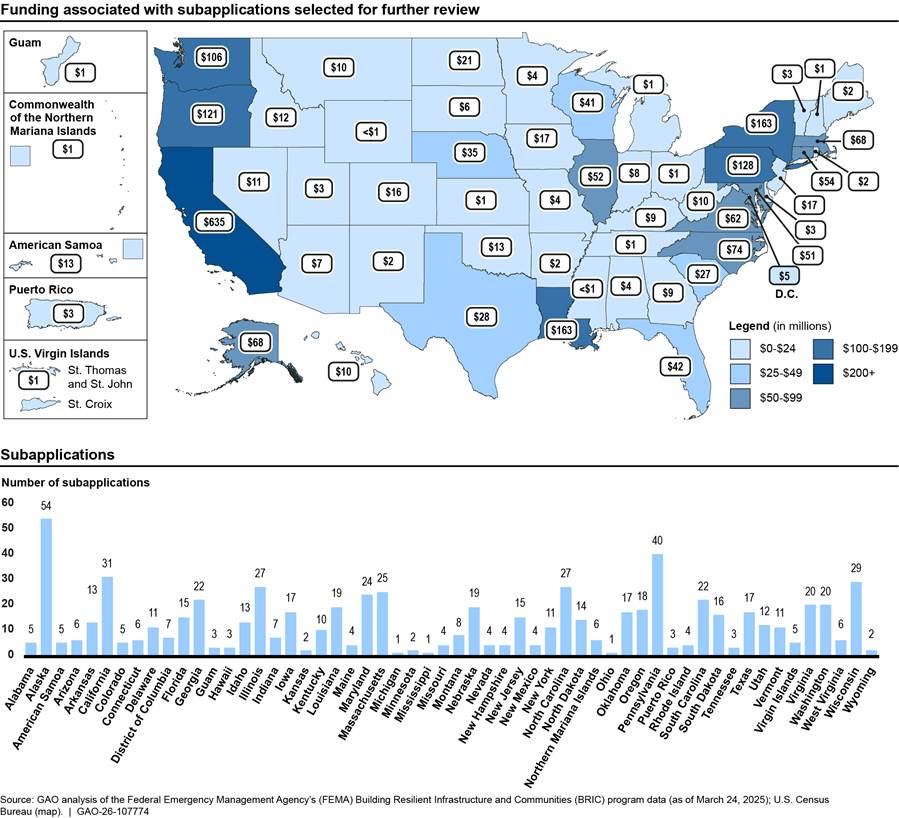
Notes: N=700. Funding associated with subapplications selected for further review is rounded to the nearest million. Number of subapplications is not rounded.
Funding associated with subapplications selected for further review means funding amounts associated with subapplications for which FEMA completed the first stage review and selected for further review but for which FEMA has not yet completed the second stage review.
Tribal governments can apply to the BRIC program as either an applicant to the Tribal Set-Aside or a subapplicant under a state/territory to the State/Territory Allocation. Tribal government applicants are associated with an “applicant state” in FEMA’s data set. Therefore, we treat tribal government subapplications as if they were part of this “applicant state.”
As FEMA restarts the BRIC program, it plans to review subapplications selected for further review from previous cycles using the review process from the grant cycle in which they were submitted, according to FEMA officials.[83] Additionally, officials told us FEMA plans to confirm with subapplicants whether they intend to move forward with the BRIC program or want to withdraw their subapplications as part of FEMA’s review process.
Subrecipients. FEMA’s public advisories lacked key information that caused uncertainty and challenges for subrecipients. For example, the advisory stated that fully obligated subgrants would be completed, but only if they had started construction.[84] It added that fully obligated subgrants that had not started construction would not be approved and would end. However, the advisory did not explain how FEMA was defining “started construction,” nor its process for confirming that construction had started.[85] According to our analysis of FEMA data, 10 percent of fully obligated subgrants (102 of 1,052) were construction projects, accounting for about $619 million in obligations, as of March 2025.[86] Officials from one of the communities we spoke with in July 2025 said it began construction in January 2025, but it had not received any official notice from FEMA confirming the project would be allowed to be completed.
The advisory did not include information on the future of fully obligated subgrants that did not involve construction, such as subgrants for plans or project scoping. Our analysis of FEMA data found that 90 percent of fully obligated subgrants (950 of 1,052) were non-construction subgrants and accounted for about $215 million in obligations. Planning and project scoping efforts are intended to help encourage public action to increase resilience and inform community investment decisions to anticipate challenges from potential future disasters, among other benefits. In addition, officials from one of the states we spoke with told us that grants for plans have significant benefits for communities and provide important front-end research and design to more quickly respond to and apply for hazard mitigation grant opportunities.[87]
FEMA had partially obligated BRIC funds for 184 subgrants, totaling $179 million in obligations, as of March 2025, and leaving about $1.5 billion yet to be obligated to those subrecipients.[88] All but nine states and territories had partially obligated subgrants prior to FEMA’s announcement, according to our analysis (see app. VIII). For example, North Carolina and California had the greatest number of partially obligated subgrants with 24 and 23, respectively. California, New York, and Florida had unobligated funding balances greater than $100 million.
One of FEMA’s April 2025 advisories also stated that FEMA would not extend a subgrant’s period of performance without approval from the Senior Official Performing the Duties of the Administrator.[89] Officials from one community told us that it applied for a period of performance extension in December 2024 but as of July 2025, it had not heard from FEMA. The community was concerned FEMA would use the extension request as a reason to terminate the remainder of the subgrant. Officials from three of the states we spoke with also expressed concerns about projects exceeding their periods of performance and needing extensions. However, in a November 2025 court filing, FEMA stated that it was continuing to review requests for period of performance extensions. Specifically, FEMA stated that at that time, the agency was processing 24 requests and had approved an extension in September 2025.[90] According to FEMA, as of April 2026, FEMA had approved 36 extension requests and denied two.
The uncertainty caused by FEMA’s advisories and lack of further communication about the future of the BRIC program resulted in delays and potentially missed opportunities for subrecipients. For example, state officials we spoke with explained that some of their subrecipients had stopped work, chosen not to start work on their subgrants, or withdrawn their subgrants because they were unsure if they would receive BRIC funding. Officials from one state added that subgrants that paused work will likely exceed their periods of performance as a result of the delay, potentially jeopardizing their project in the future.[91] Delays in implementing projects could put communities at risk of permits expiring, escalating costs, and eroded trust with industry partners and other stakeholders, according to court filings. In addition, officials from one community told us that uncertainty in federal funding created budgeting and planning process challenges for local governments.
Standards for Internal Control in the Federal Government states that management should externally communicate relevant and quality information to achieve the entity’s objectives. In particular, management should communicate relevant and quality information externally through reporting lines so that external parties can help the entity achieve its objectives and address related risks.[92]
As discussed previously, FEMA initially attributed the absence of additional communication to external stakeholders about BRIC’s future to a lack of final decisions about how it would end the program before stating that it had not ended the program. In December 2025, a U.S. District Court ordered FEMA to promptly take all steps necessary to reverse the discontinuation of BRIC.[93] The court subsequently issued an order in March 2026 to enforce the December 2025 order and set timelines for FEMA to restore BRIC.[94]
In March 2026, FEMA issued a public advisory announcing that it was restarting the BRIC program and resuming programmatic support for BRIC awards and subapplications (see app. II). On the same day, FEMA sent letters to all BRIC recipients updating them on the status of their BRIC projects. These letters were FEMA’s first direct communication with external stakeholders about the status of their grants since April 2025. The letters directed recipients to continue to complete their approved and obligated projects according to their scope of work.
Although FEMA resumed communications with external stakeholders following the announcement restarting BRIC, the lack of communication over the previous 11 months resulted in negative impacts, such as communities withdrawing or delaying progress on their mitigation efforts. As the program resumes, delays to BRIC projects could, in turn, result in rising costs, extended time frames, and other complications that affect communities’ ability to complete their mitigation effort. Consequently, stopping or pausing mitigation efforts could decrease the nation’s resilience and increase its fiscal exposure to future disasters. Taking steps to identify and apply lessons learned from FEMA’s external communication following the announcement ending the program, could help the agency ensure relevant, clear, and timely communication of any future program updates or other relevant information.
FEMA Has Not Fully Incorporated Key Practices to Assess BRIC’s Performance and Inform Decisions
During the four BRIC cycles from fiscal year 2020 through fiscal year 2023, FEMA incorporated some, but not all, key performance management practices that could help it better assess and manage BRIC.[95] Performance management involves measuring progress toward preestablished goals and objectives. In our prior work, we have described performance management as a three-step process by which organizations (1) set performance goals to identify the results they seek to achieve, (2) collect relevant information to measure performance, and (3) use performance information to assess progress and inform agency decision making, as well as communicate information externally (see fig. 16).[96]
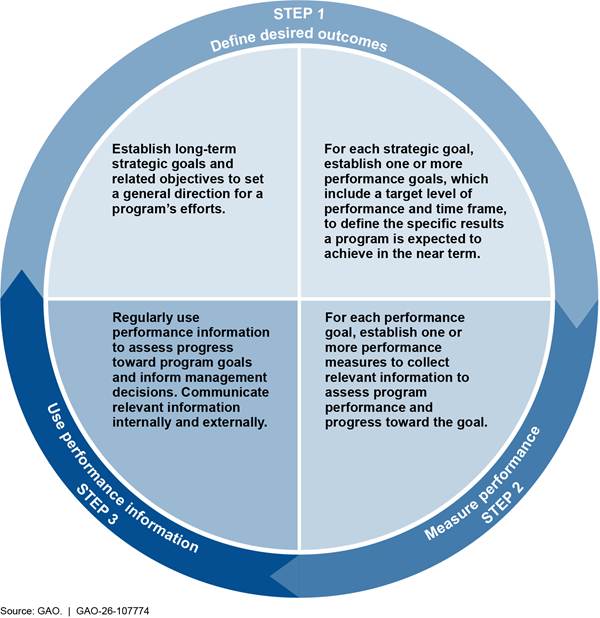
FEMA Did Not Fully Define BRIC Performance Goals
FEMA established performance goals for the BRIC program that aligned with broader DHS and agency goals at the time, but these performance goals did not incorporate some key practices.[97] Specifically, the performance goals FEMA established for all four BRIC cycles did not always provide a basis to determine actual achievement, establish methods to measure performance, and include targets (see fig. 17).
Figure 17: Extent to Which BRIC’s Performance Goals Incorporate Elements of Key Performance Management Practices, Fiscal Years 2020—2023
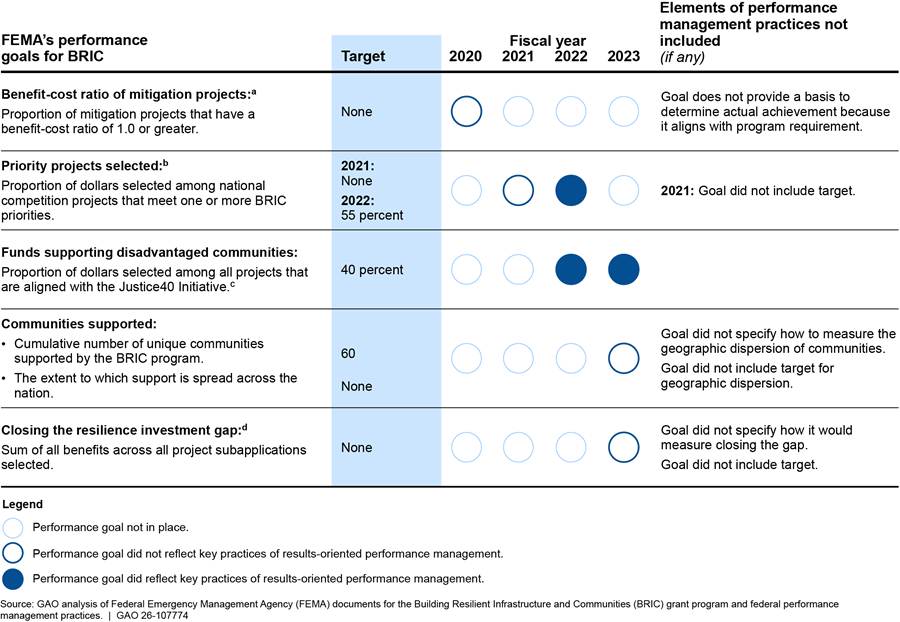
aA metric used to evaluate the economic soundness of an investment by comparing the total expected benefits to the total expected costs.
bBRIC priorities included risk reduction activities that (1) mitigate risk to public infrastructure and disadvantaged communities as referenced in Executive Order 14008; (2) incorporate nature-based solutions; (3) enhance climate resilience and adaptation; and (4) increase funding to applicants that facilitate the adoption and enforcement of the latest published editions of building codes.
cThe Justice40 Initiative was a U.S. government effort established in 2021 to ensure that at least 40 percent of the overall benefits from certain federal investments would reach disadvantaged communities. However, in January 2025, the President revoked the executive order that established it, thereby terminating the initiative. Exec. Order No. 14008, 86 Fed. Reg. 7619 (Feb. 1, 2021) (revoked by Exec. Order No. 14148, 90 Fed. Reg. 8237 (Jan. 28, 2025)).
dThe amount of money that could be spent cost-effectively to reduce liability from future disasters.
Federal performance management practices include establishing performance goals that provide a basis to determine actual achievement. However, in fiscal year 2020, FEMA’s performance goal was for all mitigation projects to have a benefit-cost ratio of 1.0 or greater.[98] However, FEMA required subapplications with projects to demonstrate a benefit-cost ratio of 1.0 or greater to be eligible for the program. As such, FEMA was largely guaranteed to achieve the performance goal and therefore the goal was not meaningful. FEMA officials agreed that this goal was not meaningful as constructed and defined and noted that FEMA removed this goal in subsequent grant cycles.
Federal performance management practices also include establishing performance goals that are measurable. However, FEMA did not always establish methods to measure performance. In fiscal year 2023, FEMA documented and established a goal for the “number of communities supported since inception.” When describing this goal, FEMA stated the goal “measures the output of the BRIC program ensuring that support is spread across the nation.” FEMA established a method to measure the first part of the goal, that is "total unique communities directly benefitting from the program (excluding statewide capability and capacity-building activities).” However, FEMA did not establish a method to measure geographic dispersion of communities. According to agency officials, FEMA conducted separate analyses of the geographic dispersion of BRIC subapplications. However, they noted that this is an area of ongoing research, and as such FEMA has not established a methodology, baseline, or targets.
Also in fiscal year 2023, FEMA established a goal intended to assess how much progress BRIC’s resilience efforts were making toward closing the nation’s resilience investment gap.[99] FEMA’s goal specified part of the measurement—the sum of all benefits across all selected project subapplications (the numerator). However, FEMA did not identify a cost to close the nation’s natural-hazard resilience investment gap (the denominator). According to agency officials, FEMA had contracted with the National Institute of Building Sciences to provide an estimate for the cost to close the nation’s natural-hazard resilience investment gap by May 2026.[100] As a result, FEMA could not produce the desired performance information as planned.
Federal performance management practices also include establishing performance goals that identify specific targets to be achieved. However, FEMA did not always establish targets for its performance goals. In fiscal year 2023, although FEMA identified three performance goals, it did not establish a target for two of the goals. As a result, FEMA could not compare its actual achievement to its desired level of performance. Moreover, without being able to make this comparison, FEMA could not use the performance information to identify any problems and make changes to improve the program or to learn what was working well. Agency officials noted that when establishing these performance goals in 2023, FEMA did not establish targets for performance goals because they did not want to bias the competitive aspect of the program, and they wanted to first establish internal baselines before setting future targets. However, in December 2025 officials noted that establishing targets for performance goals would add value for leadership and said that FEMA plans to establish targets.
A key federal performance management practice is planning for results by setting program performance goals to identify the results the agency seeks to achieve. Generally, performance goals provide a basis to determine actual achievement and are expressed as tangible, measurable objectives, or as quantitative standards, values, or rates. In addition, performance goals must include targets the agency plans to achieve within a specified time frame.[101] During the four BRIC cycles, FEMA’s performance goals did not consistently include these elements. As such, FEMA could not determine the extent to which it was achieving its goals. FEMA could better assess the performance of BRIC by consistently establishing and tracking performance goals that include key elements—such as including methods to measure performance goals and setting targets—so the agency can assess performance by comparing planned and actual results.
FEMA Did Not Always Produce BRIC Performance Information
Although FEMA established some effective performance goals during the four BRIC cycles, the agency did not always generate performance information to build evidence that could be used to identify effective approaches, identify opportunities for improvement, and inform decision-making. For example, in fiscal year 2022, FEMA established two performance goals related to (1) the proportion of BRIC funds awarded to priority project types in the National Competition and (2) the proportion of BRIC funds awarded to disadvantaged communities. FEMA also identified methods to measure these performance goals, established targets, and determined the extent to which FEMA met these two performance goals. According to FEMA documentation, FEMA exceeded its fiscal year 2022 performance goal (55 percent) on BRIC priority projects, awarding 66 percent of its National Competition funding to such projects.
However, in fiscal year 2023, FEMA established three performance goals but did not generate performance information for two of them. According to agency officials, FEMA did not generate performance information for these two goals because FEMA discontinued previous research efforts into the BRIC program’s performance and realigned staff to meet other priorities. Looking ahead, FEMA officials agreed that generating quantitative performance information can inform administration and congressional decision-making, as well as help the public understand the impact of FEMA investments.
A key federal performance management practice includes building evidence, such as generating performance information, to enable the agency to measure performance.[102] In turn, agencies can use this evidence to examine why results were or were not achieved. Moreover, the Foundations for Evidence-Based Policymaking Act requires agencies to develop a systematic plan for identifying and addressing policy questions, such as identifying the data the agency intends to collect and use.[103]
Taking steps to identify evidence that can help an agency assess, understand, and identify the effectiveness of the BRIC program would help leaders to better understand and address challenges, as well as set priorities to help improve program performance. Without consistent, annual performance information, FEMA may lack the evidence it needs to assess the effectiveness of the BRIC program and for management to identify opportunities to build upon or improve the program.
FEMA Did Not Use Performance Information to Inform Agency Decision-Making
Although FEMA generated some performance information for BRIC, agency officials told us that they did not use this information when making decisions about the future of the program. FEMA’s April 2025 announcement that it was ending BRIC stated that the program was “wasteful and ineffective.” However, the advisory did not provide information, such as performance results, on how FEMA determined that the program was wasteful and ineffective. In addition, agency officials told us FEMA did not use BRIC performance information to make this determination.
As discussed above, FEMA had taken steps to establish performance goals and generate performance information for BRIC that could be used to inform decisions. For example, FEMA exceeded its target for its priority projects performance goal in fiscal year 2022. However, according to FEMA officials, the agency did not use this information to inform its decision to announce ending the program because the performance goal was no longer in use for the fiscal year 2023 grant cycle. In addition, FEMA exceeded its performance goal related to the proportion of awards made to disadvantaged communities in both fiscal year 2022 and fiscal year 2023. However, according to FEMA officials, FEMA did not use this information to inform its decision to announce ending the program because the performance goal did not align with the current administration’s priorities.[104]
A key federal performance management practice is to use performance information to identify trends, effective approaches, and problems to inform agency decision-making. FEMA management did not use BRIC’s performance information that demonstrated that FEMA had met two performance goals in its decision to announce the end of the program. Using performance information for decision-making as FEMA restarts the BRIC program could help the agency ensure the effectiveness of the program and determine whether improvements are needed.
FEMA Did Not Share Performance Information for BRIC with Stakeholders
Although FEMA generated some performance information on BRIC (discussed above), the agency did not share these results with stakeholders (e.g., state, tribal, and local governments, and the public) when it announced decisions about the future of the program. As previously discussed, FEMA’s April 2025 announcement ending BRIC stated that the program was “wasteful and ineffective.” However, the agency did not provide the public with evidence, such as performance results or quantitative information, that it used to make this determination. According to FEMA officials, the agency did not provide such evidence to the public because the performance goals were no longer applicable for the fiscal year 2023 grant cycle.
Federal performance management practices include collecting performance information at least annually.[105] Generating this information allows for regular monitoring and oversight—both within a federal agency and by outside parties, such as Congress, the public, and other stakeholders. Federal performance management practices also include communicating results to key external stakeholders.[106] By communicating performance information, agencies help their stakeholders to understand how well a program is performing and the decisions the agency has made to improve results.[107] Ultimately, sharing performance information can help build buy-in and assistance in carrying out agency decisions. Organizations can tailor their communications to meet the needs of various stakeholders, such as what information to share and the presentation of the information. By sharing FEMA’s performance results for BRIC with the public, the agency would provide transparency about the extent to which FEMA met its goals for the program and increase awareness and understanding about the basis for the agency’s actions.
Conclusions
Disasters caused by natural hazards have become more frequent in recent years, costing billions of dollars in economic damage, as well as causing hundreds of deaths. Hazard mitigation projects and activities, such as those funded through the BRIC grant program, can help reduce the effects of disasters and lower future disaster response and recovery costs. Given this, it is critical that FEMA efficiently and effectively administers the billions of dollars it provides through the BRIC grant program.
Hundreds of communities that submitted subapplications for a BRIC subgrant that FEMA selected for further review continue to await FEMA’s final award decision for about $2.2 billion in grant funds. Although FEMA took some steps to shorten the amount of time to award BRIC subgrants, it did not plan to implement recommendations to improve review timeliness. And, although FEMA has disallowed phased projects and included new evaluation criteria for “project readiness” for the grant cycle for fiscal years 2024 & 2025, it is uncertain if these changes will result in shorter timeframes for reviewing subapplications and obligating funds. As a result, FEMA could miss opportunities to identify additional efficiencies to streamline its review of subapplications in future cycles. Reducing these time frames may enable communities to initiate their hazard mitigation activity sooner and minimize additional expenses due to cost increases. Moreover, completing projects and other hazard mitigation activities sooner would likely enable communities to be more resilient to future hazards, avoid costly repairs and reconstruction, and reduce human costs.
FEMA’s lack of actionable communication with internal and external stakeholders after announcing it was ending BRIC created uncertainty, delays, and missed opportunities for hazard mitigation nationwide. As a result, as FEMA restarts BRIC, regions face backlogs from the first four grant cycles. Further, states and communities may experience increased costs, expiring permits, and other negative effects that could further impact their projects and hazard mitigation capabilities. Identifying and applying lessons learned from its internal and external communication following the announcement ending BRIC will help improve FEMA’s ability to effectively communicate future program updates in a timely and actionable manner that helps to avoid potential negative impacts.
FEMA has not incorporated certain key performance management practices to assess and monitor BRIC, such as not fully defining performance goals and not always generating performance information on the program. Further, FEMA has not used this information to inform agency decision-making about BRIC’s future, such as determining the program’s effectiveness and whether improvements are needed or whether the program should continue. Fully incorporating practices to set performance goals and measure performance could help FEMA better manage BRIC’s performance and determine the effectiveness of the program. In addition, incorporating practices to use performance information could inform agency decisions about whether improvements are needed and increase transparency about its effectiveness.
Recommendations for Executive Action
We are making the following seven recommendations to FEMA:
The Administrator of FEMA should assess FEMA’s processes for reviewing subapplications to finalize its decisions to award BRIC subgrants to identify any inefficiencies and apply lessons learned that help ensure the agency awards subgrants in a timely manner. (Recommendation 1)
The Administrator of FEMA should assess FEMA’s internal communication to identify and apply any lessons learned that could help ensure the agency communicates relevant program information, and any future program changes, to internal regional managers and staff in a timely and actionable manner. (Recommendation 2)
The Administrator of FEMA should assess FEMA’s external communication to identify and apply lessons learned that help ensure the agency communicates relevant program information, and any future program changes, to applicants and recipients in a clear and timely manner. (Recommendation 3)
The Administrator of FEMA should establish BRIC performance goals that reflect key practices of results-oriented performance management such as including methods to measure the goal and setting targets. (Recommendation 4)
The Administrator of FEMA should ensure that FEMA consistently generates annual performance information for BRIC. (Recommendation 5)
The Administrator of FEMA should use BRIC’s established performance goals and information to identify trends, effective approaches, and problems to inform agency decision-making. (Recommendation 6)
The Administrator of FEMA should annually inform external stakeholders about the extent to which the agency is meeting BRIC’s established performance goals. (Recommendation 7)
Agency Comments and Our Evaluation
We provided a draft of this report to DHS for review and comment. DHS provided written comments that are reprinted in appendix IX. DHS concurred with all seven of our recommendations, and provided steps it plans to address them. Generally, these steps could address the intent of the recommendations, if implemented effectively. DHS also provided technical comments, which we incorporated as appropriate.
Regarding our second recommendation regarding assessing FEMA’s internal communication to identify and apply any lessons learned, FEMA requested we close the recommendation as implemented based on actions the agency has already taken. Specifically, FEMA stated that it had assessed internal communication processes, identified lessons learned, and applied improvements to ensure relevant BRIC program information is communicated to regional leadership and staff in a timely and actionable manner. FEMA added that, in April 2026, it instituted recurring weekly meetings to communicate important programmatic updates with regional staff to support timely information sharing. FEMA also stated that the agency has developed an internal, centralized repository to make key programmatic information and new tools available to regional staff. FEMA did not provide additional detail on how it conducted its assessment and the extent to which it formalized the steps it took. As such, it is too soon to tell whether these actions fully address our recommendation.
Regarding our fourth recommendation that the agency establish BRIC performance goals that reflect key practices of results-oriented performance management, FEMA stated it would use performance measurement templates to help ensure it establishes broad and specific program goals, identifies methods for measuring progress, and includes targets for assessing performance. However, FEMA used these templates for the BRIC program for two fiscal years (i.e., 2022 and 2023), and as we discuss in our report, FEMA’s process was insufficient in measuring progress. For example, in fiscal year 2023, although FEMA identified three performance goals, it did not establish a target for two of the goals. If FEMA’s annual performance goals for future fiscal years identify complete methods to measure progress and targets for assessing progress, these actions should address our recommendation.
We are sending copies of this report to the appropriate congressional committees, the Secretary of Homeland Security, FEMA, and other interested parties. In addition, the report is available at no charge on the GAO website at https://www.gao.gov.
If you or your staff have any questions about this report, please contact me at curriec@gao.gov. Contact points for our Offices of Congressional Relations and Media Relations may be found on the last page of this report. GAO staff who made key contributions to this report are listed in appendix X.
Chris Currie
Director
Homeland Security and Justice
List of Addressees
The Honorable Charles E. Schumer
Minority Leader
United States Senate
The Honorable Rand Paul, M.D.
Chairman
The Honorable Gary C. Peters
Ranking Member
Committee on Homeland Security and Governmental Affairs
United States Senate
The Honorable Katie Britt
Chair
The Honorable Chris Murphy
Ranking Member
Subcommittee on Homeland Security
Committee on Appropriations
United States Senate
The Honorable Andrew Garbarino
Chairman
The Honorable Bennie G. Thompson
Ranking Member
Committee on Homeland Security
House of Representatives
The Honorable James Comer
Chairman
The Honorable Robert Garcia
Ranking Member
Committee on Oversight and Government Reform
House of Representatives
The Honorable Sam Graves
Chairman
The Honorable Rick Larsen
Ranking Member
Committee on Transportation and Infrastructure
House of Representatives
The Honorable Mark Amodei
Chairman
The Honorable Henry Cuellar
Ranking Member
Subcommittee on Homeland Security
Committee on Appropriations
House of Representatives
The Honorable Scott Perry
Chairman
The Honorable Greg Stanton
Ranking Member
Subcommittee on Economic Development, Public Buildings, and Emergency
Management
Committee on Transportation and Infrastructure
House of Representatives
This report examines (1) the communities that applied for and received Building Resilient Infrastructure and Communities (BRIC) grants and activities the grants funded; (2) challenges that stakeholders identified with the BRIC program and the extent to which the Federal Emergency Management Agency (FEMA) has addressed them; (3) the extent to which FEMA communicated the status of the BRIC program to stakeholders and the impact of the announcement ending the program; and (4) the extent to which FEMA measured the BRIC program’s performance and considered such information to inform agency decision-making.
To obtain information about all four objectives, we interviewed officials from FEMA headquarters and three FEMA regions regarding BRIC’s development, implementation, and assessment, as well as the decision to announce BRIC’s end.[108] We also interviewed officials from a non-generalizable selection of six state hazard mitigation offices including California, Michigan, Maryland, North Carolina, South Carolina, and Utah, and six communities that received BRIC subgrants across those states regarding their experiences with the BRIC program, both prior to and following FEMA’s announcement to end the program.[109] In addition, we spoke with officials from three national emergency management organizations with knowledge of FEMA hazard mitigation programs about their perspectives on the BRIC program and the impacts of FEMA’s announcement ending the program.[110] Information from all of these interviews is not generalizable nor representative of all perspectives and experiences with the BRIC program.
In addition, we obtained and analyzed FEMA record-level data on BRIC applications and grants for four grant cycles, fiscal year 2020 through fiscal year 2023 as of March 24, 2025.[111] We analyzed BRIC data to identify the states, territories, and communities that applied for and received BRIC subgrants and allocated funding, as well as the primary activities and primary hazards the subgrants funded, prior to FEMA announcing BRIC’s end in April 2025. We also identified the number and proportion of subapplications that were eligible and ineligible and calculated award rates.
We calculated award rates by dividing the number of awarded subgrants by the number of eligible subapplications. We included all subapplications that were either “identified for further review” or “not selected” for further review after the first review stage in this calculation because these subapplications all met eligibility and completeness requirements. If a subapplication was marked “not selected” for further review at the first review stage, it indicated that the subapplication met eligibility and completeness requirements, but FEMA chose not to move the subapplication to the second review stage due to funding limitations. We excluded subapplications that were identified as “did not meet HMA requirements,” an indicator of ineligibility, or were deemed ineligible. Over the four cycles, we identified 785 ineligible subapplications and 3,035 subapplications that met eligibility requirements. According to FEMA officials, in their calculations, subapplications must be selected for further review in order to receive an award, and FEMA would, therefore, calculate award rates by excluding both ineligible and “not selected” subapplications. Our award rate calculation differs from FEMA in that our intent is to show the breadth of eligible and complete subapplications received and awarded regardless of review stage. See appendix VI for complete information on the number of subapplications by status.
To identify potential challenges stakeholders experienced with the BRIC program’s processes and the extent to which FEMA addressed them, we calculated median timelines associated with FEMA’s second stage review process to award BRIC subgrants and obligate grant funds. We reported median times due to outliers in the data. Additionally, we analyzed and summarized the funding status of BRIC subgrants at the time of FEMA’s announcement ending the program and the potential financial impacts on grants based on the information in FEMA’s public advisories. The data we analyzed are as of March 24, 2025, and do not exactly align with FEMA’s April 4, 2025, announcement ending the program; however, FEMA did not award new subgrants or obligate funding between April 2025 and early March 2026. As a result, we consider the data to be sufficient for our purposes and reflective of the status of the program as of March 2026. To assess the reliability of these data, we conducted validity checks, including conducting electronic and manual tests for missing data, outliers, and obvious errors; reviewing agency documents, such as data standards; and interviewing agency officials. We determined that the data were sufficiently reliable for the purposes of our reporting objectives.
To further address our second objective, we reviewed FEMA documents, such as BRIC’s Notices of Funding Opportunity, Eligibility and Completeness Handbook, and Business Rules, to identify the program’s grant processes. We also reviewed FEMA’s 2023 Stakeholder Report to identify potential challenges that stakeholders experienced with the BRIC program. To assess FEMA’s efforts to address identified challenges, we reviewed internal FEMA studies of the BRIC program’s processes. We evaluated FEMA’s efforts against its internal plans to guide its efforts to continuously review and enhance BRIC.
To further address our third objective, we evaluated FEMA’s internal and external communication regarding the decision to end the BRIC program against standards for internal control in the federal government.[112] We also reviewed court documents filed by FEMA and the plaintiff states, as well as court decisions, as part of the BRIC litigation.[113] We interviewed FEMA headquarters officials about their decision and efforts to restart the program in March 2026 and reviewed the fiscal years 2024 & 2025 Notice of Funding Opportunity to identify key changes to the program, as compared to fiscal year 2023.
To further address our fourth objective, we reviewed FEMA’s strategic plans and BRIC’s performance metrics and results from fiscal year 2020 through fiscal year 2023, prior to FEMA’s announcement ending the program. We compared FEMA’s actions to incorporate key practices to assess the performance of BRIC against performance management practices we previously identified to help agencies manage their performance.[114]
We conducted this performance audit from August 2024 to September 2026 in accordance with generally accepted government auditing standards. Those standards require that we plan and perform the audit to obtain sufficient, appropriate evidence to provide a reasonable basis for our findings and conclusions based on our audit objectives. We believe that the evidence obtained provides a reasonable basis for our findings and conclusions based on our audit objectives.
Figure 18: FEMA’s April 4, 2025, Advisory Ending the Building Resilient Infrastructure and Communities (BRIC) Program
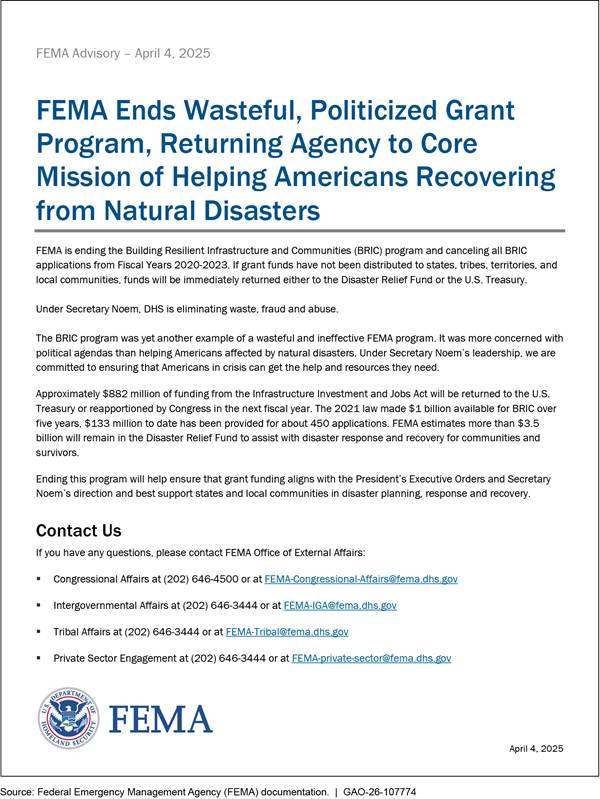
Figure 19: FEMA’s April 16,
2025, Advisory Providing an Update on the Ending of the Building Resilient
Infrastructure and Communities (BRIC) Program
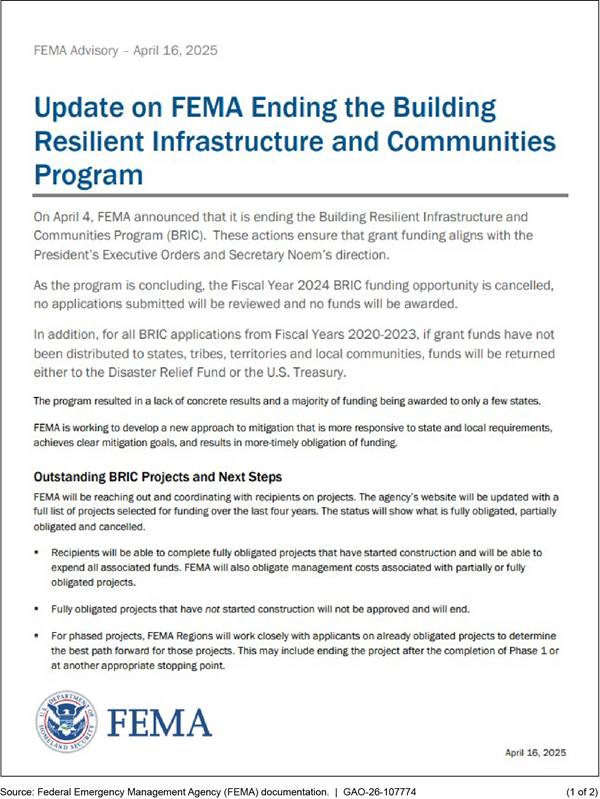
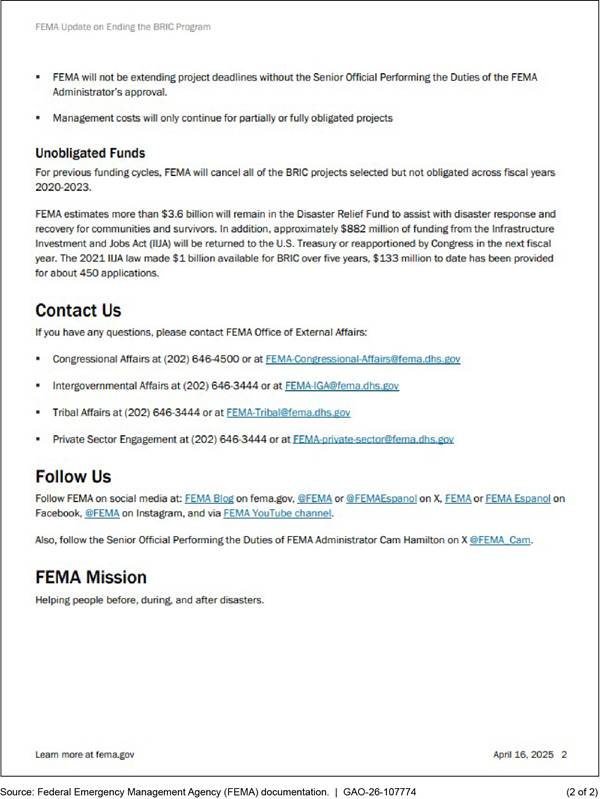
Figure 20: FEMA’s March 18,
2026, Advisory Announcing the Restart of the Building Resilient Infrastructure
and Communities (BRIC) Program
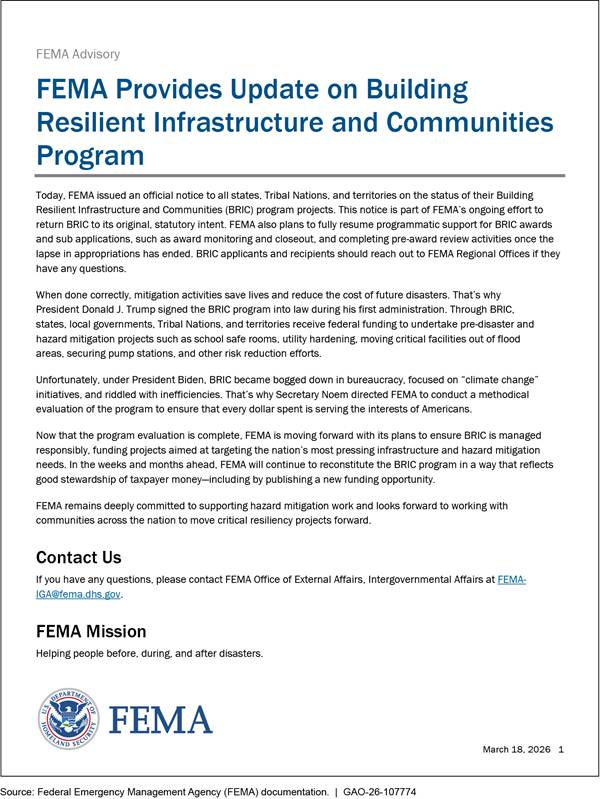
Appendix III: Key Changes to the BRIC Program from the Fiscal Year 2023 NOFO to the Fiscal Years 2024 & 2025 NOFO
The Federal Emergency Management Agency (FEMA) issued a combined fiscal years 2024 & 2025 Notice of Funding Opportunity (NOFO) on March 25, 2026.[115] This NOFO introduced key changes to the Building Resilient Infrastructure and Communities (BRIC) program, as compared to the most recent funding opportunity in fiscal year 2023. FEMA stated that the fiscal years 2024 & 2025 funding opportunity, and the changes it made to the BRIC program, was designed to (1) prioritize infrastructure resilience, (2) move money faster, and (3) shift responsibility and authority for resilience and risk reduction to states, territories, and Tribes.
Key changes FEMA made across the BRIC program for the fiscal years 2024 & 2025 cycle included (1) changing the amount of funding available in some funding categories, (2) eliminating the direct technical assistance (DTA) initiative, (3) limiting eligible mitigation activities, and (4) revising the criteria and approach for scoring subapplications submitted to the National Competition.
Available funding. FEMA made changes to individual funding category totals in the fiscal years 2024 & 2025 cycle. Both the fiscal year 2023 and fiscal years 2024 & 2025 NOFOs announced $1 billion in total available funding for BRIC (see table 1).[116] However, FEMA made changes to how it distributed the $1 billion across different funding categories. For example, FEMA reduced the available funding for the State/Territory Building Code Plus-Up by $56 million, or half the available funding in fiscal year 2023.[117] At the same time, FEMA increased the funding available for the National Competition by $56 million, from $701 million in fiscal year 2023 to $757 million in fiscal years 2024 & 2025. FEMA also reduced the maximum subgrant amount for the National Competition for the first time, lowering it from $50 million to $20 million per subapplication. FEMA officials told us they reduced the maximum subgrant amount to reflect the program’s priorities of funding construction-ready projects that are faster to obligate and complete and increasing the number of communities that can receive funding in the National Competition.
Table 1: Available BRIC Funding by Funding Category, Fiscal Year 2023 and Fiscal Years 2024 & 2025 Funding Cycles
|
Funding category |
Fiscal year 2023 (dollars in millions) |
Fiscal years 2024 & 2025 (dollars in millions) |
|
Total available fundinga |
$1,000 |
$1,000 |
|
State/Territory Allocation subtotal (Maximum allocation) |
$112 ($2 per applicant) |
$112 ($2 per applicant) |
|
Tribal Set-Aside subtotalb (Maximum allocation) |
$50 ($2 per applicant) |
$50 ($2 per applicant) |
|
State/Territory Building Code Plus-Up subtotal (Maximum allocation) |
$112 ($2 per applicant) |
$56 ($1 per applicant) |
|
Tribal Building Code Plus-Up subtotal (Maximum allocation) |
$25 (n/a) |
$25 (n/a) |
|
National Competition subtotal (Maximum subgrant amount) |
$701 ($50 per subapplication) |
$757 ($20 per subapplication) |
Legend:
|
|
FEMA did not make changes to funding category |
|
|
FEMA made changes to funding category |
Source: Federal Emergency Management Agency
(FEMA) Building Resilient Infrastructure and Communities (BRIC) program
documentation. | GAO‑26‑107774
aAlthough the annual amount of available funding for the fiscal years 2024 & 2025 cycle was lower than the fiscal year 2023 cycle, as it provided $1 billion for two fiscal years instead of one, FEMA did not make changes to the way it calculated the amount of total available funding. Both the fiscal years 2024 & 2025 and fiscal year 2023 cycles were comprised of a set-aside from the Disaster Relief Fund and $200 million for each fiscal year from the Infrastructure Investment and Jobs Act. According to FEMA officials, the Disaster Relief Fund set-aside was lower in fiscal years 2024 & 2025 than previous fiscal year cycles due to a decrease in disaster declarations in fiscal year 2025, resulting in a lower total available funding amount in the fiscal years 2024 & 2025 cycle.
bThe $2 per applicant cap for the Tribal Set-Aside is for capability- and capacity-building activities only in both the fiscal year 2023 and fiscal years 2024 & 2025 funding cycles.
Direct technical assistance. The fiscal years 2024 & 2025 NOFO did not include BRIC DTA. In fiscal year 2020 through fiscal year 2023 FEMA offered a non-financial DTA initiative to support the development of resilience planning and project design in underserved and disadvantaged communities, as well as federally recognized Tribes that were disproportionately affected by natural hazard risk. However, FEMA ended BRIC DTA for the fiscal years 2024 & 2025 cycle. FEMA announced that it was ending DTA to shift responsibility and authority for resilience and risk reduction to states, territories, and Tribes. According to agency officials, regional staff can provide technical assistance to applicants and recipients as part of their regular programmatic duties.
Eligible hazard mitigation activities. The BRIC program offers funding for three hazard mitigation activities: (1) capability- and capacity-building activities; (2) hazard mitigation projects; and (3) management costs. However, in the fiscal years 2024 & 2025 NOFO, FEMA limited the eligibility of capability- and capacity-building activities and hazard mitigation projects, as compared to the fiscal year 2023 cycle:
• Capability- and capacity-building activities. In fiscal year 2023, eligible capability- and capacity-building activities included (1) building codes, (2) partnerships, (3) project scoping, and (4) hazard mitigation planning and planning-related activities. In contrast, for fiscal years 2024 & 2025, FEMA limited eligible capability- and capacity-building activities to (1) those that were directly tied to infrastructure projects, such as building code adoption and enforcement, (2) related technical training, and (3) project scoping activities for specific infrastructure projects. Unlike previous cycles, hazard mitigation plan development or updates and project scoping activities not directly supporting a specific infrastructure project were not eligible in the fiscal years 2024 & 2025 cycle. FEMA stated that it removed funding for hazard mitigation planning to shift responsibility and authority for resilience and risk reduction to states, territories, and Tribes, rather than federal investment in a wide range of activities.
• Hazard mitigation projects. In fiscal year 2023, BRIC offered funding for cost-effective projects designed to increase resilience and public safety, reduce injuries and loss of life, and reduce damage and destruction to property, critical services, facilities, and infrastructure from a multitude of natural hazards. Projects did not have to demonstrate construction readiness and could be phased or non-phased. However, in the fiscal years 2024 & 2025 cycle, FEMA limited eligibility of hazard mitigation projects to only those that had, at a minimum, a conceptual design. FEMA stated it was prioritizing infrastructure resilience by funding construction projects that were ready to be implemented. In addition, FEMA no longer offered funding for phased projects. In its advisory announcing the NOFO, FEMA stated that it eliminated phased projects to “move money faster.”
• Management costs. FEMA did not make substantial changes to management cost activities in the fiscal years 2024 & 2025 NOFO, as compared to the fiscal year 2023 NOFO.
Subapplication scoring criteria. FEMA revised its criteria and approach for scoring subapplications submitted to the National Competition in the fiscal years 2024 & 2025 NOFO. In prior cycles, subapplications submitted to the National Competition were subject to programmatic review that scored the subapplications on technical evaluation criteria and qualitative evaluation criteria. A National Review Panel was responsible for scoring the qualitative evaluation criteria. However, in the fiscal years 2024 & 2025 NOFO, FEMA no longer broke out the evaluation criteria into technical and qualitative criteria. In addition, FEMA revised, added, and removed criteria as compared to the fiscal year 2023 cycle (see fig. 21). For example, FEMA updated the infrastructure project criteria to include an evaluation of the proposed project’s construction readiness, and FEMA removed criteria for subapplicants to describe their community outreach strategy. FEMA officials told us it made these criteria changes to better align with the administration’s priorities of funding construction-ready infrastructure projects, increasing geographic dispersion of grant funding, and simplifying and increasing speed of the review process. In addition, FEMA eliminated the National Review Panel as the reviewer of subapplications to increase efficiency of the review cycle. According to FEMA officials, FEMA headquarters staff will be responsible for reviewing and scoring subapplications in the fiscal years 2024 & 2025 cycle.
Figure 21: Comparison of FEMA’s Evaluation Criteria for BRIC Subapplications in the National Competition, Fiscal Year 2023 and Fiscal Years 2024 & 2025
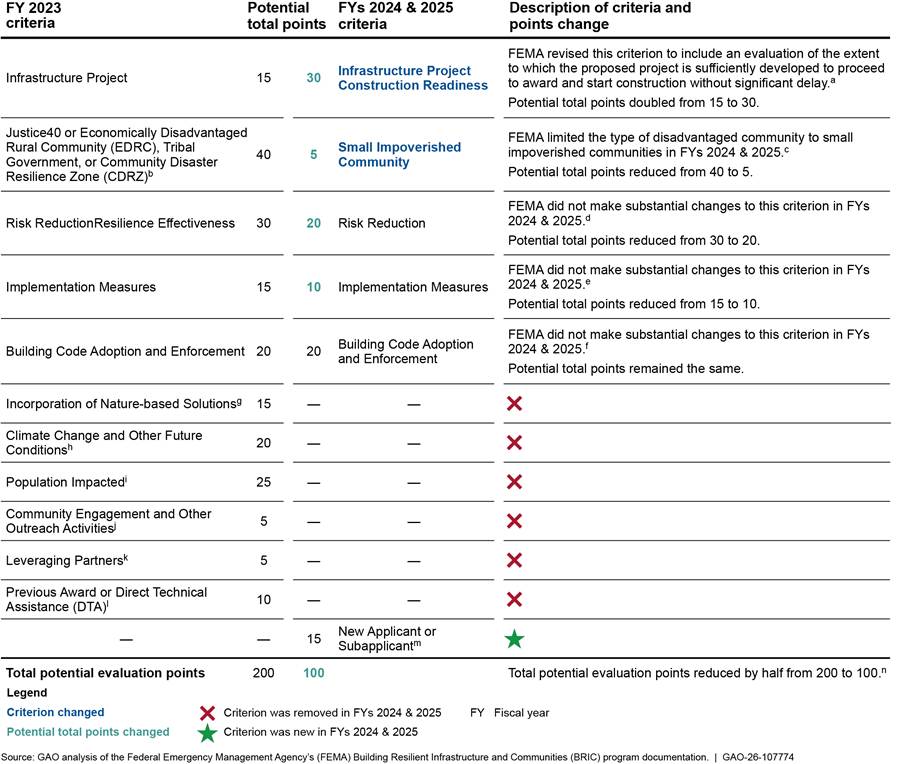
Note: FEMA classified evaluation criteria in fiscal year 2023 as technical or qualitative criteria. Technical evaluation criteria included: (1) Infrastructure Project; (2) Justice40 or EDRC, Tribal Government, or CDRZ; (3) Building Code Adoption and Enforcement; (4) Incorporation of Nature-Based Solutions; and (5) Previous Award or DTA. Qualitative evaluation criteria included: (1) Risk Reduction/Resilience Effectiveness; (2) Implementation Measures; (3) Climate Change and Other Future Conditions; (4) Population Impacted; (5) Community Engagement and Other Outreach Activities; and (6) Leveraging Partners. FEMA did not break out evaluation criteria into technical and qualitative in fiscal years 2024 & 2025.
aAccording to the fiscal years 2024 & 2025 NOFO, infrastructure projects with basic conceptualization and design (i.e., at least 30 percent design) receive 5 points; infrastructure projects with refined and detailed design including major systems, materials, dimensions, and draft specifications (i.e., greater than 30 percent design) receive 15 points; or infrastructure projects with detailed drawings and specifications for bidding, permitting, and actual construction (i.e., 90 percent design or greater) receive 30 points.
bThe fiscal year 2023 NOFO defines this criterion as “application covers a project that is located in or primarily benefits: a. A Justice40 community or communities, including any geographically defined community or communities identified by the Climate and Economic Justice Screening Tool (CEJST) OR b. Designation as an Economically Disadvantaged Rural Community (as defined in 42 U.S.C. § 5133(a) as a small impoverished community) or a federally recognized tribal government, or a subapplication that benefits or primarily benefits a Community Disaster Resilience Zone (as defined in 42 U.S.C. § 5136(a)(1))” (Justice40 or EDRC, tribal government, or CDRZ). Applications that cover a project that is located in or primarily benefits a Justice40 community or communities receive 30 points. Applications that cover a project that is located in or primarily benefits an EDRC, federally recognized tribal government, or CDRZ receive 40 points.
cThe fiscal years 2024 & 2025 small impoverished community criteria and potential total points align with the criteria FEMA used in the fiscal year 2020 cycle. The Justice40 Initiative was a U.S. government effort established in 2021 to ensure that at least 40 percent of the overall benefits from certain federal investments would reach disadvantaged communities. However, in January 2025, the President revoked the executive order that established it, thereby terminating the initiative. Exec. Order No. 14008, 86 Fed. Reg. 7619 (Feb. 1, 2021) (revoked by Exec. Order No. 14148, 90 Fed. Reg. 8237, 8238 (Jan. 28, 2025)).
dIn both the fiscal year 2023 and the fiscal years 2024 & 2025 NOFOs, the criteria requires subapplications to detail how the project will (1) effectively reduce risk; (2) increase resilience within the community based on their primary natural hazard risk, and (3) realize ancillary benefits, or benefits other than the project’s primary risk reduction objective. The fiscal year 2023 criteria also asked subapplicants to identify how the project would leverage innovation, such as leveraging collaborations and resources with partners.
eIn both the fiscal year 2023 and the fiscal years 2024 & 2025 NOFOs, the criteria requires subapplications to describe (1) cost management, (2) schedule management, (3) successful implementation and incorporation of any innovative techniques, and (4) technical and managerial staff, and resource availability. The fiscal year 2023 criteria also asked subapplicants to describe whether and how the project would incorporate strong labor standards to ensure high-quality work, avert disruptive and costly delays, and promote efficiency.
fIn both the fiscal year 2023 and the fiscal years 2024 & 2025 NOFOs, the criteria specify that the subapplication will receive 5 points if the community where the project will be developed has locally adopted current or next most recent hazard-resistant consensus-based model building code such as both the International Building Code and the International Residential Code model codes published by the International Code Council. The subapplication will receive an additional 5 points if the locally adopted building codes by the community are based on the applicant’s mandatory state-, Tribe-, or territory-wide adoption of current or next most recent hazard-resistant consensus-based model building code such as both the International Building Code and the International Residential Code model codes published by the International Code Council. The subapplication will receive an additional 10 points if the subapplicant has a Building Code Effectiveness Grading Schedule rate of 1 to 5. Or, any subapplicant that has not received points under these criteria could receive 5 points by providing a narrative demonstrating that they hold higher hazard-resistant standards for the primary hazard they have identified in their subapplication. The most recent building codes used in the fiscal years 2024 & 2025 NOFO have been updated to codes from 2021 or 2024, whereas the most recent building codes used in the fiscal year 2023 NOFO were from 2018 or 2021.
gIn the fiscal year 2023 NOFO, the incorporation of nature-based solutions for hazard mitigation (Incorporation of nature-based solutions) criterion states that subapplications that include a neighborhood or site scale nature-based solution(s) receive 5 points; or subapplications that include watershed or landscape scale nature-based solution(s), including those that support coastal resilience, receive 15 points.
hThe fiscal year 2023 NOFO states that “subapplications should describe how the project will enhance climate adaptation and resilience using the best available data, detail how the project is being responsive to the effects of climate change (such as sea level rise, increased rainfall, increased likelihood of flash flood due to wildfire, etc.) and/or other future conditions (population/demographic/land use, etc.), and cites data sources, assumptions, and models.”
iThe fiscal year 2023 NOFO states that the project subapplication should demonstrate community-wide benefits and identify the proportion of the population that will be impacted, including a description of the disadvantaged communities as referenced in Executive Order 14008 and identified in the Climate and Economic Justice Screening Tool.
jThe fiscal year 2023 NOFO states that the subapplication should describe outreach strategy and supporting activities appropriate to the project and the community that advance mitigation. The subapplication should also outline the types of community planning processes leveraged and describe how input from a diverse range of stakeholders, including overburdened and underserved communities, was gathered and incorporated into project conception and design. Further, the subapplication should outline how such community planning and stakeholder input will continue to be used to help direct project execution.
kThe fiscal year 2023 NOFO states that the project subapplication should incorporate partnerships (e.g., state, Tribe, private, local community, etc.) that will ensure the project meets community needs, including those of overburdened and underserved populations, and show the outcome of those partnerships (e.g., leveraging resources such as financial, material, and education resources, coordinating multi-jurisdictional projects, heightened focus on equity related issues, etc.).
lThe fiscal year 2023 NOFO defines this criterion as “application generated from a previous FEMA Hazard Mitigation Assistance project scoping award or any other federal grant award, or the subapplicant is a past recipient of BRIC direct technical assistance (DTA)” (Previous award or DTA).
mThe fiscal years 2025 & 2025 NOFO includes subapplications submitted from a subapplicant or a state, territory, or tribal applicant who has never been selected in the BRIC National Competition in this criterion.
nIn fiscal year 2023, there were 100 points available for the technical evaluation criteria and 100 points available for the qualitative evaluation criteria.
Performance goals. FEMA changed some of BRIC’s performance goals for the fiscal years 2024 & 2025 BRIC cycle compared to the fiscal year 2023 cycle. For example, it removed one goal, modified two goals, and created one new goal. See table 2 for a description of these changes.
|
Fiscal year 2023 |
Fiscal years 2024 & 2025 |
Description of change and elements of performance management practices |
|
Funds supporting disadvantaged communities: Proportion of dollars selected among all projects that are aligned with the Justice40 Initiative.a Target: 40 percent |
Not applicable |
FEMA removed this goal because it does not align with the current administration’s priorities, according to agency officials. |
|
Communities supported: Cumulative number of unique communities supported by the BRIC program. Target: 60 The extent to which support is spread across the nation. Target: None |
Communities supported: Cumulative number of unique communities supported by the BRIC program. Target: 70 The extent to which support is spread across the nation. Target: None |
FEMA maintained this goal. However, it continues to not include a method to measure geographic dispersion or include a target for this goal. According to FEMA officials, this is an area of ongoing research. |
|
Closing the resilience investment gap:b Sum of all benefits across all project subapplications selected Target: None |
Closing the resilience investment gap: Sum of all benefits across all project subapplications selected. Target: $1 billion |
FEMA maintained this goal and added a target. However, the goal does not determine actual achievement because the $1 billion target largely aligns with a program requirement (i.e., subapplications for projects must demonstrate a benefit-cost ratio of 1.0 or greater to be eligible for the program) and the amount of funding available for the funding cycle ($1 billion). In addition, FEMA has made changes to the program that will likely increase the proportion of funding awarded to projects.c |
|
Not applicable |
Communities adopting hazard-resistant building codes: Annual number of new communities that adopted hazard-resistant building codes through BRIC grants. Target: 50 |
FEMA established a new goal that is meaningful and includes a target. |
Source: GAO analysis of Federal Emergency Management Agency (FEMA) documents for the Building Resilient Infrastructure and Communities (BRIC) grant program and key performance management practices. | GAO‑26‑107774
aThe Justice40 Initiative was a U.S. government effort established in 2021 to ensure that at least 40 percent of the overall benefits from certain federal investments would reach disadvantaged communities. However, in January 2025, the President revoked the executive order that established it, thereby terminating the initiative. Exec. Order No. 14008, 86 Fed. Reg. 7619 (Feb. 1, 2021) (revoked by Exec. Order No. 14148, 90 Fed. Reg. 8237, 8238 (Jan. 28, 2025)).
bThe amount of money that could be spent cost-effectively to reduce liability from future disasters.
CEligible activities for FEMA’s BRIC cycle for fiscal years 2024 & 2025 include: hazard mitigation projects, capability- and capacity-building activities that are directly supporting a specific infrastructure project; and management costs. For fiscal year 2020 through fiscal year 2023, FEMA allocated the majority (78 percent) of funding to projects, as of March 24, 2025. Specifically, $1.9 billion for projects compared to $545 million for other purposes (e.g., management costs, project scoping, and plans). Although FEMA continues to permit management costs, FEMA no longer permits hazard mitigation planning and project scoping activities that are not directly supporting a specific infrastructure project. Moreover, FEMA’s advisory announcing the BRIC cycle for fiscal years 2024 & 2025 stated the agency is prioritizing construction projects.
Appendix IV: Total Requested Funding and Number of BRIC Program Subapplications by State and Territory
Every state, five territories, and the District of Columbia submitted varying numbers of Building Resilient Infrastructure and Communities (BRIC) subapplications requesting different funding amounts (see fig. 22). For example, 14 states submitted 100 or more subapplications over the four cycles from fiscal year 2020 through fiscal year 2023. In comparison, nine states/territories submitted 25 or fewer subapplications. Further, three states requested more than $1 billion, compared to 11 states/territories requesting less than $50 million, over the four cycles.
Figure 22: Total Requested BRIC Funding and Number of Subapplications by State and Territory, Fiscal Years 2020—2023
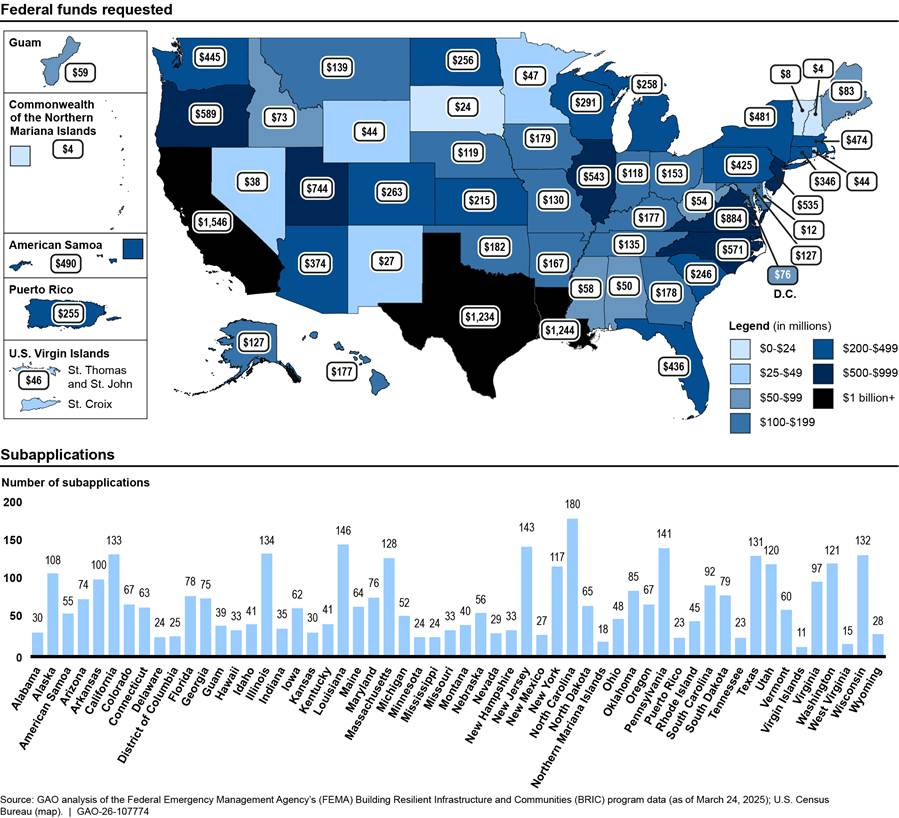
Notes: N=3,820. Requested funding is rounded to the nearest million. Number of subapplications is not rounded.
Tribal governments can apply to the BRIC program as either an applicant to the Tribal Set-Aside or a subapplicant under a state/territory to the State/Territory Allocation. Tribal government applicants are associated with an “applicant state” in the Federal Emergency Management Agency’s data set. Therefore, we treat tribal government subapplications as if they were part of this “applicant state.”
Subapplicant characteristics and outcomes. According to our analysis of Federal Emergency Management Agency (FEMA) data, over the four cycles from fiscal year 2020 through fiscal year 2023, local government subapplicants submitted two-thirds of the 3,820 Building Resilient Infrastructure and Communities (BRIC) subapplications (2,572). In contrast, state government agencies and Tribes made up about 17 percent (636) and 8 percent (304) of subapplications, respectively (see fig. 23).[118] About 16 percent of all subapplications (621) were from economically disadvantaged rural communities (EDRC).[119] Subapplications from these communities increased each cycle, more than doubling from 102 in fiscal year 2020 to 262 in fiscal year 2023.
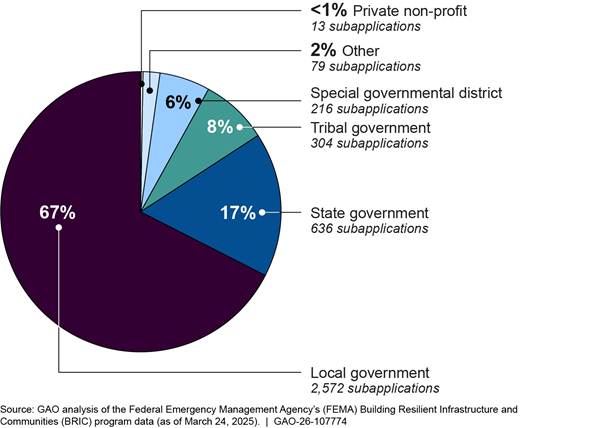
Note: N=3,820. According to FEMA officials, “other”
subapplicants include entities that do not fall under any of the other
predefined categories, such as universities, schools, and port authorities.
Over the four cycles, FEMA awarded more than half of all 1,245 subgrants and allocated more than half of the about $2.5 billion in funding to local governments.[120] According to our analysis of FEMA data, FEMA awarded 763 subgrants, allocating about $1.4 billion, to local governments. In contrast, FEMA awarded 303 subgrants (24 percent) to state agencies and 113 subgrants (9 percent) to Tribes (see fig. 24).[121] However, local governments and Tribes had lower award rates compared to state agencies.[122] Furthermore, subapplications submitted by EDRC subapplicants had an award rate of 32 percent (151 of 474).
Figure 24: Total Number of Awarded BRIC Subgrants, Award Rate, and Allocated Funding by Subapplicant Type, Fiscal Years 2020—2023
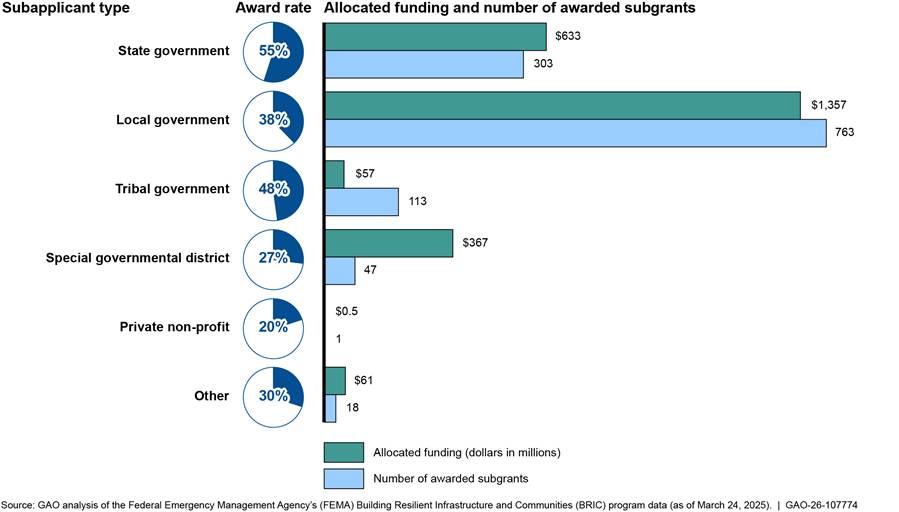
Notes: N=1,245. Allocated funding is rounded to the nearest million. Award rate is rounded to the nearest percent. Number of awarded subgrants is not rounded.
Allocated funding means funding amounts, both obligated and unobligated, for awarded subgrants. The final obligated amount for partially obligated subgrants may change.
We calculated award rates by dividing the number of awarded subgrants by the number of eligible subapplications. We included in our calculation all subapplications that met eligibility and completeness requirements regardless of if they moved to stage two review. We excluded subapplications that were identified as “did not meet HMA requirements,” an indicator of ineligibility, or were deemed ineligible. Over the four cycles, we identified 785 ineligible subapplications and 3,035 subapplications that met eligibility requirements. According to FEMA officials, in their calculations, subapplications must be selected for further review in order to receive an award, and FEMA would, therefore, calculate award rates by excluding both ineligible and “not selected” subapplications. Our award rate calculation differs from FEMA in that our intent is to show the breadth of eligible and complete subapplications received and awarded regardless of review stage. See appendix VI for complete information on the number of subapplications by status.
According to FEMA officials, “other” subapplicants include entities that do not fall under any of the other predefined categories, such as universities, schools, and port authorities.
Subapplication characteristics and outcomes. Over the four BRIC cycles, more than half of the 3,820 subapplications (2,244) were for projects, more than 80 percent of which (1,862) were for construction projects (see fig. 25). Additionally, about one-quarter of all subapplications (1,015) proposed using nature-based solutions, such as floodplain restoration, rain gardens, and living shorelines, as part of their mitigation activity.[123]
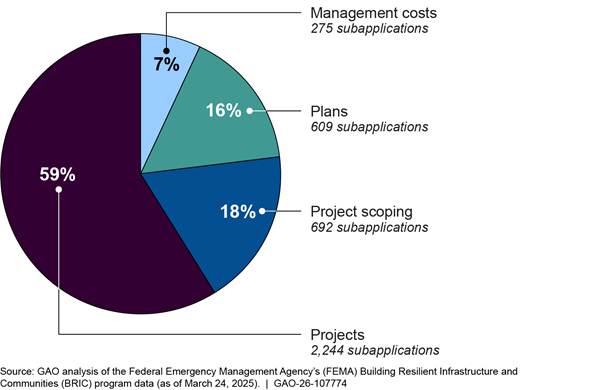
Note: N=3,820.
Over the four cycles, FEMA awarded the most subgrants (405 or 33 percent) for project scoping but allocated the most funding to projects (about $2 billion or 78 percent). As shown in figure 26, subapplications for projects had a lower award rate than other subapplication types. Within the subapplications for projects, those requesting funds for construction projects had an award rate of 14 percent (192 of 1,374). Additionally, subapplications using nature-based solutions had an award rate of 17 percent (130 of 745).
Figure 26: Total Number of Awarded BRIC Subgrants, Award Rate, and Allocated Funding by Subapplication Type, Fiscal Years 2020—2023
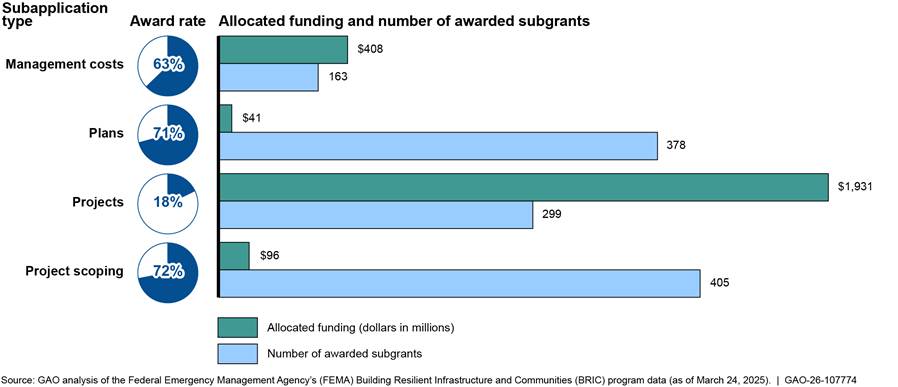
Note: N=1,245. Allocated funding is rounded to the nearest million. Award rate is rounded to the nearest percent. Number of awarded subgrants is not rounded.
Allocated funding means funding amounts, both obligated and unobligated, for awarded subgrants. The final obligated amount for partially obligated subgrants may change.
We calculated award rates by dividing the number of awarded subgrants by the number of eligible subapplications. We included in our calculation all subapplications that met eligibility and completeness requirements regardless of if they moved to stage two review. We excluded subapplications that were identified as “did not meet HMA requirements,” an indicator of ineligibility, or were deemed ineligible. Over the four cycles, we identified 785 ineligible subapplications and 3,035 subapplications that met eligibility requirements. According to FEMA officials, in their calculations, subapplications must be selected for further review in order to receive an award, and FEMA would, therefore, calculate award rates by excluding both ineligible and “not selected” subapplications. Our award rate calculation differs from FEMA in that our intent is to show the breadth of eligible and complete subapplications received and awarded regardless of review stage. See appendix VI for complete information on the number of subapplications by status.
Appendix VI: Status of BRIC Subapplications by State and Territory in Fiscal Years 2020—2023 as of March 2025
Over the four Building Resilient Infrastructure and Communities (BRIC) cycles, from fiscal year 2020 through fiscal year 2023, state and territory subapplications had varying outcomes from the Federal Emergency Management Agency’s (FEMA’s) review process. According to our analysis of FEMA data as of March 2025, FEMA determined that about 21 percent (785) of the 3,820 subapplications were ineligible for award during the first or second stage review (see table 3). All but two states and territories had at least one subapplication deemed ineligible. North Carolina and Mississippi had the highest percentage of their subapplications deemed ineligible, with 39 percent and 38 percent, respectively.
Furthermore, about 29 percent (1,089) of all subapplications were determined to be eligible for award but were not selected for further review due to funding limits. Four states and territories had more than half of their subapplications not selected for further review. In contrast, one state had all of its eligible subapplications selected for further review over the four cycles. As discussed previously in the report, FEMA selected 700 subapplications for further review but had not yet finalized its review to award them subgrants as of March 2025, and FEMA had awarded 1,246 subgrants.
Table 3: Status of BRIC Subapplications by State/Territory, Fiscal Years 2020–2023 (as of March 2025)
|
State/territory |
Number of subapplications |
Number of ineligible subapplicationsa |
Number of not selected subapplicationsb |
Number of subapplications selected for further reviewc |
Number of awarded subapplicationsd |
|
Alabama |
30 |
5 17% |
14 47% |
5 17% |
6 20% |
|
Alaska |
108 |
29 27% |
5 5% |
54 50% |
20 19% |
|
American Samoa |
55 |
14 25% |
29 53% |
5 9% |
7 13% |
|
Arizona |
74 |
16 22% |
32 43% |
6 8% |
20 27% |
|
Arkansas |
100 |
11 11% |
38 38% |
13 13% |
38 38% |
|
California |
133 |
11 8% |
36 27% |
31 23% |
55 41% |
|
Colorado |
67 |
9 13% |
31 46% |
5 7% |
22 33% |
|
Connecticut |
63 |
23 37% |
17 27% |
6 10% |
17 27% |
|
Delaware |
24 |
4 17% |
3 13% |
11 46% |
6 25% |
|
District of Columbia |
25 |
2 8% |
1 4% |
7 28% |
15 60% |
|
Florida |
78 |
18 23% |
28 36% |
15 19% |
17 22% |
|
Georgia |
75 |
12 16% |
15 20% |
22 29% |
26 35% |
|
Guam |
39 |
13 33% |
14 36% |
3 8% |
9 23% |
|
Hawaii |
33 |
3 9% |
15 45% |
3 9% |
12 36% |
|
Idaho |
41 |
2 5% |
13 32% |
13 32% |
13 32% |
|
Illinois |
134 |
26 19% |
53 40% |
27 20% |
28 21% |
|
Indiana |
35 |
4 11% |
9 26% |
7 20% |
15 43% |
|
Iowa |
62 |
6 10% |
8 13% |
17 27% |
31 50% |
|
Kansas |
30 |
9 30% |
11 37% |
2 7% |
8 27% |
|
Kentucky |
41 |
12 29% |
11 27% |
10 24% |
8 20% |
|
Louisiana |
146 |
50 34% |
62 42% |
19 13% |
15 10% |
|
Maine |
64 |
16 25% |
5 8% |
4 6% |
39 61% |
|
Maryland |
76 |
13 17% |
13 17% |
24 32% |
26 34% |
|
Massachusetts |
128 |
18 14% |
37 29% |
25 20% |
48 38% |
|
Michigan |
52 |
10 19% |
17 33% |
1 2% |
24 46% |
|
Minnesota |
24 |
6 25% |
4 17% |
2 8% |
12 50% |
|
Mississippi |
24 |
9 38% |
7 29% |
1 4% |
7 29% |
|
Missouri |
33 |
0 0% |
18 55% |
4 12% |
11 33% |
|
Montana |
40 |
13 33% |
8 20% |
8 20% |
11 28% |
|
Nebraska |
56 |
3 5% |
12 21% |
19 34% |
22 39% |
|
Nevada |
29 |
0 0% |
3 10% |
4 14% |
22 76% |
|
New Hampshire |
33 |
3 9% |
1 3% |
4 12% |
25 76% |
|
New Jersey |
143 |
45 31% |
48 34% |
15 10% |
35 24% |
|
New Mexico |
27 |
4 15% |
1 4% |
4 15% |
18 67% |
|
New York |
117 |
34 29% |
32 27% |
11 9% |
40 34% |
|
North Carolina |
180 |
70 39% |
35 19% |
27 15% |
48 27% |
|
North Dakota |
65 |
3 5% |
20 31% |
14 22% |
28 43% |
|
Commonwealth of the Northern Mariana Islands |
18 |
1 6% |
1 6% |
6 33% |
10 56% |
|
Ohio |
48 |
3 6% |
23 48% |
1 2% |
21 44% |
|
Oklahoma |
85 |
11 13% |
30 35% |
17 20% |
27 32% |
|
Oregon |
67 |
22 33% |
18 27% |
18 27% |
9 13% |
|
Pennsylvania |
141 |
44 31% |
30 21% |
40 28% |
27 19% |
|
Puerto Rico |
23 |
7 30% |
12 52% |
3 13% |
1 4% |
|
Rhode Island |
45 |
6 13% |
4 9% |
4 9% |
31 69% |
|
South Carolina |
92 |
26 28% |
22 24% |
22 24% |
22 24% |
|
South Dakota |
79 |
8 10% |
2 3% |
16 20% |
53 67% |
|
Tennessee |
23 |
8 35% |
4 17% |
3 13% |
8 35% |
|
Texas |
131 |
32 24% |
69 53% |
17 13% |
13 10% |
|
Utah |
120 |
7 6% |
56 47% |
12 10% |
45 38% |
|
Vermont |
60 |
7 12% |
2 3% |
11 18% |
40 67% |
|
U.S. Virgin Islands |
11 |
2 18% |
1 9% |
5 45% |
3 27% |
|
Virginia |
97 |
24 25% |
34 35% |
20 21% |
19 20% |
|
Washington |
121 |
19 16% |
39 32% |
20 17% |
43 36% |
|
West Virginia |
15 |
5 33% |
0 0% |
6 40% |
4 27% |
|
Wisconsin |
132 |
18 14% |
33 25% |
29 22% |
52 39% |
|
Wyoming |
28 |
9 32% |
3 11% |
2 7% |
14 50% |
|
Total |
3,820 |
785 21% |
1,089 29% |
700 18% |
1,246 33% |
Source: GAO analysis of the Federal Emergency Management Agency’s (FEMA) Building Resilient Infrastructure and Communities (BRIC) program data (as of March 24, 2025) | GAO-26-107774
Note: Percentages are rounded to the nearest whole percent.
aFEMA determined the subapplication did not meet eligibility and completeness programmatic requirements during the first or second stage review.
bFEMA determined that the subapplication did meet eligibility and completeness requirements, but it was not selected for further review for a subgrant due to a lack of available funding.
cFEMA completed the first stage review of the subapplication and selected it for further review for a subgrant. FEMA’s final award determination is pending completion of the second stage review.
dFEMA completed both the first and second stage reviews of the subapplication and awarded it a subgrant. According to FEMA officials, the subrecipient declined one of these awards and the funds will be deobligated.
States and territories had varying outcomes in the Building Resilient Infrastructure and Communities’ (BRIC’s) National Competition. According to our analysis of Federal Emergency Management Agency (FEMA) data, FEMA awarded 31 states and the District of Columbia at least one subgrant in the National Competition, with North Carolina, California, and New Jersey receiving the most subgrants (see fig. 27).[124] The average award rate across all states/territories was about 7 percent. However, two states—South Dakota and North Carolina—and the District of Columbia had award rates greater than 30 percent. California and New York were allocated the greatest amount of funding in the National Competition, with more than $200 million each.[125]
Figure 27: Total Number of Awarded BRIC Subgrants, Award Rate, and Allocated Funding by State and Territory in the National Competition, Fiscal Years 2020—2023
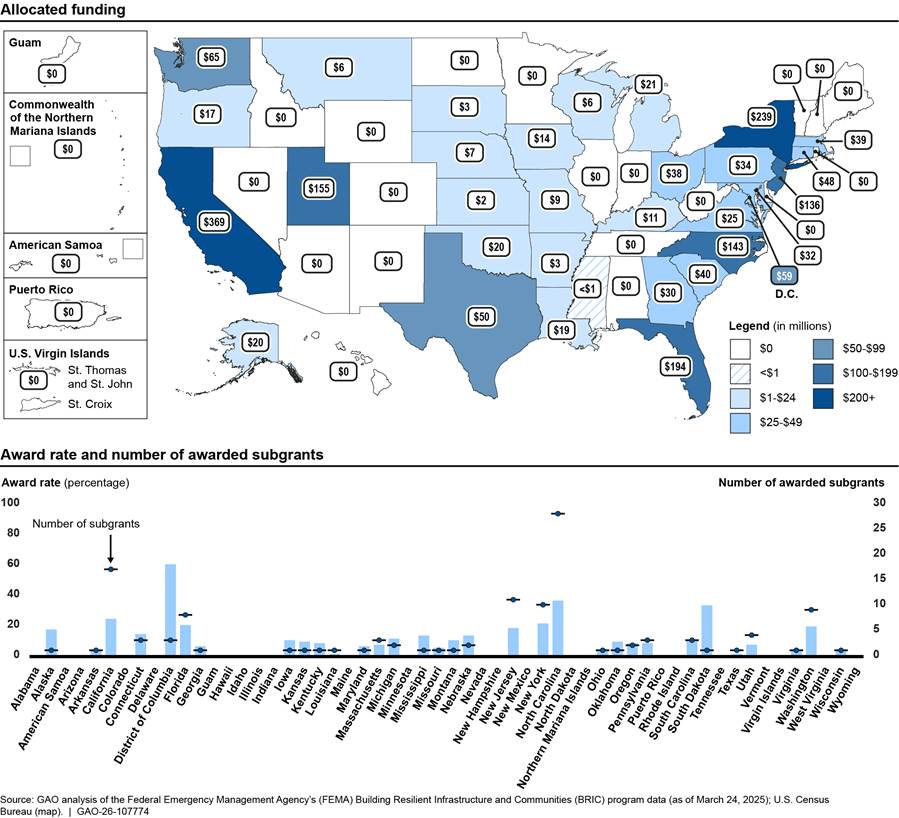
Notes: N=125. Allocated funding is rounded to the nearest million. Award rate is rounded to the nearest percent. Number of awarded subgrants is not rounded.
Allocated funding means funding amounts, both obligated and unobligated, for awarded subgrants. The final obligated amount for partially obligated subgrants may change.
We calculated award rates by dividing the number of awarded subgrants by the number of eligible subapplications. We included in our calculation all subapplications that met eligibility and completeness requirements regardless of if they moved to stage two review. We excluded subapplications that were identified as “did not meet HMA requirements,” an indicator of ineligibility, or were deemed ineligible. Over the four cycles, we identified 461 ineligible subapplications and 1,292 subapplications that met eligibility requirements in the National Competition. According to FEMA officials, in their calculations, subapplications must be selected for further review in order to receive an award, and FEMA would, therefore, calculate award rates by excluding both ineligible and “not selected” subapplications. Our award rate calculation differs from FEMA in that our intent is to show the breadth of eligible and complete subapplications received and awarded regardless of review stage. See appendix VI for complete information on the number of subapplications by status.
Tribal governments can apply to the BRIC program as either an applicant to the Tribal Set-Aside or a subapplicant under a state/territory to the State/Territory Allocation. Tribal government applicants are associated with an “applicant state” in FEMA’s data set. Therefore, we treat tribal government subapplications as if they were part of this “applicant state.”
Our analysis of Federal Emergency Management Agency (FEMA) data found that FEMA had partially obligated Building Resilient Infrastructure and Communities (BRIC) funds for 184 subgrants, totaling $179 million as of March 2025. However, FEMA had not yet obligated the remaining $1.5 billion to those recipients.[126] All but nine states and territories had partially obligated subgrants, and North Carolina and California had the greatest number of partially obligated subgrants (see fig. 28). Unobligated balances for these partially obligated subgrants range from less than $1 million to $442 million.
Figure 28: Total Number of Partially Obligated BRIC Subgrants and Associated Unobligated Balances by State and Territory as of March 2025
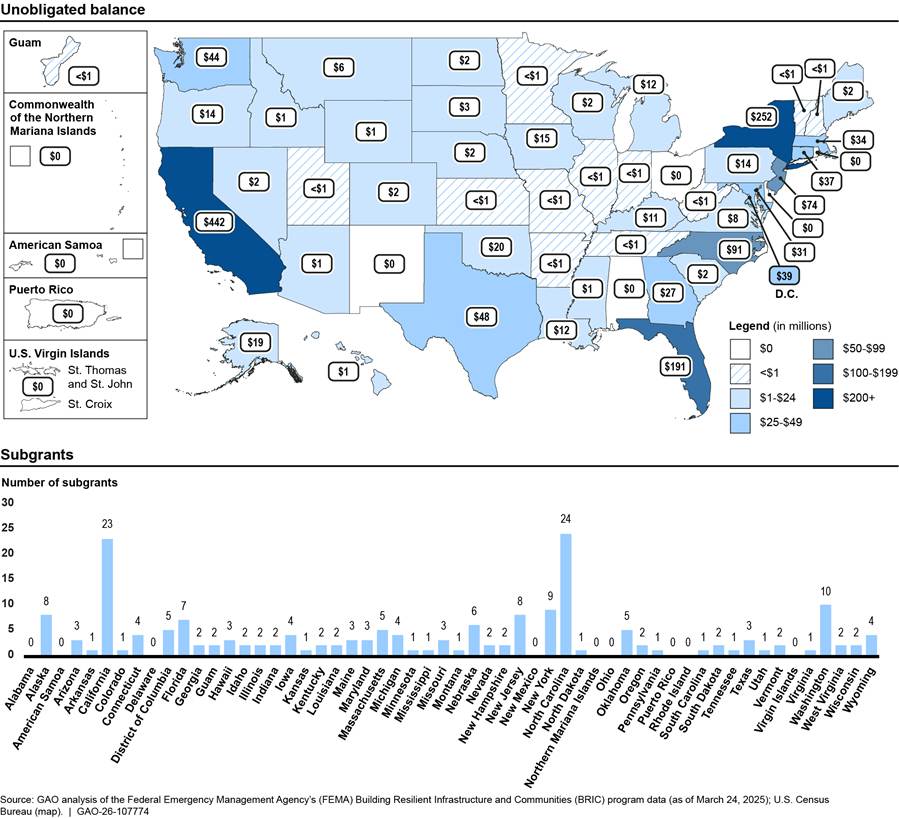
Notes: N=184. Unobligated balances are rounded to the nearest million. Number of subapplications is not rounded.
Unobligated balances are associated with partially obligated subgrants. Awarded subgrants may be fully or partially obligated. For example, for phased subgrants, FEMA initially approves and obligates funding for the first phase of the project. The subrecipient must provide FEMA with certain deliverables upon completion of phase one, which FEMA reviews to approve and obligate funds for phase two. Depending on the results of the phase one deliverables, FEMA may approve and obligate a different amount of funds for phase two. Therefore, unobligated balances are subject to change.
Tribal governments can apply to the BRIC program as either an applicant to the Tribal Set-Aside or a subapplicant under a state/territory to the State/Territory Allocation. Tribal government applicants are associated with an “applicant state” in FEMA’s data set. Therefore, we treat tribal government subapplications as if they were part of this “applicant state.”
GAO Contact
Christopher Currie, curriec@gao.gov.
Staff Acknowledgement
In addition to the contact named above, Aditi Archer (Assistant Director), Caryn Kuebler (Assistant Director), Anne Akin (Analyst-in-Charge), Xiang Bi, Dominick Dale, Peter Del Toro, Megan Ferren, Steven Flint, Forrest Gatrell, Eric Hauswirth, Tracey King, Norma-Jean Simon, Casie Venable, and Riley Wilson made key contributions to this report.
The Government Accountability Office, the audit, evaluation, and investigative arm of Congress, exists to support Congress in meeting its constitutional responsibilities and to help improve the performance and accountability of the federal government for the American people. GAO examines the use of public funds; evaluates federal programs and policies; and provides analyses, recommendations, and other assistance to help Congress make informed oversight, policy, and funding decisions. GAO’s commitment to good government is reflected in its core values of accountability, integrity, and reliability.
Obtaining Copies of GAO Reports and Testimony
The fastest and easiest way to obtain copies of GAO documents at no cost is through our website. Each weekday afternoon, GAO posts on its website newly released reports, testimony, and correspondence. You can also subscribe to GAO’s email updates to receive notification of newly posted products.
Order by Phone
The price of each GAO publication reflects GAO’s actual cost of production and distribution and depends on the number of pages in the publication and whether the publication is printed in color or black and white. Pricing and ordering information is posted on GAO’s website, https://www.gao.gov/ordering.htm.
Place orders by calling (202) 512-6000, toll free (866) 801-7077,
or
TDD (202) 512-2537.
Orders may be paid for using American Express, Discover Card, MasterCard, Visa, check, or money order. Call for additional information.
Connect with GAO
Connect with GAO on X,
LinkedIn, Instagram, and YouTube.
Subscribe to our Email Updates. Listen to our Podcasts.
Visit GAO on the web at https://www.gao.gov.
To Report Fraud, Waste, and Abuse in Federal Programs
Contact FraudNet:
Website: https://www.gao.gov/about/what-gao-does/fraudnet
Automated answering system: (800) 424-5454
Media Relations
Sarah Kaczmarek, Managing Director, Media@gao.gov
Congressional Relations
David A. Powner, Acting Managing Director, CongRel@gao.gov
General Inquiries
[1]GAO, High-Risk Series: Heightened Attention Could Save Billions More and Improve Government Efficiency and Effectiveness, GAO‑25‑107743, (Washington, D.C.: Feb. 2025).
[2]U.S. Chamber of Commerce, Allstate, and U.S. Chamber of Commerce Foundation, Beyond the Payoff: How Investments in Resilience and Disaster Preparedness Protect Communities, (Washington, D.C.: 2025).
[4]6 U.S.C. § 313(b)(1). Communities can include state government agencies, local governments, and tribal governments; as well as special governmental districts, private non-profit entities, and other entities, such as universities, schools, and port authorities.
[5]Pub. L. No. 115-254, Div. D, § 1234, 132 Stat. 3186, 3461-63 (codified at 42 U.S.C. § 5133).
[6]Pub. L. No. 117-58, 135 Stat. 429, 1387.
[7]See Summary Judgment Order, Washington v. FEMA, No. 1:25-cv-12006 (D. Mass. Dec. 11, 2025) (ECF No. 130).
[8]Staff of H. Comm. on Appropriations, 117th Cong., Explanatory Statement on the Consolidated Appropriations Act, 2023, Pub. L. No. 117-328, 136 Stat. 4459 (2022), at 2342 (Comm. Print 2023).
[9]We spoke with state and community officials from California, Maryland, Michigan, North Carolina, South Carolina, and Utah prior to FEMA’s announcement resuming the program. We selected the six communities based on a variety of factors, including activity type, progress made on the activity, and geographic dispersion. We spoke with state-level officials that aligned with the communities we selected. We spoke with a state-level official from Maryland during our interview with the National Emergency Management Association.
[10]We spoke with members from the National Emergency Management Association, the International Association of Emergency Managers, and the Association of State Floodplain Managers prior to FEMA’s announcement resuming the program. We selected these organizations based on their relevance to and expertise in hazard mitigation, as well as their experience with BRIC.
[11]We spoke with one FEMA region prior to the April 2025 announcement ending the program and two regions following the announcement. We selected three of FEMA’s 10 regions to interview based on their geographic dispersion and alignment with the states and communities we spoke with.
[12]Federal Emergency Management Agency, FEMA Ends Wasteful, Politicized Grant Program, Returning Agency to Core Mission of Helping Americans Recovering from Natural Disasters (Washington, D.C.: Apr. 4, 2025).
[13]Federal Emergency Management Agency, Update on FEMA Ending the Building Resilient Infrastructure and Communities Program (Washington, D.C.: Apr. 16, 2025).
[14]FEMA published BRIC’s fiscal year 2024 NOFO on January 6, 2025. The application deadline for BRIC’s fiscal year 2024 program was planned for April 18, 2025.
[15]Federal Emergency Management Agency, Disaster Relief Fund: Monthly Report as of April 30, 2025, Fiscal Year 2025 Report to Congress, at 19 (Washington, D.C.: June 3, 2025); Federal Emergency Management Agency, Disaster Relief Fund: Monthly Report as of July 31, 2025, Fiscal Year 2025 Report to Congress, at 20 (Washington, D.C.: Aug. 11, 2025).
[16]See Complaint, at 3, Washington v. FEMA, 1:25-cv-12006 (D. Mass. July 16, 2025) (ECF No. 1).
[17]Defendants’ Opposition to Plaintiffs’ motion for Preliminary Injunction, Washington (D. Mass. July 25, 2025) (ECF No. 58); Defendants’ Cross-Motion for Summary Judgment and Opposition to Plaintiffs’ Motion for Summary Judgment, Washington (D. Mass. Nov. 5, 2025) (ECF No. 116).
[18]Summary Judgment Order, Washington (D. Mass. Dec.11, 2025) (ECF No. 130).
[19]Order to Enforce the Court’s Summary Judgment Order, Washington (D. Mass. Mar. 6, 2026) (ECF No. 137).
[20]Federal Emergency Management Agency, FEMA Provides Update on Building Resilient Infrastructure and Communities Program (Washington, D.C.: Mar. 18, 2026).
[21]The Department of Homeland Security, Notice of Funding Opportunity (NOFO): Fiscal Year 2024 & 2025 Building Resilient Infrastructure and Communities (BRIC) (Washington, D.C.: Mar. 25, 2026). The deadline to submit applications for the fiscal years 2024 & 2025 cycle was July 23, 2026.
[22]42 U.S.C. § 5133.
[23]Id. § 5133(e).
[24]Id. § 5133(g)(1)-(12).
[25]This includes about $4.4 billion set-aside from the Disaster Relief Fund and $400 million appropriated by the Infrastructure Investment and Jobs Act. There was a significant increase in funds set aside for BRIC in fiscal year 2022 due to an additional set-aside of about $1.8 billion based on the COVID-19 major disaster declarations. Only federally recognized Tribes are eligible for BRIC grants.
[26]FEMA established a cap of $50 million for individual subgrants for the National Competition.
[27]As part of the allocations and set-asides, FEMA established maximum amounts for individual states, territories, and Tribes. For example, in fiscal year 2023, the maximum amount in the State/Territory Allocation for individual states and territories was $2 million.
[28]In fiscal year 2023, the maximum amount for the Building Code Plus-Up funds for individual states and territories was $2 million. There was no maximum amount for individual Tribes.
[29]FEMA requires states, territories, Tribes, and local governments to have a hazard mitigation plan to remain eligible for funding for a BRIC project. FEMA also requires that these plans are updated every 5 years. 44 C.F.R. pt. 201. Some BRIC activities, such as hazard mitigation planning and planning related activities, do not require a hazard mitigation plan to remain eligible for BRIC funding.
[30]From fiscal year 2020 through fiscal year 2023, FEMA also provided hazard mitigation planning and project support through BRIC’s non-financial direct technical assistance (DTA) program to help communities, territories, and Tribes submit quality grant applications and implement mitigation projects and plans. However, FEMA did not provide non-financial DTA through BRIC for the fiscal years 2024 & 2025 grant cycle.
[31]FEMA’s fiscal years 2024 & 2025 NOFO for BRIC limited the eligibility of capability- and capacity-building activities and hazard mitigation projects. For example, phased projects were no longer eligible under this funding opportunity. See appendix III for more details.
[32]FEMA’s previous pre-disaster hazard mitigation grant program, Pre-Disaster Mitigation, had a project limit of $10 million in fiscal year 2019. FEMA’s fiscal years 2024 & 2025 NOFO for BRIC reduced the project limit to $20 million.
[33]Examples of FEMA documentation include BRIC NOFOs, as well as FEMA handbooks and guides.
[34]Appropriations to the Disaster Relief Fund are no-year appropriations, meaning that they are available for obligation without fiscal year limitation. Similarly, the appropriations in the Infrastructure Investment and Jobs Act became available in fiscal year 2022 through fiscal year 2026 and were no-year appropriations. Pub. L. No. 117-58, 135 Stat. 429, 1387.
[35]The BRIC authorizing statute requires that mitigation measures funded by the program be cost-effective. 42 U.S.C. § 5133(b). Generally, a benefit-cost analysis compares the total expected economic benefits to the total expected economic costs.
[36]BRIC’s authorizing statute provides that FEMA may contribute up to 75 percent of the total cost of mitigation activities, except that it may contribute up to 90 percent for small impoverished communities, which FEMA called economically disadvantaged rural communities (EDRC). Such a community is defined as a community of 3,000 or fewer individuals that is economically disadvantaged, with residents having an average per capita annual income not exceeding 80 percent of the national per capita income, based on best available data. See 42 U.S.C. § 5133(a), (h). FEMA’s notices provided that the period of performance was 36 months, starting on the date of the applicant’s federal grant award.
[37]FEMA’s fiscal years 2024 & 2025 NOFO for BRIC changed some elements of FEMA’s process for reviewing subapplications. See appendix III for more details.
[38]For example, the subapplication must have met applicable cost share requirements, included calculation of management costs—if applicable, and contained required supporting documentation for the project.
[39]Subapplications for mitigation projects were subject to additional specialty assessments, such as a preliminary cost-effectiveness review, technical assessments to determine the feasibility of the projects, and an Environmental Planning and Historic Preservation (EHP) screening.
[40]Subapplications for project scoping required a mitigation plan assessment, and subapplications for management costs did not require any specialty assessments.
[41]If regional staff were uncertain about a subapplication’s eligibility, regions submitted the subapplication to FEMA headquarters’ Eligibility Issues Review Board. FEMA held weekly meetings among headquarters and regional staff to discuss subapplications referred to the board and made a final eligibility determination.
[42]During the four BRIC cycles from fiscal year 2020 through fiscal year 2023, FEMA modified some elements of the eligibility and completeness reviews.
[43]Additional criteria included from fiscal years 2020 through 2023 the extent to which the community had adopted and/or enforced building codes, if the subapplication was developed from a previous federal award, and if the subapplication proposed a project located in a disadvantaged area, such as a Community Disaster Resilience Zone (CDRZ). Generally, the criteria remained similar during the four BRIC cycles. FEMA’s fiscal years 2024 & 2025 NOFO for BRIC changed some criteria for reviewing subapplications. See appendix III for more details.
[44]During the four BRIC cycles from fiscal year 2020 through fiscal year 2023, FEMA made some modifications to how it calculated the numerical score.
[45]FEMA’s fiscal years 2024 & 2025 NOFO for BRIC changed some elements of FEMA’s process for reviewing subapplications. See appendix III for more details.
[46]For example, for the fiscal year 2022 cycle, panelists included representatives from 40 local governments, 46 states, 10 federal agencies, two territories, and four Tribes, according to FEMA officials. Panelists were not permitted to evaluate subapplications in the state in which they worked, and all panelists were required to complete a conflict-of-interest form.
[47]Additional criteria included the extent to which the project would enhance climate adaptation and resilience, as well as the extent to which the subapplication demonstrated community-wide benefits; leveraged external partners to ensure the project met community needs; and demonstrated community engagement and other outreach activities. Generally, the criteria remained similar during the four BRIC cycles from fiscal year 2020 through fiscal year 2023.
[48]During the four BRIC cycles from fiscal year 2020 through fiscal year 2023, FEMA made some modifications to how it calculated the numerical score.
[49]During the first stage review, FEMA also determined the funding source for individual subapplications. Funding sources for BRIC grants included the Disaster Relief Fund and appropriations in the Infrastructure Investment and Jobs Act. According to agency officials, FEMA prioritized Infrastructure Investment and Jobs Act funding for subapplications submitted to the State/Territory Allocation, the Tribal Set-Aside, and the Building Code Plus-Up before those submitted to the National Competition. FEMA assigned funds from the Disaster Relief Fund to management costs subapplications and subapplications submitted to the National Competition after Infrastructure Investment and Jobs Act funding was exhausted.
[50]See Pub. L. No. 91-190, 83 Stat. 852 (1970) (codified as amended at 42 U.S.C. §§ 4321—4347).
[51]See 54 U.S.C. §§ 300101–320303.
[52]Generally, only BRIC subapplications for projects and project scoping require EHP reviews, according to a program handbook.
[53]For the purposes of this report, we define allocated funding as funding amounts, both obligated and unobligated, associated with awarded subgrants. The allocated funding amount is subject to change.
[54]According to a program guide, subrecipients had to provide FEMA with certain deliverables upon completion of phase one, which FEMA reviewed to approve and obligate phase two funds. If the subrecipient did not provide phase one deliverables, then they may not have been approved and obligated phase two funds.
[55]2 C.F.R. § 200.337. For example, FEMA may have monitored recipients to ensure that administrative processes, policies and procedures, and budgets were meeting federal government-wide and FEMA regulations.
[56]There is an additional subapplication in FEMA’s data set that is fully obligated but has a status that indicates the subgrant was selected for further review but not yet awarded. According to FEMA officials, the subrecipient declined the award and the funds will be deobligated. As such, we do not include this subapplication in our subgrant analyses.
[57]For the purposes of this report, we define allocated funding as funding amounts, both obligated and unobligated, associated with awarded subgrants. Awarded subgrants can be fully obligated or partially obligated, and allocated funding includes funding amounts for fully obligated subgrants and funding amounts (both obligated and unobligated) for partially obligated subgrants. The final obligated amount for partially obligated subgrants may change. For example, for phased subgrants, FEMA initially approves and obligates funding for the first phase of the project. The subrecipient must provide FEMA with certain deliverables upon completion of phase one, which FEMA reviews to approve and obligate funds for phase two. Depending on the results of the phase one deliverables, FEMA may approve and obligate a different amount of funds for phase two. Therefore, the allocated funding amount is subject to change.
[58]FEMA officials told us that, as of June 2026, FEMA had reimbursed subrecipients $326 million. About 15 percent, 188 of the 1,245 subgrants, had closed or initiated closeout. Closed subgrants and subgrants that have initiated close out may not represent all subgrants that have completed work on their mitigation activity.
[59]Other funding categories that subapplications were submitted to include the Building Code Plus-Up (115 of 3,820) and the Tribal Set-Aside (60 of 3,820). Subapplications could be selected in a funding category different to the one they applied to. For example, according to FEMA officials, tribal applicants were unable to submit to the Tribal Set-Aside in fiscal year 2020 through fiscal year 2022 due to a limitation in the FEMA Grants Outcomes system. Instead, tribal applicants submitted to either the National Competition or State/Territory Allocation and FEMA manually moved these subapplications to the Tribal Set-Aside funding category during the application review cycle.
[60]For the purposes of this report, we define allocated funding as funding amounts, both obligated and unobligated, associated with awarded subgrants. Awarded subgrants can be fully obligated or partially obligated, and allocated funding includes funding amounts for fully obligated subgrants and funding amounts (both obligated and unobligated) for partially obligated subgrants. The final obligated amount for partially obligated subgrants may change. For example, for phased subgrants, FEMA initially approves and obligates funding for the first phase of the project. The subrecipient must provide FEMA with certain deliverables upon completion of phase one, which FEMA reviews to approve and obligate funds for phase two. Depending on the results of the phase one deliverables, FEMA may approve and obligate a different amount of funds for phase two. Therefore, the allocated funding amount is subject to change. There is an additional subapplication in FEMA’s data set that is fully obligated but has a status that indicates the subgrant was selected for further review but not yet awarded. According to FEMA officials, the subrecipient declined the award and the funds will be deobligated. As such, we do not include this subapplication in our subgrant analyses.
[61]An obligation is a definite commitment that creates a legal liability of the government for the payment of goods and services ordered or received.
[62]Tribal governments can apply to the BRIC program as either an applicant to the Tribal Set-Aside or a subapplicant under a state/territory to the State/Territory Allocation. Tribal government applicants are associated with an “applicant state” in FEMA’s data set. Therefore, we treat tribal government subapplications as if they were part of this “applicant state.”
[63]We calculated the average by taking the mean of the awarded subgrants per state/territory.
[64]We calculated award rates by dividing the number of awarded subgrants by the number of eligible subapplications. We included in our calculation all subapplications that met eligibility and completeness requirements regardless of if they moved to stage two review. We excluded subapplications that were identified as “did not meet HMA requirements,” an indicator of ineligibility, or were deemed ineligible. Over the four cycles, we identified 785 ineligible subapplications and 3,035 subapplications that met eligibility requirements. According to FEMA officials, in their calculations, subapplications must be selected for further review in order to receive an award, and FEMA would, therefore, calculate award rates by excluding both ineligible and “not selected” subapplications. Our award rate calculation differs from FEMA in that our intent is to show the breadth of eligible and complete subapplications received and awarded regardless of review stage. See appendix VI for complete information on the number of subapplications by status.
[65]Every state and territory submitted at least one subapplication to the BRIC National Competition from fiscal year 2020 through fiscal year 2023. States and territories that did not receive a National Competition award are Alabama, American Samoa, Arizona, Colorado, Delaware, Guam, Hawaii, Idaho, Illinois, Indiana, Maine, Minnesota, Nevada, New Hampshire, New Mexico, North Dakota, Commonwealth of the Northern Mariana Islands, Puerto Rico, Rhode Island, Tennessee, Vermont, U.S. Virgin Islands, West Virginia, and Wyoming.
[66]FEMA, 2023 Stakeholder Engagement Report Building Resilient Infrastructure and Communities (BRIC), (Washington, D.C.: Aug. 2024). This report details stakeholder feedback gathered during a 3-month period from June to August 2023. During this time, the fiscal year 2022 funding application period had closed, and the review cycle was underway.
[67]FEMA recognized the following communities as vulnerable, underserved, or disadvantaged: applicants and subapplicants that qualify as an EDRC (as defined in 42 U.S.C. § 5133(a)) or federally recognized tribal governments, as well as projects within or primarily benefiting a CDRZ (as defined in 42 U.S.C. § 5136(a)). FEMA’s NOFO for BRIC’s fiscal years 2024 & 2025 cycle no longer includes a reduced requirement for vulnerable, underserved, or disadvantaged communities regarding the benefit-cost analysis portion of their submission.
[68]Generally, only BRIC subapplications for projects and project scoping required EHP reviews.
[69]Examples of other federal agencies include the U.S. Army Corps of Engineers and the U.S. Fish and Wildlife Service. Examples of state agencies include environmental offices and state historic preservation offices.
[70]We report the median times across grant years due to outliers in the data. We did not include subapplications from fiscal year 2023 in our analysis because FEMA’s efforts to complete the second review stage of these subapplications was largely underway as of the date of the FEMA data. For example, as of March 24, 2025, FEMA had made award decisions for 84 percent (678 of 803) of subapplications from the fiscal year 2022 BRIC cycle. In contrast, FEMA had made award decisions for 57 percent (700 of 1,235) of subapplications from the fiscal year 2023 cycle.
[71]As noted above, we did not include fiscal year 2023 in our analysis because FEMA’s efforts to complete the second review stage of these subapplications was largely underway as of the date of the FEMA data.
[72]Although the median amount of time it took FEMA to award BRIC subgrants for project scoping and plans decreased from fiscal year 2020 to fiscal year 2021, the median amount of time increased in fiscal year 2022. In contrast, the median amount of time it took FEMA to award BRIC subgrants for projects decreased during the three cycles from fiscal year 2020 through fiscal year 2022.
[73]Officials from one of the FEMA regions we spoke with told us that regions were not formally involved in the decision to end the BRIC program.
[74]FEMA also experienced two lapses in appropriations between April 2025 and April 2026, which officials told us restricted its ability to communicate with external stakeholders.
[75]Defendants’ Responses to Plaintiffs’ Statement of Material Facts and Additional Statement of Material Facts, at 11-12, Washington v. FEMA, No. 1:25-cv-12006 (D. Mass. Nov. 5, 2025) (ECF No. 117).
[76]GAO, Standards for Internal Control in the Federal Government, GAO‑25‑107721, (Washington, D.C.: May 2025).
[77]Department of Homeland Security, Federal Emergency Management Agency Budget Overview: Fiscal Year 2025 Congressional Justification, (Washington, D.C.: Apr. 2024).
[78]See appendix III for additional details regarding FEMA’s fiscal years 2024 & 2025 funding cycle.
[79]FEMA officials told us that it did not terminate any subgrants during this period.
[80]According to FEMA, FEMA continued to reimburse BRIC grant recipients since April 2025, making 804 payments totaling about $110 million to 398 subgrants between April 4, 2025, and September 30, 2025. According to FEMA officials, as of June 2026, FEMA had reimbursed a total of $326 million.
[81]According to FEMA, FEMA also sent requests for information to three applicants in order to close out subgrants during this period.
[82]According to FEMA officials, lower staffing levels than in previous cycles, as well as new congressional notification requirements, will affect their ability to address the backlog of subapplications. The Homeland Security and Further Additional Continuing Appropriations Act, 2026, requires FEMA to notify the Committees on Appropriations of the House of Representatives and the Senate of grant awards from the Disaster Relief Fund greater than $100,000. The notification must be made at least 3 business days in advance of making the grant or, if the Secretary of Homeland Security determinates that compliance would pose a substantial risk to human life, health, or safety, an award may be made without prior notification, and notification must be made not later than three business days after the award. Pub. L. No. 119-86, 140 Stat. 773, 798.
[83]Officials told us that these subapplications are subject to updated discount rate criteria for their benefit-cost analyses. The Office of Management and Budget updated the discount rate for benefit-cost analyses from 3.1 percent to 7 percent in April 2025. FEMA will allow subapplicants to modify their subapplication with the updated discount rate and further adjust their analysis to demonstrate the cost-effectiveness of the project to remain eligible for award. Officials said that they do expect some subapplications to become ineligible as a result of the updated discount rate.
[84]According to FEMA officials, BRIC subrecipients were able to complete work on their projects and draw down funds on their active subgrants between April 2025 and March 2026. They added that the only exceptional periods were when FEMA Grants Outcomes was unavailable during lapses in appropriations for DHS.
[85]According to FEMA officials, FEMA tracks the status of BRIC project progress through quarterly performance progress reports, which subrecipients submit to their FEMA region, and FEMA regions submit to FEMA headquarters. These reports contain information about the current status of their BRIC subgrants, including the percentage of work completed.
[86]According to our analysis of FEMA data as of March 2025, 84 percent of awarded subgrants (1,052 of 1,245) were fully obligated prior to FEMA announcing BRIC’s end, totaling about $834 million in obligations. One of these fully obligated subgrants had a status that indicated the subgrant was selected for further review but not yet awarded in FEMA’s data. According to FEMA officials, the subrecipient declined the award and the funds will be deobligated.
[87]Hazard mitigation plan development or updates and project scoping activities not directly supporting a specific infrastructure project are no longer eligible for BRIC grants in the fiscal years 2024 & 2025 cycle.
[88]According to FEMA officials, FEMA’s data system, FEMA Grants Outcomes, is not able to track withdrawn subapplications. As a result, these data may include subapplications that were awarded but withdrawn before being fully obligated. As of April 4, 2025, FEMA had obligated $1 billion in BRIC funds. Between April 4, 2025 and May 8, 2026, FEMA did not obligate BRIC funds. FEMA could obligate the full BRIC award amount in a single transaction or across multiple partial obligation transactions. For example, FEMA typically obligated phased projects in two separate transactions by phase. As previously discussed, FEMA’s advisory stated that FEMA regions would work with recipients to determine the best path forward for phased projects, which may include ending the project after the first phase. In this scenario, the subrecipient would not be obligated funds for the second phase of the project.
[89]Prior to April 2025, FEMA regions were primarily responsible for reviewing and approving or denying period of performance extension requests up to 24 months in duration from the original period of performance end date and FEMA headquarters had a role in approving extensions greater than 24 months, according to FEMA officials.
[90]See Defendants’ Responses to Plaintiffs’ Statement of Material Facts and Additional Statement of Material Facts, at 11, Washington v. FEMA, No. 1:25-cv-12006 (D. Mass. Nov. 5, 2025) (ECF No. 117).
[91]FEMA officials we spoke with told us that FEMA is taking the program’s pause between April 2025 and March 2026 into consideration when reviewing period of performance extension requests.
[93]Summary Judgment Order, Washington v. FEMA, No. 1:25-cv-12006 (D. Mass. Dec. 11, 2025) (ECF No. 130).
[94]Order to Enforce the Court’s Summary Judgment Order, Washington (D. Mass. Mar. 6, 2026) (ECF No. 137).
[95]See appendix III for information on FEMA’s performance goals for the fiscal years 2024 & 2025 cycle. Evaluating FEMA’s performance goals for the fiscal year 2024 & 2025 cycle was not within the scope of this review.
[96]GAO, Evidence-Based Policy Making: Practices to Help Manage and Assess the Results of Federal Efforts, GAO‑23‑105460 (Washington, D.C.: July 2023).
[97]FEMA is an agency within DHS. For example, FEMA identified alignment between BRIC and the Department’s strategic goal to strengthen preparedness and resilience. In addition, FEMA identified alignment between BRIC and FEMA’s strategic goal to build a culture of preparedness.
[98]FEMA considers a project to be cost-effective when the benefits of a project are greater than the costs, resulting in a benefit-cost ratio of 1.0 or greater.
[99]FEMA’s performance measure documents noted that research has found that the United States has at least a $500 billion resilience investment gap—the amount of money that could be spent cost-effectively to reduce its liability from future disasters—and could save at least $2 trillion by implementing such cost-effective resilience measures.
[100]On March 28, 2025, FEMA issued a stop work order to the National Institute of Building Sciences, according to agency officials.
[103]Pub. L. No. 115-435, § 101, 132 Stat. 5529, 5530 (2019). Although this requirement applies to DHS, Office of Management and Budget guidance implementing the Act provides that this action is strongly recommended for components within the covered agencies. Office of Management and Budget, Phase 1 Implementation of the Foundations for Evidence-Based Policymaking Act of 2018: Learning Agendas, Personnel, and Planning Guidance, M-19-23 (July 10, 2019).
[104]See Exec. Order No. 14148, 90 Fed. Reg. 8237, 8238 (Jan. 28, 2025).
[107]Key stakeholders can include Congress, other federal organizations; state, tribal, and local governments; and the public.
[108]We spoke with one FEMA region prior to the April 2025 announcement ending the program and two regions following the announcement. We selected three of FEMA’s 10 regions to interview based on their geographic dispersion and alignment with the states and communities we spoke with.
[109]We spoke with the six communities prior to FEMA’s announcement resuming the program. We selected the six communities based on a variety of factors, including activity type, progress made on the activity, and geographic dispersion. For our first four selections, we primarily selected communities based on available FEMA grant and performance progress report data. For example, we selected communities whose subgrant was (1) for a project, (2) had received payments from FEMA, and (3) had a project status of completed, nearly complete, or underway but delayed. We also considered additional characteristics like geographic location (state) and hazard mitigated. We selected two additional communities primarily based on available FEMA grant data and web searches to identify communities with funded BRIC projects that were underway. We spoke with state-level officials prior to FEMA’s announcement resuming the program. We selected states that aligned with the communities we selected. We spoke with a state-level official from Maryland in our conversation with the National Emergency Management Association.
[110]We spoke with members from the National Emergency Management Association, the International Association of Emergency Managers, and the Association of State Floodplain Managers prior to FEMA’s announcement resuming the program. We selected these organizations based on their relevance to and expertise in hazard mitigation, as well as their experience with BRIC.
[111]FEMA provided record-level data from FEMA Data Exchange. According to FEMA officials, FEMA Data Exchange contains data on BRIC applications and grants from fiscal year 2020 through fiscal year 2023 that is replicated from the FEMA Grants Outcomes grant management system.
[112]GAO, Standards for Internal Control in the Federal Government, GAO‑25‑107721, (Washington, D.C.: May 2025).
[113]Washington v. FEMA, No. 1:25-cv-12006 (D. Mass. July 16, 2025).
[114]GAO, Evidence-Based Policymaking: Practices to Help Manage and Assess the Results of Federal Efforts, GAO‑23‑105460 (Washington, D.C.: July 2023).
[115]FEMA previously issued a fiscal year 2024 NOFO in January 2025 but rescinded this NOFO in February 2025. In April 2025, FEMA announced it was ending the BRIC program. However, in March 2026, FEMA announced it was resuming the BRIC program and subsequently issued the fiscal years 2024 & 2025 NOFO. The application deadline for the fiscal years 2024 & 2025 cycle was July 23, 2026.
[116]The fiscal years 2024 & 2025 cycle combined two fiscal years, including $525 million for fiscal year 2024 and $475 million for fiscal year 2025—according to FEMA’s Disaster Relief Fund Monthly Report as of April 30, 2026. Although the annual amount of available funding for the fiscal years 2024 & 2025 BRIC cycle was lower than the fiscal year 2023 cycle, both the fiscal years 2024 & 2025 and fiscal year 2023 cycles were comprised of a set-aside from the Disaster Relief Fund and $200 million for each fiscal year from the Infrastructure Investment and Jobs Act. According to FEMA officials, the Disaster Relief Fund set-aside was lower in fiscal years 2024 & 2025 than previous fiscal year cycles due to a decrease in the number and cost of major disaster declarations in fiscal year 2025. For example, the 6 percent set-aside in fiscal year 2023 was $686 million, compared to $276 million in fiscal year 2025. This, in turn, resulted in a lower total available funding amount in the fiscal years 2024 & 2025 cycle.
[117]The fiscal years 2024 & 2025 NOFO also reduced the State/Territory Building Code-Plus Up maximum allocation by half, from $2 million to $1 million.
[118]Subapplicants self-select the subapplicant type in their subapplication. Subapplicants also included special governmental districts (216 of 3,820), private non-profits (13 of 3,820), and other subapplicants (79 of 3,820). According to FEMA officials, “other” subapplicants include entities that do not fall under any of the other predefined categories and typically include entities that are not governments themselves but are funded by governments, such as universities, schools, port authorities, etc. Individuals, businesses, and nonprofit organizations are not eligible to apply for BRIC funds; however, an eligible applicant or subapplicant may apply for funding on their behalf.
[119]EDRCs, called small impoverished communities in BRIC’s authorizing statute, are communities of 3,000 or fewer individuals that are economically disadvantaged, with residents having an average per capita annual income not exceeding 80 percent of the national per capita income, based on best available data. See 42 U.S.C. § 5133(a). For fiscal year 2023, this includes both EDRCs and Community Disaster Resilience Zones (CDRZ), as defined by 42 U.S.C. § 5136(a).
[120]For the purposes of this report, we define allocated funding as funding amounts, both obligated and unobligated, associated with awarded subgrants. Awarded subgrants can be fully obligated or partially obligated, and allocated funding includes funding amounts for fully obligated subgrants and funding amounts (both obligated and unobligated) for partially obligated subgrants. The final obligated amount for partially obligated subgrants may change. For example, for phased subgrants, FEMA initially approves and obligates funding for the first phase of the project. The subrecipient must provide FEMA with certain deliverables upon completion of phase one, which FEMA reviews to approve and obligate funds for phase two. Depending on the results of the phase one deliverables, FEMA may approve and obligate a different amount of funds for phase two. Therefore, the allocated funding amount is subject to change.
[121]FEMA awarded special governmental districts 47 subgrants, private non-profits one subgrant, and other subapplicants 18 subgrants.
[122]Special governmental districts had an award rate of 27 percent, private non-profits had an award rate of 20 percent, and other subapplicants had an award rate of 30 percent.
[123]FEMA defines nature-based solutions as sustainable planning, design, environmental management, and engineering practices that weave natural features or processes into the built environment to build more resilient communities and mitigate the impact of climate change.
[124]FEMA did not award subgrants in the National Competition to 19 states and five territories.
[125]For the purposes of this report, we define allocated funding as funding amounts, both obligated and unobligated, associated with awarded subgrants. Awarded subgrants can be fully obligated or partially obligated, and allocated funding includes funding amounts for fully obligated subgrants and funding amounts (both obligated and unobligated) for partially obligated subgrants. The final obligated amount for partially obligated subgrants may change. For example, for phased subgrants, FEMA initially approves and obligates funding for the first phase of the project. The subrecipient must provide FEMA with certain deliverables upon completion of phase one, which FEMA reviews to approve and obligate funds for phase two. Depending on the results of the phase one deliverables, FEMA may approve and obligate a different amount of funds for phase two. Therefore, the allocated funding amount is subject to change.
[126]Awarded subgrants may be fully or partially obligated. For example, for phased subgrants, FEMA initially approves and obligates funding for the first phase of the project. The subrecipient must provide FEMA with certain deliverables upon completion of phase one, which FEMA reviews to approve and obligate funds for phase two. Depending on the results of the phase one deliverables, FEMA may approve and obligate a different amount of funds for phase two. Therefore, unobligated balances associated with partially obligated subgrants are subject to change. According to FEMA officials, FEMA’s data system, FEMA Grants Outcomes, is not able to track withdrawn subapplications. As a result, these data may include subapplications that were awarded but withdrawn before being fully obligated.