
Report to Congressional Committees
United States Government Accountability Office
A report to congressional committees.
Contact: Alissa Czyz at czyza@gao.gov.
What GAO Found
The Department of Defense (DOD) has periodically assessed its office space needs in the National Capital Region (NCR)—Washington D.C. and surrounding counties in Maryland and Virginia—often relying on usage data.
In 2025, DOD issued guidance requiring collection of additional data on owned and leased office space usage, including the number of people occupying each workspace. However, GAO found that over half of DOD office spaces in the NCR had not reported occupancy data as of September 2025. Further, some of the submitted data likely included inaccuracies. GAO identified potential data entry errors and outliers in DOD data, and officials stated they were concerned whether data were free from error. Developing actions to enforce its guidance on the collection of occupancy data and establishing a process to ensure accuracy could help equip DOD with the data needed to consolidate unused space and reduce leasing costs.
DOD has established processes for entering into lease agreements in the NCR when government-owned space is not feasible but lacks key information for decision-making. For example, although Washington Headquarters Services has coordinated with the military departments on new leases, its inventory of leased office space did not include all DOD leased office space in the NCR, as of January 2026. GAO identified 17 leases executed by the military departments that were not included in the inventory. These leases constituted about 20 percent of leases and comprised over 492,000 square feet. Coordinating leases with the military departments would enable Washington Headquarters Services to better ensure the efficiency and economy of leasing decisions.
Washington Headquarters Services also does not have full visibility into the space available on military installations. Officials stated that they have relied on the military departments to coordinate with installations. Officials from the military departments told GAO they do not track or report available space. Establishing in guidance how Washington Headquarters Services is to coordinate with installations on available space, as DOD requires, should help DOD avoid entering into unnecessary leases and reduce costs.
Why GAO Did This Study
DOD managed about 35 million square feet of DOD-owned or leased office space in the NCR, as of March 2025. DOD’s needs for and use of these spaces are dynamically changing, partly because of the return to in-person work and changing workforce needs.
The military departments are responsible for office space on their installations and may also execute leases. Washington Headquarters Services, within DOD, is responsible for space planning and management for office space outside installations and for reviewing leasing requests in the NCR.
House Report 118-125 includes a provision for GAO to review how DOD manages its real property needs in the NCR. This report evaluates the extent to which DOD has (1) assessed its office space needs and usage in the NCR and (2) established processes for entering into lease agreements for office space in the NCR.
GAO reviewed DOD needs assessments, occupancy data from April to September 2025, and leasing processes; interviewed DOD officials; and visited a non-generalizable sample of DOD-owned and -leased office spaces in the NCR.
What GAO Recommends
GAO is making four recommendations to DOD, including to develop actions for enforcing occupancy reporting, establish processes for accurate occupancy data, and improve coordination between Washington Headquarters Services and the military departments on leases. DOD concurred with one recommendation, partially concurred with two, and nonconcurred with one. GAO continues to believe DOD should fully implement all of the recommendations, as discussed in the report.
|
Abbreviations |
|
|
|
DOD |
Department of Defense |
|
|
GSA |
U.S. General Services Administration |
|
|
NAVFAC |
Naval Facilities Engineering Command |
|
|
NCR |
National Capital Region |
|
|
USACE |
U.S. Army Corps of Engineers |
|
|
USD(A&S) |
Under Secretary of Defense for Acquisition and Sustainment |
|
|
WHS |
Washington Headquarters Services |
|
This is a work of the U.S. government and is not subject to copyright protection in the United States. The published product may be reproduced and distributed in its entirety without further permission from GAO. However, because this work may contain copyrighted images or other material, permission from the copyright holder may be necessary if you wish to reproduce this material separately.
May 13, 2026
Congressional Committees
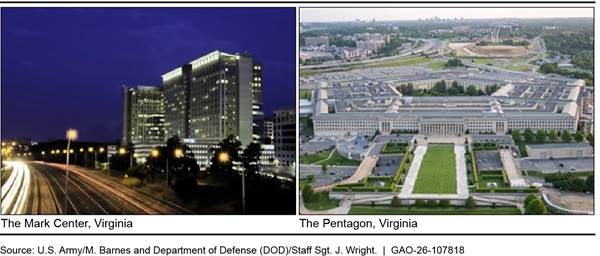
The Department of Defense (DOD) managed about 35 million square feet of office space in the National Capital Region (NCR), as of March 2025.[1] Almost three-quarters of DOD office space in the NCR—about 24.7 million square feet—is in DOD-owned buildings, such as the Pentagon, and about 10.2 million square feet is leased at an annual cost of about $318 million.[2]
DOD office space needs in the NCR are dynamically changing. As the COVID-19 pandemic subsided, federal policy encouraged agencies, including DOD, to resume in-person work. In January 2025, the President issued a memorandum directing all agencies to require employees to work in-person at an agency office on a full-time basis.[3] In July 2025, DOD reported its employees had largely returned to in-person work, with some exceptions, such as for personnel assigned to an office with insufficient space.[4] In the future, changes to DOD’s workforce and office space inventory, including potential reductions to the civilian workforce and to leased space, may further affect DOD office space needs and usage in the NCR.
Since 2003, federal real property management has been on GAO’s High-Risk list, in part because of challenges managing underused property.[5] In 2023, GAO reported that 17 federal agencies’ headquarters buildings, including a large DOD office building, called the Mark Center, were used at 25 percent capacity or less due to long-standing challenges and increased telework at that time, producing unnecessary financial and environmental costs.[6]
Past challenges related to data quality for real property usage have hindered DOD’s reform efforts. In March 2025, we reported that DOD lacked a clear picture of its real property portfolio because the military services had not consistently measured usage. Specifically, DOD had not consistently measured real property utilization rates—the space needed to support the mission divided by the space available for the main function of the building—as required.[7] We recommended that DOD develop actions to enforce guidance on utilization data consistently and accurately. DOD agreed with our recommendation, but as of February 2026, DOD has not implemented it. For a complete list of our previous work in this area, see the Related GAO Products page at the end of this report.
House Report 118-125, accompanying a bill for the National Defense Authorization Act for Fiscal Year 2024, includes a provision for us to review how DOD manages its real property needs in the NCR in light of changing workforce needs.[8] This report evaluates the extent to which DOD has (1) assessed its office space needs and usage in the NCR, and (2) established processes for entering into lease agreements for office space in the NCR.
For our first objective, we reviewed DOD needs assessments against DOD requirements and interviewed officials from the Office of the Under Secretary of Defense for Acquisition and Sustainment (USD(A&S)) and military departments on the needs assessments. We also obtained and analyzed occupancy data from USD(A&S) for DOD-owned and leased office space in the NCR from April to September 2025.[9] We reviewed the data against DOD requirements for occupancy tracking.[10] We also conducted data tests and interviewed DOD officials to determine the completeness and reliability of the data. We found the data sufficiently reliable for determining the number of DOD office spaces in the NCR that had submitted occupancy data to USD(A&S). The data were not reliable for determining the occupancy of DOD office space in the NCR, as discussed later in this report.
For the second objective, we reviewed documentation and interviewed USD(A&S) and military department officials to determine the process for leasing within the NCR and collected information on existing leases from Washington Headquarters Services (WHS), the U.S. Army Corps of Engineers (USACE), and Naval Facilities Engineering Command (NAVFAC). We compared leasing processes and information against DOD requirements for coordination in the NCR.[11] We also analyzed DOD data on leased office space in the NCR as of March 2025. To assess the reliability of the data, we conducted electronic testing on leased office space data and determined they were sufficiently reliable to determine the number of leases in the NCR.
For both objectives, we conducted site visits to four military installations, six leased office spaces, the Pentagon, and the Mark Center to observe office space occupancy and space condition. We selected these sites to include DOD-owned and leased spaces, and all military services, among other variables. We also discussed the management of office space and office space usage with officials from tenant organizations. See appendix I for a detailed description of our scope and methodology.
We conducted this performance audit from September 2024 to May 2026 in accordance with generally accepted government auditing standards. Those standards require that we plan and perform the audit to obtain sufficient, appropriate evidence to provide a reasonable basis for our findings and conclusions based on our audit objectives. We believe that the evidence obtained provides a reasonable basis for our findings and conclusions based on our audit objectives.
Background
Overview of DOD Office Space in the NCR
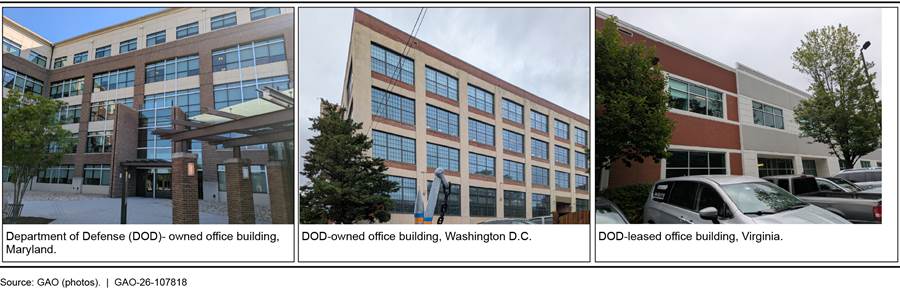
DOD office space in the NCR consists of both DOD-owned office space—located on and off military installations—and DOD-leased office space in Virginia, Maryland, and Washington D.C. (see fig. 1).
· DOD-owned office space. About two-thirds of DOD-owned office space in the NCR is located on military installations, a total of about 16.2 million square feet across 334 office buildings.[12] The Army and Navy manage most of this space on installations, about 7.3 and 4 million square feet, respectively. The Air Force and Marine Corps are responsible for the remainder, with about 3.1 and 1.7 million square feet, respectively. WHS is responsible for managing an additional 8.5 million square feet of office space at the Pentagon and the Mark Center in Northern Virginia.
· DOD-leased office space. DOD components, which include the military services, the Office of the Secretary of Defense and other DOD organizations, are tenants using leased office space across the NCR. These totaled 86 office spaces or 10.2 million square feet, as of March 2025. As the main leasing agent for the federal government, the U.S. General Services Administration (GSA) is generally responsible for leasing space from private building owners for federal agencies, including for DOD. In some cases, DOD leases office space in the NCR through the military departments rather than through GSA (see fig. 2).
Figure 2: DOD-Owned and -Leased Office Space in the National Capital Region, by Military Service and Washington Headquarters Services (WHS)
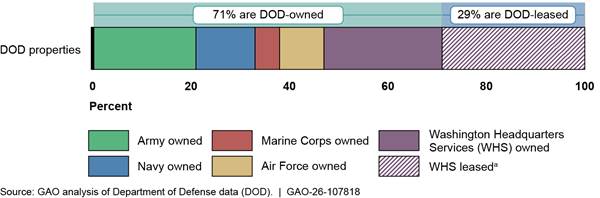
aA variety of DOD components, including military services, are tenants in WHS leased spaces.
Responsibilities for Managing DOD Real Property in the NCR
Responsibilities for managing DOD real property, including office space in the NCR, extend across the department and include the following:
· Office of the Secretary of Defense. USD(A&S) exercises overall policymaking and oversight responsibility of DOD real property, including for office space.[13] The Assistant Secretary of Defense for Energy, Installations and Environment provides additional guidance and procedures for implementing real property management across the department and serves as DOD’s Senior Real Property Officer.[14] The Senior Real Property Officer is responsible for developing and implementing a DOD-wide real property assets management process and for providing an annual report to the Office of Management and Budget and to GSA that lists and describes real property under DOD’s control, among other responsibilities.[15]
· Military departments. The secretaries of the military departments are responsible for establishing programs and procedures to manage real property on their installations, and for monitoring its use to ensure efficiency, including for DOD-owned office space on NCR installations.[16] In addition, each of the military departments has statutory authority to execute leases.[17] The Departments of the Army and Navy have delegated this authority to USACE and NAVFAC, respectively.[18] The Air Force does not exercise its statutory authority to execute leases, according to Air Force officials.
· WHS. WHS is responsible for space planning and management for all DOD office space in the NCR outside military installations, whether DOD-owned or -leased.[19] For example, WHS is responsible for acquiring leased office space through GSA or the military departments, and subsequently assigning, withdrawing, and reassigning this space within the NCR. WHS is further responsible for regulating and monitoring office space at the Pentagon and the Mark Center.
· DOD components. DOD components are responsible for designating an NCR space coordinator to manage their component’s office space in the NCR, including space on military installations, at the Pentagon, and the Mark Center, and in leased office space where the component is a tenant organization. DOD components include the military departments, and other DOD organizations, such as the Office of the Secretary of Defense, defense agencies, DOD field activities (including WHS), the Joint Staff, and the combatant commands, among others.[20]
DOD Periodically Assesses Office Space Needs, but Does Not Have Complete and Accurate Usage Data
DOD periodically assesses its office space needs in the NCR through recurring reviews conducted annually or continuously, as well as additional reviews as directed. In 2025, DOD began collecting additional data on office space usage, but these data are incomplete and inaccurate.
DOD Periodically Assesses Its Needs for Office Space in the NCR
DOD—specifically the military departments and WHS—generally conduct reviews of office space needs in the NCR on a periodic basis, including recurring and additional reviews. DOD Instruction 4165.70 requires DOD components, including the military departments and WHS, to periodically review their real property to identify and report unneeded facilities.[21] As part of this determination, DOD components must decide whether the property is being used effectively, is necessary for current or projected mission requirements, or if a different, less costly property can provide equal or better working conditions.
Recurring Reviews
The military departments and WHS have each issued guidance implementing DOD’s requirements to assess office space needs on a recurring basis, such as annually.
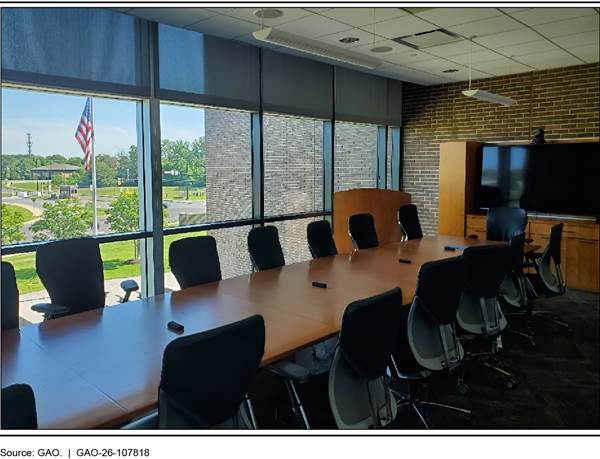
Department of the Air Force. Air Force guidance requires an annual review of all real property to identify unneeded space.[22] In addition, installation officials at Joint Base Andrews told us they assess needs for office space at the installation on a continuous basis whenever they receive space requests from existing or potential tenants. For example, officials said they keep a running tally of space requests at Joint Base Andrews, and that office space is generally only available when an existing tenant leaves. See figure 3 for an example of Air Force office space.
Department of the Army. Army guidance requires installation commanders to identify unneeded properties through annual surveys on space usage at their assigned installations.[23] In addition, installation officials at Fort Belvoir told us they review space needs on a continuing basis as they receive new space requests. For example, they said they have conducted reviews of space to accommodate teleworkers returning to in-person work and to relocate personnel to office buildings in better condition. The Army also occupies a large number of leased office spaces in the NCR—about 900,000 square feet of leased space, according to Army officials.
Since 2013, the Army has assessed its leased office space needs in the NCR by, according to officials, conducting reviews every 2 years. Reviews include assessing usage information, such as telework data and personnel information, according to officials. Army officials told us that due in part to these efforts, the Army has reduced its leased space in the NCR. Specifically, the Army has reduced leased space by over 1 million square feet since fiscal year 2014, from 26 facilities down to 12. The Army projects it will reduce its leased space by about an additional 200,000 square feet, from 12 office spaces down to eight, by fiscal year 2028.[24]
Department of the Navy. Navy guidance requires the Chief of Naval Operations and the Commandant of the Marine Corps to continually review whether real property under their control is still needed.[25] During our site visit to Naval Support Activity Washington, an installation official told us they conduct assessments of office space every 5 years to determine if space meets the needs of a tenant organization’s mission. In doing so, the official said they had identified underused space. For example, officials found that one tenant occupied a building on base that was more than twice as large as the organization’s current needs. Installation officials at Marine Corps Base Quantico told us they also conduct assessments every 5 years that include a comparison of personnel needs against assigned space. See figure 4 for an example of Marine Corps office space.
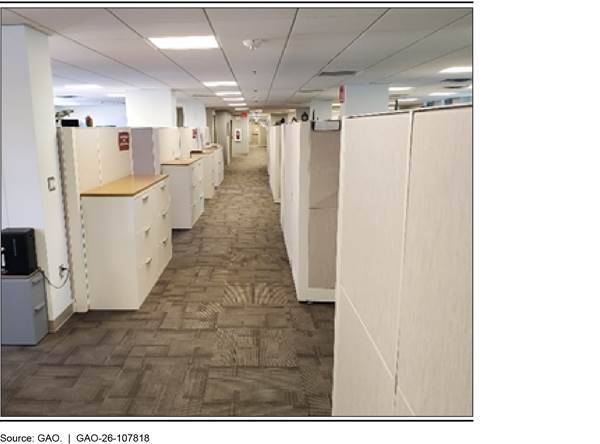
WHS. DOD guidance requires WHS to survey space utilization when a tenant requests an expansion to their existing office space.[26] WHS officials told us that they annually assess office space needs at the Pentagon, Mark Center and NCR leased office space by reviewing tenant usage of space. For example, WHS collects information on the number of assigned personnel from tenants. Officials also told us that they conduct regular walk-throughs of office spaces to identify potential consolidation opportunities.
Additional Reviews
Some DOD organizations have also conducted additional reviews assessing selected portions of their office space inventory in the NCR in response to a specific directive or changing circumstances. Specifically, the Office of the Secretary of Defense, military installations, and WHS have conducted additional reviews.
Office of the Secretary of Defense leased space reviews. In April 2025, the Secretary of Defense directed DOD organizations to develop plans for reducing leasing costs by 30 percent within the next 18 months.[27] To support these reductions, USD(A&S) is to review each DOD organization’s implementation of these plans and provide progress reports on the 30 percent reduction effort to the Secretary of Defense. According to military department officials, the departments have identified approaches to reducing leasing costs for office space in the NCR. For example, Navy officials told us they are working to reduce the number of leases in the NCR and renegotiate rents to reduce existing lease costs.[28] Air Force officials said that, in response to the 2025 requirement, they planned to not renew an existing lease that would soon be vacant. Army officials told us they plan to use occupancy data to reduce the Army’s leased space in the NCR.[29]
Military installation reviews. Both the Navy and Air Force have conducted additional reviews of office space at specific NCR installations. For example, installation officials at Joint Base Andrews told us that a May 2025 review of office space identified a 98 percent utilization rate across the installations. Navy officials told us that in 2021 they conducted a review of consolidation options for office space at Naval Support Activity Washington based on varied levels of telework.
WHS reviews. In response to a June 2021 request by the Deputy Secretary of Defense, WHS began three related reviews of its office space needs across the Pentagon, the Mark Center, and DOD-leased space in the NCR (see fig. 5).
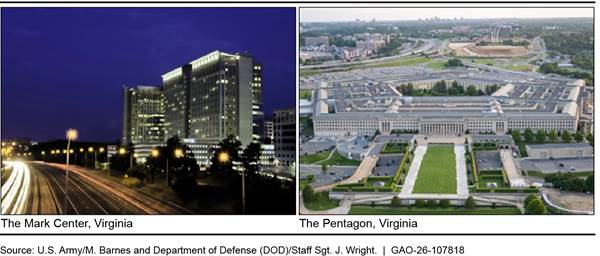
For its review of Pentagon space needs, WHS surveyed Pentagon tenants on space usage, with specific questions on the percentage of personnel teleworking. Mark Center and leased space needs assessments, while less formal, also included review of usage information collected from tenants. As a result of review findings, WHS coordinated with tenants to reallocate space in the Pentagon and the Mark Center and reduced leasing costs by terminating or not renewing a number of leases, totaling in the tens of millions of dollars, according to WHS officials. From October 2018 to October 2025, WHS reduced leasing costs by about $38 million by terminating or not renewing 33 leases.
DOD Has Begun Collecting New Data on Space Usage, but These Data Are Incomplete and Likely Inaccurate
Since April 2025, DOD has begun collecting data on office space usage across its owned and leased office spaces in the NCR in response to new requirements to improve visibility into real property usage. However, our analysis showed that the data are incomplete and likely inaccurate.
An April 2025 Secretary of Defense memorandum required biweekly reporting of occupancy data for all DOD-owned and leased office space, including in the NCR, starting on April 16, 2025.[30] USD(A&S) implementing guidance states that DOD organizations must report occupancy data because DOD has a collective responsibility to the taxpayer to use provided resources as effectively and efficiently as possible.[31] The scale and pace of occupancy data collection differ from past efforts to track the usage of DOD real property. For example, since December 2016, DOD has required the military departments to measure and report a different type of usage data—utilization rate—as part of its annual federal real property inventory.[32] The utilization rate measures space allocation. DOD calculates the utilization rate by dividing the basic facility requirement—the space needed to support the mission—by the space available for the main function of the building. However, as we reported in March 2025, about 8 years after the requirement was introduced, the services have made limited progress in consistently and accurately collecting utilization data.[33]
In contrast, the April 2025 memo required a new metric—occupancy rate—that measures the number of workers entering a building divided by the number of workstations. USD(A&S) implementing guidance for collecting and reporting biweekly occupancy data directed DOD organizations working in owned and leased office space to report on the number of desks, the number of workers entering an office space, the real property unique identifier—a unique identification number assigned to all DOD property—and other identifying information such as building name.[34] The implementing guidance states that organizations should submit this occupancy data through an online form on the first and third Wednesday of each month, beginning April 16, 2025 (see fig. 6).
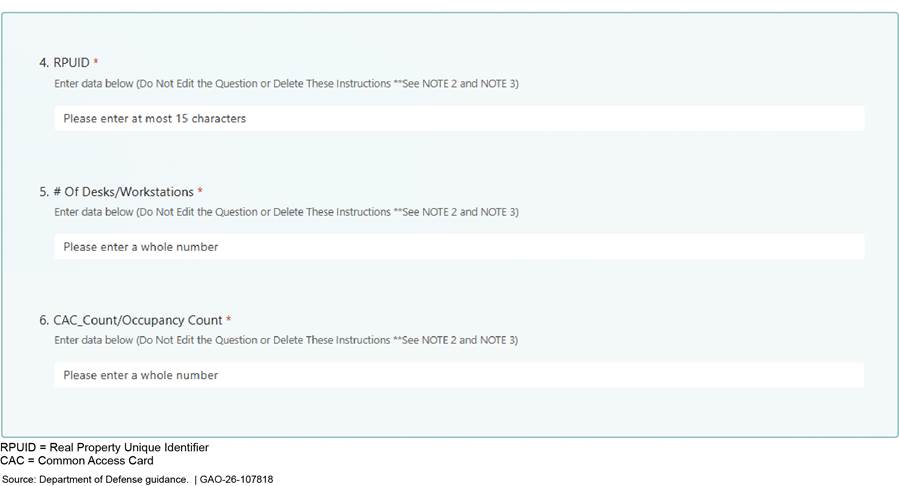
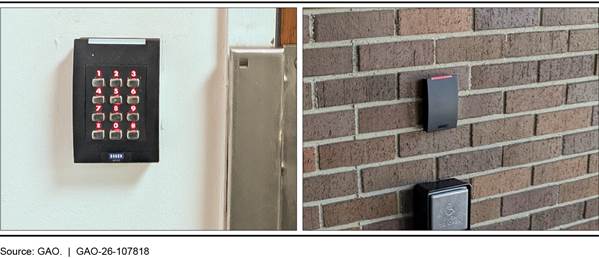
The implementing guidance directs organizations to collect occupancy data in one of two ways—credential badge swipes or manual counts via an Occupancy Data Collection Form.[35] In addition, USD(A&S) officials told us they have accepted occupancy data collected in other ways, such as assessing computer network activity. When conducting manual counts, the guidance states that organizations should avoid counting workers during lunch periods, early morning, or late afternoon, and instead count workers during core business hours, when the maximum number of workers are present. During site visits to DOD-owned and -leased office spaces, officials told us they have collected occupancy data using a variety of methods, including paper or electronic sign-in sheets, manual headcounts, building or office space badge swipe data, or some combination of methods (see fig. 7).
Figure 7: Department of Defense Badge Swipe Mechanisms Observed at Office Spaces in the National Capital Region
As of September 2025, our analysis of DOD occupancy data collected in response to the April 2025 requirement showed that the data were incomplete and likely inaccurate.[36] We used steps from GAO’s data reliability framework to assess the completeness and accuracy of these data, including interviewing knowledgeable officials and data testing.[37] In using these steps, we found that many of the DOD organizations required to begin submitting occupancy data in the NCR had not yet done so as of September 2025. For the office spaces that have submitted occupancy, many have not submitted occupancy on a consistent and timely basis, and we found instances where the data may contain errors and not accurately represent what they purport to. Further, officials from most of our site visits told us that collecting and reporting biweekly occupancy data was challenging.
Incomplete Occupancy Data
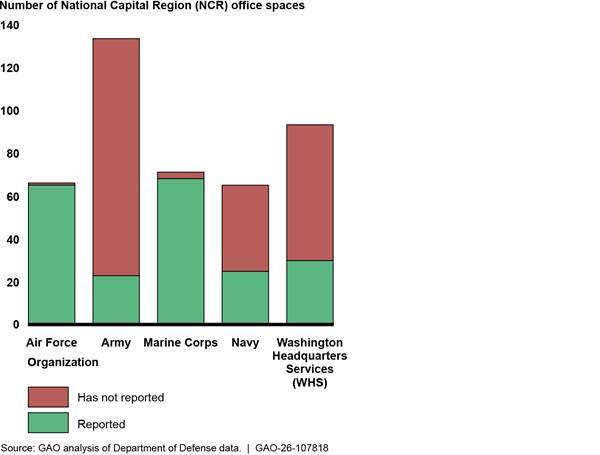
From April 11 to September 3, 2025, DOD organizations had submitted occupancy data to USD(A&S) at least once for 49 percent of DOD office spaces in the NCR (211 of 428). As such, over half had never reported.[38] The Air Force and Marine Corps had the highest reporting rates for their spaces, and the Army and Navy had the lowest. No military service or WHS had reported occupancy for all its office space in the NCR (see fig. 8).
Figure 8: Number of Owned and Leased Office Spaces in the NCR that Reported Occupancy Data at Least Once, Apr. 11—Sept. 3, 2025, by Military Service and WHS
Note: We compared Department of Defense (DOD) occupancy
data received as of September 2025 against DOD’s inventory of office space in
the NCR. To compile the inventory, we combined DOD office space inventories
from DOD’s Real Property Asset Database, dated December 2024, as well as
inventories for office space from WHS and the U.S. Army Corps of Engineers,
dated March 2025, and from Naval Facilities Engineering Systems Command,
received July 2025. We excluded recruiting centers, National Guard
installations, and leases with foreign military tenants.
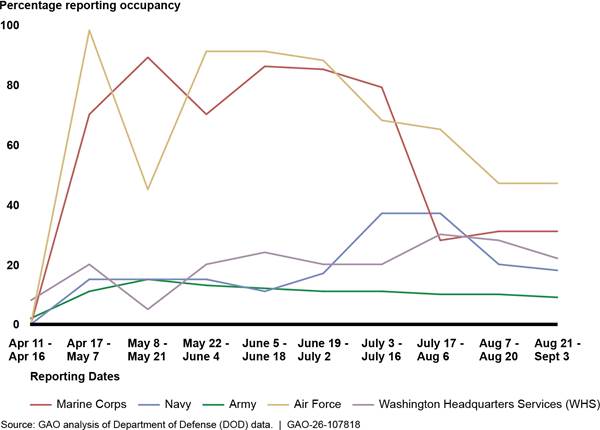
We found that between April and September 2025, neither the military services nor WHS consistently reported occupancy at their NCR office spaces on a timely basis. WHS, the Army, and the Navy did not report occupancy for most of their office spaces as required during this time. The Air Force and the Marine Corps reported occupancy for most of their office spaces between May and June 2025, but the number of office spaces with reported occupancy has declined from June to September (see fig. 9).
Figure 9: Percentage of Owned and Leased Office Spaces in the National Capital Region that Reported Occupancy Data at Least Once During Biweekly Periods from Apr. 11—Sept. 3, 2025, by Military Service and WHS
Note: We compared Department of Defense (DOD) occupancy
data received as of September 2025 against DOD’s inventory of office space in
the NCR. To compile the inventory, we combined DOD office space inventories
from DOD’s Real Property Asset Database, (RPAD), dated December 2024, as well
as inventories for office space from WHS and the U.S. Army Corps of Engineers,
dated March 2025, and from Naval Facilities Engineering Systems Command,
received July 2025. We excluded recruiting centers, National Guard installations,
and leases with foreign military tenants.
In August 2025, USD(A&S) officials told us that over half of DOD’s office spaces in the NCR were submitting occupancy data, but acknowledged that many were not consistently reporting, including because some tenants were unaware of the requirement. However, our analysis of occupancy data indicated that in the reporting period between August 21 and September 3, 2025, the most recent period for which we have data, just 23 percent of office spaces reported occupancy to USD(A&S).
Standards for Internal Control in the Federal Government states that management should use quality information to make informed decisions. Quality information is complete and provided on a timely basis.[39] We found that the military services and WHS have reported incomplete occupancy data because USD(A&S) has not developed actions to enforce its guidance and the completeness of occupancy data. Such actions could include holding organizations accountable for not reporting occupancy data—such as through incentives or consequences—to ensure that DOD can identify opportunities for consolidation. It could also include issuing more detailed implementing guidance that clarifies how the military services should designate reporting personnel. USD(A&S) implementing guidance for occupancy tracking states that tenant organizations using space in the NCR should designate personnel responsible for reporting occupancy. However, USD(A&S) has not enforced the requirement such as by ensuring the military services and WHS designate reporting personnel.
We identified a significantly larger number of office spaces in the NCR subject to the occupancy reporting requirement compared to DOD. In January 2026, USD(A&S) officials told us that they believed all office spaces in the NCR required to report occupancy had done so. Documentation DOD provided showed that 236 offices with different real property unique identifiers in the NCR were required to report.[40] Subsequently, USD(A&S) officials told us they had identified an additional 23 offices, bringing the total in the NCR to 259. However, our analysis of DOD data showed a total of 428 office spaces in the NCR with different real property unique identifiers—over 100 more offices than DOD had identified.
USD(A&S) officials told us that NCR office spaces identified as administrative facilities using specific facility codes were subject to occupancy reporting requirements. For example, in January 2026, USD(A&S) officials identified 44 Army office spaces in the NCR subject to the occupancy reporting requirements. In contrast, we found a total of 133 Army office buildings in the NCR, all identified with the administrative facility code. During our site visit to Fort Belvoir in May 2025, Army officials told us there were 89 office buildings on that installation alone.
Military service officials identified a range of challenges that have prevented more complete occupancy data collection and reporting, such as unclear roles and responsibilities, and the absence of consequences for not reporting, among others.
Army and Navy installation officials, and tenants in some WHS-managed leased spaces, told us they were unsure who was responsible for collecting and reporting occupancy, especially in office buildings with multiple tenants, and therefore were not doing so. Officials at Naval Support Activity Washington and Fort Belvoir told us that tenant organizations were responsible for designating personnel responsible for reporting occupancy. In contrast, Air Force and Marine Corps officials told us they have designated personnel responsible for collecting occupancy data at their installations.[41] Although a greater proportion of Air Force and Marine Corps properties have submitted occupancy at least once, we found that reporting from these services decreased over time.
Navy and Marine Corps officials told us that in the absence of consequences, such as a tenant losing their space after not reporting, tenants may not be taking the new requirements seriously. These officials also told us that some tenant organizations may decide not to report occupancy because they are concerned doing so would be a security risk. Similarly, at Fort Belvoir, officials told us they were likely to temporarily pause reminders to tenants to report occupancy until they received further guidance from the Army, including the consequences for not reporting.
By holding the military services and WHS accountable for implementing its guidance on occupancy reporting and developing actions to enforce the completeness of occupancy reporting across DOD, USD(A&S) can better ensure the completeness of biweekly occupancy data. DOD would then be better positioned to oversee the department’s efforts to minimize unused space and reduce leasing costs in the NCR.
Inaccurate Occupancy Data
Our review of the occupancy data submitted to USD(A&S) indicated likely inaccuracies. Using GAO’s data reliability framework, we conducted data tests, such as checking for obvious errors, testing for missing data, and looking for duplicate records.[42] In doing so, we identified potential data entry errors and outliers. For example, we found one large building with reported occupancy over 1000 percent 25 times between April and September 2025. Similarly, WHS reported Mark Center occupancy to USD(A&S) 100 times between April 11 and September 8, 2025. Of these reports, 98 indicated the Mark Center had thousands of workstations; one report indicated the Mark Center had about 1,400 workstations; and another report indicated the building had zero workstations. Finally, another organization reported multiple changes in the number of workstations between April and August 2025, starting with 93 workstations in April, 30 workstations in May, down to 10 workstations in early August, and back up to 93 at the end of August.
We also identified hundreds of instances where offices had reported exactly 100 percent occupancy each time from April to September 2025. During one of our site visits, installation officials told us they were directing tenants to report the number of personnel required to meet their mission—including vacant positions—rather than the number of workers entering an office space, as required by the guidance implementing the Secretary of Defense memorandum.
Military department and WHS officials, as well as officials from other DOD organizations at eight of the 12 sites we visited, told us they had concerns about whether the data were free from error. Marine Corps and Navy officials told us they were concerned the data contained mistakes due to human error. Army officials said that they were not familiar enough with expected usage to determine data reliability for most leased office space. For example, at one site visit, officials from a tenant organization said that to be able to report on occupancy in their assigned space, they had to assign employees to manually filter data from badge swipe terminals to remove duplicate swipes, a process they described as time-consuming.
Military department and WHS officials, as well as officials from other DOD organizations told us they had concerns about whether the data faithfully represent office space occupancy. For example, WHS officials stated that they were not able to distinguish workers assigned to workstations from visitors based on Pentagon and Mark Center badge swipe data. These officials stated they also did not have badge swipe data specific to tenant spaces within the Pentagon or Mark Center and therefore did not have visibility into the location of underused space that could be reallocated more efficiently.
Officials could not confirm that organizations were counting workers consistently, making it difficult to compare occupancy across locations with accuracy. Air Force officials told us the data may be inaccurate if occupancy is collected while personnel on rotating schedules are not at their desks. During site visits, an official from one tenant organization told us they counted workers only if they were in the office on a given day. Officials at another location told us they counted workers with an assigned workstation even if they were out of the office on leave. Army officials told us the data likely contained inaccuracies because the Army does not have sufficient time or personnel to verify the data before they are submitted. Navy officials told us they were concerned that poor data quality could result in organizations with crucial missions losing needed space.
USD(A&S) implementing guidance indicated it conducted a limited data quality review in June 2025 to ensure submitting offices used a real property unique identifier. USD(A&S) issued additional guidance on January 13, 2026 requiring some quality checks, such as verifying outliers with the military services. An official from USD(A&S) also told us that they continue to refine the quality of their data, and plan to document a process for identifying, assessing, reporting, and correcting data anomalies in the future.
The April 2025 Secretary of Defense memorandum states that occupancy tracking will enable DOD to advance its efficiency objectives by reducing DOD leasing costs and preventing inefficient acquisition of leased space in the future.[43] DOD Instruction 4165.14 states that under the authority, direction, and control of USD(A&S), the Assistant Secretary of Defense for Energy, Installations, and Environment is to develop policy and guidance for the creation and maintenance of an accurate real property inventory.[44] Further, Standards for Internal Control in the Federal Government states that management should use quality information that is accurate, reasonably free from error and bias, and faithfully represents what it purports to represent in order to achieve the entity’s objective.[45]
However, USD(A&S) has not established a process for the creation and maintenance of accurate occupancy data that are reasonably free from error and represent office space occupancy in the NCR. For example, such a process could include standardizing how occupancy data are to be collected and reported, or implementing a review of the quality of data submitted. By establishing such a process, DOD will improve the quality of the data needed to identify opportunities for efficiencies and consolidation, including toward its goal of reducing leased space by 30 percent. WHS officials told us that in the absence of occupancy data, they have generally relied on tenants to report underused space and thus identify opportunities for efficiencies. For example, officials said they were able to consolidate office space at the Mark Center in 2018 to support divesting from an existing lease. Higher quality occupancy data could help DOD identify more opportunities for consolidation across office space in the NCR.
DOD Has Established Processes for Entering into Lease Agreements in the NCR, but Lacks Key Information for Decision-Making
DOD has established processes to request and enter into leases for office space in the NCR. However, although WHS has coordinated with military departments on new leases, it does not have a complete inventory of DOD-leased office space in the NCR nor full visibility into the availability of DOD-owned space in the NCR. This information is needed for WHS to strategically manage NCR leasing decisions and fulfill responsibilities to promote, enforce, and establish efficient space utilization in the NCR.
DOD Has Established Processes for Entering into Leases in the NCR
DOD has established processes for DOD organizations to enter into leases for office space in the NCR. As part of this process, DOD organizations are to submit a space request to WHS through the organization’s established NCR space coordinator.[46] WHS is then responsible for approving or denying space requests and for ensuring appropriate documentation is included, such as justifications supporting the need for a lease and anticipated costs.[47] For example, WHS officials said they review space requests to ensure square footage needs are accurate and check to ensure there is appropriate endorsement from senior leadership. USD(A&S) exercises final approval of all new leasing actions and reports certain, more expensive leases to Congress (see fig. 10).[48]
Figure 10: Department of Defense (DOD) Process for Entering into New Leases in the National Capital Region (NCR)
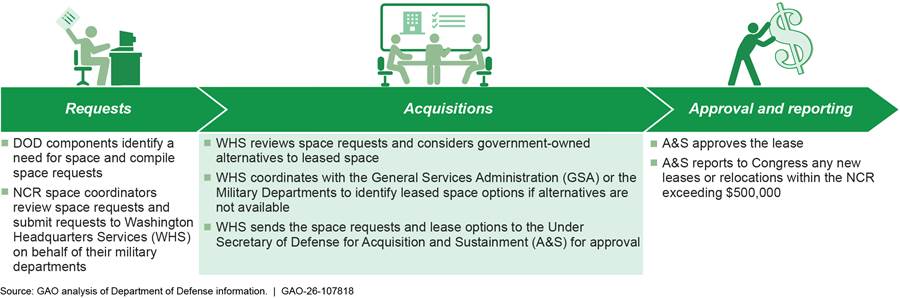
Note: An April 2025 Secretary of Defense Memorandum states
all new leasing actions shall be submitted to the Under Secretary of Defense
(A&S) for approval (Secretary of Defense Memorandum, Rationalizing Real
Property Leasing to Support Rebuilding the Military). Prior to April 2025, the
Under Secretary of Defense (A&S) had to approve all relocations into the
NCR exceeding $500,000 in relocation costs (DOD Instruction 5305.05 Space
Management Procedures for the National Capital Region and Washington Headquarters
Services-Serviced Components). Thereafter, a September 2025 DOD Memorandum
states that a moratorium is imposed on new DOD leases in the NCR, but that
USD(A&S) is authorized to waive the NCR moratorium if such a waiver is
determined to be in the best interest of the department. Deputy Secretary of War
Memorandum, Leasing of Administrative and Warehouse Space to Department of
War (Sept. 30, 2025).
When submitting space requests, DOD organizations are to develop a leasing package for review. Leasing packages are to include information related to personnel, space requirements, and costs. For example, requests should include the number of personnel the organization is authorized to hire, the type of space and square footage needed, a statement of probable costs, and a certification that funds are available for rent and other expenses.[49]
In addition, organizations must justify their need for space in accordance with statutory requirements. DOD organizations submit background information, coordinate with their general counsel, and provide any additional documentation required for relocations into or within the NCR exceeding $500,000 as directed by WHS in a move certification package. [50] Additionally, DOD organizations must submit a report to Congress for new leases with a rental cost exceeding $750,000.[51] The report certifies that DOD evaluated the feasibility of using existing DOD space and determined the lease was appropriate due to lack of available DOD space, cost considerations, or interference with an ongoing military mission.[52]
During our visits to DOD-leased space, officials told us that DOD organizations may prefer leased office space over DOD-owned space on military installations for a variety of reasons, including the following:
· Unique missions. Officials at several leased office spaces told us their organizations’ missions required or benefited from locations outside a military installation. For example, officials at one leased space in Virginia told us their mission required providing public services, and relocation to a military installation would create access challenges due to military installations not being open to the public. Additionally, officials from a DOD organization with judicial responsibilities in D.C. told us that they prefer to stay in leased space because relocation onto a military installation could affect service members’ and the general public’s perception of the court’s independence.
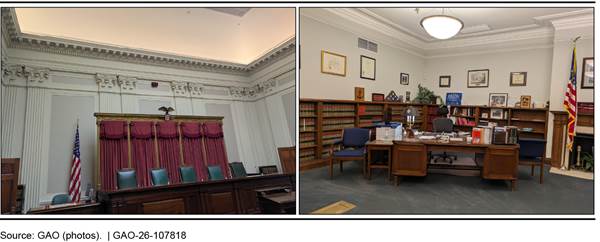
· Requirements for purpose-built space. According to officials from multiple tenant organizations, some DOD organizations require purpose-built space to successfully carry out their missions and would require significant renovations or military construction to relocate to a military installation. For example, officials at one leased space we visited told us they conduct due process hearings that require soundproof witness rooms—a key space requirement needed to protect the integrity of a witness’s testimony. Another DOD organization in D.C. we visited was a court whose lease included courtrooms, judicial chambers, and office space for personnel supporting the court and the judges (see fig. 11).
Figure 11: Examples of Purpose-Built Space in a Department of Defense-Leased Office Space in the National Capital Region
· Building condition. Officials at most military installations and leased spaces we visited told us they prefer spaces in good condition, including because these spaces can provide better working conditions. We observed office spaces in good and poor condition, whether DOD-owned or -leased. For example, officials at one leased space in Virginia we visited told us they were previously located on an installation but moved into leased space due to mold caused by issues with the heating and cooling system. Officials from one tenant organization located on Joint Base Andrews told us they had to use $4,000 of unit funding for mold removal, funding they typically use for training and equipment. Installation leadership at multiple installations we visited told us they receive a limited amount of funding for facility maintenance and cannot address all facility issues.[53]
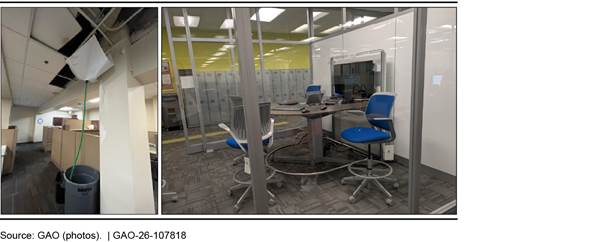
We also observed instances of leased space in poor condition and DOD-owned space in good condition. One leased space we toured was inside an aging building with issues across building systems—mechanical, electrical, plumbing, and heating and cooling. Officials said they sometimes send personnel home due to issues with the building, which means personnel are not able to complete assigned work. At Naval Support Activity Washington, we toured the installation’s newest building and observed no visual signs of damage caused by building issues, as well as recently updated workstations and conference rooms. At the Mark Center, we toured three tenant spaces and observed all in good condition. Additionally, officials at multiple leased spaces told us that moving onto an installation would provide additional security, and ease safety concerns, such as security breaches. See figure 12 for examples of varied building condition.
Figure 12: Variation in Building Condition at Department of Defense Office Space in the National Capital Region
WHS Has Coordinated on New Office Space Leases but Does Not Have a Complete Inventory
WHS coordinated with military departments to enter into new leases but does not have a complete inventory of DOD-leased office space in the NCR.[54] WHS coordinates with both GSA and the military departments to identify leased space options if alternatives are not available. Both GSA and the military departments have statutory authority to execute leases, and in some cases, DOD leases office space in the NCR through USACE and NAVFAC rather than GSA.[55] USD(A&S) now reviews all new NCR space requests and accompanying leasing packages that WHS submits.[56]
Of the 86 existing DOD leases we identified in the NCR as of March 2025, six were new leases made between 2019 and 2024; USD(A&S) reviewed all six leasing packages during this time period, as required. For all six leasing packages, WHS also coordinated with the military departments on proposed leases, as required. For example, leasing packages include signatures from WHS officials, and descriptions of coordination conducted, such as that WHS checked availability in the NCR for a Sensitive Compartmented Information Facility required by the tenant (see table 1).[57]
Table 1: Leasing Packages Reviewed by the Under Secretary of Defense for Acquisition and Sustainment and WHS from 2019—2024
|
Tenant organization |
Lease executor |
Present in WHS inventory |
Evidence of WHS coordination |
|
Joint Special Operations Command |
U.S. Army Corps of Engineers (USACE) |
✗ |
✓ |
|
Naval Sea Systems Command |
Naval Facilities Engineering Systems Command |
✗ |
✓ |
|
F-35 Joint Program Office |
U.S. General Services Administration (GSA) |
✓ |
✓ |
|
Armed Services Board of Contract Appeals |
GSA |
✗ |
✓ |
|
Strategic Capabilities Office; the Space Development Agency; the Joint Staff; and Washington Headquarters Services (WHS) Boards, Commissions, and Task Forces and Cross Functional Teams |
USACE |
✓ |
✓ |
|
Defense Intelligence Agency |
USACE |
✓ |
✓ |
Legend: ✓ = Yes; ✗ = No
Source: GAO Analysis of Department of Defense Information. | GAO‑26‑107818
However, WHS does not have a complete inventory of DOD-leased office space in the NCR because its inventory does not account for all leases, including those executed by USACE- and NAVFAC. As of March 2025, WHS maintained an inventory of 63 leases, including six USACE-executed leases. In January 2026, WHS officials also told us that they were aware of 63 DOD-office space leases in the NCR. Our analysis shows this inventory excluded about 20 percent of leases from USACE and NAVFAC inventories. Specifically, 16 leases executed by USACE and one by NAVFAC were absent from WHS’s inventory. The 17 USACE- and NAVFAC-executed leases absent from WHS’s inventory collectively comprise over 492,000 square feet of office space and total about $26.5 million in annual costs.[58] Tenants of the missing leases varied and included military services, a combatant command, and other DOD organizations. Three of the six leasing packages USD(A&S) and WHS reviewed from 2019-2024 referred to leases absent from the WHS inventory.[59]
DOD Instruction 5305.05, Space Management Procedures for the National Capital Region and Washington Headquarters Services-Serviced Components, states all DOD components located in or seeking a location in the NCR are to forward all space requests to WHS for processing and action. In addition, this guidance states WHS is responsible for promoting, enforcing, and establishing efficient space utilization in the NCR based on the policies and standards in the instruction.
DOD officials told us that WHS is the NCR space manager for the department and is responsible for exercising oversight and conducting administrative monitoring of NCR leases, including those executed through the military departments. Further, DOD officials stated that appropriate monitoring of all DOD leases is needed for WHS to exercise oversight, including by making space assignments across the NCR.[60]
WHS does not have a complete inventory of leases because WHS has not established in guidance a process for periodically coordinating with organizations executing leases to ensure its inventory of current leases is up to date. In the absence of a process for periodic coordination after entering into a new lease, both WHS and USD(A&S) officials said they were aware of instances of leases missing from WHS’s inventory. WHS officials told us they focus on incorporating any missing leases into their inventory rather than identifying the cause of the error and adjusting coordination processes.
Navy and USACE officials told us they coordinate with WHS on space requests, but that they were unaware of WHS tracking or monitoring of NCR leases after DOD has entered into the lease. By developing and implementing a process for continued coordination on leases executed through USACE and NAVFAC, WHS and the military departments will improve overall visibility of leases in the NCR.
Further, implementing such a process will help ensure WHS has the full information it needs to better promote the efficiency and economy of leasing decisions, including efforts to reduce office space costs by DOD’s goal of 30 percent by April 2027. According to DOD data, at least 55 DOD leases in the NCR have lease terms ending in the next 5 years, and DOD paid over $212 million in annual rental costs for those leases in 2024. Improving WHS’s visibility into all leases in the NCR could help DOD avoid entering into new leases unnecessarily, such as when an existing lease might meet the needs of a new tenant. For example, the space leased by NAVFAC that was not in WHS’s inventory includes a Sensitive Compartmented Information Facility. This is an office space feature critical for supporting some aspects of DOD’s mission for which there is a shortage in the NCR, according to officials.
WHS Does Not Have Full Visibility into DOD NCR Office Space to Effectively Manage Leasing Actions
WHS does not have full visibility into the availability of space on military installations needed to strategically manage leasing actions. DOD Instruction 5305.05 states WHS is responsible for coordinating with local military installations on the availability of unneeded space on military installations in the NCR.[61] Further, according to the instruction, military department NCR space coordinators are to be the central point of contact for information regarding availability of office space on installations in the NCR, and are to report underused space available for other DOD organizations to WHS. However, we found that neither WHS nor the military departments fully address their respective responsibilities.
WHS. WHS officials told us they do not collect information on office space availability on military installations, and that they rely on military department leaders’ endorsements of leasing actions to assess whether alternative space is available on military installations. For example, WHS officials told us if a DOD organization is seeking new space, it is that organization’s responsibility to check for available space across installations in the NCR. However, WHS officials also said they were not aware of the process DOD organizations use to check for available office space on installations.
Military departments. Military department NCR space coordinators do not track or report information on underutilized office space on installations to WHS, as required. For example:
· Navy NCR space coordinator officials stated they have a process for reporting underutilized space within the Navy, and to other military services. However, this process does not include reporting to WHS when space becomes available on an installation, such as when a tenant requires less space or vacates their space.
· Army NCR space coordinator officials said they have limited visibility into military installation office space because they are positioned to only have visibility into Army Headquarter organizations’ office space rather than the office space of all Army organizations on installations. For example, Army officials told us they have visibility into about 20 percent of the office space on Fort Belvoir.[62] Additionally, Army NCR space coordinators officials said Army installations are responsible for identifying underutilized space, such as space a tenant no longer needs or vacant buildings, and communicating availability to WHS.
· Air Force NCR space coordinator officials stated they have limited visibility into available space on NCR installations, including the status of tenant-occupied spaces and whole structures, because they are only involved in the space request process for Air Force Headquarters organizations; a different Air Force organization is responsible for non-Headquarter organizations. Despite this, officials said they communicate frequently with installation officials to stay updated on space information.
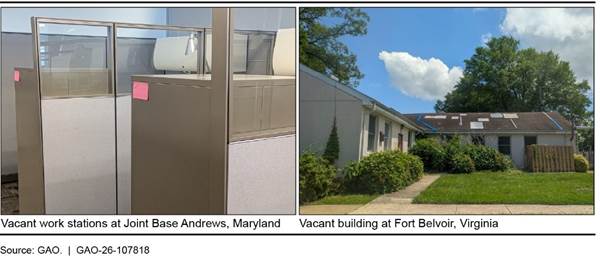
At three of the four installations we visited, officials said they did not have sufficient visibility into underutilized space due to outdated or inaccurate utilization data. For example, at one installation, officials told us utilization data available in their real property management system is generally 1 year out of date. At another installation we visited, an official told us it would take up to a year and a half to update essential space information in their real property management system, such as documentation indicating DOD tenant organizations’ space requirements to carry out their missions. Officials at one installation found a tenant organization with a space requirement of 21,000 square feet assigned to a building of 68,000 square feet. See figure 13 for examples of vacant office spaces.
Officials from the Army, Navy, and Air Force acting as NCR space coordinators told us they check for available space within their respective military department before moving forward in the space request process. For example, Army requests for space in the NCR are sent to an Army planning board with senior leaders to determine existing space the Army can use to accommodate the request. Similarly, a Navy NCR space coordinator official said the Navy checks for available Navy space to meet the organization’s requirements through regional space managers as well as regional space management boards. An Air Force NCR space coordinator official said they have a strong working relationship with installation personnel and are in constant communication about space availability on base.
Officials from some of the installations we visited told us that they did not fully track available office space, and officials from most installations said that they were aware of vacant office buildings, many of which needed renovation. For example, at one installation, officials estimated that 30 out of the installation’s 90 buildings were uninhabitable but would be usable for office space if renovated with investments ranging from $10 to $50 million. At another installation, officials said six out of 81 facilities were vacant and would provide an additional 96,000 square feet if renovated, an estimated investment of $20 to $100 million.
Our analysis of the six space requests for new leases that USD(A&S) and WHS reviewed from 2019 through 2024 found three requests did not assess whether existing DOD office space on installations was reasonably available. For example, two leasing packages stated that the DOD organization did not canvass local military installations due to mission concerns such as the need for regular interaction with non-DOD organizations. Another stated that the organization’s preference was to remain in leased facilities to more effectively meet operational requirements. DOD officials told us that the space requests show that tenants considered, but did not select, the use of DOD-owned office space on NCR installations because space on an installation would not be suitable for the tenants’ missions. However, leasing package documentation DOD provided does not show coordination with, or consideration of, specific installations in the NCR.
DOD guidance requires WHS and military installations to coordinate on the availability of military department-controlled office space on installations.[63] Although DOD began collecting occupancy data on office space usage across owned and leased space in the NCR in April 2025, as discussed above, WHS and the military departments have not established in guidance how they are to coordinate on the availability of unneeded office space on military installations in the NCR. For example, a documented, formal coordination process between WHS and the military departments could include outlining how they are to coordinate on potential available space before entering into a new lease, and how military departments are to regularly share information on the availability of underused space on installations.
WHS officials told us they were not responsible for checking office space inventories and availability on installations, and they were not aware of how DOD organizations determined that no space was available. WHS officials also said that their review of leasing packages constituted sufficient coordination with military installations. However, as described above, half of the six most recent leasing packages documented a specific search for available installation space in the NCR, while the other half did not consider potential existing space. Military department officials stated it is not the responsibility of space coordinators to inform WHS on the availability of office space in the NCR. However, DOD guidance states that WHS is responsible for coordinating with local installations in the NCR, and that the military departments—through their space coordinators—should report underutilized space to WHS.
By establishing in guidance how WHS is to coordinate with military departments on the availability of office space on NCR installations, WHS and the departments will be better positioned to evaluate the feasibility of using existing office space on installations and to promote, enforce, and establish efficient space utilization in the NCR. For example, DOD may be entering or renewing leases to fulfill space requirements that could be met with vacant or underused DOD-owned space.
Conclusions
DOD manages about 35 million square feet of both owned and leased office space in the NCR. Although DOD has faced long-standing challenges in managing its properties, it has taken steps to gather office space usage data. However, DOD has not consistently gathered complete and accurate data because it has not established processes or developed actions to ensure the completeness and accuracy of these reported data, like requiring tenant organizations to designate reporting personnel. Also, DOD may not have a complete picture of all DOD-leased office spaces in the NCR because WHS has not established in guidance a process for periodically coordinating with organizations executing leases to ensure its current inventory is up to date. Further, DOD has limited visibility into available space on NCR military installations because WHS and the military departments have not established in guidance a coordination process on the availability of unneeded space. More reliable data would give DOD a more complete, accurate picture of its property portfolio and put DOD in a better position to reach its goal of reducing leased office space while still meeting the needs of its changing workforce in the NCR.
Recommendations for Executive Action
We are making the following four recommendations to the Department of Defense:
The Secretary of Defense should ensure that the Under Secretary of Defense for Acquisition and Sustainment develops actions to enforce its guidance and the completeness of occupancy reporting, such as by holding Department of Defense organizations accountable for not reporting, and issuing guidance on the designation of reporting personnel. (Recommendation 1)
The Secretary of Defense should ensure that the Under Secretary of Defense for Acquisition and Sustainment establishes a process for the creation and maintenance of accurate occupancy data that are reasonably free from error and represent office space occupancy in the National Capital Region. (Recommendation 2)
The Secretary of Defense should ensure that Washington Headquarters Services establishes in guidance a process for periodically coordinating with organizations executing leases to ensure its inventory of current leases is up to date. (Recommendation 3)
The Secretary of Defense should ensure Washington Headquarters Services, in coordination with the military departments, establishes in guidance how they are to coordinate on the availability of unneeded office space on military installations in the National Capital Region. (Recommendation 4)
Agency Comments and Our Evaluation
We provided a draft of this report to DOD for review and comment. In its written comments, reproduced in their entirety in appendix II, DOD partially concurred with the first two recommendations and provided planned or ongoing actions to address these recommendations. DOD nonconcurred with the third recommendation and concurred with the last one. DOD also provided technical comments, which we incorporated as appropriate.
DOD partially concurred with our first recommendation that the department develop actions to enforce its guidance and the completeness of occupancy reporting, such as by holding DOD organizations accountable for not reporting, and issuing guidance on the designation of reporting personnel. In its response, DOD stated it plans to establish a process to track and verify reporting compliance, and issue clarifying guidance that formally designates responsibilities for data collection and reporting. However, DOD stated that it is not appropriate to implement enforcement of guidance until guidance is revised in such a way that standardizes reporting and allows agencies to understand roles and responsibilities. We agree it is important for DOD to enforce standardized guidance on reporting, and to ensure guidance allows agencies to understand their roles and responsibilities. DOD’s planned actions, if implemented, should help it enforce the requirement to report occupancy and better position the department to minimize unused space and reduce leasing costs in the NCR.
DOD also partially concurred with our second recommendation that it establish a process for the creation and maintenance of accurate occupancy data that are reasonably free from error and represent office space occupancy in the NCR. In its response, DOD stated that it is actively developing and implementing technology solutions to automate the collection and reporting of space occupancy data across DOD facilities. DOD’s response also acknowledged challenges with data accuracy during the time period of our review, stating that the period from April to August 2025 was marked by significant personnel fluctuations.
As described in our report, DOD’s office space needs are dynamically changing, in part because of fluctuations in DOD’s workforce. As such, establishing a process for the creation and maintenance of accurate occupancy data is all the more important, and will help DOD ensure reliable occupancy data going forward. As discussed in the report, USD(A&S) has issued guidance implementing some quality checks, such as verifying outliers in occupancy data with the military services. However, an USD(A&S) official told us that they continue to refine the quality of their data, and plan to document a process for identifying, assessing, reporting, and correcting data anomalies in the future. By establishing a process to create and maintain accurate data, DOD will improve the quality of the data needed to identify opportunities for efficiencies and consolidation.
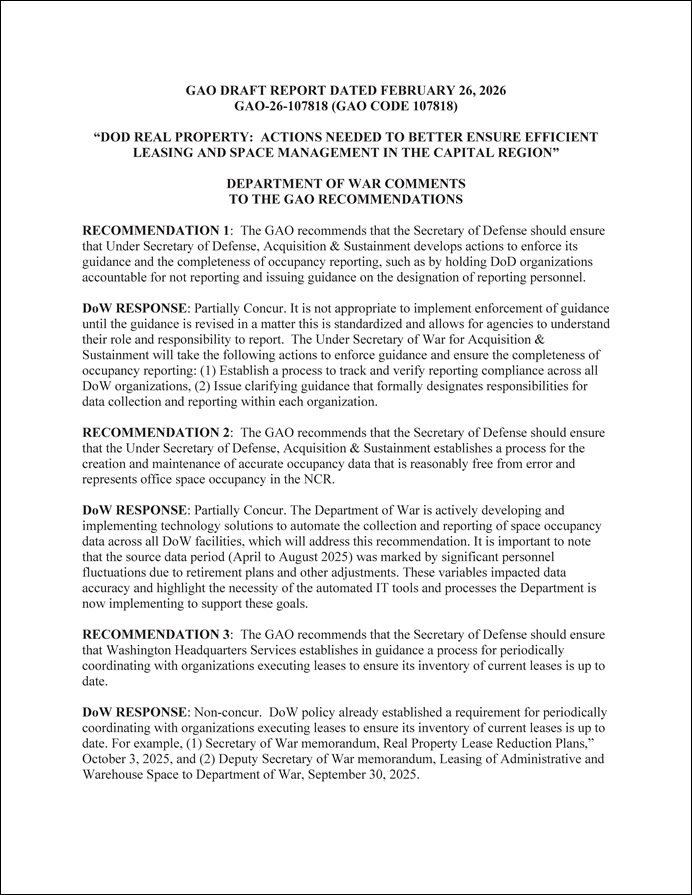
DOD nonconcurred with our third recommendation that the department establish in guidance a process for periodically coordinating with organizations executing leases to ensure its inventory of current leases is up to date. In its response, DOD stated that existing policy already established a requirement for periodically coordinating with organizations executing leases to ensure its inventory of current leases is up to date.
DOD’s response identified two 2025 memos related to DOD leasing policy. DOD had not previously provided either of these memos to us during our audit work or during discussions of our key findings before we provided DOD our draft report for formal comment.[64] These memos approve and direct implementation of lease reduction plans across the department, provide additional direction on approval processes for new lease requests, and establish a moratorium on new DOD leases in the NCR, among other efforts. However, neither memo references WHS’s roles or responsibilities related to lease reduction in the NCR, such as the need to coordinate with organizations executing leases to ensure complete visibility into the current NCR inventory.
As described in our report, 17 USACE- and NAVFAC-executed leases were absent from WHS’s inventory, collectively comprising over 492,000 square feet of office space and totaling about $26.5 million in annual costs. In the absence of a process to periodically coordinate with lease executors, WHS does not have complete visibility into its leases in the NCR, and so cannot effectively carry out its responsibilities. We continue to believe that implementing such a process will help WHS ensure it has full information needed to promote efficiency and economy in leasing decisions.
We are sending copies of this report to the appropriate congressional committees; the Secretary of Defense; the Secretaries of the Army, Air Force, and Navy; and other interested parties. In addition, the report is available at no charge on the GAO website at https://www.gao.gov.
If you or your staff have any questions about this report, please contact me at CzyzA@gao.gov. Contact points for our Offices of Congressional Relations and Media Relations may be found on the last page of this report. GAO staff who made key contributions to this report are listed in appendix III.

Alissa H. Czyz
Director, Defense Capabilities and Management
List of Committees
The Honorable Roger Wicker
Chairman
The Honorable Jack Reed
Ranking Member
Committee on Armed Services
United States Senate
The Honorable Mitch McConnell
Chair
The Honorable Christopher Coons
Ranking Member
Subcommittee on Defense
Committee on Appropriations
United States Senate
The Honorable Mike Rogers
Chairman
The Honorable Adam Smith
Ranking Member
Committee on Armed Services
House of Representatives
The Honorable Ken Calvert
Chairman
The Honorable Betty McCollum
Ranking Member
Subcommittee on Defense
Committee on Appropriations
House of Representatives
This report evaluates the extent to which the Department of Defense (DOD) has (1) assessed its office space needs and usage in the National Capital Region (NCR), and (2) established processes for entering into lease agreements for office space in the NCR.
For our first objective, we interviewed officials from the Office of the Under Secretary of Defense for Acquisition and Sustainment (USD(A&S)), Washington Headquarters Services (WHS) and the military departments on needs assessments, as well as procedures for data collection and review of occupancy data. We reviewed DOD needs assessments from 2021 through 2025 for office space in the NCR against DOD requirements for conducting periodic reviews of real property to identify and report unneeded facilities.[65] For example, we reviewed military department guidance requiring reviews of DOD office space needs.[66] We also reviewed WHS needs assessments of space at the Pentagon and the Mark Center, and needs assessments from specific military installations, among others.
We compared data collection and review procedures for occupancy data against DOD requirements for collecting these data.[67] We also compared these procedures against selected principles from Standards for Internal Control in the Federal Government—specifically, the principle that states that management should use quality information that is complete and accurate information to achieve the entity’s objective. Quality information is also reasonably free from error and bias and faithfully represents what it purports to represent.[68]
Further, we obtained and analyzed occupancy data from USD(A&S) for DOD-owned and -leased office space in the NCR, from April 15, 2025, to September 3, 2025.[69] We reviewed the data against DOD requirements for occupancy tracking, conducted data tests and interviewed DOD officials to determine the completeness and reliability of the data. To identify the number of office spaces reporting and not reporting occupancy, we compared occupancy data to an inventory of DOD office space in the NCR.
We compiled the inventory of DOD office space by combining DOD office space inventories from DOD’s Real Property Asset Database, dated December 2024, as well as inventories for office space from WHS and U.S. Army Corps of Engineers (USACE), dated March 2025, and from Naval Facilities Engineering Systems Command’s (NAVFAC) inventory, received July 2025.[70] We excluded from our scope recruiting offices, National Guard installations, and leases with foreign military tenants. We also identified and removed duplicates within and between data sets by reviewing Real Property Unique Identifiers, square footage, and location. We then matched occupancy data received by DOD as of September 8, 2025, described above, to the compiled inventory using Real Property Unique Identifiers. We found the data were sufficiently reliable for determining the number of office spaces in the NCR for which DOD organizations had submitted occupancy data to USD(A&S).
For the second objective, we reviewed documentation and interviewed USD(A&S), WHS, and military department officials to determine the process for leasing within the NCR. We also met with officials from USACE and NAVFAC. We also obtained and reviewed all six leasing packages USD(A&S) reviewed from calendar year 2019 through 2024. We then compared leasing processes against DOD requirements for entering into a new lease in the NCR. Specifically, we compared evidence of WHS coordination with USACE and NAVFAC, and with military installations, against requirements for submitting requests for new leased space, efficiently managing leased space in the NCR, and for coordination between military installations and WHS on available space.[71]
We obtained and analyzed real property information on existing leases from USD(A&S), WHS, USACE, and NAVFAC. To assess the reliability of the data, we conducted electronic testing. For example, we compared real property unique identifiers, site location, and square footage to identify leases that appeared in multiple inventories, and we removed any duplicates, as discussed above. We determined they were sufficiently reliable to determine the number of leases in the NCR. We then identified the number of leases present in USACE and NAVFAC inventories that were missing from WHS’s inventory.
For both objectives, we conducted site visits to a non-generalizable sample of office spaces selected to include DOD-owned and -leased space, each of the military services, varied square footage and geographic areas within the NCR, tenant organizations, and usage data, where available. We visited four military installations in the NCR to include Joint Base Andrews, Maryland (Air Force); Marine Corps Base Quantico, Virginia (Marine Corps); Naval Support Activity Washington, Washington D.C. (Navy); and Fort Belvoir, Virginia (Army). We also visited the Pentagon and the Mark Center in Virginia, and six DOD-leased office spaces. Leased office spaces included locations in Virginia, Maryland, and Washington, D.C., and tenants from the Army, Air Force, Navy, and other DOD organizations using leased office space in the NCR.
During site visits, we observed office space usage and condition. We also discussed the management of office space, office space usage, and leasing processes with officials from tenant organizations, installation facility management offices, and with installation leadership.
We conducted this performance audit from September 2024 to May 2026 in accordance with generally accepted government auditing standards. Those standards require that we plan and perform the audit to obtain sufficient, appropriate evidence to provide a reasonable basis for our findings and conclusions based on our audit objectives. We believe that the evidence obtained provides a reasonable basis for our findings and conclusions based on our audit objectives.

GAO Contact
Alissa H. Czyz, CzyzA@gao.gov
Staff Acknowledgments
In addition to the individual named above, Gina Hoffman (Assistant Director), Miranda Cohen (Analyst in Charge), Jesse Andrews, Christopher Cronin, Ryan D’Amore, Elisebet Lalisan, Terence Lam, Samuel Portnow, Patricia Powell, Adam Rizzoli, Megan Sussman, Theologos Voudouris, and Emily Wilson made key contributions to this report.
Civilian Telework and Remote Work: DOD Should Evaluate Programs in Relation to Department Goals. GAO‑26‑107601.Washington D.C., January 8, 2026.
DOD Real Property: Actions Needed to Improve Oversight of Underutilized and Excess Facilities. GAO‑25‑106132. Washington D.C., March 3, 2025.
High Risk Series: Heightened Attention Could Save Billions More and Improve Government Efficiency and Effectiveness. GAO‑25‑107743. Washington D.C., February 25, 2025.
Federal Real Property: Agencies Need New Benchmarks to Measure and Shed Underutilized Space. GAO‑24‑107006. Washington D.C.: October 26, 2023.
Military Barracks: Poor Living Conditions Undermine Quality of Life and Readiness. GAO‑23‑105797. Washington, D.C.: September 19, 2023.
Defense Infrastructure: DOD Should Better Manage Risks Posed by Deferred Facility Maintenance. GAO‑22‑104481. Washington, D.C.: January 31, 2022.
Defense Real Property: DOD Needs to Take Additional Actions to Improve Management of Its Inventory Data. GAO‑19‑73. Washington, D.C.: November 13, 2018.
Defense Infrastructure: More Accurate Data Would Allow DOD to Improve the Tracking, Management, and Security of Its Leased Facilities. GAO‑16‑101. Washington, D.C.: March 15, 2016.
Defense Infrastructure: DOD Needs to Improve Its Efforts to Identify Unutilized and Underutilized Facilities. GAO‑14‑538. Washington, D.C.: September 8, 2014.
The Government Accountability Office, the audit, evaluation, and investigative arm of Congress, exists to support Congress in meeting its constitutional responsibilities and to help improve the performance and accountability of the federal government for the American people. GAO examines the use of public funds; evaluates federal programs and policies; and provides analyses, recommendations, and other assistance to help Congress make informed oversight, policy, and funding decisions. GAO’s commitment to good government is reflected in its core values of accountability, integrity, and reliability.
Obtaining Copies of GAO Reports and Testimony
The fastest and easiest way to obtain copies of GAO documents at no cost is through our website. Each weekday afternoon, GAO posts on its website newly released reports, testimony, and correspondence. You can also subscribe to GAO’s email updates to receive notification of newly posted products.
Order by Phone
The price of each GAO publication reflects GAO’s actual cost of production and distribution and depends on the number of pages in the publication and whether the publication is printed in color or black and white. Pricing and ordering information is posted on GAO’s website, https://www.gao.gov/ordering.htm.
Place orders by calling (202) 512-6000, toll free (866) 801-7077,
or
TDD (202) 512-2537.
Orders may be paid for using American Express, Discover Card, MasterCard, Visa, check, or money order. Call for additional information.
Connect with GAO
Connect with GAO on X,
LinkedIn, Instagram, and YouTube.
Subscribe to our Email Updates. Listen to our Podcasts.
Visit GAO on the web at https://www.gao.gov.
To Report Fraud, Waste, and Abuse in Federal Programs
Contact FraudNet:
Website: https://www.gao.gov/about/what-gao-does/fraudnet
Automated answering system: (800) 424-5454
Media Relations
Sarah Kaczmarek, Managing Director, Media@gao.gov
Congressional Relations
David A. Powner, Acting Managing Director, CongRel@gao.gov
General Inquiries
[1]10 U.S.C. § 2674(f)(2) defines the National Capital Region (NCR) as the geographic area located within the boundaries of the District of Columbia; Montgomery and Prince George’s Counties in the State of Maryland; Arlington, Fairfax, Loudoun, and Prince William Counties and the City of Alexandria in the Commonwealth of Virginia; and all cities and other units of government within the geographic areas of such District, Counties, and City.
[2]The U.S. General Services Administration (GSA) defines typical office space as including workstations, private offices, conference and training rooms, storage space and other communal areas, such as break rooms and reception areas, among others. For this report, we use the term “office space” in place of DOD’s term “administrative buildings.” According to officials from the Office of the Under Secretary of Defense for Acquisition and Sustainment (USD(A&S)), administrative buildings may include classified space, such as Sensitive Compartmented Information Facilities, among others. DOD’s Real Property Categorization System identifies 11 subcategories within “administrative buildings” including seven within our scope. These include “General Administrative Buildings” and “General Administrative Buildings, High-Rise,” and “Large Unit Headquarters,” among others. See also DOD Instruction 4165.03, DOD Real Property Categorization (Jan. 5, 2023).
[3]Presidential Memorandum, Return to In-Person Work (Jan. 20, 2025). In response, the Secretary of Defense issued a memorandum directing the return to in-person work for all DOD employees, with some exemptions such as employees for whom no suitable office space was available, see Secretary of Defense Memorandum, Initial Department of Defense Implementation Guidance, Return to In-Person Work (Jan. 31, 2025).
[4]Limited exceptions for returning to in-person work also included personnel for whom telework or remote work is a reasonable accommodation pursuant to applicable law, employees who are approved for remote work to accompany their service member spouse to an assignment not in the vicinity of their worksite, and other compelling reasons approved by the Secretary of Defense. Secretary of Defense Memorandum, Initial Department of Defense Implementation Guidance, Return to In-Person Work (Jan. 31, 2025). In January 2026, we reported on DOD’s civilian telework and remote work programs. See GAO, Civilian Telework and Remote Work: DOD Should Evaluate Programs in Relation to Department Goals, GAO‑26‑107601 (Washington D.C.: Jan. 8, 2026).
[5]GAO. High Risk Series: Heightened Attention Could Save Billions More and Improve Government Efficiency and Effectiveness, GAO‑25‑107743 (Washington, D.C.: Feb. 25, 2025).
[6]GAO. Federal Real Property: Agencies Need New Benchmarks to Measure and Shed Underutilized Space, GAO‑24‑107006 (Washington, D.C.: Oct. 26, 2023).
[7]GAO. DOD Real Property: Actions Needed to Improve Oversight of Underutilized and Excess Facilities, GAO‑25‑106132 (Washington, D.C.: Mar. 3, 2025).
[8]H.R. Rep. No. 118-125, at 392-93 (2023).
[9]A government shutdown occurred in October and November 2025. According to DOD officials, the government shutdown affected occupancy reporting. Officials told us that data collected during the shutdown were substantially different from data collected before and after. As such, we excluded occupancy data from October and November 2025 from our analysis.
[10]Secretary of Defense Memorandum, Rationalizing Real Property Leasing to Support Rebuilding the Military (Apr. 11, 2025).
[11]DOD Instruction 5305.05, Space Management Procedures for the National Capital Region and Washington Headquarters Services-Serviced Components (Nov. 4, 2015) (incorporating change 1, effective July 27, 2022).
[12]Military installations that have office space in the NCR include Joint Base Andrews (Maryland), Joint Base Anacostia-Bolling (Washington D.C.), Marine Corps Base Quantico (Virginia), Marine Corps Barracks (Washington D.C.), Fort Belvoir (Virginia), Aberdeen Proving Ground (Maryland), Joint Base Myer-Henderson Hall (Virginia), Naval Support Activity Washington (Washington D.C.), and Naval Support Activity Bethesda (Maryland).
[13]DOD Directive 4165.06, Real Property (July 19, 2022).
[14]DOD Instruction 4165.70, Real Property Management (Apr. 6, 2005) (incorporating change 1, Aug. 31, 2018).
[15]Exec. Order No. 13,327, Federal Real Property Asset Management, 69 Fed. Reg. 5897 ((Feb. 4, 2004).
[16]The January 2025 Utilizing Space Efficiently and Improving Technologies Act required federal agencies, including DOD, to establish standard methodologies and identify technologies available for measuring occupancy in public buildings and federally leased space. Thomas R. Carper Water Resources Development Act, Pub. Law No. 118-272, § 2302 (2025). Section 3301(a)(5) of title 40, United States Code, defines public buildings as excluding buildings on military installations. As such, only DOD-leased office space is subject to the requirements of the Act.
[17]10 U.S.C. § 2661.
[18]Army Regulation 10-87, Organizations and Functions: Army Commands, Army Service Component Commands, and Direct Reporting Units (Dec. 11, 2017); Secretary of the Navy Instruction 11011.47D, Acquisition, Management, and Disposal of Real Property and Real Property Interests by the Department of the Navy (June 26, 2019); and Navy P-73, Navy Real Estate Procedural Manual (Oct. 2017, revised Oct. 2022).
[19]DOD Instruction 5305.05.
[20]Department of Defense Dictionary of Military and Associated Terms (Dec. 2025).
[21]DOD Instruction 4165.70.
[22]Air Force Instruction 32-9002: Management of Real Property (Dec. 18, 2020).
[23]Army Regulation 405-70: Utilization of Real Property (May 12, 2006).
[24]To conduct these reviews, the Army collected office space utilization information that is self-reported by tenants via a standardized form, supplemented with additional sources, such as telework data.
[25]Secretary of the Navy Instruction 11011.47D: Acquisition, Management, and Disposal of Real Property and Real Property Interests by the Department of the Navy (June 26, 2019).
[26]DOD Instruction 5305.05.
[27]Secretary of Defense Memorandum, Rationalizing Real Property Leasing to Support Rebuilding the Military (Apr. 11, 2025).
[28]The Marine Corps does not have leased office space in the NCR, so we did not discuss leased space reduction plans with them. The Marine Corps has several leased office spaces in Stafford County, Virginia, which is adjacent to the NCR and close to Marine Corps Base Quantico, according to Marine Corps officials.
[29]In September 2024, USD(A&S) began an assessment of classified space needs in the NCR, according to USD(A&S) officials; the officials said the review was complete but has not yet resulted in actions because the office is focused on other priorities. During our site visits, officials from multiple locations told us that classified space, especially Sensitive Compartmented Information Facility space, was insufficient in the NCR.
[30]Secretary of Defense Memorandum, Rationalizing Real Property Leasing to Support Rebuilding the Military (Apr. 11, 2025).
[31]Most DOD organizations are required to report occupancy directly to USD(A&S), with two exceptions. First, DOD organizations using WHS-managed leased space are required to report occupancy to WHS. Second, DOD intelligence components are required to report office space occupancy to the Director of National Intelligence rather than to USD(A&S). WHS combines and reports occupancy data for its total leased office space in the NCR to USD(A&S). WHS issued a memorandum detailing procedures tenants should use to report occupancy on April 17, 2025. The WHS memorandum requires tenants in WHS space to report occupancy data more frequently than the USD(A&S) implementing instructions—daily occupancy over a 7-day period, twice a month. See WHS Memorandum: Improving Visibility into WHS-Managed Leased Space—Immediate Action (Apr. 17, 2025). According to officials from the Office of the Director of National Intelligence, not all Intelligence Community properties are reported to GSA or included in USD(A&S)’s list of DOD real property due to security requirements arising from the classified nature of their mission. Officials also said that the Office of the Director of National Intelligence’s Chief Financial Officer manages the Intelligence Community’s Real Property Portfolio and conducts oversight of this portfolio through an annal property data call.
[32]Assistant Secretary of Defense (Energy, Installations & Environment) Memorandum, Real Property Update for Reporting Utilization of Real Property Assets (Dec. 19, 2016).
[34]DOD Office of Energy, Installations, and Environment, Occupancy Data Collection Instructions (updated as of May 16, 2025). In contrast, the Utilizing Space Efficiently and Improving Technologies Act requires federal agencies to track building occupancy using a different measure of capacity—150 square feet per person rather than the number of desks. USD(A&S) officials told us that they are separately reporting occupancy data using the 150 square feet per person metric to OMB for DOD-leased office spaces. The Act applies to DOD-leased spaces, and not to office spaces on military installations. See Pub. L. No. 118-272, § 2302 (2025). In contrast, the April 2025 requirement applies to all DOD office space, including on military installations. We have ongoing work examining the costs of occupancy reporting for agencies, including DOD, under the Act.
[35]To support compliance with the Utilizing Space Efficiently and Improving Technologies Act, GSA developed instructions to federal agencies and provided them on their official website. These instructions state that agencies may use various tools to collect occupancy data, such as badge swipes and daily check-in surveys, among others. GSA, USE IT Act Occupancy Data, available at https://www.gsa.gov/real-estate/real-estate-services/for-federal-customers/use-it-act-and-occupancy-data.
[36]A government shutdown occurred in October and November 2025.According to DOD officials, the government shutdown affected occupancy reporting. Officials told us that data collected during the shutdown were substantially different from data collected before and after. As such, we excluded occupancy data from October and November 2025 from our analysis.
[37]GAO, Assessing Data Reliability, GAO‑20‑283G (Washington, D.C.: Dec. 16, 2019).
[38]This total includes all DOD-owned and DOD-leased office space in the National Capital Region. We combined Office of the Secretary of Defense, military department, and WHS data to calculate the total number of office spaces.
[39]GAO, Standards for Internal Control in the Federal Government, GAO- 25-107721 (Washington, D.C: May 2025).
[40]This total does not include National Guard or Joint Recruiting Program offices.
[41]For example, officials at Air Force and Marine Corps bases we visited said they had directed building managers to collect and report data. Officials at Marine Corps Base Quantico said that though they did not have sufficient public works personnel to conduct occupancy counts for all office space on base, they were able to report occupancy installation-wide by delegating responsibility to building managers at tenant organizations.
[43]Secretary of Defense Memorandum, Rationalizing Real Property Leasing to Support Rebuilding the Military (Apr. 11, 2025).
[44]DOD Instruction 4165.14, Real Property Inventory and Reporting (Sept. 8, 2023).
[46]DOD guidance defines NCR space coordinators as DOD component administrative officials responsible for coordinating and managing internal office space matters with WHS for space within the NCR. This includes monitoring and overseeing their component’s assigned space; coordinating space for continuing needs with WHS; releasing and returning excess space; and organizing and submitting space requests to WHS. See DOD Instruction 5305.05 Space Management Procedures for the National Capital Region and Washington Headquarters Services-Serviced Components (Nov. 4, 2015) (incorporating change 1, effective July 27, 2022).
[47]DOD Instruction 5305.05 states all NCR space requests must include a move certification package, which includes information on the requesting DOD component and reason for relocation, statement of probable costs, and any additional information requested by WHS.
[48]An April 2025 Secretary of Defense Memorandum states that all new leasing actions shall be submitted to USD(A&S) for approval. Secretary of Defense Memorandum, Rationalizing Real Property Leasing to Support Rebuilding the Military (Apr. 11, 2025). Prior to April 2025, USD(A&S) had to approve all relocations into or within the NCR exceeding $500,000 in relocation costs. DOD Instruction 5305.05. Thereafter, a September 2025 DOD Memorandum states that a moratorium is imposed on new DOD leases in the NCR, but that USD(A&S) is authorized to waive the NCR moratorium if such a waiver is determined to be in the best interest of the department. Deputy Secretary of War Memorandum, Leasing of Administrative and Warehouse Space to Department of War (Sept. 30, 2025).
[49]DOD Instruction 5305.05 states relocation costs include architectural and engineering design; construction; installation of technology and communication cabling or other infrastructure; and moving services for relocation of office furniture, equipment, files, etc.
[50]The Consolidated Appropriations Act, 2026 states no more than $500,000 of funds appropriated by the act may be used to relocate a DOD organization, unit, activity, or function into or within the NCR absent a waiver under which the Secretary of Defense certifies to Congress that the relocation is required in the best interest of the government (DOD Directive 4165.06 delegates this certification to USD(A&S)). Consolidated Appropriations Act, 2026, Pub. L. No. 119-75, § 8019 (2026).
[51]10 U.S.C. § 2662 states the secretaries of the military departments or, with respect to a defense agency, the Secretary of Defense may not enter into a lease exceeding $750,000 without a report to Congress including certifications that no DOD space is reasonably available, entering into a lease would be more cost effective, or using DOD space would interfere with the military mission of the property.
[52]10 U.S.C. § 2662(a)(5)(B).
[53]We have reported on DOD’s long-standing challenges with building condition and building maintenance. See Military Barracks: Poor Living Conditions Undermine Quality of Life and Readiness, GAO‑23‑105797 (Washington, D.C.: Sep. 19, 2023) and Defense Infrastructure: DOD Should Better Manage Risks Posed by Deferred Facility Maintenance. GAO‑22‑104481 (Washington, D.C.: Jan. 31, 2022).
[54]DOD Instruction 4165.70 states secretaries of the military departments (including the Director, WHS for purposes of the Pentagon Reservation) shall accurately inventory and account for real property under their accountability. DOD officials told us that the military departments hold real property accountability for leases they execute in the NCR.
[55]40 U.S.C. § 585; 10 U.S.C. § 2661.
[56]An April 2025 Secretary of Defense Memorandum states all new leasing actions shall be submitted to USD(A&S) for approval. Secretary of Defense Memorandum, Rationalizing Real Property Leasing to Support Rebuilding the Military (Apr. 11, 2025). Thereafter, a September 2025 DOD Memorandum states that a moratorium is imposed on new DOD leases in the NCR, but that USD(A&S) is authorized to waive the NCR moratorium if such a waiver is determined to be in the best interest of the department. Deputy Secretary of War Memorandum, Leasing of Administrative and Warehouse Space to Department of War (Sept. 30, 2025). During the time period USD(A&S) reviewed the six leasing packages, USD(A&S) was only required to review relocations into or within the NCR exceeding $500,000 in relocation costs. DOD Instruction 5305.05.
[57]According to officials from WHS and all military departments, there is a shortage of office spaces with Sensitive Compartmented Information Facilities across the NCR, including at the Pentagon. WHS officials told us the number of classified missions has increased exponentially in recent years, and that finding available Sensitive Compartmented Information Facilities space for tenant organizations is challenging.
[58]An additional six leases we identified were not included in WHS’s inventory. We identified the six leases within DOD’s real property system of record, Real Property Asset Database. DOD officials told us it was possible leases in the database that are absent from WHS’s inventory may have been cancelled or not renewed.
[59]Leases USD(A&S) reviewed from 2019—2024 and absent from WHS’s inventory include one lease each executed by USACE, NAVFAC, and GSA.
[60]DOD officials also said that WHS’s real property data system only captures GSA leases, and the military departments hold real property accountability for leases they execute in the NCR. Despite this, WHS’s inventory does include a portion, though not all, of USACE executed leases, as described above.
[61]DOD Instruction 5305.05, Space Management Procedures for the National Capital Region and Washington Headquarters Services-Serviced Components (Nov. 4, 2015) (incorporating change 1, effective July 27, 2022).
[62]The Army NCR Space Coordinator told us they only have visibility into office space on Fort Belvoir where Army headquarters organizations were tenants. According to officials, Army headquarters organizations are tenants in about 20% of the office buildings on Fort Belvoir.
[63]DOD Instruction 5305.05.
[64]Secretary of War Memorandum, Real Property Lease Reduction Plans (Oct. 3, 2025) and Deputy Secretary of War Memorandum, Leasing of Administrative and Warehouse Space to Department of War (Sept. 30, 2025).
[65]DOD Instruction 4165.70, Real Property Management (Apr. 6, 2005) (incorporating change 1, effective Aug. 31, 2018).
[66]Air Force Instruction 32-9002, Management of Real Property (Dec. 18, 2020). Army Regulation 405-70: Utilization of Real Property (May 12, 2006). Secretary of the Navy Instruction 11011.47D: Acquisition, Management, and Disposal of Real Property and Real Property Interests by the Department of the Navy (June 26, 2019).
[67]Secretary of Defense Memorandum, Rationalizing Real Property Leasing to Support Rebuilding the Military (Apr. 11, 2025). DOD Office of Energy, Installations, and Environment, Occupancy Data Collection Instructions (updated as of May 16, 2025).
[68]GAO, Standards for Internal Control in the Federal Government, GAO- 25-107721 (Washington, D.C: May 2025).
[69]A government shutdown occurred in October and November 2025. According to DOD officials, the government shutdown affected occupancy reporting. Officials told us that data collected during the shutdown were substantially different from data collected before and after. As such, we excluded occupancy data from October and November 2025 from our analysis.
[70]DOD collects information for its Real Property Asset Database annually. Real property data from this database therefore serves as an annual snapshot of DOD’s real property inventory.
[71]DOD Instruction 5305.05, Space Management Procedures for the National Capital Region and Washington Headquarters Services-Serviced Components (Nov. 4, 2015) (incorporating change 1, effective July 27, 2022).