
Report to Congressional Committees
United States Government Accountability Office
A report to congressional committees
Contact: Allison Bawden at bawdena@gao.gov
What GAO Found
The Department of Energy (DOE) faces two challenges affecting Advanced Test Reactor (ATR) operations in the near term. First, the National Nuclear Security Administration’s (NNSA) Office of Naval Reactors (Naval Reactors) is finding it increasingly difficult to meet testing requirements due to the age of the ATR, according to Naval Reactors officials. Second, Idaho National Laboratory’s spent fuel management facility that stores ATR spent fuel is nearing capacity. However, while DOE is working to fund the facility reconfiguration, DOE has not yet completed its evaluation of its Idaho Operations Office’s plan to reconfigure the facility to store spent fuel beyond 2030 when the facility will reach capacity. If DOE continues to delay approval of a reconfiguration plan to enable continued storage of ATR spent fuel after 2030, it risks a suspension of ATR operations, which provides vital testing capability that supports the Navy’s nuclear-powered fleet of submarines and aircraft carriers.
Apart from the fuel storage issue, between June 2019 to March 2022 DOE identified three project options—through its Thermal Test Reactor Capability (TTRC) project—to maintain, modify, or replace the ATR and ensure an enduring thermal test reactor capability to meet the Navy’s and other users’ requirements through the mid- 2080s. The options were to (1) maintain and repair the ATR through the mid-2080s, (2) modify the ATR to improve its performance, or (3) replace the ATR with a new test reactor. DOE’s cost estimates for these project options ranged from $4.9 billion to $19.8 billion.
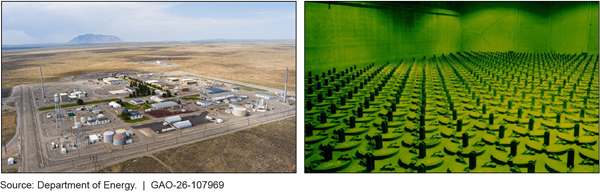
Department of Energy’s Advanced Test Reactor Complex and Interior View of the Idaho National Laboratory Spent Fuel Management Facility
In December 2025, DOE Office of Nuclear Energy officials told GAO the agency had suspended the TTRC acquisition project. They said that the plan, for now, is to maintain the ATR and improve its reliability to ensure operations until at least the early 2050s. GAO found that this new approach, similar to but less expensive than the first of the project options it identified, would cost approximately $1.26 billion over 20 years. However, DOE officials noted uncertainties in their estimate that may lead to higher costs. For example, DOE’s estimate to replace heat exchangers in the early 2040’s is technically complex and its estimate is primarily based on engineering judgement rather than a detailed, bottom up, cost analysis. DOE officials said they would continue to refine their approach along with cost estimates to meet ATR user requirements.
Why GAO Did This Study
DOE’s Advanced Test Reactor started operating in 1967 at the Idaho National Laboratory. It is the only U.S. test reactor capable of meeting nuclear fuel and structural material testing requirements for the joint U.S. Navy and NNSA Naval Nuclear Propulsion Program, which supports the Navy’s nuclear-powered fleet of submarines and aircraft carriers. DOE and Naval Reactors identified an enduring mission need for a thermal test reactor capability through the mid-2080s, and began planning to address this need in 2019.
Senate Report 118-188 to accompany S. 4638, a bill for the National Defense Authorization Act for Fiscal Year 2025, includes a provision for GAO to review DOE’s plans and estimated costs to continue operating or replace the ATR and report on any challenges associated with implementing these plans. This report examines (1) the status of ATR operations, (2) options DOE identified for ensuring an enduring thermal test reactor capability and associated costs, and (3) the status of DOE’s plan for doing so. GAO reviewed ATR and TTRC project documents, toured the ATR, and interviewed DOE and Naval Reactors officials as well as other users of the ATR.
What GAO Recommends
GAO is recommending that DOE complete its evaluation of the Idaho Operations Office’s research and test reactor spent fuel storage facility reconfiguration plan to enable continued storage and management of ATR spent fuel after 2030 and without an interruption to ATR operations. DOE concurred with this recommendation and detailed action it has planned to address it.
No table of contents entries found.
This is a work of the U.S. government and is not subject to copyright protection in the United States. The published product may be reproduced and distributed in its entirety without further permission from GAO. However, because this work may contain copyrighted images or other material, permission from the copyright holder may be necessary if you wish to reproduce this material separately.
|
Abbreviations |
|
|
|
|
|
ATR |
Advanced Test Reactor |
|
CD |
critical decision |
|
DOE |
Department of Energy |
|
FY |
Fiscal Year |
|
INL |
Idaho National Laboratory |
|
INTEC |
Idaho Nuclear Technology and Engineering Center |
|
NNSA |
National Nuclear Security Administration |
|
Naval Reactors |
Office of Naval Reactors |
|
TTRC |
Thermal Test Reactor Capability |
May 7, 2026
Congressional Committees
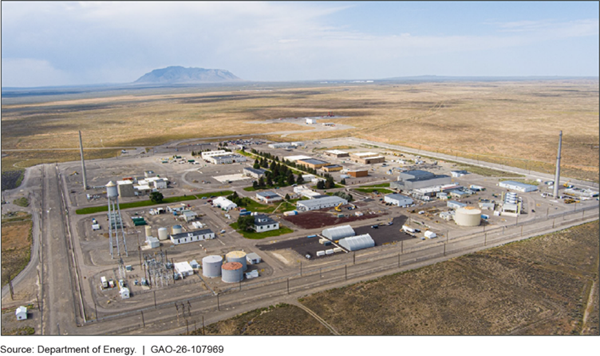
The Department of Energy’s (DOE) Advanced Test Reactor (ATR) is a one-of-a-kind, high-flux, thermal test reactor located at the Idaho National Laboratory (INL).[1] Since 1967, the ATR has been among the world’s highest-powered and most versatile test reactors, providing the U.S. advanced testing capabilities and isotope production for military, federal, university, and industry partners and customers. However, due to the age of the reactor, it is becoming more difficult to maintain, repair, and replace systems and equipment needed to support reactor operations. Figure 1 shows the ATR complex.
Within DOE, the Office of Nuclear Energy is the program office responsible for the planning and budgeting to ensure ATR’s safe and continuing operations to meet mission needs of all users.
Among other uses, the ATR provides vital testing capability for the joint U.S. Navy and DOE National Nuclear Security Administration (NNSA) Naval Nuclear Propulsion Program that supports the Navy’s nuclear-powered fleet of submarines and aircraft carriers.[2] The U.S. Navy and NNSA jointly manage the Office of Naval Reactors (Naval Reactors), which implements the Naval Nuclear Propulsion Program. This office oversees all aspects of naval nuclear propulsion, including the design, development, and operational support required to provide and maintain the U.S. Navy’s nuclear-powered fleet.[3] Naval Reactors has specific testing requirements for the national security materials and fuel that support the Navy. The ATR was designed with unique features to meet Naval Reactors’ testing requirements and is, therefore, the only U.S. test reactor capable of providing the essential testing data needed to ensure the reliable operational performance of the nuclear-powered fleet. Consequently, Naval Reactors’ testing regularly utilizes more than half of ATR’s annual testing capacity.
In July 2019, DOE’s Offices of Nuclear Energy and Naval Reactors identified an enduring mission need for a thermal test reactor capability, potentially exceeding the ATR’s current capability, to support U.S. naval nuclear power and commercial nuclear power systems through the mid-2080s.[4] In response, DOE initiated planning to explore options for this thermal test reactor capability.
Senate Report 118-188 to accompany S. 4638, a bill for the National Defense Authorization Act for Fiscal Year (FY) 2025, includes a provision for us to review DOE’s plans and estimated costs to continue operating the ATR or to replace it, and to report on any challenges associated with implementing these plans. This report examines (1) the status of ATR operations, (2) options DOE identified for ensuring an enduring thermal test reactor capability and associated costs, and (3) the status of DOE’s plan for ensuring an enduring thermal test reactor capability.
To address these objectives, we examined key documents and interviewed officials from DOE’s Offices of Nuclear Energy in Germantown, Maryland, and Naval Reactors headquarters in Washington, D.C. We toured the ATR facility at INL and interviewed DOE staff in the INL Operations Offices of Nuclear Energy and Environmental Management and contractor representatives responsible for operating the ATR.
To examine the status of ATR operations, we analyzed ATR operations data, including user and mission operating days from the last 10 years starting on January 1, 2015, and ending on March 31, 2025. We reviewed DOE’s and Naval Reactors’ ATR operations and management plans to identify the strategy and challenges, if any, with continued operation of the ATR. To examine the options DOE identified for an enduring thermal test reactor capability and associated costs, we reviewed DOE’s planning documents for options DOE explored as part of a capital asset acquisition project for which DOE initiated planning in July 2019. We also reviewed a report on the results of a subsequent independent DOE cost review of these plans. To examine the status of DOE’s plan for an enduring thermal test reactor capability, we examined recently developed ATR maintenance planning documents, including DOE’s October 2025 ATR master plan, and interviewed federal officials and contractor representatives. For more information on our methodology, see appendix I.
We conducted this performance audit from December 2024 to May 2026 in accordance with generally accepted government auditing standards. Those standards require that we plan and perform the audit to obtain sufficient, appropriate evidence to provide a reasonable basis for our findings and conclusions based on our audit objectives. We believe that the evidence obtained provides a reasonable basis for our findings and conclusions based on our audit objectives.
Background
ATR Design, Operating Features, and Fuel
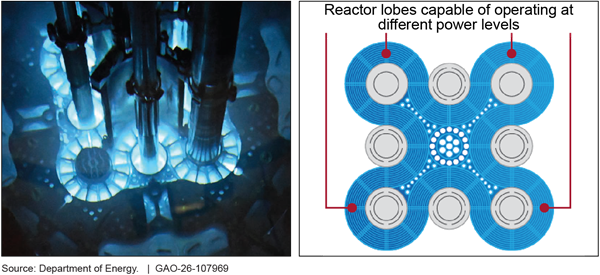
The ATR provides the U.S. with advanced thermal irradiation testing capabilities. The ATR has a thermal neutron spectrum and operates testing loops that can mimic the conditions found in naval reactors (e.g., pressure, temperature, and chemistry). Instead of heat for generating electricity, the ATR’s main product is radiation in the form of neutrons and gamma rays for material and fuels testing and isotope production.[5] The ATR has a distinctive, cloverleaf-shaped reactor core, which allows the reactor to create regions with extremely high concentrations of neutrons.[6] The high number of neutrons means materials will experience radiation damage more quickly than they would in an actual operating naval reactor. Thus, investigators can study the effects of material damage in a much shorter amount of time. In addition, the reactor can operate at different power levels in separate “lobes” of the clover leaf simultaneously. This capability provides users the flexibility to run a wide range of experiments at the same time by placing the experiments in different parts of the reactor core. Figure 2 shows the ATR’s cloverleaf-shaped core.
A key feature of the ATR’s design is that it allows for a “core-internals-changeout,” where certain reactor core components are replaced during a 6-to-12-month shutdown.[7] ATR core-internals-changeouts occur every 7–10 years and are designed to enable the reactor to run safely and efficiently over a long period of time, according to DOE officials.
The ATR is designed to operate using highly enriched uranium fuel whereas most commercial nuclear reactors currently in operation use low-enriched uranium fuel.[8] According to DOE officials, ATR operators rearrange and replace part of the fuel approximately every 90 days to ensure optimal performance. The spent nuclear fuel is placed in the ATR’s spent fuel canal where it cools in water for approximately 3 years. Once spent fuel is sufficiently cooled, operators process and place it in containers and ship it to INL’s research and test reactors spent fuel management facility, Idaho Nuclear Technology and Engineering Center (INTEC) Building 603. This is where all of ATR’s dry spent fuel, along with dry spent fuel from several other research and test reactors, is stored. According to DOE officials, until DOE determines plans for the permanent disposal of this spent fuel, it will remain stored at INTEC Building 603. Progress is stalled toward constructing a permanent geological repository to dispose of the nation’s nuclear waste, including spent fuel from DOE’s own experimental and research and test reactors.
ATR Users and Applications
Since the ATR was built, Naval Reactors has been the primary user of the reactor. As detailed in a 2020 DOE report to Congress, the Navy uses the ATR for several purposes. These include test campaigns that assess (1) naval reactor design to determine the performance of reactor materials, (2) technology development of advanced reactor fuels, and (3) performance of structural materials that support the Navy fleet.[9] For each test campaign, Naval Reactors defines requirements for annual reactor operating days and power levels needed for each type of test. The Navy has planned test campaigns through the 2050s. Each campaign can last from one year to several decades depending on the type of test and its purpose.
Several other users rely on the ATR for its unique testing capabilities to support reactor material and fuels research, development, and other applications. Each of the ATR’s users has different applications for the ATR that are specific to each testing campaign. The following are a few examples of other key ATR users and how they use the ATR.
· DOE Office of Nuclear Energy. This office works to advance nuclear energy science and technology to meet the nation’s energy, environmental, and economic needs. The Office of Nuclear Energy has two sub-offices that are key users of the ATR. First, the Office of Advanced Reactor Technologies uses the ATR to conduct nuclear reactor materials performance test programs for new types of commercial nuclear reactors.[10] Second, the Office of Nuclear Fuel Cycle and Supply Chain uses the ATR to test innovative nuclear reactor fuels that may offer improved safety, functionality, and affordability for U.S. commercial reactors. The Office of Nuclear Energy also uses the ATR to produce plutonium-238, which is a plutonium isotope used to power the National Aeronautics and Space Administration’s deep space missions.
· NNSA’s Office of Defense Nuclear Nonproliferation.[11] This office is executing the U.S. High Performance Research Reactor Project, which aims to convert certain high-performance research reactors from using highly enriched uranium as fuel to using a type of low-enriched uranium fuel called high-assay low-enriched uranium fuel.[12] The office uses the ATR to test new types of high-assay low-enriched uranium fuel, which may potentially be used by the high-performance research reactors in the scope of the project.
· DOE Office of Science. This office uses the ATR to produce critical isotopes for medical treatments and other uses. Specifically, the office uses the ATR to produce the isotope cobalt-60, which is used to treat brain tumors, for industrial sterilization of medical and food products, and for defense research needs.
DOE Management and Oversight of ATR Operations
Several DOE offices oversee planning and operations for the ATR and its spent fuel, which are managed day-to-day by contractors, as follows:
· According to DOE officials, the Office of Nuclear Energy’s Office of Nuclear Infrastructure Programs is responsible for planning and budgeting for Nuclear Energy infrastructure and property, including funding to operate and maintain the ATR.[13]
· The Idaho Operations Office oversees the INL management and operating contractor, Battelle Energy Alliance, responsible for day-to-day ATR management, operations, maintenance, and security, according to officials.
· DOE’s Office of Environmental Management is responsible for overseeing INTEC Building 603, which is operated by a contractor, the Idaho Environmental Coalition, LLC.
DOE 1995 Settlement Agreement with the U.S. Navy and State of Idaho
DOE is party to a 1995 settlement agreement with the U.S. Navy and State of Idaho that governs the acceptance, management, and removal of spent fuel and other forms of nuclear waste from Idaho (the Idaho Settlement Agreement). This agreement, including a 2008 Navy Addendum and a 2020 ATR Addition, commits DOE to ship all spent fuel, including ATR spent fuel, out of Idaho by January 1, 2035. In addition, the agreement includes the following key provisions:
· Spent fuel generated as a result of the operation of the ATR after January 1, 2018, may be stored in the ATR operating canal for up to 6 years.
· In the event that the federal parties do not carry out the requirement that all spent fuel located at INL be removed from Idaho by January 1, 2035, then subject to the availability of the appropriations provided in advance for this purpose, the federal parties shall pay to the State of Idaho $60,000 for each day such requirement has not been met.[14]
Thermal Test Reactor Capability Project
In July 2019, DOE initiated planning for a capital asset acquisition construction project, called the Thermal Test Reactor Capability (TTRC) project, to address the mission need for an enduring thermal test reactor capability. DOE’s TTRC mission need document called for a capability to support U.S. naval nuclear power and commercial nuclear power systems through the mid-2080s.
DOE must generally manage capital asset projects following project management requirements in DOE’s Order 413.3B, Program and Project Management for the Acquisition of Capital Assets.[15] The order establishes critical decisions (CD) that divide projects into five project management phases that progress, starting with CD-0 for approval of mission need and ending with CD-4 for project completion. As part of the initiation phase before CD-0 approval, DOE Order 413.3B requires the program to prepare a rough order of magnitude cost range and schedule estimates for completing the project. Further, for major projects such as the TTRC project, the order requires an independent cost review of these early project estimates, among other things. After CD-0 (mission need approval), the project moves into the early design planning phase. This phase includes an analysis of alternatives and preferred alternative selection, as well as completion of a conceptual design for that preferred alternative and ends with CD-1 approval.
Meeting Requirements with the ATR Is Increasingly Difficult, and DOE’s Spent Fuel Storage Facility Is Nearing Capacity Without an Approved Plan
DOE faces two challenges affecting ATR operations in the near term. First, it is becoming increasingly difficult for the ATR to meet users’ testing needs because, as the facility has aged, available operating time to conduct tests is reduced, and maintaining and repairing the facility is becoming more difficult. Second, the facility used to store the ATR’s spent nuclear fuel is nearing capacity. According to a 2025 DOE report, if the spent fuel storage facility reaches capacity in the FY 2028–2030 timeframe—which is anticipated if no action is taken—the ATR will not be able to operate beyond FY 2030.[16]
Meeting Testing Requirements with the Aging ATR Is Increasingly Difficult
ATR operations currently meet some users’ testing needs, according to ATR operating data we reviewed and DOE officials we interviewed. Key users of the ATR other than Naval Reactors told us they have been able to meet their thermal irradiation testing needs with recent ATR operational reliability. For example, officials with the Office of Nuclear Energy’s Office of Advanced Reactor Technologies stated that they have been able to meet mission goals in a timely manner, although unscheduled ATR shutdowns have resulted in delays completing test campaigns.
However, over the last 10 years, ATR operations have not always met Naval Reactors’ testing needs, according to Naval Reactors officials. Naval Reactors requires 200 operational days per year for its fuel and materials testing.[17] Data we reviewed showed that, for the last 10 years, ATR operated significantly fewer days per year than required by Naval Reactors. Specifically, from January 1, 2015, through March 31, 2025, ATR operated an average of 121 days per year. According to Naval Reactors officials, decreased ATR operational availability has necessitated more time to complete testing campaigns, which delays receipt of test data and resolution of nuclear fleet material performance concerns and may result in imposing more restrictive performance limits on naval vessels’ nuclear reactors.
According to Office of Nuclear Energy officials, the ATR’s decreased operational reliability is due to aging and obsolete plant components and systems, and the increasing challenge of maintaining, repairing, and replacing reactor systems and equipment, as well as the facility’s aging infrastructure. For example, ATR operational reliability has been impacted by the need to perform repairs on the heat exchangers, which are part of the reactor’s primary cooling system, according to Office of Nuclear Energy officials. In response, in 2024 DOE developed a 20-year operations strategy which includes a major equipment restoration plan to improve reliability and availability of the ATR.[18] This 2024 strategy is separate from the planning that began in 2019 for the capital asset TTRC project and was intended to be pursued in parallel. The strategy prioritized refurbishment or replacement of systems and equipment. According to Naval Reactors officials, one of the goals of the strategy was to ensure an operational schedule averaging 200 operating days per year over the next 20 years to 2044. According to the ATR operations strategy report, by executing the 20-year operations strategy, DOE estimated the ATR would provide an average of 171 operational days per year from FY 2024 through FY 2027, and an average of 211 operational days per year from FY 2028 through FY 2033. Further, from FY 2033 until FY 2044, DOE anticipated the ATR would provide approximately 200 days per year except in the years when the ATR must shut down for a core-internals-changeout.
DOE’s Spent Fuel Storage Facility for the Reactor Is Nearing Capacity Without an Approved Plan for Reconfiguration
DOE’s research and test reactor spent fuel management facility at INL, INTEC Building 603, is nearing capacity, according to a 2025 DOE Idaho Operations Office report.[19] As of May 2025, INTEC Building 603 spent fuel inventory included 3,432 spent ATR fuel elements, amounting to approximately three metric tons. According to DOE officials and ATR contractors, the ATR canal, which can store up to approximately 800 spent fuel elements in the short term, is also nearing capacity. (See fig. 3 and fig. 4.) To continue receiving ATR spent fuel at the rate the ATR is currently expected to generate it, the Office of Environmental Management must reconfigure INTEC Building 603 by 2030, according to the DOE Idaho Operations Office report.
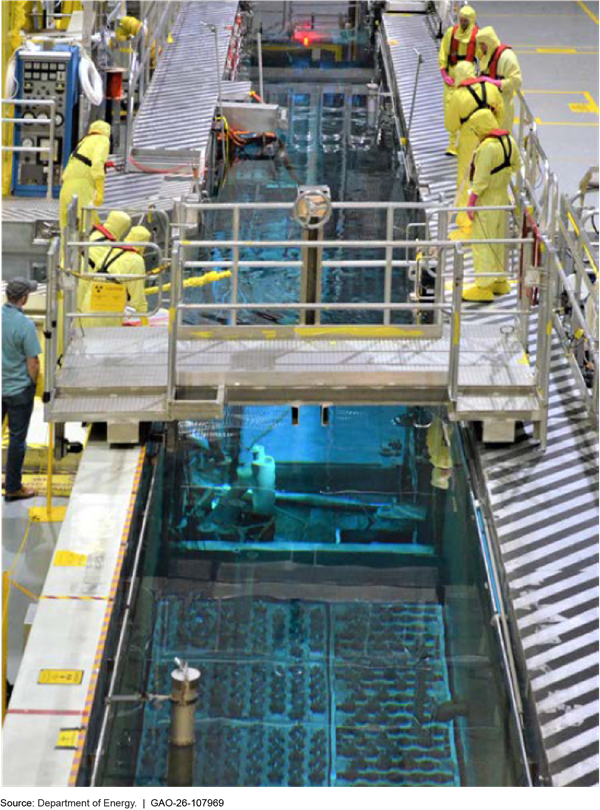
Figure 4: Interior of Idaho Nuclear Technical and Engineering Center Building 603 at Idaho National Laboratory
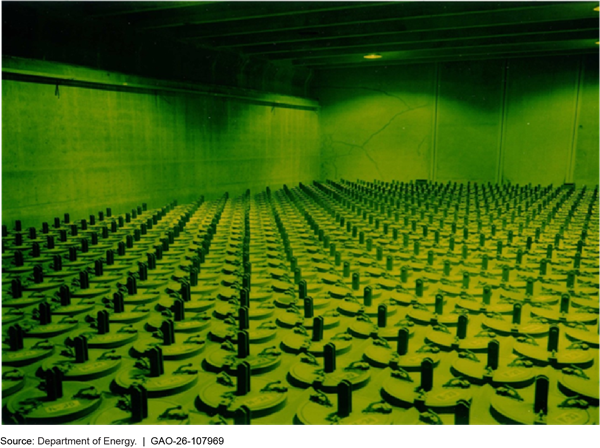
According to DOE Idaho Operations Office officials, DOE’s Offices of Environmental Management and Nuclear Energy do not currently have an approved plan to store ATR spent fuel outside of the ATR spent fuel canal after 2029 or 2030. DOE’s Idaho Operations Office, in consultation with the DOE Office of Environmental Management site officials at INL, prepared a draft ATR spent fuel plan and in February 2025 submitted it to leadership of the Offices of Environmental Management and Nuclear Energy for evaluation and approval.[20] The plan details an approach to reconfigure parts of INTEC Building 603 to facilitate receiving and managing ATR spent fuel until 2036 at an estimated cost of $4 million to complete the reconfiguration.
According to DOE’s Idaho Operations Office draft ATR spent fuel plan, in addition to the plan to reconfigure parts of INTEC Building 603, the Office of Environmental Management has directed the INTEC Building 603 contractor to begin a spent fuel packaging demonstration project to prepare spent fuel stored in INTEC Building 603 for shipping out of the state. This action is needed to meet the 1995 Idaho Settlement Agreement and the 2020 ATR Addition commitments. According to DOE officials, DOE is executing this project in anticipation of eventually approving plans for a permanent geological repository to dispose of the nation’s nuclear waste. Estimated to begin in 2030, this reconfiguration project would also free up space within INTEC Building 603 for future ATR spent fuel storage, according to the draft ATR spent fuel plan. With completion of the proposed reconfiguration and packaging demonstration, ATR spent fuel transfers to INTEC Building 603 could continue until approximately 2085, provided that the facility is maintained in an acceptable condition, according to the draft spent fuel plan.
According to the Idaho Settlement Agreement 2020 ATR Addition, ATR spent fuel generated after January 1, 2018, may be kept in the ATR canal for a time frame reasonably necessary for cooling before placement into dry storage, but this time frame may not exceed 6 years. However, according to DOE Idaho Operations Office officials, although they submitted the plan to reconfigure parts of INTEC Building 603 to receive and store ATR spent fuel after 2030 in February 2025, senior leadership from the Offices of Environmental Management and Nuclear Energy has not yet completed evaluating the plan. In December 2025, DOE Office of Nuclear Energy officials told us that they plan to seek approval within the department to allocate existing FY 2026 funding for the project during FY 2026 and prior to the anticipated approval for the project starting in FY 2027. If a spent fuel management plan is not approved allowing enough time to reconfigure INL’s research and test reactor spent fuel management facility, ATR’s spent fuel canal and INL’s spent fuel storage facility will reach capacity in the 2028 to 2030 timeframe, according to a DOE Idaho Operations Office report on ATR spent fuel management and DOE Idaho Operations Office officials.[21] According to the report, this could have significant consequences by preventing the ATR from continuing to operate beyond FY 2030. Moreover, unless additional storage space is provided at INTEC Building 603, DOE would be at risk of violating the Idaho Settlement Agreement requirements because spent fuel would be stored in the ATR canal for longer than permitted. If DOE continues to delay approval of an INTEC reconfiguration plan to enable continued storage and management of ATR spent fuel after 2030, it risks a suspension of ATR operations.
DOE Identified Options to Maintain, Modify, or Replace the ATR That Varied Substantially in Cost
DOE identified options with widely varied cost estimates to maintain, modify, or replace the ATR to ensure an enduring thermal testing capability. Specifically, DOE’s Office of Nuclear Energy’s initial (rough order of magnitude) estimated cost range for these options ranged from $2.8 billion to $11.1 billion in FY 2022 dollars, or $4.9 to $19.8 billion in escalated dollars.[22]
DOE Office of Nuclear Energy identified these options from June 2019 to March 2022 through its initial planning for the capital asset TTRC project to achieve CD-0 (mission need approval). The office developed the options and conducted preliminary evaluation of them based on the Navy’s and other users’ testing requirements, as understood at the time, and the assumption that a test reactor would operate through the mid-2080s. According to a DOE and Naval Reactors report and officials, in the near and long term Naval Reactors will require the ATR to operate more reliably and at higher power levels to meet the Navy’s testing requirements to support existing and future classes of nuclear-powered vessels.[23]
According to DOE Office of Nuclear Energy officials, through the TTRC project they identified three options to provide a thermal testing capability that can meet the Navy’s and other user’s testing requirements through the mid-2080s. According to DOE’s planning documents and officials, options for the planned capital asset acquisition project were as follows:
1. Maintain the ATR and repair and replace aging facility infrastructure, as needed. This option would entail maintaining the ATR to modern standards through at least the mid-2080s to the extent practicable. The acceptability of this approach would be determined by the forecasted impacts to key user missions based on operational and environmental evaluations.
2. Modify the ATR to provide improved performance, and repair and replace aging facility infrastructure, as needed. This option would involve expanding ATR capabilities, such as adding capabilities to conduct higher-power testing and experiment handling, to meet a portion of the identified capability gaps. The acceptability of this option would depend on Naval Reactors’ and other users’ specific capability requirements that can be met and the effect on ongoing missions of extended ATR outages (i.e., the time the reactor cannot operate while large ATR facility replacement projects are undertaken).
3. Replace ATR with a new thermal test reactor. This option would involve construction of a new reactor designed to meet all users’ long-term requirements for thermal irradiation testing in support of national security and energy security missions.[24] According to Office of Nuclear Energy officials, replacing the ATR would also entail replacing ATR facility infrastructure with new equipment and systems to support the new reactor.[25]
DOE officials told us that both options 1 and 2 would require DOE to replace aging major facility infrastructure: the heat exchangers for the ATR’s primary cooling system and the ATR’s Liquid Warm Waste Treatment Facility and underground piping (see fig. 5). Both are key facility infrastructure needed to ensure safe reactor operations, according to DOE officials. However, due to the age of these systems, DOE would need to complete the replacement projects by 2044 or earlier to support extending ATR operations into the mid-2080s. DOE estimated that replacing the heat exchangers on the primary cooling system would require replacement during a core-internals-changeout maintenance window and cost in excess of $140 million. In addition, DOE estimates that the projects to replace the Liquid Warm Waste Treatment Facility and underground piping could cost $97 million to complete.[26]
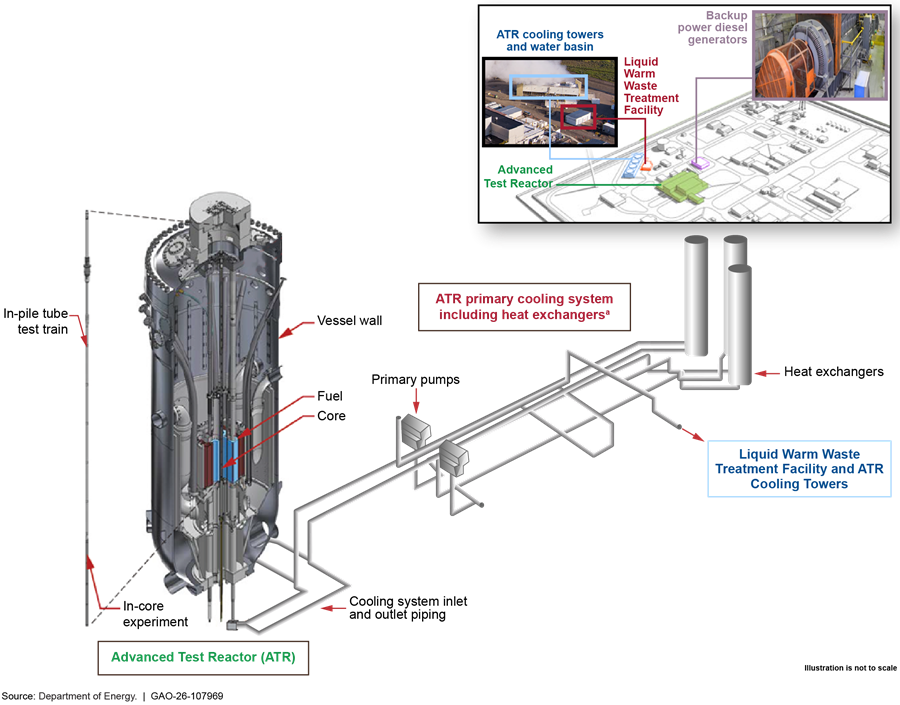
aPartial cooling system diagram for illustrative purposes.
DOE’s Office of Nuclear Energy developed an initial (rough order of magnitude) estimated cost range in FY 2022 for carrying out the TTRC project of $2.8 to $11.1 billion in FY 2022 dollars, or $4.9 to $19.8 billion in escalated dollars, according to DOE’s mission need statement.[27] Furthermore, during an independent cost review of the early project plans in May 2022, DOE’s Office of Project Management developed a second estimated range of $9 to $24 billion, for the TTRC project.[28]
DOE Has Suspended Planning for the TTRC Project and Intends to Maintain the ATR at Least Through the Early 2050s
In December 2025, DOE Office of Nuclear Energy officials told us that the office decided to suspend the capital asset TTRC project. For now, they have opted to maintain the ATR, similar to option 1 for the TTRC project, by implementing an updated operations strategy to improve reliability and ensure operations until the early 2050s, and potentially until 2085, but without carrying out the effort as a new capital asset project.[29] The officials told us that this new approach could also potentially involve modifying the ATR to add capabilities, similar to option 2 of the TTRC project, for conducting higher-power testing and experiment handling to meet Naval Reactors’ thermal irradiation test requirements. However, the scope of the planned activities to maintain the ATR is not yet fully determined.
According to DOE Office of Nuclear Energy officials, they made the decision to suspend the TTRC project based on current fiscal constraints and the large, estimated costs they had identified for the project, including potentially building a new reactor. These officials told us, however, that the project is not permanently canceled and could resume in the future if the fiscal situation were to become more favorable. DOE Office of Nuclear Energy officials also said that, as a result of this decision, they will not seek CD-0 approval from the department in the near term to transition the capital asset project to the next phase (completing the analysis of alternatives, selecting a preferred alternative, and further defining the project concept and cost and schedule estimates).
Based on our review of DOE documents and interviews with DOE and Naval Reactors officials, DOE did not seek CD-0 approval for the TTRC project after July 2022, when the department completed initial project planning documents, indicating that it had not fully settled on the options developed at that time. In October 2023, DOE’s Office of Nuclear Energy, Naval Reactors, and NNSA signed a memorandum of agreement that defined each office’s roles for further investigating options for the project in a future analysis of alternatives and for funding the project after selection of a preferred alternative.[30] However, even with future roles and responsibilities defined, no further steps were taken to seek CD-0 approval.
In December 2025, DOE reported to us that, in June 2024, DOE leadership directed the Office of Nuclear Energy not to include TTRC project funding in the FY 2026 budget request and to instead focus on other priorities.[31] By January 2025, DOE’s Office of Nuclear Energy determined that maintaining the ATR without carrying out a major line-item construction project for a replacement reactor was feasible and decided to suspend the project. According to DOE Office of Nuclear Energy officials, the new approach to maintain the ATR until the early 2050s and possibly 2080s is evolving.
Naval Reactors officials we interviewed told us they are confident that DOE’s Office of Nuclear Energy’s new approach for the ATR will support meeting their thermal irradiation test requirements for the next 20 years. As previously described in this report, Naval Reactors has stated that it requires the ATR to operate reliably for 200 or more days per year and with higher power in particular core locations than the ATR currently supports. Naval Reactors officials told us they are working with DOE’s Office of Nuclear Energy to determine if ATR can support all Naval Reactors’ irradiation testing deliverables beyond 2040, which will help determine if ATR modifications are needed. Naval Reactors officials told us this work should be completed in the next 18 months, allowing the scope of needed activities to be clarified.
Based on our review of the revised operations strategy, we found that DOE’s new approach is expected to cost at least $1.26 billion. DOE officials told us that they believe the approach would cost less than the $4.9 billion estimated for TTRC project option 1. According to DOE officials, however, there is uncertainty regarding the estimate for the new approach and actual costs may be higher. Specifically, the estimate did not include potential costs to modify the ATR to improve performance that may be needed to meet Naval Reactors’ operating requirements. Additionally, the estimate did not include ATR maintenance costs beyond FY 2044 into the early 2050s or later, if DOE decides to operate the reactor until 2085. The estimate only included estimated costs from FY 2027 until FY 2044.[32] We did not independently evaluate the quality of DOE’s $1.26 billion cost estimate because of its known level of uncertainty. DOE officials told us they will continue to evaluate their new approach and refine their estimated costs for continuing to operate the ATR into the future, especially as the scope of needed activities is clarified.
Finally, DOE officials told us they plan to execute this new approach under the ATR operations program instead of through a capital asset project. To carry out the approach under the ATR operations program, DOE’s Office of Nuclear Energy plans to begin requesting funding as part of the ATR operations and maintenance budget starting in FY 2027, pending availability of funds. In contrast, carrying out a capital asset project would have required, among other things, requesting project funding through a line item in the President’s budget request.[33]
Conclusions
The ATR began operations in 1967 and is planned to continue operating through the early 2050’s, and possibly until 2085. The ATR’s spent fuel canal and INL’s research and test reactor spent fuel management facility, INTEC Building 603, are both nearing capacity. Unless timely action is taken to evaluate a plan and approve funding for its implementation, such as the one submitted by DOE’s Idaho Operations Office to DOE’s Office of Nuclear Energy to reconfigure INTEC Building 603 to enable the facility to continue receiving ATR spent fuel, the ATR will not be able to operate after FY 2030. This would result in the U.S. losing a scientific asset that is crucial to both military superiority and our nation’s competitiveness and preeminence in the commercial nuclear field. By directing DOE’s Offices of Environmental Management and Nuclear Energy to review the Idaho Operations Office’s recently drafted ATR spent fuel storage facility reconfiguration plan and determine a path forward for spent fuel storage, DOE will ensure that the U.S. does not lose use of this crucial asset in the near term.
Recommendation for Executive Action
We are making the following recommendation to DOE:
The Secretary of Energy should direct the Office of Nuclear Energy senior leadership, in coordination with the Office of Environmental Management, to complete its evaluation of the Idaho Operations Office’s research and test reactor spent fuel storage facility reconfiguration plan to enable continued storage and management of ATR spent fuel after 2030 without an interruption to ATR operations. (Recommendation 1)
Agency Comments and Our Evaluation
We provided a draft of this report to DOE and NNSA for review and comment.
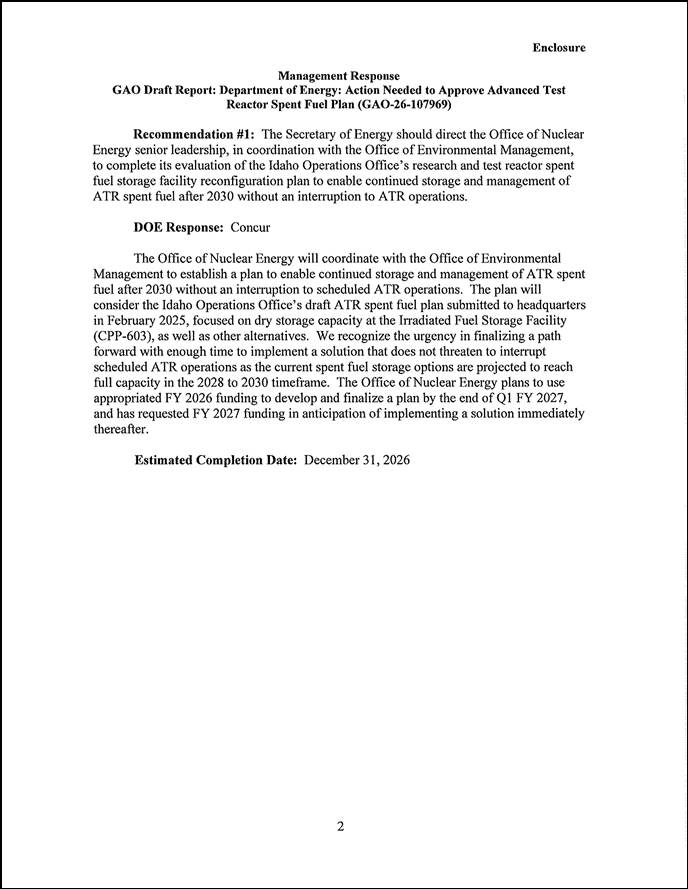
In its comments, reproduced in appendix II, DOE concurred with our recommendation. In addition, DOE states that the department will establish a plan to enable continued storage and management of ATR spent fuel after 2030, without interruption to scheduled operations. DOE also provided technical comments, which we incorporated as appropriate.
We are sending copies of this report to the appropriate congressional committees, the Secretary of Energy, the NNSA Administrator, and the Deputy Administrator for Naval Reactors. This report will also be available at no charge on GAO’s website at https://www.gao.gov. If you or your staff have any questions about this report, please contact me at bawdena@gao.gov. Contact points for our Offices of Congressional Relations and Media Relations may be found on the last page of this report. GAO staff who made key contributions to this report are listed in appendix III.

Allison Bawden
Director, Natural Resources and Environment
List of Committees
The Honorable Roger Wicker
Chairman
The Honorable Jack Reed
Ranking Member
Committee on Armed Services
United States Senate
The Honorable John Kennedy
Chairman
The Honorable Patty Murray
Ranking Member
Subcommittee on Energy and Water Development
Committee on Appropriations
United States Senate
The Honorable Mike Rogers
Chairman
The Honorable Adam Smith
Ranking Member
Committee on Armed Services
House of Representatives
The Honorable Chuck Fleischmann
Chairman
The Honorable Marcy Kaptur
Ranking Member
Subcommittee on Energy and Water Development, and Related Agencies
Committee on Appropriations
House of Representatives
Our objectives were to examine (1) the status of Advanced Test Reactor (ATR) operations, (2) options the Department of Energy (DOE) identified for an enduring thermal test reactor capability and their associated costs, and (3) the status of DOE’s plan for an enduring thermal test reactor capability.
To address these objectives, we obtained documentation and interviewed officials with DOE’s Office of Nuclear Energy, the National Nuclear Security Administration’s (NNSA) Office of Naval Reactors (Naval Reactors) and Office of Defense Nuclear Nonproliferation, DOE Idaho Operations Office, DOE Office of Environmental Management, and contractors with Battelle Energy Alliance, which is the management and operating contractor for Idaho National Laboratory (INL) that manages day-to-day operations of the ATR. We also interviewed officials from the primary users of the ATR, including Naval Reactors, DOE’s Office of Nuclear Energy sub-offices of Advanced Reactor Technologies and Nuclear Fuel Cycle, and NNSA Office of Defense Nuclear Nonproliferation’s U.S. High Performance Research Reactor Program. We also visited the ATR at INL to observe facility conditions and operations.
To determine the status of ATR operations, we examined DOE Office of Nuclear Energy, DOE Idaho Operations Office, and Naval Reactors documents. These included ATR’s Long-Term (20-Year) Operational Strategy and ATR’s Long-Term Asset Management (5-Year) Investment Strategy, the Office of Naval Reactors Forecast of Irradiation Testing Needs 2020, and the ATR User Guide.[34] We also examined 10 years of ATR operations data from January 1, 2015, through March 31, 2025, to identify the ATR’s operating efficiency. To determine if ATR operations data provided by DOE’s Office of Nuclear Energy was sufficiently reliable for our reporting purposes, we sent questions to knowledgeable agency officials about the processes for collecting and maintaining these data and received written responses regarding these data. Specifically, we reviewed the ATR’s planned operating days versus the actual operating days over the 10-year period. We also reviewed the DOE Idaho Operations Office’s draft ATR spent fuel plan to reconfigure spent fuel inside Idaho Nuclear Technical and Engineering Center Building 603.
To examine options DOE identified for an enduring thermal test reactor capability and their associated costs, and the status of DOE’s plan for an enduring thermal test reactor capability, we examined DOE Office of Nuclear Energy and Naval Reactors documents to identify the options that DOE has considered. Specifically, we reviewed DOE’s mission need statement for the Thermal Test Reactor Capability Project, the ATR’s 20-Year Operational Strategy, Naval Reactors Forecast of Irradiation Testing Needs, and DOE’s Office of Project Management’s independent cost review report on the Thermal Test Reactor Capability (TTRC) project. This also included a review of the project documentation completed between June 2018 and July 2022 for DOE’s Office of Nuclear Energy to seek approval of CD-0 (mission need approval) and compared it with the capital asset order. In addition, to examine the status of DOE’s plan for an enduring thermal test reactor capability, we examined recently developed ATR maintenance planning documents, including DOE’s October 2025 revised ATR master plan, and interviewed DOE Office of Nuclear Energy and Naval Reactors officials regarding these plans.
We conducted this audit from December 2024 through May 2026 in accordance with generally accepted government auditing standards. Those standards require that we plan and perform the audit to obtain sufficient, appropriate evidence to provide a reasonable basis for our findings and conclusions based on our audit objectives. We believe that the evidence obtained provides a reasonable basis for our findings and conclusions based on our audit objectives.
GAO Contact
Allison Bawden, bawdena@gao.gov
Staff Acknowledgments
In addition to the contact named above, Brian M. Friedman (Assistant Director), Peter Ruedel (Analyst in Charge), Will Bauder, Kevin Bray, Michael del Campo, John Delicath, Jason Lee, Serena Lo, Sara Sullivan, and Edwin Woodward made key contributions to this report.
The Government Accountability Office, the audit, evaluation, and investigative arm of Congress, exists to support Congress in meeting its constitutional responsibilities and to help improve the performance and accountability of the federal government for the American people. GAO examines the use of public funds; evaluates federal programs and policies; and provides analyses, recommendations, and other assistance to help Congress make informed oversight, policy, and funding decisions. GAO’s commitment to good government is reflected in its core values of accountability, integrity, and reliability.
Obtaining Copies of GAO Reports and Testimony
The fastest and easiest way to obtain copies of GAO documents at no cost is through our website. Each weekday afternoon, GAO posts on its website newly released reports, testimony, and correspondence. You can also subscribe to GAO’s email updates to receive notification of newly posted products.
Order by Phone
The price of each GAO publication reflects GAO’s actual cost of production and distribution and depends on the number of pages in the publication and whether the publication is printed in color or black and white. Pricing and ordering information is posted on GAO’s website, https://www.gao.gov/ordering.htm.
Place orders by calling (202) 512-6000, toll free (866) 801-7077,
or
TDD (202) 512-2537.
Orders may be paid for using American Express, Discover Card, MasterCard, Visa, check, or money order. Call for additional information.
Connect with GAO
Connect with GAO on X,
LinkedIn, Instagram, and YouTube.
Subscribe to our Email Updates. Listen to our Podcasts.
Visit GAO on the web at https://www.gao.gov.
To Report Fraud, Waste, and Abuse in Federal Programs
Contact FraudNet:
Website: https://www.gao.gov/about/what-gao-does/fraudnet
Automated answering system: (800) 424-5454
Media Relations
Sarah Kaczmarek, Managing Director, Media@gao.gov
Congressional Relations
David A. Powner, Acting Managing Director, CongRel@gao.gov
General Inquiries
[1]Test and research reactors are nuclear reactors primarily used for research, training, testing, and development, and not for making electricity. For example, these reactors may be designed to produce radiation to test the effects of radiation on materials. The term “thermal” refers to the average energy of the neutrons.
[2]NNSA is a separately organized agency within DOE.
[3]A Navy admiral is in charge of the Naval Nuclear Propulsion Program and serves as a deputy administrator in the National Nuclear Security Administration.
[4]If the ATR were to continue operating through the mid-2080s, ATR’s age would be twice that of any U.S. reactor today.
[5]Neutrons are electrically neutral nuclear particles that, along with protons, make up atomic nuclei. During a fission reaction, neutrons are emitted as high-energy radiation, allowing them to penetrate other materials. Gamma radiation is high-energy, short-wavelength, electromagnetic radiation emitted from the nucleus of an atom. Both neutrons and gammas are types of ionizing radiation, which has the ability to harm biological tissue and damage other materials. Isotopes are varieties of a given chemical element with the same number of protons but different numbers of neutrons. For example, the helium-3 isotope has one less neutron than the helium-4 isotope, which is the helium isotope commonly used in party balloons.
[6]Neutron concentrations in a reactor are expressed as the flow of neutrons through a given area per second—a parameter called “neutron flux.” The ATR design features regions of high neutron flux known as “flux traps.”
[7]The changeouts replace parts like beryllium neutron reflectors, which are damaged over years of operation.
[8]Uranium is categorized by concentration of the isotope uranium-235—the primary fissionable isotope of uranium—expressed as a percentage “assay.” Natural uranium must be enriched to increase its uranium-235 content to the level required for a certain purpose. Low-enriched uranium (LEU) has less than 20 percent uranium-235, with the concentration used in civilian nuclear reactors typically between 3 to 5 percent. Highly enriched uranium refers to any enrichment of uranium-235 greater than 20 percent. The fuel used in the ATR is enriched to a level of 93 percent uranium-235, which is akin to concentrations used in nuclear weapons.
[9]U.S. Department of Energy, National Nuclear Security Administration, Naval Reactors Forecast of Irradiation Testing Needs—Report to Congress, CUI//SP-NNPI//NOFORN (Washington, D.C.: March 2020).
[10]DOE’s Office of Advanced Reactor Technologies is currently working on the following reactor programs: Next Generation Nuclear Plant, Advanced Reactor Concepts, and Advanced Small Modular Reactor. These programs are intended to promote safety, technical, economical, and environmental advancements of innovative Generation IV nuclear energy technologies for commercial applications.
[11]NNSA’s Office of Defense Nuclear Nonproliferation works globally to prevent state and non-state actors from developing nuclear weapons or acquiring weapons-usable nuclear or radiological materials, equipment, technology, and expertise.
[12]NNSA’s nonproliferation mission requires high-assay low-enriched uranium, or HALEU—meaning LEU enriched in the uranium-235 isotope below 20 percent—for research and isotope production reactor fuel. HALEU is not widely available commercially at present, and the HALEU used for nonproliferation purposes is obtained by down-blending HEU. According to NNSA documents, the HEU inventory allocated for down-blending for research and isotope production reactors is projected to be exhausted by around 2040. After this time, a new supply of HALEU for research and isotope production reactors will need to be identified. The Office of Nuclear Energy’s HALEU Availability Program is currently pursuing several pathways to secure a domestic supply of HALEU. See GAO, Nuclear Weapons: NNSA Should Clarify Long-Term Uranium Enrichment Mission Needs and Improve Technology Cost Estimates, GAO‑18‑126 (Washington, D.C.: Feb. 16, 2018).
[13]DOE funds ATR activities through the Office of Nuclear Energy’s annual program operations budget, Naval Reactors dedicated funding for ATR, and cost recovery fees from users, according to DOE officials.
[14]The Idaho Settlement Agreement 2020 Addition also states that starting January 1, 2020, DOE shall provide notice to Idaho on (1) quantity of spent nuclear fuel kept in the ATR canal, and (2) date of which each spent fuel element was determined to be “spent fuel”. Annual notice must be provided by May 1 each year. Additionally, DOE shall perform technical assessments of the existing ATR canal and determine that ATR canal integrity is not compromised.
[15]Specifically, capital asset projects estimated to cost greater than $50 million are to follow the order. Department of Energy, Program and Project Management for the Acquisition of Capital Assets, DOE Order 413.3B (Change 7) (Washington, D.C.: June 21, 2023).
[16]U.S. Department of Energy, Office of Nuclear Energy, Idaho Operations Office, in consultation with the Office of Environmental Management’s Idaho Cleanup Project, Dry Storage of Office of Nuclear Energy (NE) Advanced Test Reactor (ATR) Spent Nuclear Fuel (SNF)—Limitations and Options (Idaho National Laboratory: Feb. 26, 2025).
[17]Because of the national security aspects of the activities conducted by Naval Reactors, specifics on the basis for the requirement of 200 operational days per year are not included here.
[18]U.S. Department of Energy, Office of Nuclear Energy, Idaho Operations Office, Advanced Test Reactor Long-Term (20-Year) Operational Strategy, INL/RPT-24-76548 (Idaho National Laboratory: July 2024).
[19]Dry Storage of Office of Nuclear Energy (NE) Advanced Test Reactor (ATR) Spent Nuclear Fuel (SNF)—Limitations and Options (Idaho National Laboratory: Feb. 26, 2025).
[20]Dry Storage of Office of Nuclear Energy (NE) Advanced Test Reactor (ATR) Spent Nuclear Fuel (SNF)—Limitations and Options (Idaho National Laboratory: Feb. 26, 2025).
[21]Dry Storage of Office of Nuclear Energy (NE) Advanced Test Reactor (ATR) Spent Nuclear Fuel (SNF)—Limitations and Options (Idaho National Laboratory: Feb. 26, 2025).
[22]DOE used an escalation rate of 4.4% for its cost estimate as recommended by the DOE Office of Project Management for INL.
[23]New vessel classes include the Columbia-class ballistic missile submarine and a potential new class of fast-attack submarine—SSNX.
[24]U.S. Department of Energy, Office of Nuclear Facilities Management, Office of Nuclear Energy, National Nuclear Security Administration, and Office of Naval Reactors, Mission Need Statement for the Thermal Test Reactor Capability Project, A Major System Acquisition Project (Washington, D.C.: Mar. 1, 2022). According to DOE officials, there are other potential alternatives, such as constructing a separate test reactor for Naval Reactors and another new reactor for other users. However, DOE is not considering such options due to the expected high cost of building two new reactors.
[25]According to DOE’s ATR planning documents, given the need to colocate the Office of Nuclear Energy’s and Naval Reactors’ ongoing missions, if DOE selected the new reactor alternative, it would most logically be sited at INL to leverage existing nuclear and security infrastructure.
[26]When we visited the ATR facility at INL, DOE officials told us the department was considering managing replacement of certain key reactor facility infrastructure as capital asset projects. According to these officials, these large projects would be funded through project-specific line-items in DOE’s budget and not under the Office of Nuclear Energy’s operations budget. Later, in December 2025, DOE’s Office of Nuclear Energy told us they now plan to manage these projects through the Office of Nuclear Energy’s annual program operations budget rather than as line-item projects.
[27]U.S. Department of Energy, Office of Nuclear Facilities Management, Office of Nuclear Energy, National Nuclear Security Administration, and Office of Naval Reactors, Mission Need Statement for the Thermal Test Reactor Capability Project, A Major System Acquisition Project (Washington, D.C.: Mar. 1, 2022).
[28]U.S. Department of Energy, Office of Project Management, Thermal Test Reactor Capability Project Independent Cost Review, Critical Decision—0, Approve Mission Need (Washington, D.C.: May 2022). DOE’s Office of Project Management recommended that the results of the review be reassessed if DOE had not approved the mission need for the project by November 30, 2022. This recommendation is consistent with GAO best practices for cost estimation, which state that estimate assumptions must be valid and that a cost estimate should be updated when there are changes in schedules or requirements.
[29]Option 1, as originally developed, would have extended the life of the ATR into the 2080s. This newer approach does not yet commit to extending its life for that long.
[30]Memorandum of Agreement Between the Office of Nuclear Energy, the Office of Naval Reactors, and the National Nuclear Security Administration for the Thermal Test Reactor Capability Project (Washington, D.C.: Oct. 30, 2023).
[31]Despite this decision, NNSA’s 25-year plan for providing specialized mission-delivery infrastructure, issued in October 2024, still reported on the need to decide whether to extend the life of the ATR or build a replacement thermal test reactor capability. NNSA, Enterprise Blueprint Essential Infrastructure for Mission Delivery. On Time. At Scale (Washington, D.C.: October 2024).
[32]U.S. Department of Energy, ATR 2085 Master Plan-Revision 4 (Washington D.C.: Oct. 22, 2025). According to DOE officials, Idaho Operations Office staff developed this maintenance and replacement plan with the DOE’s Office of Nuclear Energy, and Naval Reactors’ primary contractor, Naval Nuclear Laboratory, completed an independent assessment to identify items for adjustment in accordance with Naval Reactors’ testing needs.
[33]According to Office of Nuclear Energy officials, the President’s budget request for FY 2027 has been provided to Congress, and they will continue to work to identify funding needs for the FY 2028 budget process. DOE officials explained that they have taken this approach now because their current budget for FY 2026 is insufficient to begin this newly planned approach.
[34]U.S. Department of Energy, Office of Nuclear Energy, Idaho Operations Office, Advanced Test Reactor Long-Term (20-Year) Operational Strategy, INL/RPT-24-76548 (Idaho National Laboratory: July 2024). U.S. Department of Energy, National Nuclear Security Administration, Naval Reactors Forecast of Irradiation Testing Needs—Report to Congress, CUI//SP-NNPI//NOFORN (Washington, D.C.: March 2020). Idaho National Laboratory, Advanced Test Reactor User Guide.