
Report to Congressional Committees
United States Government Accountability Office
A report to congressional committees
For more information, contact: Travis J. Masters at masterst@gao.gov.
What GAO Found
When communities are hit by a major disaster—such as a flood, hurricane, or wildfire—a key first step is removing large quantities of debris so that they can begin to recover. The Federal Emergency Management Agency (FEMA), a component within the Department of Homeland Security (DHS), and the U.S. Army Corps of Engineers can help them respond quickly by awarding contracts before disasters strike. Tribes, states, and localities may also award their own advance contracts for debris removal. GAO found that six of 16 selected governments had awarded advance contracts for debris removal and identified benefits of having them, such as speed of debris removal.
GAO also found confusion among FEMA’s procurement training group and its regional offices about roles and responsibilities for encouraging governments to award advance debris removal contracts. Clarifying roles and responsibilities would improve information sharing to encourage advance contract use.
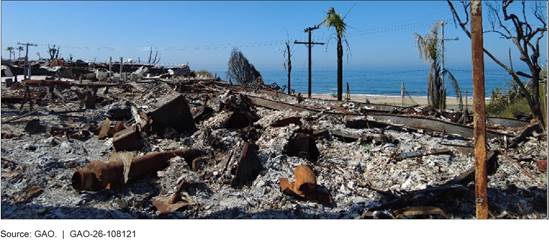
GAO found that the Army Corps’s processes for reporting debris removal data to those affected by the Los Angeles wildfires (January 2025) and Hurricane Helene in North Carolina (September 2024) differed. In Los Angeles, the Army Corps publicly shared an online interactive map with real-time debris removal data within about 6 weeks after the wildfires began. In contrast, it did not share county-specific infographics for those in North Carolina affected by the hurricane until 4 months after the disaster. Because the Army Corps has not completed an analysis of the reasons for the differences in data sharing, it may miss opportunities to improve its approach to providing timely and consistent data, including real-time debris removal data, during future disasters.
FEMA put controls in place to mitigate the risks of fraud, waste, and abuse in its debris removal program. For example, it requires that grant applicants ensure that debris removal quantities are accurate to avoid incurring unnecessary costs. But, FEMA is not well positioned to obtain and evaluate information about new or evolving fraud, waste, and abuse risks in its debris removal program because its efforts do not align with fraud risk management leading practices. Conducting regular risk assessments and developing a process to address risks would help FEMA more strategically manage risks across its entire debris removal program.
Why GAO Did This Study
FEMA and the Army Corps spend billions of dollars annually to respond to major disasters. Using advance contracts can help quickly start the recovery because contractors may be able to start work soon after a disaster.
The Disaster Contract Improvement Act includes a provision for GAO to review several areas related to debris removal. This report, among other objectives, examines (1) selected governments’ perspectives on the use of advance contracts for debris removal, and the extent to which FEMA encouraged the use of advance contracts; and the extent to which (2) the Army Corps developed processes for reporting advance contract debris removal efforts during the responses to two disasters, and (3) FEMA mitigated risks in its debris removal program.
To conduct this review, GAO reviewed FEMA and Army Corps policies, data, and other documents and conducted site visits to observe ongoing debris removal in Los Angeles and North Carolina. GAO also interviewed FEMA and Army Corps officials, and officials from 16 governments, selected based on obligation amounts and geographic variation, among other factors.
What GAO Recommends
GAO is making six recommendations, including that FEMA defines roles and responsibilities in encouraging advance contract use, that the Army Corps analyzes differences in information sharing in its recent disaster responses, and that FEMA develops a process to identify and address risks of fraud, waste, and abuse. DHS and the Army concurred with our recommendations.
|
Abbreviations |
|
CRC Consolidated Resource Center |
|
DHS Department of Homeland Security |
|
FAR Federal Acquisition Regulation |
|
FEMA Federal Emergency Management Agency |
|
OIG Office of Inspector General |
|
PA Public Assistance |
|
PDAT Procurement Disaster Assistance Team |
|
PKEMRA Post-Katrina Emergency Management Reform Act of 2006 |
|
T&M time-and-material |
This is a work of the U.S. government and is not subject to copyright protection in the United States. The published product may be reproduced and distributed in its entirety without further permission from GAO. However, because this work may contain copyrighted images or other material, permission from the copyright holder may be necessary if you wish to reproduce this material separately.
June 9, 2026
Congressional Committees
A key initial step for a community to recover from a major disaster is removing large quantities of debris. For example, in the aftermath of Hurricane Helene, which made landfall in the southeast United States in September 2024, the U.S. Army Corps of Engineers—which has a key role in debris removal—estimated that there were almost 20 million cubic yards of debris to be removed across multiple states. By the middle of September 2025, the Army Corps estimated that it had removed approximately 9 million cubic yards of debris in western North Carolina alone (see fig. 1).[1]
Figure 1: Depiction of the Volume of Hurricane Helene Debris in Western North Carolina the Army Corps Estimated It Removed, September 2024-September 2025

In instances where there is a large amount of debris to be removed, the Federal Emergency Management Agency (FEMA)—a component within the Department of Homeland Security (DHS)—and the Army Corps can use advance contracts—contracts established prior to disasters—to quickly start the recovery process.[2] The Post-Katrina Emergency Management Reform Act of 2006 (PKEMRA) requires FEMA to coordinate on federal advance contracts with state and local governments and to encourage them to engage in similar pre-planning and contracting.[3] States, localities, and tribal and territorial governments may also award their own contracts for debris removal following a disaster. Costs for these debris removal contracts may be reimbursed through grant funds under FEMA’s Public Assistance (PA) program, subject to PA debris eligibility and procurement requirements. However, we previously reported that FEMA did not consistently share information or coordinate with state and local governments on advance contracts, resulting in these governments lacking the tools needed to establish their own advance contracts.[4] In addition to DHS Office of the Inspector General (OIG) reports on the risk of fraud, we previously reported that FEMA faced challenges balancing the need to quickly deliver PA grant funds for emergency work while minimizing the risks of fraud, waste, and abuse by its debris removal contractors.[5]
The Disaster Contract Improvement Act includes a provision for us to review a number of areas related to debris removal for disasters.[6] This report addresses:
1. selected state, local, and tribal governments’ perspectives on the use of advance contracts for debris removal, and the extent to which FEMA shared information to encourage the use of advance contracts;
2. the extent to which the Army Corps developed processes for reporting advance contract debris removal efforts to state, local, and tribal governments during the responses to the wildfires in Los Angeles, California in 2025 and Hurricane Helene in North Carolina in 2024;
3. the extent to which FEMA assessed whether the costs for selected state, local, and tribal governments’ debris removal grants are eligible for reimbursement; and
4. the extent to which FEMA has taken steps to mitigate fraud, waste, and abuse risks in its debris removal program.
To assess selected state, local, and tribal governments’ perspectives on the use of advance contracts for debris removal and the extent to which FEMA shared information to encourage the use of advance contracts, we selected 10 states, three local governments, and three Tribes to include in our nongeneralizable sample. Our selections were based on PA obligation amounts from October 1, 2023, to March 11, 2025, and geographic variation, among other factors.[7] We met with selected state, local, and tribal government officials and discussed their use of advance contracts, and the benefits and challenges they have faced implementing them. To assess the extent to which FEMA shared information to encourage the use of advance contracts, we reviewed FEMA training documentation as well as provisions in PKEMRA. We also interviewed FEMA and selected state, local, and tribal government officials about FEMA’s efforts to encourage the use of advance contracts. We compared FEMA’s efforts with our leading practices for interagency collaboration—specifically, the practice of defining roles and responsibilities—and federal internal control standards.[8]
To assess the extent to which the Army Corps developed processes for reporting advance contract debris removal efforts to state, local, and tribal governments during the responses to the wildfires in Los Angeles, California in 2025 and Hurricane Helene in North Carolina in 2024, we reviewed the Army Corps’s debris removal guidance and assessed the various methods that the Army Corps used to keep selected governments updated on the status, including progress, of debris removal operations. We also conducted site visits in March 2025 to areas in North Carolina damaged by Hurricane Helene and in May 2025 to sites affected by the Los Angeles wildfires to observe Army Corps debris removal efforts and oversight activities. We selected North Carolina and Los Angeles because they had ongoing disaster debris removal operations and represented different types of disasters—a hurricane and wildfires. During these visits, we met with Army Corps, state, and local officials to discuss debris removal operations, the Army Corps’s efforts to keep state and local governments informed about its progress in removing the debris, and steps they took, if any, to prevent and address contractor noncompliance.
To assess the extent to which FEMA determined whether the costs for selected state, local, and tribal governments’ debris removal grants were eligible for reimbursement, we reviewed how FEMA applied its key cost eligibility policies across a nongeneralizable sample of six PA debris removal grants.[9] We also reviewed FEMA’s internal policy, guidance and procedures to identify key steps FEMA followed to assess cost eligibility, such as adherence to cost reasonableness and federal procurement requirements for PA grants. Further, we interviewed FEMA officials about their cost eligibility review process and the extent to which they consistently applied key steps for the selected grants.
To assess the extent to which FEMA has taken steps to mitigate fraud, waste, and abuse risks in its debris removal program, we reviewed FEMA’s 2022 Fraud Risk Profile Report to determine the fraud, waste, and abuse risks FEMA had identified in its debris removal program and how often such risk assessments were being conducted. We analyzed FEMA’s policies, procedures, and guidance and interviewed FEMA officials to identify the specific control activities FEMA implemented to mitigate fraud, waste, and abuse risks in its debris removal program. Additionally, we assessed the six selected grants to determine the extent to which FEMA consistently applied these specific control activities. See appendix I for additional details about our objectives, scope, and methodology.
We conducted this performance audit from February 2025 to June 2026 in accordance with generally accepted government auditing standards. Those standards require that we plan and perform the audit to obtain sufficient, appropriate evidence to provide a reasonable basis for our findings and conclusions based on our audit objectives. We believe that the evidence obtained provides a reasonable basis for our findings and conclusions based on our audit objectives.
Background
The United States suffered numerous devastating disasters from 2023 through 2025, including hurricanes, mudslides, floods, and wildfires. Hurricane Helene in September 2024 and the Los Angeles wildfires in January 2025 are two disasters during that time frame that resulted in significant damage.
When major disasters occur, state and local entities are typically responsible for carrying out disaster response efforts.[10] The Robert T. Stafford Disaster Relief and Emergency Assistance Act, as amended, establishes a process by which the governor of the affected state or the Chief Executive of an affected Indian tribal government may request a presidential major disaster declaration to obtain federal assistance.[11] That assistance can include funding, technical and advisory assistance, personnel support, and other essential resources such as food and medicine.
FEMA is the lead coordinator of federal disaster response efforts across federal agencies, according to the DHS National Response Framework—a guide to how the federal government, states and localities, and other public and private sector institutions should respond to disasters and emergencies.[12] FEMA coordinates federal disaster response efforts through its 10 regional offices, which are also responsible for the delivery of FEMA’s programs and activities to state, tribal, local, and territorial governments; nongovernmental organizations; and citizens. FEMA ensures that federal preparedness actions are coordinated to prevent gaps in the federal government’s efforts to respond to all major disasters, among other emergencies. Under the framework, the Army Corps is the primary agency responsible for public works and engineering—which can include debris removal.
Advance Contracts
When PKEMRA became law in 2006, FEMA took responsibility for encouraging state, local, and tribal governments to award advance contracts—which are established prior to disasters and are typically used to quickly provide services, such as debris removal, in the immediate aftermath of disasters.[13] According to its advance contracting strategy, FEMA should maximize the use of advance contracts to the extent they are practical and cost effective, which should help avoid the need to procure goods and services under urgent circumstances after a disaster occurs.
However, we reported in 2018 that FEMA lacked an updated strategy on its advance contract use and that it did not clearly communicate its objectives and requirements for contracting officers to encourage states and localities to enter into their own advance contracts.[14] We made several recommendations to FEMA, including that it update its strategy and guidance to clarify the use of advance contracts and provide more consistent guidance and information to contracting officers to coordinate with and encourage states and localities to establish advance contracts. Since then, FEMA developed a strategy and updated guidance to contracting officers on performing outreach to state and local governments on their use and establishment of advance contracts. FEMA has also leveraged its Procurement Disaster Assistance Team (PDAT), a group that offers training to state, local, tribal, and territorial governments on federal procurement requirements under grants, including high-level information on advance contracts, and reviews contracts when requested by state, local, tribal, or territorial governments. PDAT provides guidance on mandatory procurement requirements that state, local, tribal, and territorial governments must follow to be reimbursed under the PA program. Additionally, the guidance provides some information regarding advance contracts, such as information on what advance contracts are, as well as potential benefits or areas of concern for entities that award them.[15]
The Army Corps also established advance contracts, which it uses to address large-scale debris removal missions. Following an emergency or major disaster declaration, FEMA can assign the Army Corps particular tasks, such as debris removal or temporary roof repairs. The Army Corps may accomplish these tasks through a contractor. For example, the Army Corps’s Advanced Contract Initiative provides advance contracts that the Army Corps can use, if appropriate, in response to a FEMA mission assignment. Since the start of fiscal year 2024, the Army Corps has obligated billions through these advance contracts to respond to major disasters.
FEMA’s PA Program
We previously reported that FEMA’s PA program is a complex and multistep grant program in which FEMA provides funding to eligible applicants—such as state, local, tribal, and territorial governments—to assist them in responding to and recovering from major disaster declarations.[16] The PA program is FEMA’s largest grant program, averaging $20.5 billion in assistance each year, or 67 percent of FEMA’s grant dollars, from fiscal years 2016 through 2025, according to PA officials. PA program funds are used for work broadly categorized as either “emergency work” or “permanent work.” Emergency work includes debris removal activities, such as clearance, removal and disposal, and monitoring of these activities.[17]
State, local, tribal, and territorial governments can apply for PA program funds following a disaster. If approved, these governments become the recipients of FEMA funding, and provide it to smaller entities like local governments, cities, and towns, known as subrecipients. For the purposes of this report, both recipients and subrecipients are referred to as applicants in the PA program process. Figure 2 shows the flow of funding for PA emergency work grants between key entities involved.
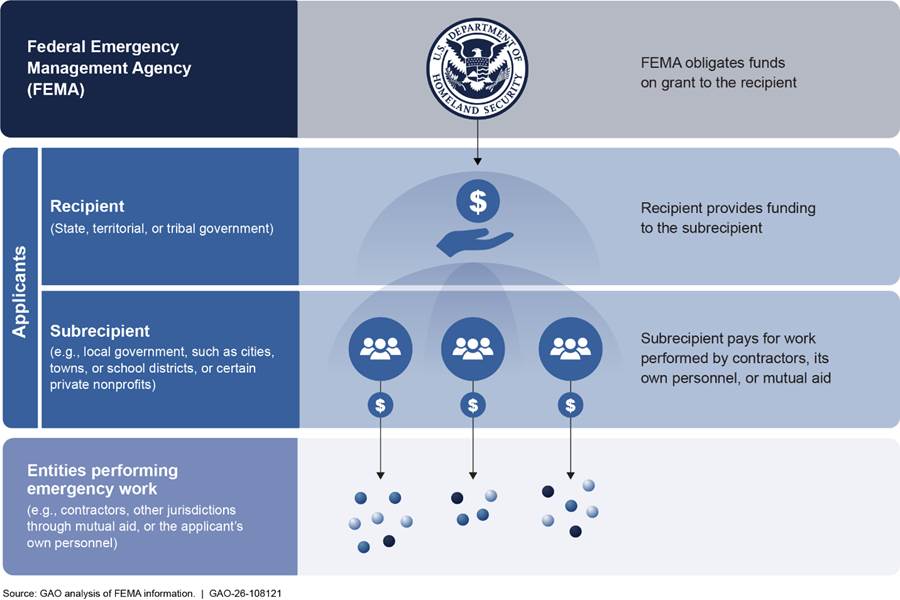
The PA program is a partnership between FEMA and state, local, tribal, or territorial government applicants. Information on PA program administration outlines roles and responsibilities, process requirements and eligibility criteria. Figure 3 provides an overview of the process for administering PA emergency work grants, from prior to the disaster declaration through project closeout.
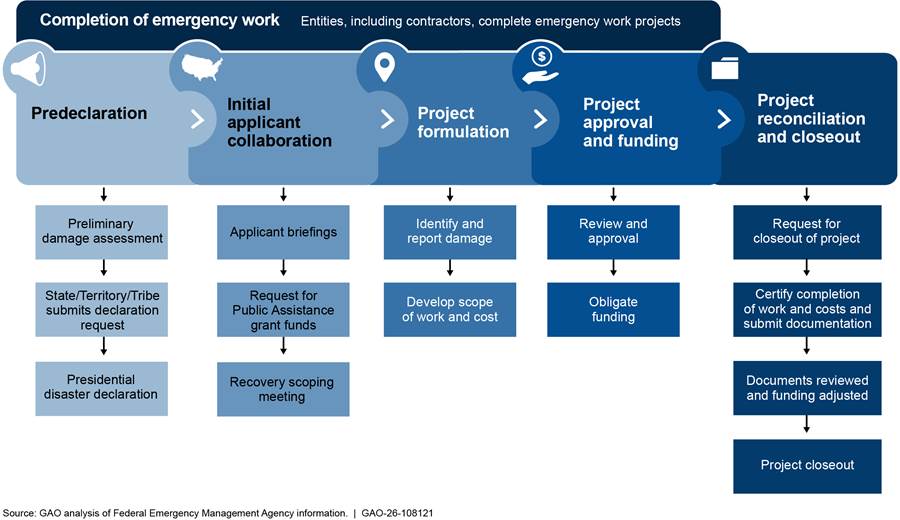
As part of the pre-declaration phase, FEMA sends PA program staff to the affected area after a disaster to work with state, local, tribal, and territorial officials to assess the damage. If the President declares a disaster, FEMA and the applicants begin initial collaboration about applying for PA funding. If interested in seeking PA funding, applicants submit a request for grant funds to FEMA. Next, as part of the project formulation phase, FEMA PA staff work with applicants to identify and document damages, identify eligible costs and work, and formulate this information into project worksheets, which describe the scope of work and estimated or actual costs.[18]
As part of the project approval and funding process, FEMA officials review project proposals to determine if they are eligible for PA emergency work funding. Specifically, FEMA determines whether each of four components—applicant, facility (for certain types of emergency work only), work, and cost—is eligible, beginning with the applicant and working up to cost. If FEMA determines that each of the components is eligible, funding is obligated. After FEMA approves the project and obligates funds, the applicant completes the work, if it has not already been completed.[19] PA emergency work may be completed by the applicant’s own personnel, by another jurisdiction through a mutual aid agreement, or under a contract, if the applicant meets federal procurement and contracting requirements.
Finally, as part of the project reconciliation and closeout phase, the applicant submits any necessary documentation to certify that the work has been completed. FEMA then reviews the documentation, makes any necessary adjustments to funding, and closes the project.
Federal regulations set reimbursement rates and cost-sharing adjustments for disasters.[20] Under the Stafford Act and these regulations, FEMA typically reimburses 75 percent of the PA costs for disaster declarations, and state, tribal, territorial, and local governments pay the other 25 percent.[21] However, an adjustment to the cost share can be requested, so that state, tribal, territorial, and local governments would pay less than 25 percent.[22] FEMA has specific criteria to evaluate a request to adjust the federal share from 75 percent to 90 percent, but does not have specific criteria to evaluate a request to adjust the federal share to above 90 percent.[23] Adjusting the federal share to above 90 percent is typically done for emergency work such as life-saving activities and debris removal projects through FEMA’s PA program. FEMA generally follows the same process to evaluate a request for a cost share adjustment as it follows to evaluate a request for a disaster declaration, according to FEMA officials. Officials also said that FEMA makes a recommendation to the President as to whether the request for a cost share adjustment should be approved or denied, and the President makes the decision. According to PA program officials, PA does not set federal reimbursement rates and does not have discretion on adjusting federal cost-share percentages.
Cost Eligibility Review for PA Applicants
A key part of the PA grant review and approval process is FEMA’s review of project applications to determine if the costs are eligible—among other eligibility components—for PA emergency work funding. As part of determining that costs are eligible, FEMA established a pre-award cost reasonableness review process. FEMA’s Consolidated Resource Centers (CRC) support field operations by reviewing and processing proposed PA project applications as shown in the project approval and funding phase in figure 3 above. CRCs review applicant documentation and conduct analyses to determine cost reasonableness before providing PA debris removal funds to applicants. Figure 4 below shows key workflow steps of a CRC’s cost eligibility review for ongoing or completed grants.
Figure 4: Key Workflow Steps of a FEMA Consolidated Resource Center (CRC) Cost Eligibility Review for Ongoing or Completed Grants
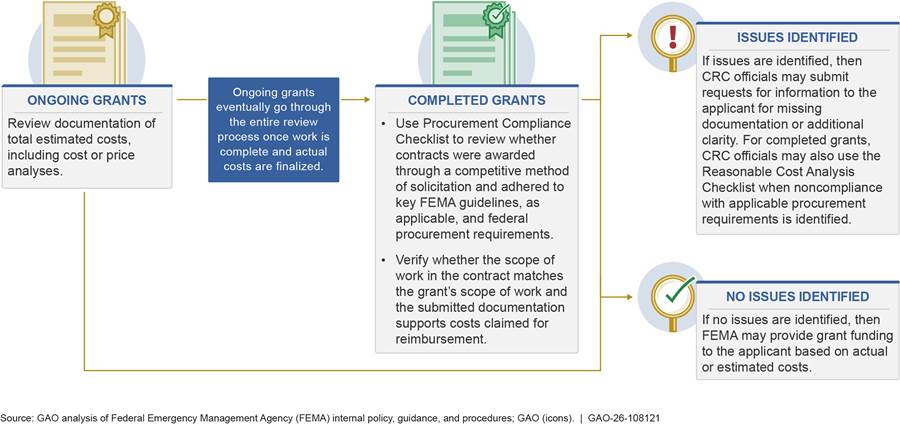
Note: CRC officials complete a Procurement Compliance Checklist for any Public Assistance grant project with a contract that exceeds the simplified acquisition threshold. FEMA uses the checklist to confirm that applicants are adhering to applicable federal, state, tribal, territorial, and local government procurement laws, regulations, and policies. Certain federal procurement standards could be inapplicable if a state applicant is following its own policies and procedures. FEMA officials complete a Reasonable Cost Analysis checklist for contracts that have been escalated for further review during or following the procurement review.
Additionally, CRCs conduct a compliance review process using the Procurement Compliance Checklist for all contracts that exceed the simplified acquisition threshold.[24] This review process is designed to strengthen CRC evaluation of an applicant’s procurement procedures and contract costs claimed in PA grants. To receive PA funding for contract costs for emergency work, applicants must comply with certain applicable procurement requirements.[25] The applicability of some federal procurement requirements varies depending on the type of entity applying and whether that entity has its own procurement policies and procedures.[26] Some federal procurement requirements apply regardless of the type of entity or whether it has its own procurement policies and procedures.[27]
As described above, FEMA reviews project applications to determine if the costs are eligible for PA emergency work funding, and one element of cost eligibility is whether the costs are reasonable. FEMA’s policy states that FEMA officials determine if a cost is reasonable by evaluating, among other things, whether the applicant complied with the federal procurement requirements described above. This part of the policy also states that FEMA generally considers contract costs reasonable when the applicant adheres to full and open competition under applicable federal procurement requirements, and the scope of services or work in the contract and level of effort are consistent with the eligible scope of work. For these situations, FEMA staff are not required to perform a detailed cost reasonableness analysis. For grant projects completed with contracted resources, CRC officials conduct a cost reasonableness analysis if applicants submit cost claims based on noncompetitive bids or contracts and certain contract types, such as time-and-material (T&M) contracts.[28] For grant projects greater than $1 million, CRC officials also conduct a cost reasonableness analysis when the contract selection was noncompliant with the applicable procurement requirements, even though there may have been price competition. CRC officials use the Reasonable Cost Analysis Checklist to conduct an escalated review and identify whether additional information is required from the grant applicant to determine whether the claimed contract costs are reasonable.
Fraud Risks to Debris Removal Grants and Risk Management
Managers of federal programs are responsible for managing fraud risks and implementing practices to combat those risks.[29] The objective of fraud risk management is to ensure program integrity by continuously and strategically mitigating both the likelihood and effects of fraud. Effectively managing fraud risk helps to ensure that federal program services fulfill their intended purpose, that funds are spent effectively, and that assets are safeguarded. In July 2015, we issued A Framework for Managing Fraud Risks in Federal Programs (Fraud Risk Framework), which provides a comprehensive set of key components and leading practices that serve as a guide for agency managers to use when developing efforts to combat fraud in a strategic, risk-based way, as shown in figure 5.[30]
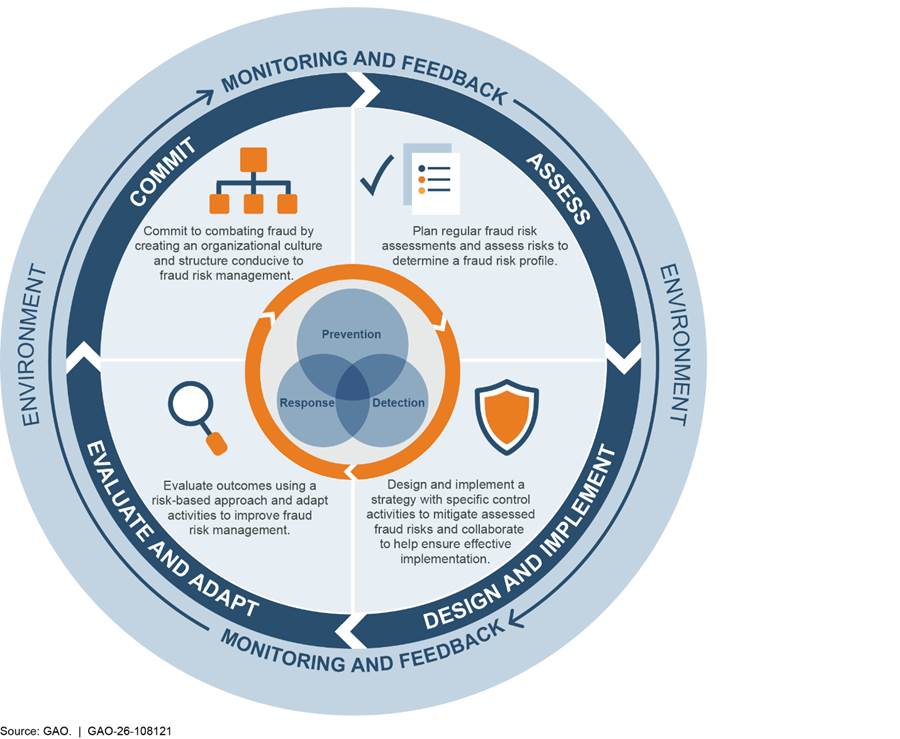
FEMA’s Office of Response and Recovery manages the PA grant program and its Grant Programs Directorate provides guidance for implementing the program monitoring process. In addition to these PA program-specific responsibilities, FEMA has other broader agency efforts related to fraud risk management specifically or risk management generally. For example, it established the Fraud Investigations and Inspections Division, a division of the Office of the Chief Security Officer, in response to fraud that occurred following major hurricanes in the mid-2000s. Among other things, the Fraud Investigations and Inspections Division is responsible for conducting program assessments to identify potential improvements to FEMA’s internal controls to prevent and detect fraud, waste, and abuse.
DHS OIG reports have highlighted fraud risks to PA debris removal grants. In a 2021 report, the DHS OIG found that FEMA did not ensure procurements and costs for debris removal operations following Hurricane Irma in Florida met federal requirements and FEMA guidelines.[31] Specifically, FEMA did not adequately review local entities’ procurements for debris removal projects and reimbursed local entities for questionable costs. The DHS OIG found that some costs were questionable because they were not supported by required documentation and others because the work was performed outside of the project’s eligible dates. The DHS OIG attributed these deficiencies to weaknesses in FEMA training and its quality assurance processes.[32]
FEMA Has Conducted Limited Information Sharing to Governments to Encourage Use of Advance Contracts for Debris Removal
Officials from Six Selected Governments Identified Benefits and Challenges in Using Advance Contracts
Officials from selected governments that awarded advance contracts for debris removal identified various benefits and challenges in doing so.[33] Six of the 16 governments we selected for our review had prior experience awarding advance contracts for debris removal.[34] See figure 6 for a map of the state, local, and tribal governments we selected in our review and whether they had prior experience awarding an advance contract.
Figure 6: Some Selected State, Local, and Tribal Governments Had Prior Experience Awarding Advance Contracts for Debris Removal
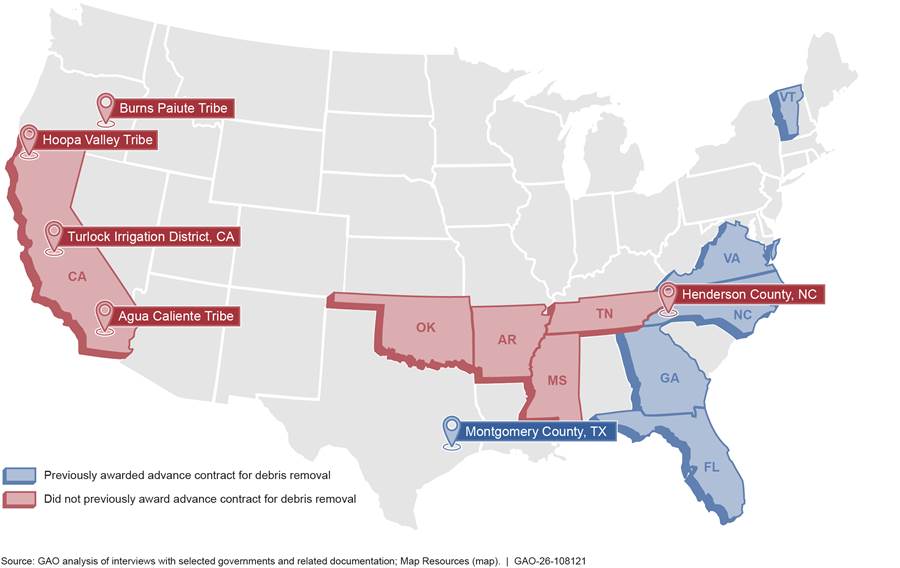
Note: This map represents data that were current at the time of GAO’s review.
Benefits. Officials from the six selected governments that awarded advance contracts identified several benefits, including:
· Speed of debris removal. Officials from five governments with advance contracts identified the speed at which debris removal could begin as the greatest benefit of advance contracts. For example, officials from one government told us that a contractor was able to start work within 48 hours of the major disaster.
· Meeting FEMA eligibility requirements. Officials from three governments noted that having the assurance that their advance contracts met FEMA’s PA eligibility requirements for federal reimbursement was another benefit. Officials from one government told us that they worked with FEMA to ensure that their advance contract followed FEMA’s PA Category A requirements and guidance.[35]
· Reduced cost. Officials from two governments with advance contracts said that reduced cost was a benefit. Officials from one of these governments said that they developed a boilerplate memorandum of understanding to allow municipalities to request use of the state’s advance contract, saving municipalities the time and resources it would have taken to award their own contract. Officials from another government, who said they were in the process of developing an advance contract, told us that they expected it to lower their administrative costs because of the reduced time spent evaluating vendors and awarding many individual post-disaster contracts.
Challenges. Officials from some selected governments experienced challenges with advance contracts. The two challenges most frequently identified were:
· Contractor capacity. Officials from four governments with advance contracts said that contractor capacity was a challenge. FEMA and Army Corps officials told us that contractors are sometimes able to start debris removal quickly after a disaster. But officials from one government affected by Hurricane Helene said that the state contractors’ capacity to complete the work was quickly overwhelmed by the amount of debris that needed to be removed. FEMA and Army Corps officials told us that the number of companies that are able to provide debris removal services anywhere in the United States after a major disaster, such as Hurricane Helene, is very limited. According to officials, when an unprecedented, multi-state disaster occurs, such as Hurricane Helene, contractor capacity can be quickly challenged.
· Competition among states for contractors. Officials from three governments with advance contracts expressed concern that contractors would take advantage of higher prices offered by other states after a disaster. For example, officials from one state told us that another state increased the price per cubic yard that it was willing to pay for debris removal services in the immediate aftermath of Hurricane Helene. Given the fact that the first state had set lower predetermined rates in its advance contract, contractors chose to conduct debris removal operations in the state that paid more.[36]
Officials from selected governments that had awarded advance contracts told us that the benefits of such contracts outweighed the challenges. FEMA and Army Corps officials identified similar benefits and challenges of advance contracts as the selected governments.
Officials from 10 Selected Governments Identified Reasons for Not Awarding Advance Contracts for Debris Removal
Officials from across the 10 governments that did not have advance contracts for debris removal said that they did not award them because of several perceived challenges. The two challenges most frequently identified were:
· Financial resources. Officials from three governments identified financial resources as a challenge. An official from one of these governments said that they lacked financial and personnel resources to award an advance contract. Officials from all three governments told us that they would be unable to pay a base fee to the contractor if required as part of an advance contract whether or not they used the contractor’s services in response to a disaster. Officials from two of the three governments added that they believed their state laws prohibited awarding contracts that they were not certain they would use.
· Geography. Officials from three governments stated that varying geography was a challenge. One government official stated that the more mountainous regions require different debris removal equipment than coastal regions and some contractors may not own or maintain this type of equipment. As a result of the varying geography of the state, among other reasons, state officials said that they did not award a statewide advance contract. In this case, state government officials told us that they could benefit from a regional advance contract rather than one that covered the entire state, but they had not yet pursued that as an option. Officials from two tribal governments said that they did not think an advance contract would be an efficient use of resources due to geographical concerns. One of these government’s area is comprised of mountainous and non-mountainous regions that officials noted would require specialized equipment for debris removal. Further, the government’s property resembled a checkerboard, where its land alternated with state or city lands. A government official also said that it is not straightforward where their land ends, so contractors could mistakenly be performing work outside of the tribal government’s boundaries without knowing it. The second government is in a very remote area and officials said that it was difficult to find debris removal contractors that would want to work there. Officials from these governments said that they can remove the debris with their own equipment or will award post-disaster contracts despite the geographic challenges.
FEMA Has Shared Limited Information to Encourage Governments’ Use of Advance Contracts
FEMA has taken some steps to encourage state, local, and tribal governments to use advance contracts. However, FEMA’s PDAT and Regional Offices have not collaborated effectively to encourage governments to award advance contracts and PDAT’s training has included only limited information related to advance contracts.
PDAT and Regional Offices collaboration. PKEMRA states that FEMA “shall encourage state and local governments to establish pre-negotiated contracts with vendors for goods and services in advance of natural disasters and acts of terrorism or other man-made disasters.”[37] According to FEMA’s Disaster Contracting Desk Guide, PDAT is one of the entities with primary responsibility for conducting coordination and outreach to state, local, tribal, and territorial governments on the use and establishment of advance contracts. However, PDAT officials told us that they rely on information from Regional Offices to inform their efforts. For example, PDAT officials told us that FEMA’s Regional Offices typically collaborate with PDAT after a government or FEMA staff request procurement training or review of an advance contract to identify potential issues of noncompliance with the federal procurement standards. They added that the Regional Offices are best positioned to coordinate with PDAT on the training or information needed to address challenges that governments face when awarding advance contracts because the Regional Offices tend to interact more frequently with these governments than other FEMA offices.
We found, however, that FEMA’s Regional Offices did not consistently have the information they needed to effectively collaborate with PDAT about their outreach to selected governments on advance contracts. Two of the four Regional Offices we spoke with did not know which states within their region had advance contracts or whether they were experiencing any challenges related to advance contracting. As such, those Regional Offices lacked the insight needed to determine if they should encourage certain states to request PDAT assistance in awarding advance contracts. Further, while eight of the 16 selected state, local, and tribal governments told us that they had heard of PDAT, only two of these eight relied on it to conduct advance contract compliance reviews.
While PDAT has responsibilities for conducting coordination and outreach on governments’ use and establishment of advance contracts, FEMA has not defined PDAT’s or the Regional Offices’ roles and responsibilities for encouraging the use of advance contracts, such as coordinating with each other to more effectively meet that goal. For example, PDAT officials said that each of the Regional Offices manages state outreach differently and PDAT does not have the authority to direct their efforts, such as directing them to share PDAT training announcements and materials with state, local, and tribal governments. PDAT officials acknowledged this gap and said that they began developing a project in September 2024 to define their roles and responsibilities, and those of the Regional Offices. The project was designed to address these differences across the Regional Offices and encourage FEMA regional staff to share applicant challenges with PDAT, evaluate the effectiveness of PDAT resources and services, and foster greater coordination on communication and distribution of PDAT resources. PDAT officials said that they briefed FEMA senior leaders on this project in January 2025, but were asked to put the project on hold a few months later due to budget constraints. As of September 2025, PDAT officials said that the project was still on hold and did not identify any other steps they had taken to define roles and responsibilities for outreach to governments on advance contracts.
We previously reported that defining roles and responsibilities is a leading practice to enhance interagency collaboration and can allow agencies to leverage their strengths and resources.[38] Clarifying roles and responsibilities between PDAT and the Regional Offices on their coordination with state, local, and tribal governments, particularly as it relates to collecting information and experiences on their use of advance contracts, would help ensure they are collaborating effectively and sharing information to support the goal of encouraging advance contract use.
PDAT training. PDAT’s training has principally focused on how to comply with federal procurement requirements under grants and included only limited encouragement to award advance contracts.[39] For example, we found that PDAT’s training does not address the actual or perceived advance contract challenges that selected governments identified to us. The training also does not include quality information—such as success stories from other governments—that might encourage state, local, and tribal governments to award advance contracts despite the challenges that might exist.
PDAT officials told us that there was limited information in their training on advance contracts because it was not originally designed to provide tips for awarding advance contracts or an advance contract template. These officials said that they have not previously provided detailed information on advance contracts in their trainings because FEMA PA applicants award contracts to companies and FEMA is not a party to that contractual relationship. They also stated that those contracts are to be awarded in accordance with state law and procurement regulations, and PDAT can only provide guidance on federal procurement rules. Further, they noted that attorneys in those states are best positioned to help ensure that those laws and regulations are met.
However, PDAT officials also told us that they recognized the need to go beyond the basics of the procurement rules and focus on real-world scenarios and challenges faced by state, local, and tribal governments. In response to this need, PDAT hosted its first Procurement Under Grants Summit in August 2024. These officials said that one of the goals of the summit was to have state, local, and tribal governments learn from each other during networking sessions by sharing success stories or challenges; however, advance contract success stories and challenges were not discussed. While PDAT had planned to deliver a second iteration of the Procurement Under Grants Summit, officials told us that this planning has been placed on hold due to budget constraints and will resume at a later date. PDAT officials acknowledged that it would be beneficial to update their training to include any advance contract success stories or challenges, but did not indicate any immediate plans to revise the training.
Standards for Internal Control in the Federal Government states that management should externally communicate the necessary quality information to achieve the entity’s objectives.[40] Given that PDAT’s mission is to support state, local, and tribal government needs through procurement training and knowledge management services, communicating quality information through its current training materials is critical to that goal. Further, PDAT is one of the key entities involved in supporting the PKEMRA requirement for encouraging the use of advance contracts among state, local, and tribal governments.[41] Updating PDAT’s training materials to include quality information, such as other governments’ advance contract success stories, would better ensure that state, local, and tribal governments have the information to help them overcome perceived challenges and more effectively award advance contracts.
Army Corps Used Different Debris Removal Reporting Processes For Two Recent Disasters
Army Corps Reporting Process on Debris Removal Progress Varied in Recent Disasters
The Army Corps’s debris removal reporting processes in response to the Los Angeles wildfires and Hurricane Helene in North Carolina included some similar steps. However, the timeliness and type of debris removal data the Army Corps provided to state and local governments differed between them, particularly during the initial response to Hurricane Helene in North Carolina.
The Army Corps’s debris removal guidance states that a successful debris management mission requires close coordination and partnership between the Army Corps, FEMA, and state and local governments. The Army Corps’s operational plan to respond to all hazards emphasizes that external communications will focus on providing accurate and timely information about the federal response.[42] In both disasters we selected, the Army Corps conducted community outreach; held frequent meetings with federal, state, and local disaster stakeholders; and developed educational materials related to debris removal work.
In Los Angeles, about 6 weeks after the wildfires began in January 2025, the Army Corps began publicly sharing an online interactive map with real-time debris removal data on each affected parcel. In addition, state and local officials received updates on next-day debris removal data. State and local government officials told us that they were impressed with the speed of the Army Corps’s debris removal operations and its efforts to keep local governments and the general public informed. See figure 7 for a screen shot of the Army Corps’s online interactive debris removal map as of September 2025.
Figure 7: Image of Army Corps’s Online Interactive Map of Los Angeles Wildfire Debris Removal Progress as of September 2025
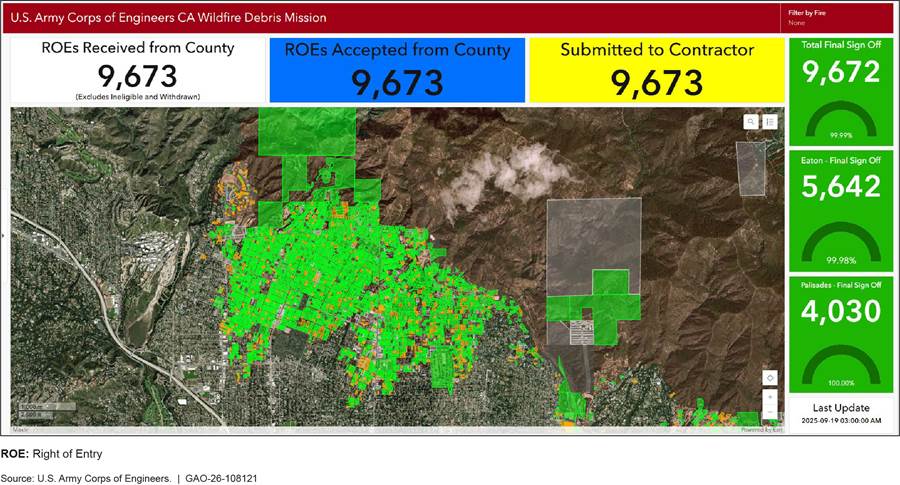
Note: The U.S. Army Corps of Engineers obtained right of entry forms before beginning work on private properties damaged by the January 2025 Los Angeles wildfires.
In contrast, the two North Carolina local governments we talked to told us that there was a lack of transparency and access to real-time data about the Army Corps’s debris removal progress in the initial months after Hurricane Helene hit North Carolina in September 2024. Army Corps officials attributed some of those concerns to differences in communication between the state contractor and the Army Corps contractor. Specifically, the local governments in North Carolina initially relied on the state contractor rather than the Army Corps for debris removal services. Officials from the local governments we spoke to told us that due to the contractual relationship between the local governments and the state contractor, the local governments had greater access to information on their contractor’s debris removal operations and progress than they did after they switched to the Army Corps debris removal program.[43] After the switch, the Army Corps directed its contractor not to share certain information requested by local governments. Officials said this was due to concern that the Army Corps needed to vet the contractor information for accuracy before it was shared with the local governments. Army Corps officials also told us that they did not share where the Corps’s debris removal contractor would be conducting work due to frequent changes in the contractor’s schedule.[44]
Further, our review of the Army Corps debris removal information sharing process in North Carolina identified differences in the timing and level of detail available to state and local officials when compared with the response in Los Angeles. For example, the Army Corps initially created a statewide infographic in North Carolina but did not develop county-specific infographics until February 2025—4 months after the disaster. The Army Corps also did not provide next-day debris removal data to local governments until December 2024. In comparison, the Army Corps began publicly sharing an online interactive map with real-time debris removal data on each affected parcel in Los Angeles about 6 weeks after the wildfires began in January 2025.
Army Corps officials attributed delays in providing information in North Carolina to their initial focus on clearing right-of-way debris—materials that block or impede public access after a storm, fire, or other emergency. They added that detailed data systems are typically established and refined as the Army Corps transitions from clearing right-of-way debris to the more methodical private property debris removal phase. Nonetheless, local officials told us that they were not able to communicate with affected homeowners about their application status or when debris removal activities would begin on private property because they did not have access to timely and accurate information to provide.
Army Corps officials identified several challenges to us that affected their reporting across the two disasters. For example, they told us that they previously developed online interactive maps for other wildfires and leveraged those efforts in Los Angeles. Officials also acknowledged that the different geographic scope of the two disasters—limited to one county in Los Angeles but affecting 23 counties in North Carolina—made providing detailed and timely information more difficult in North Carolina.[45] Additionally, officials stated that the Army Corps supported a single private property debris removal mission in Los Angeles compared to multiple debris removal missions (e.g., right-of-way, waterway, and private property debris removal) and other concurrent emergency support function missions in North Carolina. They said the different geographic scopes and the variety of debris removal missions in North Carolina limited their ability to provide the same type and frequency of reporting as in the Los Angeles wildfires.
After certain missions, Army Corps procedures required districts to prepare an After-Action Report that provides a consolidated summary of disaster operations, interagency coordination, key observations, and lessons learned. Officials told us that the After-Action Report process for a large-scale event, such as Hurricane Helene, does not begin until after response operations have ended. According to officials, they incorporated some lessons learned and best practices over the course of their response in North Carolina and are working to refine the current products they use to track and report debris removal progress for hurricanes. These efforts have not yet included an analysis of the Army Corps’s debris removal data sharing differences between the Los Angeles wildfires and Hurricane Helene or—more importantly—any lessons learned to address the communication challenges that occurred because of these differences. For example, while officials stated that additional funding could be needed to establish or improve data sharing tools, they have not analyzed what additional time or resources would be needed to develop online interactive maps for other types of disasters, such as hurricanes. Additionally, because Army Corps After-Action Reports are typically disaster-specific, officials confirmed that they do not plan to include the data sharing practices used in Los Angeles in their After-Action Report analysis for the debris removal mission in North Carolina.
Officials we spoke with at one local government in North Carolina told us that the Army Corps’s inconsistent reporting process across these two major disasters caused uncertainty, and also created a perception of inequity among some local officials who were aware of the amount of public information available on the Los Angeles wildfires. Officials from the other local government in North Carolina told us that they did not have the information they needed to share with the public and it caused them to lose constituents’ trust. While the recent Los Angeles and North Carolina cases reflect the experiences of communities after two specific disasters, they are illustrative of the response efforts the Army Corps is likely to encounter in future disasters. Further, while there were differences in the Army Corps’s debris removal missions following these two disasters, the timing and magnitude of the response efforts provide the Army Corps with the opportunity to assess the information sharing practices it used, determine what communication practices could be leveraged across different disasters and debris removal missions, and learn from its experiences and those of the affected communities. Without such an analysis, the Army Corps may miss opportunities to improve its data sharing during future disasters.
Army Corps Addressed Contractor Noncompliance with Debris Removal Eligibility Requirements
Army Corps officials told us that they addressed contractor noncompliance by instructing the contractor to follow debris removal guidance, but stated that they did not find significant violations of laws and regulations by their debris removal contractors in Los Angeles or western North Carolina that required state regulatory or enforcement agencies to act. Army Corps officials said that they instituted several controls to minimize the risk of noncompliance. For example, in Los Angeles, they said that each debris removal, reduction, and disposal site had quality assurance inspectors who monitored contractor work, routinely verified debris hauling trucks’ load weight and capacity limits, and identified and reported any instances of noncompliance.
During our site visit to western North Carolina and in subsequent meetings, Army Corps officials provided examples of how they addressed contractor noncompliance. For instance, they told us that, since March 2025, they investigated allegations of contractors removing ineligible debris and endangering wildlife. They said the subcontractors found to have repeated noncompliance for removing ineligible debris were removed from debris removal operations. Some specific examples of contractor noncompliance that the Army Corps reported include:
· State and Army Corps officials told us that a stop-work order was issued in March 2025 for contractors removing excessive amounts of ineligible debris and vegetation, including healthy trees, along the banks of a waterway debris site. Army Corps officials told us that they then retrained the contractors to ensure they all followed the same standards for clearing waterway debris. Waterway debris removal operations resumed a day later once contractors completed retraining and after the Army Corps had consulted with FEMA and North Carolina’s Department of Environmental Quality about the incident.
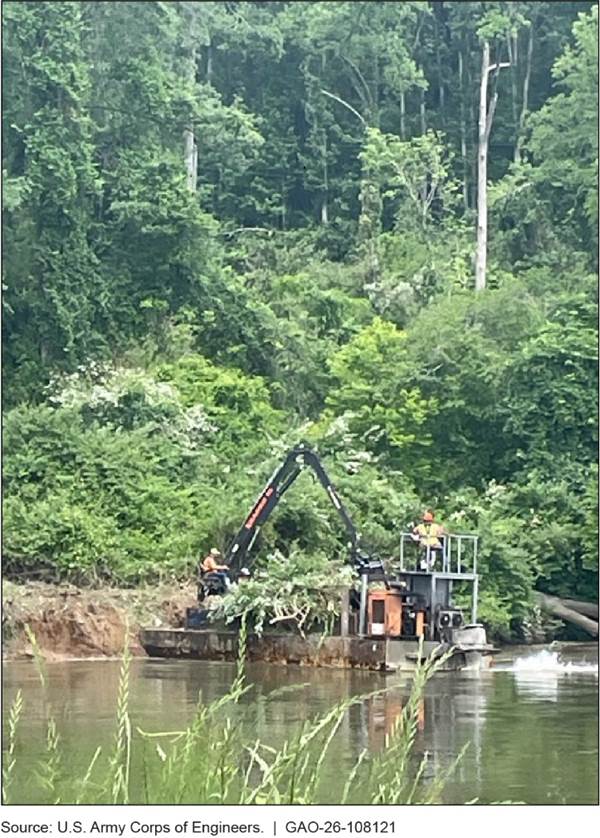
· Army Corps officials told us that in late May 2025, there was another instance where a contractor took ineligible “green” vegetative debris from the banks of a different waterway debris site. The officials said the contractor removed the staff that cut down the ineligible debris from the project and identified to the Army Corps the associated load tickets—formal documents that track and record the details of each load of material. Army Corps officials told us that the contractor voided the load tickets to ensure that the contractor would not receive payment for the ineligible debris. See figure 8 for a picture of the ineligible Hurricane Helene vegetative debris.
Figure 8: Contractors Removing Ineligible Vegetative Debris After Hurricane Helene in North Carolina, May 2025
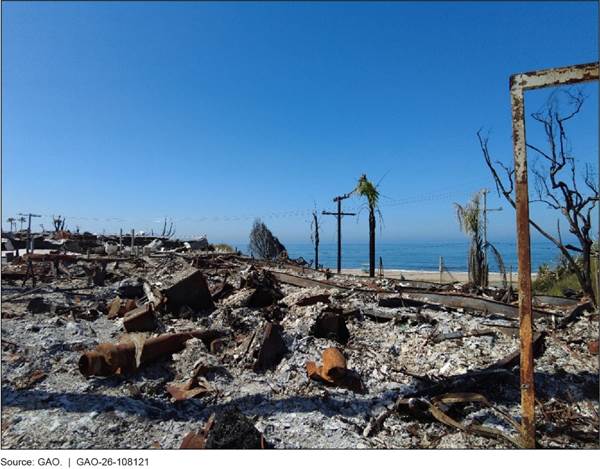
Army Corps officials overseeing debris removal efforts in Los Angeles told us that they did not identify any violations of laws and regulations by their debris removal contractor that needed to be reported to state agencies, or instances of noncompliance. They said that they instituted several controls to minimize the risk of noncompliance—similar to the controls used by Army Corps officials in North Carolina, such as routinely verifying debris hauling trucks’ capacity limits—all of which we observed during our site visit to Los Angeles. See figure 9 for uncleared fire debris at Tahitian Terrace, a mobile home park in Pacific Palisades, California.
FEMA Inconsistently Assessed Reimbursement Costs for Some Selected Debris Removal Grants
FEMA Applied Cost Eligibility Steps for Two Ongoing Grants We Selected
FEMA completed its review of independent cost estimates and other price information to determine cost eligibility for the two ongoing debris removal grants we selected for review.[46] For both of those grants, FEMA CRC officials used applicant-supplied documentation—such as contracts, bids, or hourly labor and equipment costs—to determine whether the estimated costs were reasonable and eligible for reimbursement.[47]
We also found that CRC officials documented and confirmed that both selected grant applicants submitted independent estimates for every procurement action above the simplified acquisition threshold. For example, one of the selected ongoing grant applicants provided specific quantities and unit rates for debris removal activities to estimate costs. The other selected ongoing grant applicant provided cost summaries and estimates, which CRC officials reviewed and validated. CRC officials documented that they noticed during their review that the grant applicant listed incorrect contractor costs in the estimate. As a result, officials corrected the contractor costs in the estimate provided. Additionally, CRC officials used relevant portions of FEMA’s cost estimate validation checklist to verify the applicant’s cost estimates. They told us that they confirmed that estimated costs were comparable to the actual costs in a similar prior debris removal grant project.
FEMA Did Not Consistently Apply Two of Its Cost Eligibility Steps Across Selected Completed Grants
FEMA completed two key cost eligibility steps for all four completed debris removal grants we reviewed, but inconsistently completed two other steps, as shown in table 1.
Table 1: GAO Assessment of Completed Debris Removal Grants That FEMA Reviewed for Cost Eligibility for Reimbursement
|
Key FEMA steps |
Grant 1 |
Grant 2 |
Grant 3 |
Grant 4 |
|
Reviewed documentation of competition, including cost reasonableness when appropriate. |
● |
● |
● |
◐ |
|
Ensured applicant’s documentation supported contract costs claimed. |
● |
● |
● |
● |
|
Identified certain contract types and verified documentation that applicant followed FEMA guidelines and federal contracting requirements for certain contract types. |
● |
◐ |
◐ |
◐ |
|
Ensured grant’s scope of work aligned with contract’s scope of work. |
● |
● |
● |
● |
● = Fully met ◐ = Partially met
Source: GAO analysis of Federal Emergency Management Agency (FEMA) policy, guidance, and selected grants. | GAO‑26‑108121
For all four completed debris removal grants, FEMA consistently validated that all contract costs claimed for reimbursement were supported by sufficient documentation. In all four instances, CRC officials also reviewed the grant’s scope of work to verify that it matched the contract’s scope of work and validated applicant-submitted invoices to ensure the dates and actual costs on the invoices matched those in the contract for work that has been completed.
We also found that CRC officials used the Procurement Compliance Checklist to verify whether or not the underlying contracts were competed in all four instances.[48] FEMA uses this checklist for each contract that exceeds the simplified acquisition threshold for work being claimed under the grant; through the checklist, CRC officials review the method of solicitation, such as whether it was awarded using competition.[49] CRC officials generally consider contract costs reasonable if the contract is competed, and the scope of services or work in the contract and level of effort are consistent with respect to the eligible scope of work. If the contract is not competed, then CRC officials are expected to conduct additional analysis to determine whether contract costs are reasonable. While CRC officials documented that three out of the four applicants awarded debris removal contracts competitively, CRC officials identified one that did not. We found that CRC officials did not use FEMA’s Reasonable Cost Analysis Checklist to conduct an escalated review for the applicant that awarded a noncompetitive contract.
Additionally, we identified issues with CRC officials identifying T&M contracts. FEMA’s cost eligibility policy requires that state, local, and tribal and territorial governments adhere to FEMA guidelines and—depending on the type of entity—federal procurement requirements that relate to certain contract types, such as T&M contracts.[50] But, when we met with CRC officials to ask about T&M contract documentation issues that we found during our review, they told us that they incorrectly identified the applicant’s contract type as a T&M contract for three of the four completed grants.[51] For example, officials told us that one applicant’s contract included fixed unit rate and T&M pricing, depending on which debris removal service was provided. CRC officials realized during the course of our audit that the applicant never utilized the debris removal services associated with the T&M pricing. However, the reviewing official initially identified the contract as T&M and did not conduct the required documentation review that would have confirmed that requirements related to T&M contracts were met.[52]
FEMA’s cost eligibility policy and associated checklists require officials to account for circumstances where contracts under grants are awarded noncompetitively or T&M contracts are used. FEMA’s Public Assistance Program Delivery Guide outlines that CRC executive leadership is responsible for analyzing and evaluating operations and the management of administrative processes, such as training and coordination with human resources. However, CRC officials acknowledged the inconsistencies we identified and attributed them to a lack of training. For example, CRC officials told us that they do not receive regular training to help staff understand certain cost eligibility policy requirements, such as T&M contracts. While they receive general federal procurement training from PDAT on an annual basis, they do not receive specific training on how to identify or assess T&M contracts. CRC officials told us that they do not receive formal training on how to complete the checklists and were last trained on how to use the Procurement Compliance and Reasonable Cost Analysis checklists in 2023.
CRC officials told us that it would be beneficial to have more training on how to consistently identify T&M contract types and better understand the documentation requirements for T&M contracts as listed in the Procurement Compliance Checklist. CRC officials told us that they plan to revise their training and processes regarding T&M contract types in response to the mistakes identified during our review. Further, they told us that they plan to issue updated guidance and provide a one-time training in the summer of 2026. CRC plans to issue updated guidance and provide training are positive steps. However, additional steps—such as providing training on using the checklists—could help FEMA ensure that CRC officials have the necessary information to apply FEMA’s cost eligibility policy requirements for grants involving noncompetitive or T&M contracts. These steps would also help FEMA reduce the risk of reimbursing ineligible and unreasonable costs.
FEMA Has Not Regularly Assessed Its Efforts to Mitigate Fraud, Waste, and Abuse Risks in Its Debris Removal Program
FEMA Has Established Several Controls for Mitigating Fraud, Waste, and Abuse Risks
FEMA has established several internal controls intended to mitigate the risks of fraud, waste, and abuse in its debris removal program. These controls include applicant requirements, FEMA processes, and information sharing.[53]
Applicant requirements. FEMA has several controls that require an applicant to take certain actions to reduce fraud, waste, and abuse risks at various stages of the grant process.
· Compliance with federal procurement requirements. Depending on an applicant’s entity type, the applicant must either follow the same policies and procedures that it would use for procurements with non-federal funds or follow the federal procurement standards.[54] For entities that follow the federal procurement standards, applicants must consider contractor integrity, compliance with public policy, and record of past performance when awarding a contract.[55] For these applicants, FEMA policy requires the applicant to ensure the contractor is not suspended or debarred.[56] For applicants that follow their own procurement policies and procedures, FEMA policy requires that contracts include provisions that cover the restriction on making federal awards to parties that are debarred or suspended.[57] To verify that state, tribal, or territorial applicants followed these procedures, FEMA either reviews relevant state, tribal, or territorial procurement policies or procedures, or requests that the applicant certify in writing that it followed these policies and procedures.
· Monitoring. The PA program does not directly monitor debris removal processes, but FEMA policy requires applicants to monitor all contracted debris removal operations to ensure compliance with contract terms and verify that the quantities and work claimed are accurate and eligible. Applicants for four of the six grants that we reviewed relied on contracted independent monitors to conduct oversight. According to FEMA officials, applicants typically begin debris removal prior to a federal disaster declaration or FEMA involvement, so an applicant’s monitors are best positioned to identify violations of laws and regulations related to debris removal because the applicant, and not FEMA, is responsible for overseeing debris removal operations.[58]
We found that our six selected grants generally met these applicant requirements, and that none of our selected grants used debris removal contractors that were suspended or debarred.
FEMA processes. FEMA officials described multiple internal review processes that the PA program uses to reduce the risks of fraud, waste, and abuse in its debris removal program.
· Peer review. In the peer review, a senior specialist conducts a technical review of the grant application. FEMA uses a risk-based framework for when this peer review occurs, including for grants over a certain dollar value or for grants processed by newer staff.
· Quality assurance review. Under FEMA policy, every project undergoes a quality assurance review aimed at ensuring that FEMA processes were correctly followed in processing the application.
· Post-obligation controls. The PA program also has controls that occur after obligating funding to the grant applicant. For example, the program uses a grants payment internal control review process to ensure FEMA’s compliance with statutory improper payment review and reporting requirements.[59]
· Site visits. PA officials told us that they can deploy staff to visit ongoing projects as needed, potentially identifying risks of fraud, waste, and abuse.
We found that FEMA generally documented peer and quality assurance reviews for our selected grants. One grant in our review did not have documentation of the peer review, which officials said was not conducted.[60]
Information sharing. We found that FEMA has controls related to information sharing to reduce the risks of fraud, waste, and abuse.
· Fact sheets and training. FEMA has fact sheets and trainings available to applicants that provide information such as who to contact if an applicant suspects fraud during the debris removal process. Further, FEMA policy is to provide training to an applicant’s debris monitors—when the applicant is using its own labor for monitoring—upon request.
· Meetings with applicants. The PA program delivery process also includes meetings between FEMA officials and applicants to ensure that applicants understand requirements that reduce the risks of fraud, waste, and abuse. For example, during the first phase of the process, FEMA conducts a recovery scoping meeting with eligible applicants to ensure that they are aware of requirements for federal procurement and contracting, document retention, and debris monitoring, among other things. FEMA documented that it conducted this scoping meeting with applicants for each of our selected grants.
FEMA’s Efforts to Assess and Address Risks Do Not Fully Align with Leading Practices
While FEMA has several controls to manage the risks of fraud, waste, and abuse in its debris removal program, its efforts do not fully align with leading practices in our Fraud Risk Framework because FEMA has not conducted regular fraud risk assessments to identify risks of fraud, waste, and abuse in its debris removal program.[61] It also has not developed a process for (1) addressing the risks identified in its assessments, (2) evaluating the effectiveness of its control activities, or (3) revising them as needed, such as when risk assessments or control activities reveal new risks or deficiencies in the existing controls.
We previously found that while FEMA had grants-management and program-integrity efforts in place that could identify risks to PA grant funds, it had not identified fraud risks through this effort or comprehensively identified or assessed fraud risks to PA emergency grants.[62] We recommended that FEMA plan and conduct regular fraud risk assessments of PA emergency work grants. FEMA agreed with this recommendation, and in 2022, the Fraud Investigations and Inspections Division—the entity responsible for identifying potential improvements to prevent and detect fraud, waste, and abuse—completed its Fraud Risk Profile Report.[63] The 2022 assessment of the debris removal program identified vulnerabilities in the PA program and made recommendations for additional control activities that PA could implement to mitigate them. However, PA officials told us that they did not agree with some of the recommendations because they were not actionable, and that they were not tracking their implementation.
Further, Fraud Investigations and Inspections Division officials told us that since their 2022 assessment, they have not reassessed risk or included additional risk-based metrics across the debris removal program specifically, and do not have plans to do so because of resource constraints. These officials said they initiated a reorganization of the Program Review and Inspections Branch in August 2025 to better deliver timely and actionable fraud, waste, and abuse vulnerability risk awareness and mitigation strategies to key stakeholders. However, it is unclear whether these efforts would include a review of the debris removal program.
Our Fraud Risk Framework leading practices call for programs to plan fraud risk assessments at regular intervals and when there are changes to the program or operating environment, consider the potential for internal and external fraud, and assess risks to determine a fraud risk profile.[64] Further, Standards for Internal Control in the Federal Government calls for program managers to identify, analyze, and respond to risks.[65] However, the Fraud Investigations and Inspections Division has not reassessed risks since its 2022 report and officials from the PA program—which could also be an appropriate entity to assess risk in the debris removal program—told us that PA also does not have plans to regularly conduct its own assessments to identify new risks within the program. Without regular program risk assessments, FEMA is not well positioned to obtain and evaluate information about new or evolving risks needed to develop adequate control activities that could help prevent fraud, waste, and abuse in its debris removal program.
In addition, we found that PA does not have a process for addressing fraud, waste, and abuse risks across the entire debris removal program, including evaluating its controls and revising them, if necessary, as it identifies new risks or opportunities to improve existing controls. FEMA evaluates some program controls through annual independent testing and reporting of CRC processes. However, these tests are limited to pre-award processes related to applications for public assistance and activities conducted at the CRCs, such as reviewing cost eligibility documentation, and do not address risks of fraud, waste, and abuse in other phases of the program.[66] Specifically, the 2024 independent testing report concluded that, due to streamlining of the pre-award process, areas of concern identified in previous tests are now conducted in the post-award phase and are no longer in the scope of the test, indicating certain risks have shifted to phases of the program where controls are not regularly tested.
Our Fraud Risk Framework calls for programs to design and implement a strategy with specific control activities to mitigate assessed fraud risks, as well as evaluate outcomes and adapt control activities to improve fraud risk management. Further, Standards for Internal Control in the Federal Government calls for programs to monitor the internal control system, evaluate results, and remediate identified deficiencies. While PA officials highlighted points of disagreement with some of the recommendations in the Fraud Investigations and Inspections Division’s 2022 assessment that sought to improve PA’s control activities, they also told us that they do not have any plans to conduct their own assessment or develop a strategy for what additional control activities may be needed to mitigate the risks of fraud, waste, and abuse.
Our prior work and reviews by the DHS OIG identified risks of fraud, waste, and abuse throughout different phases of the debris removal program. This includes risks identified during contract performance, such as during debris removal and monitoring. For example, in a 2018 management alert, DHS OIG reported that inadequate monitoring of debris removal for Hurricane Irma in Florida and Georgia posed risks of overstated debris removal activity and questionable costs for reimbursement.[67] Moreover, as we previously reported, the deceptive nature of fraud and the possibility for new fraud schemes to emerge in federal programs underscores the importance of agencies, like FEMA, assessing their controls to help ensure they are appropriately designed to address programmatic risks and having a process in place to revise its controls if needed.[68] Without a process to evaluate and revise, as necessary, controls in all phases, the PA program is missing valuable insight into potential deficiencies or opportunities for improving its controls to reduce the risks of fraud, waste, and abuse in its debris removal program.
Conclusions
When major disasters strike, the communities they impact need help to effectively respond and recover. A key early step in disaster response is removing the large quantities of debris. Governments that serve these communities have a greater chance of accomplishing this step effectively and efficiently when they have advance contracts in place to quickly procure debris removal services. However, the offices within FEMA tasked with encouraging state, local, tribal, and territorial governments to award advance contracts have not clarified their roles and responsibilities for doing so consistent with leading practices to enhance collaboration. Further, FEMA’s training on federal procurement requirements under grants does not include information to help these governments overcome challenges and establish advance contracts that could allow them to more efficiently conduct their own debris removal efforts following a disaster.
The Army Corps has a responsibility to provide state and local governments with timely and accurate information about debris removal progress, but the Army Corps was inconsistent in its information sharing approaches in two recent major disasters, leading to a perception of inequity among some North Carolina local officials. Army Corps officials told us that they recognized that the Army Corps took different approaches to the two disasters, but they have not assessed the reasons for the differences or identified any lessons learned that might improve future responses. Without analyzing the reasons for the differences, the Army Corps may miss opportunities to improve its approach to providing governments timely and consistent data during future disasters.
State, local, tribal, and territorial governments also look to FEMA’s PA grant program—averaging $20.5 billion in assistance each year from fiscal years 2016 through 2025, according to officials—to defray costs for debris removal contracts. While FEMA followed its prescribed processes for evaluating cost eligibility for some of the grants we reviewed, it could do more to ensure that the agency officials responsible for making cost reasonableness determinations understand and consistently apply cost eligibility policy requirements. Given the size of the PA program and the evolving nature of fraud, establishing regular assessments of fraud, waste, and abuse risks affecting the program and a process to address these risks would help FEMA to more strategically identify and manage risks across the entire debris removal program. While the agency has several fraud risk controls in place, additional focus in this area would allow FEMA to identify new risks and provide critical information about the effectiveness of its current risk mitigation efforts.
Recommendations for Executive Action
We are making a total of six recommendations, including five to FEMA and one to the Army Corps. Specifically:
The FEMA Administrator should define the Procurement Disaster Assistance Team’s and Regional Offices’ roles and responsibilities in encouraging state, local, and tribal governments to award advance contracts for debris removal, including how they should coordinate and share information. (Recommendation 1)
The FEMA Administrator should ensure that the Procurement Disaster Assistance Team updates its training materials to include quality information, such as other governments’ success stories using advance contracts. (Recommendation 2)
The Assistant Secretary of the Army for Civil Works should ensure that the Chief of Engineers and the Commanding General of the U.S. Army Corps of Engineers conduct an analysis of the information sharing practices for debris removal missions, including the differences between the Hurricane Helene and Los Angeles wildfires, and identify any lessons learned for responding to future disasters. (Recommendation 3)
The FEMA Administrator should take steps, such as providing training on how to use checklists, to ensure Consolidated Resource Center officials are aware of cost eligibility policy requirements for reviewing grants involving noncompetitive and time-and-material contracts. (Recommendation 4)
The FEMA Administrator should conduct regular assessments to identify risks of fraud, waste, and abuse in FEMA’s debris removal program. (Recommendation 5)
The FEMA Administrator should ensure that the PA program develops a process for addressing fraud, waste, and abuse risks identified in regular risk assessments of its debris removal program, including evaluating and revising its controls for these risks and, if necessary, instituting additional controls. (Recommendation 6)
Agency Comments
We provided a draft of this report to the Department of Defense and DHS for review and comment. The Office of the Assistant Secretary of the Army for Civil Works and DHS provided written comments, which are reproduced in appendices II and III. The Army concurred with our recommendation that the Assistant Secretary of the Army for Civil Works ensure the Army Corps conducts an analysis of its information sharing practices for debris removal missions to capture lessons learned to improve future disaster responses. DHS concurred with all five of our recommendations to FEMA and described actions it has taken or plans to take to address them. For example, DHS noted that, by the end of August 2026, FEMA’s Recovery Directorate expects to complete its initial fraud risk assessment, including a specific review of the debris removal assistance provisions of the Public Assistance program, and FEMA plans to conduct those assessments annually thereafter. FEMA and Army Corps provided technical comments, which we incorporated into the report as appropriate.
We are sending copies of this report to the appropriate congressional committees, the Secretary of Homeland Security, the Senior Official Performing the Duties of FEMA Administrator, the Secretary of Defense, the Office of the Assistant Secretary of the Army for Civil Works, the Chief of Engineers and Commanding General of the U.S. Army Corps of Engineers, and other interested parties. In addition, the report is available at no charge on the GAO website at https://www.gao.gov.
If you or your staff have any questions about this report, please contact me at MastersT@gao.gov. Contact points for our Offices of Congressional Relations and Media Relations may be found on the last page of this report. Key contributors to this report are listed in appendix IV.
Travis J. Masters
Director, Contracting and National Security Acquisitions
List of Committees
The Honorable Shelley Moore Capito
Chairman
The Honorable Sheldon Whitehouse
Ranking Member
Committee on Environment and Public Works
United States Senate
The Honorable Rand Paul, M.D.
Chairman
The Honorable Gary C. Peters
Ranking Member
Committee on Homeland Security and Governmental Affairs
United States Senate
The Honorable John Kennedy
Chair
The Honorable Patty Murray
Ranking Member
Subcommittee on Energy and Water Development
Committee on Appropriations
United States Senate
The Honorable Katie Britt
Chair
The Honorable Chris Murphy
Ranking Member
Subcommittee on Homeland Security
Committee on Appropriations
United States Senate
The Honorable Andrew Garbarino
Chairman
The Honorable Bennie G. Thompson
Ranking Member
Committee on Homeland Security
House of Representatives
The Honorable Sam Graves
Chairman
The Honorable Rick Larsen
Ranking Member
Committee on Transportation and Infrastructure
House of Representatives
The Honorable Chuck Fleischmann
Chairman
The Honorable Marcy Kaptur
Ranking Member
Subcommittee on Energy and Water Development and Related Agencies
Committee on Appropriations
House of Representatives
The Honorable Mark Amodei
Chairman
The Honorable Henry Cuellar
Ranking Member
Subcommittee on Homeland Security
Committee on Appropriations
House of Representatives
The Disaster Contract Improvement Act includes a provision for us to review a number of areas related to debris removal for disasters.[69] This report addresses:
1. selected state, local, and tribal governments’ perspectives on the use of advance contracts for debris removal, and the extent to which the Federal Emergency Management Agency (FEMA) shared information to encourage the use of advance contracts;
2. the extent to which the U.S. Army Corps of Engineers developed processes for reporting advance contract debris removal efforts to state, local, and tribal governments during the responses to the wildfires in Los Angeles, California in 2025 and Hurricane Helene in North Carolina in 2024;
3. the extent to which FEMA assessed whether the costs for selected state, local, and tribal governments’ debris removal grants are eligible for reimbursement; and
4. the extent to which FEMA has taken steps to mitigate fraud, waste, and abuse risks in its debris removal program.
To assess selected governments’ perspectives on the use of advance contracts for debris removal and the extent to which FEMA shared information to encourage the use of advance contracts, we selected a nongeneralizable sample of state, local, and tribal governments based on Public Assistance (PA) obligation amounts and geographic variation, among other factors. For the purposes of the review, we merged data on FEMA’s Disaster and Other Declarations website with FEMA’s PA Category A obligations data from October 1, 2023, to March 11, 2025.[70] We totaled the obligations for each state’s and Tribe’s major disaster declarations and selected 10 states and two Tribes with the highest Category A obligations. We selected two additional Tribes with the highest pending obligations in order to expand the number of Tribes to include in our sample. During our outreach efforts, one state and one Tribe did not respond or declined to participate. As a result, we excluded them from our review.
Of the six grants we reviewed in our third objective, we identified and selected five applicants that were local governments. We decided to include one local government solely because its grant involved a noncompetitive contract, and we excluded this local government from our first objective analysis due to our audit timeframes. During the course of our review, we determined that another one of these selected grants was awarded to a state rather than a local government, so we reclassified that entity as a state in our sample. Our nongeneralizable sample consisted of 10 states, three local governments, and three Tribes for a total of 16 selected governments. The information we obtained from these governments provided us with insights on debris removal advance contract use. Our methodology for grant selection is discussed later in this appendix.
To assess the reliability of the FEMA PA Category A obligations data that we used to select the governments to include in our nongeneralizable sample, we:
· reviewed our prior assessment of these data,
· collected responses to data reliability questions from FEMA officials,
· conducted electronic data testing to look for obvious errors or outliers, and
· compared FEMA’s PA Category A obligations data to publicly available data on FEMA’s website, known as OpenFEMA.
We determined that the FEMA PA Category A obligations data were sufficiently reliable for the purposes of selecting state, local, and tribal governments.
We interviewed officials from our 16 selected governments about whether the governments had advance contracts for debris removal, what benefits and challenges they experienced implementing them, and whether they identified or imposed penalties for violations of laws related to debris removal. We requested copies of advance contracts from state, local, and tribal governments if they awarded one.
To assess the extent to which FEMA shared information to encourage the use of advance contracts, we reviewed the FEMA Procurement Disaster Assistance Team’s (PDAT) training slides, class schedules, attendee data, and draft plans to improve collaboration and coordination between itself and other entities within FEMA. We also reviewed the Post-Katrina Emergency Management Reform Act of 2006, which directs FEMA to encourage state and local governments to use advance contracts.[71] We interviewed officials from PDAT and the five Regional Offices from regions where our selected grants were awarded about their efforts to encourage state, local, and tribal governments to use advance contracts and any challenges. We also interviewed state, local, and tribal officials from the selected governments about their awareness of PDAT, any help they received from PDAT on advance contracts, FEMA’s efforts to encourage the use of advance contracts, and any challenges. We compared FEMA’s efforts with our leading practices for interagency collaboration—specifically, the practice of defining roles and responsibilities, which we determined was most relevant to our objective.[72] We also compared these efforts to the Standards for Internal Control in the Federal Government.[73] In particular, we determined that the information and communication components of internal controls were significant to this objective. We determined that the principle that management externally communicate quality information to achieve objectives was also significant.
To assess the extent to which the Army Corps developed processes for reporting advance contract debris removal efforts to state, local, and tribal governments during the responses to the wildfires in Los Angeles, California in 2025 and Hurricane Helene in North Carolina in 2024, we reviewed the Army Corps’s debris removal guidance, including the Disaster Mission Doctrine Guide for Debris and the Wildfire Private Property Debris Removal Mission Guide. We also assessed the various methods that the Army Corps used to keep selected governments updated on the status, including progress, of debris removal operations, such as briefing slides, an online interactive map, and frequently asked questions. We analyzed emails between the Army Corps and its debris removal contractor to identify instances where the Army Corps took steps to identify and address contractor noncompliance during debris removal operations.
We conducted site visits in March 2025 to areas in North Carolina damaged by Hurricane Helene and in May 2025 to areas affected by the Los Angeles wildfires to observe Army Corps debris removal efforts and oversight activities. We selected North Carolina and Los Angeles because they had ongoing disaster debris removal operations and represented different types of disasters—hurricanes and wildfires. During these visits, we met with Army Corps and state and local officials to discuss debris removal operations, Army Corps’s efforts to keep state and local governments informed about progress in removing the debris, and steps the Army Corps took, if any, to prevent and address contractor noncompliance. We observed Army Corps contractors removing, reducing, and disposing of various types of debris, including fire ash, vegetative, metal, and concrete.
To assess the extent to which FEMA determined whether the costs for selected state, local, and tribal governments’ debris removal grants were eligible for reimbursement, we reviewed how FEMA applied its key cost eligibility policies across a nongeneralizable sample of six PA debris removal grants. For the purposes of this review, we selected grants with total costs over FEMA’s threshold for large projects that require more extensive review.[74] We selected grants with obligations between October 2023 and February 2025 across five states and one Tribe. We identified state and tribal governments from which to select grants to review, based on factors such as geographic variation across the four Consolidated Resource Center (CRC) regions, variation in the number of major disaster declarations states and Tribes had in calendar years 2023 and 2024, and disasters that were among the highest in terms of PA debris removal obligations since October 2023. After selecting the five states and one Tribe, we identified six PA debris removal grants to include in the review based on factors such as whether the grant was expedited or ongoing, variation in terms of whether the underlying contract for the grant was awarded competitively, and variety in the type of debris (e.g., waterway or right-of-way). The grant applicants we selected include four local governments, one state government, and one tribal government.
We also reviewed FEMA’s internal policy, guidance and procedures to identify key steps that FEMA followed to assess cost eligibility, such as adherence to cost reasonableness and federal procurement requirements for PA grants. Our review of steps focused on those included in FEMA’s Procurement Compliance Checklist and procurement review guidance for CRCs related to determining cost eligibility. Further, we interviewed FEMA officials in each of the four CRC regional offices about their cost eligibility review process and the extent to which they consistently applied key steps for the selected grants.
To assess the extent to which FEMA had taken steps to mitigate fraud, waste, and abuse risks in its debris removal program, we reviewed FEMA’s 2022 Fraud Risk Profile Report to determine the risks FEMA had identified in its debris removal program and how often it conducted such risk assessments of the debris removal program. We analyzed FEMA’s policies, procedures, and guidance to identify the specific control activities FEMA implemented to mitigate fraud, waste, and abuse risks in its debris removal program and assessed the six grants we selected to determine the extent to which FEMA consistently applied these specific control activities. Further, we interviewed FEMA officials, including those in the PA program and the Fraud Investigations and Inspections Division, to identify the specific control activities FEMA implemented and the extent to which it has consistently applied them. Finally, we interviewed FEMA and selected governments on whether they levied any penalties for violations of laws and regulations relating to debris removal. We also reviewed the System for Award Management (SAM.gov) to assess whether any of the selected grants used debris removal contractors that were either suspended or debarred. We evaluated FEMA’s policies and efforts against our Fraud Risk Framework and federal internal controls principles.[75] We determined that the following internal controls components were significant to this objective: identify, analyze, and respond to risks; assess fraud risk; design control activities; and implement control activities.
We conducted this performance audit from February 2025 to June 2026 in accordance with generally accepted government auditing standards. Those standards require that we plan and perform the audit to obtain sufficient, appropriate evidence to provide a reasonable basis for our findings and conclusions based on our audit objectives. We believe that the evidence obtained provides a reasonable basis for our findings and conclusions based on our audit objectives.
GAO Contact
Travis J. Masters, masterst@gao.gov
Staff Acknowledgments
In addition to the contact named above, the following staff members made key contributions to this report: Janet McKelvey (Assistant Director), Meghan Perez (Assistant Director), Jeff Hartnett (Analyst-in-Charge), Dominique Belanger, Rose Brister, Matthew T. Crosby, Lorraine Ettaro, Steven Flint, James Holley, Kathryn C. Long, Rithi Mulgaonker, and Adam Wolfe.
The Government Accountability Office, the audit, evaluation, and investigative arm of Congress, exists to support Congress in meeting its constitutional responsibilities and to help improve the performance and accountability of the federal government for the American people. GAO examines the use of public funds; evaluates federal programs and policies; and provides analyses, recommendations, and other assistance to help Congress make informed oversight, policy, and funding decisions. GAO’s commitment to good government is reflected in its core values of accountability, integrity, and reliability.
Obtaining Copies of GAO Reports and Testimony
The fastest and easiest way to obtain copies of GAO documents at no cost is through our website. Each weekday afternoon, GAO posts on its website newly released reports, testimony, and correspondence. You can also subscribe to GAO’s email updates to receive notification of newly posted products.
Order by Phone
The price of each GAO publication reflects GAO’s actual cost of production and distribution and depends on the number of pages in the publication and whether the publication is printed in color or black and white. Pricing and ordering information is posted on GAO’s website, https://www.gao.gov/ordering.htm.
Place orders by calling (202) 512-6000, toll free (866) 801-7077,
or
TDD (202) 512-2537.
Orders may be paid for using American Express, Discover Card, MasterCard, Visa, check, or money order. Call for additional information.
Connect with GAO
Connect with GAO on X,
LinkedIn, Instagram, and YouTube.
Subscribe to our Email Updates. Listen to our Podcasts.
Visit GAO on the web at https://www.gao.gov.
To Report Fraud, Waste, and Abuse in Federal Programs
Contact FraudNet:
Website: https://www.gao.gov/about/what-gao-does/fraudnet
Automated answering system: (800) 424-5454
Media Relations
Sarah Kaczmarek, Managing Director, Media@gao.gov
Congressional Relations
David A. Powner, Acting Managing Director, CongRel@gao.gov
General Inquiries
[1]U.S. Army Corps of Engineers, Helene Response, “Debris Removal Progress: U.S. Army Corps of Engineers Hurricane Helene North Carolina Emergency Field Office,” accessed September 18, 2025, https://www.saw.usace.army.mil/Missions/HeleneResponse/dvpTag/USACE/.
[2]FEMA is the lead coordinator of federal disaster response efforts across federal agencies and can assign the Army Corps to coordinate engineering and construction services, such as debris removal or temporary roofing.
[3]Pub. L. No. 109-295, § 691 (codified at 6 U.S.C. § 791(b)(3), (4)). FEMA defines advance contracts to include indefinite-delivery contracts, including those under the General Services Administration schedules, as well as interagency agreements and interagency reimbursable work agreements. FEMA also considers blanket purchase agreements as a type of advance contracting vehicle. A blanket purchase agreement is not a contract; therefore, the government is not obligated to purchase a minimum quantity or dollar amount and the contractor is not obligated to perform until it accepts an order under the purchase agreement. Although PKEMRA does not apply to the Army Corps, the Army Corps awards indefinite-delivery contracts as a preparedness measure as part of its Advanced Contracting Initiative, a program developed and implemented specifically for emergency and disaster scenarios. For the purposes of this report, we rely on how FEMA and the Army Corps define advance contracts.
[4]GAO, 2017 Disaster Contracting: Action Needed to Better Ensure More Effective Use and Management of Advance Contracts, GAO‑19‑93 (Washington, D.C.: Dec. 6, 2018). We made recommendations to improve FEMA’s management and use of advance contracts, which we discuss later in this report.
[5]GAO, Disaster Assistance: FEMA Should Take Additional Actions to Strengthen Fraud Risk Management for Public Assistance Emergency Work Grants, GAO‑20‑604 (Washington, D.C.: Sept. 29, 2020). We made recommendations to improve FEMA’s fraud risk management for these grants, which we discuss later in this report. Also see, for example, Department of Homeland Security, Office of Inspector General, FEMA Must Take Additional Steps to Demonstrate the Importance of Fraud Prevention and Awareness in FEMA Disaster Assistance Programs, OIG-19-55 (Washington, D.C.: July 24, 2019); FEMA’s Procurement and Cost Reimbursement Review Process Needs Improvement, OIG-21-26 (Washington, D.C.: Mar. 4, 2021); and Management Alert: Observations of FEMA’s Debris Monitoring Efforts for Hurricane Irma, OIG-18-85 (Washington, D.C.: Sept. 27, 2018).
[6]Disaster Contract Improvement Act, Pub. L. No. 118-153, § 2(e) (2024) (codified at 42 U.S.C. § 5173 note).
[7]The details of our selection methodology are in appendix I.
[8]GAO, Government Performance Management: Leading Practices to Enhance Interagency Collaboration and Address Crosscutting Challenges, GAO‑23‑105520 (Washington, D.C.: May 24, 2023); and Standards for Internal Control in the Federal Government, GAO‑25‑107721 (Washington, D.C.: May 2025).
[9]For the purposes of this review, we selected grants with total costs over $1 million dollars between October 2023 and February 2025 across five states and one Tribe, based on factors such as whether the grant was expedited or ongoing, whether the underlying contract for the grant was competitively awarded, and variety of type of debris removed. Our review of key steps focused on those included in FEMA’s Procurement Compliance Checklist and procurement review guidance for Consolidated Resource Centers related to determining cost eligibility.
[10]A major disaster is any natural catastrophe (including any hurricane, tornado, storm, high water, wind driven water, tidal wave, tsunami, earthquake, volcanic eruption, landslide, mudslide, snowstorm, or drought), or, regardless of cause, any fire, flood, or explosion, in any part of the United States, which the President determines causes damage of sufficient severity and magnitude to warrant major disaster assistance to supplement the efforts and available resources of states, local governments, and disaster relief organizations in alleviating damage, loss, hardship, or suffering. See 42 U.S.C. § 5122(2).
[11]42 U.S.C. § 5170. The Robert T. Stafford Disaster Relief and Emergency Assistance Act, as amended, permits the President to declare a major disaster after a state’s governor or chief executive of an affected Indian tribal government—a governing body of an Indian or Alaska Native Tribe, band, nation, pueblo, village, or community that is federally recognized—finds that the disaster is of such severity and magnitude that effective response is beyond local capabilities.
[12]Department of Homeland Security, National Response Framework (October 2019).
[13]Pub. L. No. 109-295, § 691 (codified at 6 U.S.C. § 791).
[15]Federal Emergency Management Agency, Procurement Under Grants Policy Guide (July 2025).
[17]FEMA identifies debris removal grant activities as Category A emergency work. PA Category A specifically covers debris removal activities, including clearance, removal, disposal, and eligible monitoring.
[18]The two ongoing or “work to be completed” grants that we selected for our review are emergency work projects that were submitted to FEMA with estimated costs for planned debris removal activities. FEMA may process emergency work projects based on estimates if the applicant provides sufficient information. Ongoing grant projects eventually go through the entire PA and cost eligibility review process once they are complete and actual costs are finalized.
[19]State, local, tribal, and territorial governments may conduct emergency response efforts while seeking FEMA reimbursement through the grant approval process. FEMA provides PA funds to the recipients, who then give those funds to the subrecipients so they can pay the entity that did the work, such as a contractor.
[20]See 44 C.F.R. §§ 206.47, 206.65, 206.228.
[21]42 U.S.C. 5170b(b). States may have cost share arrangements with localities and, accordingly, pass along a portion of the required nonfederal cost share to them. See GAO, Budgeting for Disasters: Approaches to Budgeting for Disasters in Selected States, GAO‑15‑424 (Washington, D.C.: Mar. 26, 2015).
[22]See 42 U.S.C. 5173(d), 44 C.F.R. § 206.47(b), 44 C.F.R. § 206.65.
[23]44 C.F.R. 206.47(b). We previously recommended that FEMA develop and implement specific criteria or factors to use when evaluating requests for cost share adjustments that would result in the federal government paying up to 100 percent of disaster declaration costs. Although FEMA initially concurred with this recommendation, it later concluded that it would not establish specific criteria or factors to use when evaluating these requests, determining that each circumstance was unique in nature and could not be used to develop criteria or factors for future decision-making. In addition, implementing criteria broad or flexible enough to capture these unique events would likely result in cost share adjustments for events that would not warrant an adjustment. See GAO, Federal Disaster Assistance: Improved Criteria Needed to Assess a Jurisdiction’s Capability to Respond and Recover on its Own, GAO‑12‑838 (Washington, D.C.: Sept. 12, 2012).
[24]The simplified acquisition threshold is defined in Federal Acquisition Regulation (FAR) § 2.101. The threshold is adjusted periodically for inflation. Effective October 1, 2025, the FAR Council increased the micropurchase threshold from $10,000 to $15,000 and the simplified acquisition threshold from $250,000 to $350,000. See 90 Fed. Reg. 41,872 (Aug. 27, 2025). Based on the dates of the grants included in our review, the applicable micropurchase threshold was $10,000 and the applicable simplified acquisition threshold was $250,000.
[25]See 44 C.F.R. §§ 206.200(b), 206.202(b), 206.207(a); 2 C.F.R. §§ 200.100(b), 200.317.
[26]The regulation at 2 C.F.R. 200.317 addresses federal procurement standards applicable to federal awards, including PA grants. Until a revision in 2024, this regulation required all non-federal entities—other than states—to follow the federal procurement standards in 2 C.F.R. §§ 200.318 through 200.327. Under the regulation, states having their own procurement policies and procedures could follow their own policies and procedures instead of following most of the federal procurement standards in 2 C.F.R. §§ 200.318 through 200.327. Through the 2024 revision, Indian Tribes also were permitted to follow their own procurement policies and procedures instead of most of the federal procurement standards in 2 C.F.R. §§ 200.318 through 200.327. See 89 Fed. Reg. 30,046 (Apr. 22, 2024). The revision became effective October 1, 2024, but federal agencies could elect to apply it to federal awards issued as early as June 21, 2024. Id. Hurricane Helene made landfall on September 26, 2024, with disaster declarations occurring both before and after October 1, 2024. To achieve uniformity in the PA grants for Hurricane Helene declarations, FEMA officials told us that FEMA amended the Hurricane Helene FEMA-State/Tribe Agreements issued prior to October 1, 2024, to permit Indian Tribes to apply their own procurement policies and procedures rather than most of those in 2 C.F.R. §§ 200.318 through 200.327.
[27]The regulation at 2 C.F.R. § 200.317 establishes that all entities must follow the federal procurement standards in 2 C.F.R. §§ 200.321, 200.322, 200.323, and 200.327.
[28]As we reported, T&M contracts allow payments to contractors based on the number of labor hours billed at a fixed hourly rate—which includes wages, overhead, general and administrative expenses, and profit—and the cost of materials, if applicable. T&M and labor-hour contracts are considered higher-risk to the government than other types because the government is not guaranteed a completed end item or service, and these contracts provide little incentive to the contractor to work efficiently or control costs. See GAO, Federal Contracting: Opportunities Exist to Reduce Use of Time-And-Materials Contracts, GAO‑22‑104806 (Washington, D.C.: June 7, 2022).
[29]As we have previously reported, fraud and fraud risk are distinct concepts. Fraud—obtaining something of value through willful misrepresentation—is challenging to detect because of its deceptive nature. Fraud risk (which is a function of likelihood and impact) exists when people have an opportunity to engage in fraudulent activity, have an incentive or are under pressure to commit fraud, or are able to rationalize committing fraud. Fraud risk management is a process for ensuring program integrity by mitigating the likelihood and impact of fraud. When fraud risks can be identified and mitigated, fraud may be less likely to occur. Although the occurrence of fraud indicates there is a fraud risk, a fraud risk can exist even if actual fraud has not yet occurred or been identified. See GAO‑20‑604.
[30]GAO, A Framework for Managing Fraud Risks in Federal Programs, GAO‑15‑593SP (Washington, D.C.: July 2015).
[31]Department of Homeland Security, Office of Inspector General, FEMA’s Procurement and Cost Reimbursement Review Process Needs Improvement, OIG-21-26 (Washington, D.C.: Mar. 4, 2021).
[32]DHS OIG made three recommendations to address these deficiencies. FEMA concurred with all three recommendations and proposed actions to address them. In response to these findings, FEMA officials told us, in November 2022, they finalized the Procurement Review Process for CRC Guidance and Workflow, including the Procurement Compliance Checklist, and required staff at the CRCs to receive training on the new procedures. In response to those changes, the OIG closed its audit finding in August 2023.
[33]Some of the advance contract benefits and challenges identified by officials could also apply to government contracts in general.
[34]For additional details on our selected states, localities, and Tribes, see appendix I.
[35]One emergency work area of the PA program includes debris removal activities, such as clearance, removal and disposal, and monitoring. FEMA refers to these debris removal grant activities as Category A emergency work.
[36]We did not review whether state officials took action or pursued recourse after the contractor chose not to conduct debris removal operations in the state. We previously found an instance where advance contracts did not require vendors to meet emergency response delivery time frames and amounts for supplies, limiting the use of the advance contracts for immediate disaster response. We previously also identified an instance where an advance contractor for supplies reached their capacity and did not deliver supplies ordered post-disaster. GAO‑19‑93.
[37]Pub. L. No. 109-295, § 691 (codified at 6 U.S.C. § 791).
[39]PDAT offers training when requested to state, local, tribal, and territorial governments on federal procurement requirements under grants, including high-level information on advance contracts.
[41]Pub. L. No. 109-295, § 691 (codified at 6 U.S.C. § 791).
[42]Accurate and timely information may or may not include real-time data sharing between the Army Corps and state and local governments.
[43]That relationship did not exist under the Army Corps program because the Corps’s contract was between it and a different debris removal contractor.
[44]Army Corps officials told us that the decision not to share specific, near-term contractor schedules was a deliberate operational control measure to allow the contractor to manage its fleet efficiently across the entire affected area rather than being influenced by external requests. For example, Army Corps officials said a contractor provided unvetted data directly to applicants early in the North Carolina mission, creating expectations for speed and detail that were not aligned with government review and validation processes and required subsequent efforts to control information flow.
[45]In addition to the different scope of the two disasters, Army Corps officials said that varying levels of collective team experience and FEMA mission assignment funding can affect their ability to establish data sharing and communication protocols or improve existing data sharing technologies.
[46]Applicants may choose to submit a grant application for ongoing work if they are seeking expedited funding for emergency projects. FEMA allows expedited funding in certain circumstances for emergency projects that meet or exceed the large project threshold ($1 million in fiscal year 2023 and $1,037,000 in fiscal year 2024) by providing funds at 50 percent of the federal share of the estimated project’s cost. Otherwise, applicants submit grant applications once work is complete to receive reimbursement.
[47]FEMA’s policy requires that applicants provide documentation of total estimated costs for all planned debris removal and monitoring activities, which may include cost or price analyses.
[48]The procurement review process is required for all contracts that exceed the simplified acquisition threshold (which was $250,000 for the contracts in our review) and aims to identify instances of noncompetitive bids or contracts, as well as T&M and cost-plus-percentage-of-cost or percentage-of-construction contracts.
[49]This aspect of FEMA’s policy relates to a requirement in 2 C.F.R. § 200.319 that procurement transactions under an award must generally be conducted in a manner that provides full and open competition. The applicability of 2 C.F.R. § 200.319 depends on a recipient’s entity type and whether that entity has its own procurement policies and procedures. 2 C.F.R. § 200.317.
[50]As noted above, 2 C.F.R. § 200.317 addresses federal procurement standards applicable to federal awards, including PA grants. As also noted above, this regulation requires certain recipients to follow the procurement standards in 2 C.F.R. §§ 200.318 through 200.327. As relevant here, 2 C.F.R. § 200.318 provides general procurements standards, including, at subsection (j), a procurement standard that dictates requirements for T&M contracts. Specifically, under subsection (j), recipients may use T&M contracts only after determining that no other contract is suitable, the contract has a ceiling price that the contractor exceeds at its own risk, and recipient asserts a high degree of oversight to obtain reasonable assurance that the contractor is using efficient methods and effective cost controls. 2 C.F.R. § 200.318(j). These requirements relate to the concern that a T&M contract provides no positive profit incentive to the contractor for cost control or labor efficiency. Id.; see also Federal Acquisition Regulation 16.601. The applicability of 2 C.F.R. § 200.318 depends on a recipient’s entity type, and whether that entity has its own procurement policies and procedures. See 2 C.F.R. § 200.317. For example, 2 C.F.R. § 200.318 is inapplicable to states having their own procurement policies and procedures. Id. Effective October 1, 2024, 2 C.F.R. § 200.318 became also inapplicable to Indian Tribes having their own procurement policies and procedures. 89 Fed. Reg. 30,046 (Apr. 22, 2024). For other entity types—such as local governments—2 C.F.R. § 200.318 is applicable. Id.; 2 C.F.R. § 200.317.
[51]The three applicants were local governments, meaning 2 C.F.R. § 200.318 was applicable. See 2 C.F.R. § 200.317.
[52]See 2 C.F.R. 200.318(j).
[53]While FEMA did not specifically identify its controls for fraud as also mitigating waste or abuse, we identified in our prior work that effective internal controls can mitigate all three risks. See GAO, GAOverview: Understanding Abuse of Federal Programs: Challenges Identifying and Determining Abuse of Federal Programs, GAO‑24‑106458 (Washington, D.C., Dec. 12, 2023); GAOverview: Understanding Waste in Federal Programs; GAO‑24‑107198 (Washington, D.C., May 9, 2024); and GAO‑15‑593SP.
[54]See 2 C.F.R. §§ 200.318 through 200.327; see also 2 C.F.R. § 200.317.
[55]2 C.F.R. § 200.318(h).
[56]See also 2 C.F.R. § 200.214. A suspension is a temporary disqualification from government contracting, while a debarment is an exclusion for a specified period. See Federal Acquisition Regulation 2.101.
[57]See 2 C.F.R. §§ 200.317, 200.327; 2 C.F.R. pt. 200, app. II.
[58]FEMA’s Environmental and Historic Preservation reviews operations and projects for compliance with environmental and historical preservation rules and regulations during debris removal. FEMA officials said that their role is not to assess penalties for noncompliance with rules and regulations. They said that they can recommend that PA not reimburse debris removal costs if contractors do not follow FEMA environmental and historical preservation rules and regulations. These officials told us that they have not made recommendations to deny the reimbursement of debris removal costs in the Hurricane Helene (North Carolina) and Los Angeles disasters. None of the selected governments we spoke with identified violations of laws and regulations related to debris removal or applied penalties on debris removal contractors.
[59]Improper payments are defined by law as any payments that should not have been made or that were made in an incorrect amount (including overpayments and underpayments) under statutory, contractual, administrative, or other legally applicable requirements. Improper payments include any payment to an ineligible recipient or for an ineligible good or service, duplicate payments, payments for a good or service not received (except where authorized by law), and any payment that does not account for credit for applicable discount. 31 U.S.C. § 3351(4). Executive agency estimates of improper payments also treat as improper any payments whose propriety cannot be determined due to lacking or insufficient information. Id. § 3352(c)(2). Improper payments and fraud are two distinct concepts that are not interchangeable but are related. For example, while all fraudulent payments are considered improper, not all improper payments are due to fraud. Because improper payments can have fraud-related root causes and impacts, internal controls related to improper payments can also serve as controls to certain fraud risks.
[60]We also found that FEMA’s process for documenting the peer review in its document management system lacks clarity. CRC officials use a field within FEMA’s grants management system intended to document the peer review to instead document completion of the Environmental and Historic Preservation reviews. Officials said that completion of the peer review can be documented in a comments field. Officials told us that the system lacks a field for them to document the Environmental and Historic Preservation reviews, so the CRCs developed this process for documenting them. CRC officials told us that they raised this issue to FEMA headquarters, but this update to the grants management system is a low priority. We are not making a recommendation on this matter at this time as CRCs demonstrated a consistent manner of documenting the peer review, despite system limitations.
[63]We closed this recommendation in 2023 after the Fraud Investigations and Inspections Division completed this review and developed a risk matrix to assess risks across PA programs. FEMA planned to use this risk matrix process to identify additional debris removal and other risk areas for further review.
[64]In general, allowing extended periods of time to pass between fraud risk assessments could result in control activities that do not effectively address the program’s risks. According to our prior work, the frequency of updates can range from 1 to 5 years, and one company suggested quarterly reviews of the assessment. While the timing can vary, effective antifraud entities plan to conduct fraud risk assessments at regular intervals and when there are changes to the program or operating environment, as fraud risk assessments are iterative and not meant to be onetime exercises. See GAO‑15‑593SP.
[66]In these annual reports, the testing team—based in FEMA’s Office of the Chief Financial Officer—identifies business process risks and internal controls that mitigate those risks, and assesses the effectiveness of those controls.
[67]GAO‑20‑604. Department of Homeland Security, Office of Inspector General, Management Alert – Observations of FEMA’s Debris Monitoring Efforts for Hurricane Irma, OIG-18-85 (Washington, D.C.: Sept. 27, 2018).
[68]GAO‑20‑604; and GAO‑15‑593SP.
[69]Disaster Contract Improvement Act, Pub. L. No. 118-153, § 2(e) (2024) (codified at 42 U.S.C. § 5173 note).
[70]One emergency work area of the PA program includes debris removal activities, such as clearance, removal and disposal, and monitoring. FEMA refers to these debris removal grant activities as Category A emergency work.
[71]Pub. L. No. 109-295, § 691 (codified at 6 U.S.C. § 791(b)(3), (4)).
[72]GAO, Government Performance Management: Leading Practices to Enhance Interagency Collaboration and Address Crosscutting Challenges, GAO‑23‑105520 (Washington, D.C.: May 24, 2023).
[73]GAO, Standards for Internal Control in the Federal Government, GAO‑25‑107721 (Washington, D.C.: May 2025).
[74]For fiscal year 2023, the large project threshold was $1 million. For fiscal year 2024, the large project threshold was $1,037,000.
[75]GAO, A Framework for Managing Fraud Risks in Federal Programs, GAO‑15‑593SP (Washington, D.C.: July 2015); and GAO‑25‑107721.