
Report to Congressional Requesters
United States Government Accountability Office
A report to congressional requesters
Contact: Heather MacLeod at macleodh@gao.gov
What GAO Found
Body-worn cameras provide law enforcement personnel with the capability to record interactions with the public. When initiating their body-worn camera programs, the U.S. Customs and Border Protection (CBP) and Immigration and Customs Enforcement (ICE) each developed a plan that included key components of a comprehensive program management plan. However, CBP and ICE have not updated their program plans since 2022 and 2024, respectively. They have therefore not taken into account significant changes in the program, such as increases in the number of cameras scheduled for deployment and a 2025 pause in further camera deployment.
CBP and ICE have stated desired results for their programs, including enhancing officer safety, transparency, accountability, and public trust. Although CBP and ICE implemented some measures to track information about camera availability and reliability, they have not implemented results-oriented performance goals and measures. Doing so would help them assess the results of their body-worn camera programs. For example, potential goals and measures might involve use of footage in use of force investigations.
CBP and ICE have established policies related to camera use and the management of footage and implemented related oversight mechanisms to help ensure compliance with policy. These include supervisory controls on camera use and monthly reviews of footage to help ensure proper categorization. However, additional controls—such as mechanisms that automatically activate the camera when a related action occurs (e.g., when emergency lights are engaged)—would provide better assurance that ICE personnel capture footage in accordance with policy.
Most CBP and ICE offices have not developed specific operational guidance that explains how personnel should use, or not use, cameras under their unique operational circumstances. The lack of guidance at this operational level increases the risk that CBP and ICE personnel will fail to use the cameras as required under policy.
Why GAO Did This Study
CBP and ICE began deploying cameras in fiscal years 2021 and 2024, respectively. As of June 2026, CBP had deployed approximately 11,500 cameras, with nearly all of these deployments to Border Patrol. As of April 2026, ICE had deployed approximately 4,800 cameras, almost evenly to Enforcement and Removal Operations and Homeland Security Investigations.
GAO was asked to review CBP and ICE’s (1) body-worn camera program planning; (2) measures to assess program impact; and (3) mechanisms that help ensure that personnel carry out related responsibilities appropriately.
GAO reviewed agency documents, including Department of Homeland Security, CBP, and ICE directives on body-worn camera use. GAO also analyzed CBP and ICE data on actual and planned deployment of cameras to component personnel. GAO interviewed DHS, CBP, and ICE headquarters officials and users of the cameras at 10 field locations that vary in geographic location and status of camera deployment.
What GAO Recommends
GAO is making seven recommendations, including that CBP and ICE each update body-worn camera program plans, implement performance goals and measures to assess effectiveness, ICE implement controls that help ensure that cameras are activated, and that CBP and ICE implement operational guidance for body-worn cameras. DHS agreed with six recommendations, but did not agree to implement automated camera activation controls. GAO maintains that implementing additional controls would help ensure adherence to ICE policy.
|
Abbreviations |
|
|
|
|
|
|
|
CBP |
U.S. Customs and Border Protection |
|
|
DHS |
Department of Homeland Security |
|
|
FOIA |
Freedom of Information Act |
|
|
ICE |
U.S. Immigration and Customs Enforcement |
|
This is a work of the U.S. government and is not subject to copyright protection in the United States. The published product may be reproduced and distributed in its entirety without further permission from GAO. However, because this work may contain copyrighted images or other material, permission from the copyright holder may be necessary if you wish to reproduce this material separately.
September 15, 2026
The Honorable Bennie G. Thompson
Ranking Member
Committee on Homeland Security
House of Representatives
The Honorable J. Luis Correa
Ranking Member
Subcommittee on Border Security and Enforcement
Committee on Homeland Security
House of Representatives
The Honorable Shri Thanedar
Ranking Member
Subcommittee on Oversight, Investigations, and Accountability
Committee on Homeland Security
House of Representatives
The Honorable Cory A. Booker
United States Senate
The Honorable Glenn F. Ivey
House of Representatives
U.S. Customs and Border Protection (CBP) is the nation’s largest federal law enforcement agency with more than 60,000 employees, the majority of whom are law enforcement personnel. CBP is responsible for, among other things, stopping the unlawful movement of people, drugs, chemicals, and other contraband across U.S. borders. With over 20,000 law enforcement and support personnel, U.S. Immigration and Customs Enforcement (ICE) is responsible for, among other things, identifying, apprehending, detaining, and removing foreign nationals from the U.S.
Body-worn cameras provide law enforcement personnel with the capability to record interactions with the public. In recent years, federal law enforcement agencies such as CBP and ICE have begun deploying cameras to provide transparency into law enforcement operations and accountability as personnel interact with the public. According to the Department of Justice’s Bureau of Justice Assistance, video and audio footage from cameras can be used by law enforcement to (1) demonstrate transparency to their communities; (2) document statements, observations, behaviors, and other evidence for purposes such as investigating critical incidents; (3) train front-line personnel; and (4) deter unprofessional, illegal, and inappropriate behaviors by both law enforcement and the public.
We have previously reported on how footage from cameras can be used to help establish the facts surrounding law enforcement encounters and evidence of criminal activity when considered alongside all other available evidence.[1] We have also reported that CBP offers training on investigations involving footage to help personnel understand human behavior involved in an incident.[2] Lastly, we have reported stakeholder views on cameras: (1) footage could be useful for training officers in many ways, such as de-escalation techniques and tactics, and (2) measures to assess the effectiveness of cameras could include reductions in use of force complaints, reductions in assaults on law enforcement personnel, and increased public perception of police accountability.[3]
You asked us to review CBP’s and ICE’s body-worn camera programs, given the potential for the cameras to promote public trust, accountability, and transparency when used in compliance with relevant policies and procedures. This report discusses three critical elements of managing the body-worn camera programs: (1) program planning, (2) measuring impact, and (3) ensuring that personnel carry out related responsibilities appropriately.
To assess CBP and ICE’s program planning, we analyzed program management documentation. We analyzed CPB’s initial and revised plans (in years 2020 and 2022) and ICE’s 2024 plan and schedules for deploying cameras to personnel. We assessed these plans against best practices for program and project management that represent basic program management principles. These principles include maintaining a project management plan; monitoring performance against cost, schedule, and technical requirements; and conducting reviews throughout the life of a program. We assessed key components of a comprehensive program management plan to determine the extent CBP and ICE demonstrated characteristics of a well-planned program.[4]
To assess efforts to measure the impact of cameras, we analyzed CBP’s calendar years 2021 to 2026 and ICE’s fiscal years 2026 to 2030 strategic plans to identify goals and objectives related to the use of cameras, such as enhancing public trust and transparency. We then analyzed agency documentation, such as policies, procedures, and program management reports, to assess how CBP and ICE intend to manage program performance. We also interviewed Department of Homeland Security (DHS), CBP, and ICE policy and program management officials (program officials) about actions they have taken to implement program measures and how cameras support operations. We compared the information we obtained to the practices in our report Evidence Based-Policymaking: Practices That Help Manage and Assess the Results of Federal Efforts.[5] These key practices were distilled from hundreds of actions identified in our past work as effective for implementing federal evidence-building and performance management activities. The practices include planning for results, assessing and building evidence, and using evidence to foster a culture of learning and continuous improvement. For instance, building evidence related to CBP and ICE’s body-worn camera program helps decision-makers assess, understand, and identify opportunities to improve the results of federal efforts.
To assess CBP and ICE efforts to ensure that personnel carry out their camera-related responsibilities appropriately, we evaluated the components’ documented control activities and oversight mechanisms to evaluate actions taken to help ensure compliance with policies. We interviewed program officials about the procedures the components used to address any instances where cameras and footage were not managed in accordance with policy, such as failure to activate cameras or categorize footage (i.e., evidentiary, potentially evidentiary, or nonevidentiary) appropriately. We also interviewed responsible program officials to determine the extent to which the video retention and other systems (e.g., use-of-force case management systems) have the capabilities to facilitate oversight on camera use and management. We evaluated these oversight mechanisms against Standards for Internal Control in the Federal Government.[6]
To address all three elements of our study, we conducted six in-person and four virtual site visits (videoconferences) to a nongeneralizable sample of 10 CBP and ICE locations. Where possible, we selected locations where both CBP and ICE deployed or were in the process of deploying cameras to collect a range of perspectives on camera deployment and use. We selected sites with multiple CBP and ICE offices across broad geographic areas throughout the United States, including field locations within Michigan, Texas, Maryland, the Northeast Border, and the Southwest Border.[7]
We conducted at least two interviews with each component and applicable office per location: one interview with local leadership and body-worn camera coordinators (local officials) and another interview with users of the cameras (personnel). During these interviews, we asked CBP and ICE local officials and personnel about their camera programs, including roles and responsibilities, camera deployment and use, technical issues, training, oversight, and impact on operations. While the information we obtained during the site visits is not generalizable to all CBP and ICE law enforcement officials and personnel, it provides valuable insight into factors that impact the body-worn camera program.
We conducted this performance audit from February 2025 through September 2026 in accordance with generally accepted government auditing standards. Those standards require that we plan and perform the audit to obtain sufficient, appropriate evidence to provide a reasonable basis for our findings and conclusions based on our audit objectives. We believe the evidence obtained provides a reasonable basis for our findings and conclusions based on our audit objectives.
Background
Body-Worn Cameras
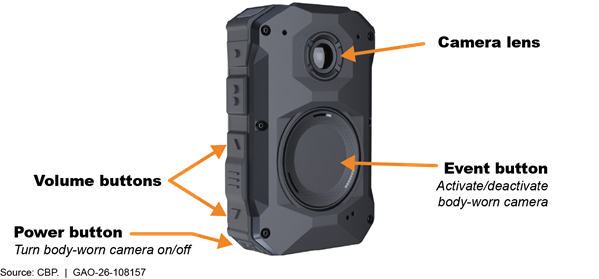
Body-worn cameras are integrated audio, video, and digital recording devices secured to a person using a variety of mounting options. They are worn to capture a first-person perspective of interactions between law enforcement personnel and the public. Personnel are to keep their cameras in standby mode and can activate or deactivate them while on duty using functional buttons, as shown in figure 1.
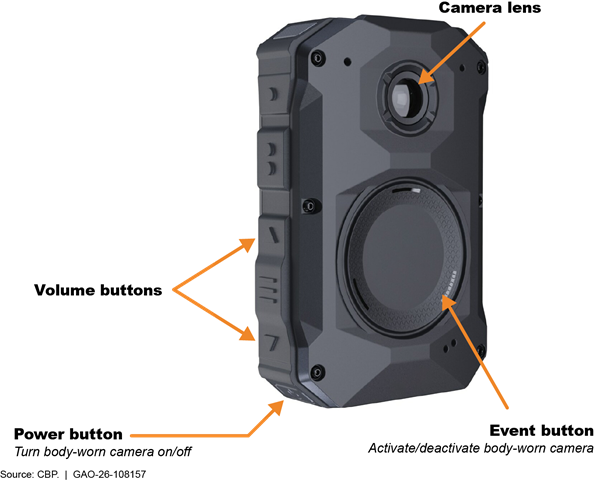
Note: Body-worn cameras include other functional buttons and features not depicted in this figure, such as the “select” functional button (e.g., to enter the menu screen or confirm end of recording), speakers, and charging port.
Body-Worn Camera Video Retention System
CBP and ICE personnel are required to upload footage to an access-restricted, web-based video retention system. Personnel can either place cameras in docking stations to automatically upload footage or manually upload footage through their computer workstations. After uploading footage, CBP and ICE personnel categorize it based on the type of law enforcement encounter, such as executing a search warrant or making an arrest. The video retention system includes safeguards, such as IT access controls, to help ensure that only approved personnel (e.g., the user and their supervisor) can access, view, or share footage. The system maintains an audit trail for every uploaded video, including any changes made to the footage and a time stamp. Additionally, the system allows CBP and ICE to securely manage, review, and share footage independently of each other.
Body-Worn Camera Program Policies
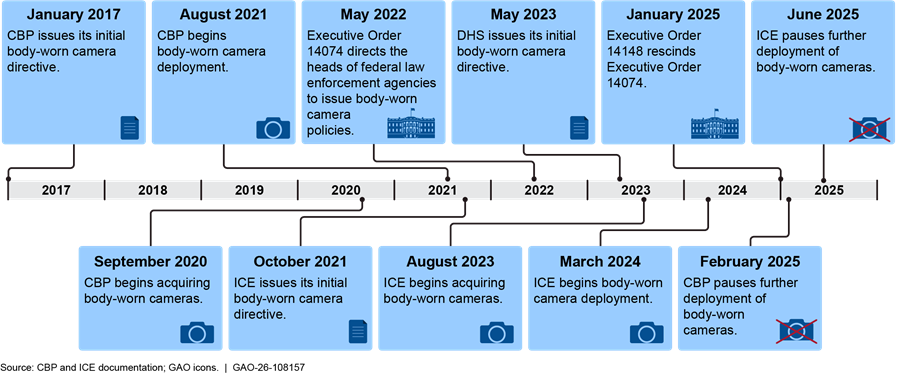
In May 2022, an Executive Order directed the heads of federal law enforcement agencies to issue policy to ensure that cameras are worn and activated in all appropriate circumstances, including patrolling, arrests, and searches.[8] In May 2023, DHS issued a policy outlining standards and general guidelines for the use of cameras by its law enforcement personnel.[9] The policy includes requirements for DHS components, including CBP and ICE, to develop policies, procedures, and training on carrying, operating, maintaining, and securing camera equipment and data. Among these requirements, personnel are to use cameras as appropriate when conducting planned (e.g., when serving and executing warrants) and unplanned (e.g., when patrolling the border) law enforcement activities. Additionally, the DHS policy describes situations when or environments where personnel are not to use cameras. These environments include courtrooms, hospital or medical facilities, undercover operations; and when personnel safety is at risk. For instance, while patrolling the U.S. border, a Border Patrol agent might experience an unplanned encounter and have to defend themself before they have an opportunity to activate their camera.
Both CBP and ICE issued directives requiring law enforcement personnel to wear and activate their cameras during enforcement encounters, with certain exemptions. CBP first issued its body-worn camera directive in January 2017 to establish requirements for the use of cameras by U.S. Border Patrol, Office of Field Operations, and Air and Marine Operations.[10] ICE first issued its directive in October 2021 for the use of cameras by Homeland Security Investigations and Enforcement and Removal Operations.[11]
Enforcement encounters include actions taken by component personnel to carry out their mission. Table 1 outlines CBP and ICE camera activation requirements and exemptions, defined in each component’s directives.
Table 1: U.S. Customs and Border Protection (CBP) and U.S. Immigration and Customs Enforcement (ICE) Body-Worn Camera Activation Requirements and Exemptions
|
|
CBP |
ICE |
|
Activation requirements |
According to the CBP directive, personnel are to activate cameras during, but not limited to · use of force incidents; · other encounters where personnel believe camera footage would assist in the investigation or prosecution of a crime, or when footage would assist in documenting the incident for further law enforcement purposes; and · observed suspicious or possible illegal activity. |
According to the ICE directive, personnel are to activate cameras during, but not limited to · arrests, including searches; · brief investigatory detentions; · execution of criminal and administrative arrest warrants and subpoenas; · execution of search or seizure warrants or orders; · execution of removal orders; · the protection of ICE and other federal government facilities; and · responding to emergencies. |
|
Recording exemptions |
When · complying with an order to deactivate cameras; · compromising personnel safety, including confidential informants and undercover personnel. · interfering with an encounter or inappropriate because of victim or witness physical condition, emotional state, age, or other sensitive circumstances; and · a witness is concerned about retaliation if seen cooperating with law enforcement. |
When · conducting undercover activity or confidential informants may be present; · conducting surveillance activities when an enforcement activity is not planned; · onboard commercial flights; · making controlled deliveries; and · conducting custodial interviews inside jails, prisons, detention centers, or ICE facilities. |
Source: CBP and ICE documentation. | GAO‑26‑108157
Note: In addition to exemptions, policies include active prohibitions. Personnel are prohibited from using cameras during nonenforcement interactions, including during peaceful protests, places of worship, while in restrooms, healthcare facilities, or other facilities such as courtrooms that prohibit the use of recording equipment.
Body-Worn Camera Program Management
CBP has a body-worn camera program management office within its Office of Field Operations Mission Support Directorate, and ICE within its Office of Firearms and Tactical Programs. These offices manage body-worn camera deployment and help provide oversight and guidance on use. Specifically, CBP and ICE program officials stated that these offices make determinations on the number of cameras to deploy and to which locations, develop guidance and training, provide technical support, and help ensure that personnel use the cameras in compliance with policy.
To help manage the programs, CBP and ICE established body-worn camera coordinators (a collateral duty typically for supervisors) at locations where personnel use the cameras. According to CBP and ICE program officials, these coordinators serve as local points of contact to help the program management offices provide direct support to personnel—including training, guidance, and remediation of technical issues.
Body-Worn Camera Program Funding and Deployment
For some fiscal years from 2019 through 2025, CBP allocated funds to support its body-worn camera program from its appropriations for “Operations and Support,” and ICE allocated funds for fiscal years 2023 through 2025 from its appropriations for “Mission Support.” Congressional reports accompanying DHS’s annual appropriations during these years sometimes specified funding amounts for CBP and ICE’s body-worn camera programs, whereas in other years there was no congressional direction as to specific funding levels.
For example, in fiscal years 2020 through 2023, the explanatory statement accompanying DHS’s annual appropriation specified amounts for CBP for body worn cameras under the operations and support appropriation. In 2020, this appropriation was $21 million; in 2021, $14.44 million; in 2022, $20 million; and in 2023, $21.05 million.[12] 2023 was the only fiscal year in which the explanatory statement also specified an amount, $12 million, for ICE’s body worn camera program.[13] In April 2026, the Homeland Security and Further Additional Continuing Appropriations Act, 2026, appropriated $20 million to the DHS Office of the Secretary and Executive Management for “procurement, deployment, and operations and body-worn cameras” for agents and officers performing immigration enforcement activities under the Immigration and Nationality Act.[14]
Our review of DHS contract obligation data shows that CBP and ICE began acquiring body-worn cameras under current contracts in 2020 and 2023, respectively, and planned to deploy cameras in phases.[15] According to program officials in both components, a phased approach allows each component to better manage logistical and other preparatory needs such as (1) updating their IT infrastructure by location, (2) acquiring equipment and support services, (3) shipping cameras and accessories (e.g., docking stations and mounts), (4) preparing and training personnel on the use of cameras and the management of footage, and (5) accounting for risks to further refine the program (e.g., significant changes in deployment requirements or reductions in program funding for either deployment or ongoing maintenance).
CBP began deploying cameras in fiscal year 2021. According to CBP data as of June 2026, CBP plans to deploy a total of approximately 49,000 cameras to Border Patrol, Office of Field Operations, Air and Marine Operations, and Office of Professional Responsibility personnel involved in enforcement actions.[16] To determine the order of deployment by location, CBP used a methodology it developed to prioritize locations based on factors such as the number of enforcement encounters and use of force incidents. As of June 2026, CBP had deployed approximately 11,500 cameras. Nearly all of these deployments have occurred within Border Patrol, with fewer than two percent of cameras deployed to other CBP offices. Figure 2 illustrates CBP’s completed deployments to each of its sectors.
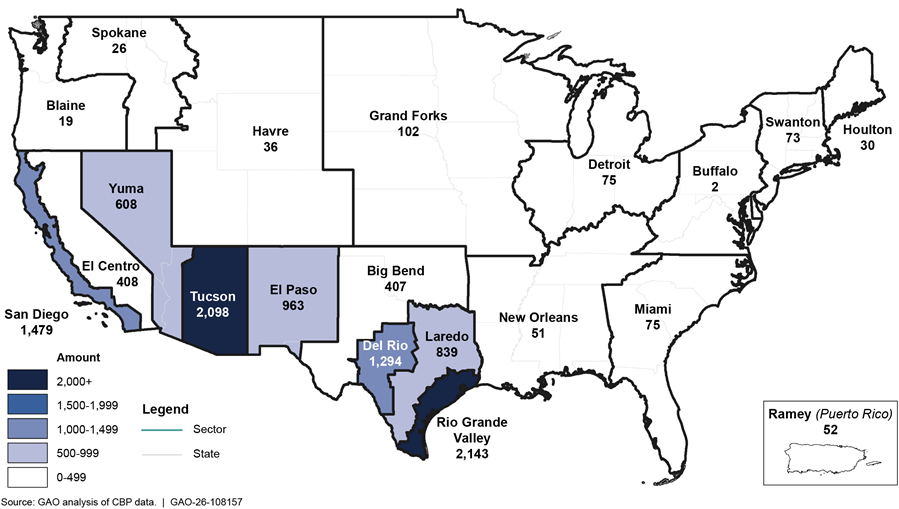
Note: CBP deployed an additional 491 cameras to units or locations not unique to one sector.
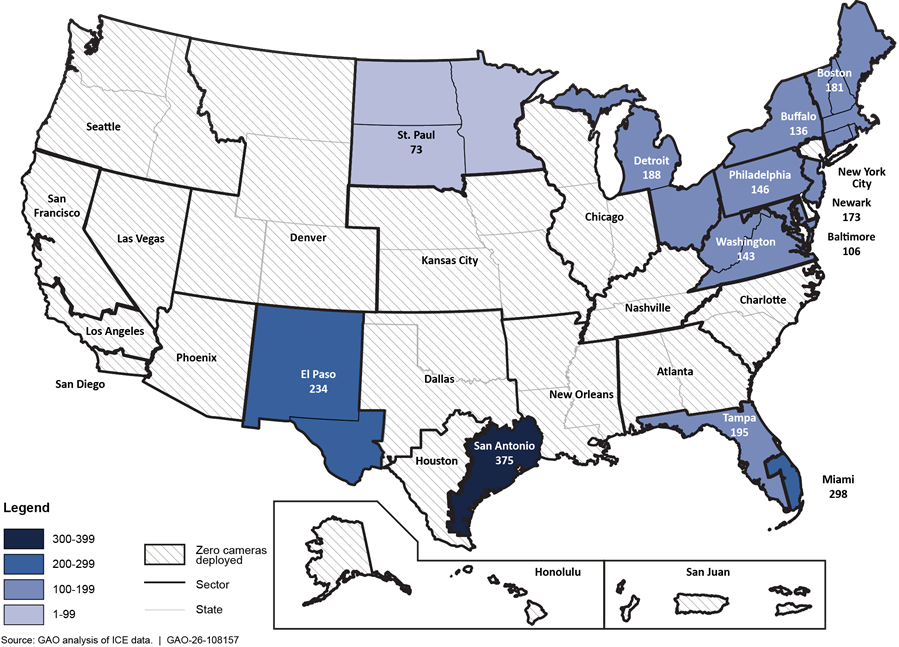
ICE began deploying cameras in fiscal year 2024. ICE documentation dated June 2024 reflects that it plans to deploy approximately 10,500 cameras to component personnel by fiscal year 2030. To determine the order of deployment by location, ICE used a model it developed in 2025 to prioritize locations based on factors such as the number of use-of-force incidents, arrests, and personnel who would use cameras. As of April 2026, ICE had deployed approximately 4,800 cameras, deploying cameras almost evenly to Enforcement and Removal Operations and Homeland Security Investigations, with about 50 cameras deployed to the ICE Office of Professional Responsibility. Figures 3 and 4 illustrate ICE’s completed deployments to its Enforcement and Removal Operations and Homeland Security Investigations offices.
Figure 3: Body-Worn Cameras Deployed to U.S. Immigration and Customs Enforcement (ICE), Enforcement and Removal Office (April 2026)
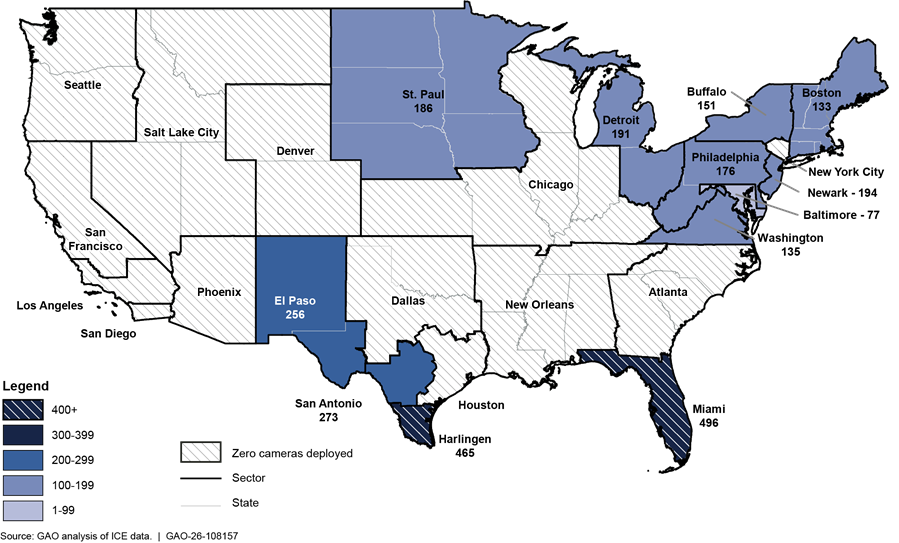
Figure 4: Body-Worn Cameras Deployed to U.S. Immigration and Customs Enforcement (ICE), Homeland Security Investigations (April 2026)
In January 2025, an Executive Order rescinded the prior directive requiring the heads of federal law enforcement agencies to issue policies to ensure that cameras are worn and activated in all appropriate circumstances.[17] Although DHS, CBP and ICE directives on body-worn camera use are still in effect, beginning in fiscal year 2025, the components chose not to allocate funds for their program offices to continue camera deployment.[18] As a result, the CBP and ICE program offices paused further camera deployment in February and June 2025, respectively. Figure 5 portrays these events, including issuance of directives and when the components began acquiring and deploying cameras to personnel.
Figure 5: U.S. Customs and Border Protection (CBP) and U.S. Immigration and Customs Enforcement (ICE) Body-Worn Camera Program Timeline
As of April 2026, program officials stated that both components are continuing program operations to support the approximately 11,500 and 4,800 cameras already in use by CBP and ICE personnel, respectively. The components indicated that they will deploy additional cameras to personnel. Additionally, in a statement to the press in early July 2026, a DHS media spokesperson announced that ICE plans to deploy cameras to all field offices within 60 days.
CBP and ICE Have Not Updated Body-Worn Camera Plans
We have previously reported on best practices for program management and have identified nine best practices for program and project management that represent basic program management principles. One key practice is that programs should develop and update a comprehensive program management plan, comprised of key components.[19] Among these components is to establish a process to manage change, including assessing the impact of changes to cost, schedule, or other program requirements. Additionally, program managers should update performance baselines such as schedules, cost estimates, and operational requirements regularly, taking into consideration changing constraints, risks, and opportunities. In particular, cost estimates should be updated regularly so that they support various program milestones and decisions, such as budget requests. A comprehensive program management plan should also include a program overview, acquisition strategy, documentation of risk management, processes for communicating with stakeholders, and processes for managing resources and human capital.
CBP. Prior to deploying cameras in 2021, the CBP program management office developed a plan that included key components of a comprehensive program management plan. For example, its plan included the number of cameras to be deployed, deployment priorities, major milestones, cost estimates, and operational requirements.[20] CBP program officials revised the cost estimate in 2021, and the program schedule and operational requirements in 2022.
However, since those updates in 2021 and 2022, CBP has experienced changes in the number of cameras scheduled for deployment and significant disruptions to its initial deployment schedule. Specifically, CBP revised the total number of cameras scheduled for deployment from about 20,000 as of January 2022 to about 49,000 as of June 2026. Also, the pause in camera deployment starting in February 2025 has delayed CBP’s implementation of the body-worn camera program by over one year at this point. According to CBP program officials, in addition to delaying or halting deployment of any additional cameras, funding reductions in future fiscal years could prevent personnel from having access to the video retention system for uploading, managing, and retaining footage. This concern represents a significant risk to program goals that would require active management of shifting operational requirements.
ICE. Similarly, as it began camera deployment in 2024, ICE’s program management office developed a plan that included key components of a comprehensive program management plan. For example, its plan included the number of cameras to be deployed, deployment priorities, major milestones, cost estimates, and operational requirements, However, as of June 2026 ICE has not updated its plans to reflect changes stemming from an increase in the total number of cameras scheduled for deployment and schedule delays caused by the pause in further camera deployment. Further, ICE, like CBP, is at least one year behind its 2024 plan. Additionally, ICE’s overall deployment needs have increased. Specifically, according to ICE program officials, the component intends to provide cameras to all personnel, including planned future hires. In July 2025, ICE initiated a hiring surge of about 12,000 additional personnel. However, the number of cameras scheduled for deployment documented in its 2024 plan has remained relatively stable as of April 2026.
Given the pause in further deployment, the future of CBP and ICE’s body-worn camera programs is uncertain as of June 2026. This disruption, along with other changes that have occurred during the life of these programs, have made plans created in 2022 and 2024, respectively, unreliable as guides to confront programmatic constraints, risks, and opportunities effectively. Updating program management plans based on an assessment of changes to program schedules and costs, as well as planning for contingencies based on current risks, would help CBP and ICE ensure they are prepared to achieve operational goals amid uncertainty. The lack of current program plans that are clearly defined and aligned with organizational objectives makes it difficult for both component programs to plan for and communicate with stakeholders about needs to respond to changing operational requirements and constraints.
CBP and ICE Have Not Implemented Performance Goals to Assess Results of Their Body-Worn Camera Programs
DHS May 2023 policy on body-worn cameras states that DHS’s Office of Strategy, Policy, and Plans will collaborate with CBP and ICE to develop measures to be tracked by their body-worn camera programs.[21] Although additional camera deployment is currently paused, DHS, CBP, and ICE policies are still in place and applicable to the approximately 11,500 and 4,800 cameras currently in use by CBP and ICE personnel, respectively. In our key practices guide on evidence-based policy making, we described results-oriented performance management as a three-step process by which organizations: (1) define desired outcomes—using strategic goals—and identify the results the program is intended to achieve—using performance goals, (2) measure performance by collecting information, and (3) use performance information to assess progress and inform decisions as well as communicate information externally.[22] This key practices guide states that collecting evidence about a program, such as measures to assess results, can inform a range of decisions, including changes to existing strategies or identifying additional needs for new evidence to achieve better results or reallocation of resources.
Strategic goals are an outgrowth of the mission, and explain what results are expected from the program’s major functions. CBP and ICE have stated desired results for their respective camera programs. Specifically, according to CBP’s component-wide strategic plan for calendar years 2021 to 2026, CBP must increase transparency into how it serves the public and provide technologically advanced systems. ICE’s component-wide strategic plan for fiscal years 2026 to 2030 emphasizes the need for data-driven capabilities, such as analytic tools and surveillance systems, that enhance officer safety, as well as public engagement to maintain transparency, accountability, and trust. According to both components’ body-worn camera policies, the use of cameras in appropriate circumstances may be beneficial to the execution of many operations and may also (1) promote public trust; (2) enhance service to the community by accurately documenting events, actions, conditions, and statements made by encountered individuals; and (3) increase officer and public safety, accountability, and transparency.
Performance goals describe a target level of performance expressed as a tangible, measurable objective against which actual achievement is to be compared. CBP and ICE have implemented some performance goals related to the availability and reliability of the cameras. For example, both components’ operational requirements state that the cameras should have an operational availability of 90 percent, and the video retention system should have a reliability, or mean time between failure, of 29,200 hours for CBP and 2,000 hours for ICE. However, aside from these performance goals related to operational availability and reliability, neither component has implemented performance goals with related measures to assess program results. For example, a performance goal related to the application of body-worn camera video footage as evidence in use of force or alleged misconduct investigations could provide insight into the extent to which the cameras are helping to achieve goals such as enhanced transparency and public trust.
Measures are the specific pieces of information used to assess results, track whether a performance goal is achieved, and assess progress towards strategic goals and objectives. We previously reported that agencies that are successful in measuring performance had measures to assess results that follow key attributes such as supporting the intent of the program and aligning with component-wide goals.[23]
CBP and ICE have implemented some measures to track basic information for their body-worn camera programs, for instance, the number of video recordings captured by category (i.e., evidentiary, potentially evidentiary, and non-evidentiary footage). CBP and ICE also collect data on camera reliability and availability, including the duration of video retention system outages and the number of camera failures. CBP and ICE’s program management offices have also conducted surveys of personnel (e.g., end users of the cameras), involving the use of certain camera mounts and satisfaction with training on camera use. These measures help the components maintain data on how the cameras are used, ensure that the cameras are functioning, and assess how certain aspects of the program, such as training, serve user needs.
However, there are other aspects of the body-worn camera program results that CBP and ICE do not currently measure. For example, CBP and ICE began the process of developing measures to assess the impact cameras have on interactions with the public as part of their preliminary analyses. CBP’s capability analysis in 2019 includes potential measures to assess results, such as the percent of certain interactions that are recorded related to use of force and those involving complaints. Similarly, ICE developed measures to gauge the success of their body-worn camera pilot program in 2021, such as the number of documented cases of use of force by type of force and the number of judicial outcomes.
Additionally, CBP and ICE local officials that we interviewed at all 10 locations stated that camera footage offers benefits due to its value as evidence, including improving the quality of reports of investigation, and resolving allegations of employee misconduct more efficiently. However, despite these stated benefits, neither component has formally adopted related measures for their existing body-worn camera programs, nor implemented performance goals to track progress towards achieving results and meeting their strategic goals.
According to DHS officials, the effort by the department to develop measures for each component’s body-worn camera program was delayed without an estimate for completion, due to competing priorities and the DHS shutdowns due to a lapse in appropriated funds in fiscal year 2026. ICE program officials stated that although they developed measures to assess results as part of their pilot program, they have not begun tracking them since the body-worn camera program is relatively new and it is too early to see quantifiable results. Similarly, CBP program officials stated they have not tracked measures to assess results, other than camera reliability and availability, that encapsulate all recordings and incidents because they have not deployed cameras to all personnel.
While ICE’s strategic plan is silent on the issue, CBP’s strategic plan emphasizes that it can take years for performance measures to fully capture the impact of a program. However, this does not prevent either component from beginning to track these measures immediately. Delaying the establishment of measures to assess results limits the components’ ability to remain focused on impact and to establish meaningful baselines for performance measurement. Implementing results-oriented performance goals and measures would help CBP and ICE assess the efficacy of their body-worn camera programs in meeting their desired results, throughout deployment and beyond. Such measures would help the components make better-informed resource decisions about camera deployment, improve internal and external communication about deployment and use, and identify potential improvements.
CBP and ICE Lack Key Controls to Ensure Compliance with the Body-Worn Camera Program
CBP and ICE Provide Training and Technical Support to Personnel Who Use Body-Worn Cameras
Training. According to CBP and ICE policy, personnel are to receive training on appropriate data handling practices and compliance with relevant privacy requirements, laws, and regulations. The program management offices each developed a structured training framework to support this training using both train-the-trainer and direct end-user training. Specifically, CBP and ICE program management offices are primarily responsible for training body-worn camera coordinators, while body-worn camera coordinators deliver training to personnel who use the cameras.
Both trainings cover a range of critical topics on the use of cameras and video retention system, including policy requirements, legal considerations, and managing evidence. After initial deployment, the policy states that coordinators should provide training to new hires as needed. Additionally, according to CBP and ICE program officials, training documents are maintained and accessible to personnel on each component’s internal network. CBP and ICE local officials that we interviewed at all 10 locations stated that training was sufficient and prepared them for the use of cameras.
CBP also offers additional training and support to personnel to reinforce camera use and policies. Specifically, CBP requires its offices to provide in-person or virtual refresher training annually for all personnel who have been issued cameras.[24] Additionally, CBP and ICE local officials that we interviewed at four of the 10 locations stated that footage from actual encounters has also been integrated into tactical training to demonstrate proper or recommended law enforcement techniques. For example, during use-of-force training, local officials stated that some offices have personnel simulate activation of their camera and practice categorizing their footage properly.
Lastly, according to CBP program officials, the Border Patrol Academy includes training on camera usage and policy provided by the Federal Law Enforcement Training Center. However, this training is not provided to other CBP offices (i.e., Air and Marine Operations or Office of Field Operations) or ICE. CBP program officials stated that training on cameras will be incorporated for all offices when additional funding for the program is provided. ICE program officials stated that the component has been coordinating with the Federal Law Enforcement Training Center to provide related training component-wide by the end of fiscal year 2026.
Technical support. According to CBP and ICE policy, personnel are to notify their supervisors when technical issues arise. Specifically, CBP and ICE supervisors are responsible for ensuring that cameras and related equipment are functioning properly. If a technical issue cannot be resolved locally, coordinators are expected to escalate it to the program management office.
CBP and ICE local officials that we interviewed at most locations described technical issues they experienced soon after deployment—some of which related to network capacity or how the docking stations interacted with their networks. CBP and ICE local officials that we interviewed in nine out of 10 locations stated that they faced technical issues with the cameras, and local officials in eight out of these nine locations stated that these technical issues have been resolved.[25]
CBP and ICE Have Oversight Mechanisms, but ICE Lacks Controls to Ensure Body-Worn Camera Activation
CBP and ICE camera policies include processes for the use of cameras and the management of footage, as shown in figure 6. The components have established some oversight mechanisms, such as supervision and audit processes, to help ensure compliance with policies for managing footage. However, ICE has not implemented controls to help ensure compliance with activating cameras when required by policy.
Figure 6: Customs and Border Protection and Immigration and Customs Enforcement Process for the Use of Body-Worn Cameras and Management of Footage
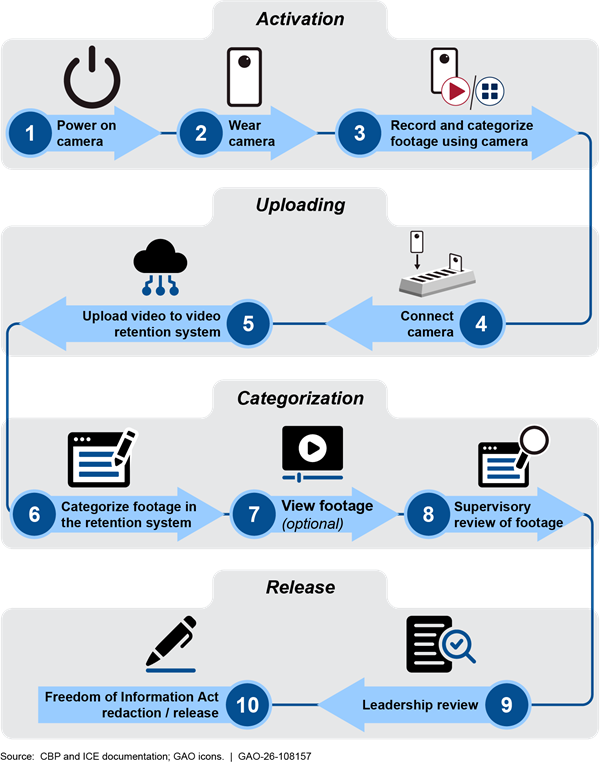
Note: According to component program officials, steps nine and ten are unique to footage that may be shared outside the component. Personnel can either categorize footage on the body worn camera after they end a recording, or after they upload footage to the video retention system.
Activation. According to CBP and ICE policy, personnel should record enforcement encounters at the start of the encounter or as soon as safely possible thereafter. Standards for Internal Control in the Federal Government states that management should design control activities in response to risks to achieve an effective internal control system.[26] Control activities can be designed and implemented in an automated, partially automated, or a manual manner.[27] For example, one possible automated control to help ensure critical events are recorded is automated camera activation. Automated activation of body-worn cameras is an available option from the current vendor when emergency vehicles are engaged, a weapon is drawn, or proximity to another activated camera occurs, which help ensure critical events are recorded.[28] An example of a potential manual control to help ensure camera activation is requiring personnel to document a reason for nonactivation in a centralized system to support accountability and supervisory review.
To help ensure that personnel activate cameras when safe to do so, CBP has some control activities, including the use of automated activation technology to trigger camera recording in specific situations (such as when a firearm is drawn or emergency lights are activated), according to CBP program officials. Additionally, according to CBP and ICE program officials, CBP body-worn camera coordinators and ICE program officials conduct reviews of use-of-force incidents to ensure that there is corresponding footage of the incident within the video retention system.
CBP and ICE’s directives state that component leadership has responsibility to ensure that their personnel use cameras in compliance with policy. ICE’s directive, in contrast to CBP’s, delegates this responsibility to supervisors who are responsible for ensuring that personnel use cameras during enforcement encounters. CBP and ICE local officials we interviewed at most locations stated that supervisors help ensure that personnel use cameras as required by communicating expectations with personnel before or during an encounter. For example, supervisors told us that they communicate these expectations before an encounter in routine daily meetings or during an encounter by radio or in person.
Also, CBP and ICE local officials we interviewed at all locations stated that personnel may be expected to inform their supervisors, either through verbal or written communication, if they failed to activate their camera during an encounter. Specifically, according to CBP policy, personnel may be required to provide a statement indicating why they did not activate their camera, but does not specify under which circumstances they would be required to do so. According to ICE policy, they must provide this statement. If personnel repeatedly fail to activate their camera as expected, CBP and ICE local officials we interviewed at most locations stated that they would determine if there is a need for corrective or disciplinary action. The topic of disciplinary action did not specifically arise in our discussions with officials at the other locations. According to each component’s program officials, CBP had issued only one written reprimand regarding compliance with camera policies for CBP personnel, and ICE had not issued any reprimands for ICE personnel since the inception of both components body-worn camera programs through September 2025.
Both CBP and ICE have manual controls to monitor camera activation, such as supervisory oversight, including relying on personnel to report a failure to activate to their supervisors, and reviews of use of force incidents. However, only CBP has automated controls, such as automatic camera activation technology. ICE does not have similar automated control activities in place to help ensure that personnel activate their cameras as required by policy or to reliably monitor whether repeated instances of failure to activate occur. This presents the risk of personnel not capturing footage of incidents when they are required to do so. According to a risk assessment in CBP’s analysis of body-worn camera capabilities, which ICE also leveraged in part, the inability to capture footage could negatively impact prospects for public engagement, successful data, enforcement, and other partnerships, including a loss of public confidence and transparency.
It can be difficult to manually monitor activation for numerous reasons cited by CBP and ICE program and local officials. Specifically, according to program officials, some case management systems used by the components and offices do not fully interface with the video retention system, making it difficult to ensure that footage exists for every case that would be maintained in these systems.[29] Additionally, due to the large amount of footage captured and the number of enforcement encounters conducted on a daily basis, program officials and some of the local officials we interviewed stated that it would not be reasonable to expect that a supervisor would be able to ensure that all cameras were activated as expected.
Lastly, local officials we interviewed at several locations stated that there are a number of situations where personnel either have not received a camera (because cameras have not been fully deployed nationally) or could not activate their camera (e.g., officer safety). For these reasons, it may sometimes be difficult for CBP and ICE to determine whether a camera was present and should have been activated.
By implementing control activities related to camera activation, such as automated camera activation technology, ICE would have an improved mechanism to ensure that footage is captured in accordance with policy and enable the agencies to promote public confidence and provide increased transparency into operations. Without reliable control activities, ICE risks gaps in documentation and video evidence that can make reviews of incidents more challenging.
Uploading. According to CBP and ICE policy, personnel are responsible for ensuring that footage is moved to storage at the end of their shift unless otherwise instructed. CBP and ICE local officials we interviewed at most of the locations stated that after an encounter, supervisors generally remind personnel to upload and categorize their footage as needed. Footage automatically uploads to the video retention system when personnel place cameras in docking stations to charge at end of shift. Personnel can also upload footage by connecting cameras to government-issued laptops or workstations.
Categorization. According to CBP and ICE policy, personnel are responsible for correctly categorizing footage within the video retention system.[30] After uploading footage, CBP and ICE personnel categorize it based on the type of law enforcement encounter. A single video may include multiple categories. As shown in table 2, each category corresponds to one of three National Archives and Records Administration records schedule retention periods based on the evidentiary nature of the law enforcement encounter. If assigned multiple categories, retention length follows the category associated with the highest retention period.
Table 2: U.S. Customs and Border Protection (CBP) and U.S. Immigration and Customs Enforcement (ICE) Body-Worn Camera Retention Categories
|
Evidentiary nature |
Definition |
Retention period |
Examples of categories |
|
Evidentiary |
Footage may have value bearing on or that could be used as evidence in any criminal, administrative, civil, or other legal proceeding. |
75 years or indefinitea |
Use of Force, Litigation Hold, Death or Serious Injury |
|
Potentially evidentiary |
Footage that could become evidentiary but is not currently associated with an open case. |
3 years |
Search Warrant, Administrative Warrant, Warrantless Arrest |
|
Non-evidentiary |
Footage recorded during normal duties that has been determined to have no evidentiary value. |
60-180 days |
Accidental Recordings, Training/Testing |
Source: GAO analysis of CBP and ICE documentation. | GAO‑26‑108157
aThe evidentiary retention period is for the associated case file, which documentation indicates as 75 years for CBP and indefinite for ICE.
Supervisors conduct monthly reviews of footage by watching a subset of randomly selected videos with their area of responsibility to help ensure proper categorization. These reviews include all footage categorized as a use of force, assault against officer, and significant incident, as well as a random sample of other footage uploaded to the system.[31] If footage was categorized incorrectly, CBP and ICE local officials we interviewed at most locations stated that supervisors will notify the responsible personnel to have them correct the mistake. The officials added that there were no pervasive compliance issues discovered as a result of these categorization reviews.
The CBP program management office conducts biweekly reviews of all footage in the video retention system to help ensure that personnel categorized footage. ICE conducts these reviews monthly. These reviews describe, by field office, the number of uncategorized videos and how long they remain uncategorized. CBP’s reports also note when a change of category occurred to a video resulting in a lower retention period. CBP and ICE’s program management offices send these reports to the field units to coordinate corrective actions with personnel.
CBP’s and ICE’s policies require that evidentiary and potentially evidentiary footage be retained for the appropriate period at least 90 percent of the time (which is accomplished by proper categorization). We found that both components generally met these requirements. For example, CBP’s March 2026 dashboard report showed that over 99 percent of footage in its video retention system was categorized. ICE’s January 2026 dashboard report showed that over 91 percent of footage was categorized.
Redaction and Release. According to CBP and ICE policy, CBP’s Privacy, Freedom of Information Act (FOIA), and Equal Employment Opportunity Office and ICE’s Office of Information Governance and Privacy receive FOIA requests for footage and are responsible for reviewing and redacting certain data. These offices also coordinate with other relevant offices, such as CBP and ICE’s respective Offices of Professional Responsibility, prior to its release.
When responding to a request, CBP and ICE FOIA officials stated that they will redact data such as officer faces, identification, license plates of federal vehicles, and protected entities, such as individuals with asylum or informant status. The video retention system includes automated redaction tools, in which authorized personnel can redact personally identifiable or law enforcement sensitive information before release, according to the officials. However, FOIA officials stated that the automated tools can be unreliable and redaction is a complex process, so for every request it is also necessary to manually review footage to make redactions. The video retention system retains original, uploaded footage separately from any subsequent edits.
Since the inception of the body-worn camera program, ICE program officials stated they have received 675 FOIA requests for footage, while CBP program officials stated they have received about 800 requests. However, this number is relatively small compared to the entire universe of FOIA requests. For instance, as of June 2026, CBP has received about 109,000 requests thus far in fiscal year 2026 according to program officials.
CBP and ICE Personnel Lack Operational-Specific Guidance on the Use of Body-Worn Cameras
DHS, CBP, and ICE have broad policy guidance on the use of cameras at the appropriate organizational level. As previously discussed, CBP and ICE policy states that personnel should record enforcement encounters at the start of the encounter or as soon as safely possible. The policy also provides general examples of activities that may qualify as an enforcement encounter. However, most CBP and ICE offices do not have operational guidance that explains how personnel should use cameras during their unique operations or activities.
During our site visits, some field personnel expressed uncertainty about (1) how to apply component-level policy in their specific operational context and (2) how to use camera functionalities. For example, CBP and ICE personnel that we interviewed in six out of 10 locations expressed uncertainty about when they were required to activate or not activate their cameras. Personnel were uncertain which law enforcement encounters qualified as an “enforcement action” and therefore required camera activation. Other personnel reported that camera use is “not mandated,” “up to interpretation,” and “has gray areas.” Specifically, they said subpoena issuance, in-custody interviews, vehicle searches, undercover operations, and detainee transports were all examples of law enforcement encounters that presented uncertainty. Personnel at one ICE location that we interviewed stated that they had not begun using cameras after deployment and completion of training due to this uncertainty.
In addition, CBP and ICE personnel that we interviewed at five out of 10 sites stated that there was a lack of guidance regarding the transition to a newer camera model, which presented confusion over how to deactivate the camera and how to use the categorization function on the camera itself. At one location, local officials stated the program management office followed up with an email notification retroactively after hearing feedback on the issue, while others stated that personnel figured out new functionalities through trial and error.
According to DHS policy, component-level policies should identify specialized or sensitive investigative techniques or equipment that may require different treatment under the camera policy. The CBP and ICE directives require each of its offices to develop operational guidance and assigns responsibility to each office for ensuring that this guidance is updated and coordinated with all applicable offices. Additionally, the ICE directive assigns local officials responsibility for ensuring personnel receive the guidance necessary to use cameras successfully.
Standards for Internal Control in the Federal Government state that management should internally communicate relevant and quality information, including objectives and responsibilities for internal control, necessary to support the functioning of the internal control system, and those in key roles for a particular organizational unit may further define policies through day-to-day procedures.[32]
Three of CBP’s four offices that use body-worn cameras—Border Patrol, Office of Field Operations, and Air and Marine Operations—have implemented internal operating procedures. However, these procedures do not include instructions on the use of cameras during specific operations, such as during vehicle checkpoints or specialized operations at ports of entry. According to these documents, personnel are responsible for determining the need to activate their camera during an enforcement encounter. For instance, all three internal operating procedures generally define enforcement encounters as actions taken by personnel to carry out their mission and also provide examples, such as use of force incidents and observed suspicious or possible illegal activity. Additionally, CBP Office of Professional Responsibility officials stated that they have not provided their personnel internal operating procedures or guidance specific to its operations. CBP officials stated that internal operating procedures were provided on the use of cameras. However, these procedures do not include guidance on the use of cameras within each office’s unique operations or activities.
ICE’s Enforcement and Removal Operations and Office of Professional Responsibility have created operational specific guidance that includes further information on using cameras during operations as required by agency policies. Officials within Enforcement and Removal Operations and the Office of Professional Responsibility published handbooks in February 2024 and December 2024, respectively, to clarify situations when its personnel must, should, and can’t record. According to Enforcement and Removal Operations officials, this guidance helps to reduce recurring misunderstandings regarding camera use.
These handbooks define the enforcement activities listed in the broader ICE directive and provide step-by-step guidance for camera use during enforcement activities unique to the office. Specifically, the Enforcement and Removal Operations handbook includes guidance regarding when to activate and deactivate cameras during executions of removal orders involving special high-risk charter flights. The ICE Office of Professional Responsibility handbook includes guidance on when to activate and deactivate cameras while making arrests, executing warrants, and other enforcement activities related to the office’s distinct mission of investigating ICE employees.
However, ICE’s Homeland Security Investigations has not yet finalized its effort to publish a handbook that would include detailed guidance on using cameras during operations as required by agency policies. Although program officials acknowledged that guidance that is more specific to the operational contexts of their offices is needed, Homeland Security Investigations officials stated they have not dedicated the resources to finalizing operational guidance due to the pause in camera deployment, as previously discussed.
Guidance on the appropriate use of cameras in operational environments for all offices, including Border Patrol, which has been allotted most of the deployed cameras, would provide clear expectations for personnel, reducing uncertainty about how to comply with the overarching CBP and ICE directives. Although CBP and ICE have paused body-worn camera deployment, personnel who currently use cameras would be better positioned to meet expectations if provided this guidance. Guidance that defines specific enforcement activities, provides step-by-step instructions for camera activation and deactivation, and clearly delineates when cameras must, should, and cannot be used, would help provide personnel, as well as leadership, better clarity and assurance that cameras are being used as required.
Conclusions
Although CBP and ICE developed initial plans for the implementation of their body-worn camera programs, neither component has updated these plans to account for changes stemming from increasing the number of cameras scheduled for deployment and pausing the further deployment of cameras. Without updating program management plans based on an assessment of these changes, CBP and ICE may face difficulties coordinating aspects of their programs and addressing issues such as pausing further deployment and increases in the total number of cameras scheduled for deployment.
CBP and ICE have implemented measures to help track basic information related to camera functionality and availability. However, it is difficult for CBP and ICE to assess the contributions of body-worn cameras to ICE’s desired results, such as enhancing public trust and transparency, because the components have not implemented results-oriented performance goals that would help the components assess the efficacy of their body-worn camera programs. Implementing results-oriented performance goals and measures is particularly important for the components to make better-informed resource decisions and identify potential improvements.
Additionally, although the components have established oversight mechanisms for some aspects of camera use and footage handling, ICE lacks reasonable assurance of compliance with activation requirements in policy. This lack of assurance is because ICE does not have automated controls to help ensure camera activation. The lack of control activities, such as automated camera activation technology, could result in failure to capture footage, which could undermine the desired results of enhancing transparency, public trust, and officer and public safety.
Lastly, CBP and ICE have established overarching directives related to camera use during enforcement encounters. However, not all ICE offices and no CBP offices have implemented guidance to describe how personnel are expected to use their cameras in specific operational situations—for example, context-driven descriptions of when cameras must be used and must not be used. Current policies assign responsibility to individual personnel to determine the need to activate their camera during an enforcement encounter. Therefore, implementing operational-specific guidance for each CBP office and each ICE’s Homeland Security Investigations office would help the components ensure that all personnel comply with policy requirements. This guidance should include, at a minimum, clear definitions of when cameras are required in the context of each office’s operational realities. The lack of this operational-specific guidance is a potential impediment to the components providing personnel clear expectations so that they can consistently meet them.
Recommendations for Executive Action
We are making a total of seven recommendations, including three recommendations to CBP and four recommendations to ICE. Specifically:
The Commissioner of CBP should update its program plans to align with changes in requirements, such as costs and schedules, and plan for contingencies based on current risks. (Recommendation 1)
The Director of ICE should update its program management plans to align with changes in requirements, such as costs and schedules, and plan for contingencies based on current risks. (Recommendation 2)
The Commissioner of CBP should implement results-oriented goals and measures that assess the effectiveness of the body-worn camera program in meeting desired results such as enhancing public trust and transparency. (Recommendation 3)
The Director of ICE should implement results-oriented goals and measures that assess the effectiveness of the body-worn camera program in meeting desired results such as enhancing public trust and transparency. (Recommendation 4)
The Director of ICE should implement additional controls, such as automated camera activation technology, that help ensure that body-worn cameras are activated in accordance with ICE’s body-worn camera policy. (Recommendation 5)
The Commissioner of CBP should ensure that U.S. Border Patrol, Office of Field Operations, Air and Marine Operations, and the Office of Professional Responsibility each implement operational guidance for body-worn cameras that includes, at a minimum, clear expectations on the appropriate use of cameras in the context of each office’s operational realities. (Recommendation 6)
The Director of ICE should ensure that Homeland Security Investigations implements operational guidance for body-worn cameras that includes, at a minimum, clear expectations on the appropriate use of cameras in the context of each office’s operational realities. (Recommendation 7)
Agency Comments and Our Evaluation
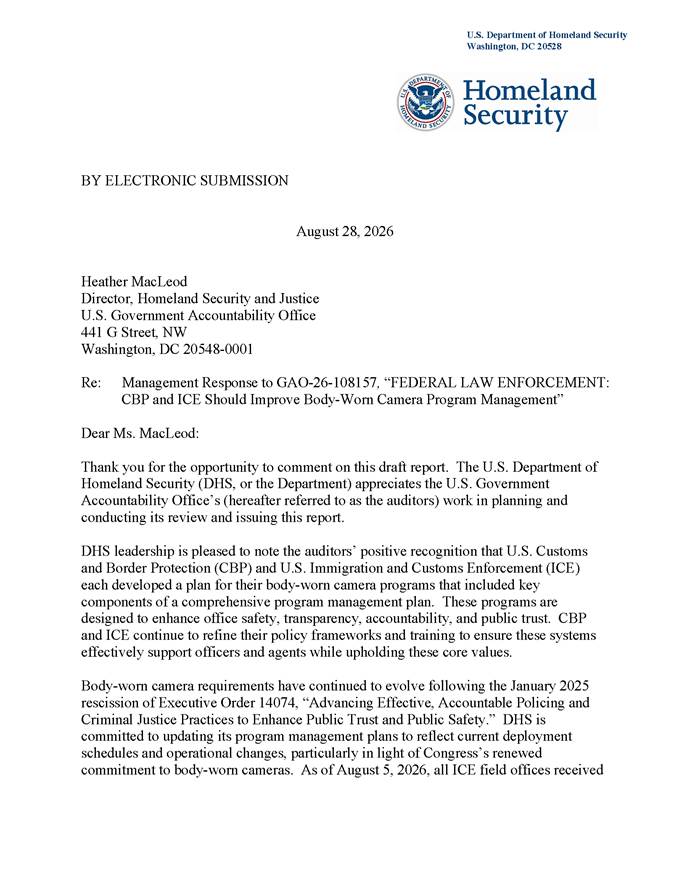
We provided a draft of this report to DHS for its review and comment. DHS provided written comments, which are reproduced in appendix I. In its comments, DHS agreed with six of the seven recommendations in the report and described planned actions to address them. It did not agree with one recommendation, as discussed below. DHS also provided technical comments, which we incorporated as appropriate.
DHS did not agree with our fifth recommendation that ICE implement additional controls, such as automated camera activation technology, that help ensure that body-worn cameras are activated in accordance with ICE’s body-worn camera policy. In its response, DHS stated that, for ICE, automatic activation presents operational risks, including inadvertent or false activations during routine movement. DHS also stated that these inadvertent or false activations could result in the unauthorized recording of sensitive interactions with informants or victims, or the recording of bystanders engaged in First Amendment activities in areas where camera use is restricted. However, DHS’s response did not include information on environments where automated activation could be effective, or other controls that could help ensure compliance with activating cameras when required by policy.
We maintain that additional controls, such as automated camera activation, would provide greater assurance that body-worn cameras meet ICE’s desired results for transparency, accountability, and public trust. This assurance could be particularly beneficial in situations where unexpected and unplanned incidents, unrelated to sensitive operations, result in use of force by or against personnel. As discussed in this report, we noted that CBP has implemented these types of controls in similar environments. We also reported that ICE and other officials said that it can be difficult to manually monitor activation for numerous reasons and that there are risks associated with personnel not capturing footage of incidents when they are required to do so. For example, the inability to capture footage could negatively impact prospects for public engagement, including a loss of public confidence and transparency. Given the important role of body-worn cameras in law enforcement activities, we maintain that additional controls are needed to help ensure that ICE personnel capture footage in accordance with policy.
As agreed with your offices, unless you publicly announce the contents of this report earlier, we plan no further distribution until 29 days from the report date. At that time, we will send copies of this report to the appropriate congressional committees, the Secretary of Homeland Security, and other interested parties. In addition, the report will be available at no charge on the GAO website at http://www.gao.gov.
If you or your staff members have any questions about this report, please contact me at MacLeodH@gao.gov. Contact points for our Offices of Congressional Relations and Media Relations may be found on the last page of this report. GAO staff who made key contributions to this report are listed in appendix II.

Heather MacLeod
Director, Homeland Security and Justice
GAO Contact
Heather MacLeod, MacleodH@gao.gov
Staff Acknowledgments
In addition to the contact named above, Kathryn Godfrey (Assistant Director), Mike Tropauer (Analyst in Charge), Nasreen Badat, Ben Crossley, Peter Del Toro, Rebecca Gambler, Bethany Gracer, Tom Jessor, Heidi Nielson, Amanda Panko, Meghan Perez, and Mary Turgeon made key contributions to this report.
The Government Accountability Office, the audit, evaluation, and investigative arm of Congress, exists to support Congress in meeting its constitutional responsibilities and to help improve the performance and accountability of the federal government for the American people. GAO examines the use of public funds; evaluates federal programs and policies; and provides analyses, recommendations, and other assistance to help Congress make informed oversight, policy, and funding decisions. GAO’s commitment to good government is reflected in its core values of accountability, integrity, and reliability.
Obtaining Copies of GAO Reports and Testimony
The fastest and easiest way to obtain copies of GAO documents at no cost is through our website. Each weekday afternoon, GAO posts on its website newly released reports, testimony, and correspondence. You can also subscribe to GAO’s email updates to receive notification of newly posted products.
Order by Phone
The price of each GAO publication reflects GAO’s actual cost of production and distribution and depends on the number of pages in the publication and whether the publication is printed in color or black and white. Pricing and ordering information is posted on GAO’s website, https://www.gao.gov/ordering.htm.
Place orders by calling (202) 512-6000, toll free (866) 801-7077,
or
TDD (202) 512-2537.
Orders may be paid for using American Express, Discover Card, MasterCard, Visa, check, or money order. Call for additional information.
Connect with GAO
Connect with GAO on X,
LinkedIn, Instagram, and YouTube.
Subscribe to our Email Updates. Listen to our Podcasts.
Visit GAO on the web at https://www.gao.gov.
To Report Fraud, Waste, and Abuse in Federal Programs
Contact FraudNet:
Website: https://www.gao.gov/about/what-gao-does/fraudnet
Automated answering system: (800) 424-5454
Media Relations
Sarah Kaczmarek, Managing Director, Media@gao.gov
Congressional Relations
David A. Powner, Acting Managing Director, CongRel@gao.gov
General Inquiries
[1]GAO, Law Enforcement: DHS Should Strengthen Use of Force Data Collection and Analysis, GAO‑23‑105927 (Washington, D.C.: July 24, 2023).
[2]GAO, Southwest Border: CBP Could Take Additional Steps to Strengthen Its Response to Incidents Involving Its Personnel, GAO‑24‑106148 (Washington, D.C.: May 13, 2024).
[3]GAO, Law Enforcement: DOJ Can Improve Publication of Use of Force Data and Oversight of Excessive Force Allegations, GAO‑22‑104456 (Washington, D.C.: Dec. 7, 2021). We identified four types of stakeholders to meet with: (1) civil rights organizations, (2) law enforcement associations, (3) academic researchers (including representatives from think tanks), and (4) federal agencies with expertise on this topic.
[4]Aspects of GAO’s program management best practices can be found in the following GAO reports: GAO, Nuclear Waste Cleanup: DOE Could Improve Program and Project Management by Better Classifying Work and Following Leading Practices, GAO‑19‑223 (Washington, D.C.: Feb. 2019) and GAO, Nuclear Waste Cleanup: Closer Alignment with Leading Practices Needed to Improve Department of Energy Program Management, GAO‑24‑105975 (Washington, D.C.: June 2024). These best practices are further defined in the GAO Program and Project Management Assessment Guide (exposure draft). To develop the exposure draft, we have worked closely with program and project management knowledgeable specialists from the public and private sectors. All best practices included in the exposure draft have been reviewed by this group of knowledgeable specialists.
[5]GAO, Evidence-Based Policymaking: Practices to Help Manage and Assess the Results of Federal Efforts, GAO‑23‑105460 (Washington, D.C.: July 12, 2023).
[6]GAO, Standards for Internal Control in the Federal Government, GAO‑25‑107721 (Washington, D.C.: May 2025). See principles: Design Control Activities, Implement Control Activities, and Communicate Internally, sections 10.02, 10.03, 10.05, 12.04, and 14.01.
[7]For CBP, we conducted interviews with Border Patrol sectors and stations in McAllen, TX; Tucson, AZ; Ogdensburg, NY; and Detroit, MI; Office of Field Operations in Baltimore, MD and Detroit, MI; and the Office of Professional Responsibility in McAllen, TX. We did not interview Air and Marine Operations local officials because CBP had not deployed cameras to that office in the locations in which we conducted interviews. For ICE, we conducted interviews with Homeland Security Investigations and Enforcement and Removal Operations in Baltimore, MD; Buffalo, NY; Harlingen, TX; Albuquerque, NM; and Detroit, MI. We did not interview ICE’s Office of Professional Responsibility because ICE had not deployed cameras to any Office of Professional Responsibility field location at the time we conducted interviews.
[8]Exec. Order 14074, Advancing Effective, Accountable Policing and Criminal Justice Practices to Enhance Public Trust and Public Safety, 87 Fed. Reg. 32945 (May 31, 2022); rescinded by Exec. Order 14148, Initial Rescissions of Harmful Executive Order and Actions, 90 Fed. Reg. 8,237 (Jan. 28, 2025).
[9]Department of Homeland Security, Department Policy on Body Worn Cameras, Policy Statement 045-07 (May 22, 2023).
[10]CBP, Incident-Driven Video Recording Systems, Directive No. 4320-030 (Jan. 31, 2017; superseded by CBP Directive No. 4320-030B, Aug. 6, 2021).
[11]ICE, Interim Policy Authorizing the Body Worn Camera Pilot, Directive No. 19010.1 (Oct. 6, 2021; superseded by ICE Directive, Body Worn Camera, No. 19010.3, Feb. 19, 2025).
[12]See 165 Cong. Rec. H10613 (daily ed. Dec. 17, 2019) (explanatory statement accompanying Pub. L. No. 116-93 (2019)); Staff of H. Comm. On Appropriations 43-479 (Comm. Print 2021) (explanatory statement accompanying Pub. L. No. 116-260 (2020)); 168 Cong. Rec. H1709 (daily ed. Mar. 9, 2022) (explanatory statement accompanying Pub. L. No. 117-103 (2022)); 168 Cong. Rec. S8553 (daily ed. Dec. 20, 2022) (explanatory statement accompanying Pub. L. No. 117-328 (2022)).
[13]168 Cong. Rec. S8553 (daily ed. Dec. 20, 2022) (explanatory statement accompanying Pub. L. No. 117-328 (2022)).
[14]Pub. L. No. 119-86, § 109, 140 Stat. 773, 779 (2026).
[15]In fiscal year 2022, DHS designated CBP as the executive agent to manage a single-award indefinite delivery/ indefinite quantity contract to acquire cameras and related technology for all DHS components through June 2028. This includes one base year (June 2023 to June 2024), four additional option years (June 2024 to June 2028), and a maximum contract value of $370 million. CBP, ICE, and other DHS components have made purchases through this contract. As of February 2026, CBP and ICE had obligated over $76,000,000 through three contract vehicles.
[16]The U.S. Customs and Border Protection’s Office of Professional Responsibility investigates allegations of employee misconduct. According to Office of Professional Responsibility officials, its staff also provide support to other CBP offices (e.g., Office of Field Operations), during certain enforcement activities such as executing warrants.
[17]Exec. Order 14148, Initial Rescissions of Harmful Executive Order and Actions, 90 Fed. Reg. 8,237 (Jan. 28, 2025).
[18]In 2025, an act commonly referred to as “The One Big Beautiful Bill Act,” was enacted, which included an appropriation for DHS for investments in information technology to support immigration purposes, and an appropriation for ICE for information technology investments to support enforcement and removal operations. An Act to provide for reconciliation pursuant to title II of H. Con. Res. 14, Pub. L. No. 119-21, §§ 100051(12), 100052(5) 139 Stat. 72 (2025) (hereafter, OBBBA). The act did not specifically require further acquisition of body-worn cameras or continued management of existing programs. In April 2026, DHS’s fiscal year 2026 appropriations act included an appropriation of $20 million to the Office of the Secretary and Executive Management for “the procurement, deployment, and operations of body-worn cameras” for agents and officers performing immigration enforcement activities under the Immigration and Nationality Act. Pub. L. No. 119-86, § 109, 140 Stat. at 779.
[19]GAO‑19‑223; GAO‑24‑105975; and GAO Program and Project Management Assessment Guide, Exposure Draft. GAO’s Program and Project Management guide includes key program management practices identified by the Project Management Institute’s A Guide to the Project Management Body of Knowledge (PMBOK® Guide)- Eighth Edition and The Standard for Project Management (2025). Recognizing the value of leading practices that we and others have identified, DHS and its components have incorporated some of these leading practices into their acquisition policies to inform decisions about high dollar acquisitions supporting mission critical needs.
[20]Operational requirements set boundaries for body-worn cameras user needs, linking these needs to technical requirements (e.g., cameras shall survive at least a six-foot drop on a hard surface).
[21]Department of Homeland Security, Department Policy on Body Worn Cameras, Policy Statement 045-07 (Washington, D.C.: May 22, 2023). In this policy, the Department uses the term performance “metrics.” In this report, we use the term performance “measures” for the same concept.
[23]GAO, Tax Administration: IRS Needs to Further Refine Its Tax Filing Season Performance Measures, GAO‑03‑143 (Washington, D.C.: Nov. 22, 2002). U.S. General Accounting Office, Executive Guide: Effectively Implementing the Government Performance and Results Act, GAO/GGD‑96‑118 (Washington, D.C.: June 1996) and U.S. General Accounting Office, The Results Act: An Evaluator’s Guide to Assessing Agency Annual Performance Plans, GAO/GGD‑10.1.20 (Washington, D.C.: Apr. 1998).
[24]ICE does not require its offices to provide refresher training. According to CBP and ICE program officials, both components are in the process of developing an annual web-based refresher training.
[25]In the one location where technical issues have persisted, local officials stated that it is most likely due to internet service bandwidth associated with the remote location of the office.
[26]GAO‑25‑107721. See section 10.02.
[27]GAO‑25‑107721. See section 10.05.
[28]DHS’s Office of Science and Technology conducted a study to evaluate these automatic activation capabilities with multiple types of cameras, and found that the Axon camera, which is currently utilized by CBP and ICE, met evaluators expectations.
[29]CBP and ICE personnel can indicate within the video retention system whether footage is associated with significant incidents such as uses of force. CBP’s Enforcement Action Statistical Analysis and Reporting System and ICE’s Use of Force, Assaults, and Discharges System each maintain records of significant incidents and have data fields that can indicate whether footage exists for these cases. Other case management systems, such as those used by individual offices for cases that do not involve significant events, do not include data fields to indicate whether footage exists unless populated in a free-text format.
[30]Personnel can either categorize footage on the body worn camera after they end a recording or after the footage is uploaded to the video retention system.
[31]According to both CBP and ICE policy, when serious bodily injury or deaths in custody occur, relevant offices, including the Office of Professional Responsibility, will convene to review footage of the event.
[32]GAO‑25‑107721. See sections 14.01 and 12.04.