
Report to the Committee on Transportation and Infrastructure, House of Representatives
United States Government Accountability Office
A report to the Committee on Transportation and Infrastructure, House of Representatives
For more information, contact Heather MacLeod at MacLeodH@gao.gov
What GAO Found
As of September 2025, the Coast Guard reported about $448 million in environmental liabilities related to its shore infrastructure. This includes about $228 million for structures, like housing, presumed to be contaminated with asbestos-containing material or lead-based paint based on their age. It also includes about $220 million in cleanup projects at sites with a known or suspected release of contaminants.
Several factors create uncertainty that could potentially lead to hundreds of millions of dollars of additional cleanup costs that the Coast Guard has not communicated to Congress. For example, the Coast Guard has identified properties which may be contaminated with “forever chemicals” (per- and polyfluoroalkyl substances [PFAS]), which could increase its fiscal exposure by hundreds of millions of dollars more than it reports. Providing additional context on the potential or likely fiscal exposure associated with contaminants the Coast Guard has identified would give Congress better insight into the total potential fiscal exposure.
Coast Guard’s Reported $448 Million Environmental Liability for Shore Infrastructure, Fiscal Year 2025
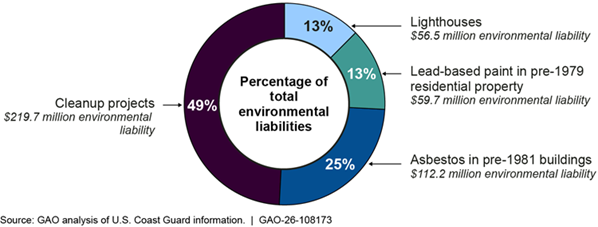
Note: The Coast Guard reviews its environmental liability data each quarter to ensure properties are not counted in more than one category.
The Coast Guard has not fully incorporated risk-informed decision-making in its management of the environmental liabilities program. For example, the Coast Guard has not developed performance measures or evaluated outcomes for the program as GAO’s framework for risk-informed decision-making recommends. According to GAO’s framework, agencies should develop an analysis plan and evaluate outcomes based on clearly defined objectives and performance measures, among other things.
The Coast Guard has not fully met these risk-informed steps, largely because it has not developed a long-term strategy to define the objectives of its environmental liabilities program. Developing a strategy could help the Coast Guard make risk-informed decisions about the long-term management of its growing portfolio of environmental liabilities and achieve financial benefits—for example, by using analysis to strategically sequence cleanup projects.
Why GAO Did This Study
The Coast Guard has a $28 billion inventory of shore infrastructure assets, such as boat stations and lighthouses. Many of these assets have environmental contamination due to past practices. Federal agencies are required to estimate and report their anticipated cleanup costs—also known as environmental liabilities—related to environmental contamination.
GAO was asked to review the Coast Guard’s environmental liabilities for its shore infrastructure assets. This report examines, among other things, (1) the Coast Guard’s environmental liabilities for shore infrastructure in recent years, including factors contributing to uncertainty in those liability estimates, and (2) the extent to which the Coast Guard uses risk-informed decision-making to manage its environmental liabilities program.
GAO analyzed Coast Guard policies, guidance, and data related to the Coast Guard’s environmental liabilities for shore infrastructure and compared these with GAO’s risk-informed decision-making framework for managing environmental hazards. GAO also interviewed agency officials to identify and describe factors related to uncertainty in its estimates.
What GAO Recommends
GAO is recommending that the Coast Guard (1) expand the information provided to Congress regarding its fiscal exposure to environmental liabilities and (2) develop a long-term strategy for managing its environmental liabilities program.
The Department of Homeland Security agreed with the recommendations.
Abbreviations
AFFF aqueous film forming foam
CDC Centers for Disease Control and Prevention
CERCLA Comprehensive
Environmental Response,
Compensation, and Liability Act
DHS Department of Homeland Security
EPA Environmental Protection Agency
LORAN long-range navigation
PAH polycyclic aromatic hydrocarbons
PCB polychlorinated biphenyls
PFAS per- and polyfluoroalkyl substances
PFOA perfluorooctanoic acid
PFOS perfluorooctane sulfonate
PMR program management review
RACER Remedial Action Cost Engineering Requirements
This is a work of the U.S. government and is not subject to copyright protection in the United States. The published product may be reproduced and distributed in its entirety without further permission from GAO. However, because this work may contain copyrighted images or other material, permission from the copyright holder may be necessary if you wish to reproduce this material separately.
July 14, 2026
The Honorable Sam Graves
Chair
The Honorable Rick Larsen
Ranking Member
Committee on Transportation and Infrastructure
House of Representatives
The Coast Guard has a vast, $28 billion inventory of shore infrastructure assets, such as boat and air stations, housing, and lighthouses. These assets can be significantly contaminated due to various factors, including the age of structures, historical usage, operations conducted, and mission support activities. For example, in addition to contaminants such as asbestos and lead in pre-1980s buildings, the Coast Guard has detected synthetic chemicals called per- and polyfluoroalkyl substances (PFAS) at dozens of shore facilities.[1] These “forever chemicals” can persist in water and soil for decades and have been linked to cancer and other human health problems.
Federal accounting standards require federal agencies responsible for cleaning up environmental contamination to estimate future cleanup and waste disposal costs and to report such costs in their annual financial statements. Agencies refer to these estimated future costs as environmental liabilities.[2] The federal government’s environmental liabilities have been growing for the past 30 years and represent one of the largest types of federal financial liability. In 2017, GAO identified the federal government’s environmental liabilities as a high-risk issue, in part because of this continued growth.[3] From fiscal years 2016 through 2023, the federal government’s estimated environmental liabilities increased from $447 billion to $645 billion. In roughly the same period, the Coast Guard has reported that its environmental liabilities have grown from about $358 million to about $448 million as of September 2025. This amount will likely continue to increase over time, which highlights the importance of avoiding delays in cleaning up contamination. Additionally, prolonged exposure to environmental contamination increases risks to service members’ health, making it all the more important for the Coast Guard to take action and prevent any delays.
You asked us to review issues related to the Coast Guard’s environmental liabilities program.[4] This report describes (1) the Coast Guard’s environmental liabilities for shore infrastructure in recent years, including factors contributing to uncertainty in those liability estimates; (2) the extent to which the Coast Guard uses risk-informed decision-making to manage its environmental liabilities program; and (3) challenges the Coast Guard faces when managing its environmental liabilities program.
To describe the Coast Guard’s environmental liabilities for shore infrastructure, we reviewed the Coast Guard’s policies and guidance related to the management of environmental liabilities and financial documents, including budget justifications for fiscal years 2021 through 2027. We analyzed the Coast Guard’s annual environmental liability reports for fiscal years 2016 through 2025 to identify trends and summarize the cost estimates, expenditures, and future plans related to various environmental liabilities, including project-level data for individual cleanup projects.[5] To assess the reliability of the data, we checked for errors and omissions and interviewed agency officials. We found the data sufficiently reliable to describe what the Coast Guard reports for its environmental liabilities. We also interviewed Coast Guard officials to better understand how uncertainties could affect the cost estimates and the nature of the impact from those uncertainties.
To describe the extent to which the Coast Guard uses risk-informed decision-making to manage its environmental liabilities program, we reviewed the Coast Guard’s policies and guidance for its environmental liabilities program and compared them with the phases and steps of GAO’s framework for risk-informed decision-making.[6] For each step, we analyzed Coast Guard documentation to determine whether the Coast Guard met, partially met, or did not meet the step. We used the following scale to evaluate the extent to which the Coast Guard met risk-informed decision-making steps in managing environmental hazards.
· Met: Coast Guard provided evidence that addressed the entire step.
· Partially met: Coast Guard provided evidence that addressed some parts of the step.
· Not met: Coast Guard did not provide evidence that addressed the step.
We reviewed the Coast Guard’s planning documentation, such as guidance memos setting annual priorities related to its management of the environmental liabilities program. We analyzed Coast Guard data on expenditures for its environmental liabilities program for fiscal years 2022 through 2025, as well as project-level data on individual cleanup projects, including their cost and risk scores.
We analyzed Coast Guard data on the number and type of its planned shore infrastructure property disposals and compared the data to the Coast Guard’s reported environmental liabilities and related documentation to determine the extent to which the Coast Guard has assessed environmental contamination by developing cleanup project cost estimates at properties it plans to dispose of. To assess the reliability of these data, we reviewed relevant documentation and interviewed Coast Guard officials and determined the data were sufficiently reliable for the purpose of identifying whether the Coast Guard had developed cleanup project cost estimates for planned property disposals.
In addition, we interviewed Coast Guard headquarters officials to understand the Coast Guard’s policies and procedures for managing the environmental liabilities program and property disposals. We interviewed Coast Guard officials at each of the agency’s six Civil Engineering Units to better understand how Coast Guard staff prioritize their environmental work and put the agency’s policies and procedures into practice. In addition, we visited a Coast Guard facility, the Traverse City Air Station in Traverse City, MI, to directly observe a cleanup project site and discuss cleanup project efforts with the responsible officials. We selected the Traverse City Air Station because it was the site of an active cleanup project, due to the accidental release of a hazardous chemical fire-fighting foam in 2015.
To describe challenges to the Coast Guard managing its environmental liabilities program, we interviewed Coast Guard headquarters officials and field-based officials. To obtain a range of input from Coast Guard stakeholders, we interviewed officials in the Office of Civil Engineering, Shore Infrastructure Logistics Center, Office of Shore Sustainment, and the Office of Environmental Management. In addition, we interviewed field-based officials in all six of the Coast Guard’s Civil Engineering Units to obtain their perspective on challenges they faced. During each interview, we asked officials to describe any challenges related to environmental liabilities, then we identified the top challenges most frequently cited across interviews.
We conducted this performance audit from March 2025 to July 2026 in accordance with generally accepted government auditing standards. Those standards require that we plan and perform the audit to obtain sufficient, appropriate evidence to provide a reasonable basis for our findings and conclusions based on our audit objectives. We believe that the evidence obtained provides a reasonable basis for our findings and conclusions based on our audit objectives.
Background
Federal Environmental Liabilities, Accounting Standards, and Fiscal Exposure
Federal agencies are required to report on their annual financial statements certain cost estimates for addressing contamination. These estimates are known as environmental liabilities. According to federal accounting standards, costs for cleanup work must be included in environmental liability estimates when they are both probable and reasonably estimable.[7] The Coast Guard reports its environmental liabilities to the Department of Homeland Security (DHS) on a quarterly basis, and DHS reports its environmental liabilities in its annual agency financial report. The Coast Guard is to adjust its environmental liability cost estimates for inflation and account for completed and in-progress cleanup work every year. Additionally, it is to update the details and estimated cost of each cleanup project approximately every 3 years—part of a triennial update—to account for new information, according to agency officials and Coast Guard procedures.
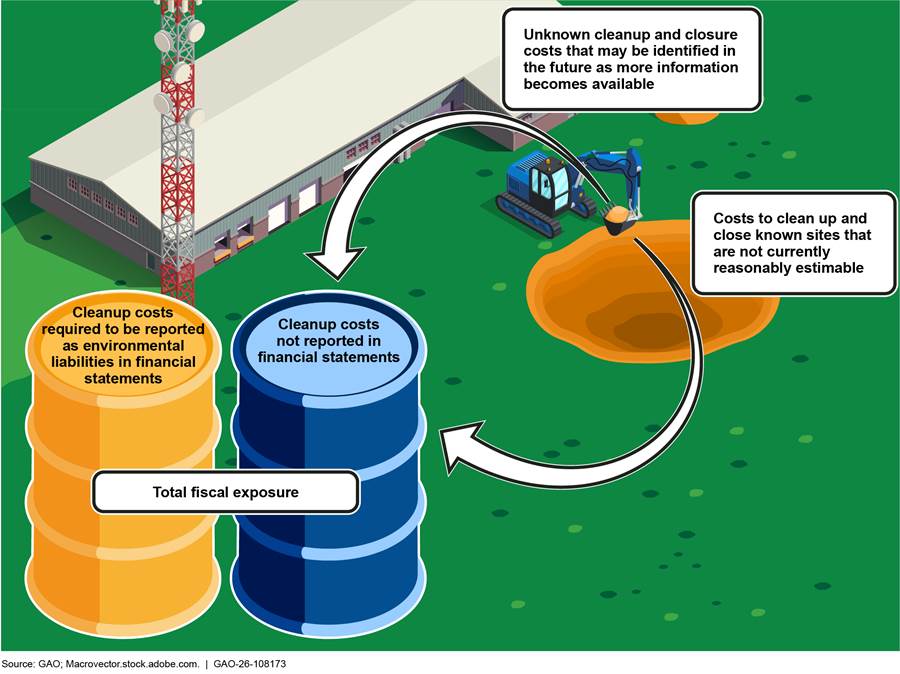
While the federal accounting standards require federal agencies to disclose certain environmental liabilities in their financial statements, reported environmental liabilities do not comprise the total amount that the federal government may have to pay to address environmental contamination, known as its fiscal exposure. As shown in figure 1, other components, when combined with the reported liabilities in financial statements, account for the total federal fiscal exposure. These other components can include (1) costs related to clean up and closure of known sites that are not currently reasonably estimable and (2) unknown cleanup and closure costs that may be identified in the future as more information becomes available. Prior GAO work has shown that the environmental liabilities reported in an agency’s financial statement might not include costs where the nature and extent of contamination or the remedy for the contamination are not yet known.[8]
Legal Framework for Coast Guard’s Environmental Cleanup Process
The Coast Guard’s cleanup activities are generally conducted in accordance with the Comprehensive Environmental Response, Compensation, and Liability Act of 1980, as amended (CERCLA), as well as other relevant statutes and regulations.[9] CERCLA authorizes the President to respond to actual or threatened releases to the environment of (1) hazardous substances and (2) pollutants or contaminants that may pose an imminent and substantial danger to public health or the environment.[10] In the late 1980s, the President delegated CERCLA’s response authorities to the Environmental Protection Agency (EPA) and other federal agencies. Under CERCLA, federal agencies—such as the Coast Guard—are responsible for cleaning up releases from facilities and vessels under their jurisdiction, custody, or control.[11]
CERCLA and its implementing regulations include a series of actions that agencies take to identify and address environmental contamination. Some CERCLA remedial actions may require long-term monitoring to ensure continued protection of human health and the environment, which the Coast Guard includes in its monitoring process for closed sites. In addition, the Coast Guard can engage in removal actions, which are generally shorter-term or emergency actions to address immediate threats to human health or the environment under certain circumstances. For cleanup projects that it carries out under CERCLA, the Coast Guard generally follows the process outlined in figure 2 and assigns one of three categories—investigation, remediation, or monitoring—to each of its cleanup projects.
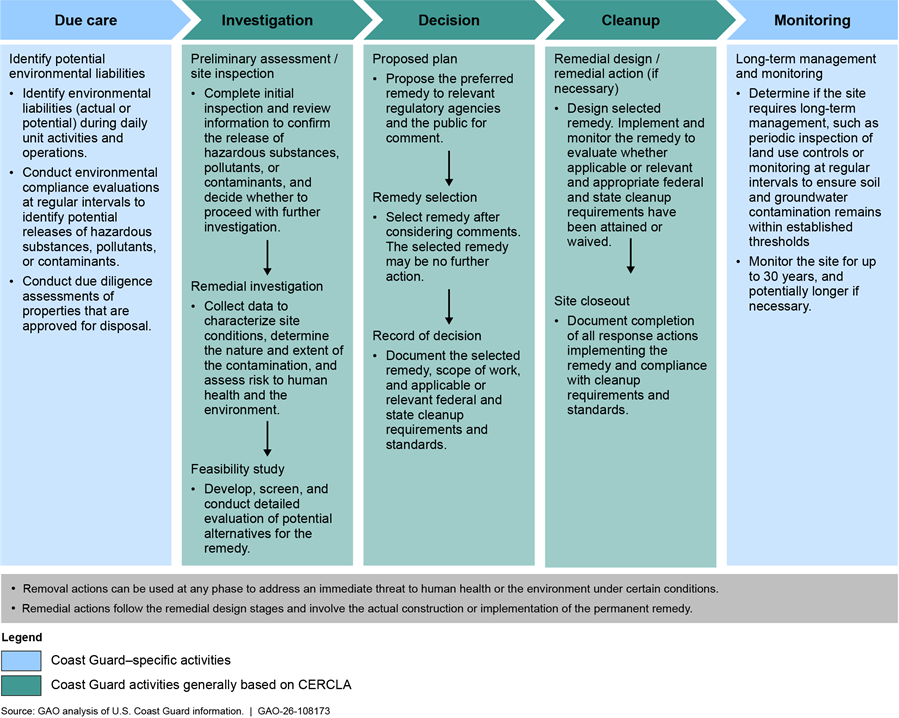
Note: For the purposes of this report, we have grouped the typical stages of the Comprehensive Environmental Response, Compensation, and Liability Act of 1980, as amended (CERLCA) cleanup process into the high-level stages of investigation, decision, and cleanup, as generally set forth in the National Oil and Hazardous Substances Pollution Contingency Plan (NCP) at 40 C.F.R. Part 300. See Pub. L. No. 96-510, 94 Stat. 2767 (codified as amended at 42 U.S.C. §§ 9601-9675). The Coast Guard generally employs these steps during its environmental cleanup process. Other federal laws may be relevant to the Coast Guard’s investigation and cleanup activities, including the Resource Conservation and Recovery Act of 1976. Pub. L. No. 94-580, 90 Stat. 2795 (codified as amended at 42 U.S.C. §§ 6901-6987).
Environmental Liabilities and Property Disposal
Like other federal agencies, the Coast Guard routinely identifies and disposes of excess property.[12] According to Coast Guard policy, assessing contamination is a key part of its disposal process for shore infrastructure. Specifically, when the Coast Guard selects a property for disposal, it initiates a due care process to investigate the potential existence of environmental contamination and, if present, evaluate its extent, as shown in figure 2. The Coast Guard generally follows the process in figure 2 to remediate identified environmental contamination prior to the disposal of the property. The Coast Guard may dispose of excess shore infrastructure by selling it for fair market value.[13] In 2025, for example, the Coast Guard sold an excess shore infrastructure property for $1,175,000 in Jonesport, ME, after completing an investigation for lead contamination and concluding there was no significant risk of harm to human health or the environment. When the Coast Guard identifies contamination at a property it wants to dispose of, it develops an environmental liability estimate to describe the potential cost and cleanup project methods.
Coast Guard Reports $448 Million in Environmental Liabilities, but Multiple Factors Create Uncertain Fiscal Exposure
Coast Guard Reports $448 Million in Environmental Liabilities
|
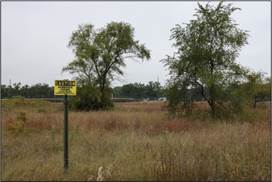
Asbestos Asbestos is a group of naturally occurring mineral fibers that are resistant to heat and corrosion. Prior to 1981, asbestos was commonly used in building materials such as insulation, floor tiles, plaster, ceiling tiles, and pipe wrapping. If asbestos becomes friable (i.e., able to be crumbled by hand pressure) tiny fibers can be released into the air. According to the Centers for Disease Control and Prevention (CDC), those who breathe asbestos fibers can develop serious or fatal diseases, such as lung cancer or mesothelioma, which might not develop until decades after an individual is exposed. From 1999 through 2020, almost 55,000 mesothelioma deaths were reported in the United States, according to analysis of CDC data. The field pictured below, at the Coast Guard’s Traverse City Air Station in Michigan, is strewn with friable asbestos from a building demolition that occurred before the Coast Guard owned the property. The Coast Guard installed signs warning people not to use the field.
Source: GAO analysis of CDC and U.S. Coast Guard information. GAO photo. | GAO‑26‑108173 |
As of September 2025, the Coast Guard reported about $448 million in environmental liabilities related to its shore infrastructure. Approximately half of that reported environmental liability—about $228 million—is for structures where the Coast Guard assumes that a contaminant is present due to the structure’s age or type. For example, as of September 2025, the Coast Guard assumed that 2,858 buildings built before 1981 were made with material containing asbestos—a designated hazardous substance under CERCLA regulations.[14] As shown in figure 3, the Coast Guard reported its environmental liability for asbestos in these buildings constructed prior to 1981 at $112.2 million. The Coast Guard also assumes that structures built before 1979 contain lead-based paint, and that lighthouses have lead in the surrounding soil due to past exterior maintenance practices. In such cases, the Coast Guard anticipates that future cleanup activities may be needed and applies a cost estimate formula based on the structure’s square footage for its environmental liability cost estimate. The Coast Guard’s reported environmental liabilities for asbestos, lead-based paint, and lighthouses remained steady over the last 10 years, as shown in figure 3.
The other half of the Coast Guard’s reported environmental liabilities—about $220 million—is composed of cleanup projects. These projects are at sites where the Coast Guard has identified the release or potential release of a contaminant and has developed a site-specific estimated project cost to address the contamination. The Coast Guard estimates the cost for these cleanup projects with a software program called RACER, and officials told us that they adjust the cost estimate based on knowledge of other cleanup projects and relevant factors (such as logistical costs).[15]
|
Lead-Based Paint As lead-based paint deteriorates into flakes and dust, it becomes a health hazard to people, especially children. Lead exposure can damage a child’s developing brain and nervous system and slow development and growth. Young children are at greater risk of exposure because they have frequent hand-to-mouth activity and often crawl on the floor. As of September 2025, the Coast Guard estimates over 1,000 of its structures and over 100 lighthouses have lead-based paint. Routine cleaning of the exterior of lighthouses and deterioration due to weather exposure has contributed to lead contaminated soil in multiple locations. Source: GAO analysis of Centers for Disease Control and Prevention, and U.S. Coast Guard information. | GAO‑26‑108173 |
A majority of cleanup projects are related to contamination from metals such as lead, and many have multiple sources of contamination. For example, the Coast Guard estimates that it will need $1.2 million to investigate and clean up soil contaminated by lead-based paint and petroleum at Wood Island Lighthouse in Biddeford, ME.[16] For details on each of the Coast Guard’s cleanup projects, see our interactive graphic and appendix I.
Figure 3: U.S. Coast Guard’s Reported Environmental Liability for Shore Infrastructure, Fiscal Years 2016–2025
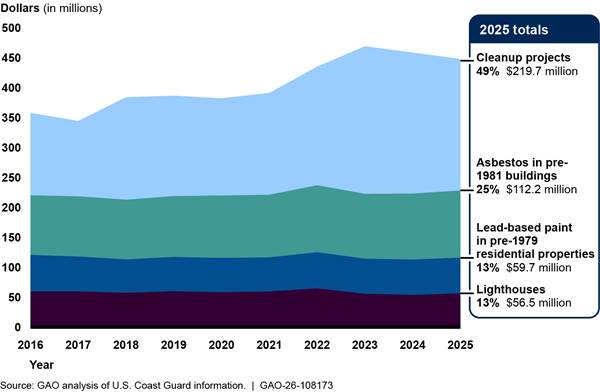
Note:Approximately half of the Coast Guard’s environmental liabilities for shore infrastructure are assumed cleanup costs for structures based on their age and type. The Coast Guard categorizes these environmental liabilities as asbestos, lead-based paint, and lighthouses (which are assumed to have lead in the surrounding soil). The other half of its reported environmental liabilities are sites where the Coast Guard has identified the release or potential release of a contaminant. These sites are referred to as cleanup projects. These estimates do not include all aspects of fiscal exposure, such as the potential liability from cleaning up per- and polyfluoroalkyl substances (PFAS).
The Coast Guard spent more than $45 million in fiscal years 2022 through 2025 on cleanup projects, but its estimated environmental liability costs increased by $57 million during the same period for reasons such as inflation, updated estimates, and newly identified cleanup projects. Inflation erased about half of the reduction from spending on cleanup efforts each year. For example, in fiscal year 2025 the Coast Guard spent $10.4 million on cleanup projects, yet inflation from fiscal year 2024 to fiscal year 2025 increased the total estimated cost of cleanup projects by more than $6 million. The Coast Guard periodically updates its cleanup project cost estimates, which tends to increase its overall environmental liability.[17] Initial data from the Coast Guard’s most recent periodic update shows an estimated $48.9 million increase in reported cost estimates and a net increase of eight cleanup projects from September 2025 to December 2025.
Multiple Uncertainties May Increase Coast Guard’s Fiscal Exposure by Several Hundred Million Dollars
The Coast Guard’s environmental liability estimates include multiple uncertainties that may increase the agency’s fiscal exposure. These uncertainties fall into four categories: the class of emerging contaminants known as PFAS, limited estimable cost, inherent uncertainty, and uncertain property history.[18] Figure 4 describes these four categories and the potential results. These uncertainties may increase or decrease the fiscal exposure for individual sites, but they indicate an overall increase in the Coast Guard’s fiscal exposure, possibly by at least hundreds of millions of dollars.
Figure 4: Categories of Factors That Contribute to Uncertainty in Estimating Environmental Liability Costs for Coast Guard Shore Infrastructure
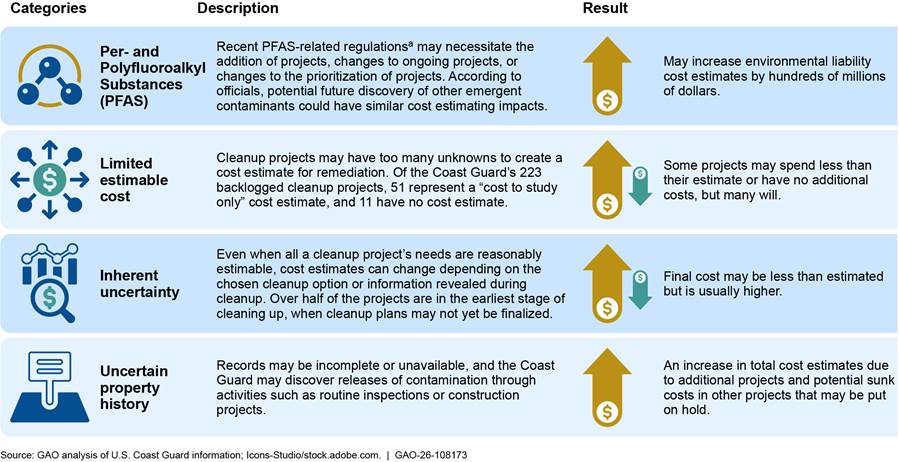
aPFAS refers to per- and polyfluoroalkyl substances. See PFAS National Primary Drinking Water Regulation, 89 Fed. Reg. 32,532 (Apr. 26, 2024); Designation of Perfluorooctanoic Acid (PFOA) and Perfluorooctanesulfonic Acid (PFOS) as CERCLA Hazardous Substances, 89 Fed. Reg. 39,124 (May 8, 2024). But see Rescission of Regulatory Determinations and Removal of Related Provisions for Four PFAS Substances (PFHxS, PFNA, HFPO-DA (GenX), and the Mixture of These Three PFAS Plus PFBS), 91 Fed. Reg. 29,413 (May 20, 2026).
|
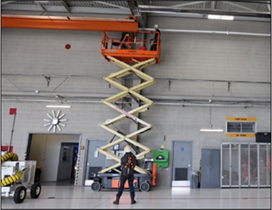
Per- and Polyfluoroalkyl Substances (PFAS) PFAS are a group of synthetic chemicals that have been linked to harmful health effects. For decades, PFAS have been used in a wide range of products including stain-resistant furniture, waterproof clothing, nonstick cookware, and certain firefighting foams like aqueous film forming foam (AFFF). PFAS are resistant to degradation and can accumulate in humans, animals, and plants. The Coast Guard identified airfields as its highest risk areas for PFAS contamination due to their storage and use of AFFF. The Coast Guard is transitioning to a water-based fire suppression system. In the photograph below, workers are replacing AFFF delivery pipes in the hangar at the Coast Guard’s Traverse City Air Station in Michigan.
Source: GAO analysis of U.S. Coast Guard information. GAO photo. | GAO‑26‑108173 |
PFAS. Recent federal and state regulations regarding PFAS—a class of emerging contaminants—as well as on-going state compliance with those regulations, add to uncertainty in estimating environmental liability costs.[19] For example, in 2024 the EPA designated two PFAS as hazardous substances under CERCLA and set maximum levels for several PFAS in drinking water.[20] These new regulations may impact the Coast Guard’s cleanup efforts because the agency historically used a firefighting foam containing PFAS at airfields, and thus cleanup actions to address these contaminants may be necessary. DHS has established a requirement that its components use the CERCLA process to perform preliminary assessments and site inspections where there is suspected PFAS contamination.[21] Then, the components are to determine follow-up actions based on the data collected.
If its average costs are similar to those estimated by the Department of Defense, cleaning up PFAS could cost the Coast Guard hundreds of millions of dollars for 34 sites. The Department of Defense estimated it would cost at least $7 billion to investigate and remediate PFAS contamination at 580 installations—an average cost of $12.2 million per site. GAO found that this estimate is likely to be low.[22] In 2025 the Coast Guard finalized its preliminary assessments of facilities it identified as high risk for PFAS releases. According to an executive summary report that the Coast Guard published on PFAS-related preliminary assessments, 34 sites need the Coast Guard to take further action.[23] Coast Guard and Department of Defense sites likely vary in size and complexity, which could lead to differences in cost estimates. However, this indicates that the Coast Guard has the potential for hundreds of millions more in estimated liability for these PFAS sites. The Coast Guard is monitoring the Department of Defense’s actions regarding PFAS as a roadmap for possible future Coast Guard PFAS remediation.
As of July 2025, the Coast Guard was conducting site inspections at 30 facilities and remedial investigations at three facilities for PFAS. Once these activities are complete, Coast Guard officials said they will be better positioned to estimate the projected cleanup costs for PFAS contamination. Coast Guard officials told us that while the current technology for cleaning up PFAS is limited, it is evolving quickly and may lead to some more efficient options in the future. Coast Guard officials said they do not know how long it might take to fully remediate PFAS contamination at its shore infrastructure facilities.
Limited estimable cost. For approximately one-quarter of its cleanup projects, the Coast Guard has estimated only the cost to study the contaminated site, not to remediate it.[24] Coast Guard officials said that, as with its nationwide PFAS investigation, the estimated cleanup cost—the cost to fully remediate—for these sites cannot be reasonably estimated until the Coast Guard completes the studies.[25] The Coast Guard refers to these cleanup projects with limited estimable costs as “cost to study”. While projects vary widely in their cleanup costs, if the average estimated cleanup cost is comparable to what the “cost to study” cleanup projects will be, then the Coast Guard could have tens of millions more in remediation costs for these 51 projects.[26] Our interactive graphic shows details and locations for the Coast Guard’s “cost to study” cleanup projects.
Inherent uncertainty. The estimated costs of remediating environmental liabilities tend to increase as the project matures, according to prior GAO work and interviews with agency officials.[27] Of the Coast Guard’s projects with a fully estimable cleanup cost, over half are in the investigation phase, when cleanup plans may not yet be finalized. As of September 2025, the Coast Guard has 37 cleanup projects that have cost more than the service’s initial estimate, for a total of $16.7 million in unanticipated spending from fiscal year 2022 to fiscal year 2025. As Coast Guard personnel work on a cleanup project, they may identify additional contaminants or larger spread of contamination, or they may encounter other obstacles. For example, the Coast Guard originally estimated $439,000 in remediation costs for an historic lighthouse in Plymouth, MA, but during the cleanup project, personnel uncovered more contaminated soil and buried historical artifacts that required an additional $1.3 million in cleanup costs.
|
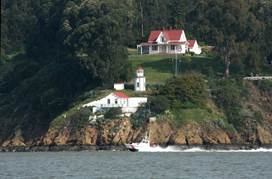
Lighthouses The Coast Guard operates 181 lighthouses, according to its most recent annual shore infrastructure report. Past practices of sandblasting or using solvent to remove lead-based paint from exterior surfaces of lighthouses may have caused the release of lead to the surrounding soil. The Coast Guard’s lighthouse on Yerba Buena Island near San Francisco, CA, pictured below with the Admiral’s house, needs an estimated $917,000 related to soil cleanup as of 2025.
Source: Defense Visual Information Distribution System. | GAO‑26‑108173 |
Uncertain property history. The Coast Guard owns property where records of historical activity may be incomplete or unavailable. As a result, Coast Guard officials said they commonly discover additional contamination during cleanup projects or new construction projects. These discoveries can lead to additional cleanup costs. For example, during a construction project in 2025, the construction crew identified a leaking fuel line at a base in Alameda, CA, that the service will need to remediate in a future cleanup project, according to Coast Guard officials. Some of the Coast Guard’s shore infrastructure facilities, such as Base Kodiak in Alaska, are located at former U.S. military sites where hazardous materials were improperly stored or disposed.[28] These types of discoveries not only add to the costs of existing cleanup projects or create new cleanup projects, but they also often cause reprioritization of existing cleanup efforts, according to officials. The Coast Guard owns and operates hundreds of assets—such as aviation fueling facilities and marine fuel storage facilities—where hazardous materials are stored.[29]
Coast Guard Has Not Communicated Its Fiscal Exposure to Congress
The Coast Guard has reported environmental liabilities to Congress but does not include full information on its fiscal exposure, including the nature and magnitude of uncertainties in its estimation. For example, the Coast Guard’s budget justifications accompanying the President’s budget for fiscal years 2021 through 2027 do not include contextual information on uncertainties, such as those described above, that might affect its fiscal exposure.[30] This fiscal exposure is likely hundreds of millions higher than its reported environmental liability. Specifically, while the budget justifications list the cleanup projects with remaining estimated costs as directed, they do not indicate which cleanup project costs only cover the cost to study.
Moreover, the Coast Guard reports outdated estimates to Congress, which obscures the total number and cost of cleanup projects for which the Coast Guard is responsible. For example, the cleanup project costs in the budget justifications do not fully reflect the environmental liabilities program’s future spending plans. We identified an additional $17 million in anticipated cleanup project costs that were not included in its cost estimates in the fiscal year 2027 budget justification.[31] Further, the Coast Guard did not use its inflation-adjusted cleanup project costs in its budget justifications from fiscal years 2024 through 2027—systematically understating known costs by millions of dollars every year. Coast Guard officials said that the service will begin reporting inflation-adjusted cleanup project costs in future budget justifications.
We have reported on the need for agencies to improve recognition of their fiscal exposures and provide Congress and the public with a more comprehensive picture of the federal government’s future financial obligations.[32] For example, in our 2025 High Risk report, we reiterated that agencies could do more to understand, monitor, and report on their environmental cleanup costs.[33] Further, as stated in our 2022 High Risk report, a key practice to successfully address high-risk areas includes that agencies ensure their capacity to communicate accurate, useful, and timely information.[34] For the Coast Guard, which faces challenges in completing environmental work with limited resources, this includes adding details to its budget materials or other supplementary information about the uncertainties in its estimation of environmental liabilities. Communicating accurate information also involves adding details about how these liabilities affect the government’s fiscal exposure and ensuring budget materials use the most up-to-date information.[35] Coast Guard officials said the annual budget justification is not the best method for providing such information. There are other methods, however, that the Coast Guard could use, such as supplementary budget materials or annual shore infrastructure reports.
Transparency through reporting in budget materials is an essential element for providing Congress with a comprehensive picture of federal fiscal exposures for environmental contamination and cleanup. Equipping stakeholders with better information on fiscal exposure, as the Coast Guard learns more about the cleanup costs involved, will better equip decision-makers—including Coast Guard leadership and Congress—to make important, risk-informed decisions, such as the level of resources needed to address emerging contaminants like PFAS.
Coast Guard Has Not Fully Met Steps in the Risk-Informed Decision-Making Process for Managing Environmental Liabilities
The Coast Guard has not fully met all steps in GAO’s risk-informed decision-making framework when managing the environmental liabilities program. GAO’s risk-informed decision-making framework for managing environmental liabilities helps agencies prioritize activities while balancing factors like cost with environmental and health risks, analyzing trade-offs, and strategically engaging with key stakeholders. Figure 5 shows the essential elements of this risk-informed decision-making process, consisting of 16 steps across four phases.[36] The design phase lays the groundwork for risk-informed decision-making throughout subsequent phases—for example, by requiring decision-making inputs such as objectives, performance measures, and constraints to be clearly defined. Agencies that apply this framework should tailor the depth and extent of the phases and steps to the nature and significance of the decision being made.
Figure 5: Phases and Steps of GAO’s Risk-Informed Decision-Making Framework for Environmental Hazards
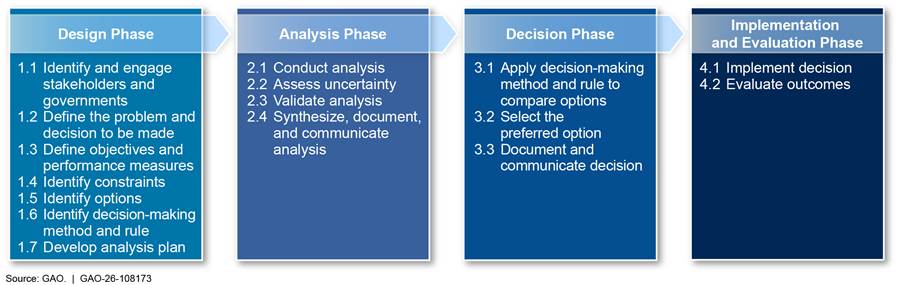
The Coast Guard has partially met or not met 12 of the framework’s 16 steps, as shown in table 1. For example, the Coast Guard did not meet the step of defining objectives and performance measures. Objectives and performance measures are important because they provide a basis for consistently and transparently comparing options during the decision phase and can be used in the final phase of the framework—the implementation and evaluation phase—to assess the performance of an agency’s implemented decision. For example, although Coast Guard policy calls for identifying, investigating, and cleaning up contamination from hazardous substances, the Coast Guard has not established any objectives or performance measures for measuring and assessing its implementation of that policy.[37]
Table 1: Extent That Coast Guard Met Risk-Informed Decision-Making Steps in Managing Environmental Hazards
|
Step |
Met, partially met, or not met |
|
Design phase |
|
|
Identify and engage stakeholders and governments |
Met |
|
Define the problem and decision to be made |
Met |
|
Define objectives and performance measures |
Not met |
|
Identify constraints |
Met |
|
Identify options |
Partially met |
|
Identify decision-making method and rule |
Partially met |
|
Develop analysis plan |
Not met |
|
Analysis phase |
|
|
Conduct analysis |
Partially met |
|
Assess uncertainty |
Not met |
|
Validate analysis |
Not met |
|
Synthesize, document, and communicate analysis |
Not met |
|
Decision phase |
|
|
Apply decision-making method and rule to compare options |
Not met |
|
Select the preferred option |
Partially met |
|
Document and communicate decision |
Partially met |
|
Implementation and Evaluation Phase |
|
|
Implement decision |
Met |
|
Evaluate outcomes |
Not met |
Met: Coast Guard provided
evidence that addressed the entire step.
Partially met: Coast Guard provided evidence that addressed some parts of the
step.
Not met: Coast Guard did not provide evidence that addressed the step.
Source: GAO analysis of U.S. Coast Guard information. | GAO‑26‑108173
Note: We developed this framework to help agencies prioritize activities while balancing factors like cost with environmental and health risks. GAO, Environmental Hazards: A Framework for Risk-Informed Decision-Making, GAO‑24‑107595 (Washington, D.C.: Sept. 23, 2024).
Additionally, the framework recommends agencies develop an analysis plan that identifies the types of analysis needed to assess a range of options to see how well each option performs relative to the agency’s objectives. Because the Coast Guard has not defined objectives and performance measures to assess against, the Coast Guard cannot develop such an analysis plan, nor can it fully meet all four steps in the framework’s analysis phase.
Likewise, the Coast Guard cannot fully meet the steps in the framework’s decision or evaluation phases, as each of these in turn depend on establishing program objectives as the basis of risk-informed decision-making. For example, the Coast Guard cannot meaningfully evaluate outcomes for its environmental liabilities program without first developing programmatic objectives that define what a successful outcome should be. According to GAO’s framework, evaluating outcomes is an essential step for agencies like the Coast Guard that manage programs where they must consider trade-offs among risks to human health and the environment, costs, and other factors in the face of uncertainty and limited resources.[38] Evaluating outcomes involves assessing whether an agency’s decisions are producing the intended results and meeting program goals. This includes tracking and monitoring the relative effectiveness of its various cleanup program activities to prioritize cleanup projects and determine the most efficient and effective actions to manage them.
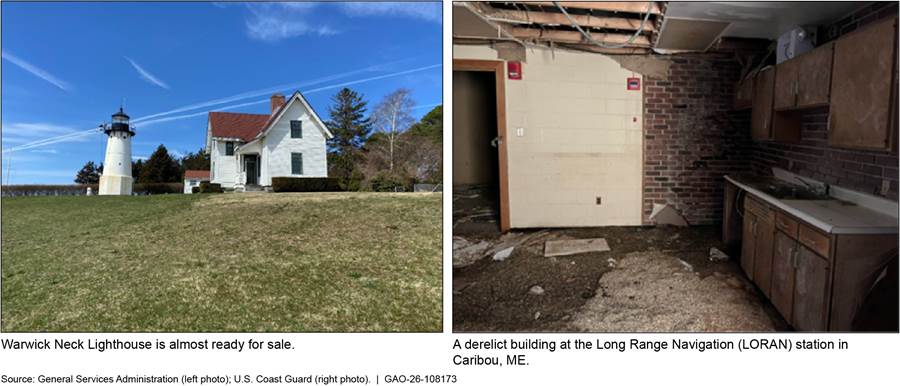
Instead, Coast Guard officials use a program management review (PMR) process to set annual priorities based on criteria related to human health risks, regulatory compliance, and property disposals, among others.[39] The Coast Guard uses these criteria to prioritize certain cleanup projects for funding in a given fiscal year. For example, when prioritizing cleanup projects for fiscal year 2025, the Coast Guard primarily selected cleanup projects at sites that were approved for disposal. But several factors can complicate the Coast Guard’s property disposal process, according to officials. First, the Coast Guard’s priorities for property disposal often shift, according to officials, and Congress may ask the Coast Guard to initiate or halt a property disposal, causing the environmental liabilities program to re-prioritize ongoing cleanup projects.[40] Second, resource constraints within the Coast Guard—staffing and workload in particular—can slow down the disposal process. Third, some Coast Guard properties are challenging to assess due to their remote location, such as at Long Range Navigation (LORAN) stations.[41] We discuss the challenges of staffing, workload, and accessing properties in remote locations in more detail later in our report.
As a result, it is difficult for the Coast Guard to efficiently develop cleanup project estimates for property disposals where the site may be contaminated. As of September 2025, the Coast Guard has developed cleanup project estimates for 41 of the 117 shore infrastructure properties (35 percent) on its long-term list of planned disposals.[42] Assessing potential contamination and developing cleanup project cost estimates can be a lengthy process, according to agency officials.
The Coast Guard has not fully incorporated risk-informed decision-making, such as developing objectives and performance measures, because it does not have a comprehensive strategy for making risk-informed decisions on the long-term management of the environmental liabilities program.[43] The Coast Guard recognized the need for long-term strategic planning in its 2022 Mission Support Action Plan, which recommended the development of a 20-year strategic investment and disposal plan for shore infrastructure. However, as of May 2026, the Coast Guard has not developed such a strategic plan. Instead, the environmental liabilities program remains in a reactive mode, with shifting priorities and a lack of long-term planning, according to several officials responsible for managing cleanup projects.
Developing a comprehensive, risk-informed strategy for managing environmental liabilities that defines program objectives, requires program officials to evaluate outcomes and measure progress against goals, and clearly articulates multi-year disposal plans and priorities, would help the Coast Guard make optimal cleanup decisions and direct resources to the highest priorities. Moreover, the Coast Guard would be better prepared to meet the substantial challenges it faces, such as managing PFAS cleanup projects that will likely cost at least several hundred million dollars more than currently reported. For example, a strategy could provide consistent direction for long-term program priorities, such as disposing of underutilized infrastructure like certain historic light stations and decommissioned LORAN sites.
A long-term strategy could further help guide difficult resource allocation decisions over multiple years by incorporating key risk-informed elements, such as an evaluation of program effectiveness. Given the length of time involved in many environmental liability remediation projects, many of which were first identified in the 1990s, it is incumbent upon the Coast Guard to better manage risks through a long-term strategy. Doing so may reduce service members’ exposure to contamination and lead to significant potential financial benefits by guiding more strategic sequencing of projects—for example, through an optimization analysis.[44]
Finally, a strategy could help align the environmental liabilities program with other agency priorities, such as the development of new shore infrastructure facilities as called for in the Coast Guard’s Force Design 2028 strategy. For example, the Coast Guard is planning several major new shore infrastructure projects in the Alaska region, including a $30 million aircraft hangar and a $50 million housing project. Although these projects will require extensive environmental planning, which officials have noted tends to divert resources away from cleanup projects, the Coast Guard may be able to use funds from Public Law 119-21—–commonly known as the One Big Beautiful Act—to remediate existing environmental contamination at some of its planned infrastructure projects.[45] Notwithstanding the improvements, without a comprehensive strategy to guide the agency’s overall efforts and identify program objectives, the Coast Guard’s current PMR process is unlikely to help the Coast Guard remediate contamination at the highest risk sites and effectively reduce or ultimately eliminate its growing portfolio of environmental liabilities over the long term.
Coast Guard Faces Challenges with Managing Environmental Liabilities
The Coast Guard faces challenges with staffing, workload, and remote sites that hinder its ability to manage its environmental liabilities related to shore infrastructure.
Challenges Related to Staffing and Workload
The Coast Guard faces staffing and workload challenges in its management of environmental liability cleanup projects. Officials at five of its six Civil Engineering Units, and officials at several program offices that help manage the environmental liabilities program, told us the issues of staffing and employee workload are among their biggest challenges.[46] As of May 2026, the Coast Guard’s Environmental Compliance and Restoration program has 40 full-time staff, such as environmental engineers and scientists, who work on cleanup projects and restoration of contaminated facilities related to environmental liabilities.
In addition to managing cleanup projects, the Coast Guard’s environmental staff have a range of responsibilities to support Coast Guard operations. Their workload supports (1) facility construction, maintenance, and repair; (2) the management, acquisition, and disposal of shore infrastructure; (3) compliance with applicable state, local, and federal environmental regulations; and (4) policy development, planning, programming, and budgeting for Coast Guard environmental management requirements.[47] For example, as the Coast Guard begins upgrading its homeports in Washington and Alaska to accommodate new Arctic Security Cutters, environmental staff will need to review construction plans and assess the applicability of relevant environmental regulations.[48]
Several officials expressed concern with the environmental staff’s ability to effectively manage cleanup projects among so many competing workload priorities. In May 2025, for example, a single staff member at the Juneau, AK Civil Engineering Unit served as the project manager for dozens of contaminated sites with active cleanup projects. According to officials, the staffing challenge makes it more difficult to work through the backlog of cleanup projects, since only the highest priority cleanup projects are typically selected for funding in any given year. Moreover, environmental staff must often shift to new, more pressing priorities. The Coast Guard is planning, for example, to expand its shore infrastructure footprint with reconciliation funds and conduct a large-scale, nationwide effort to assess and remediate PFAS contamination, according to officials.
Several officials said the Coast Guard will need additional engineering personnel and project managers to handle the increased workload that will accompany these large-scale, nationwide efforts. However, shifts in priorities can make it more difficult to effectively work through the existing backlog of cleanup projects. According to officials, the Coast Guard would need a dedicated team of interdisciplinary staff to effectively manage the cleanup efforts associated with property disposals.
|
Coast Guard Shore Infrastructure Backlogs In addition to its backlog of cleanup projects, the Coast Guard has significant backlogs of other shore infrastructure projects. As of June 2024, the Coast Guard had (1) a backlog of 309 recapitalization and new construction projects with an estimated total cost of $6.1 billion; and (2) a backlog of 1,852 deferred depot-level maintenance projects with an estimated total cost of $877 million. In 2025, we reported that these backlogs, with a combined estimated cost of over $7 billion, had more than doubled since 2019 (GAO‑25‑107851). Source: GAO analysis of U.S. Coast Guard information. | GAO‑26‑108173 |
As of May 2026, however, officials said the Coast Guard has one full-time staff member dedicated to managing the service’s shore infrastructure disposal plans. Officials said it can be difficult to attract and retain qualified staff for the environmental liabilities program due to job competition from other federal agencies and the private sector. In its strategic workforce planning, the Coast Guard has acknowledged the challenge of staff retention in a competitive job market.[49] We have previously reported that federal agencies do not have sufficient workforce capacity to address their environmental liabilities and that the Coast Guard could do more to assess its own workforce needs in a number of areas, such as civil engineering.[50] Coast Guard officials told us they plan to mitigate their staffing and workload challenges by hiring additional contractors and finding new ways to work with federal partners, such as the Army Corps of Engineers.
Challenges with Remote Sites
Managing cleanup projects at remote sites is a significant challenge, according to nearly all the Coast Guard officials we spoke with. Officials characterized remote sites as properties that are difficult to access, typically due to their location far from land or lack of connection to a transportation system such as a road network. Many of these sites are in Alaska and Hawaii—in some instances over 1,000 miles from the nearest Civil Engineering Unit—although several other Civil Engineering Units manage remote sites with environmental contamination.[51]
Figure 7: Distance to Remote Cleanup Project Sites from the U.S. Coast Guard Civil Engineering Unit in Juneau, Alaska
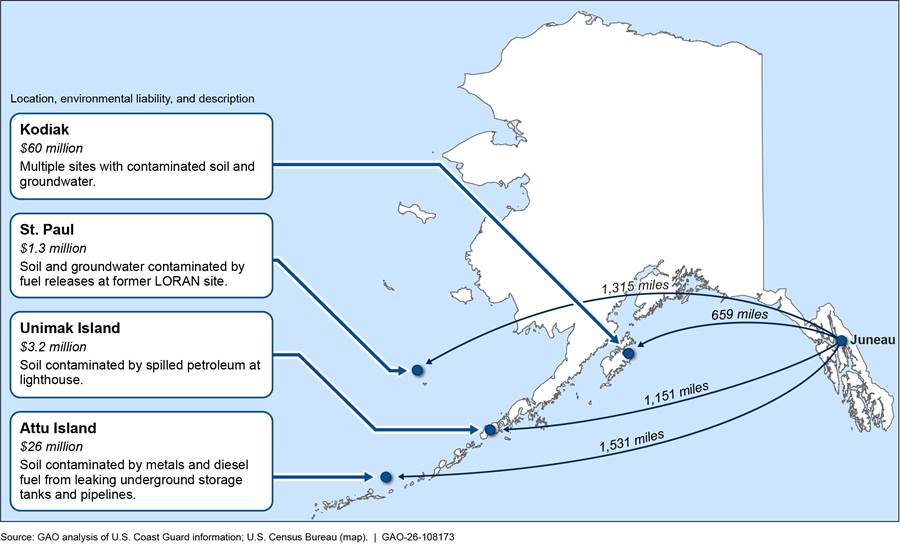
Long distances such as these tend to increase project costs, as equipment must be brought in—and any contaminated materials removed—by air or sea. For example, one of the major cost factors is the increased cost of shipping contaminated soil by barge over long distances. In the Bering Sea, for example, the Coast Guard may need to remove more than 8,700 cubic yards of petroleum contaminated soil from St. Paul, AK—enough to fill more than two Olympic-sized swimming pools—and transport it over 3,000 miles by barge to Washington State for safe treatment and disposal. The Coast Guard estimated these activities will cost approximately $10 million as of fiscal year 2025.
Remote sites also present logistical challenges. Some sites are uninhabited and lack basic infrastructure. There are no lodgings or dwellings at the Coast Guard’s former LORAN station on Kure Atoll, for example, so the Coast Guard needs to bring additional resources for shelter and food preparation when traveling there. According to one official, mobilization costs to remote sites can account for up to 60 percent of an environmental cleanup project’s cost in the Alaska region.
According to officials, one way the Coast Guard can potentially mitigate the challenge of working at remote sites is by finding logistical efficiencies. For example, the Civil Engineering Unit in Honolulu, HI, bundled projects at five remote sites in the Marshall Islands into a single contract to lessen the contractor’s mobilization costs. Some of the remote sites are uninhabited, so the potential risk to human health is very low, which officials said may allow the Coast Guard to establish a less costly long-term monitoring plan instead of a more expensive remediation project.
As previously discussed, the Coast Guard could benefit from the development of a long-term strategy that includes optimization analysis. Optimization analysis could help identify efficiencies and more cost-effective ways to manage environmental liabilities at remote sites.
Conclusions
The Coast Guard’s environmental liability has grown from $358 million in fiscal year 2016 to $448 million as of September 2025 and may increase significantly as the service attempts to better define and address the extent of its environmental contamination. But the Coast Guard’s environmental liabilities as reported to Congress do not comprise the total amount that the federal government may have to pay to address environmental contamination, known as its fiscal exposure. In particular, PFAS contamination represents a significant source of uncertainty and fiscal exposure that is not fully estimated in the Coast Guard’s current reporting. The Coast Guard is taking steps to assess its potential environmental liabilities related to PFAS and other contamination but has not fully communicated the associated risks and uncertainties to stakeholders and Congress, particularly in budget requests. Without this information, decision-makers will not have a complete picture of the Coast Guard’s environmental liability and total fiscal exposure. Consequently, the funds available for the Coast Guard’s annual environmental cleanup and remediation are likely to continue barely keeping pace with inflation.
Moreover, the Coast Guard’s efforts to manage its environmental liabilities program have not fully incorporated risk-informed decision-making. Specifically, without a comprehensive strategy to manage environmental liabilities with clearly defined objectives and performance measures, the Coast Guard will have limited ability to make essential risk-informed decisions over the long run. Such a strategy would allow the Coast Guard to systematically analyze its own efforts by evaluating outcomes against key objectives, such as limiting servicemembers’ exposure to contamination. Importantly, an environmental liability strategy could also guide the Coast Guard through challenging resource allocation decisions as the service undertakes an historic investment in its aging shore infrastructure.
Additionally, the challenges the Coast Guard is currently experiencing are likely to worsen if unaddressed. For example, staffing and workload challenges may cause environmental staff to be stretched even more as the Coast Guard spends billions on new shore infrastructure without expanding key positions, such as environmental engineers. Nevertheless, the Coast Guard will not be positioned to address these challenges without a comprehensive, long-term strategy for managing its environmental liabilities.
Recommendations
The Commandant of the Coast Guard should expand the information provided to Congress regarding the Coast Guard’s fiscal exposure for environmental cleanup activities, for example by identifying cleanup projects that are not reasonably estimable and the magnitude of uncertainties in its estimates in supplemental or other budget materials. (Recommendation 1)
The Commandant of the Coast Guard should develop a long-term strategy for managing the Coast Guard’s environmental liabilities program that incorporates the elements of the risk-informed decision-making framework, such as having clearly defined program objectives by which to measure progress, evaluating outcomes, and analyzing ways to optimize its cleanup projects for potential cost savings. (Recommendation 2)
Agency Comments
We provided a draft of this report to the Secretary of the Department of Homeland Security for review and comment. In its comments, reproduced in Appendix II, DHS concurred with our recommendations. DHS and the Coast Guard also provided technical comments, which we incorporated as appropriate.
We are sending copies of this report to the appropriate congressional committees, the Secretary of DHS, and other interested parties. In addition, the report is available at no charge on the GAO website at https://www.gao.gov.
If you or your staff have any questions about this report, please contact me at MacLeodH@gao.gov. Contact points for our Offices of Congressional Relations and Public Affairs may be found on the last page of this report. GAO staff who made key contributions to this report are listed in appendix III.

Heather MacLeod
Director
Homeland Security and Justice
Table 2 shows selected key information on the Coast Guard’s environmental cleanup projects.[52] The Coast Guard generally conducts its cleanup activities in accordance with the Comprehensive Environmental Response, Compensation, and Liability Act of 1980, as amended (CERCLA), as well as other relevant statutes and regulations.[53] However, the project phases outlined here have been identified by Coast Guard for the purposes of managing its environmental liabilities portfolio and do not necessarily reflect corresponding stages in the CERCLA process. Our interactive map shows the locations of these projects.
|
Cleanup project |
Location |
Environmental liability |
Year identified |
Project phase |
Cost to study |
Source of contamination |
|
Air Station Annette Island |
Annette Island, AK |
$1,118,040 |
1989 |
Investigation |
yes |
Soil contamination from diesel-range organics and semi-volatile organic compounds; metals in surface water and groundwater |
|
Air Station Brooklyn |
Brooklyn, NY |
$75,020 |
2020 |
Investigation |
yes |
PFAS from fire suppression system |
|
Air Station Clearwater |
Clearwater, FL |
$127,050 |
1993 |
Long-term monitoring |
no |
Contamination from former burn pit |
|
Air Station Detroit |
Detroit, MI |
$661,265 |
2018 |
Remediation |
no |
PFAS contamination due to release of aqueous film-forming foam (AFFF) |
|
Air Station Port Angeles |
Port Angeles, WA |
$108,900 |
1998 |
Long-term monitoring |
no |
Contamination by underground storage tanks from petroleum hydrocarbons, aviation gas, and diesel fuel |
|
Air Station Port Angeles |
Port Angeles, WA |
$848,210 |
2013 |
Investigation |
no |
Lead from small arms firing range and lead-based paint |
|
Air Station Sitka |
Sitka, AK |
$106,480 |
2021 |
Investigation |
yes |
Potential PFAS contamination due to release of AFFF firefighting foam |
|
Air Station Traverse City |
Traverse City, MI |
$2,727,340 |
2021 |
Investigation |
no |
PFAS from fire suppression system |
|
Akhiok |
Akhiok, AK |
$137,940 |
2012 |
Investigation |
no |
Contamination from diesel fuel |
|
Alligator Island |
Alligator Island, AK |
$110,110 |
2014 |
Investigation |
no |
Potential contamination from improper battery disposal |
|
Anguar LORAN Station |
Angaur Island, Republic of Palau |
$245,630 |
2006 |
Investigation |
yes |
Potential soil and groundwater contamination from improper disposal practices |
|
Attu Island LORAN Station |
Attu Island, AK |
$26,008,950 |
1992 |
Investigation |
no |
Soil contaminated by metals and diesel-range organics from leaking underground storage tanks and pipelines |
|
Aviation Support Facility Cordova |
Cordova, AK |
$49,610 |
1995 |
Investigation |
no |
Soil contaminated by fuel spill |
|
Base Alameda |
Oakland, CA |
$175,450 |
2021 |
Investigation |
yes |
Potential contamination from metals and fuel |
|
Base Cape Cod |
Sandwich, MA |
$55,660 |
2022 |
Investigation |
no |
PFAS contamination due to release of AFFF firefighting foam |
|
Base Elizabeth City (Building 75) |
Elizabeth City, NC |
$629,321 |
1996 |
Long-term monitoring |
no |
Improper disposal of solvents |
|
Base Elizabeth City (Building 77) |
Elizabeth City, NC |
$633,798 |
1996 |
Long-term monitoring |
no |
Groundwater contaminated by leaked solvents |
|
Base Elizabeth City (Building 79) |
Elizabeth City, NC |
$490,050 |
1988 |
Long-term monitoring |
no |
Leaking underground storage tank |
|
Base Elizabeth City (fuel farm) |
Elizabeth City, NC |
$899,635 |
1991 |
Long-term monitoring |
no |
Fuel leakage from underground storage tank |
|
Base Elizabeth City (burn area) |
Elizabeth City, NC |
$702,526 |
1997 |
Long-term monitoring |
no |
Improper waste disposal at former burn area |
|
Base Elizabeth City (former barracks) |
Elizabeth City, NC |
$525,140 |
2000 |
Long-term monitoring |
no |
Leakage from above-ground storage tank |
|
Base Elizabeth City (Building 87) |
Elizabeth City, NC |
$767,624 |
2007 |
Long-term monitoring |
no |
Improper waste storage |
|
Base Elizabeth City (JP-4 Pipeline) |
Elizabeth City, NC |
$557,931 |
1988 |
Long-term monitoring |
no |
Pipeline release |
|
Base Elizabeth City (North Beach disposal area) |
Elizabeth City, NC |
$857,164 |
1998 |
Long-term monitoring |
no |
Improper waste disposal |
|
Base Elizabeth City (seaplane pipeline) |
Elizabeth City, NC |
$501,061 |
1996 |
Long-term monitoring |
no |
Improper waste disposal |
|
Base Ketchikan |
Ketchikan, AK |
$4,900,500 |
1988 |
Investigation |
no |
Marine sediment contaminated by use of metals at waterfront |
|
Base Kodiak (laundry post-closure) |
Kodiak, AK |
$19,971,655 |
1988 |
Investigation |
no |
Laundry facility solvent disposal. |
|
Base Kodiak (RCRA) |
Kodiak, AK |
$11,179,190 |
2017 |
Long-term monitoring |
no |
Various sources across the site including a former laundry, leaking underground storage tanks, and improperly stored hazardous waste. |
|
Base Kodiak (barrel storage area 1) |
Kodiak, AK |
$6,629,590 |
1987 |
Long-term monitoring |
no |
Improper barrel storage |
|
Base Kodiak (Nyman fuel farm) |
Kodiak, AK |
$4,648,820 |
1990 |
Remediation |
no |
Leaking aboveground and underground storage tanks |
|
Base Kodiak (Coast Guard landfill) |
Kodiak, AK |
$3,478,750 |
1987 |
Long-term monitoring |
no |
Former landfill |
|
Base Kodiak (paint storage) |
Kodiak, AK |
$2,958,450 |
1987 |
Long-term monitoring |
no |
Leak from fuel line |
|
Base Kodiak (Navy landfill) |
Kodiak, AK |
$2,176,790 |
1995 |
Long-term monitoring |
no |
Former landfill |
|
Base Kodiak (small arms firing range) |
Kodiak, AK |
$701,800 |
2007 |
Investigation |
no |
Soil contaminated by lead from firing range |
|
Base Kodiak (Upper Government Hill) |
Kodiak, AK |
$457,380 |
1993 |
Investigation |
yes |
Oil leak from underground storage tanks |
|
Base Kodiak (marine sediment) |
Kodiak, AK |
$406,560 |
1987 |
Investigation |
yes |
Releases of polycyclic aromatic hydrocarbons and polychlorinated biphenyls (PCB) |
|
Base Kodiak (MOGAS) |
Kodiak, AK |
$222,640 |
1987 |
Long-term monitoring |
no |
Leaking underground storage tanks |
|
Base Kodiak (fire training pit) |
Kodiak, AK |
$105,270 |
1987 |
Investigation |
yes |
Fuel and PFAS contamination from unlined burn pits used for firefighting training |
|
Base Kodiak (former building 28) |
Kodiak, AK |
$52,030 |
1999 |
Investigation |
yes |
Oil separator sump located inside Building 28 was found to contain sediment contaminated with fuels, lead, and PCBs. |
|
Base Kodiak (old power plant) |
Kodiak, AK |
$1,816,210 |
1990 |
Investigation |
no |
Fuel and PCB contamination from power plant operations |
|
Base Kodiak (Lake Louise housing) |
Kodiak, AK |
$35,090 |
1991 |
Investigation |
yes |
Leaking underground storage tanks |
|
Base Kodiak (fire training pit) |
Kodiak, AK |
$320,650 |
1997 |
Investigation |
yes |
AFFF used at fire training area resulting in PFAS contaminated soil and groundwater. |
|
Base Kodiak (Buskin Lake) |
Kodiak, AK |
$4,617,360 |
2016 |
Investigation |
no |
Soil contaminated by lead-based paint |
|
Base Kodiak (Holiday Beach) |
Kodiak, AK |
$229,900 |
2021 |
Investigation |
yes |
Potential contamination from lead-based paint and fuel leak |
|
Base Milwaukee |
Milwaukee, WI |
$1,662,540 |
1980 |
Investigation |
no |
Underground storage tank release |
|
Base Tongue Point |
Astoria, OR |
$232,320 |
2021 |
Investigation |
yes |
Potential soil contamination from sandblasting |
|
Biorka Island LORAN Station |
Biorka Island/Sitka, AK |
$240,790 |
1988 |
Investigation |
no |
Fuel leakage from tanks and pipelines |
|
Boston Light Lighthouse |
Hull, MA |
$627,990 |
2020 |
Investigation |
no |
Soil contaminated by lead-based paint and petroleum |
|
Browns Point Lighthouse |
Browns Point / Tacoma, WA |
$135,520 |
2004 |
Investigation |
no |
Soil contaminated by lead-based paint |
|
Cape Blanco Lighthouse |
Cape Blanco, OR |
$105,270 |
1993 |
Remediation |
no |
Soil contaminated by lead; cistern water contaminated by total petroleum hydrocarbons |
|
Cape Decision Lighthouse |
Kuiu Island / Sumner Straight, AK |
$59,290 |
2001 |
Long-term monitoring |
no |
Soil contaminated by lead-based paint |
|
Cape Flattery Lighthouse |
Cape Flattery, WA |
$882,090 |
1998 |
Investigation |
no |
Soil contaminated by total petroleum hydrocarbons |
|
Cape Hinchinbrook Lighthouse |
Hinchinbrook Island, Prince William Sound, AK |
$1,032,130 |
1994 |
Investigation |
no |
Soil contaminated by fuel-related constituents, PCBs, and lead impacts to soils from drum and battery dumping and waste oil storage |
|
Cape Kumukahi Lighthouse |
Island of Hawaii, HI |
$243,210 |
2009 |
Investigation |
yes |
Soil contaminated by lead-based paint |
|
Cape Sarichef LORAN Station |
Cape Sarichef, AK |
$1,187,010 |
1997 |
Investigation |
no |
Soil contaminated by total petroleum hydrocarbons from leaking underground storage tanks and lead |
|
Cape Spencer Lighthouse |
Cape Spenser / Cross Sound-Icy Strait, AK |
$634,040 |
1993 |
Investigation |
yes |
Soil contaminated by spilled petroleum hydrocarbons and lead-based paint |
|
Cape St. Elias Lighthouse |
Kayak Island, AK |
$1,276,550 |
1994 |
Investigation |
no |
Soil contaminated by petroleum hydrocarbons |
|
Coast Guard Academy |
New London, CT |
$13,310 |
1996 |
Long-Term monitoring |
no |
Improper debris and waste disposal |
|
Coast Guard Yard (Site 9) |
Baltimore, MD |
$87,120 |
1993 |
Long-Term monitoring |
no |
Improper storage and disposal of debris |
|
Coast Guard Yard (Site 7) |
Baltimore, MD |
$392,040 |
1993 |
Long-Term monitoring |
no |
Contamination from site’s prior use as debris burn pit |
|
Coast Guard Yard (burial pits) |
Baltimore, MD |
$1,134,980 |
2014 |
Remediation |
no |
Improper disposal of demolition debris |
|
Cocos Island LORAN Station |
Cocos Island, Guam |
$1,450,790 |
|
Long-Term monitoring |
no |
Soil contaminated by PCBs |
|
Destruction Island Lighthouse |
Jefferson County, WA |
$2,608,760 |
1996 |
Investigation |
no |
Soil contaminated by metals, total petroleum hydrocarbons, and lead-based paint |
|
Diamond Head Lighthouse |
Diamond Head, HI |
$226,270 |
2019 |
Remediation |
no |
Soil contaminated by lead-based paint |
|
Dry Tortugas Lighthouse |
Key West, FL |
$327,910 |
2004 |
Investigation |
no |
Soil contaminated by lead-based paint |
|
East Brother Lighthouse |
East Brother, CA |
$228,690 |
2003 |
Investigation |
no |
Soil contaminated by lead-based paint |
|
Ebeye LORAN Station |
Ebeye Island, Kwajalein Atoll, Republic of the Marshall Islands |
$100,430 |
2006 |
Investigation |
yes |
Potential soil and groundwater contamination from improper disposal practices |
|
Egmont Key Lighthouse |
Egmont Key Island/ Tampa Bay, FL |
$8,954 |
1995 |
Long-term monitoring |
no |
Groundwater contaminated by leaking underground fuel pipe |
|
Eldred Rock Lighthouse |
Lynn Canal / Haines, AK |
$938,960 |
1997 |
Investigation |
no |
Soil contaminated by lead-based paint |
|
Fairway Island Lighthouse |
Fairway Island, AK |
$1,103,520 |
2002 |
Investigation |
no |
Soil contaminated with lead and mercury |
|
Farallon Island Lighthouse |
Farallon Island, CA |
$3,333,550 |
2003 |
Investigation |
no |
Soil contaminated with metals and total petroleum hydrocarbons |
|
Five Finger Island Lighthouse |
Five Finger Islands / Frederick Sound, AK |
$60,500 |
2001 |
Long-term monitoring |
no |
Soil contaminated by lead-based paint |
|
Governor’s Island |
Governors Island, NY |
$81,070 |
2010 |
Investigation |
yes |
Potential soil and groundwater contamination from unknown source |
|
Hanapepe Point Lighthouse |
Island of Kauai, HI |
$75,020 |
2003 |
Investigation |
yes |
Soil contaminated by lead-based paint |
|
Kalaniana’ole Highway Quarters |
Wailupe Honolulu, Oahu, HI |
$442,860 |
2021 |
Investigation |
no |
Lead-based paint |
|
Kauhola Point Lighthouse |
Island of Hawaii, HI |
$110,110 |
2004 |
Investigation |
yes |
Soil contaminated by lead-based paint |
|
Kure LORAN Station |
Kure Atoll, HI |
$643,720 |
1992 |
Long-term monitoring |
no |
Soil contaminated by PCBs from scrap metal disposal |
|
Kwadak LORAN Station |
Kwadak Island, Kwajalein Atoll, Republic of the Marshall Islands |
$98,010 |
2006 |
Investigation |
yes |
Potential soil and groundwater contamination from improper disposal practices |
|
Lā’au Point Lighthouse |
Island of Molokai, HI |
$75,020 |
2005 |
Investigation |
yes |
Soil contaminated by lead-based paint |
|
Lighthouse Alcatraz |
Alcatraz Island, CA |
$312,180 |
2004 |
Remediation |
no |
Soil contaminated by lead-based paint |
|
Lighthouse Alki Point |
Alki Point, WA |
$1,373,350 |
2004 |
Investigation |
no |
Soil contaminated by lead-based paint |
|
Lime Kiln Lighthouse |
San Juan Island, WA |
$102,850 |
2021 |
Investigation |
yes |
Potential soil contamination from lead-based paint |
|
Lime Point Lighthouse |
Lime Point, CA |
$221,430 |
2005 |
Investigation |
no |
Soil contaminated by lead-based paint and leaking transformers |
|
Lincoln Island Lighthouse |
Lincoln Island, AK |
$611,050 |
1993 |
Remediation |
no |
Soil contaminated by lead-based paint |
|
Little Sand Island |
Little Sand, AL |
$359,370 |
2003 |
Investigation |
yes |
Potential soil contamination from lead-based paint |
|
Long Island Head Lighthouse |
Boston, MA |
$607,420 |
2009 |
Investigation |
no |
Soil contaminated by lead-based paint |
|
Long Point Lighthouse |
Provincetown Harbor, MA |
$88,330 |
2008 |
Investigation |
no |
Soil contaminated by lead-based paint |
|
Malone LORAN Station |
Malone, FL |
$49,610 |
2007 |
Investigation |
yes |
Soil contaminated by lead and potential improper waste disposal |
|
Marblehead Lighthouse |
Marblehead, MA |
$137,940 |
2008 |
Investigation |
no |
Soil contaminated by lead-based paint |
|
Marine Safety Office Valdez |
Valdez, AK |
$405,350 |
2004 |
Investigation |
no |
Heating oil spill |
|
Mary Island Lighthouse |
Mary Island / Revillagigedo Channel, AK |
$623,150 |
1997 |
Investigation |
no |
Soil contaminated by lead-based paint and leaking underground storage tanks |
|
Middletown LORAN Station |
Middletown, CA |
$822,800 |
2000 |
Investigation |
no |
Soil contaminated by lead from small arms firing range, PFAS from firefighting, and potential groundwater contamination from leaking underground storage tanks |
|
Millers Island |
Garibaldi, OR |
$181,500 |
2013 |
Remediation |
no |
Potential contamination from improper battery disposal |
|
Mount Diablo Radio Station |
Concord, CA |
$588,060 |
2005 |
Remediation |
no |
Soil contaminated by lead-based paint |
|
Nápó’opo’o Lighthouse |
Island of Hawaii, HI |
$75,020 |
2005 |
Investigation |
yes |
Soil contaminated by lead-based paint |
|
Nawiliwili Harbor Lighthouse |
Brunswick, ME |
$64,130 |
2016 |
Investigation |
yes |
Potential contamination by lead-based paint and PCBs from transformers and |
|
Nawiliwili Harbor Lighthouse |
Island of Kauai, HI |
$243,210 |
2004 |
Investigation |
yes |
Soil contaminated by lead-based paint |
|
Ned Point Lighthouse |
Mattapoisett, MA |
$121,000 |
2009 |
Investigation |
no |
Soil contaminated by lead-based paint |
|
New Dungeness Lighthouse |
New Dungeness, WA |
$1,975,930 |
2003 |
Investigation |
no |
Contamination by lead-based paint and PCBs from transformers and |
|
Ocean Cape LORAN Station |
Yakutat, AK |
$859,100 |
2021 |
Investigation |
yes |
Unknown |
|
Palaoa Point Lighthouse |
Island of Lanai, HI |
$243,210 |
2005 |
Investigation |
yes |
Soil contaminated by lead-based paint |
|
Passage Island Lighthouse |
Keweenaw, MI |
$1,408,440 |
1997 |
Remediation |
no |
Soil contaminated by lead-based paint |
|
Pauwela Point Lighthouse |
Island of Maui, HI |
$75,020 |
2004 |
Investigation |
no |
Soil contaminated by lead-based paint |
|
Perkins Island Lighthouse |
Georgetown, ME |
$497,310 |
2009 |
Investigation |
no |
Soil contaminated by lead-based paint |
|
Point Crowley |
Kuiu Island, AK |
$136,730 |
2008 |
Investigation |
no |
Potential contamination from compressed gas cylinders |
|
Point Diablo Lighthouse |
Point Diablo, CA |
$105,270 |
2005 |
Investigation |
no |
Soil contaminated by lead-based paint |
|
Point Montara Lighthouse |
Point Montara, CA |
$912,340 |
2005 |
Remediation |
no |
Soil contaminated by lead-based paint |
|
Point Retreat Lighthouse |
Admiralty Island, AK |
$61,710 |
1997 |
Long-term monitoring |
no |
Soil contaminated by lead-based paint and diesel-range organics |
|
Point Vicente Lighthouse |
Point Vicente, CA |
$1,196,690 |
2005 |
Investigation |
no |
Soil contaminated by lead-based paint |
|
Point Wilson Lighthouse |
Port Townsend, WA |
$1,167,650 |
1999 |
Investigation |
no |
Soil contaminated by lead-based paint |
|
Portland Marine Safety Unit |
Portland, OR |
$425,920 |
2021 |
Investigation |
yes |
Unknown |
|
Poverty Island Lighthouse |
Poverty Island, MI |
$1,334,630 |
1999 |
Investigation |
no |
Soil contaminated by lead-based paint |
|
Pulo Anna LORAN Station |
Pulo Anna Island, Republic of Palau |
$169,400 |
2006 |
Investigation |
yes |
Potential soil and groundwater contamination from improper disposal practices |
|
Race Point Lighthouse |
Provincetown, MA |
$60,500 |
2008 |
Investigation |
no |
Soil contaminated by lead-based paint and improper petroleum storage |
|
Radar Station Point Higgins |
Sitka, AK |
$3,956,700 |
1997 |
Investigation |
no |
Soil contaminated by petroleum hydrocarbons from spills from above ground storage tanks and lead-based paint |
|
Robinson Point Lighthouse |
Vashon, WA |
$924,440 |
1999 |
Investigation |
no |
Soil contaminated by total petroleum hydrocarbons, leaking underground storage tanks, and lead-based paint |
|
Roguron LORAN Station |
Roguron Island, Republic of the Marshall Islands |
$78,650 |
2006 |
Investigation |
yes |
Potential soil and groundwater contamination from improper disposal practices |
|
Scotch Cap Lighthouse |
Unimak Island, AK |
$3,262,160 |
1989 |
Investigation |
no |
Soil contaminated by spilled petroleum |
|
Sector Field Office Cape Hatteras |
Cape Hatteras, NC |
$124,630 |
1999 |
Investigation |
no |
Above-ground storage tank release |
|
Sentinel Island Lighthouse |
Sentinel Island / Lynn Canal, AK |
$315,810 |
1997 |
Long-term monitoring |
no |
Soil contaminated by lead-based paint and diesel-range organics |
|
Shoal Cove LORAN Station |
Shoal Cove, AK |
$491,260 |
1997 |
Investigation |
no |
Soil contaminated by fuel leakage from underground storage tanks and lead from former small arms firing range at site |
|
Sitkinak LORAN Station |
Sitkinak Island, AK |
$1,677,060 |
2001 |
Long-term monitoring |
no |
Improper battery disposal |
|
Sledge Island |
Sledge Island, AK |
$210,540 |
1995 |
Investigation |
no |
Soil contaminated by diesel-range organics and residual range organics |
|
Slip Point Lighthouse |
Clallam, Bay, WA |
$972,840 |
2003 |
Investigation |
no |
Soil contaminated by lead-based paint |
|
Smilax Mooring |
Jacksonville, FL |
$77,440 |
2003 |
Investigation |
yes |
Potential contamination from lead-based paint and fuel storage |
|
Split Rock Point Lighthouse |
Essex, VT |
$153,670 |
2010 |
Investigation |
no |
Soil contaminated by lead-based paint |
|
St. Paul LORAN Station |
St. Paul Island, AK |
$1,287,440 |
1993 |
Investigation |
no |
Soil and groundwater contaminated by fuel releases |
|
Station Alexandria Bay |
Wellesley Island, NY |
$83,490 |
2020 |
Investigation |
no |
Contamination from leaking transformer |
|
Station Beach Haven |
Beach Haven, NJ |
$62,920 |
1990 |
Investigation |
yes |
Underground storage tank release |
|
Station Cape Disappointment |
Ilwaco, WA |
$231,110 |
2021 |
Investigation |
yes |
Leaking buried motor oil drums |
|
Station Grand Haven |
Grand Haven, MI |
$36,300 |
2001 |
Long-Term monitoring |
no |
Leaking diesel fuel from underground storage tanks |
|
Station Jones Beach |
Freeport, NY |
$37,510 |
2013 |
Investigation |
yes |
Potential soil contamination by petroleum leakage from oil-water separator system |
|
Station Oak Island |
Oak Island, NC |
$159,720 |
1992 |
Investigation |
no |
Leaking petroleum from underground storage tanks |
|
Station Rochester |
Rochester, NY |
$116,160 |
1991 |
Investigation |
no |
Contamination from underground storage tanks |
|
Station Sault Ste Marie |
Sault Ste Marie, MI |
$248,050 |
2008 |
Investigation |
no |
Hazardous waste released at site |
|
Station Sheboygan |
Sheboygan, WI |
$53,240 |
2002 |
Investigation |
no |
Soil contaminated by lead-based paint |
|
Training Center Cape May (auxiliary building) |
Cape May, NJ |
$43,560 |
2002 |
Investigation |
no |
Soil contaminated by lead-based paint |
|
Training Center Cape May (small arms firing range) |
Cape May, NJ |
$2,157,430 |
1997 |
Investigation |
no |
Soil contaminated by lead from small arms firing range |
|
Training Center Petaluma (Building 115) |
Petaluma, CA |
$145,200 |
2016 |
Long-term monitoring |
no |
Potential leaking underground storage tank |
|
Training Center Petaluma (skeet range) |
Petaluma, CA |
$5,740,240 |
2004 |
Investigation |
no |
Soil contaminated by metals and polycyclic aromatic hydrocarbons from skeet shooting range |
|
Training Center Petaluma (small arms firing range - investigation) |
Petaluma, CA |
$337,590 |
2007 |
Investigation |
no |
Soil contaminated by lead from small arms firing range |
|
Training Center Petaluma (small arms firing range) |
Petaluma, CA |
$166,980 |
2007 |
Investigation |
no |
Soil contaminated by lead from small arms firing range |
|
Tree Point Lighthouse |
Revillagigedo Channel / Ketchikan, AK |
$1,906,960 |
1997 |
Investigation |
no |
Soil contaminated by lead-based paint, diesel-range organics, spilled from above-ground storage tanks, and metals from improper battery disposal |
|
Ulithi LORAN Station |
Ulithi Atoll, NMI |
$9,356,930 |
2011 |
Investigation |
no |
Soil and structure contaminated by lead-based paint and asbestos-containing materials |
|
Umpqua River Lighthouse |
Umpqua River / Winchester Bay, OR |
$330,330 |
2005 |
Investigation |
no |
Soil contaminated by lead-based paint |
|
Upolu Point LORAN Station |
Hawi, HI |
$605,000 |
2019 |
Investigation |
yes |
Potential contamination from lead, pesticides, and diesel-range organics |
|
Valcour Bluff Lighthouse |
Plattsburgh, NY |
$398,090 |
2010 |
Investigation |
no |
Soil contaminated by lead-based paint |
|
Wildwood LORAN Support Unit |
Wildwood, NJ |
$491,260 |
2007 |
Investigation |
no |
Soil contaminated by release of semivolatile organic compounds |
|
Wood End Lighthouse |
Provincetown / Cape Cod, MA |
$94,380 |
2008 |
Investigation |
no |
Contaminated soil from lead-based paint and potential underground storage tank release |
|
Wood Island Lighthouse |
Biddeford, ME |
$1,493,140 |
2008 |
Investigation |
no |
Contaminated soil from lead-based paint and underground storage tank release |
|
Yap LORAN Station |
State of Yap, FSM |
$3,573,130 |
2004 |
Long-term monitoring |
no |
Soil contaminated by PCBs from landfill |
|
Yerba Buena Island |
Yerba Buena Island, San Francisco CA |
$882,090 |
2012 |
Investigation |
no |
Potential underground storage tank release |
Source: GAO analysis of U.S. Coast Guard information. | GAO‑26‑108173
Notes: Aqueous film forming foam (AFFF): AFFF is an extinguishing agent used in firefighting that often contains PFAS and has been linked to health problems.
Asbestos: Asbestos is the name given to a group of naturally occurring mineral fibers that were commonly used in construction materials until they were linked to serious illness and fell out of widespread use in the United States beginning in the 1970s. Exposure to asbestos increases the risk of developing lung disease, including lung cancer and mesothelioma.
Diesel range organics: Diesel range organics are typically compounds found in diesel fuel. They can persist in soil for many years and have been linked to adverse neurological and respiratory health effects.
Lead-based paint: As lead-based paint deteriorates into flakes and dust it becomes a health hazard to people, especially children. Lead exposure can damage a child’s developing brain and nervous system and slow development and growth.
Metals: Metals, such as lead, have varying degrees of toxic and carcinogenic properties that may produce adverse human health effects.
Polychlorinated biphenyls (PCB): PCBs are man-made compounds that have been used in transformers and other electrical equipment. PCBs can be released into the environment from hazardous waste sites, improper disposal of industrial waste and consumer products, and from leaking transformers. Both the EPA and the International Agency for Research on Cancer have determined that PCBs are carcinogenic to humans and can lead to cancer.
PFAS: PFAS are a large group of synthetic chemicals that are found in many consumer and industrial products. PFAS have caused environmental contamination; can remain in the water, soil, and air for decades or longer; and have been linked to health problems in humans. According to the EPA, exposure to certain PFAS—such as perfluorooctanoic acid (PFOA) and perfluorooctane sulfonate (PFOS)—may have adverse effects on human health, including effects on fetal development, the immune system, and the thyroid, and may cause liver damage and cancer.
Polycyclic aromatic hydrocarbons (PAH): These are a group of chemicals that are formed during the incomplete burning of coal, oil, gas, wood, garbage, or other organic substances, such as tobacco and charbroiled meat. PAHs can attach to dust particles in the air and settle in lakes and rivers. Some PAHs may be carcinogenic, and studies have shown that individuals exposed by breathing or skin contact for long periods to mixtures that contain PAHs can develop cancer.
Volatile organic compounds: Volatile organic compounds include a wide variety of chemicals and may be emitted by thousands of products such as paint, disinfectants, adhesives, and building materials. The nature and extent of their effects on human health depends on many factors, such as level of exposure and length of time exposure.
GAO Contact:
Heather MacLeod, MacLeodH@gao.gov
Staff Acknowledgments:
In addition to the contact named above, GAO staff who made key contributions to this report include Andrew Curry (Assistant Director), Ben Nelson (Analyst in Charge), Jenn Alexander, Lauri Barnes, Michele Fejfar, Eric Hauswirth, Amanda Kolling, Rob Letzler, Azinwi Numfor, Mary Offutt-Reagin, Janice Poling, and Jack Wang.
The Government Accountability Office, the audit, evaluation, and investigative arm of Congress, exists to support Congress in meeting its constitutional responsibilities and to help improve the performance and accountability of the federal government for the American people. GAO examines the use of public funds; evaluates federal programs and policies; and provides analyses, recommendations, and other assistance to help Congress make informed oversight, policy, and funding decisions. GAO’s commitment to good government is reflected in its core values of accountability, integrity, and reliability.
Obtaining Copies of GAO Reports and Testimony
The fastest and easiest way to obtain copies of GAO documents at no cost is through our website. Each weekday afternoon, GAO posts on its website newly released reports, testimony, and correspondence. You can also subscribe to GAO’s email updates to receive notification of newly posted products.
Order by Phone
The price of each GAO publication reflects GAO’s actual cost of production and distribution and depends on the number of pages in the publication and whether the publication is printed in color or black and white. Pricing and ordering information is posted on GAO’s website, https://www.gao.gov/ordering.htm.
Place orders by calling (202) 512-6000, toll free (866) 801-7077,
or
TDD (202) 512-2537.
Orders may be paid for using American Express, Discover Card, MasterCard, Visa, check, or money order. Call for additional information.
Connect with GAO
Connect with GAO on X,
LinkedIn, Instagram, and YouTube.
Subscribe to our Email Updates. Listen to our Podcasts.
Visit GAO on the web at https://www.gao.gov.
To Report Fraud, Waste, and Abuse in Federal Programs
Contact FraudNet:
Website: https://www.gao.gov/about/what-gao-does/fraudnet
Automated answering system: (800) 424-5454
Media Relations
Sarah Kaczmarek, Managing Director, Media@gao.gov
Congressional Relations
David A. Powner, Acting Managing Director, CongRel@gao.gov
General Inquiries
[1]Per- and polyfluoroalkyl substances (PFAS) are a group of synthetic chemicals that have been linked to harmful health effects. For decades, PFAS have been used in a wide range of products including stain-resistant furniture, waterproof clothing, nonstick cookware, and certain firefighting foams like aqueous film-forming foam (AFFF). PFAS are resistant to degradation and can accumulate in humans, animals, and plants.
[2]Federal Accounting Standards Advisory Board, FASAB Handbook of Federal Accounting Standards and Other Pronouncements, as Amended (Washington, D.C.: June 30, 2025). Under these standards, and throughout our report, an environmental liability is defined as a probable, measurable, and reasonably estimable future outflow or expenditure of resources that exist for environmental cleanup costs resulting from past transactions or events.
[3]GAO, High-Risk Series: Progress on Many High-Risk Areas, While Substantial Efforts Needed on Others, GAO‑17‑317 (Washington, D.C.: Feb. 15, 2017).
[4]Throughout our report, we use the term environmental liabilities program to refer to the Coast Guard’s collective processes and activities for identifying, assessing, and managing the contamination associated with its environmental liabilities.
[5]Throughout our report, we use the term cleanup projects to refer to sites where the Coast Guard has identified the release or potential release of a contaminant and developed a site-specific estimated project cost to address the contamination. The Coast Guard refers to these estimated project costs as environmental liability estimates—a term which we also use in our report—and includes such costs as environmental liabilities in its financial reporting.
[6]GAO, Environmental Hazards: A Framework for Risk-Informed Decision-Making, GAO‑24‑107595 (Washington, D.C.: Sept. 23, 2024).
[7]“Probable” relates to whether a future outflow of resources will be required—specifically, that it is more likely than not that the agency will incur a future outflow of resources. In determining whether an agency’s environmental cleanup responsibilities meet the probable criterion, the agency must establish its legal liability or financial responsibility for the project and determine that it is more likely than not that it will have to conduct the cleanup. “Reasonably estimable” refers to the ability to reliably quantify in monetary terms the outflow of resources that will be required.
[8]For example, if there is no completed study or comparable site or condition, remediation costs for a site would not be considered reasonably estimable at that time, but the agency would recognize the anticipated cost of conducting a future study, if required, plus any other identifiable costs. GAO, Abandoned Hardrock Mines: Land Management Agencies Should Improve Reporting of Total Cleanup Costs, GAO‑23‑105408 (Washington, D.C.: Jan. 13, 2023); Environmental Liabilities: NASA's Reported Financial Liabilities Have Grown, and Several Factors Contribute to Future Uncertainties, GAO‑21‑205 (Washington, D.C.: Jan. 15, 2021).
[9]Comprehensive Environmental Response, Compensation, and Liability Act of 1980, Pub. L. No. 96-510, 94 Stat. 2767 (codified as amended at 42 U.S.C. §§ 9601-9675). Other federal laws may be relevant to the Coast Guard’s investigation and cleanup activities, including the Resource Conservation and Recovery Act of 1976. Pub. L. No. 94-580, 90 Stat. 2795 (codified as amended at 42 U.S.C. §§ 6901-6987).
[10]42 U.S.C. § 9604(a).
[11]Specifically, Executive Order 12,580, as amended, delegates the authority of the President under CERCLA section 104 to federal agencies to, among other things, take remedial actions for releases or threatened releases of any hazardous substances, pollutants, or contaminants from any facility or vessel under the federal agency’s jurisdiction, custody, or control. Exec. Order No. 12,580, § 2(e)(1), 52 Fed. Reg. 2923, 2924 (Jan. 29, 1987).
[12]The U.S. government routinely identifies and disposes of excess federal property, such as unused or underutilized buildings. Throughout our report, we refer to this process as disposal. The General Services Administration often manages the property disposal process on behalf of other agencies. We have reported on several aspects of federal property management and disposal. For example, see Federal Real Property: GSA Should Create Goals to Ensure New Approach Saves Money and Accelerates Disposal of Unneeded Property, GAO‑26‑107760 (Washington, D.C.: Apr. 9, 2026).
[13]See 14 U.S.C. § 2945(a).
[14]40 C.F.R. § 302.4.
[15]The Remedial Action Cost Engineering Requirements (RACER) system is estimating software designed to provide cost estimations based on site-specific information and available technologies used in the industry. Coast Guard officials told us that RACER estimates may not include appropriate site-specific logistical costs, which they estimate and enter manually based on knowledge and lessons learned from prior environmental cleanup projects.
[16]Petroleum is not a designated hazardous substance subject to CERCLA. See 40 C.F.R. § 302.4. The Coast Guard uses other authorities to address contamination from petroleum.
[17]The Coast Guard’s Environmental Liabilities Process Guide states that cleanup project estimates must be renewed periodically. During these updates, the Coast Guard identifies and quantifies the cleanup costs for new projects or updates the costs of projects where estimates can be improved based on new information. Coast Guard officials told us they typically do this full update and renewal every 3 years. In addition, at the beginning of each calendar year, the Coast Guard adjusts all its environmental liabilities for inflation, including cleanup project estimates. U.S. Coast Guard, Environmental Liabilities Process Guide (March 21, 2016).
[18]PFAS are a large group of synthetic chemicals that have a wide range of uses in consumer products, manufacturing, and fire safety. They also have caused environmental contamination of water and soil, and some have been linked to health problems in humans.
[19]See PFAS National Primary Drinking Water Regulation, 89 Fed. Reg. 32,532 (Apr. 26, 2024); 40 C.F.R. § 142.12(b) (generally requiring State requests for approval of program revisions to adopt new or revised EPA regulations be submitted to EPA not later than 2 years after promulgation of the new or revised EPA regulations). But see Rescission of Regulatory Determinations and Removal of Related Provisions for Four PFAS Substances (PFHxS, PFNA, HFPO-DA (GenX), and the Mixture of These Three PFAS Plus PFBS), 91 Fed. Reg. 29,413 (May 20, 2026) (proposing recission of parts of the April 2024 final rule).
[20]PFAS National Primary Drinking Water Regulation, 89 Fed. Reg. 32,532 (Apr. 26, 2024); Designation of Perfluorooctanoic Acid (PFOA) and Perfluorooctanesulfonic Acid (PFOS) as CERCLA Hazardous Substances, 89 Fed. Reg. 39,124 (May 8, 2024). EPA proposed the rescission of some, but not all, of the maximum drinking water contaminant levels for PFAS set in 2024. Rescission of Regulatory Determinations and Removal of Related Provisions for Four PFAS Substances (PFHxS, PFNA, HFPO-DA (GenX), and the Mixture of These Three PFAS Plus PFBS), 91 Fed. Reg. 29,413 (May 20, 2026).
[21]Department of Homeland Security, Policy for Site Evaluation and Investigation of Per- and Polyfluoroalkyl Substances at Current and Former Operating Facilities, Policy Directive 025-04 (Washington, D.C.: Aug. 9, 2021).
[22]GAO, Persistent Chemicals: DOD Needs to Provide Congress More Information on Costs Associated with Addressing PFAS, GAO‑25‑107401 (Washington, D.C.: Feb. 24, 2025).
[23]Department of Homeland Security, United States Coast Guard, Executive Summary Report: U.S. Coast Guard Nationwide Per- and Polyfluoroalkyl Substances Preliminary Assessments (Norfolk, VA: May 2025).
[24]Federal accounting standards permit agencies to report partially estimated costs as environmental liabilities if the full cost to remediate cannot yet be reasonably estimated. The Coast Guard refers to these types of environmental liabilities as “cost to study” cleanup projects.
[25]Not all partially estimated projects result in additional costs. After investigation, the Coast Guard may determine there is no contamination or no further action is needed. For example, at one potential cleanup project site, a pipe suspected of being part of a leaking underground storage tank was discovered to be an electrical conduit, resulting in no further action.
[26]We calculated this additional fiscal exposure by averaging the estimation for projects that were fully estimated, multiplying by 51 (the number of projects with a "cost to study” estimation that are not included in the Coast Guard’s nationwide PFAS effort as of September 2025), and subtracting the total amount of the partial estimates.
[27]GAO‑25‑107401. We have also previously found that in general, cost estimates tend to increase over time. See GAO, Cost Estimating and Assessment Guide: Best Practices for Developing and Managing Program Costs, GAO‑20‑195G (Washington, D.C.: Mar. 12, 2020).
[28]In 2022, we reported on the extent of environmental liabilities at former military sites. Specifically, we found that the Department of Defense is responsible for cleaning up contamination at approximately 1,700 former military sites, at an estimated cost of approximately $10.2 billion. See GAO, Environmental Liabilities: Improvements Needed to Measure Progress of Cleanup of Formerly Used Defense Sites, GAO‑22‑104744 (Washington, D.C.: June 16, 2022).
[29]Such materials may not always be hazardous substances pursuant to CERCLA. The Coast Guard may use other authorities to address contamination where applicable.
[30]The Senate Report accompanying the Department of Homeland Security Appropriations Act, 2016, directed the Coast Guard to include in its annual budget justification a listing of the activities projected to be funded by Coast Guard’s funding request and an updated backlog report for Environmental Compliance and Restoration projects with an explanation of how the amount of funding requested will impact this documented backlog. S. Rep. No. 114-68, at 78 (2016) (accompanying Pub. L. No. 114-113, div. F, 129 Stat. 2242, 2493).
[31]For example, according to its September 2025 environmental liability report, the Coast Guard plans to spend $3 million on a project to remediate lead-contaminated soil at the small arms firing range at Station Cape Disappointment. This spending plan is not reflected in the agency’s fiscal year 2027 Congressional Budget Justification.
[32]GAO‑23‑105408; GAO‑21‑205; GAO, Fiscal Exposures: Improving the Budgetary Focus on Long-Term Costs and Uncertainties, GAO‑03‑213 (Washington, D.C.: Jan. 24, 2003).
[33]GAO, High-Risk Series: Heightened Attention Could Save Billions More and Improve Government Efficiency and Effectiveness, GAO‑25‑107743 (Washington, D.C.: Feb. 25, 2025).
[34]GAO, High-Risk Series: Key Practices to Successfully Address High-Risk Areas and Remove Them from the List, GAO‑22‑105184 (Washington, D.C.: Mar. 3, 2022).
[35]We recommended that the Coast Guard include more detailed information in its congressional budget requests. See GAO, Coast Guard Shore Infrastructure: Applying Leading Practices Could Help Better Manage Project Backlogs of At Least $2.6 Billion, GAO‑19‑82 (Washington, D.C.: Feb. 21, 2019). As of May 2026, the Coast Guard had not implemented this recommendation.
[37]U.S. Coast Guard, Environmental Compliance Program, COMDTINST 5090.15 (Washington, D.C.: Mar. 2026).
[39]Officials said the program management review (PMR) process, which they implemented in 2023, is intended to strengthen program management and oversight by identifying trends and resource gaps, discussing risks, and developing future requirements to meet program needs. According to officials, the PMR process has resulted in several improvements, such as greater coordination among internal stakeholders and better ability to discuss resource constraints and cleanup project priorities, that enhance the Coast Guard’s decision-making about how to manage the environmental liabilities program.
[40]We have previously reported on congressional involvement in Coast Guard real property management. See GAO, Coast Guard: Actions Needed to Close Stations Identified as Overlapping and Unnecessarily Duplicative, GAO‑18‑9 (Washington, D.C.: Oct. 26, 2017).
[41]Prior to the introduction of GPS, long-range navigation (LORAN) was a navigation aid that used radio signals to help mariners and pilots navigate. As maritime and aviation modes transitioned to GPS technologies, the Coast Guard discontinued its use of LORAN but is still responsible for maintaining its network of decommissioned LORAN sites. As of December 2025, the Coast Guard has 41 LORAN stations on its long-term disposal list. We have reported on the federal government’s transition from systems like LORAN to GPS; see GAO, GPS Disruptions: DOT Could Improve Efforts to Identify Interference Incidents and Strengthen Resilience, GAO‑23‑105335 (Washington, D.C.: Dec. 15, 2022).
[42]These 117 properties represent all shore infrastructure properties that the Coast Guard listed as approved for disposal as of November 2025. Data on cleanup project cost estimates for the 117 properties is current as of September 2025. In its list, the Coast Guard listed an additional 110 shore infrastructure properties as potential candidates for disposal that have not yet been approved, with anticipated future disposal dates ranging from 2032 to 2035.
[43]The Coast Guard has policies and guidance that define and direct the responsibilities of its environmental workforce, but they do not require the establishment of a comprehensive strategy for the long-term management of the environmental liabilities program.
[44]Prior GAO work has found that optimization analysis, such as the strategic sequencing of activities, can save agencies money. See GAO, Nuclear Waste: An Integrated Disposal Plan Could Help DOE Complete Its Cleanup Mission and Save Billions, GAO‑25‑107109 (Washington, D.C.: May 29, 2025).
[45]In July 2025, Congress passed legislation providing the Coast Guard with $4.379 billion for design, planning, engineering, recapitalization, construction, rebuilding, improvement of, and program management for shore facilities. An act to provide for reconciliation pursuant to title II of H. Con. Res. 14, Pub. L. No. 119-21, tit. IV, § 40001, 139 Stat. 72, 127 (2025). Coast Guard policy permits the use of procurement, construction, and improvement funds (instead of environmental compliance and restoration funds) to investigate and remediate contamination, as long as the investigation and remediation work occurs within the footprint of the planned new building construction.
[46]The Coast Guard has six Civil Engineering Units that oversee shore infrastructure and environmental issues, including environmental liabilities, across the U.S. They are responsible for executing cleanup projects related to environmental liabilities. The Civil Engineering Units are in Cleveland, OH; Honolulu, HI; Juneau, AK; Miami, FL; Oakland, CA; and Providence, RI.
[47]We have previously reported on challenges associated with the Coast Guard’s growing backlog of shore infrastructure maintenance projects. See GAO, Coast Guard Shore Infrastructure: More Than $7 Billion Reportedly Needed to Address Deteriorating Assets, GAO‑25‑107851 (Washington, D.C.: Feb. 25, 2025).
[48]Such environmental regulations could include those issued pursuant to the National Environmental Policy Act of 1969, as amended. Pub. L. No. 91-190, 83 Stat. 852. According to its fiscal year 2027 budget justification, the Coast Guard is planning to spend $306 million on homeports for its new Arctic Security Cutters.
[49]U.S. Coast Guard, Ready Workforce 2030 (Washington, D.C.: Apr. 2022).
[50]GAO‑25‑107743; GAO, Nuclear Waste Cleanup: Changes Needed to Address Current and Growing Shortages in Mission-Critical Positions, GAO‑24‑106479 (Washington, D.C.: July 18, 2024); Coast Guard: Actions Needed to Evaluate the Effectiveness of Organizational Changes and Assess Workforce Needs, GAO‑20‑223 (Washington, D.C.: Feb. 26, 2020).
[51]We have previously reported on issues related to Coast Guard operations in remote areas. For example, see GAO, Coast Guard: Efforts to Identify Arctic Requirements Are Ongoing, but More Communication About Agency Planning Efforts Would Be Beneficial, GAO‑10‑870 (Washington, D.C.: Sept. 15, 2010).
[52]Table 2 includes all Coast Guard environmental cleanup projects with an estimated cost of more than $0 as of September 2025.
[53]See Pub. L. No. 96-510, 94 Stat. 2767 (codified as amended at 42 U.S.C. §§ 9601-9675). Other federal laws may be relevant to the Coast Guard’s investigation and cleanup activities, including the Resource Conservation and Recovery Act of 1976. Pub. L. No. 94-580, 90 Stat. 2795 (codified as amended at 42 U.S.C. §§ 6901-6987).