
Report to Congressional Requesters
United States Government Accountability Office
A report to congressional requesters
For more information, contact: J. Alfredo Gόmez at GomezJ@gao.gov
What GAO Found
The Inflation Reduction Act of 2022 (IRA) provided $125 million in supplemental appropriations to the U.S. Fish and Wildlife Service (FWS) to rebuild and restore units of the National Wildlife Refuge System (NWRS) and state wildlife management areas. Among other things, the appropriations are intended to increase the resiliency of habitats and infrastructure to withstand weather events. As of April 1, 2026, FWS had obligated 99.6 percent of the appropriations, primarily for financial awards to state agencies and other partners for the design, implementation, and monitoring of nine projects across 23 states and more than 75 NWRS units. For example, a northern forest project aims to restore forests, improve wildlife habitat, and reduce flood risks in the Northeast and Midwest. FWS has expended about $48.9 million, or 39 percent, of its appropriations. FWS officials told GAO that, so far, the IRA projects have resulted in the restoration of more than 5,000 acres of wetlands and 16,000 acres of other habitats.
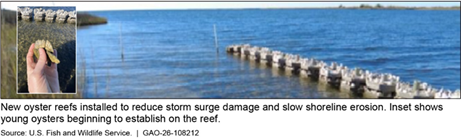
To select projects for IRA funding, FWS officials stated that the agency identified NWRS areas with planned, but unfunded, activities that aligned with the purpose of the IRA appropriations, such as to increase the resiliency of NWRS areas to weather events. FWS also prioritized projects in parts of the country that had not previously received supplemental appropriations, such as for disaster assistance, and where FWS could collaborate with long-standing partners, including state and local agencies, to expand the geographic scope of work. Once projects were selected, FWS’s regional offices used existing processes and partnerships to determine activities to undertake, such as building water control structures to reduce flood risks and fences to improve bison management. FWS then used standard agency policies and procedures, such as recipient risk guidance, to issue financial awards and contracts to carry out activities.
To oversee IRA projects, FWS developed an implementation plan with objectives for meeting the purpose of the IRA appropriations. For example, the plan calls for projects to improve the capacity to recover from extreme weather events. FWS tracked data, such as acres restored, but did not establish performance goals for measuring progress toward the objectives. By developing and using performance goals for assessing progress toward the objectives in its IRA implementation plan, FWS can better develop and use evidence to assess the extent to which the IRA projects are achieving intended results, and change course if they are not.
Why GAO Did This Study
FWS, within the U.S. Department of the Interior, manages NWRS, a national network of 856 million acres of land and water dedicated to protecting fish and wildlife habitats and providing outdoor recreation opportunities, such as hunting and fishing. IRA appropriations for NWRS and state wildlife management areas are available to FWS for obligation through September 2026 and amount to over 23 percent of NWRS’s typical annual appropriations. FWS uses grants, cooperative agreements, and contracts to fund partners, including federal and state agencies and nonprofits.
GAO was asked to review FWS’s use of its IRA appropriations. This report (1) describes how FWS has obligated and expended IRA appropriations for NWRS and state wildlife management areas; (2) describes how FWS selected, prioritized, and funded projects for these appropriations; and (3) examines how FWS provided oversight for these projects to ensure they achieve intended results.
GAO reviewed FWS obligations and expenditures data through April 1, 2026; FWS documents about its use and oversight of IRA appropriations; and recipients’ single audit reports. GAO interviewed selected financial award and contract recipients based on factors such as geographic variation, as well as FWS and Interior officials. GAO also compared FWS efforts with federal guidance and key practices, such as for performance management.
What GAO Recommends
GAO is making two recommendations, including that FWS develop and use performance goals for each IRA project to determine if FWS is meeting the purpose of the IRA appropriations and achieving the objectives in its IRA implementation plan. FWS concurred.
|
Abbreviations |
|
|
FAR |
Federal Acquisition Regulation |
|
FWS |
U.S. Fish and Wildlife Service |
|
IRA |
Inflation Reduction Act of 2022 |
|
IT |
information technology |
|
NWRS |
National Wildlife Refuge System |
|
OMB |
Office of Management and Budget |
|
OPM |
U.S. Office of Personnel Management |
This is a work of the U.S. government and is not subject to copyright protection in the United States. The published product may be reproduced and distributed in its entirety without further permission from GAO. However, because this work may contain copyrighted images or other material, permission from the copyright holder may be necessary if you wish to reproduce this material separately.
July 10, 2026
Congressional Requesters
The U.S. Fish and Wildlife Service (FWS), within the U.S. Department of the Interior, manages the National Wildlife Refuge System (NWRS), a network of millions of acres of land and water dedicated to protecting fish and wildlife habitats and providing outdoor recreation opportunities, such as hunting and fishing. For fiscal year 2026, FWS received about $522 million in appropriations to support NWRS operations, including wildlife and habitat management, refuge maintenance, visitor services, law enforcement, and conservation planning.[1] In addition, Section 60302 of the Inflation Reduction Act of 2022 (IRA) provided $125 million in supplemental appropriations to FWS to rebuild and restore units of the NWRS and state wildlife management areas.[2] The IRA Section 60302 appropriations are available to FWS through the end of fiscal year 2026.[3]
On January 20, 2025, Executive Order 14154 directed federal agencies, including FWS, to immediately pause the disbursement of funds appropriated through the IRA to review their policies, processes, and programs for the use of these funds.[4] In response, FWS paused its IRA obligations and expenditures to conduct a review for alignment with the administration’s policies.[5] In April 2025, Interior reported that it had begun obligating and expending some but not all IRA appropriations again.
We have previously testified that federal agencies tasked with spending large supplemental appropriations, such as those provided under the IRA, would benefit from innovations in oversight to foster accountability, help ensure appropriations are used as intended, and provide reasonable assurances that their missions, goals, and objectives can be met.[6] In addition, Interior’s Inspector General reported on challenges and risks for FWS in expediting its IRA obligations.[7]
You asked us to review FWS’s use of the appropriations provided in the IRA.[8] Additionally, the IRA includes a provision for us to support oversight of the distribution and use of IRA appropriations.[9] This report (1) describes how FWS has obligated and expended IRA Section 60302 appropriations; (2) describes how FWS selected, prioritized, and funded IRA Section 60302 projects; and (3) examines how FWS has provided oversight for these projects to ensure they achieve intended results.
To describe how FWS has obligated and expended IRA Section 60302 appropriations, we analyzed FWS data on its IRA obligations and expenditures as of April 1, 2026, and reviewed related documents such as spending plans and financial accounting reports. We assessed the reliability of the data by interviewing FWS officials and conducting a review of the data, including by tracking the consistency of the data provided over time. We found the data sufficiently reliable for describing how FWS has obligated and expended its IRA Section 60302 appropriations. We also interviewed and obtained written responses from FWS and Interior officials about IRA obligations and expenditures.
In addition, we interviewed eight financial award and contract recipients about their experiences working with FWS. We selected these recipients based on the following factors: (1) the recipient received an interest payment from FWS for a late invoice payment, (2) geographic variation, and (3) variety in the type of service the contract involved. Although the experiences of our selected interviewees are not generalizable to all recipients, they provide examples across a range of recipient types.
To describe how FWS selected, prioritized, and funded IRA Section 60302 projects, we reviewed FWS documents regarding its uses of IRA appropriations, such as spending reports and guidance for funding decision-making. We interviewed and obtained written responses from FWS headquarters and regional officials about how they made decisions regarding how to use IRA appropriations. Specifically, we interviewed officials from the five regions with leadership who had been involved in decision-making about the projects. We also reviewed single audit reports from the Federal Audit Clearinghouse for all recipients of IRA Section 60302 financial awards for audit years 2022 through 2025 and reviewed all findings that were reported as both a material weakness in internal controls and a modified opinion on program compliance.[10]
To examine how FWS has provided oversight for these projects to ensure they achieve intended results, we reviewed related documents, such as FWS guidance on the use of appropriations, progress reports, and relevant federal laws and regulations. Additionally, we interviewed and obtained written responses from FWS and Interior officials about FWS’s approach to program and project management, performance measurement, and oversight and monitoring of the final recipients of these appropriations, such as entities that were awarded contracts. We then compared FWS’s efforts with FWS’s IRA implementation plan and guiding vision document for the NWRS.[11] In addition, we compared FWS’s efforts with key practices for evidence-based policymaking and performance-management activities.[12] We also compared FWS’s efforts to the U.S. Office of Personnel Management’s (OPM) workforce planning guidance in effect during our review and our key principles for strategic workforce planning.[13]
We conducted this performance audit from April 2025 to July 2026 in accordance with generally accepted government accounting standards. Those standards require that we plan and perform the audit to obtain sufficient, appropriate evidence to provide a reasonable basis for our findings and conclusions based on our audit objectives. We believe that the evidence obtained provides a reasonable basis for our findings and conclusions based on our audit objectives.
Background
NWRS is a network of 856 million acres of land and water managed by FWS.[14] NWRS’s statutory mission is to administer a national network of lands and waters for the conservation, management, and, where appropriate, restoration of the fish, wildlife, and plant resources and their habitats within the United States for the benefit of present and future generations of Americans.[15] NWRS covers many types of ecosystems, including forests, prairies, coral reefs, tundra, and wetlands. As of 2024, NWRS units consisted of 573 national wildlife refuges, 212 waterfowl production areas, 48 coordination areas, and seven national monuments.[16]
Of the 856 million acres, 152 million are located across all 50 states and five U.S. territories, including over 76 million acres in Alaska. The remaining 704 million acres comprise land, submerged land, and water in marine national monuments. Most national wildlife refuges are open to the public and provide recreational opportunities, including hunting, fishing, and wildlife observation.[17]
NWRS Appropriations
For fiscal year 2026, FWS received about $522 million in appropriations to support NWRS operations and related activities.[18] In recent years, NWRS has received supplemental and disaster aid funding in addition to funding received through the annual appropriations process.[19] For example, the American Relief Act, 2025 appropriated $500 million to FWS for construction related to consequences from natural disasters in 2024 and prior years.[20] Our prior work has highlighted the importance of federal efforts to promote resilience to natural disasters, including weather events.[21] We identified the rising number of natural disasters and increasing reliance on federal assistance as a significant source of federal fiscal exposure.
IRA Appropriations
In August 2022, IRA Section 60302 provided $125 million in supplemental appropriations to FWS to address weather events.[22] Of this, the IRA requires that FWS use $121.25 million for direct expenditures, grants, cooperative agreements, and contracts for the purposes of rebuilding and restoring NWRS units and state wildlife management areas by (1) addressing the threat of invasive species, (2) increasing the resiliency and capacity of habitats and infrastructure to withstand weather events, and (3) reducing the amount of damage caused by weather events. The remaining $3.75 million was for necessary administrative expenses associated with carrying out IRA Section 60302. The IRA also specifies that these appropriations remain available until September 30, 2026.
FWS Organization and Key Activities
FWS is composed of its headquarters in the Washington, D.C. area, eight regional offices across the country, and almost 800 field stations, including NWRS units. FWS’s mission is to conserve, protect, and enhance fish, wildlife, plants, and their habitats. To accomplish its mission, FWS conducts a variety of activities, including monitoring plant and animal populations; restoring wetland, forest, grassland, and marine habitats; and controlling invasive species. FWS maintains a range of in-house professionals and other experts, such as maintenance workers, veterinarians, and biologists.
FWS also partners with outside groups, including Tribes, federal agencies, state and local governments, nonprofits, and private landowners. Among these, FWS collaborates with state fish and wildlife agencies that manage wildlife management areas adjacent to NWRS.[23] State fish and wildlife agencies have authorities and responsibilities for managing fish and wildlife on NWRS units, and these are not affected by FWS’s authorities and requirements to administer the NWRS.[24] FWS provides funding to outside groups using grants, cooperative agreements, and contracts.[25]
FWS Management of Grants and Cooperative Agreements
FWS is subject to Interior’s requirements and guidance for managing grants and cooperative agreements. Interior has established the Financial Assistance Interior Regulation, which supplements the Office of Management and Budget’s (OMB) Uniform Administrative Requirements, Cost Principles, and Audit Requirements for Federal Awards (Uniform Guidance).[26] The Uniform Guidance establishes requirements for how federal agencies, including Interior, should administer and manage financial assistance provided to non-federal entities.[27] For competitive grants under the Uniform Guidance, federal agencies are to, among other things, design and execute an objective merit review process of evaluating federal award applications in accordance with written standards set forth by the federal awarding agency.[28] Moreover, in recent years, Interior issued new policies to ensure that officials document the rationale for award decisions.[29]
In addition to federal regulatory and Interior requirements, FWS policies and procedures for awarding grants and cooperative agreements include several steps designed to mitigate potential fraud or performance issues.[30] FWS selection officials are also to review financial award applications for potential overlap or duplication with other FWS projects. If duplication is found, officials are to either request modifications or not provide funding, according to FWS’s instructions.[31] To make noncompetitive awards, FWS policy states that the agency must justify and document the decision to issue noncompetitive discretionary financial awards, which FWS refers to as single source awards, based on at least one of the following criteria: (1) unsolicited proposal, (2) continuation, (3) legislative intent, (4) unique qualifications, and (5) emergencies.[32]
FWS procedures include several steps to monitor awards and respond to applicant risks. FWS officials are to conduct award recipient risk assessments annually, and if the assessments raise concerns, the recipient may receive more frequent monitoring or site visits. Based on the risk assessments, FWS officials are to create a monitoring plan tailored to each recipient, including using an entity’s single audit findings to monitor previously identified deficiencies.[33] If they determine a recipient to be high risk, FWS officials are to take additional steps to mitigate these risks. For example, they may ask for written documentation of procurement procedures or internal controls.
FWS’s primary post-award monitoring tools are annual financial and performance reports.[34] In addition, award recipients are subject to regular audits. For example, FWS audits its state fish and wildlife agency grant recipients on a 6-year cycle, according to FWS officials. FWS may require more frequent reporting if it identifies additional risks during the risk assessment process.
Interior grant management officers provide administrative guidance and oversight for FWS cooperative agreements and grants, including by reviewing each financial award application for completeness and compliance with federal regulations and policies.[35] FWS project officers are biologists or other technical experts assigned to a cooperative agreement or grant, and project officers have primary responsibility for ensuring the obligations in the award’s scope of work are being met. For example, project officers are responsible for monitoring and evaluating the recipient’s performance and compliance with award terms and conditions, including the review of financial and performance reports.[36]
FWS Contracting
FWS is subject to the Federal Acquisition Regulation (FAR), which sets forth uniform policies and procedures by which executive branch agencies acquire supplies or services.[37] FWS is also subject to the Department of the Interior Acquisition Regulation.[38] Additionally, FWS is required under the Prompt Payment Act, as amended, to establish the due date for payments under a contract and pay interest on the amount due when a payment is not made within 30 days of the due date.[39] FWS supplements these requirements with its Contracting Officer’s Handbook, an internal web-based resource that states that FWS acquisition planning should expedite the acquisition process, promote full and open competition, promote the acquisition of commercial items, and integrate the efforts of all personnel responsible for significant aspects of the acquisition.
Interior’s contracting officers award and administer FWS contracts, including oversight of contractors’ compliance with the FAR. For example, contracting officers assigned to each FWS contract have the primary responsibility, along with project officers, to ensure the responsibilities outlined within the scope of work are being met.[40]
Workforce Actions by the Executive Branch
Beginning January 20, 2025, the President, OMB, and OPM issued directives and guidance to reform the federal workforce.[41] These directives and guidance initiated a hiring freeze, a voluntary Deferred Resignation Program, and terminations of probationary employees, as well as instructed agencies to develop plans for large-scale reductions in force and reorganizations.[42] Interior issued an order describing plans for consolidation of administration functions and other reorganization as a result of the directives and guidance from the administration.[43] Appendix I provides a timeline of selected workforce actions by the President, OMB, OPM, and Interior starting January 20, 2025.
FWS Obligated Over 99 Percent of Its IRA Section 60302 Appropriations, Mostly Through Cooperative Agreements to Enhance Habitat and Infrastructure Resilience
FWS obligated over 99 percent of its IRA Section 60302 appropriations by January 2025, mostly to partner organizations through cooperative agreements and grants, to design, implement, and assess projects intended to enhance habitat and infrastructure resilience in the NWRS and state wildlife management areas. Specifically, FWS allotted Section 60302 appropriations across nine projects.[44] In January 2025, an executive order directed agencies to pause expenditures of IRA funds and review grants, contracts, and other expenditures for consistency with laws and the new administration’s priorities.[45] In April 2025, FWS restarted expenditures for cooperative agreements and grants, and in March 2026, FWS restarted normal payment processing for some contracts.
FWS Obligated Over 99 Percent of Its IRA Section 60302 Appropriations, Primarily Through Cooperative Agreements and Grants to Partner Organizations
FWS obligated $124.4 million (99.6 percent) and expended $48.9 million (39.1 percent) of its IRA Section 60302 appropriations, as of April 1, 2026 (see table 1). FWS obligated nearly all of the appropriations as of January 2025, having obligated $124.6 million (99.6 percent) by that date.[46] Obligations have been largely through cooperative agreements (63.5 percent), grants (13.9 percent), and contracts (8.3 percent) used to distribute funds to state agencies and other partner organizations. According to FWS officials, these obligations were used for acquiring necessary permits for work and for the design, implementation, and assessment of selected resilience projects across the country. The remaining obligations have been for other expenditures, such as salary and benefits, equipment, supplies, and materials.
Table 1: U.S. Fish and Wildlife Service (FWS) Inflation Reduction Act of 2022 (IRA), Section 60302, Obligations and Expenditures, as of April 1, 2026
|
Appropriation category |
Appropriations
|
Obligations |
Expenditures |
Obligations as percentage of appropriations |
Expenditures as percentage of appropriations |
|
General |
$121.3 |
$121.0 |
$45.6 |
99.8% |
37.6% |
|
Administrative |
$3.8 |
$3.5 |
$3.2 |
92.0% |
86.1% |
|
Total |
$125.0 |
$124.4a |
$48.9 |
99.6% |
39.1% |
Source: GAO analysis of FWS data. | GAO‑26‑108212
Notes: The “General” appropriation category refers to the IRA appropriation for direct expenditures, grants, contracts, and cooperative agreements for the purposes of rebuilding and restoring units of the National Wildlife Refuge System and state wildlife management areas. The “Administrative” appropriation category refers to the appropriation for necessary administrative expenses associated with carrying out IRA Section 60302. Pub. L. No. 117-169, § 60302, 136 Stat. 1818, 2079 (2022). Numbers may not sum to column totals due to rounding.
aAs of January 15, 2025, FWS had obligated $124.6 million, or 99.6 percent, of its IRA Section 60302 appropriations. According to agency officials, the decline in obligations between January 15, 2025, and April 1, 2026, was due to the cancelation of a contract.
Obligations. FWS had planned to obligate 80 percent of its IRA Section 60302 appropriations by September 30, 2025, according to plans FWS provided us in August 2024. However, FWS officials stated that they obligated appropriations more quickly using financial awards and contracts with partner organizations, making use of FWS’s existing long-term relationships. As of September 30, 2024, FWS had obligated $67.8 million (54.3 percent) of its IRA appropriations, and as of January 15, 2025, FWS had obligated $124.6 million, or 99.6 percent, of its IRA Section 60302 appropriations.
Expenditures. FWS officials stated that it will take several years to expend the appropriations because many of the on-the-ground activities to enhance habitat and infrastructure resilience, such as shoreline reconstruction and stream rechanneling, are time and labor intensive. In addition, the work can be season-dependent and frequently has components that must occur sequentially over a long time. For example, according to FWS officials, some construction work can only be done in winter months when construction equipment has less impact on wetlands.
FWS Allotted IRA Section 60302 Appropriations Across Nine Projects
FWS allotted IRA Section 60302 appropriations to nine projects ranging from $0.5 million to $27.25 million each, including eight on-the-ground projects to enhance habitat and infrastructure resilience at national wildlife refuges and state wildlife management areas and a ninth project to improve national elevation data.[47] FWS obligated IRA Section 60302 appropriations to these nine projects through cooperative agreements, grants, contracts, and other expenditures. Table 2 shows the allotments, obligations, and expenditures for each of the nine projects.
Table 2: U.S. Fish and Wildlife Service (FWS) Inflation Reduction Act of 2022, Section 60302, Allotments, Obligations, and Expenditures by Project, State, and FWS Region, as of April 1, 2026
|
Project, state, and FWS region |
Allotments (in millions) |
Obligations |
Expenditures |
Obligations as a percentage of project allotments |
Expenditures as a percentage of project obligationsa |
|
Albemarle-Pamlico Sound Restoration, NC (Region 4) |
$27.3 |
$27.3 |
$1.4 |
100.0% |
5.0% |
|
Landscape Conservation Approach for a Climate Resilient Northern Forest, MA, ME, MI, MN, NH, NJ, NY, PA, VT, and WI (Regions 3 and 5) |
$25.0 |
$25.0 |
$6.7 |
100.0% |
26.8% |
|
Prairie Pothole Region Landscape Conservation and Restoration, IA, MN, MT, ND, and SD (Regions 3 and 6) |
$23.0 |
$23.0 |
$10.2 |
100.0% |
44.6% |
|
Lower Mississippi River Valley Nature-based Resiliency, AR, LA, MS, and TN (Region 4) |
$20.0 |
$20.0 |
$17.6 |
100.0% |
88.1% |
|
Upper Mississippi and Illinois River Nature-based Resiliency and Restoration, IL, MO, WI, IA, and MN (Region 3) |
$10.0 |
$9.8 |
$1.5 |
98.4% |
15.4% |
|
Bison Management and Grasslands Habitat Improvements, AK, CO, ND, NE, NM, and OK (Regions 2,6,7) |
$7.5 |
$7.4 |
$6.0 |
98.9% |
80.8% |
|
Nature-based Solutions to Support the Endangered Yaqui Fish Species on San Bernadino National Wildlife Refuge, AZ (Region 2) |
$7.0 |
$7.0 |
$1.3 |
100.0% |
19.1% |
|
Charles M. Russell National Wildlife Refuge and UL Bend National Wildlife Refuge Grasslands and Nature-based Resiliency, MT (Region 6) |
$0.5 |
$0.5 |
<$0.1 |
100.0% |
<1% |
|
Elevation Data over National Wildlife Refuge System Lands (Nationwide) |
$1.0 |
$1.0 |
$0.9 |
100.0% |
87.5% |
|
Total |
$121.3 |
$121.0 |
$45.6 |
99.8% |
37.7% |
Source: GAO analysis of FWS data. | GAO‑26‑108212
aThe total percent expenditures in this table does not match the total percent expenditures in table 1. In this table, the calculation is based on total obligations, whereas it is based on the total appropriations in table 1.
Across the nine projects, FWS officials said there were more than 100 subprojects. For example, the Lower Mississippi River Valley Nature-based Resiliency project includes subprojects to regrade and ditch lands and repair and update water control structures to improve water drainage, reduce the risks of flooding and drought, and improve wetland habitats. These officials stated that as of December 2024, the subprojects had 240 activities underway, such as installing water control structures and ditches to restore wetlands, constructing infrastructure to improve bison population management, and conducting maintenance on a dam to improve wetland habitats and reduce flood risks.
In April 2026, FWS officials told us that IRA projects so far had resulted in the restoration of more than 5,000 acres of wetland habitat and 16,000 acres of other habitats. The officials also stated that projects had improved passage for fish and other aquatic organisms on more than 15 stream miles. Table 3 summarizes the nine projects, including examples of the activities involved in each project.
Table 3: U.S. Fish and Wildlife Service (FWS) Inflation Reduction Act of 2022, Section 60302, Project Descriptions
|
Project |
Project summary |
|
Albemarle-Pamlico Sound Restoration |
Eastern North Carolina project to improve resilience to wildfire, floods, drought, and extreme weather events. Activities include installing water control structures and ditches to restore wetlands and rebuilding living shorelines to protect against storm surges. |
|
Landscape Conservation Approach for a Climate Resilient Northern Forest |
Northeast and Midwest project to restore forests, benefit wildlife, improve recreational opportunities, and reduce risks from drought and flooding. Activities include replacing undersized river culverts with wider natural stream beds to reduce flood hazard and improving water quality and fish passage. |
|
Prairie Pothole Region Landscape Conservation and Restoration |
West and Midwest project to restore wetlands and grasslands, reduce flood risk, improve water quality and ground water supplies, and support migratory bird populations. Activities include improving water control structures, including dam maintenance. |
|
Lower Mississippi River Valley Nature-based Resiliency |
Southeast project to restore and protect forests, wetlands, and coastal floodplains to improve the regulation of water supply and forest production, reduce risks from flooding and droughts, and improve migratory bird habitat. Activities include building living shorelines, restoring stream channels with living banks, and reforesting floodplain systems. |
|
Upper Mississippi and Illinois River Nature-based Resiliency and Restoration |
Midwest project to restore rivers, floodplain forests, and wetlands to improve fisheries, water quality and shoreline stability, and reduce flood and drought risks. Activities include moving levees, restoring floodplain forests, and restoring waterflow in wetlands. |
|
Bison Management and Grasslands Habitat Improvements |
Alaska and Western states project to improve bison populations and grassland ecosystem quality and reduce fire hazard and flood risks. Activities include constructing infrastructure for bison management, improving water flows to reduce fire hazards, and improving stream habitats to reduce flood risks. |
|
Nature-based Solutions to Support the Endangered Yaqui Fish Species on San Bernadino National Wildlife Refuge |
Arizona project to restore the aquatic habitats of seven desert fish species found only in the Rio Yaqui watershed by improving water flow and enhancing underground aquifer water storage. Activities include creating levees, streams, and ponds, as well as improving solar pumps and monitoring infrastructure. |
|
Charles M. Russell National Wildlife Refuge and UL Bend National Wildlife Refuge Grasslands and Nature-based Resiliency |
Montana project to restore sagebrush and wetland habitats to improve rangeland quality and wildlife habitat and reduce the risk of fire hazards. Activities include removing trees and applying herbicides to remove flammable invasive grasses. |
|
Elevation Data over National Wildlife Refuge System Lands |
Nationwide project with the U.S Geological Survey to improve elevation data, which can be used to evaluate tree heights and water depth, for example, to provide data on invasive species or to identify wetlands that exist or which could be restored. In addition to improving the quality of data for natural resource management, expected outcomes include improving the efficiency and quality of FWS workflows, natural disaster response, and compliance reviews. |
Source: GAO analysis of FWS information. | GAO‑26‑108212
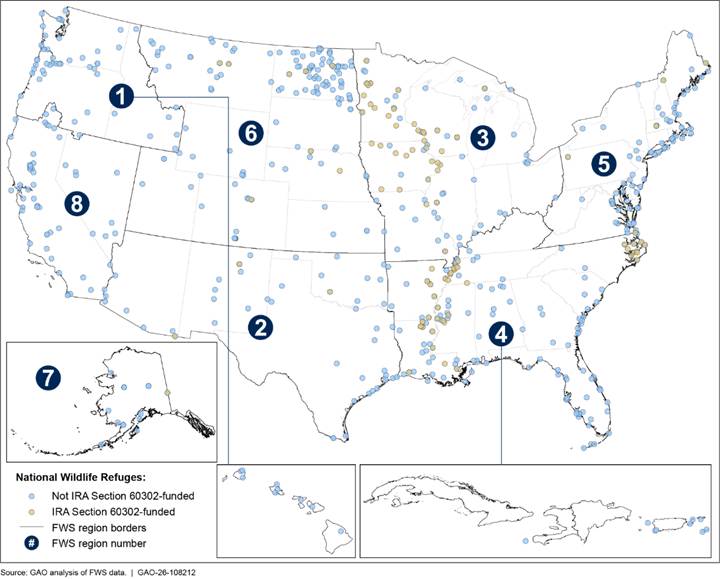
According to Interior data, the nine projects span 23 states and include at least 58 national wildlife refuges and 18 waterfowl production areas within the NWRS and 17 state wildlife management areas.[48] Figure 1 shows the location of NWRS units with IRA Section 60302-funded projects.
Figure 1: Geographic Distribution of the Uses of Inflation Reduction Act of 2022 (IRA), Section 60302, Appropriations by the U.S. Fish and Wildlife Service (FWS), Fiscal Years 2023–2026
FWS Paused Expenditures for Cooperative Agreements and Grants for 3 Months and Paused Expenditures for Contracts for More Than a Year
Issued on January 20, 2025, Executive Order 14154 directed agencies to pause expenditures of funds appropriated through the IRA, and to review grants, contracts, and other expenditures for consistency with existing laws and the policy outlined in the executive order.[49] On or about January 24, 2025, Interior paused all expenditures of all IRA Section 60302 obligated appropriations, including for cooperative agreements, grants, and contracts.
For cooperative agreements and grants, FWS officials told us that, in response to the executive order, the agency reviewed all cooperative agreements and grants awarded with IRA Section 60302 appropriations and identified 40 awards that potentially did not align with the order. These officials said that, aside from one cooperative agreement that was canceled at Interior’s request, all other IRA Section 60302 cooperative agreements and grants are active, as of March 2026.[50] On April 24, 2025, in response to a court order, FWS restarted expenditures for IRA Section 60302 cooperative agreements and grants.[51]
For contracts, FWS officials stated that, beginning in January 2025, FWS, the U.S. General Services Administration, and Interior each conducted their own separate reviews of all active FWS contracts to assess alignment with multiple executive orders and requirements. These officials told us that, as of April 2025, all IRA-awarded contracts were determined to be in compliance with Executive Order 14154.[52] Interior and FWS officials stated that FWS stopped normal payment processing in January 2025 and made some payments to contractors after receiving additional approval from Interior leadership.[53] On March 11, 2026, according to FWS officials, FWS restarted normal payment processing for some IRA Section 60302 contracts but not for other invoices that are subject to further review.
FWS and Interior officials we interviewed stated that, between January 2025 and March 2026, Interior leadership in the Office of the Assistant Secretary for Policy, Management and Budget reviewed and approved invoice payments collectively in batches, about every 4 months.[54] These officials also told us that Interior leadership directed them not to notify contractors about the pause in expenditures for all IRA appropriations and not to issue stop work orders. According to the officials, because expenditures of funds for IRA Section 60302 contracts were paused, the contracts themselves were not cancelled, and stop work orders were not issued, contractors remained obligated to complete the work under the terms and conditions of the contract. The officials said that between January 2025 and March 2026, FWS did not pay contract invoices until leadership in the Office of the Assistant Secretary for Policy, Management and Budget reviewed the contracts and invoices and approved invoice payments.
Between January 2025 and March 2026, FWS paid multiple contractors’ invoices late, according to Interior data and interviews with FWS and Interior officials. From about January 24, 2025, to February 25, 2026, FWS made late payments to 30 contractors on invoices for 39 contracts awarded under IRA Section 60302, based on Interior data. As a result of these late payments, FWS paid $47,071 in interest penalties to its IRA Section 60302 contractors, related to invoices totaling to $5,545,708.[55] By regulation, each agency head is responsible for ensuring timely payments and payment of interest penalties where required.[56] The Prompt Payment Act, as amended, requires agencies to pay interest penalties when they pay their invoices after the due date.[57]
FWS and Interior officials told us that, between January 2025 and March 2026, the agency paid a small number of contractors outside of the payment batches approved by the Office of the Assistant Secretary for Policy, Management and Budget. Interior officials we interviewed said that some contractors sought assistance with delayed payments from a member of Congress or the Small Business Administration’s Office of the National Ombudsman, and officials said that individual payments made between batch payments may have been related to that outreach. The officials stated that they were unaware of past instances of FWS broadly pausing the payment of contract invoices or paying regular interest penalties on late payments. The officials said that, in the past, the agency typically aimed to pay contractors within 2 weeks of receiving an invoice and typically paid them before the 30-day due date. FWS officials stated that FWS began resuming normal payment processing procedures for some contracts in March 2026 to minimize interest penalties on late payments.
Contractors and a FWS refuge manager we interviewed highlighted challenges related to the late payments. For instance, a FWS refuge manager reported that a contractor that built and delivered a water control structure was not paid until 5 months after its delivery and was aware that this had been a hardship for the contractor. A contractor stated that their firm had submitted invoices for building a new piece of equipment and was not paid for 5 months. The contractor said that because they are a small firm, the delay in payment made it difficult to maintain payroll and inventory. Four contractors we spoke with said that they had not been notified that there would be any change to invoice processing, saying that they learned of the paused expenditures when they realized invoices were not paid on time and then contacted FWS for more information about the late payments.
FWS Used a New Approach to Select IRA Section 60302 Projects, Prioritizing Projects Where FWS Could Collaborate with Partners to Broaden Geographic Scope
FWS used a new collaborative approach and broad criteria to select projects to fund with its IRA Section 60302 appropriations. Additionally, FWS prioritized funding projects in regions that had not previously received supplemental appropriations and where FWS could collaborate with long-standing partners to expand the geographic scope of the agency’s work. After FWS selected final projects, regional offices used existing processes and partnerships to determine specific on-the-ground activities to fund. They then followed standard agency procedures and policies to implement financial awards and contracts, often with partner organizations, to carry out the activities.
FWS Used a New Collaborative Approach and Broad Criteria to Select Projects to Fund
To select IRA Section 60302 projects, FWS used a new collaborative approach and broad criteria to help identify geographic areas with multiple NWRS funding needs that could be addressed using IRA appropriations, according to FWS officials we interviewed. Under this approach, FWS identified eight projects with planned but unfunded on-the-ground activities to improve weather resilience and a ninth project to improve national elevation data at NWRS units across the country.[58] FWS officials stated that this was different than the agency’s prior approaches for using supplemental appropriations because, in the past, specific appropriations language had explicitly identified certain disaster-affected areas to fund, as opposed to the broader scope of the IRA Section 60302 appropriations.[59] FWS’s new approach included the following steps:
· On August 4, 2022, prior to the enactment of the IRA, NWRS headquarters leadership led a strategy session involving FWS division chiefs, deputy division chiefs, and other FWS headquarters officials, where they developed an internal memorandum outlining an implementation strategy for decision-making. Specifically, this memorandum proposed four broad criteria for project types that FWS would target with the proposed appropriations—for projects related to coastal resilience, invasive species, climate adaptation, and NWRS data collection.[60]
· In August and September 2022, after the IRA was enacted, the same team of NWRS and FWS headquarters officials developed an initial pool of potential projects based on known unfunded needs that aligned with the memorandum. During this process, NWRS regional chiefs also provided informal project nominations for consideration.
· In September 2022, FWS headquarters then collaborated with NWRS regional chiefs to develop and submit a final set of eight projects that prioritized, among other things, projects where FWS could collaborate with partners to broaden the geographic scope of the work.
· In September and November 2022, a team of Interior, FWS, and NWRS leaders reviewed and provided input on the list of projects.
· On January 13, 2023, the Assistant Secretary of Fish and Wildlife and Parks approved the final set of projects to be funded.
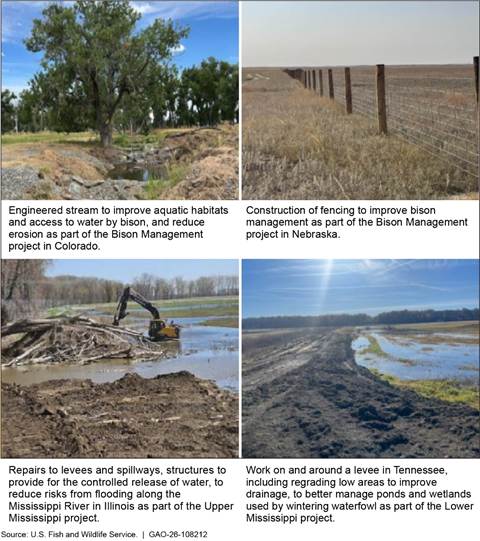
After selecting the projects, FWS generally used existing processes to identify subprojects and specific activities for the eight on-the-ground projects, according to officials. For example, FWS officials said that regional and local staff used professional judgment and existing lists of needed activities, which allowed FWS to efficiently identify subprojects and activities aligned with the requirements of IRA Section 60302.[61] Additionally, FWS regional offices used existing relationships with external partners to identify complementary on-the-ground subprojects and activities to fund with IRA appropriations. Figure 2 shows examples of on-the-ground activities funded with IRA Section 60302 appropriations.
Figure 2: On-the-Ground Activities for the U.S. Fish and Wildlife Service Projects Funded by Section 60302 of the Inflation Reduction Act of 2022
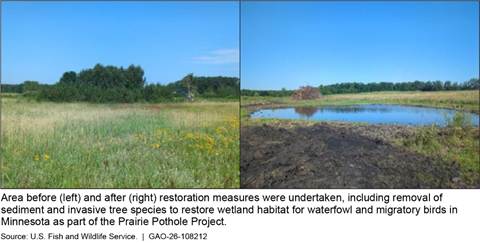
By early 2023, FWS also began developing an IRA implementation plan that provided guidance to direct on-the-ground activities, according to FWS officials.[62] For example, the implementation plan, first released in May 2023, specifies that invasive species control should be limited to site preparation work, rather than recurring treatments.[63] According to the implementation plan and agency officials, FWS also provided regions with tools to assist with selecting on-the-ground subprojects and activities, such as tools to identify nature-based solutions, evaluate alternative projects, and quantify where people and infrastructure are at risk of weather-related hazards. For example, the IRA implementation plan provides links to resources, including an online tool for assessing local exposure to climate hazards and a decision framework to assist in making strategic decisions on the broad goals for the management of ecosystems. Figure 3 provides photographs of an area before and after a wetland was restored as part of the Prairie Pothole Region Landscape Conservation and Restoration project in Minnesota.
Figure 3: Before and After Photographs from the U.S. Fish and Wildlife Service’s Prairie Pothole Region Landscape Conservation and Restoration Project
FWS Prioritized Projects in Regions That Had Not Received Prior Supplemental Appropriations and Where FWS Could Expand the Geographic Scope of Its Work
FWS officials we interviewed said that in selecting projects through FWS’s new approach, FWS prioritized geographic regions that had not previously received supplemental appropriations, such as disaster relief appropriations. The agency also prioritized projects that could provide community benefits and where FWS could collaborate with long-standing partners doing complementary work. For example, FWS did not prioritize projects in coastal New Jersey that had received supplemental disaster appropriations in recent years. FWS prioritized projects where the agency collaborates with partner organizations that bring their own funding to do work on neighboring lands, expanding the geographic scope of FWS’s work.
FWS officials also said that FWS prioritized projects that could provide community benefits, such as by creating jobs and supporting local economies. For example, these officials said that the Albemarle-Pamlico Sound Restoration project would enhance the resilience of one of the largest estuaries in the United States by reducing risks from flooding, storm surge, and wildfires that can burn dry peatlands. They also said that FWS prioritized this project for its economic benefits to fishing and oystering industries and by protecting farmlands from saltwater. In addition, the Lower Mississippi River Valley Nature-based Resiliency project aims to improve wetland and forest systems along the Lower Mississippi River and its tributaries. According to project plans, these efforts are to improve wildlife habitat and recreational opportunities, as well as reducing threats from flooding and drought.
In addition, FWS officials told us the agency prioritized projects where FWS could collaborate with long-standing partners doing complementary work to strengthen the impacts of their combined efforts. These officials said that FWS prioritized funding projects where it could leverage partners to conduct complementary work and therefore expand the projects’ impact. These partners use their own non-IRA funding to perform work on neighboring lands to expand the projects’ scope of work. For example, officials said that the geographic scope of the project aiming to improve the climate resilience of the Albemarle-Pamlico Sound is large and requires efforts beyond NWRS and state wildlife management area lands that were funded through other sources. In another example FWS officials provided, FWS works with partners on the Prairie Pothole Region Landscape Conservation and Restoration project—including Ducks Unlimited, The Nature Conservancy, the state of Minnesota, and the Minnesota Land Trust—to acquire land from willing landowners, and then work collaboratively to improve hydrology, including on the broader landscape, with the goal of restoring waterfowl habitats.
FWS officials said that working with collaborators on neighboring lands expanded the projects’ impact, since the IRA Section 60302 appropriations are limited to NWRS units and state wildlife management areas. Moreover, officials told us that FWS considered returns on investment in choosing to support a relatively small number of projects with larger amounts of financial assistance. They said that doing so would allow the agency to undertake larger-scale work that would help FWS ensure each project had a measurable impact.
FWS Funded Partners to Implement Project Activities and Used Standard Agency Policies and Procedures to Issue Financial Awards and Contracts
FWS officials we interviewed said they generally relied on existing long-term partnerships to direct IRA funds to state agencies and other partner organizations to conduct on-the-ground and other activities, such as designing, implementing, and assessing IRA Section 60302 projects. FWS headquarters and regional officials stated that in the normal course of the agency’s work to manage NWRS units, FWS collaborates widely with partner organizations, such as state natural resource agencies and local governments. FWS officials told us that, even during the normal course of its work, FWS uses collaborations to expand the geographic scope of its resilience efforts beyond NWRS boundaries. FWS officials said that the way the agency deployed financial awards and contracts, including competitive grants in some cases, was directed by prioritizing needs on the ground.
FWS’s internal memorandum outlining an implementation strategy stated that NWRS is uniquely positioned to implement projects through its existing programs. In addition, FWS officials said they followed standard agency policies and procedures for issuing financial awards and contracts, including FWS’s grants management and contracting policies and procedures and applicable federal regulations.[64] These policies and procedures include several steps designed to mitigate potential fraud or performance issues. For example, FWS staff are to check government-wide databases to identify whether the applicant or any associated key personnel have been debarred from working with the federal government. They are also to complete a pre-award risk assessment for each applicant, which includes reviewing any past audit results or performance issues.
FWS officials also stated that they followed standard agency policies and procedures to assess and resolve conflicts of interest in recipients of financial awards and contracts and said that standard award terms and conditions extend these requirements to sub-recipients of financial awards.[65] In our review of single audit reports for IRA Section 60302 financial award recipients for audit years 2022 through 2025, we did not find any recipients that had relevant findings that included both a modified opinion and a material weakness.[66] Recipients of these financial awards and contracts included universities; state, local, and municipal governments; nonprofit organizations; and for-profit companies.
FWS officials told us that 87 percent of IRA Section 60302 contracts were awarded competitively, and that this aligns with the overall competitive rate for all FWS contracts, regardless of funding type. FWS officials stated that competition in contracting is a priority for FWS, and that any limited competition must be justified in accordance with the FAR. According to FWS officials, 27 percent of IRA Section 60302 financial awards were awarded competitively. FWS policy is to justify and document the issuance of single source awards.[67] Officials said that FWS policy encourages competition when making financial awards, and that the agency does not have a typical rate for the use of single source awards.
FWS Developed a Plan for Overseeing IRA Section 60302 Projects, but Has Not Assessed Progress Toward Meeting Objectives or Assessed Staffing Needs
FWS developed and began implementing a plan for overseeing the nine projects that were funded with IRA Section 60302 appropriations. The plan includes long-term and project-level objectives to meet the purpose of IRA appropriations. To track the results of the nine projects, FWS is collecting data for measures that it routinely uses for NWRS projects, such as number of acres restored. However, FWS has not developed performance goals to measure progress toward its implementation plan objectives. Further, FWS and Interior officials said that they have modified their practices to conduct oversight with fewer staff because of large workforce reductions since January 2025. These officials also said they have not yet assessed NWRS staffing needs.
FWS Developed an Implementation Plan for Overseeing Its Nine IRA Projects
FWS officials told us that the agency developed its IRA implementation plan to help FWS achieve intended objectives for its nine IRA-funded projects.[68] The implementation plan directs projects to follow FWS’s standard policies, such as policies for awarding grants and contracts. In addition, the implementation plan identifies supplemental practices for the use and administration of IRA appropriations, including permitted uses, how IRA expenditures are to be tracked in FWS budget data systems, and supplemental contracting reviews, to provide greater oversight for how the appropriations are used.
The implementation plan also adds supplemental oversight practices. For example:
· FWS is to consult with Interior’s Office of Acquisition and Property Management regarding projects with “substantial associated risks” that could affect project schedule, budget, or scope, or are high profile (e.g., of interest to Congress or dealing with sensitive environmental issues) to determine if additional oversight is needed.
· IRA project managers are to monitor project costs and schedules to ensure timeliness and effective implementation.
· IRA program managers are to create an IRA oversight team to improve coordination between FWS and NWRS headquarters and teams managing IRA-funded projects. Through the oversight team, the project teams are to provide updates to FWS and NWRS headquarters, to help them facilitate implementation of the projects.[69]
The implementation plan also identifies hiring flexibilities that may be available for IRA-funded projects. For example, the plan outlines permissible types of temporary and term non-career appointments that FWS can use to meet human capital needs for implementing and overseeing IRA-funded projects. The implementation plan specifies that these hiring authorities allow projects to complete IRA-funded work without the long-term fiscal obligations of hiring permanent federal employees, and it states that project teams should consult with FWS’s human resources office to determine which appointments are appropriate for individual projects.
FWS officials stated that FWS carried out activities related to IRA-funded projects—such as compliance and permitting, developing restoration designs, project administration, implementation, and monitoring—using a combination of existing FWS staff and temporary staff hired with IRA funding, as well as through grants, cooperative agreements, and contracts. FWS officials stated that temporary staff hired with IRA funding did not support the administration of grants, cooperative agreements, or contracts and said that these project administrative tasks were managed by existing Interior and FWS staff.
FWS Has Not Developed Performance Goals to Measure Progress Toward Its Implementation Plan Objectives
FWS’s IRA implementation plan identifies long-term and project-level objectives for IRA-funded projects, but FWS has not established performance goals for achieving them.[70] Specifically, the implementation plan includes a project template that identifies six long-term objectives, and for each long-term objective, also identifies project-level objectives that align with the purpose of the appropriations (see table 4). For example, the implementation plan identifies improved climate adaptation and resilience as a long-term objective and identifies the enhanced capacity needed to recover or persist through disturbances as a related project-level objective.
Table 4: Objectives in the U.S. Fish and Wildlife Service (FWS) Implementation and Internal Control Plan for Inflation Reduction Act of 2022 (IRA) Appropriations
|
Long-term objective |
Examples of project-level objectives |
|
Climate adaptation and resilience |
· Describe how the project will improve resiliency (the capacity to recover from or persist through disturbances or changes due to climate change or urbanization) of the focal species or habitat. · How will the project improve resiliency for the surrounding human community? |
|
Climate mitigation potential |
· Describe the natural climate solution to be deployed. |
|
Collaborative landscape approach |
· How does the project contribute to shared vision, goals, and objectives for long-term holistic outcomes at the systems level? |
|
Effectiveness and measurable ecological and societal outcomes |
· What are the expected ecological, community and socio-economic benefits for the defined geography and time scale? What are the monitoring and performance metrics for each? · How has the best available science been considered? |
|
Equity, community involvement and partner engagement |
· How is this project supported by the state, and how does it support state objectives? |
|
Readiness and leveraging potential |
· Do financial commitments toward the cost of the project from other sources exceed 50 percent of the total project costs? |
Source: FWS IRA Implementation and Internal Control Plan. (Washington, D.C.: July 2024). | GAO‑26‑108212
Note: Long-term objectives and project-level objectives are referred to as “criteria” in the FWS IRA Implementation and Internal Control Plan.
FWS officials we interviewed said that the nine IRA Section 60302 projects are subject to the agency’s standard performance reporting for financial awards and contracts. For example, FWS’s Recipient Risk Assessment Guidance specifies required monitoring activities according to awardee risk levels. FWS’s Financial Assistance Monitoring Financial and Performance Reporting specifies financial and performance requirements that apply to all awardees, such as requiring that the awardee report a comparison of the actual accomplishments to the objectives outlined in the financial award.
In addition, FWS developed reporting requirements specific to IRA-funded projects. For example, IRA project leads are to provide written monthly progress updates at the IRA oversight team’s monthly meeting. The monthly progress updates include descriptions of planned activities, progress toward project activities, and progress toward developing collaborations needed to carry out activities and to assess the effectiveness of those activities. Also, project teams are to report annually on FWS’s standard output-level measures for projects, such as the number of wetland acres restored.
Based on our review of project templates and interviews with FWS headquarters and regional officials, the nine IRA Section 60302 projects generally have not developed and are not using performance goals to measure progress toward the objectives in FWS’s IRA implementation plan. FWS officials said that the long timeline for accomplishing some of the objectives made it challenging to develop measures. Instead, to measure results and evaluate progress, project teams are tracking and reporting the output-level data they routinely collect for NWRS projects. In addition, officials told us that their plan for assessing progress includes reporting related to monthly coordination meetings. For example, a monthly progress report for one of the IRA projects estimated the carbon sequestration benefits of its wetland and grassland restoration efforts, but we did not find other examples where projects had specific performance goals or targets defined.
Instead of performance goals for assessing progress against IRA implementation plan objectives, project teams are reporting anecdotally on selected IRA-funded activities. In these cases, it is not clear how these activities relate to the objectives in the implementation plan. For instance, in monthly project updates, several subprojects reported plans to assess water quality, but none mentioned planned targets for those assessments. FWS officials told us that measuring progress toward the objectives in the IRA implementation plan would help improve their oversight of the nine projects, such as by helping the agency leadership determine key management priorities.
FWS’s IRA implementation plan states that each project should describe how it will measurably contribute to meeting the implementation plan’s objectives and document how they will do so in the project template. It further states that each project template should include a definition of project success and performance metrics, including a list of performance metrics that will be used to evaluate progress. In addition, FWS’s guiding vision document for the NWRS states that clear goals and comparable and useful data are necessary for the success of its national focus on increasing the monitoring of wildlife and habitats and informing its conservation efforts.[71]
Our prior work has also found that planning for results can help agencies more effectively develop and use evidence to better understand the outcomes of their actions.[72] Planning for results includes establishing performance goals to assess whether efforts are achieving intended results and also includes setting target levels of performance and time frames for achieving them.[73] Planning for results can help agencies assess whether they are achieving intended results and change course if they are not. By developing and using performance goals for meeting the objectives in its IRA implementation plan, FWS can better develop and use evidence to assess the extent to which each IRA-funded project is achieving intended results, including meeting the specified purposes of the IRA appropriations.
FWS Has Not Assessed Its NWRS Staffing Needs for Conducting Oversight
FWS officials we interviewed stated that large workforce reductions have put a strain on their oversight resources, and they have not assessed staffing needs, including for conducting NWRS oversight.[74] According to FWS officials, the agency has lost many staff since January 2025, largely due to early retirements and other reduction-in-force initiatives in response to an executive order on reforming the federal workforce to maximize efficiency and productivity.[75] Officials said that, as of March 2026, FWS had 6,071 employees, including 2,304 NWRS employees. By comparison, officials said that there were 8,859 FWS employees and 3,358 NWRS employees, as of February 2025. For example, FWS officials said that FWS’s Office of Conservation Investment had 22 full-time grants management specialists who contributed to supporting IRA Section 60302 financial awards in January 2025 compared with 12 of these specialists in January 2026. Officials further said that, to support contracting, FWS had 84 full-time equivalent contract specialists in January 2025 compared with 76 of these specialists in January 2026.
FWS officials said the agency has faced oversight challenges because certain administrative roles and staff have been consolidated at Interior’s department-level offices. For example, officials told us that FWS’s contracting and grants management staff have shifted to Interior as part of its consolidation efforts.[76]
FWS and Interior officials stated that, due to staff losses, they have modified their practices to oversee financial awards and contracts with fewer staff. FWS and Interior officials said individual offices are continuously assessing oversight needs and adjusting, such as by enhancing information sharing and shifting staff responsibilities, to address staffing gaps as they arise and ensure adequate oversight. FWS officials said these adjustments include modifying the agency’s oversight of IRA appropriations compared with what is described in its IRA implementation plan. For example, the implementation plan calls for FWS’s Joint Administrative Operations team to assist project teams with certain administrative tasks, such as in creating new budget reporting codes. As of May 2025, FWS officials said this team had lost many staff and that some of its key functions—including human resources, contracting, grants management, and finance functions—were recently consolidated into an Interior-level office. According to FWS and Interior officials, these ad hoc efforts have resulted in ongoing adjustments to staff roles and responsibilities, including which staff are responsible for specific oversight functions, but the officials said the quality of oversight remains strong.
However, FWS officials said they do not know whether the agency has skills gaps or is able to meet its long-term oversight priorities, such as recipient risk assessment and financial and performance reporting, with current staffing levels. According to agency officials, FWS has not conducted or documented an analysis of NWRS staffing needs. Specifically, FWS officials stated that NWRS staffing needs are difficult to plan strategically at this time because the agency recently initiated an effort to redevelop its overall vision and goals. One contractor and a refuge manager we interviewed raised concerns about a decline in expertise in FWS staff administering contract agreements, stating that, in some cases, it is taking longer to set up contracting agreements, due to the loss of experienced staff.
Under OPM’s workforce planning guidance, identifying an agency’s strategic direction is a key part of workforce planning.[77] OPM’s guidance states that workforce planning is a systematic and continuous process for identifying the size and composition of a workforce needed to achieve an organization’s goals and objectives. Additionally, our principles for strategic workforce planning call for an agency to identify current and future needs, including the appropriate number of employees, the key competencies and skills for mission accomplishment, and the appropriate deployment of staff across the agency.[78] The principles state that, after completing these activities, the agency should then create strategies for identifying and filling staffing gaps. In February 2025, we testified that, among other challenges to monitoring and oversight, staff reductions may affect the quality of agencies’ financial awards, have the potential to adversely affect agencies’ ability to monitor existing projects, and could increase the associated fraud and financial risks.[79]
In December 2025, the FWS Director issued an order requiring the agency to conduct a comprehensive review of NWRS, including its workforce, to assess opportunities to achieve efficiencies, and develop recommendations for organizational change.[80] Incorporating principles for strategic workforce planning into its comprehensive review of NWRS would enable FWS to better understand its mission-critical skills and whether any staffing or skills gaps exist. Strategic workforce planning would also help FWS develop strategies for filling any gaps to ensure that NWRS has the necessary staff to accomplish its objectives and provide oversight, including identifying opportunities to achieve efficiencies and developing any recommendations for organizational change.
Conclusions
FWS funded nine projects with IRA Section 60302 appropriations to enhance habitat and infrastructure resilience in more than 75 NWRS units across 23 states. To help oversee projects, FWS developed an implementation plan with objectives for IRA-funded projects. However, FWS has not established performance goals for measuring progress toward achieving the objectives. By developing and using performance goals for meeting its implementation plan objectives, FWS could better develop and use evidence to assess the extent to which the IRA projects are achieving intended results, and change course if they are not.
FWS and Interior officials have made ad hoc staffing adjustments to oversee financial awards and contracts, as FWS and NWRS staff levels have decreased by more than 30 percent since January 2025. However, FWS officials do not know whether the agency has skills gaps or is able to meet its long-term oversight priorities with current staff, and FWS has not conducted an analysis of NWRS staffing needs. In December 2025, FWS announced it would conduct a comprehensive review of NWRS, including its workforce, to assess opportunities to achieve efficiencies and develop recommendations for organizational change. Incorporating principles for strategic workforce planning into its comprehensive review, including determining the critical skills and staffing levels that are needed to achieve NWRS goals, and developing strategies to address any gaps, would help FWS ensure that NWRS has the necessary staff to accomplish its objectives and provide oversight of financial awards and contracts. This includes identifying opportunities for efficiencies and organizational change and staffing levels needed for oversight of obligated IRA Section 60302 appropriations.
Recommendations for Executive Action
We are making the following two recommendations to FWS:
The FWS Director should direct the NWRS Chief to develop and use performance goals for each of its IRA Section 60302 projects to determine if the agency is meeting the purpose of the IRA appropriations and making progress toward achieving the objectives in its IRA implementation plan. (Recommendation 1)
The FWS Director should ensure that FWS’s comprehensive review of the NWRS includes (1) determining the critical skills and staffing levels that are needed to achieve NWRS goals, and (2) developing strategies to address any gaps in those critical skills and overall staffing levels. (Recommendation 2)
Agency Comments
We provided a draft of this report to Interior for review and comment. Interior commented via email that FWS concurs with our recommendations. FWS provided technical comments that we incorporated, as appropriate.
We are sending copies of this report to the appropriate congressional committees, the Secretary of the Interior, and other interested parties. In addition, the report is available at no charge on the GAO website at https://www.gao.gov.
If you or your staff have any questions about this report, please contact me at gomezj@gao.gov. Contact points for our Offices of Congressional Relations and Media Relations may be found on the last page of this report. GAO staff who made key contributions to this report are listed in appendix II.
J. Alfredo Gómez
Director, Natural Resources and Environment
List of Requesters
The Honorable Shelley Moore Capito
Chairman
Committee on Environment and Public Works
United States Senate
The Honorable Brett Guthrie
Chairman
Committee on Energy and Commerce
House of Representatives
The Honorable Bruce Westerman
Chairman
Committee on Natural Resources
House of Representatives
The Honorable Sam Graves
Chairman
Committee on Transportation and Infrastructure
House of Representatives
Table 5 provides a timeline of selected workforce actions by the President, Office of Management and Budget (OMB), U.S. Office of Personnel Management (OPM), and the U.S. Department of the Interior starting January 20, 2025.
Table 5: Timeline of Selected Workforce Actions by the President, OMB, OPM, and the U.S. Department of the Interior Starting January 20, 2025
|
Date |
Description |
|
January 20, 2025 |
Presidential Memorandum of January 20, 2025, Hiring Freeze, 90 Fed. Reg. 8247 (Jan. 28, 2025) The President issued a memorandum ordering a hiring freeze of federal civilian employees throughout the executive branch. The memorandum directed the Office of Management and Budget (OMB), in consultation with the Office of Personnel Management (OPM) and the U.S. Department of Government Efficiency Service, to submit a plan to reduce the size of the federal government’s workforce through efficiency improvements and attrition.a |
|
January 20, 2025 February 14, 2025 (Chief Human Capital Officers Council communication) |
OPM Guidance on Probationary Periods, Administrative Leave and Details This guidance required agencies to provide OPM with a report identifying all probationary employees by January 24, 2025, and to promptly determine whether those employees should be retained.b The Chief Human Capital Officers Council subsequently communicated to agency chief human capital officers and deputy chief human capital officers that the council had asked that agencies separate probationary employees that the agencies had not identified as mission critical, no later than February 17, 2025.c The OPM guidance and agency terminations of probationary employees have been challenged in several lawsuits.d |
|
January 28, 2025 |
Deferred Resignation Program OPM released information allowing federal employees to voluntarily resign via a Deferred Resignation Program.e Deferred resignation was available to full-time federal employees, except for military personnel of the armed forces, employees of the U.S. Postal Service, and those in positions specifically excluded by the employing agency. OPM explained that electing employees would retain all pay and benefits, regardless of workload, until their effective resignation date, which could be no later than September 30, 2025. Electing employees would promptly have their duties reassigned or eliminated and be placed on administrative leave, except during necessary transition activities. Under the U.S. Department of the Interior’s Deferred Resignation Program, employees who were eligible for early or normal retirement during calendar year 2025 could also accept the Deferred Resignation Program but had to retire no later than December 31, 2025. |
|
February 11, 2025 |
Executive Order 14210 of February 11, 2025, “Implementing the President’s ‘Department of Government Efficiency’ Workforce Optimization Initiative,” 90 Fed. Reg. 9669 (Feb. 14, 2025) This executive order directs federal agency heads to undertake preparations to initiate large-scale reductions in force (RIF), consistent with applicable law.f |
|
February 26, 2025 |
OPM and OMB, “Guidance on Agency RIF and Reorganization Plans Requested by Implementing the President’s ‘Department of Government Efficiency’ Workforce Optimization Initiative” OMB and OPM issued guidance that noted that Executive Order 14210 directed agency heads to promptly undertake preparations to initiate large-scale RIFs consistent with applicable law and prepare reorganization plans. The guidance outlines the principles agencies should achieve with reorganization plans, including better serving the American people, significantly reducing full-time equivalent positions by eliminating positions that are not required, reducing the real property footprint, and reducing the topline budget. |
|
March 13, 2025 |
Deadline for Phase 1 RIF and Reorganization Plans OMB and OPM instructed agencies to submit a Phase 1 RIF and reorganization plan no later than March 13, 2025. These plans were to include a timetable and the specific tools the agency will use in fiscal years 2025, 2026, and 2027 to achieve efficiencies, including continuation of the current hiring freeze and attrition through various means, including RIFs. For each tool in the Phase 1 plan, OMB and OPM requested the number of full-time equivalents reduced and any potential savings and an agency timetable. |
|
April 14, 2025 |
Deadline for Phase 2 RIF and Reorganization Plans The OMB and OPM guidance also requested agencies submit a Phase 2 plan for review and approval no later than April 14, 2025. The guidance asked that a number of elements be included in the plan (e.g., a proposed future organization chart, any proposed relocations of agency bureaus and offices from Washington, D.C., competitive areas for large-scale RIFs) and that the plans be targeted for implementation by September 30, 2025. |
|
April 17, 2025 |
U.S. Department of the Interior Secretary’s Order No. 3429, “Consolidation, Unification and Optimization of Administrative Functions” On April 17, 2025, in response to Executive Order 14210, Interior issued Secretary’s Order No. 3429. The purpose of this order is to take steps to consolidate, unify, and optimize administrative functions within Interior to achieve effectiveness, accountability, and cost savings. The order explains that Interior will unify and consolidate into the Office of the Secretary functions across the department and its components. Functions to consolidate include human resources, IT, financial management, training and development, international affairs, contracting, communications, and federal financial assistance. |
Source: GAO analysis of presidential directives, agency guidance, and related documentation. | GAO‑26‑108212
aIn Executive Order 14158, the U.S. Digital Service was renamed the U.S. Department of Government Efficiency Service, and the U.S. Department of Government Efficiency Service Temporary Organization was established within the Executive Office of the President. 90 Fed. Reg. 8441 (Jan. 29, 2025).
bU.S. Office of Personnel Management, Guidance on Probationary Periods, Administrative Leave and Details, Memorandum to Heads and Acting Heads of Departments and Agencies (Jan. 20, 2025).
cEmail from the Chief Human Capital Officers Council, re: “Follow up: Chief Human Capital Officers Council Special Session” (Feb. 14, 2025).
dIn one such case, the U.S. District Court for the Northern District of California partially granted plaintiffs’ motion for summary judgment, ruling that OPM lacked authority to direct agencies to terminate their employees. The court also permanently enjoined OPM from doing so, and defendant agencies from following any such OPM direction, except in accordance with OPM regulations at 5 C.F.R. § 5.3, and directed agencies to correct the stated bases for terminating probationary employees, while not ordering reinstatement of the employees. Am. Fed’n of Gov’t Emps. v. Off. of Personnel Mgmt., No. 3:25-cv-1780, 2025 U.S. Dist. LEXIS 179606 (N.D. Cal., Sept. 12, 2025) (appealed Am. Fed’n of Gov’t Emps. v. Off. of Personnel Mgmt., No. 25-5875 (9th Cir.)).
eThe Deferred Resignation Program was challenged, although the case was dismissed. Am. Fed’n of Gov’t Employees v. Ezell, No. 1:25-cv-10276, 2025 U.S. Dist. LEXIS 187652 (D. Mass., Sept. 24, 2025). That dismissal has been appealed. Am. Fed’n of Gov’t Employees v. Kupor, No. 25-1959 (1st Cir.).
fWorkforce reduction actions stemming from Executive Order 14210 are currently subject to a number of legal challenges. See, e.g., Am. Fed’n of Gov’t Emps. v. Trump, No. 3:25-cv-3698 (N.D. Cal.); Nat’l Treasury Employees Union v. Trump, No. 1:25-cv-420 (D.D.C.).
GAO Contact
J. Alfredo Gómez at gomezj@gao.gov
In addition to the contact named above, Chad M. Gorman (Assistant Director), Gretel Clarke (Analyst in Charge), Adrian Apodaca, Mark Braza, Virginia Chanley, John Delicath, Liz Erdmann, Ivan Hernandez, Mick Ray, and Linda Tsang made key contributions to this report.
The Government Accountability Office, the audit, evaluation, and investigative arm of Congress, exists to support Congress in meeting its constitutional responsibilities and to help improve the performance and accountability of the federal government for the American people. GAO examines the use of public funds; evaluates federal programs and policies; and provides analyses, recommendations, and other assistance to help Congress make informed oversight, policy, and funding decisions. GAO’s commitment to good government is reflected in its core values of accountability, integrity, and reliability.
Obtaining Copies of GAO Reports and Testimony
The fastest and easiest way to obtain copies of GAO documents at no cost is through our website. Each weekday afternoon, GAO posts on its website newly released reports, testimony, and correspondence. You can also subscribe to GAO’s email updates to receive notification of newly posted products.
Order by Phone
The price of each GAO publication reflects GAO’s actual cost of production and distribution and depends on the number of pages in the publication and whether the publication is printed in color or black and white. Pricing and ordering information is posted on GAO’s website, https://www.gao.gov/ordering.htm.
Place orders by calling (202) 512-6000, toll free (866) 801-7077,
or
TDD (202) 512-2537.
Orders may be paid for using American Express, Discover Card, MasterCard, Visa, check, or money order. Call for additional information.
Connect with GAO
Connect with GAO on X,
LinkedIn, Instagram, and YouTube.
Subscribe to our Email Updates. Listen to our Podcasts.
Visit GAO on the web at https://www.gao.gov.
To Report Fraud, Waste, and Abuse in Federal Programs
Contact FraudNet:
Website: https://www.gao.gov/about/what-gao-does/fraudnet
Automated answering system: (800) 424-5454
Media Relations
Sarah Kaczmarek, Managing Director, Media@gao.gov
Congressional Relations
David A. Powner, Acting Managing Director, CongRel@gao.gov
General Inquiries
[1]Joint Explanatory Statement, 172 Cong. Rec. H531 (daily ed. Jan. 8, 2026) accompanying Commerce, Justice, Science; Energy and Water Development; and Interior and Environment Appropriations Act, 2026, Pub. L. No. 119-74, § 4, 14038 Stat. 5.
[2]An Act To provide for reconciliation pursuant to title II of S. Con. Res. 14, Pub. L. No. 117-169, § 60302, 136 Stat. 1818, 2079 (2022) (commonly known as the Inflation Reduction Act of 2022 or IRA).
[3]Id. § 60302. The $125 million in supplemental appropriations to FWS also includes $3.75 million for administrative expenses associated with rebuilding and restoring units of the NWRS. The IRA also provided $125 million to FWS for Endangered Species Act recovery plans, which was reviewed by Interior’s Office of Inspector General. Id. § 60301. See also U.S. Department of the Interior, Office of Inspector General, Flash Report: U.S. Fish and Wildlife Service’s Inflation Reduction Act Endangered Species Recovery Efforts, 2024-ISP-012 (Washington, D.C.: April 2025). In 2025, Public Law 119-21—commonly known as the One Big Beautiful Bill Act—rescinded unobligated appropriations provided under IRA Section 60301 for Endangered Species Act recovery plans. An Act to provide for reconciliation pursuant to title II of H. Con. Res. 14, Pub. L. No. 119-21, tit. VI, § 60017, 139 Stat. 72, 156 (2025).
[4]See Exec. Order No. 14154 of January 20, 2025, 90 Fed. Reg. 8353, 8357 (Jan. 29, 2025). Disbursement refers to the amounts paid by federal agencies to liquidate government obligations and is used interchangeably with the term expenditure.
[5]Obligation refers to a definite commitment that creates a legal liability of the federal government for the payment of goods and services ordered or received, or a legal duty on the part of the United States that could mature into a legal liability by virtue of actions on the part of the other party beyond the control of the United States. Expenditure refers to the federal government’s actual spending of money, which liquidates an obligation.
[6]GAO, Oversight of Agency Spending: Implementing GAO Recommendations Could Help Address Previously Identified Challenges at Commerce, DOE, and EPA, GAO‑23‑106726 (Washington, D.C.: Mar. 29, 2023).
[7]U.S. Department of the Interior, Office of Inspector General, Flash Report: U.S. Fish and Wildlife Service’s Inflation Reduction Act Endangered Species Recovery Efforts.
[8]You also asked us to review IRA-related activities at the U.S. Environmental Protection Agency, Federal Highway Administration, U.S. General Services Administration, and the Council on Environmental Quality. We are reviewing these agencies’ IRA activities separately. See also GAO, Oversight of EPA and DOE Spending: Implementing Remaining GAO Recommendations Could Help Address Identified Challenges, GAO‑25‑108135 (Washington, D.C.: Feb. 26, 2025); Inflation Reduction Act: Opportunities Exist to Help Ensure GSA Programs Achieve Intended Results, GAO‑25‑107349 (Washington, D.C.: Apr. 29, 2025); and Inflation Reduction Act: Council on Environmental Quality’s Uses and Oversight of Appropriations as of December 2024, GAO‑25‑107108 (Washington, D.C.: May 21, 2025).
[9]Pub. L. No. 117-169, § 70004, 136 Stat. 1818, 2087 (2022). We have also previously reported on provisions of the IRA related to prescription drug pricing and tax administration. See GAO, Inflation Reduction Act of 2022: Initial Implementation of Medicare Drug Pricing Provisions, GAO‑25‑106996 (Washington, D.C.: Apr. 28, 2025); and Energy-Related Tax Expenditures: Information and Questions for Policymakers’ Oversight of the Inflation Reduction Act, GAO‑25‑107704 (Washington, D.C.: May 19, 2025). When referring to the “use” of appropriations, we mean the specific activities to which FWS is obligating and expending appropriations.
[10]A single audit is an organization-wide financial statement and federal awards audit of a nonfederal entity. Effective on or after October 1, 2024, the expenditure threshold requirement for a single audit increased to $1,000,000 in federal awards per the nonfederal entity’s fiscal year, up from the previous $750,000 threshold. See 2 C.F.R. §§ 200.501(b), 200.514; Guidance for Federal Financial Assistance, 89 Fed. Reg. 30046, 30047 (Apr. 22, 2024). For our purposes, “federal award” generally refers to federal financial assistance, such as grants and cooperative agreements, and cost-reimbursement contracts that nonfederal entities receive directly from federal agencies or indirectly from a pass-through entity. See 2 C.F.R. § 200.1.
[11]U.S. Fish and Wildlife Service, Inflation Reduction Act Implementation and Internal Control Plan (Washington, D.C.: July 2024). U.S. Fish and Wildlife Service, The National Wildlife Refuge System, Conserving the Future: Wildlife Refuges and the Next Generation (Washington, D.C.: October 2011).
[12]GAO, Evidence-Based Policymaking: Practices to Help Manage and Assess the Results of Federal Efforts, GAO‑23‑105460 (Washington, D.C.: July 12, 2023).
[13]U.S. Office of Personnel Management, Workforce Planning Guide (Washington, D.C.: November 2022). OPM is in the process of rescinding or revising the guide in accordance with Executive Order 14151, Ending Radical and Wasteful Government DEI Programs and Preferencinq, 90 Fed. Reg. 8339 (Jan. 29, 2025); and Executive Order 14173, Endinq Illegal Discrimination and Restoring Merit-Based Opportunity, 90 Fed. Reg. 8633 (Jan. 31, 2025)). See also GAO, Human Capital: Key Principles for Effective Strategic Workforce Planning, GAO‑04‑39 (Washington, D.C.: Dec. 11, 2003).
[14]NWRS is one of 13 FWS programs that also include wildlife and sport fish restoration, fish and aquatic conservation, and law enforcement programs.
[15]National Wildlife Refuge System Improvement Act of 1997, Pub. L. 105-57, § 4, 111 Stat. 1252, 1254 (amending the National Wildlife Refuge System Administration Act of 1966; codified at 16 U.S.C. § 668dd(a)(2)).
[16]NWRS units are all administered by FWS but include some nonfederal lands. Waterfowl production areas are wetlands or grasslands that have been acquired by FWS to provide habitat for waterfowl and other wildlife and can include federal land and nonfederal land managed by FWS through conservation easements. Coordination areas typically are federal land managed with or by states through cooperative agreements between FWS and state fish and wildlife agencies, or by long-term leases. National monuments can be created on federal land by Congress or the President and have been established in land and marine areas. See U.S. Const., art. IV, § 3, cl. 2 (giving Congress the authority to create, modify, and abolish national monuments on federal lands); 54 U.S.C. §§ 320301-320303 (authorizing the President to proclaim national monuments on federal lands that contain “historic landmarks, historic and prehistoric structures, and other objects of historic or scientific interest”).
[17]In 2021, we reported on FWS spending for outdoor recreation. See GAO, Federal Lands and Waters: Information on Agency Spending for Outdoor Recreation Is Limited, GAO‑21‑592 (Washington, D.C.: July 21, 2021).
[18]Joint Explanatory Statement, 172 Cong. Rec. H531 (daily ed. Jan. 8, 2026) accompanying Commerce, Justice, Science; Energy and Water Development; and Interior and Environment Appropriations Act, 2026, Pub. L. No. 119-74, § 4, 14038 Stat. 5.
[19]In 2023, we reported on FWS’s supplemental appropriations provided by the American Rescue Plan Act of 2021. See GAO, American Rescue Plan Act: Implementation of Economic Development, Environment, and Wildlife Provisions, GAO‑23‑105795 (Washington, D.C.: Apr. 26, 2023).
[20]Pub. L. No. 118-158, 138 Stat 1747, 1746-47 (2024).
[21]GAO, Disaster Resilience Framework: Principles for Analyzing Federal Efforts to Facilitate and Promote Resilience to Natural Disasters, GAO‑20‑100SP (Washington, D.C.: Oct. 23, 2019); and Climate Resilience: Congressional Action Needed to Enhance Climate Economics Information and to Limit Federal Fiscal Exposure, GAO‑24‑106937 (Washington, D.C.: Aug. 14, 2024).
[22]Pub. L. No. 117-169, § 60302, 136 Stat. 1818, 2079 (2022).
[23]Like NWRS, state wildlife management areas are land and water managed by states to protect fish and wildlife resources and provide wildlife-based recreation.
[24]16 U.S.C. § 668dd(m).
[25]FWS provides financial assistance to recipients through various agreements, such as grants and cooperative agreements. With grants, FWS conducts broad oversight of the recipient in carrying out funded activities. With cooperative agreements, FWS is expected to have substantial involvement with the recipients on an ongoing basis. For the purposes of this report, financial assistance or financial award refers to cooperative agreements and grants.
[26]2 C.F.R. pt. 1402 (Financial Assistance Interior Regulation), pt. 200 (Uniform Guidance).
[27]2 C.F.R. §§ 200.100(a)-(b), 200.101.
[28]2 C.F.R. § 200.205. Our prior work has highlighted the importance of awarding competitive grants in a fair and transparent way. We have found that it is important for federal agencies to employ a fair and transparent process to select awards for competitive grant programs and to monitor federal grant funds to ensure that they are used properly and effectively to achieve program goals. GAO, Grants Management: EPA Could Improve Certain Monitoring Practices, GAO‑16‑530 (Washington, D.C.: July 14, 2016); Grants Management: Selected Agencies Should Clarify Merit-Based Award Criteria and Provide Guidance for Reviewing Potentially Duplicative Awards, GAO‑17‑113 (Washington, D.C.: Jan. 12, 2017); and Grants Management: EPA Has Taken Steps to Improve Competition for Discretionary Grants but Could Make Information More Readily Available, GAO‑17‑161 (Washington, D.C.: Jan. 23, 2017).
[29]In 2022, we found that two FWS grant programs did not clearly identify criteria and weights in funding announcements, and that selected grant files at FWS and two other Interior bureaus lacked documentation supporting award decisions. We recommended, among other things, that Interior should develop a policy to ensure officials document the rationale for award decisions. FWS and Interior implemented our recommendations. See GAO, Grants Management: Interior Should Improve the Award Process for Some Competitive Grant Programs, GAO‑22‑105407 (Washington, D.C.: Aug. 23, 2022).
[30]Several guidance documents outline these policies and procedures, including FWS office roles and responsibilities for the grant and cooperative agreements process, as well as the risk assessment process. See, for example, U.S. Department of the Interior, U.S. Fish and Wildlife Service, Responsibilities for Grants and Cooperative Agreements, 515 FW 1 (Washington, D.C.: 2013); and Financial Assistance Business Process: Recipient Risk Assessment Guidance (Washington, D.C.: December 2020).
[31]In 2017, we recommended, among other things, that FWS issue guidance to ensure grants management staff review grant applications for potential duplication and overlap before making awards. FWS implemented our recommendations. See GAO‑17‑113.
[32]Policies and procedures outline how FWS employees are to justify and document issuing discretionary awards without engaging in competition. U.S. Department of the Interior, U.S. Fish and Wildlife Service, Issuing Discretionary Grant and Cooperative Agreement Awards without Competition, 516 FW 6 (Washington, D.C.: 2020).
[33]Under OMB’s Uniform Guidance, a federal agency’s financial award processes must (1) adjust award requirements based on recipient risk, as applicable; (2) communicate terms and conditions to award recipients, including how performance will be reported and assessed; and (3) monitor the results of a single audit, as applicable. See 2 C.F.R. §§ 200.206(c), 208(b), 200.301, 200.513(c).
[34]U.S. Fish and Wildlife Service, “Chapter 1: Monitoring Financial and Performance Reporting for Financial Assistance 516 FW 1,” Fish and Wildlife Service: Federal Financial Assistance (Washington, D.C.: July 9, 2018).
[35]FWS officials said that financial assistance support services were formerly provided by FWS’s Financial Assistance Support and Oversight Program offices, and in May 2025, these staff were consolidated into an office in Interior’s Office of Grants Management.
[36]U.S. Fish and Wildlife Service, “Chapter 1: Monitoring Financial and Performance Reporting.” See also U.S. Department of the Interior, Office of Inspector General, Flash Report: U.S. Fish and Wildlife Service’s Inflation Reduction Act Endangered Species Recovery Efforts.
[37]48 C.F.R. pts. 1-99. OMB’s Office of Federal Procurement Policy is leading a comprehensive revision of the FAR. This initiative, called the Revolutionary FAR Overhaul, began in April 2025 as directed by Executive Order 14275, Restoring Common Sense to Federal Procurement. The stated aim of the initiative is to remove provisions from the FAR that are not required by statute or essential to sound procurement. Exec. Order No. 14275 of April 15, 2025, 90 Fed. Reg. 16447 (Apr. 18, 2025). In May through October 2025, the Office of Federal Procurement Policy and the FAR Council issued model “class deviation” text—departures from the FAR that affect more than one contract action—for each part of the FAR and continue to issue updates. The FAR Council plans to initiate the formal rulemaking process to incorporate the model class deviation text into the FAR. Agencies are in various stages of adopting the model text. This report refers to the FAR provisions in effect prior to the start of the Revolutionary FAR Overhaul initiative.
[38]48 C.F.R. pt. 1401.
[39]See Pub. L. No. 97-177, 96 Stat. 85 (1982) (codified as amended at 31 U.S.C. §§ 3901-3907); Federal Acquisition Regulation 52.212-4(i). See also OMB Directive, 5 C.F.R. pt. 1315.
[40]FWS’s contracting support services were formerly provided by FWS’s Joint Administrative Operations team, and in May 2025, its acquisition staff were consolidated into Interior’s Office of Acquisition and Property Management.
[41]See, e.g., Exec. Order No. 14210 of February 11, 2025, 90 Fed. Reg. 9669 (Feb. 14, 2025) (stating that the order’s purpose is to “restore accountability” by “eliminating waste, bloat, and insularity” and directs agencies to reform the federal workforce to maximize efficiency and productivity).
[42]See, e.g., Presidential Memorandum, Hiring Freeze (Jan. 20, 2025); OPM Memorandum, “Guidance on Probationary Periods, Administrative Leave and Details” (Jan. 20, 2025, revised on Mar. 4, 2025); OPM, Deferred Resignation Email to Federal Employees (Jan. 28, 2025); OMB and OPM, Guidance on Agency RIF and Reorganization Plans Requested by Implementing The President’s “Department of Government Efficiency” Workforce Optimization Initiative (Feb. 26, 2025). See appendix I for other related directives and guidance.
[43]U.S. Department of the Interior, Consolidation, Unification and Optimization of Administrative Functions, Secretary’s Order 3429 (Washington, D.C.: Apr. 17, 2025).
[44]Allotment refers to an authorization by either the agency head or another authorized employee to their subordinates to incur obligations within a specified amount.
[45]Exec. Order No. 14154 of January 20, 2025, 90 Fed. Reg. 8353, 8357 (Jan. 29, 2025).
[46]According to FWS officials, the decline in obligations between January 15, 2025, and April 1, 2026, was due to the cancelation of a contract.
[47]The national elevation data project is being completed through an interagency agreement between FWS and the U.S. Geological Survey. FWS’s project justification explains that through partnerships and a governance structure that enables the acquisition, management, and dissemination of data, the U.S. Geological Survey coordinates efficient and reliable collection of elevation data, which it makes available for public use. The project justification also states that elevation data provides data for land management decision-making. For example, elevation data can be used to analyze vegetation types, forest stand ages, and the presence of invasive species. Subsurface river, lake, and ocean elevation data can be used to characterize aquatic habitats, or to model wetlands that exist or can be restored.
[48]Interior data include several national wildlife refuge complexes and wetland management districts. Each refuge complex and wetland management district could include multiple national wildlife refuges and waterfowl production areas with IRA-funded projects. Thus, the counts may underestimate the actual number of NWRS units with IRA-funded projects.
[49]Exec. Order No. 14154 of January 20, 2025, 90 Fed. Reg. 8353, 8357 (Jan. 29, 2025).
[50]FWS officials told us that this cooperative agreement was canceled in May 2025 after OMB determined that it was no longer aligned with presidential priorities.
[51]Memorandum and Order at 61, Woonasquatucket River Watershed Council v. U.S. Department of Agriculture, No. 25-cv-00097 (D.R.I. Apr. 15, 2025), ECF No. 45, appeal docketed, No. 25-1428 (1st Cir. May 1, 2025) (Preliminary Injunction); Supplemental Declaration of Director of the Office of Grants Management, DOI, Status Report, Ex. 1, at 2, id. (May 2, 2025), ECF No. 64 (Supplemental Declaration). Interior, with other federal agencies and officials, is a defendant in a lawsuit brought by or on behalf of federal financial assistance recipients challenging the pausing of funds appropriated by IRA and the Infrastructure Investment and Jobs Act, Pub. L. No. 117-58, 135 Stat. 429 (Nov. 15, 2021), pursuant to Executive Order 14154, among other executive orders. Complaint, Woonasquatucket River Watershed Council v. U.S. Department of Agriculture, No. 25-cv-00097 (D.R.I. Mar. 13, 2025).
[52]Officials we interviewed stated that, as of March 2026, Interior and FWS were continuing to review contracts funded with IRA Section 60302 appropriations.
[53]Of 73 contracts funded with IRA Section 60302 appropriations, all but one was subject to the pause in expenditures, as of September 2025, according to FWS data. The one contract that was not paused was for helicopter flight services related to bison herd management.
[54]In June 2026, FWS officials told us that these reviews and batch payments are continuing for some IRA Section 60302 contracts.
[55]FWS and Interior officials stated that Interior had accrued more than $200,000 in interest penalties across all bureaus since October 2025. We previously reported on federal agencies that paid interest penalties to contractors. For example, in February 2026, we found that the Federal Bureau of Prisons made roughly 65,000 late payments to contractors from October 2021 through March 2025, and that, as a result, the bureau paid $12.5 million in interest penalties to contractors. We recommended that the Bureau of Prisons implement a corrective action plan to address the causes of late payments. See GAO, Bureau of Prisons: Actions Needed to Better Achieve Financial and Other Benefits of Moving Individuals to Halfway Houses on Time, GAO‑26‑107353 (Washington, D.C.: Feb. 11, 2026). Also, see GAO, DOD Financial Management: Improvements Needed in Prompt Payment Monitoring and Reporting, GAO‑12‑662R (Washington, D.C.: June 26, 2012).
[56]5 C.F.R. § 1315.3(e).
[57]Pub. L. No. 97-177, 96 Stat. 85 (1982) (codified as amended at 31 U.S.C. §§ 3901-3907). This interest compounds for the first year, and the rate is set twice per year by the Bureau of the Fiscal Service. As of January 2026, the Prompt Payment Act interest rate is set at 4.125 percent. Prompt Payment Act regulations require federal agencies to (1) establish effective internal controls systems for prompt payment to vendors and for taking necessary corrective actions for late payments; and (2) establish quality control processes to quantify payment performance and qualify corrective actions, and aid cash management decision-making. 5 C.F.R. § 1315.3(a)-(b).
[58]FWS officials stated that there were originally eight total projects in January 2023, with the Charles M. Russell National Wildlife Refuge and UL Bend National Wildlife Refuge Grasslands and Nature-based Resiliency project initially a subproject of the larger Bison Management project. In April 2023, FWS made the Charles M. Russell project a stand-alone project, which resulted in nine total projects.
[59]For example, the Disaster Relief Appropriations Act, 2013 provided FWS with $49.9 million for necessary expenses related to the consequences of Hurricane Sandy. Pub. L. No. 113-2, 127 Stat. 4, 10.
[60]FWS officials stated that they began this work before the IRA was enacted on August 16, 2022, based on a summary of proposed IRA language.
[61]FWS’s IRA implementation plan refers to the list of needed activities as “existing, unfunded needs.”
[62]U.S. Fish and Wildlife Service, Inflation Reduction Act Implementation and Internal Control Plan (Washington, D.C.: July 2024).
[63]FWS’s IRA implementation plan states that other appropriations, including other supplemental appropriations, are more appropriate for the long-term requirements of addressing invasive species.
[64]See, e.g., 2 C.F.R. pt. 200 (Uniform Administrative Requirements, Cost Principles, and Audit Requirements for Federal Awards); 2 C.F.R. pt. 1402 (Financial Assistance Interior Regulation); 48 C.F.R. pts. 1-99 (Federal Acquisition Regulation); 48 C.F.R. pt. 1401 (Interior Acquisition Regulation). See also FWS, Service Manual: Responsibilities for Grants and Cooperative Agreements, 515 FW 1 (Feb. 2013); FWS, Financial Assistance Business Process Recipient Risk Assessment Guidance (updated Dec. 2020).
[65]FWS officials told us that Interior financial award terms and conditions were included in all FWS’s IRA Section 60302 financial awards. The terms and conditions in effect at the time FWS issued the financial awards specify that recipients who pass federal funds to subrecipients and contractors must ensure that entities understand and comply with applicable award statutes, regulations, and agency requirements. According to these terms and conditions, recipients are also responsible for ensuring that they do not enter into a covered transaction—such as through a grant, cooperative agreement, or contracts of assistance—with a disqualified participant. See, e.g. U.S. Department of the Interior, Office of Grants Management, General Award Terms and Conditions (Washington, D.C.: July 30, 2025). In addition, Interior conflict of interest policies require that all Interior financial awards must include a conflict of interest statement which specifies that recipients who pass federal funds to subrecipients must (1) establish safeguards to prohibit subrecipients from using their positions for purposes that constitute or present the appearance of personal or organizational conflict of interest, and (2) notify the grants officer of any actual or potential conflicts of interest. See U.S. Department of the Interior, Acquisition, Assistance, and Asset Policy: Conflict of Interest and Mandatory Disclosures for Financial Assistance: Department of the Interior Implementation of 2 CFR Part 200, Sections 200.112 and 200.113 (Washington, D.C.: Dec. 22, 2014).
[66]One recipient had findings that included both a modified opinion and material weakness. However, these findings were related to the administration of student financial aid at an institution of higher learning and were not relevant to the activities performed by award recipients with IRA Section 60302 appropriations.
[67]FWS officials said that the decision to issue a single source award is made on an award-by-award basis. FWS policy requires that FWS employees working with financial awards must provide documentation to justify the issuance of a single source award. FWS officials also said that, although long-standing partners can meet one or more of the criterion to justify the issuance of a single source award, being a long-standing partner does not, in and of itself, satisfy any of those criteria.
[68]FWS officials stated that the agency has developed similar implementation plans for past supplemental appropriations, such as those received in 2021 for regional ecosystem restoration purposes and the restoration of fish and wildlife passage by removing in-stream barriers and providing technical assistance under the Infrastructure Investment and Jobs Act, Pub L. No. 117-58, div. J, tit. VI, 135 Stat. 429, 1389 (2021).
[69]FWS’s IRA implementation plan identifies responsibilities for key FWS staff, including IRA project and IRA program managers. FWS officials stated that while, for example, IRA project managers are typically refuge managers, there is variability in which staff perform these roles across the different IRA-funded projects.
[70]FWS’s IRA implementation plan refers to its long-term and project-level objectives as criteria. In this report, we refer to them as objectives for consistency with the terminology in OMB guidance and our key practices for evidence-based policymaking and performance management activities. Under OMB guidance, strategic objectives are the outcomes or impacts the organization is intending to achieve through its various activities. They are usually outcome-oriented to reflect core mission and service-related functions, as well as the breadth of the organization’s efforts. Performance goals are target levels of performance to be accomplished within a time frame. They are generally expressed as tangible, measurable objectives, or as quantitative standards, values, or rates. See Office of Management and Budget, Circular No. A-11: Preparation, Submission, and Execution of the Budget (Washington, D.C.: August 2025); and GAO‑23‑105460.
[71]NWRS’s guiding vision document includes 24 recommendations, such as working nationwide to project conservation benefits beyond refuge boundaries; leveraging resources through partnerships with other governmental agencies, conservation groups, and private landowners; and achieving mutually shared and scientifically sound restoration and protection goals around refuges. See U.S. Department of the Interior, U.S. Fish and Wildlife Service, The National Wildlife Refuge System, Conserving the Future: Wildlife Refuges and the Next Generation (Washington, D.C.: October 2011).
[73]To ensure that an agency can assess progress toward its long-term goals, it should break those goals down into one or more related performance goals that define the specific results the agency expects to achieve in the near-term and cover all programs and activities. Agencies have greater assurance that progress can be assessed by identifying long-term objectives and near-term performance goals. See GAO‑23‑105460.
[74]Our prior work found IRA implementation increased the workload for Interior. Specifically, we found IRA implementation increased the workload for Interior’s Indian Affairs components and exacerbated existing workforce capacity challenges, affecting their ability to meet overall workload demands. We made several recommendations to improve Indian Affairs’ workforce planning and efforts to address workload demands, including that Interior should identify skills, knowledge, and competency gaps in mission-critical occupations. Interior agreed with our recommendations and is taking steps to address them, such as by developing guidance on hiring flexibilities. See GAO, Indian Affairs: Additional Actions Needed to Address Long-standing Challenges with Workforce Capacity, GAO‑25‑106825 (Washington, D.C.: Nov. 13, 2024); Indian Affairs: Information on 2025 Workforce Reductions, GAO‑26‑108673 (Washington, D.C.: Jan. 27, 2026); and Indian Affairs: Opportunities Exist to Address Bureau’s Strained Regional Workforce Capacity, GAO‑26‑107940 (Washington, D.C.: Feb. 17, 2026).
[75]In February 2025, Executive Order 14210, Implementing the President’s “Department of Government Efficiency” Workforce Optimization Initiative, directed agency heads to prepare for large-scale reductions in force, consistent with applicable law, and develop agency reorganization plans to maximize efficiency and productivity. 90 Fed. Reg. 9669 (Feb. 14, 2025). On April 2, 2026, Interior announced plans to offer additional incentives for voluntary workforce reductions as part of a strategic initiative to improve efficiency, including through optimizing operations. U.S. Department of the Interior, Press Release: Interior Announces Strategic Initiative to Improve Efficiency, Boost American Energy Independence and Better Serve the American Taxpayer (Washington, D.C.: Apr. 2, 2026). In February 2026, we reported on workforce changes across the federal government in response to presidential direction since January 2025. See GAO, Federal Agency Workforce Changes: Update for January to June 2025, GAO‑26‑108719 (Washington, D.C.: Feb. 24, 2026).
[76]U.S. Department of the Interior, Consolidation, Unification and Optimization of Administrative Functions, Secretary’s Order No. 3429 (Washington, D.C.: Apr. 17, 2025). We have previously reported on other agencies’ reorganization efforts. See GAO, Department of Education: Full Costs and Savings Estimate Needed for Reduction-in-Force and Restructuring of the Office for Civil Rights, GAO‑26‑108320 (Washington, D.C.: Jan. 29, 2026); and Consumer Financial Protection Bureau: Status of Reorganization Efforts, GAO‑26‑108448 (Washington, D.C.: Jan. 27, 2026).
[77]U.S. Office of Personnel Management, Workforce Planning Guide. OPM is in the process of rescinding or revising the guide in accordance with Executive Order 14151, Ending Radical and Wasteful Government DEI Programs and Preferencing and Executive Order 14173, Endinq Illegal Discrimination and Restoring Merit-Based Opportunity.
[80]U.S. Fish and Wildlife Service, Director’s Order No. 230, Requirements and Expectations – Review of the National Wildlife Refuge System and the National Fish Hatchery System (Dec. 16, 2025).