
Report to Congressional Requesters
United States Government Accountability Office
A report to congressional requesters
Contact: Nathan Anderson at AndersonN@gao.gov
What GAO Found
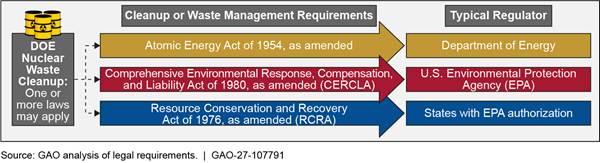
The Department of Energy’s (DOE) nuclear waste cleanup is proceeding largely under three laws that set cleanup and waste management requirements. Each law has different requirements, applications, and regulators.
Selected Cleanup and Waste Management Laws and Regulators for the Department of Energy’s (DOE) Nuclear Waste Cleanup
GAO and experts GAO convened with the National Academies of Sciences, Engineering, and Medicine identified several legal and regulatory factors that affect the cost and schedule of DOE’s nuclear waste cleanup.
Certain state regulatory actions may exceed state authority. According to experts who participated in GAO’s National Academies meetings, some states are taking legal and regulatory actions that address the radiological aspects of nuclear waste at DOE’s cleanup sites, which are generally regulated by DOE under the Atomic Energy Act of 1954, as amended. Such actions may exceed a state’s authority to regulate hazardous waste under authorizations from the U.S. Environmental Protection Agency (EPA) pursuant to the federal Resource Conservation and Recovery Act of 1976, as amended (RCRA). These state actions have led to disagreements between DOE and states on requirements for the radiological portion of DOE’s waste, longer cleanup schedules, and billions in higher costs for the federal government, according to experts.
Courts have recognized that DOE’s authority to manage and regulate its nuclear waste under the Atomic Energy Act preempts certain state regulatory actions that impact DOE’s management of nuclear waste during its cleanup efforts. However, based on GAO’s analysis, statutes and case law are unclear on what kinds of state actions that affect DOE’s management and cleanup of radioactive waste are appropriate under the law, in part because of the prevalence of mixed waste at DOE cleanup sites. According to experts, because states are often taking such actions under state programs that are authorized by EPA to implement a federal law (RCRA), EPA could play a more active role in addressing instances where states may be improperly seeking to regulate radioactive materials covered by the Atomic Energy Act. EPA officials told us they currently do not have authority to challenge such state actions, as long as those actions are at least as stringent as federal requirements. If Congress clarifies the scope of the Atomic Energy Act’s preemption—and creates a mechanism that allows for DOE to appeal to EPA to evaluate state actions that may infringe on federal authority over nuclear waste covered by the Atomic Energy Act—costly and resource-intensive legal disputes could be reduced and decision-making could be accelerated.
Assumptions about anticipated future land and groundwater use are sometimes unrealistic and can unnecessarily increase costs and schedules. Under the applicable laws and regulations, DOE’s cleanup of its sites is based, in part, on the anticipated future uses of land and groundwater for an area. According to experts at GAO’s meetings, DOE is cleaning up some areas based on unrealistic assumptions about those future uses. For example, DOE has agreed with state regulators and EPA to clean up large portions of some sites to allow for future residential use, even though there are no plans for such use. DOE did not evaluate the costs associated with cleaning up to less stringent standards associated with different land uses in those cases.
By comparison, realistic decisions about future land use have been critical to the successful cleanup of other DOE sites, such as at Rocky Flats in Colorado. After Congress designated that site as a national wildlife refuge in 2001, cleanup costs decreased from an estimated $23 billion for residential use to about $10 billion.
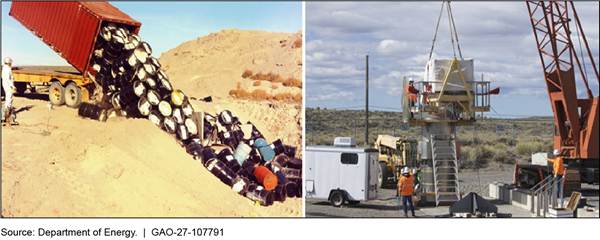
According to experts, a better framework for making realistic assumptions about future land use at DOE’s cleanup sites is needed. For example, DOE could assess benefits and costs associated with cleanup based on a range of potential future land uses. Clarification from Congress, and additional guidance from EPA and DOE, on incorporating future land use assumptions into the cleanup process would better position DOE to select appropriate cleanup approaches that are realistic, cost-effective, and aligned with congressional expectations.
The legal framework often requires DOE to clean up contaminated groundwater to meet drinking water standards, but, according to experts, the assumption that groundwater beneath contaminated sites will be used for drinking water in the future is sometimes unrealistic. Further, according to experts, standards for certain contaminants that can apply to groundwater are based on outdated information from the 1960s and may affect the feasibility of cleanup. By accounting for current scientific information, DOE may be able to achieve cleanup that is both protective and avoids unnecessary expenditures.
Other aspects of the legal and regulatory framework for DOE’s nuclear cleanup are sources of conflict and affect costs and schedule. For example, DOE entered into various cleanup agreements with EPA and states in the 1990s before the extent of contamination was fully known. These agreements include hundreds of milestones that DOE has sometimes struggled to meet.
In a poll, all experts at GAO’s meetings recommended that DOE and EPA create an interagency task force of experts to review high-priority cleanup decisions and areas of legal and regulatory disagreement for opportunities to make DOE’s cleanup approach more risk-informed and cost-effective. Having an independent task force provide recommendations to DOE and EPA—such as when disagreements occur over revising cleanup agreements—may help to allow for cleanup approaches that more efficiently complete DOE’s cleanup mission.
Why GAO Did This Study
DOE is cleaning up nuclear sites across the country, the majority of which were created during World War II and the Cold War to research and produce nuclear weapons. DOE has estimated it could take until 2100 and cost $641 billion to $840 billion dollars to complete its nuclear waste cleanup mission. Much of the waste at DOE sites is mixed waste, meaning that it includes both radiological and hazardous constituents. Radioactive waste emits radiation, sometimes for thousands of years. Hazardous waste may be toxic, corrosive, ignitable, or reactive.
Under a complex legal and regulatory framework, DOE and regulators (EPA and states) make decisions that affect the cost and schedule of DOE’s nuclear cleanup efforts. For years, organizations have reported on the ways in which this framework has affected DOE’s ability to complete its nuclear waste cleanup mission, such as through inconsistent decision-making processes for similar risks across sites.
GAO was asked to review the impact of the legal and regulatory framework on DOE’s nuclear waste cleanup mission. This report examines (1) how state legal and regulatory actions affect DOE’s ability to manage the radiological portions of nuclear waste at its cleanup sites, (2) how DOE’s cleanup efforts are affected by assumptions about future land and groundwater use under the applicable legal framework, and (3) other aspects of the legal and regulatory framework that can contribute to higher cleanup costs and longer schedules.
GAO convened a series of expert meetings with the National Academies; conducted legal research, a literature review, and four case studies across six DOE cleanup sites; and interviewed DOE, EPA, and state officials.
What GAO Recommends
GAO recommends that Congress consider (1) clarifying the preemptive scope of the Atomic Energy Act with respect to DOE nuclear waste cleanup and related activities, (2) creating a mechanism whereby DOE can appeal to EPA to evaluate state actions that may infringe on certain federal authorities over nuclear materials, and (3) providing more specific direction about incorporating potential future land use assumptions in the process for DOE nuclear waste cleanup.
GAO is also making six recommendations to DOE and EPA, including (1) that EPA take action to clarify guidance on making assumptions regarding future land use during the cleanup process, and (2) that DOE evaluate and document the expected costs and schedule associated with cleanup of a particular area based on multiple potential future land use assumptions when substantial cost or schedule benefits are possible. GAO is further recommending that DOE and EPA work together to (1) develop options to address certain outdated standards that can apply to groundwater cleanup; and (2) establish an interagency task force of experts to review cleanup decisions, processes, and areas of disagreement driving higher costs and longer schedules.
DOE concurred with two recommendations and did not concur with one related to evaluating multiple future land use assumptions. EPA also concurred with two recommendations and did not concur with one related to developing options to address certain outdated standards that can apply to groundwater cleanups. GAO continues to believe that taking action on these recommendations will help DOE achieve cleanup in a more risk-informed, cost-effective manner.
|
Abbreviations |
|
|
|
|
|
AEA |
Atomic Energy Act of 1954, as amended |
|
ARARs |
Applicable or Relevant and Appropriate Requirements |
|
CERCLA |
Comprehensive Environmental Response, Compensation, and Liability Act of 1980, as amended |
|
DOE |
Department of Energy |
|
EPA |
U.S. Environmental Protection Agency |
|
HLW |
High-Level Radioactive Waste |
|
LLW |
Low-Level Radioactive Waste |
|
National Academies |
National Academies of Sciences, Engineering, and Medicine |
|
National Contingency Plan |
National Oil and Hazardous Substances Pollution Contingency Plan |
|
RCRA |
Resource Conservation and Recovery Act of 1976, as amended |
|
TRU |
Transuranic |
|
WIPP |
Waste Isolation Pilot Plant |
This is a work of the U.S. government and is not subject to copyright protection in the United States. The published product may be reproduced and distributed in its entirety without further permission from GAO. However, because this work may contain copyrighted images or other material, permission from the copyright holder may be necessary if you wish to reproduce this material separately.
October 2, 2026
The Honorable Brett Guthrie
Chairman
The Honorable Frank Pallone, Jr.
Ranking Member
Committee on Energy and Commerce
House of Representatives
The Honorable Robert E. Latta
Chairman
The Honorable Kathy Castor
Ranking Member
Subcommittee on Energy
Committee on Energy and Commerce
House of Representatives
The Honorable Diane DeGette
House of Representatives
The Department of Energy’s (DOE) Office of Environmental Management is responsible for the cleanup of nuclear waste at sites that have been contaminated from decades of nuclear weapons production and nuclear energy research. This cleanup can include deactivating and decommissioning contaminated buildings, remediating contaminated soil and groundwater, and constructing and operating facilities to treat radioactive waste. In its fiscal year 2027 budget request, DOE estimated that ongoing cleanup at its 15 remaining active cleanup sites will cost between $641 billion and $840 billion and be completed in 2100.[1]
There is no single law governing cleanup of DOE’s nuclear waste. Rather, DOE’s cleanup is governed by a complex framework that involves many federal and state laws and regulations, DOE orders, and cleanup agreements. Much of the nuclear waste at DOE sites is mixed waste, meaning that it includes both radiological and hazardous constituents. Radioactive waste emits radiation, sometimes for thousands of years, which can damage cells and lead to cancer. Hazardous waste may be toxic, corrosive, ignitable, or reactive, and it can similarly cause cancer. In general, DOE is legally responsible for regulating the radiological components of mixed waste, while the U.S. Environmental Protection Agency (EPA) and states are responsible for regulating the hazardous components of mixed waste.
For years, several organizations have reported on the ways in which this complicated legal and regulatory framework has affected DOE’s ability to complete its nuclear waste cleanup mission. In 2015, the Omnibus Risk Review Committee—a congressionally directed effort to evaluate DOE’s cleanup mission—found that the complicated legal and regulatory framework had resulted in what seemed to be inconsistent decision-making processes and cleanup approaches for similar risks across DOE’s cleanup sites.[2] The committee found that these inconsistent processes and approaches could, in turn, result in substantially higher costs for cleanup at one site compared with another site with similar waste. Similarly, a 2017 National Academies of Sciences, Engineering, and Medicine (National Academies) report on the treatment and disposal of one type of radioactive waste identified the complexity of the current regulatory framework as a major theme, noting that unintended effects of the complicated framework included potential loss of public trust and confidence, increasing costs for waste disposal, and levels of regulation that are disproportionate to the hazards posed by the waste.[3]
You asked us to review the legal and regulatory framework for DOE’s nuclear waste cleanup. Our report examines (1) how state legal and regulatory actions affect DOE’s ability to manage the radiological portions of nuclear waste at its cleanup sites, (2) how DOE’s cleanup efforts are affected by assumptions about future land and groundwater use under the applicable legal framework, and (3) other aspects of the legal and regulatory framework that can contribute to higher cleanup costs and longer schedules.
To address all three of our objectives, we first conducted a literature review of 114 articles and reports to identify factors in the legal and regulatory framework that are affecting DOE’s cleanup of nuclear waste—particularly cost and schedule—and policy options to address those factors. We reviewed reports from the National Academies, reports and studies from government agencies, academic research, and our prior reports. We then worked with the National Academies to select 15 multidisciplinary experts and convened two sets of meetings to obtain expert input on (1) the set of legal and regulatory factors significantly affecting the cost and schedule of DOE’s cleanup of nuclear waste and (2) options to address them.[4] We also reviewed relevant statutes, regulations, policy, guidance, and case law and interviewed DOE and EPA headquarters officials. With the experts’ input, we conducted case studies across six different DOE sites that illustrate the impact of one or more of the factors identified through our literature review. For our case studies, we reviewed legal and regulatory documents and conducted interviews with officials from the respective DOE sites, EPA regional offices, and state regulatory offices.[5] See appendix I for a more detailed description of our objectives, scope, and methodology.
We conducted this performance audit from September 2024 through October 2026 in accordance with generally accepted government auditing standards. Those standards require that we plan and perform the audit to obtain sufficient, appropriate evidence to provide a reasonable basis for our findings and conclusions based on our audit objectives. We believe that the evidence obtained provides a reasonable basis for our findings and conclusions based on our audit objectives.
Background
Radioactive Waste Classifications
The classification of radioactive waste affects the waste treatment and disposal options available to DOE, and DOE must therefore classify its radioactive waste to make cleanup decisions. Federal statutes define different classifications of radioactive waste, including low-level radioactive waste (LLW), transuranic (TRU) waste, and high-level radioactive waste (HLW) (see fig. 1).
Figure 1: Selected Statutory Definitions for Specific Classifications of Radioactive Waste Managed by the Department of Energy
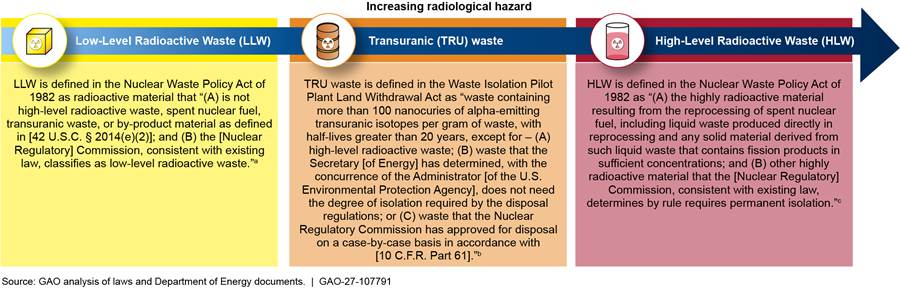
aPub. L. No. 97-425, § 2(16), 96 Stat. 2201 (1983) (codified at 42 U.S.C. § 10101(16)). LLW is also defined by the Low-Level Radioactive Waste Policy Amendments Act of 1985 as “radioactive material that (A) is not high-level radioactive waste, spent nuclear fuel, or byproduct material as defined in [42 U.S.C. § 2014(e)(2)]; and (B) the Nuclear Regulatory Commission, consistent with existing law and in accordance with paragraph (A), classifies as low-level radioactive waste.” The term does not include byproduct material as defined in 42 U.S.C. § 2014(e)(3) and (4). Pub. L. No. 99-240, § 102, 99 Stat. 1842 (1986) (codified as amended at 42 U.S.C. § 2021b(9)).
bPub. L. No. 102–579, § 2(20), 106 Stat. 4777 (1992). Transuranic waste is also defined in the Atomic Energy Act of 1954, as amended, and the West Valley Demonstration Project Act as material contaminated with elements that have an atomic number greater than 92, including neptunium, plutonium, americium, and curium, and that are in concentrations greater than 10 nanocuries per gram, or in such other concentrations as the Nuclear Regulatory Commission may prescribe to protect the public health and safety. 42 U.S.C. § 2014(jj); Pub. L. No. 96-368, § 6(5), 94 Stat. 1347, 1350 (1980).
cPub. L. No. 97-425, § 2(12), 96 Stat. 2201 (1983) (codified at 42 U.S.C. § 10101(12)). This definition is also cross-referenced in the Atomic Energy Act of 1954, as amended, 42 U.S.C. § 2014(ee), and the Waste Isolation Pilot Plant Land Withdrawal Act, Pub. L. No. 102–579, § 2(10), 106 Stat. 4777 (1992). High-level radioactive waste is also defined in the West Valley Demonstration Project Act as “the high-level radioactive waste which was produced by the reprocessing at the [Western New York Service] Center [in West Valley, New York] of spent nuclear fuel. Such term includes both liquid wastes which are produced directly in reprocessing, dry solid material derived from such liquid waste, and such other material as the [Nuclear Regulatory] Commission designates as high level radioactive waste for purposes of protecting the public health and safety.” Pub. L. No. 96-368, § 6(4), 94 Stat. 1347, 1350 (1980).
Most of the 15 remaining sites where DOE actively conducts cleanup have LLW requiring disposal, and DOE can dispose of this waste in near-surface facilities at six DOE sites and two commercial facilities. DOE’s TRU waste generally consists of contaminated materials, such as clothing or solid sludge resulting from the production of plutonium. Currently, DOE’s only option for disposing of this waste is the Waste Isolation Pilot Plant (WIPP) in New Mexico, a geological repository that can only accept TRU waste generated by atomic energy defense activities.[6] DOE’s HLW takes several forms, the majority of which is waste in underground tanks. There is no existing disposal option for HLW, which DOE plans to dispose of in the future in a deep geologic repository that can accept this waste.[7]
Legal and Regulatory Framework for DOE’s Nuclear Waste Cleanup
DOE’s cleanup of nuclear waste is governed by many federal and state laws and regulations, DOE orders, and cleanup agreements. The legal and regulatory requirements that apply and who oversees a particular cleanup effort differ among and within each DOE site, depending on things such as the applicability of federal and state laws, the nature of the contamination, and state input. Key federal laws that govern DOE’s cleanup of its sites include the Atomic Energy Act of 1954, as amended (AEA); the Comprehensive Environmental Response, Compensation, and Liability Act of 1980, as amended (CERCLA); and the Resource Conservation and Recovery Act of 1976, as amended (RCRA).
In some cases, one of these laws may serve as the primary driver for a particular cleanup approach. In other cases, the requirements that stem from these laws may run in tandem to establish how a particular cleanup will be addressed. For example, much of DOE’s waste is mixed waste that contains both radioactive waste subject to the AEA and hazardous waste subject to RCRA.[8] However, mixed waste is generally not segregable into distinct radioactive and hazardous components, meaning that the requirements of both laws and their associated orders and regulations can apply to a mixed waste stream. For DOE nuclear waste cleanup, each law has different requirements, applications, and relevant regulators (see fig. 2).
Figure 2: Selected Cleanup and Waste Management Laws and Regulators for the Department of Energy’s (DOE) Nuclear Waste Cleanup
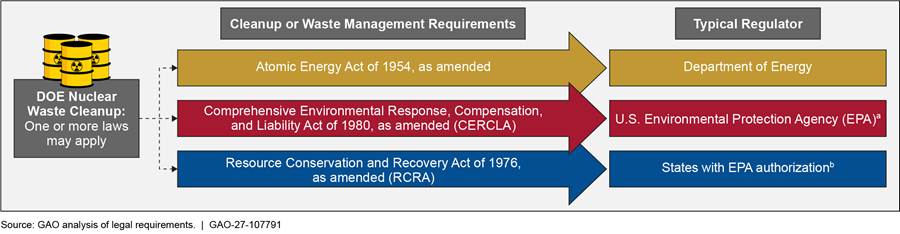
Note: While this figure highlights selected key laws that apply to DOE’s cleanup of nuclear waste, there are various additional federal and state laws that also apply.
aUnder CERCLA, EPA has certain oversight authorities for the cleanup of releases of hazardous substances, pollutants, or contaminants at federal facilities on the National Priorities List, which includes most of the DOE sites with cleanup proceeding under CERCLA.
bRCRA is administered by EPA and governs hazardous waste from generation to disposal. Under RCRA, EPA can authorize states to administer their own hazardous waste regulatory programs to operate in lieu of the federal program. Every state in which a DOE cleanup state is located has been authorized to administer aspects of the federal RCRA program.
Key laws, regulations, and agreements relevant to DOE’s cleanup of nuclear waste include the following:
· The Atomic Energy Act of 1954, as amended (AEA). The AEA established a comprehensive regulatory scheme for military and domestic nuclear energy. It authorized the Atomic Energy Commission—now DOE and the Nuclear Regulatory Commission—to regulate possession and use of nuclear material, including radioactive waste.[9] Under the AEA, as amended, along with the Department of Energy Organization Act, as amended, DOE is authorized to regulate defense nuclear materials, facilities, and wastes. DOE implements the AEA in part through a series of internal directives, including orders, policies, and manuals. For example, DOE Order 435.1 and Manual 435.1-1 set forth procedures for DOE’s management and disposal of radioactive and hazardous wastes in a manner that is protective of worker and public health and safety and the environment.[10]
· The Comprehensive Environmental Response, Compensation, and Liability Act of 1980, as amended (CERCLA). CERCLA, commonly known as Superfund and administered by EPA, authorizes the President to respond to releases or threatened releases of hazardous substances to the environment. In the late 1980s, the President delegated the act’s response authorities to EPA and other federal agencies. If there is a release from a federal facility, the agency that administers the facility—such as DOE—has the responsibility and authority to take response actions under the act, subject to oversight by EPA and the states in which those facilities are located.[11] Of DOE’s 15 remaining active cleanup sites, six are on the Superfund National Priorities List, which includes some of the most seriously contaminated federal and non-federal sites around the country. At these six sites, the act requires DOE to enter into an interagency agreement with EPA, known as a federal facility agreement. These agreements at DOE sites are generally negotiated among DOE, EPA, and state regulators, and govern the investigation and cleanup of releases at these facilities. There are several activities in the typical CERCLA cleanup process, including investigation, decision-making, and cleanup activities. See appendix II for the general CERCLA cleanup process at National Priorities List sites.
· EPA’s National Oil and Hazardous Substances Pollution Contingency Plan (National Contingency Plan) Regulation. The National Contingency Plan outlines the procedures and standards for preparing for and responding to releases of hazardous substances, pollutants, and contaminants under CERCLA.[12] The regulation specifies nine criteria for selecting a cleanup remedy: (1) overall protection of human health and the environment, (2) compliance with “applicable or relevant and appropriate requirements,” also known as ARARs, (3) long-term effectiveness and permanence, (4) reduction of toxicity, mobility, or volume through treatment, (5) short-term effectiveness, (6) implementability, (7) cost, (8) state acceptance, and (9) community acceptance.[13] CERCLA and the National Contingency Plan do not establish regulatory standards for the cleanup of specific substances but rather require that long-term cleanups comply with ARARs. ARARs may include a host of federal and state standards—such as maximum contaminant levels—that generally regulate exposure to contaminants.[14] The regulation also establishes EPA’s generally acceptable exposure level for known or suspected carcinogens for CERCLA cleanups as concentration levels that represent lifetime cancer risk to an individual of between 10-4 (1 in 10,000) and 10-6 (1 in 1,000,000).[15] After cleanup, the cumulative cancer risk of remaining contaminants—both radioactive and hazardous—should generally fall within this risk range in order to fulfill CERCLA’s requirement that cleanup is protective of human health and the environment.
· The Resource Conservation and Recovery Act of 1976, as amended (RCRA). RCRA is administered by EPA and governs hazardous waste from generation to disposal. Under RCRA, EPA can authorize a state to implement its own hazardous waste regulatory program to operate in lieu of the federal RCRA program so long as the state program is equivalent to and at least as stringent as the federal program. State hazardous waste programs may be more stringent and broader in scope than the federal RCRA program. Through the Federal Facility Compliance Act of 1992—which amended RCRA—Congress made clear that federal facilities, including DOE cleanup sites, are subject to the requirements of RCRA as well as state hazardous waste laws. The states where DOE nuclear cleanup sites are located have all been authorized by EPA to implement aspects of the federal RCRA program. EPA regional offices assist states with the implementation and enforcement of RCRA within their regions.
RCRA generally requires facilities that treat, store, or dispose of hazardous waste to have a permit from EPA or an authorized state to operate, and RCRA regulations establish detailed and often waste-specific requirements for the handling, storage, treatment, and disposal of hazardous wastes by permitted facilities. RCRA also requires corrective action (i.e., cleanup) of releases of hazardous and mixed waste from RCRA-regulated facilities.[16]
Nuclear materials covered by the AEA are expressly excluded from RCRA’s hazardous waste regulatory regime, meaning that DOE’s waste that is solely radioactive in nature is not subject to regulation or permitting under RCRA. But, subject to certain exclusions, RCRA gives EPA and authorized states regulatory and permitting authority over the hazardous components of the mixed waste managed by DOE. Many DOE facilities operate under permits issued by states under their authorized RCRA authority. See appendix II for the typical RCRA cleanup process used for releases of hazardous waste and constituents.
Unlike the National Contingency Plan for CERCLA, RCRA’s hazardous waste cleanup regulations are not detailed.[17] Instead, EPA and authorized states primarily use guidance to implement corrective actions and set cleanup requirements at individual facilities through permits or compliance orders.
· Cleanup agreements. DOE has negotiated agreements with various regulatory entities that establish hundreds of milestones specifying the actions DOE must take and deadlines it must meet as it carries out its cleanup work across the complex. These agreements include CERCLA federal facility agreements, as well as other compliance agreements, administrative compliance and consent orders, and judicial consent decrees under RCRA or other laws. In addition to cleanup milestones, federal facility agreements can include sections designed to integrate cleanup and other requirements under CERCLA and RCRA and may designate which law will govern—and which regulator will oversee—particular cleanup activities at a site. Compliance and consent orders are issued by regulators and typically require DOE to take site-specific actions to correct violations of laws, regulations, permits, or agreements. Consent decrees are generally negotiated to end a lawsuit and enforced by a court. Cleanup agreements can be amended if the parties agree and follow the amendment process specified in the agreement. Figure 3 shows an example of varying legal and regulatory approaches for contaminated areas across a single DOE cleanup site; in this case, certain cleanup activities at DOE’s Hanford Site and the different laws governing—and regulators overseeing—them under applicable cleanup agreements.
Figure 3: Map of the Department of Energy Hanford Site and Selected Cleanup Activities and Facilities Proceeding or Regulated Under CERCLA or RCRA
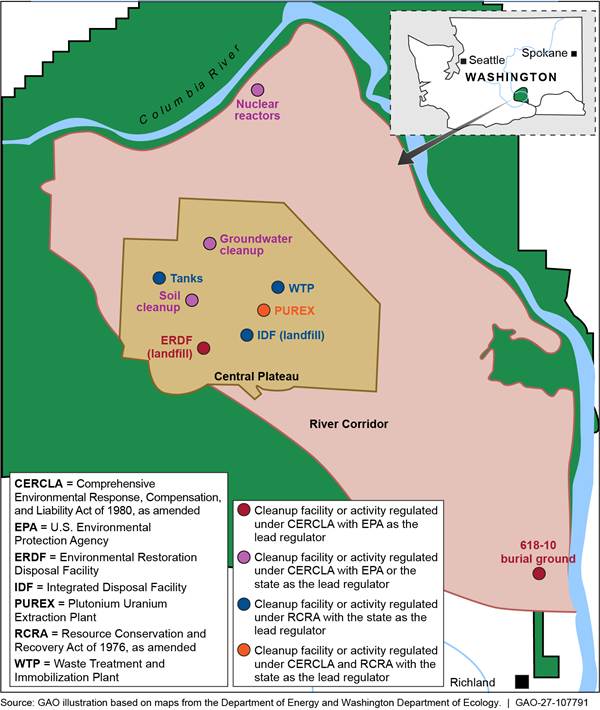
Notes: Locations of cleanup activities and facilities are approximate. Some activities and facilities, such as nuclear reactors, tanks, and soil and groundwater cleanup, occur in multiple locations within the site; locations on map are for illustrative purposes only. When RCRA is indicated, we are referring to the federal RCRA program and the state hazardous waste program operating in lieu of the federal RCRA program in Washington State.
At Hanford, the lead regulator for particular cleanup activities is generally determined based on criteria outlined in Hanford Federal Facility Agreement and Consent Order. For example, EPA is generally the lead regulator for facilities or activities that contain primarily CERCLA-only materials, and the state is generally the lead regulator for facilities or activities that contain major or priority RCRA-regulated treatment, storage, and disposal units. When these criteria overlap, EPA and the state consider other criteria, such as which agency has available resources to undertake additional work in a timely manner.
Overview of Remaining DOE Cleanup Sites
DOE has completed cleanup of 92 sites across the country, and there are 15 remaining sites where DOE actively conducts cleanup activities.[18] This cleanup work, generally performed by contractors working for DOE, is expected to generate over 11 million cubic meters of radioactive waste, according to DOE estimates. According to DOE, the most complex and costly work remaining is the treatment and disposal of approximately 90 million gallons of waste generated primarily from reprocessing spent nuclear fuel that resides in tanks (tank waste), primarily at the Hanford Site and Savannah River Site. As described above, requirements under CERCLA, RCRA, or both drive major aspects of DOE’s nuclear cleanup and waste management activities across its sites. Often such requirements and associated cleanup milestones are embedded in cleanup agreements for the sites. DOE is required to estimate the lifecycle cost and schedule for completing the cleanup work at each site, which, according to DOE officials, includes the estimated cost of future cleanup work and costs already incurred (see fig. 4). DOE is also required to annually update the estimated cost for future cleanup as part of calculating its environmental liability.[19]
Figure 4: Estimated Costs, Completion Dates, and Key Laws Driving Cleanup or Waste Management for the Department of Energy (DOE) Office of Environmental Management’s 15 Active Sites, as of April 2026
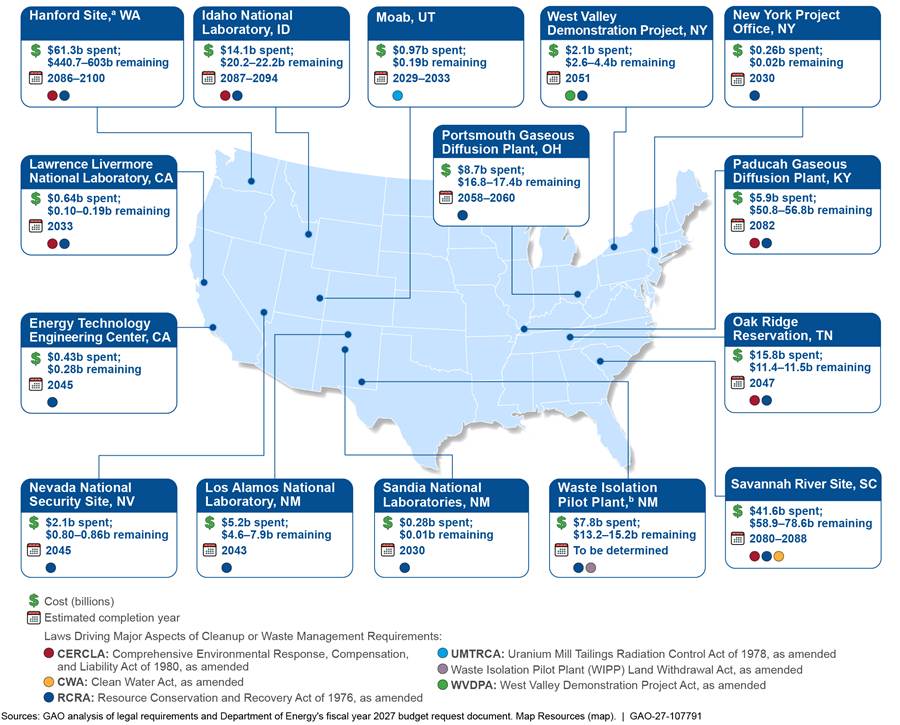
Notes: While this figure highlights selected key laws that apply to DOE’s cleanup and management of nuclear waste, there are various additional federal and state laws that also apply. We did not specify the Atomic Energy Act of 1954, as amended, as a key law because DOE exercises its authority under this law at all of the Office of Environmental Management’s sites. When RCRA is indicated, we are referring to the federal RCRA program and the state hazardous waste programs operating in lieu of the federal RCRA program in the relevant states. When CERCLA is indicated, we are referring to sites that are on the U.S. Environmental Protection Agency’s CERCLA National Priorities List.
The cost estimates for each site represent the lifecycle estimates developed by DOE’s Office of Environmental Management, which include costs for work that has already been completed and remaining costs. The costs in this figure are in escalated dollars based on the year of expenditure. EPA officials told us they do not agree with some of DOE’s estimated site completion dates.
aDOE’s Hanford Site was historically counted as two separate sites (the Office of River Protection and the Richland Operations Office), but these were consolidated into one site office in 2024.
bThis facility supports completion of DOE work at other sites. Therefore, the end date will be determined by the completion of cleanup at other sites or reaching maximum waste storage capacity, as defined in the WIPP Land Withdrawal Act of 1992, as amended. Further, according to DOE officials working at the site, their latest estimated year to complete WIPP operations is 2083. As of August 2025, this estimate was still awaiting approval by DOE headquarters.
The Role of Anticipated Future Land and Groundwater Use in the Cleanup Process
The extent of DOE cleanup is based, in part, on the anticipated future uses of land and groundwater for an area, which are determined in different ways. Specifically, anticipated future land use is generally decided as a part of the cleanup process under applicable cleanup laws. By comparison, anticipated future groundwater use is often established by EPA or state designations, which are typically made outside the context of a particular cleanup.
Anticipated Future Land Use
For DOE sites where cleanup activities are proceeding under CERCLA or RCRA, as a part of the cleanup process, DOE and regulators typically make assumptions about how the land will be used in the future to help determine how much cleanup needs to occur. EPA guidance notes that the anticipated future land use of a site is important in determining the appropriate extent of remediation.[20] At DOE’s cleanup sites, assumptions about future land uses are made by DOE, usually with or subject to the approval of EPA and state regulators.[21]
Assumptions that people may use land in ways that would result in frequent or extensive exposure to contaminants can mean that DOE needs to achieve more stringent cleanup levels, and thus use more intensive cleanup approaches, than would be required if the land is expected to be used in ways that limit human access and exposure. According to EPA guidance, general categories of assumed future land use include, but are not limited to, ecological, recreational, industrial, and residential (see text box). A contaminated site that is assumed may be used for residential purposes in the future may require deeper excavation of contaminated soil than would be required if the site were instead to be used for industrial, recreational, or ecological purposes, for example.[22] Cleaning up a site to a level that allows for future residential use means that the site is also clean enough for uses that require less stringent cleanup levels, such as industrial and recreational uses.
|
Example Categories of Anticipated Future Land Uses at Department of Energy (DOE) Nuclear Waste Cleanup Sites Residential use – for areas where access to the land should be unrestricted and available for residential housing development. Industrial use – for areas where activities such as scientific research and development, manufacturing, waste management, and warehouse and distribution operations may occur. Recreational use – for areas where activities such as hiking, camping, hunting, and boating may occur. Ecological use – for areas where access to the land should be restricted to protect and manage archeological, cultural, ecological, and natural resources. |
Source: GAO analysis of DOE land use plans. | GAO‑27‑107791
EPA guidance discusses how the future land use assumption should be incorporated into the cleanup process and what considerations should go into selecting a reasonably anticipated future land use as a part of the cleanup process. Although the guidance is primarily for the CERCLA cleanup process, it can also be used under RCRA.[23] The EPA guidance states that the identification of reasonably anticipated future land use should begin early in the cleanup process through engagement with the local community, local government, states, and Tribes. The guidance emphasizes that the reasonably anticipated future land use should have specific attributes, including that it is realistic, and allows for the development of cost-effective and practicable cleanup options. It further states that if the cleanup needed to allow for a particular anticipated future land is not cost-effective or practicable, the level of cleanup may be revised, which may result in different, more reasonable anticipated land uses.
Anticipated Future Groundwater Use
Existing EPA or state designations regarding the current and anticipated future use of groundwater can drive groundwater cleanup requirements at DOE sites under the applicable cleanup laws. During cleanup, DOE identifies which groundwater aquifers have plumes of contamination from DOE activities. DOE then checks how EPA or the state has designated those aquifers for potential future use. For example, a state may classify its groundwater for a particular use, such as for drinking water, under an EPA-approved Comprehensive State Groundwater Protection Program. Under CERCLA and the National Contingency Plan, EPA generally requires sites to clean groundwater to national drinking water standards established under the Safe Drinking Water Act, as amended, if there is current or potential future use of the groundwater for drinking water.[24] For groundwater cleanup under RCRA, EPA guidance recommends that state regulators base groundwater cleanup levels on the maximum beneficial use of the groundwater wherever practicable within a reasonable time frame given the circumstances of the site. Maximum beneficial use is frequently drinking water, which should meet relevant standards. At DOE sites, groundwater may need to be pumped out and treated in an above-ground system for decades to meet drinking water standards; the same water may not need treatment to the same levels if drinking water use is not expected.
Certain State Regulatory Actions Slow DOE Cleanup and May Exceed State Authority
According to experts at the meetings we convened with the National Academies, our review of literature, and case study information, some states are taking actions at DOE cleanup sites under their state RCRA programs that address the radiological aspects of nuclear waste at DOE’s cleanup sites—rather than solely the hazardous aspects of the waste—which is slowing cleanup progress and leading to billions of dollars in higher costs. Courts have recognized that certain state regulatory actions that impact federal decisions regarding nuclear facilities and radiological safety are preempted by the Atomic Energy Act of 1954—which authorizes DOE to manage and regulate nuclear waste generated from defense activities. However, based on GAO’s analysis, statutes and case law are unclear on precisely what kinds of state actions that affect DOE’s cleanup of nuclear waste are within state authority. Additionally, while RCRA is a federal program administered by EPA, EPA has sometimes avoided weighing in on disputes involving states’ application of their authorized RCRA programs to DOE mixed waste.
Experts Believe Certain State Regulatory Actions Address the Radiological Aspects of DOE’s Nuclear Waste, Which Slows Cleanup
According to experts at our meetings, our review of literature, and case study information, some states are taking actions under their state RCRA programs that address the radiological aspects of nuclear waste at DOE’s cleanup sites. As discussed above, RCRA regulates hazardous waste and it does not apply to DOE’s waste that is solely radioactive or to the radiological components of DOE’s mixed waste (see fig. 5).
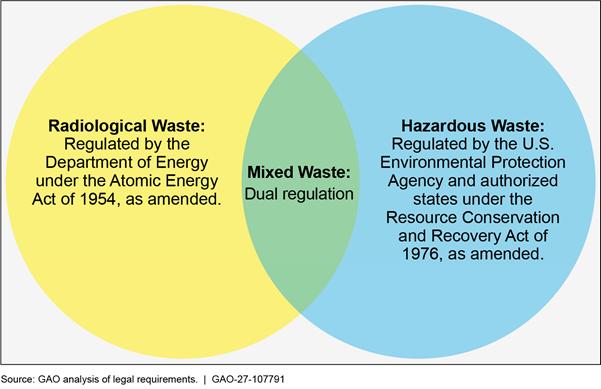
Note: Much of DOE’s waste is mixed waste that contains both radioactive waste and hazardous waste that are subject to different laws. However, mixed waste is generally not segregable into distinct radioactive and hazardous components—meaning that the requirements of both laws and their associated orders and regulations can apply to a mixed waste stream.
Experts generally said that these state actions are slowing cleanup progress and leading to billions of dollars in higher costs by limiting DOE’s options for addressing radioactive waste in a more cost-effective and efficient manner.[25] Experts, literature we reviewed, and prior GAO reports provided the following examples.
Hanford tank waste. The Hanford Site in Washington state is home to one of the largest and most expensive environmental cleanup projects in
|
The Application of Waste Classification Tools Across DOE Sites Federal law broadly defines high-level radioactive waste (HLW) as the highly radioactive material resulting from the reprocessing of spent nuclear fuel. Due to various requirements, HLW is expected to be more difficult and costly to treat and dispose of compared with other waste types, like low-level radioactive waste (LLW) and transuranic (TRU) waste. In March 2026, GAO found that the statutory definition of HLW is ambiguous and has impeded the Department of Energy’s (DOE) cleanup process. To help overcome this ambiguity, DOE has relied on three processes—known as waste classification tools—it can use to determine that certain waste associated with reprocessing can be treated and disposed of as LLW or TRU waste, rather than HLW, when the waste meets specific criteria. However, GAO found that the three tools have shortcomings. In particular, the tools have varying requirements and do not all apply at the four sites that have this waste. For example, one tool applies only to two sites and does not cover waste that will be transported out of state for disposal. Moreover, DOE stated in a 2024 settlement agreement that it intends to forbear from using one tool—the HLW Interpretation tool—to classify or reclassify reprocessing wastes at or from the Hanford Site as non-HLW for the purposes of disposal of treated waste or closure of tank systems within Washington State. Given these issues, we suggested that Congress consider convening a panel of experts to recommend revisions to the statutory definition of HLW. Source: GAO-26-108018. | GAO‑27‑107791 |
the world. DOE’s mission at the site includes addressing approximately 54 million gallons of hazardous and radioactive waste stored in 155 large underground storage tanks. The tanks are regulated by Washington State under its authorized RCRA program, as well as by DOE pursuant to its AEA authorities. As a matter of policy, DOE manages Hanford’s tank waste as if it is mixed high-level radioactive waste (HLW) as defined by federal law unless it is formally classified as another waste type (see sidebar).[26]
Generally, RCRA regulations require mixed HLW to be vitrified (immobilized in a glass form) prior to disposal.[27] The State of Washington’s RCRA program has adopted these standards for treating mixed HLW. However, DOE expects that up to 90 percent of Hanford’s tank waste could potentially be managed as mixed low-level radioactive waste (LLW) following pre-treatment and solidification of the waste.[28] RCRA regulations do not generally require mixed LLW to be vitrified; instead, mixed LLW can often be treated with less expensive methods like grout (a cement-like mixture) to meet the applicable RCRA standards for the relevant hazardous constituents.[29]
If DOE classifies some tank waste at Hanford as LLW, DOE officials assert that this waste should be subject to the RCRA requirements that apply to mixed LLW and be eligible for DOE to use less expensive options for treating and disposing of the waste, such as grouting. By contrast, as we reported in December 2021, the State of Washington has asserted that, even if DOE classifies portions of the tank waste as mixed LLW pursuant to DOE’s AEA authority, DOE would still be required to meet RCRA’s mixed HLW treatment standard of vitrification for the waste.[30] This is because the state’s interpretation of RCRA’s requirements is that the RCRA HLW treatment standard remains attached to the waste until the standard has been met or a variance from the standard is obtained. DOE officials disagree and believe that waste determined to be LLW based on the radioactivity of the waste should be subject to the same RCRA requirements as mixed LLW, which does not require vitrification.
After we reported on this disagreement in 2021, EPA granted DOE in 2024 a treatment variance under RCRA authorizing DOE to grout 2,000 gallons of low-activity Hanford tank waste for off-site disposal as a part of a demonstration project.[31] However, that variance did not address the underlying disagreement, and questions remain about how RCRA’s treatment standards will apply to other portions of Hanford’s tank waste that DOE has historically managed as HLW but expects to manage as LLW in the future and does not intend to vitrify.[32] As a result, experts generally said that DOE may be limited in its ability to use treatment approaches—namely, grout—that could help the agency complete cleanup decades sooner and save billions of dollars.
Waste Isolation Pilot Plant (WIPP) permit. The WIPP repository in New Mexico is currently the nation’s only disposal option for transuranic (TRU) waste, and the repository can only accept TRU waste generated by atomic energy defense activities (see fig. 6).
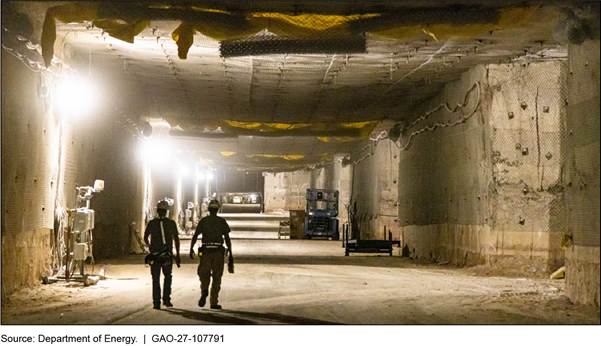
WIPP operates under a hazardous waste facility permit issued by the State of New Mexico under the state’s authorized RCRA program. This permit prohibits disposal of waste at WIPP that has ever been managed as HLW, as well as waste from certain specified tanks at DOE’s Hanford, Idaho, and Savannah River Sites, unless the waste is specifically accepted through a permit modification.[33] This prohibition applies even if DOE determines that waste once managed as HLW is properly classified as TRU waste and otherwise meets WIPP’s acceptance criteria.
Experts generally said that DOE has several waste streams that, while currently managed as HLW, could be classified as TRU waste and safely disposed of at WIPP based on their radiological characteristics. For example, in 2019 we found that DOE hoped to dispose of sodium-bearing tank waste from Idaho National Laboratory at WIPP—an approach that could expedite cleanup and save costs for disposal—instead of vitrifying that waste for disposal in a deep geologic repository.[34] Since 2023, DOE has been actively treating this waste in the Integrated Waste Treatment Unit, which is converting the waste to a granular solid—not a vitrified waste form. DOE believes Idaho’s sodium-bearing waste could be classified as TRU waste because the waste has radiological characteristics that could allow it to be safely disposed of at WIPP. However, this approach is not permissible under WIPP’s current permit because DOE historically managed this tank waste as if it were HLW. Experts generally told us that the State of New Mexico may not agree to a permit modification to allow disposal of the treated sodium-bearing waste, leaving this waste with no disposal route.[35] According to DOE officials, the State of New Mexico has opposed DOE’s requests to remove this prohibition from the permit during permit renewal negotiations, which most recently occurred in 2023.
Energy Technology Engineering Center. At the Energy Technology Engineering Center near Los Angeles, California, DOE site officials and the State of California are working together to decide how to address soil cleanup at the site.[36] See Figure 7.
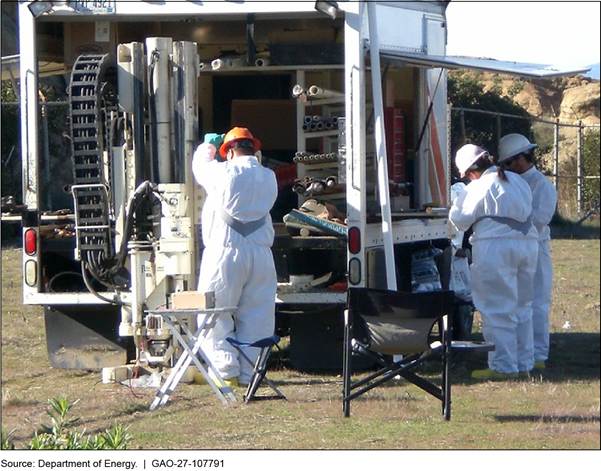
Cleanup and other activities at the center are regulated by the state under their authorized RCRA program. Under a 2010 Administrative Order on Consent for Remedial Action issued by the state, DOE agreed to clean up soil contamination, including radiological contamination, at the site to background levels—that is, at the completion of cleanup, no contaminants will remain in the soil that are above local background levels.[37]
Experts generally noted that the state-established background cleanup level for the site is a highly stringent standard that is not feasible for DOE to meet and has led to more than a decade of delays in cleaning up the site. Moreover, as we found in September 2025, DOE reported that background cleanup levels for many contaminants including radionuclides could be difficult for analytical instruments to accurately measure in soil, which could lead to false positives that result in unnecessary cleanup.[38]
Additionally, DOE was not able to find backfill soil clean enough to meet the standards established by the State of California. According to a 2018 DOE report, the Energy Technology Engineering Center conducted an initial evaluation in 2015 of three other sites that could potentially provide clean soil to replace the contaminated soil at the center.[39] The evaluation concluded that none of the sites had soil clean enough to serve as backfill, as the soils could not meet the state-established background cleanup standards. Further, the center tested soil products sold by home improvement stores, which also exceeded the level of contamination that would meet cleanup standards.
In 2023, the State of California released its final environmental impact report that acknowledged these challenges but reiterated that the state expects DOE to clean up soil at the site to background levels as required by the terms of the 2010 order.[40] However, DOE officials told us that the state is considering revising the technical approach for how DOE will be required to meet the background cleanup levels in the order because of some of the technical challenges that DOE identified.
Statutes and Case Law Are Unclear on What Actions That Impact DOE’s Radioactive Waste Cleanup Are Within State Authority
Certain exercises of state authority raise questions about whether—and to what extent—state actions that impact DOE’s cleanup of nuclear waste are preempted by the AEA. Through the Federal Facility Compliance Act of 1992, Congress expressed a clear intent to make federal facilities—including DOE cleanup sites—subject to federal and state hazardous waste laws such as RCRA.[41] As noted above, most states implement aspects of RCRA through state authorized hazardous waste programs, which can be more stringent and broader in scope than the federal program.[42] However, RCRA, its state authorized equivalents, and other federal environmental laws, such as the Clean Water Act, do not apply to certain nuclear materials defined and covered by the AEA.[43]
In addition, Congress has expressed a clear intent to preempt—that is, supplant—certain state regulatory activities that impact the construction and operation of specific nuclear facilities and the disposal of certain nuclear materials.[44] Federal preemption is grounded in the Supremacy Clause of the U.S. Constitution, which establishes the principle that federal law takes precedence over the laws of the states.[45] In a series of decisions, the U.S. Supreme Court has stated that the AEA can preempt certain state laws that impact nuclear facilities.[46] In other words, the Supreme Court has decided that certain state laws may be inapplicable because the AEA supplants them. Under existing Supreme Court precedent, whether the AEA preempts a particular state law depends on the purpose and the effect of the law. Specifically, the Court has determined that the AEA (1) prevents states from directly regulating nuclear facilities for the purpose of radiological safety and (2) preempts state laws with a direct and substantial effect on decisions made by those who build and operate nuclear facilities concerning radiological safety levels. Such activities fall within the exclusive purview of the federal government, namely DOE and the Nuclear Regulatory Commission.
However, the precise scope of the AEA’s preemption—and thus the extent to which states can regulate nuclear activities, including DOE nuclear cleanup activities—has been long litigated and remains uncertain. This uncertainty particularly applies to DOE’s nuclear waste cleanup for at least two reasons:
· Application to DOE’s defense nuclear waste cleanup. Supreme Court cases regarding preemption under the AEA have all addressed the commercial nuclear field regulated by the Nuclear Regulatory Commission, rather than defense nuclear cleanup activities regulated by DOE. In one of those cases, the Court noted that, in enacting the AEA, Congress intended “that the federal government should regulate the radiological safety aspects involved in the construction and operation of a nuclear plant, but that the states retain their traditional responsibility in the field of regulating electrical utilities for determining questions of need, reliability, cost, and other related state concerns.”[47] Thus, the Supreme Court has provided some guidelines around when state regulation may be appropriate in the realm of commercial nuclear power. In contrast, it has not directly addressed the role of states in the realm of defense nuclear waste cleanup that involves DOE’s radioactive waste.
· Application to mixed waste. The question of how, if at all, AEA preemption impacts state regulation of DOE cleanup activities is complicated by the prevalence of “mixed waste”—or waste that contains both (1) hazardous waste subject to RCRA and (2) radioactive source, special nuclear, or byproduct material subject to the AEA—at DOE cleanup sites.[48] There is no federal statute that specifically delegates authority to regulate mixtures of these two wastes, but DOE and EPA have issued rules stating that mixed waste will be subject to dual regulation: the AEA will govern the radioactive component, and RCRA (or a state program authorized to operate in lieu of RCRA) will govern the non-radioactive, hazardous component.[49] However, DOE and others have recognized that the radioactive and non-radioactive components of mixed waste are, for all practical purposes, not segregable. This physical reality—in combination with the dual regulatory structure—has led to conflict and litigation between DOE and the states regarding whether certain state regulation of DOE nuclear cleanup is preempted by the AEA. Several federal court cases highlight this conflict, as shown in table 1.
Table 1: Selected Federal Court Cases Concerning Preemption of State Activities by the Atomic Energy Act of 1954, as amended (AEA), at or Near Department of Energy (DOE) Nuclear Cleanup Sites
|
Case name and year |
DOE site involved |
Summary of preemption matters |
|
Public Service Co. v. Andrus (1991)a |
Idaho National Laboratory, Idaho |
The court considered an attempt by the governor of Idaho to prohibit DOE from shipping radioactive waste from the Fort Vrain Site in Colorado to Idaho National Lab for storage. The court held that the governor’s action was preempted by the AEA, recognizing that, as a prior court had stated, ”nuclear wastes have to be stored somewhere, and the place of storage should be chosen without regard to the parochial interests of the states.” The court further noted that “although the Governor’s position may be politically favorable, it clearly violates the Constitution and is completely unsupported in the law.” |
|
United States v. Kentucky (2001)b |
Paducah, Kentucky |
The court addressed whether the AEA preempted conditions on disposal of radioactive waste in a state Resource Conservation and Recovery Act of 1976 (RCRA) permit for a landfill at DOE’s Paducah Gaseous Diffusion Plant. The permit conditions prohibited DOE from placing waste with more than a negligible amount of radioactivity in the landfill and from disposing of radioactive waste in the landfill without state approval. The court noted that these permit conditions sought to “limit the amount of ‘radioactivity’ and ‘radionuclides’” in the landfill and that, while federal law does not preempt state regulation of solid waste under RCRA, “states may not regulate the radioactive component of solid waste.” The court explained that because the permit conditions sought “to regulate materials covered by the AEA based on the [state’s] safety and health concerns” the conditions were preempted by the AEA. |
|
United States v. Manning (2008)c |
Hanford, Washington |
The court struck down a Washington State law that, among other things, would have (1) required the cleanup of mixed waste contamination at Hanford before additional waste could be stored at the site and (2) required the state to take RCRA corrective action against releases of radionuclides into the environment. The court noted that the AEA would preempt the state law if the state’s purpose was “to regulate against radiation hazards” or if the law directly affected “decisions concerning radiological safety.” The court held that the state law was preempted on both grounds and explained that the state sought “to impose conditions on the disposal of AEA materials out of concern for the health and environmental risks that increased contamination will cause” which “falls squarely within the field preempted by the AEA.” Further, the court stated that “[b]ecause radioactive materials are excluded from [] RCRA, requiring a corrective action for the release of radionuclides exceeds” the state’s RCRA authority. Finally, the court found that the Washington law was also preempted because it would “directly and substantially impact[] the DOE’s decisions on the nationwide management of nuclear waste.” |
|
Boeing v. Robinson (2011)d |
Energy Technology Engineering Center, California |
The court considered a California state law (SB 990) enacted in 2007 that sought to prescribe cleanup standards for both radioactive and chemical contamination applicable only to the Santa Susana Field Laboratory, which is owned by Boeing and within which DOE’s Energy Technology Engineering Center site is located. The court explained that the state law mandated a “land-use assumption” that would have required Boeing and the federal government to clean up radioactive and chemical contamination at the site so that the land could be used for subsistence farming. The court concluded that the state law “is an attempt to regulate squarely within the federally occupied field of nuclear health and safety and, therefore, it is preempted by the AEA.”e |
Source: GAO analysis of relevant case law. | GAO‑27‑107791
aPublic Serv. Co. v. Andrus, 1991 U.S. Dist. LEXIS 6892 (D. Idaho 1991).
bUnited States v. Kentucky, 252 F.3d 816 (6th Cir. 2001).
cUnited States v. Manning, 527 F.3d 828 (9th Cir. 2008).
dBoeing Co. v. Robinson, 2011 U.S. Dist. LEXIS 52507 (C.D. Cal. 2011). The judgment of the district court invalidating the California state law was affirmed on different grounds in Boeing Co. v. Movassaghi, 768 F.3d 832 (9th Cir. 2014). The court of appeals held that the California state law
|
Recent Supreme Court Case Related to Preemption: Virginia Uranium, Inc. v. Warren, 58 U.S. 761 (2019) In 2019, the Supreme Court decided the most recent case concerning preemption under the Atomic Energy Act of 1954, as amended (AEA), when it ruled that the act did not preempt a Virginia law banning uranium mining. A fractured court held that the Virginia law was not preempted, but the Court produced no majority opinion. A primary source of disagreement among the justices was whether the legislative intent of the state law is relevant to AEA preemption, and, if so, in what way. In the lead opinion, Justice Gorsuch explained that, because the text of the AEA does not cover mining, the states are free to regulate the mining of uranium. Notably, that opinion declined to consider the state’s intent behind the ban, suggesting that such consideration was not appropriate. In a concurring opinion authored by Justice Ginsberg, three justices agreed that the Court did not need to consider the state’s intent behind the law in the instant case. However, those justices refused to join Justice Gorsuch’s “discussion of the perils of inquiring into legislative motive,” and explicitly acknowledged that state intent was relevant to whether a particular state action was preempted by the AEA in other cases. In a dissent joined by two other justices, Chief Justice Roberts noted that the lead opinion was answering the wrong question, stating “the opinion devotes its analysis to whether the field of uranium mining safety is preempted under the [AEA], ultimately concluding that it is not. But no party disputes that. Rather, the question we agreed to address is whether a State can purport to regulate a field that is not preempted (uranium mining safety) as an indirect means of regulating other fields that are preempted (safety concerns about uranium milling and tailings). And on that question, our precedent is clear: The AEA prohibits state laws that have the purpose and effect of regulating preempted fields.” Because no opinion received a majority of the Court, the case produced no binding precedent and left lingering questions about how the Supreme Court may consider state intent in future cases regarding AEA preemption. Source: GAO analysis of Virginia Uranium, Inc. v. Warren, 587 U.S. 761 (2019). | GAO‑27‑107791 |
impermissibly regulated and discriminated against the federal government and its contractor, and the court did not reach the question of whether the state law was preempted by the AEA. In its opinion, the court of appeals noted that SB 990 would drive cleanup standards such that “hypothetical subsistence farmers could live safely on their farms eating nothing but their chickens, eggs, crops, and cheese and drinking their milk from their cows eating the grass, in this patch of nuclear and chemical toxic waste in the Los Angeles suburbs.” The court stated that California could not exercise authority over DOE’s cleanup of radioactive waste at the site in part because “[t]here is no clear congressional authorization in the Atomic Energy Act that would allow California to regulate DOE’s cleanup of radioactive materials at Santa Susana” and neither RCRA nor the Comprehensive Environmental Response, Compensation, and Liability Act of 1980, as amended, extended such authority to the state.
eBefore California law SB 990 was invalidated in this case, the California Department of Toxic Substances Control and DOE agreed to an Administrative Order on Consent in 2010 that addresses the cleanup of radiological and chemical soil contamination by DOE at portions of the Santa Susana Field Laboratory site. In Boeing v. Robinson, the court noted that negotiations on this order were “not without the typical legal posturing from all parties about SB 990’s validity.” Nonetheless, DOE agreed to the Administrative Order on Consent before SB 990 was struck down. That Administrative Order on Consent remains in place today and requires DOE to cleanup soil at the Energy Technology Engineering Center to “background levels” for radiological and chemical contamination.
As noted above, experts in our meetings raised several instances in which they believe current state regulatory actions address the radiological aspects of nuclear waste at DOE’s cleanup sites and limit DOE’s options for addressing that waste under its AEA authorities. Several courts have addressed preemption issues at DOE cleanup sites but have not consistently defined the type or range of state regulatory action preempted by the AEA, particularly in the case of mixed waste.
This lack of clarity about the scope of the AEA’s preemption has resulted in disputes between DOE and regulators that have slowed the progress of cleanup and may continue to do so in the future. For example, in 2003 and 2004, when the State of New Mexico sought to add the provision to the WIPP permit that prohibits disposal of waste that has ever been managed as HLW, DOE initially opposed the provision, and stated the following in a letter to the state:
The proposed permit modification is an attempt by the State to prevent WIPP from disposing of waste that [the State] believes is high-level waste . . . The focus of the information supporting the modification is the classification of the waste based on its radiological constituents, not its hazardous constituents . . . [T]he State’s effort to regulate the waste disposed of at WIPP based on its radiological properties is (1) contrary to the [AEA]; (2) disregards the Supremacy Clause of the United States Constitution VI, cl.2; and (3) exceeds the waiver of sovereign immunity contained in RCRA because the modification attempts to regulate materials outside the statutory definition of solid waste, which excludes “source, special nuclear and byproduct material).”[50]
Despite these statements, DOE ultimately accepted the State of New Mexico’s permit condition pertaining to waste managed as HLW, though DOE succeeded in removing other conditions the state sought to add. The disagreement and negotiations regarding the permit modification lasted about 1 year, taking agency time and resources along the way. Likewise, it took over 2 years, and involvement by EPA, for DOE and the Washington Department of Ecology to temporarily set aside their disagreement regarding the application of RCRA’s treatment standards to Hanford low-activity tank waste in order to allow DOE’s Test Bed Initiative—a demonstration project to treat a small volume of Hanford tank waste with grout and dispose of it off-site—to move forward. The EPA variance that temporarily addresses this disagreement, however, applied to only 2,000 gallons of low-activity Hanford tank waste that was grouted and disposed of offsite.[51] That variance left the fundamental legal disagreement unanswered and does not address the nearly 24 million gallons of Hanford’s low-activity waste that DOE is actively pursuing options to grout and dispose of as LLW.
The Supreme Court has explained that, given the AEA’s statutory scheme, “it is for Congress to rethink the division of regulatory authority [between the states and the federal government] in light of its possible exercise by the States to undercut a federal objective,” such as DOE’s cleanup of nuclear waste.[52] With respect to preemption under the AEA, the opportunity for congressional action is particularly ripe. This is because the most recent Supreme Court case on the issue resulted in a fractured opinion that further complicates questions about the law’s preemptive scope generally, in addition to the specific uncertainties for defense nuclear waste cleanup discussed above (see sidebar on previous page). Until Congress clarifies the preemptive scope of the AEA with respect to DOE’s nuclear waste cleanup activities, disputes about the appropriate exercise of state authority will continue to arise, slowing the pace of cleanup at DOE’s sites across the country.
EPA Has Taken Limited Steps to Evaluate Whether State Actions Under EPA-Authorized RCRA Programs Infringe on Federal Authorities
Legal experts we met with following our expert meetings emphasized that clarification by Congress regarding the preemptive scope of the AEA would not address all state regulatory actions that experts identified as slowing DOE cleanup. For example, experts generally said that the nature of the existing cleanup framework—particularly the states’ implementation of RCRA and existing cleanup agreements and orders between DOE and states—gives state regulators significant authority and discretion to set requirements for DOE. They noted that states’ actions that are not necessarily directly applicable to the radiological aspects of DOE’s waste can nonetheless drive the requirements for radiological cleanup. According to experts, the degree of state authority—particularly over mixed waste—has led DOE to agree to certain cleanup milestones that it may not be able to achieve or that are overly rigid and result in higher cost and longer cleanups.
For example, experts generally pointed to the Federal Facility Compliance Act of 1992, which clarified that DOE facilities are subject to state hazardous waste law, along with state fines and penalties for hazardous waste violations. According to experts, as a result of this, DOE cleanup sites were in immediate violation of environmental laws across the country and DOE faced billions of dollars in potential fines, which put DOE under pressure to reach agreements with state regulators while it held minimal negotiating power and was in the early stages of the cleanup mission. Experts generally said this imbalance of negotiating power led DOE to make some agreements with states that DOE may not be able to meet or that are inflexible and result in higher cost and longer cleanups. According to the legal experts we met with following our expert meetings, clarifying the preemptive scope of the AEA will likely not affect such agreements under which DOE willingly accepted state regulation of the radiological aspects of its waste or cleanup.
Experts identified specific policy options to address concerns they raised related to the balance of state and federal authority over DOE’s cleanup efforts (see app. IV). Twelve of 14 experts we polled during our expert meetings recommended that Congress amend the Federal Facility Compliance Act of 1992 to limit the act’s waiver of federal sovereign immunity. This change would lessen the degree of state control over DOE cleanup and could allow DOE to be better positioned to renegotiate existing cleanup agreements to achieve more risk-informed outcomes.[53] Twelve of the 14 experts we polled also recommended that more of DOE’s cleanup should operate under CERCLA—for which EPA is typically the lead regulator—as opposed to RCRA—for which the state is typically the lead regulator. This recommendation would likely require congressional action. However, experts identified limitations for each of these policy options, such as generally noting that states would likely disagree with them and the corresponding reduction in their role in DOE cleanup.
Most of the experts we polled recommended that (1) Congress should amend the Federal Facility Compliance Act of 1992 to limit the waiver of sovereign immunity and (2) DOE cleanup should primarily operate under CERCLA instead of RCRA. However, these policy options raise complex trade-offs and suggest a significant policy change regarding the degree of state authority over environmental compliance at federal sites, including non-DOE sites. Such policy changes are at Congress’s discretion, informed by the information about the functioning of the legal framework we discuss here.
In contrast, other policy options experts identified to help address these concerns operate within the existing balance of federal and state authority established by Congress. In particular, most experts also suggested that EPA could play a more direct role in addressing disputes related to the management of mixed waste between DOE and states that involve implementation of an authorized RCRA program. Specifically, 10 out of 14 experts we polled during our expert meetings recommended that Congress formalize EPA’s ability to overrule state regulators in their application of RCRA requirements to DOE’s mixed waste if that application improperly addresses the radiological aspects of the waste. Further, experts generally told us that EPA headquarters should be obligated to intervene if there are concerns with a state’s application of its authorized RCRA program to mixed waste, especially if that application has significant cost implications.[54]
As discussed, Congress has made clear that nuclear materials covered by the AEA are excluded from RCRA’s hazardous waste regulatory regime, meaning that DOE’s waste that is solely radioactive in nature is not subject to regulation or permitting under RCRA or state-authorized RCRA programs. However, RCRA gives EPA and authorized states regulatory and permitting authority over the hazardous components of the mixed waste managed by DOE, which can create tension between the exclusive federal control over the radioactive components of the waste and state authority over the hazardous components of the waste.
As the court cases above demonstrate, states have passed laws and taken regulatory actions that apply to radiological materials and DOE’s cleanup activities in a manner that infringes on federal authority. Some of these actions were taken under a state’s authorized RCRA program.[55] While RCRA is a federal program administered by EPA, EPA has sometimes avoided weighing in on disputes involving states’ application of their authorized RCRA programs to DOE mixed waste.[56] For example, as discussed above, in December 2021, we found that DOE and the State of Washington disagree on how RCRA’s waste treatment standards apply to Hanford tank waste that was previously managed as mixed HLW, but that DOE has determined can instead be managed as mixed LLW following pretreatment, processing, and treatment. At DOE’s request, in May 2024, EPA granted DOE a treatment variance under RCRA to “clear a regulatory pathway” for DOE to grout—rather than vitrify—2,000 gallons of Hanford low-activity tank waste and dispose of it offsite.[57]
However, in doing so, EPA noted that its “decision to propose this treatment variance approval does not resolve DOE and the State’s differing interpretations of the [RCRA land disposal] requirements, and EPA is not concluding that [the HLW vitrification standard] does or does not apply to the [Test Bed Initiative] waste. Rather, EPA proposes to approve this variance to provide a clear regulatory pathway for the 2,000-gallon [Test Bed Initiative] to proceed.” Therefore, questions remain about how RCRA’s treatment requirements will apply to other portions of Hanford’s tank waste that DOE has historically managed as HLW. As a result, this disagreement could delay DOE’s plans to grout other tank waste at Hanford, including approximately 24 million gallons of low-activity tank waste that DOE has agreed to retrieve by 2040 for grouting and offsite disposal.[58]
Clarifying the preemptive scope of the AEA may help address the lines of state authority pertaining to mixed waste. However, even with congressional clarification of the AEA’s preemptive scope in the case of DOE’s nuclear waste cleanup activities, disputes regarding whether states are acting within their authorized RCRA authority with respect to mixed waste may continue to arise. In such instances, DOE is left with two options: (1) to litigate, as it did, for example, in United States v. Kentucky or (2) to agree to state requirements that may ultimately be beyond state authority, as it did, for example, when agreeing to clean up radiological contamination in soil to background levels at the Energy Technology Engineering Center. Both options may cause delays to DOE’s cleanup mission and cost taxpayer dollars.
Experts generally emphasized that because states are exercising authorities under RCRA—a federal program that Congress directed EPA to administer—EPA could play a much more active role in addressing or weighing in on instances where states may be seeking to regulate AEA materials. For example, in June 2026, EPA issued a comment letter to the State of New Mexico to raise concerns that the state’s recent effort to modify WIPP’s permit could violate the Supremacy Clause of the U.S. Constitution and impede TRU waste shipping and disposal across the DOE complex.[59] However, this letter was provided at EPA’s discretion and not the result of a formal process that would require EPA’s involvement in the dispute. The State of New Mexico responded to EPA in August 2026, saying it did not view the proposed permit modification as preempted under the Supremacy Clause.
EPA officials told us that EPA’s authority is to authorize state RCRA programs that are equivalent to and at least as stringent as the federal requirements. As a result, officials said that EPA does not have authority to challenge such state actions, as long as those actions are at least as stringent as federal requirements. Lacking a formal method to challenge specific state actions taken under authorized RCRA programs, in its June 2026 letter to New Mexico, EPA cited its ability to withdraw approval of a state’s authorized RCRA program if the program “no longer meets the requirements for final authorization” including through “repeated issuance of permits which do not conform to requirements.”[60]
By providing a statutory mechanism that DOE or states can use to appeal to EPA to review and evaluate proposed state cleanup or waste management requirements set for DOE pursuant to that state’s authorized RCRA program that may impermissibly address AEA materials, disputes between DOE and the states may be resolved faster, helping to avoid delays and unnecessary cleanup costs.
Experts Said Future Land and Groundwater Use Assumptions May Be Unrealistic and Can Increase DOE’s Cleanup Costs and Schedule
Experts at the meetings we convened with the National Academies generally said that DOE is cleaning up some of its sites based on unrealistic assumptions about how the land and groundwater will be used in the future, resulting in increased costs and time for cleanup. We found that unrealistic assumptions about potential future land uses at DOE cleanup sites stem from insufficient EPA and DOE guidance, as well as unclear congressional intent regarding how DOE’s sites should incorporate future land use assumptions into the cleanup process. In addition, according to experts and our analysis, the legal framework often drives DOE to clean up contaminated groundwater to drinking water standards, even when the groundwater is unlikely to be used for such purposes and when cleanup to those standards is not cost-effective. Experts generally said that DOE has been unable to successfully apply existing regulatory flexibilities that could allow more cost-effective groundwater cleanup, and cleanup requirements for certain radionuclides in groundwater are based on outdated scientific information.
Experts Believe DOE May Be Using Unrealistic Future Land and Groundwater Use Assumptions
According to experts in our meetings and our analysis of literature and case study information, DOE is conducting cleanup at some of its sites based on unrealistic assumptions about potential future land and groundwater uses.[61] The assumptions about how land and groundwater may be used at some sites are unrealistic in three ways: (1) the assumed uses for land are unlikely to occur; (2) the assumed uses for groundwater are not aligned with the assumed future land uses; and (3) the expected future use for groundwater is not achievable given the nature of contamination and available technology. We and others have reported that assumptions about future land and groundwater use directly affect the cost of cleanup at DOE’s sites, with unrestricted uses, such as residential, being costlier than more restricted uses.[62]
Unlikely Future Land Uses
In some cases, DOE is cleaning up land to allow for future residential use in places where the land is not likely to be used in such ways. For example, at the Hanford Site, DOE has cleaned up a 7.5-acre radioactive
|
Cleaning up Without Future Land Use Assumptions at the Moab Site The Department of Energy’s (DOE) Moab Site in Utah is being remediated under a law that relies on specific cleanup standards—unlike DOE’s other 14 cleanup sites which rely on a future land use assumption that drives the selected cleanup approach. The Moab Site is a closed mill that previously processed uranium ore. DOE has been relocating mill tailings and other contaminated materials to a disposal cell near Crescent Junction, Utah. The Moab Site is being remediated under the Uranium Mill Tailings Radiation Control Act of 1978, as amended. Under the act, the U.S. Environmental Protection Agency (EPA) set standards for cleanup of certain residual radioactive material at inactive uranium processing sites, including certain constituents in groundwater. DOE is cleaning up the Moab Site to these standards and does not need to consider how the site may be used in the future to drive cleanup. Nonetheless, DOE has engaged with the community and stakeholders regarding the site’s future, including a potential transfer of parts of the site to the surrounding county when active cleanup is complete. EPA attempted to develop uniform, national radioactivity cleanup standards with a rule that was planned to be released in 1996. However, the rule was never finalized due to disagreement among federal agencies on the appropriate standards. As a result, aside from Moab, site-specific cleanup standards informed by future land use assumptions are generally developed at DOE’s sites. Sources: GAO analysis of relevant laws, regulations, DOE documents, and GAO-26-108654; DOE (photo). | GAO‑27‑107791 |
waste burial ground to a standard that allows for future residential use, even though the agency does not anticipate the land will used for such a purpose. The burial ground, known as 618-10, received low- to high-activity radioactive waste in the 1950s and 1960s and is being remediated under a CERCLA process. In 2018, DOE completed excavating waste and contaminated soil from the burial ground to 36 feet below surface level and met standards that allow for future residential use. However, according to the record of decision that covers 618-10, DOE expects the area to be used for industrial, rather than residential, purposes.[63] Nonetheless, EPA selected residential as the assumed future land use, and DOE agreed to clean up the site to support that use.[64] EPA officials told us that EPA selected residential as the assumed future land use because cleaning up the site to allow for future residential use also means that the site is clean enough for many other potential uses, including industrial.
Burial ground 618-10 is one of many areas at the Hanford Site where DOE has agreed to clean up to standards that allow for future residential use. As we reported in October 2026, DOE agreed with regulators to clean up large portions of the Hanford Site, as well as most of Idaho National Laboratory, to standards that allow for future residential use, even though there are no plans for such uses.[65] Specifically, at Hanford, DOE and regulators adopted cleanup standards that allow for future residential use for nearly one-third of the 586-square-mile site. However, DOE’s 1999 comprehensive land use plan—which DOE adopted following an extensive public outreach process—had identified expected future uses of these areas to be conservation, preservation, or industrial.[66]
Experts generally told us that expecting these areas at Hanford to be used for residential development is unrealistic because they are in a remote location with large buffer zones separating them from surrounding communities. Cleanup for most of the Idaho National Laboratory Site is also based on an assumption of future residential use, according to DOE officials. However, none of the 891-square-mile site was designated for residential use in DOE’s 1996 original future land use plan.[67] State regulators for the Savannah River Site also told us that DOE agreed to clean up some portions of that site to levels that allow for future residential use, even though the regulators and DOE expect that the site is likely to remain under federal control in perpetuity.
Experts generally said that assuming that large portions of contaminated sites, such as Hanford, will be used for residential purposes in the future can result in cleanup levels that are substantially more extensive, and costly, than those required for future industrial or ecological use. For burial ground 618-10, DOE officials told us that DOE spent $276.5 million from 2006 to 2018 cleaning up to a standard that allows future residential use. EPA officials told us that cleaning up land to a level that allows future residential use can potentially lead to cost savings over time because, once cleanup is complete, ongoing maintenance and inspection are no longer required.[68] However, they said they were not aware of any analyses comparing the costs of cleaning up to residential standards with potential savings from avoided maintenance and inspection activities.
Misaligned Future Land and Groundwater Uses
In the context of site cleanup, future use assumptions for land and groundwater are developed through different processes and are not necessarily aligned with one another.[69] At several sites, DOE is cleaning up groundwater to meet drinking water standards but the overlying land is not being cleaned up to allow for residential use in the future. For example, at the Oak Ridge Reservation, EPA and state regulatory officials said that, while a final decision has yet to be made, DOE may be required to clean the groundwater contaminated by several burial grounds in the Melton Valley area to meet drinking water standards, based on the National Contingency Plan’s requirements.[70] DOE officials told us they expect this area of Oak Ridge to remain a waste management area that is inaccessible to the public in perpetuity, and they said that cleaning the groundwater to meet drinking water standards in areas where the groundwater will not be used is cost-prohibitive, given other cleanup priorities. Figure 8 depicts an example of groundwater contaminated by buried waste.
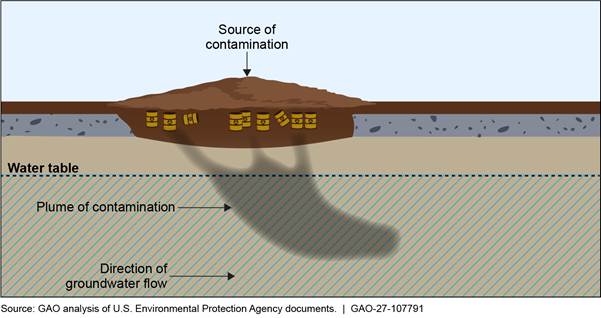
Similarly, at the Savannah River Site, DOE has determined that the site should remain under federal control in perpetuity, meaning that the groundwater on the site would remain inaccessible for drinking water purposes. Nonetheless, because the groundwater at the site is classified as a potential source of drinking water, DOE is required to clean contaminated groundwater to meet drinking water standards.[71] Experts generally told us that at sites like Savannah River, where DOE has long-term nuclear research and production missions that extend beyond DOE’s cleanup mission, cleaning up groundwater to meet drinking water standards is unnecessarily costly given DOE’s plans to maintain control of the land, and thus control of the groundwater, in perpetuity. However, EPA and state regulatory officials told us that one consideration affecting groundwater cleanup levels is that groundwater may flow off the DOE site and affect adjacent groundwater or surface water. We reported in November 2024 that Savannah River Site officials estimated that groundwater cleanup projects would cost $2.2 billion through 2065, with an additional estimated $1.4 billion in overall program management costs for both groundwater and soil cleanup.[72]
Unachievable Future Groundwater Uses
In an area of the Hanford Site’s Central Plateau, DOE has agreed to clean up contaminated groundwater to drinking water standards, but use of this groundwater for drinking water is unlikely to be achievable given the continued presence of iodine-129 (see fig. 9).
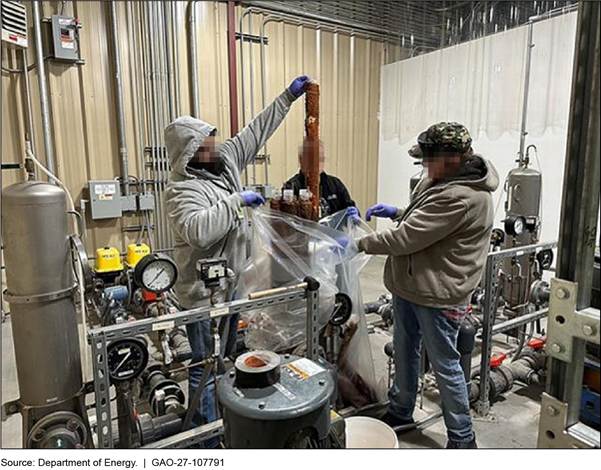
Iodine-129 is a long-lived radioactive contaminant—it has a half-life of 15.7 million years—and is particularly challenging to remove.[73] As we reported in November 2024, DOE has found that it is technically impracticable, from an engineering perspective, to achieve the drinking water standard applicable to iodine-129 in this groundwater area.[74] Based on these findings, DOE is seeking a waiver of this standard from EPA.[75] EPA officials told us that, even if DOE receives the waiver and is no longer required to meet the drinking water standard applicable to iodine-129, the waiver would be specific only to the standard for iodine-129 and would not apply to the other seven contaminants that co-mingle with it.[76] Thus, EPA officials said that DOE would likely need to continue pumping and treating the groundwater because the cleanup will still need to achieve drinking water standards for the seven co-mingled contaminants—even though the water will not be available as a drinking water source for the foreseeable future because of the iodine-129 contamination.
Experts generally told us that cleaning an aquifer to drinking water standards for some—but not all—contaminants does not make sense because the water will not be drinkable unless all contaminants are cleaned up. They said that such efforts can increase the costs and time required for cleanup without providing comparable reduction in human health risks. In this groundwater area at the Hanford Site, DOE officials told us that the site spent about $73 million from 1995 to 2024 remediating this plume and that it plans to spend an additional estimated $41 million by 2037.
EPA and DOE May Not Make Realistic Assumptions About Future Land Use Due to Insufficient Guidance
As noted above, assumptions about the potential future uses of DOE’s cleanup sites can have significant implications for the nature of the cleanup, and its cost and schedule. In light of this, 13 of the 14 experts we polled during our expert meetings recommended that EPA and DOE improve the framework for making these assumptions at DOE cleanup sites to help ensure they are transparent, realistic, and support the selection of cost-effective cleanup approaches.
The current framework for incorporating assumptions about future land use into the cleanup process consists primarily of EPA guidance. DOE generally relies on this guidance when making assumptions about future land use during the cleanup process at DOE’s sites. EPA has issued three guidance documents on how to factor assumptions about future land use into the CERCLA cleanup process, which—according to EPA officials—can also be used for RCRA corrective actions.[77] The guidance discusses what considerations should go into selecting a reasonably anticipated future land use and emphasizes that the reasonably anticipated future land use should be realistic and allow for the development of cost-effective and practicable cleanup alternatives.
EPA’s guidance generally encourages considering the reasonably anticipated future land use early in the cleanup process—for example, early in the remedial investigation phase of the CERCLA process—and then proceeding under that anticipated future use throughout the remainder of the process.[78] For example, in our case studies, DOE selected a single anticipated future land use early in the process before cleanup began. This led DOE to only evaluate cleanup alternatives that were able to support the single selected potential future land use, thereby excluding from further consideration alternative cleanup approaches only possible under other future land use assumptions (see fig. 10).[79]
Figure 10: Example of How Reasonably Anticipated Future Land Use Can Affect the Cleanup Approaches Considered and Selected Under the CERCLA Cleanup Process
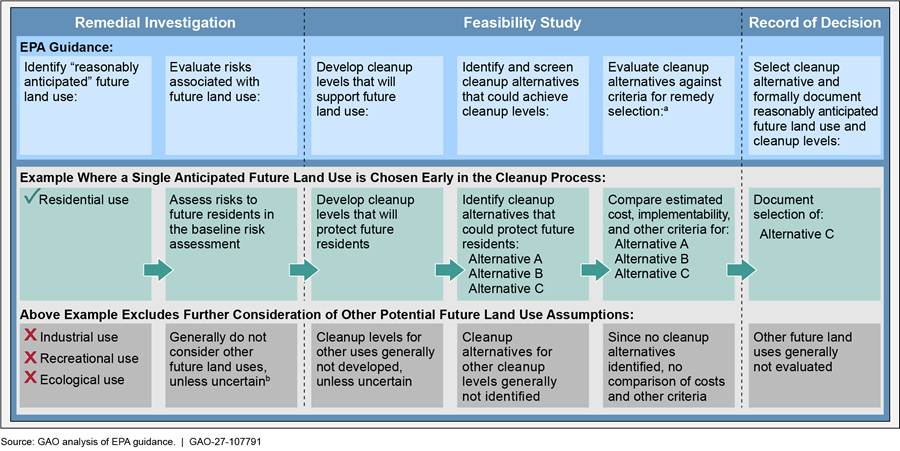
Note: See figure 12 in appendix II for descriptions of the activities in the Comprehensive Environmental Response, Compensation, and Liability Act of 1980, as amended (CERCLA), cleanup process.
aThe nine criteria for remedy selection under CERCLA include (1) overall protection of human health and the environments; (2) compliance with applicable or relevant and appropriate requirements; (3) long-term effectiveness and permanence; (4) reduction of toxicity, mobility, or volume through treatment; (5) short-term effectiveness; (6) implementability; (7) cost; (8) state acceptance; and (9) community acceptance. 40 C.F.R. § 300.430.
bU.S. Environmental Protection Agency (EPA) guidance provides that, when there is uncertainty about the potential future land use, multiple future land use assumptions should be considered in (1) the baseline risk assessment, (2) when developing cleanup levels, and (3) when identifying potential cleanup approaches. However, the guidance does not define what constitutes uncertainty. EPA, Land Use in the CERCLA Remedy Selection Process, OSWER Directive No. 9355.7-04 (1995).
For example, DOE’s early selection of the reasonably anticipated land use for a disposal area with transuranic waste at the Idaho National
|
Future Land Use Assumption at Idaho National Laboratory Disposal Area For cleanup at the Idaho National Laboratory’s Subsurface Disposal Area, the Department of Energy (DOE) assumed the land would be used for industrial purposes in the future and evaluated risks to human health and the environment associated with industrial use for 100 years. DOE also considered risks associated with residential development adjacent to the Subsurface Disposal Area beginning in the year 2110. DOE determined exposure to long-lived radionuclides like plutonium-239 at the surface level represented the greatest carcinogenic risk. Next, during the feasibility study phase for the Subsurface Disposal Area, DOE developed cleanup levels that would protect human health and the environment assuming a degree of exposure to contaminants at the site commensurate with an industrial land use. DOE then evaluated four cleanup approaches that would be able to meet the cleanup levels based on the industrial future land use assumption, including potentially removing all the waste from the disposal area. All four cleanup approaches included the long-term use of a surface barrier, which would cover the disposal area to prevent water infiltration and minimize movement of the remaining contamination. The record of decision formally documented the industrial land use assumption and selected a cleanup approach that combined aspects of three of the four cleanup approaches evaluated—excluding the full removal of waste approach. Ultimately, these DOE decisions all supported the initially selected anticipated future land use and did not consider other potential future land uses, such as ecological or recreational. As a result, decision-makers did not evaluate the costs and schedules of cleanup based on other potential future land use options. Source: GAO analysis of regulatory documents and DOE information. | GAO‑27‑107791 |
Laboratory—referred to as the Subsurface Disposal Area—cascaded throughout the CERCLA cleanup process (see sidebar).[80]
According to our case studies and experts in our meetings, future land use assumptions vary substantially across and within DOE’s cleanup sites, and DOE may not always sufficiently consider if the anticipated future land use selected is realistic and allows for the development of cost-effective and practicable cleanup options. Experts generally said there is not a formal process defining when and how DOE should determine if a potential future land use is realistic.
EPA officials told us that they expect that DOE will consider if the reasonably anticipated future land use is realistic as part of its remedial investigation and feasibility study, such as when evaluating cleanup alternatives using the National Contingency Plan’s nine criteria for remedy selection.
However, in our case studies of disposal areas with transuranic waste at DOE cleanup sites, we observed that DOE’s cleanup alternatives identified in the feasibility study supported a single future land use assumption and were evaluated relative to each other. Thus, viable cleanup approaches associated with potential land uses other than the single selected anticipated future land use were not considered, and the cost differences are unknown. Without such a consideration, it is unclear how DOE would have determined if the underlying future land use assumption was realistic or supported a cost effective and practicable cleanup approach, as EPA guidance calls for.[81]
EPA guidance does not specifically state that objectives and alternatives to support multiple potential future land use assumptions should generally be developed and their costs evaluated as part of the cleanup process. Nor does the guidance provide a general description of how—absent such an evaluation—agencies should determine and document that the selected future land use assumption is realistic and allows for development of cost-effective and practicable cleanup alternatives.
Instead, EPA guidance provides that, when there is uncertainty about the potential future land use, multiple future land use assumptions may be considered (1) in the baseline risk assessment, (2) when developing cleanup objectives, and (3) when identifying potential cleanup approaches. However, the guidance does not define what constitutes uncertainty, and DOE and EPA do not compile data on how often multiple future land assumptions are considered in these various phases. For example, as discussed above, DOE appears to have faced significant uncertainty in making the future land use assumption at Hanford’s 618-10 burial ground. Despite switching from an assumption of future industrial use to future residential use after the issuance of the interim record of decision, in its 2013 feasibility study and final record of decision, DOE did not evaluate cleanup approaches based on other potential future land assumptions for 618-10, or the costs associated with those other cleanup approaches.
One expert said, for DOE cleanup sites, the future land use “decision and the cost of that decision should be clear” before selecting the cleanup approach, and another expert added that agencies should be “fully understanding what the implications” of these assumptions are. In addition, according to DOE officials, it is difficult to calculate the cost differences among cleanup options based on different potential future land uses after they have gone through the cleanup process using only
|
Future Land Use Assumptions at the Rocky Flats and Fernald Sites
One expert told GAO that the future land use decisions and assumptions at the Department of Energy’s (DOE’s) Rocky Flats Site in Colorado and Fernald Site in Ohio were paramount to successful cleanup and closure. Specifically, early in the cleanup process at Rocky Flats—a site that produced plutonium pits for nuclear weapons—DOE evaluated the expected cleanup cost to allow for residential use as over $22 billion. Uncertainty and disagreement about the site’s potential future use posed a major challenge to DOE in progressing with the cleanup. In 2001, Congress intervened with the passage of a law establishing that Rocky Flats would be used as a national wildlife refuge. This declaration of the future use of the land primarily drove the costs of cleanup down to $10 billion. Another expert said the community accepted this new future land use in part because it understood the cost implications of other uses. DOE completed cleanup at Rocky Flats in 2005. At the Fernald Site—which produced high-purity uranium for nuclear weapons—DOE evaluated cleanup approaches associated with multiple future land uses in the feasibility study. A DOE report attributed consideration of multiple future land uses as a significant reason for cost savings of over $3.6 billion through using a more realistic future land use assumption—restricted, non-farming use. DOE completed cleanup at Fernald in 2006. Sources: GAO analysis of laws, DOE documents, and expert statements; DOE (photo). | GAO‑27‑107791 |
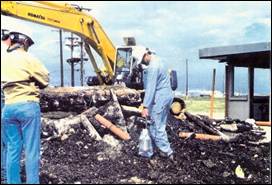
cleanup levels that support the initially selected future land use assumption. Similarly, EPA’s National Remedy Review Board—which consults and advises on some of the most complex cleanup decisions under CERCLA—previously recommended that DOE compare the cost of multiple potential future land uses when the use was potentially a significant cost driver at Idaho National Laboratory.[82]
As discussed above, assumptions about future land use can have significant cost and schedule implications for DOE cleanup (see sidebar on cost savings at two closed sites). Evaluating and documenting the expected costs and schedule of cleanup associated with multiple potential future land uses could be particularly fruitful when DOE sees potential for substantial cost or schedule benefits using a future land use assumption other than the one initially selected. This action would be in line with general views from the experts at our meetings and the inherent uncertainties of future land use assumptions. Conducting such an evaluation before selecting a cleanup approach, such as by incorporating multiple potential future land uses in DOE’s development of cleanup levels and approaches, could help DOE ensure the selected cleanup approach is informed by a realistic future land use assumption and thereby prevent unnecessarily high costs and delays in completion of cleanup.
Additional guidance or clarification from EPA on incorporating future land use assumptions at DOE cleanup sites could also help DOE adopt a more consistent approach to cleanup across its remaining sites.[83] Such additional guidance or clarification could also better ensure that the anticipated future land use assumption used by DOE during the cleanup process has the characteristics described in existing EPA guidance. For example, guidance on how and when DOE cleanup sites should consider whether the anticipated future land use is (1) realistic and (2) supports the development of cost-effective and practicable cleanup options would help DOE. Similarly, additional guidance could help DOE determine whether there is sufficient uncertainty to warrant consideration of multiple future land uses at later stages in the cleanup process, such as at stages where alternative cleanup options are being considered and evaluated.
Congressional Intent Regarding the Role of Future Land Use Assumptions in DOE’s Cleanup Process Is Unclear
While additional EPA guidance could help ensure DOE and regulators are more fully considering the tradeoffs of cleanup approaches based on multiple future land use assumptions, EPA is explicit that it retains “the discretion to adopt approaches that differ from [its] guidance.”[84] Therefore, even if DOE more fully considers the tradeoffs of cleanup approaches based on multiple future land use assumptions going forward, EPA and other interested parties may still push for a more stringent future land use assumption—and associated cleanup levels—regardless of whether it is practical or realistic, or what the associated cost is. We recommended in 1994 that—if Congress agreed with DOE’s and EPA’s plans to utilize land use planning as part of the cleanup process—Congress could consider amending CERCLA to provide more specific direction about incorporating future land use when determining cleanup levels and selecting remedial actions.[85] One expert at our meetings similarly said that specific congressional action could help ensure cleanup approaches at DOE sites are not based on unrealistic future land use assumptions.
In 1994, we found that CERCLA does not specifically address how to determine and incorporate possible future land uses into cleanup decisions.[86] Two years after that report, the National Defense Authorization Act for Fiscal Year 1997 directed DOE to develop a future land use plan for four of its cleanup sites and authorized DOE to develop such plans for other cleanup sites.[87] A U.S. House of Representatives report accompanying the act explained that the purpose of this requirement was in part to support improved decision-making and priority-setting for cleanup efforts.[88] The report outlined an expectation that reaching agreement about anticipated future land use with local authorities would result in DOE cleanup approaches that were appropriate for that anticipated future use. In response to the act, DOE developed future land use plans for seven sites and adopted them starting in the late 1990s.
However, the future land use assumptions made by DOE and its regulators as part of the cleanup process at DOE sites have not always matched DOE’s actual future land use plans for these sites. As we reported in October 2026 and discussed above, at large portions of the Hanford Site and Idaho National Laboratory, the future land use assumptions made as part of the cleanup process were not aligned with DOE’s land use plans and may increase the costs and time of cleanup.[89] The gap between DOE’s congressionally mandated land use plans and future land use assumptions made during the cleanup process primarily relate to the following:
· Which agency should select the reasonably anticipated future land use is unclear. For National Priorities List sites—which includes most of DOE’s CERCLA sites—CERCLA authorizes EPA to select the final cleanup approach, in the event that DOE and EPA disagree. In light of EPA’s authority, DOE sometimes defers to EPA regarding the selection of the future land use assumption during the cleanup process. However, in 2015, the Omnibus Risk Review Committee—a congressionally directed effort to evaluate DOE’s cleanup mission—found it is not clear that EPA’s authority to select the final cleanup approach means that EPA also has authority to select the inputs that inform what cleanup approaches are considered, such as the future land use assumption.[90]
In our review of case study information, we found differences among EPA regions in how regulators view their role regarding future land use assumptions made during the cleanup process. For example, EPA Region 4 officials, who oversee cleanup at the Savannah River Site and Oak Ridge Reservation, among other DOE cleanup sites, told us that defining the anticipated future land use during cleanup is DOE’s role, not EPA’s. They said that EPA supports whatever DOE decides, as long as the proposed anticipated land use is generally in line with factors like zoning, land use plans, and residual risk that may remain after cleanup. In contrast, in EPA Region 10, where the Hanford Site and Idaho National Laboratory are located, EPA officials told us that the lead regulatory agency has authority to make the final decision about future land use assumptions. For example, at Hanford’s 618-10 burial ground, EPA’s preference for a residential future land use assumption was ultimately adopted over DOE’s preference for an industrial future land use assumption.
· Different preferences between DOE and regulators. According to our case studies, the literature we reviewed, and experts, in some cases, regulators prefer to use more conservative future land use assumptions—such as residential use, rather than industrial use—than DOE. EPA guidance directs agencies like DOE to “assume future residential land use if it seems possible” when assessing risks but also acknowledges that EPA has been criticized for “often assuming that future uses will be residential.”[91] In addition to EPA, state regulators similarly may prefer more conservative future land use assumptions than DOE and assert that preference, even when they are not the lead regulator, as is generally the case when cleanup occurs under CERCLA at National Priorities List sites. For example, an EPA analysis of federal cleanup sites that used a residential future land use assumption during cleanup found that “state regulators play a significant role in determining cleanup levels at [CERCLA] sites” and played a major role in making the residential future land use assumption in eight of the 20 sites included in a sample.[92] As discussed, DOE found in its land use planning efforts that less intensive cleanup using an ecological or industrial future land use assumption was sometimes suitable. According to literature, past GAO reporting, and experts, it is likely not realistic or cost-effective to clean up many areas at DOE sites to support possible future residential use.[93]
As discussed above, the future land use assumption is a significant driver of the eventual cleanup approach because it helps answer “how clean is clean” for a particular area. Congress’ 1996 authorization and direction to DOE to develop future land use plans did not include information about how, if at all, such plans should be incorporated into the cleanup process. By clarifying how future land use assumptions should be incorporated into the cleanup process at DOE sites—in particular, by clarifying the roles and decision-making authority of DOE, EPA, and state regulators regarding the anticipated future land use—Congress could help prevent further disagreements among the entities. In addition, by clarifying what types of potential future land use assumptions are acceptable or preferred to consider, Congress can help ensure DOE sites are incorporating anticipated future land use into the cleanup process in a manner that Congress finds appropriate.
DOE Has Not Successfully Applied Regulatory Flexibilities to Groundwater Cleanups and Some Standards Applied to Groundwater Cleanups Are Outdated
Experts in our meetings generally said that requirements to clean groundwater at DOE sites to drinking water standards can add costs and time to DOE’s cleanup without providing commensurate reduction in risk, particularly in areas where the groundwater is unlikely to be used for drinking water. For example, experts said that the large size of DOE sites and level of contamination can make cleaning up groundwater to these standards technically challenging and costly. As a result, if a source of groundwater is unlikely to be used for drinking and flows under land that will remain under federal control, experts said that cleaning up groundwater to drinking water standards is not cost-effective. Experts identified two ways to achieve more cost-effective, risk-informed groundwater cleanup: (1) using available regulatory flexibilities and (2)
|
The Role of Point of Compliance in Cleanup The Department of Energy (DOE) and regulators measure progress toward meeting groundwater cleanup levels at a specific location within an aquifer known as a “point of compliance.” The point of compliance is the location in groundwater where monitoring data should show that contaminant levels comply with established cleanup levels. DOE may engage with regulators to determine the appropriate point of compliance for a given cleanup. For example, depending on the situation and relevant legal and regulatory requirements, the point of compliance may be set to throughout a contaminated groundwater plume, or at or beyond the edge of a waste management area. According to DOE, the point of compliance location has a substantial bearing on how extensive a cleanup needs to be to achieve cleanup levels, with points of compliance at the edge of a plume generally requiring less extensive cleanup approaches than those required for points of compliance throughout a plume. For example, for groundwater contaminated by a 4-acre burial ground at the Hanford Site, DOE and regulators set the point of compliance throughout the contaminated plume. DOE officials told GAO that this point of compliance contributed to a decision to fully exhume the burial ground’s waste. Had the point of compliance instead been located at the edge of the plume, DOE may have left the waste in place and installed a protective cap over it, according to DOE officials. Sources: Regulatory and guidance documents; interviews with DOE officials. | GAO‑27‑107791 |
addressing outdated standards that can apply to groundwater cleanup of iodine-129 and a set of similar contaminants.
For cleanups taking place under CERCLA and RCRA—due to the intersection of several federal laws—when groundwater has been designated by EPA or the states as an actual or potential source of drinking water, DOE is often required to clean up the contaminated groundwater to meet drinking water standards at a point of compliance (see sidebar). Specifically:
· CERCLA. Under CERCLA, EPA typically requires groundwater classified as an actual or potential source of drinking water to be cleaned up to meet drinking water standards established under the Safe Drinking Water Act.[94] The National Contingency Plan establishes an expectation to “return usable ground waters to their beneficial uses wherever practicable, within a timeframe that is reasonable given the particular circumstances of the site.”[95]
· RCRA. For cleanups taking place under RCRA, EPA guidance similarly states that cleanups “return usable groundwater to its maximum beneficial use wherever practicable within a timeframe that is reasonable given the particular circumstances of the facility.”[96] Maximum beneficial use is frequently drinking water.[97]
Experts in our meetings generally told us that EPA and states often default to designating groundwater as an actual or potential source of drinking water, sometimes without detailed analysis of the likelihood of the groundwater being used for that purpose. For example, according to South Carolina state regulators, state regulations designate all groundwater as a potential source of drinking water.[98] Information about how the land may be used in the future is not considered when making groundwater classifications, according to EPA’s 2009 guidance on groundwater restoration at CERCLA sites.[99] In accordance with this guidance, EPA and state regulatory officials told us they do not consider how DOE plans to use the land overlying groundwater when setting groundwater cleanup levels. For example, at Idaho National Laboratory’s Subsurface Disposal Area, the land will be used as a waste management area for the foreseeable future, but groundwater underneath must be cleaned up to meet drinking water standards. EPA officials told us that one reason future land use is not considered when making groundwater use designations is because groundwater contaminants can migrate and affect drinking water sources outside of a given cleanup area.
Use of Available Regulatory Flexibilities
Experts in our meetings generally said that one way to achieve more cost-effective, risk-informed groundwater cleanup is to use regulatory flexibilities that are available as part of the cleanup process.[100] These flexibilities include:
· Technical impracticability waivers. For CERCLA cleanups where it is technically impractical to meet cleanup standards, DOE may seek a waiver from EPA of certain requirements, such as drinking water maximum contaminant levels.[101] Technical impracticability waivers are contaminant- or area-specific waivers that would allow sites to implement an alternative clean up strategy when compliance with the requirement is technically impracticable from an engineering perspective. EPA has criteria for obtaining these waivers, including consideration of whether cleanup is “inordinately costly” or unable to be attained “within a reasonable timeframe.”[102] EPA officials told us that sites with technical impracticability waivers must still have measures in place to protect human health and the environment, such as institutional controls restricting access to the groundwater or containment methods to prevent contaminated groundwater from migrating.
· Alternate concentration limits. CERCLA and RCRA regulations provide authority for EPA and authorized states (in the case of RCRA) to establish alternate concentration limits in place of certain standards that otherwise apply to groundwater cleanups.[103] An EPA policy memo describes several factors that EPA should consider to use alternate concentration limits under CERCLA, including, for example, whether contaminated groundwater discharges to surface water and whether enforceable measures can be implemented to preclude human consumption of contaminated groundwater and ensure that there would be no exposure to contaminants above health-based levels.[104] RCRA regulations for permitted hazardous waste facilities include provisions that allow for alternate concentration limits for cleanup of releases of hazardous constituents to groundwater from regulated units in certain circumstances.[105] For example, these regulations provide that alternate concentration limits may only be considered if the hazardous constituent will not pose a substantial present or potential hazard to human health or the environment as long as the alternate concentration limit is not exceeded.[106]
Experts in our meetings generally said that DOE is not maximizing opportunities to apply for available regulatory flexibilities, and that the amount of flexibility granted to DOE is generally minimal. For instance, they said that, compared with DOE, other federal entities like the Department of Defense have more frequently pursued and been granted waivers for cleanups being conducted under CERCLA. One expert said that in their work with EPA, they observed a “night and day difference” between DOE’s and the Department of Defense’s pursuit of waivers. According to data provided by EPA, EPA issued 16 technical impracticability waivers to federal facilities between 1988 and 2024, all of which were to Department of Defense facilities. Experts said that when groundwater cleanup is estimated to require very long timeframes or significantly high cost, DOE and regulators should consider applying regulatory flexibilities. They generally noted that groundwater cleanup is often the driver of a site’s estimated cleanup completion date because cleaning up groundwater to meet drinking water standards can take decades or longer. For example, cleaning up groundwater in some areas of the Hanford Site to meet drinking water standards is expected to take more than 100 years.[107]
We identified that DOE’s groundwater remediation efforts had limited past use of technical impracticability waivers and alternate concentration levels. Across all of its cleanup sites, DOE has applied for one technical impracticability waiver—the one for iodine-129 groundwater cleanup in an area at the Hanford Site, described above. DOE applied for this waiver in 2024, following 13 years of collecting data and evaluating available technologies for cleaning up iodine-129. In February 2026, EPA officials told us that the process of evaluating this potential technical impracticability waiver is on hold until DOE fully characterizes and controls the sources of iodine-129 contamination in Hanford’s Central Plateau area. DOE officials at several sites where we conducted case studies told us that alternate concentration levels are not currently in place, but that such levels could help DOE achieve groundwater cleanup in a manner that is faster while still being protective of human health and the environment.
There are several reasons why DOE has not pursued or been granted these flexibilities for groundwater cleanup. Broadly, experts told us that DOE and EPA have not systematically evaluated opportunities to pursue flexibilities that would enable more cost-effective, risk-informed groundwater cleanup.[108] DOE officials also said that EPA and state regulators differ in their willingness to consider or use flexibilities. We identified additional reasons why specific flexibilities are not widely used at DOE cleanup sites based on input from experts and our review of literature and case study information (see table 2).
Table 2: Flexibilities for Groundwater Remediation and Reasons They Are Not Widely Used at Department of Energy (DOE) Nuclear Waste Cleanup Sites
|
Cleanup flexibility and description |
Reasons they are not widely used |
|
Technical impracticability waivers Contaminant- or area-specific waivers that allow sites to implement an alternative clean up strategy when compliance with a particular standard is technically impracticable, from an engineering perspective. |
· Many years of monitoring data may be required to demonstrate the basis for a waiver. For example, DOE collected data for 13 years to demonstrate the need for a waiver of certain standards applicable to the cleanup of iodine-129 in groundwater at the Hanford Site. · There is no defined threshold for determining whether cleanup is “inordinately costly” or can be completed “within a reasonable timeframe,” two of the considerations for obtaining waivers.a · Waivers are generally applied for and granted for a particular unit or area of contamination, including for the same contaminant at the same site.b |
|
Alternate concentration limits Alternatives to certain standards that otherwise apply to groundwater. |
· EPA issued a policy memo in 2005 on the application of alternate concentration limits under CERCLA. According to one expert with expertise in groundwater cleanup, the memo effectively eliminated the use of this flexibility.c · Some state regulators do not use or consider alternate concentration limits under their authorized RCRA programs. For example, South Carolina and Washington state regulatory officials told us they do not consider alternate concentration limits as an option for groundwater cleanups. |
Legend:
CERCLA = Comprehensive Environmental Response, Compensation, and Liability Act of 1980, as amended
RCRA = Resource Conservation and Recovery Act of 1976, as amended
Sources: GAO analysis of expert meetings transcripts, EPA guidance documents, and interviews with DOE and regulatory officials at case study sites. | GAO‑27‑107791
aThese considerations are articulated in U.S. Environmental Protection Agency (EPA) guidance. See: U.S. Environmental Protection Agency, Guidance for Evaluating the Technical Impracticability of Ground-Water Restoration (Washington, D.C.: September 1993). According to this guidance, EPA's decisions about technical impracticability waivers should focus primarily on the technical capability of achieving a cleanup level, with cost playing a subordinate role.
bDuring cleanup, a site can be divided into distinct areas, or operable units, depending on the complexity of the problems associated with the site. Operable units may address geographic areas of a site, specific site problems, or areas where a specific action is required.
cU.S. Environmental Protection Agency, Memorandum: Use of Alternate Concentration Limits (CLs) in Superfund Cleanups (Washington, D.C.: July 19, 2005). The memo states that the alternate concentration limit provision in CERCLA is directed at standards that are “otherwise applicable for hazardous constituents in groundwater.” It says that federal or state maximum contaminant levels established under the Safe Drinking Water Act generally are not “applicable” requirements but are instead considered to be “relevant and appropriate.” According to EPA officials, because groundwater cleanup levels are often based on such “relevant and appropriate” requirements, they cannot be replaced with “applicable” requirements such as alternate concentration limits.
Addressing Outdated Standards for Iodine-129 and Other Contaminants
Twelve out of 14 experts we polled during our expert meetings recommended addressing outdated standards that can apply to the cleanup of iodine-129 and other contaminants that are beta-emitting radionuclides in groundwater. In addition to being at the Hanford Site, iodine-129 is present in contaminated groundwater at the Savannah River Site. Groundwater at these and other DOE cleanup sites is also contaminated with other beta-emitting radionuclides, such as technetium-99 and tritium.
As discussed above, cleanup of groundwater at DOE sites is often required to meet drinking water standards set under the Safe Drinking Water Act. While these standards actually apply to the public water systems that provide drinking water to most Americans, they are regularly used as cleanup levels for contaminated groundwater at DOE sites. Under EPA’s drinking water regulations, the average annual concentration of beta particle and photon radioactivity from man-made radionuclides—including iodine-129—in drinking water must not produce an annual dose equivalent to the total body or any internal organ greater than 4 millirem per year (mrem/year).[109] Under this standard, EPA determined that the maximum allowable concentration of iodine-129 in drinking water is 1 picocurie per liter (pCi/L).[110]
However, EPA’s determination of the allowable concentration of iodine-129 and other beta-emitting radionuclides in drinking water is based on scientific research that was conducted more than 60 years ago. Specifically, EPA derived the concentration limits for beta-emitters (like iodine-129) in drinking water using health physics methodologies and assumptions that were last updated in 1963. By regulation, EPA is required to use these methodologies and assumptions.[111] EPA officials said that the methodologies used to establish these limits have been superseded with more recent and scientifically robust methodologies, and experts told us that these limits are now considered outdated. Further, research from the Pacific Northwest National Laboratory published in 2020 showed that the allowable concentration of iodine-129 and other beta-emitting radionuclides in drinking water could be increased while still meeting the relevant drinking water standard—which limits the dose of radioactivity to the body.[112] For example, the Pacific Northwest National Laboratory research showed that the allowable concentration of iodine-129 in drinking water could be increased from 1 pCi/L to 13 pCi/L while remaining under the 4 mrem/year dose limit allowed by the relevant drinking water standard.[113]
In 1991, EPA proposed a revision to its regulations under the Safe Drinking Water Act that would have resulted in an increase to the allowable concentrations of beta-emitting radionuclides—including iodine-129—in drinking water based on new science.[114] The proposal would have increased the allowable concentration of iodine-129 in drinking water from 1 pCi/L to 21 pCi/L. However, in 2000, the agency announced that it had determined that for some beta-emitting radionuclides, the associated risks to human health would be too high, and that the agency would maintain the existing drinking water standard for beta-emitting radionuclides.[115]
EPA officials told us that they are aware of the 2020 research from Pacific Northwest National Laboratory and have discussed it with DOE. In a 2003 court case, EPA stated that it interpreted a provision in the Safe Drinking Water Act known as the “anti-backsliding rule” as prohibiting the agency from raising the limits for man-made beta-emitting radionuclides in drinking water, even if the level of protection being achieved is greater than the level the agency initially sought to provide when setting the limit—as is the case for iodine-129.[116] EPA officials told us that the agency does not have a current position on whether increasing the allowable concentration of iodine-129 and other beta-emitters in drinking water would conflict with the anti-backsliding provision of the Safe Drinking Water Act. They told us that, as required by the Safe Drinking Water Act, the agency reviews and revises, as appropriate, drinking water standards, including those for man-made beta-emitting radionuclides, every 6 years.[117] EPA most recently reviewed the standards in 2024 and found that the drinking water standard for beta particle radioactivity from man-made radionuclides was not appropriate for revision at that time due to a health effects assessment that was in process.[118] Specifically, the review noted that EPA’s Office of Air and Radiation is conducting a review of beta-emitting radionuclides. EPA officials told us that, as of June 2026, this review is ongoing.
DOE officials and experts told us that updating the cleanup levels for iodine-129 in groundwater, to the extent allowed under the relevant cleanup laws, to reflect current scientific research would reduce the amount of groundwater that needs to be cleaned up at the Hanford and Savannah River sites.[119] For example, one expert with expertise in groundwater told us that applying a 13 pCi/L cleanup level for iodine-129 in the groundwater at Hanford could mean that up to 80 percent of the existing plume would not require cleanup. Similarly, DOE officials at the Savanah River Site said that, under a 13 pCi/L cleanup level for iodine-129 in the groundwater, several groundwater plumes currently undergoing cleanup would already meet the level. The amount of groundwater cleanup of other beta-emitting radionuclides at DOE sites may also be reduced if DOE were able to use groundwater cleanup levels based on more recent science.
DOE’s Office of Environmental Management—which leads DOE’s nuclear cleanup efforts—has a program management protocol that states the office should lead risk-informed strategic planning and program development and use a risk-informed prioritization approach for its remaining cleanup work.[120] Moreover, GAO’s framework for risk-informed decision-making states that, to cost-effectively address risks to human health and the environment posed by environmental hazards, agencies need to use current scientific knowledge and practice and use the most up-to-date data when conducting analyses.[121] While cleanup levels for groundwater are often based on drinking water standards, other options may exist for safely cleaning up beta-emitters in groundwater at DOE’s sites. By developing options to ensure that, for groundwater cleanups, the cleanup levels for iodine-129 and similar radionuclides reflect the most up-to-date science, EPA and DOE may be able to facilitate faster and less costly cleanup of contaminated groundwater at Hanford and the Savannah River Site while achieving protection of human health.[122]
Experts Said Disagreements Between DOE and Regulators Can Stymie Cost-Effective and Timely Cleanup
Experts at the meetings we convened with the National Academies identified other aspects of the legal and regulatory framework that can be sources of disagreement between DOE and regulators and contribute to more costly and longer cleanup at DOE’s sites. All 14 experts we polled during our expert meetings recommended that DOE and EPA create a task force to review specific, high-priority cleanup decisions; ongoing cleanup processes; and areas of legal or regulatory conflict that are delaying cleanup and driving up costs. There are existing formal processes for addressing disputes between DOE and regulators in the context of individual cleanup agreements. However, according to experts, having a task force comprised of technical experts not involved in the decision-making could help produce more risk-informed and feasible cleanup decisions that allow DOE to more efficiently complete its cleanup mission.
Experts Said Other Aspects of Cleanup Can Lead to Disagreement, Higher Costs, and Longer Schedules
Experts in our meetings generally said other aspects of the legal and regulatory framework for nuclear waste cleanup—aside from concerns about states’ implementation of RCRA and future groundwater and land use discussed above—can be sources of intractable conflict and contribute to more costly and longer cleanup at DOE’s sites. In particular, experts highlighted: (1) the determination of Applicable or Relevant and Appropriate Requirements (ARARs) under CERCLA, (2) weighing of criteria for selecting a cleanup approach, and (3) implementation of site cleanup agreements. We discuss each below.
Disagreements over ARARs under CERCLA. Experts generally said that the determination of ARARs—substantive standards from federal and state environmental laws that a cleanup approach must meet—for a cleanup project under CERCLA can be a source of conflict among DOE, EPA, and state regulators and lead to increased cost and time for cleanup. Because ARARs are determined on a site-by-site basis, literature and experts indicated that it can be complex and challenging to determine what federal and state requirements should apply to cleanups as ARARs. As a result, disagreements can occur in making these determinations. For example, disagreement among DOE, EPA, and the State of Tennessee about whether to apply certain Clean Water Act requirements as ARARs for a proposed landfill at the Oak Ridge Site took about 8 years to resolve, and the resolution remains the subject of litigation from non-government organizations.[123] Moreover, ARARs are generally environmental standards that regulate exposure to contaminants in a wide array of situations (such as air emissions and drinking water) and are not specific to Superfund sites. Thus, the determination of which standards are ARARs does not necessarily consider a site’s specific risks, and ARARs may be highly costly or potentially infeasible to attain, such as in the case of iodine-129 in groundwater at Hanford discussed above.
Experts generally also noted that DOE sites and regulators may not always thoroughly evaluate the requirements that are selected as ARARs to determine whether they should apply to cleanup, as well as whether an ARAR waiver could be warranted.[124]
At our expert meetings, 11 out of 14 experts we polled recommended a policy option that would seek more risk-informed application of ARARs and more thorough consideration of relevant regulatory flexibilities. However, experts did not land on a more specific policy solution and cautioned against pursuing sweeping policy changes to how ARARs are generally determined for CERCLA cleanups. One expert said that it would be more feasible to address discrete issues, such as those associated with application of particular ARARs to a specific cleanup.
Disagreements over weighing criteria for selection of a cleanup approach. For CERCLA cleanups, DOE and regulators evaluate cleanup approaches using nine criteria that are outlined in the National Contingency Plan (see table 3).
|
Criteria Type |
Criteria |
EPA Guidance for Use |
|
Threshold |
Overall protection of human health and the environment |
Mandatory for a cleanup approach to meet. |
|
Compliance with Applicable or Relevant and Appropriate Requirements (unless waived) |
||
|
Balancing |
Long-term effectiveness and permanence |
Agencies should use their judgment to apply and weigh these criteria to appropriately balance trade-offs among cleanup options. |
|
Reduction of toxicity, mobility, or volume through treatment |
||
|
Short-term effectiveness |
||
|
Implementability |
||
|
Cost |
||
|
Modifying |
State acceptance |
Agencies should use their judgment to apply and weigh these criteria to appropriately balance trade-offs among cleanup options. |
|
Community acceptance |
Source: GAO analysis of U.S. Environmental Protection Agency (EPA) guidance and 40 C.F.R. § 300.430. | GAO‑27‑107791
While the threshold criteria must be met, EPA’s guidance provides that agencies should use their judgment to apply and weigh balancing and modifying criteria to appropriately balance trade-offs among cleanup options. According to EPA guidance, cleanups under RCRA should use a similar set of threshold criteria (including overall protection of human health and the environment) and balancing criteria (including implementability and cost) when evaluating corrective actions.
According to experts and our review of literature, some regulators may not place the same emphasis on balancing or modifying criteria, resulting in differences in how the criteria are applied to make trade-offs for cleanup decisions. Consequently, according to experts and literature we reviewed, differences in how DOE and regulators weigh criteria and trade-offs for particular cleanup decisions can be a source of conflict among DOE, regulators, and stakeholders and result in significant cost variability among cleanups. For example, in September 2025, we reported that the State of New Mexico and DOE have disagreed about how to weigh criteria for selecting a cleanup approach for a legacy DOE landfill (Material Disposal Area C) at Los Alamos National Laboratory, with the state’s prioritization of long-term effectiveness over cost leading it to propose selecting a cleanup approach that could cost almost $800 million more than DOE’s preferred approach.[125]
In general, experts said that, while they believe that the criteria used for selecting remedies are appropriate, there could be more consistency in how trade-offs are evaluated when weighing the criteria for some DOE cleanup decisions. Additionally, experts generally noted that some DOE cleanup decisions may not sufficiently consider all criteria or place enough emphasis on criteria that could play a key role in the decision, such as cost or community acceptance.
Disagreements over site cleanup agreements. Starting in 1989, DOE and state and federal regulators entered into numerous site-specific cleanup agreements that defined the scope of cleanup work and established milestones for coming into compliance with applicable environmental laws.[126] For certain agreements, DOE may face penalties for missing milestones, and DOE regularly seeks to renegotiate cleanup milestones that it is struggling to meet. Experts generally said that many of these agreements were made before the sites were assessed for the extent of contamination or when there were significant uncertainties regarding cleanup technology. Further, experts said that some of these agreements can include highly stringent or inflexible requirements that lead to higher cost and schedule. Experts generally noted that, in the time since some of the original requirements were determined in cleanup agreements, there have been significant advances in cleanup technology and disposal options for DOE waste. As a result, revisiting certain cleanup agreement provisions could lead to more cost-effective and timely cleanups, according to experts.
In general, experts said renegotiating cleanup agreements to better account for new information or technology can be a source of conflict between DOE and regulators. Experts noted that regulators, states, and local communities often expect DOE to meet existing cleanup agreements and may disagree with renegotiating certain requirements. In particular, experts said that there can be a lack of trust between DOE and local communities or that regulators may see DOE as trying to avoid meeting its cleanup commitments by trying to renegotiate requirements that it previously agreed to. Experts also noted that, at some point, regulatory decisions must be final in order to enable cleanup progress, which makes determining when to renegotiate DOE’s cleanup requirements challenging.
Experts Recommend an Interagency Task Force to Review Specific Cleanup Decisions and Areas of Disagreement
Experts in our meetings generally referred to the current framework for DOE’s nuclear waste cleanup as a “regulatory morass.” As discussed above, we identified several legal and regulatory factors that play a key role in cleanup decisions and can have significant effects on the cost and schedule of DOE’s cleanup of nuclear waste. These factors can also be sources of conflict between DOE and regulators (see sidebar on next page for example). Experts we polled during our meetings broadly agreed that those factors were significant in their impact and made several recommendations to address many of the legal and regulatory challenges and related decisions described above (see app. III & IV).
|
Disagreements on Cleaning Up the Chromium Plume at Los Alamos In 2004, hexavalent chromium—a hazardous contaminant—was discovered in groundwater samples taken from the regional aquifer under the Department of Energy’s (DOE) Los Alamos National Laboratory Site in New Mexico. The contamination originated from a nonnuclear power plant at the site, where workers periodically flushed water from cooling towers from 1956 to 1972. The contamination created a chromium plume at the edge of the site. In 2018, to prevent the plume from migrating off the site while deciding on a final cleanup approach, DOE implemented interim measures with the agreement of the State of New Mexico, which regulates and oversees the site’s cleanup under its hazardous waste program. The interim measures include a modified pump-and-treat system that involves extracting contaminated water from the ground, treating it, and reinjecting it. However, in November 2025, the state directed DOE to halt a component of the interim measures due to concerns about the measures’ effectiveness. The state and DOE have significant disagreements on whether the interim measures are causing the chromium contamination to spread. Moreover, New Mexico state officials told GAO they have concerns with DOE’s model for regulatory evaluation of the plume, which has slowed their ability to confirm the model. These disagreements have stalled progress toward developing a final cleanup approach. Additionally, DOE and the state do not have a shared vision on the final cleanup goals and approach that should be used for the plume. For example, state officials told GAO they expect DOE to clean up the groundwater to meet drinking water standards—in line with a cleanup agreement between DOE and the state which provides that cleanup levels for groundwater at the site shall be based on the water’s maximum beneficial use. However, DOE officials told GAO that, given the complexity of treating this contamination due to its depth—it extends about 1,000 feet below the ground’s surface—and the remote nature of the site, they would also like to consider alternative approaches that may not clean up the plume to drinking water standards. In 2023, GAO reported that the strained relationship between DOE and the state may increase cleanup scope, cost, and schedule—see GAO‑23‑105665. Sources: Interviews with DOE and state regulators, prior GAO reports, and regulatory documents. | GAO‑27‑107791 |
The most strongly supported policy option from the experts was for DOE and EPA to create an interagency task force focused on addressing specific, high-priority cleanup decisions, ongoing cleanup processes, and areas of legal or regulatory disagreement in order to achieve more risk-informed and cost-effective cleanup approaches at DOE sites. All 14 experts we polled during our expert meetings recommended this policy option.
Experts generally suggested that their proposed task force review—across the DOE cleanup complex—high-priority areas of legal and regulatory conflict pertaining to ongoing cleanup, or impasses where a cleanup decision has yet to be made, and then develop recommendations for DOE and EPA to implement (see fig. 11 on next page). Experts generally said the task force could improve the efficiency, consistency, cost-effectiveness, and timeliness of DOE’s cleanup and address what one expert called “a cost issue that’s out of control with the cost increasing every year.”
Figure 11: Overview of the Interagency Task Force Recommended by Experts That Would Be Co-Led by the Department of Energy (DOE) and the U.S. Environmental Protection Agency (EPA)
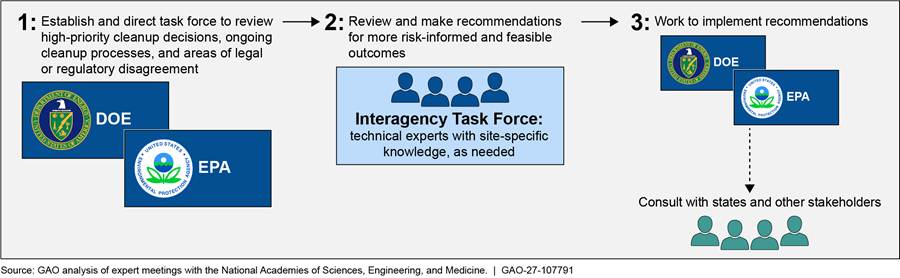
Experts generally suggested several key characteristics that would make the task force successful:
· DOE and EPA should establish and direct the standing task force, which should comprise technical experts who were not involved in the decision, process, or conflict being reviewed. The task force could include members with site-specific knowledge and consult with stakeholders and other government agencies, as needed. One expert said the task force should be “focused on being an arbitrator, being a decision-maker when there is a request for deviation, and being a peer reviewer.”[127]
· DOE and EPA should direct the task force to review and make recommendations addressing specific high-priority cleanup decisions, ongoing cleanup processes, and areas of legal or regulatory disagreement that are preventing cleanup approaches from being more risk-informed and cost-effective, including (1) existing commitments in cleanup agreements, (2) cleanup based on unrealistic future land and groundwater use assumptions, (3) opportunities to use available regulatory flexibilities, and (4) decisions related to other aspects of the legal and regulatory framework that can lead to conflict.
· Experts generally said DOE and EPA, when implementing task force recommendations, should seek local, state, and tribal input, as well as input from other agencies like the Nuclear Regulatory Commission, the Department of Defense, and the International Atomic Energy Association, as appropriate.
In 2015, the Omnibus Risk Review Committee recommended that Congress create a similar interagency task force co-led by DOE and EPA.[128] As of August 2026, Congress has not established such a task force. At our expert meetings, an expert who also served on that committee said that it is within DOE and EPA’s current authorities to establish a task force without congressional action. However, experts at our meetings generally said that congressional backing for a task force would be helpful, such as by supplying funding and increasing its ability to be productive. As one expert noted, efforts similar to such a task force have usually failed, and congressional backing could create a “forcing mechanism for change” to help overcome impasses between DOE and regulators.
While the 2015 committee recommended that the task force be composed of senior agency officials, experts at our meetings generally suggested the task force be composed of independent experts. This independence could offer new perspectives that avoid current biases and ensure resulting recommendations are technically and scientifically driven. Experts generally noted that DOE’s failure to meet some of its past commitments has reduced states’ trust in DOE. One expert said the task force could “communicate very effectively around issues that could be controversial but do it in an objective, scientific, and yet collegial manner.”
|
DOE and Regulators Still Determining Final Cleanup Levels at Oak Ridge As of June 2026, the Department of Energy (DOE) and regulators have not agreed on final cleanup levels for three burial grounds that contain transuranic (TRU) waste that was buried before 1970 and other contamination at the Oak Ridge Reservation in Tennessee. DOE and state regulators told GAO that difficult and potentially high-cost decisions, like for these Oak Ridge burial grounds, are often pushed to the end of a site’s cleanup. Initial disagreement between DOE and regulators about cleanup levels delayed action. In 2000, 9 years after the site’s primary cleanup agreement was signed, DOE and regulators agreed on an interim remedy to cover the burial grounds to help prevent human exposure and migration of the waste to surface water. Under the interim remedy, none of the TRU waste buried before 1970 was exhumed due to feasibility and cost concerns—at the time, exhuming this TRU and other waste was estimated to cost about $1 billion more than the agreed upon interim remedy. According to officials from DOE and the U.S. Environmental Protection Agency (EPA), this area is expected to be used as a waste management area for the foreseeable future. DOE officials told GAO that a final cleanup decision for these burial grounds hinges on DOE and regulators first reaching agreement about how to address groundwater contaminated by the burial grounds. EPA and state regulators told GAO they expect DOE to clean this groundwater to meet all applicable or relevant and appropriate requirements, which they expect to include meeting drinking water standards. However, DOE officials said that meeting these standards would require exhuming the burial grounds at enormous cost and with significant worker safety challenges. As a result of this impasse, DOE and its state regulator told GAO they have delayed making a decision about groundwater cleanup in this area until the 2040s. Sources: Interviews with DOE, EPA, and state regulators; GAO (analysis). | GAO‑27‑107791 |
Experts generally said one strength of such a task force is that it creates a clearer and more achievable path to cost savings and schedule reduction than more significant reform of the legal and regulatory framework, given the complexity and variety of stakeholder perspectives across DOE’s cleanup efforts that must be considered. In addition, experts generally noted that the federal interest in achieving more risk-informed decisions may not always align with states’ preferences. Specifically, experts generally said states have a substantial amount of authority over cleanup decisions and may primarily act to protect their own interests, such as by maximizing the level of cleanup that occurs without regard to cost. One expert also suggested that if states choose to set more stringent requirements than federal requirements, states should pay for the difference in cost needed to clean up to higher standards. Another expert noted that states, in practice, would likely not be able to pay this difference in cost.
DOE will continue to make significant cleanup decisions with regulators in the coming decades as cleanup continues (see sidebar). For example, we recently reported that at least nine nuclear waste streams across the DOE complex face barriers to disposal—barriers mostly tied to legal and regulatory constraints that span multiple sites and states.[129] Billions of taxpayer dollars hinge on forthcoming cleanup decisions about these and other waste streams. In a situation where disposal options are limited, these difficult remaining decisions are becoming more interconnected as DOE nears the end of its cleanup mission. One expert identified this task force as the “transformative” change needed to help address the more than half a trillion dollars of remaining cleanup for which DOE is responsible.
GAO’s framework for risk-informed decision-making regarding environmental hazards states that, to identify cost-effective approaches and achieve consensus among multiple decision-makers, a neutral and informed mediator can be useful.[130] Moreover, DOE’s Program Management Protocol states that the agency should take a risk-informed approach to prioritizing its cleanup work.[131] There are existing formal processes for addressing disputes between DOE and regulators in the context of individual cleanup agreements. However, according to experts, having an independent task force provide recommendations to DOE and EPA may help the agencies reconsider certain past decisions and produce more risk-informed and feasible cleanup decisions going forward that allow DOE to more efficiently complete its cleanup mission.
Conclusions
Within a complicated legal and regulatory framework for nuclear waste, DOE faces longstanding challenges with inconsistent cleanup approaches, disputes with regulators, and requirements that are sometimes technically unachievable. These factors have contributed to years of delays and billions in additional costs. Over the coming decades, DOE and its state and federal partners will continue to make consequential cleanup decisions within this complex framework that will shape the pace, affordability, and feasibility of cleanup across DOE’s sites.
Opportunities exist for Congress to clarify the boundary between federal and state authorities over nuclear waste cleanup, and for EPA and DOE to better ensure realistic cleanup decisions based on potential future land and groundwater uses and to resolve disputes using a coordinated, inter-agency structure:
· If Congress clarifies the scope of AEA preemption—and provides a formal mechanism for EPA to evaluate actions taken under authorized state RCRA programs that may improperly address radiological hazards—costly and resource-intensive legal disputes could be reduced and decision‑making could be accelerated.
· If Congress provides more direction, and EPA and DOE clarify or issue guidance, regarding how DOE should evaluate cleanup alternatives based on different potential future land uses in the cleanup process, DOE could be better positioned to select appropriate cleanup approaches that are aligned with congressional expectations and on-the-ground realities. Further, if EPA and DOE account for current scientific methods and information when identifying options for cleaning up radionuclides in groundwater such as iodine-129, the agencies may be able to achieve their cleanup mission while avoiding unnecessary expenditures.
· If DOE and EPA create an independent interagency task force as recommended by experts to help review high-priority cleanup decisions and processes, such as revising cleanup agreements, it could help DOE and EPA address specific legal and regulatory pain points, promote more consistency in DOE’s overall approach across sites, and better manage the more than half‑trillion‑dollar cleanup liability that remains.
Matters for Congressional Consideration
We are recommending the following three matters for congressional consideration:
Congress should consider clarifying the preemptive scope of the Atomic Energy Act of 1954, as amended, with respect to DOE’s nuclear waste cleanup and related activities. (Matter for Consideration 1)
Congress should consider creating a mechanism whereby DOE can appeal to EPA to evaluate cleanup or waste management requirements set for DOE by a state under an authorized RCRA hazardous waste program that may infringe on federal authorities over radiological materials, wastes, and hazards under the Atomic Energy Act of 1954, as amended. (Matter for Consideration 2)
Congress should consider providing more specific direction about incorporating potential future land uses in the process for DOE’s nuclear waste cleanup, including (1) what role DOE and regulators should play in making assumptions about future land use as a part of the cleanup process, (2) which federal agency or other entity should have the final decision about the anticipated future land use of a cleanup site, and (3) what types of potential future land use options are acceptable or preferred. (Matter for Consideration 3)
Recommendations for Executive Action
We are making the following six recommendations to DOE and EPA:
The DOE Assistant Secretary for Environmental Management should direct DOE cleanup sites to evaluate and document the expected costs and potential schedule associated with cleanup of a particular area based on multiple potential future land use assumptions when substantial cost or schedule benefits could potentially be achieved using a future land use assumption other than the one initially selected. This evaluation should occur prior to the selection of a cleanup approach for that area and be included as part of the decision-making process. (Recommendation 1)
The Administrator of EPA should clarify or provide additional guidance on considering reasonably anticipated future land use as part of the environmental cleanup process at DOE cleanup sites. Specifically, EPA should provide guidance on (1) how DOE should evaluate and document if an anticipated future land use is realistic and supports cost-effective and practicable cleanup alternatives, (2) when this evaluation should be done in the cleanup process, and (3) when multiple future land use assumptions should be incorporated at later stages in the cleanup process, such as at stages where alternative cleanup options are being considered and evaluated. (Recommendation 2)
The Secretary of Energy, in collaboration with EPA and other relevant federal agencies, as appropriate, should develop options that could allow DOE to clean up iodine-129 and other beta-emitting radionuclides in groundwater at DOE sites to levels that consider current scientific methods, and report those options to Congress along with plans to pursue them. (Recommendation 3)
The Administrator of EPA, in collaboration with DOE and other relevant federal agencies, as appropriate, should develop options that could allow DOE to clean up iodine-129 and other beta-emitting radionuclides in groundwater at DOE sites to levels that consider current scientific methods, and report those options to Congress along with plans to pursue them. (Recommendation 4)
The Secretary of Energy, in collaboration with EPA, should establish an interagency task force of experts focused on DOE’s nuclear waste cleanup to review high-priority site and project-level cleanup decisions, ongoing cleanup processes, and areas of legal or regulatory disagreement that are driving higher-than-expected costs and longer schedules and make recommendations for DOE and EPA to implement. (Recommendation 5)
The Administrator of EPA, in collaboration with DOE, should establish an interagency task force of experts focused on DOE’s nuclear waste cleanup to review high-priority site and project-level cleanup decisions, ongoing cleanup processes, and areas of legal or regulatory disagreement that are driving higher-than-expected costs and longer schedules and make recommendations for DOE and EPA to implement. (Recommendation 6)
Agency Comments and Our Evaluation
We provided a draft of this report to DOE and EPA for review and comment. In Table 4, we summarize how the agencies responded to our recommendations. Below, we expand on the agencies’ comments and provide our own responses, as appropriate.
Table 4: Department of Energy (DOE) and U.S. Environmental Protection Agency (EPA) Responses to GAO Recommendations in GAO-27-107791
|
GAO recommendation |
DOE response |
EPA |
|
Recommendation 1: The DOE Assistant Secretary for Environmental Management should direct DOE cleanup sites to evaluate and document the expected costs and potential schedule associated with cleanup of a particular area based on multiple potential future land use assumptions when substantial cost or schedule benefits could potentially be achieved using a future land use assumption other than the one initially selected. This evaluation should occur prior to the selection of a cleanup approach for that area and be included as part of the decision-making process. |
Non-concur |
- |
|
Recommendation 2: The Administrator of EPA should clarify or provide additional guidance on considering reasonably anticipated future land use as part of the environmental cleanup process at DOE cleanup sites. Specifically, EPA should provide guidance on (1) how DOE should evaluate and document if an anticipated future land use is realistic and supports cost-effective and practicable cleanup alternatives, (2) when this evaluation should be done in the cleanup process, and (3) when multiple future land use assumptions should be incorporated at later stages in the cleanup process, such as at stages where alternative cleanup options are being considered and evaluated. |
- |
Concur |
|
Recommendation 3: The Secretary of Energy, in collaboration with EPA and other relevant federal agencies, as appropriate, should develop options that could allow DOE to clean up iodine-129 and other beta-emitting radionuclides in groundwater at DOE sites to levels that consider current scientific methods, and report those options to Congress along with plans to pursue them. |
Concur |
- |
|
Recommendation 4: The Administrator of EPA, in collaboration with DOE and other relevant federal agencies, as appropriate, should develop options that could allow DOE to clean up iodine-129 and other beta-emitting radionuclides in groundwater at DOE sites to levels that consider current scientific methods, and report those options to Congress along with plans to pursue them. |
- |
Non-concur |
|
Recommendation 5: The Secretary of Energy, in collaboration with EPA, should establish an interagency task force of experts focused on DOE’s nuclear waste cleanup to review high-priority site and project-level cleanup decisions, ongoing cleanup processes, and areas of legal or regulatory disagreement that are driving higher-than-expected costs and longer schedules and make recommendations for DOE and EPA to implement. |
Concur |
- |
|
Recommendation 6: The Administrator of EPA, in collaboration with DOE, should establish an interagency task force of experts focused on DOE’s nuclear waste cleanup to review high-priority site and project-level cleanup decisions, ongoing cleanup processes, and areas of legal or regulatory disagreement that are driving higher-than-expected costs and longer schedules and make recommendations for DOE and EPA to implement. |
- |
Concur |
Legend:
- = Not applicable.
Source: GAO analysis of DOE and EPA comments. | GAO-27-107791.
In its comments, reproduced in appendix V, DOE did not concur with one of our recommendations and concurred with the other two.
· DOE did not concur with recommendation 1 to evaluate and document the expected costs and potential schedule associated with cleanup of a particular area based on multiple potential future land use assumptions when substantial cost or schedule benefits could potentially be achieved using a future land use assumption other than the one initially selected. According to DOE, it discussed this recommendation with EPA and will monitor EPA’s efforts to review and update current guidance. In its response, DOE provided an overview of the current process to make reasonably anticipated future land use assumptions under CERCLA and RCRA regulations and guidance. Specifically, DOE stated that where the anticipated future land use is uncertain, a range of anticipated future land uses may be considered when developing cleanup alternatives. However, DOE noted that this analysis occurs before the costs of alternatives are considered.
We found that EPA’s guidance generally encourages considering the reasonably anticipated future land use early in the cleanup process and then proceeding under a single anticipated future use throughout the remainder of the decision-making process. Accordingly, in our case studies, we found that DOE selected a single anticipated future land use early in the decision-making process and only evaluated cleanup approaches that were able to support that single anticipated future land use. For example, experts who participated in our meetings convened by the National Academies identified the anticipated future land use for one of our case studies—future residential use at Hanford’s 618-10 burial ground—as unrealistic. Despite facing uncertainty, DOE did not evaluate cleanup approaches based on other potential future land assumptions for 618-10 in its 2013 feasibility study or final record of decision, or the costs associated with those other cleanup approaches. As a result, DOE may be spending additional taxpayer dollars to clean up parcels of land like 618-10 to support residential use when such a use is not, in fact, realistic or reasonably anticipated.
While assumptions about future land use can have significant cost and schedule implications for cleanup, it is worth emphasizing that CERCLA, RCRA, and their implementing regulations do not explicitly discuss the role of anticipated future land use in cleanup decisions. Instead, as we note above, this concept and its implementation are defined almost entirely in EPA policy and guidance. Such guidance may encourage DOE to select and rely on a single assumption about anticipated future land use early in the cleanup process. But there is nothing in the law or the regulations that prevents DOE from documenting and assessing viable cleanup approaches—and their costs and schedules—associated with other potential future land uses when substantial cost or schedule benefits are possible. In these situations, we believe that the cost and schedule tradeoffs of different potential future land use assumptions should be made transparent to the public, rather than remaining unexplored.
As we note above in our report, DOE saved billions of dollars cleaning up the Rocky Flats and Fernald sites after evaluating the costs associated with multiple future land use assumptions to ensure realistic cleanup approaches. Ultimately, by further evaluating the cleanup approaches needed for different potential land uses, DOE could save billions of dollars in the costs of completing cleanup across its remaining sites.
· DOE concurred with recommendation 3 to, in collaboration with EPA and other relevant federal agencies, develop options that could allow DOE to clean up iodine-129 and other beta-emitting radionuclides in groundwater at DOE sites to levels that consider current scientific methods, and report those options to Congress along with plans to pursue them. DOE’s response stated that the agency is committed to working collaboratively to solve technical challenges associated with the cleanup of iodine-129 and other beta-emitting radionuclides in groundwater at DOE sites. Moreover, DOE told us that it is currently looking at options to address these contaminants in groundwater and has had discussions with EPA and other relevant federal agencies. We believe that if DOE and EPA account for current scientific methods and information when identifying options for cleaning up certain radionuclides in groundwater, DOE may be better able to achieve its cleanup mission while avoiding unnecessary expenditures.
· DOE concurred with recommendation 5 that DOE, in collaboration with EPA, should establish an interagency task force of experts focused on DOE’s nuclear waste cleanup to review high-priority sites and project-level cleanup decisions, ongoing cleanup processes, and areas of legal or regulatory disagreement that are driving higher-than-expected costs and longer schedules and make recommendations for DOE and EPA to implement. While DOE concurred with this recommendation, it also stated that it considers the recommendation to already be implemented. According to DOE’s responses, DOE and EPA management meet quarterly and across several intergovernmental groups to review priorities and resolve shared concerns. DOE added that they may invite technical experts to participate in these discussions. These quarterly meetings do not address the intent of our recommendation.
We agree that DOE and EPA have various mechanisms to collaborate. Instead of addressing any gap in agency collaboration, our recommended task force would serve as a dedicated forum for independent experts to provide input on areas of conflict or impasses where DOE and EPA’s collaboration has not resulted in an agreement or led to an agreement that is not risk-informed and cost-effective. We highlight throughout our report aspects of the legal and regulatory framework that can be sources of disagreement, as well as specific examples of where these disagreements continue to occur despite DOE and EPA’s existing coordination efforts. In June 2026, the Assistant Secretary for DOE’s Office of Environmental Management highlighted the “regulatory morass” as a bottleneck to DOE’s cleanup mission. All 14 experts who participated in our expert meetings recommended that DOE and EPA create a task force of experts to address the challenging legal and regulatory issues facing DOE cleanup and to improve the efficiency, consistency, cost-effectiveness, and timeliness of DOE’s cleanup.
DOE also provided technical comments, which we incorporated as appropriate.
In its comments, reproduced in appendix VI, EPA did not concur with one of our recommendations and concurred with the other two. EPA also made several global comments on our report that we respond to here.
First, EPA’s response stated that our report does not reflect discussions between GAO and EPA in which EPA staff raised concerns that the report does not accurately characterize EPA’s authority and limitations under CERCLA and RCRA. We disagree. We carefully documented and reviewed all information—both written and oral—provided to us by EPA and appropriately reflected it in the report.[132] Further, we solicited and EPA provided technical comments on a draft of this report, and we incorporated nearly all of them, except for those that we determined included excessive detail that was not needed to understand our findings or were otherwise inappropriate (for example, because they concerned areas outside of EPA’s expertise, knowledge, or authority). We stand by the accuracy of our report.
Second, EPA stated that our report does “not correctly represent the realities or complexities of environmental remediation under the applicable legal frameworks governing environmental cleanup” and does not accurately describe how current and reasonably anticipated future land use are identified, what informs groundwater cleanup decision-making, and the legal framework for authorized state RCRA programs. Again, we disagree. EPA’s comments demonstrated a misunderstanding of the purpose of this review. We were not asked to catalogue every detail of how environmental remediation proceeds under CERCLA and RCRA. Instead, we were asked to explore how the legal framework impacts DOE’s ability to complete a cleanup mission that is expected to cost at least half a trillion dollars and take nearly a century. Our report does just that. As stated above, we incorporated nearly all of EPA’s technical comments on this report, and believe it accurately reflects the relevant complexities of the legal and regulatory framework for DOE’s nuclear cleanup mission. EPA did not identify any of the specific findings in our report as being inaccurate. As a result, we maintain that the issues identified and options to address them warrant meaningful consideration by EPA, along with DOE.
Third, EPA stated that our report relies on statements provided by unidentified experts without citing sources regarding cleanup practices. This is not accurate. The names and affiliations of experts who participated in our meetings convened by the National Academies are listed in appendix I, and we cite to referenced laws, regulations, guidance, reports, and studies throughout our report. When we report on statements made by experts, we do not identify which specific expert or experts provided each statement. Instead, in keeping with our methodology—which comports with generally accepted government auditing standards—we aggregated all expert comments. This was a deliberate methodological decision to ensure experts could have a candid and open discussion regarding entrenched approaches to environmental remediation at DOE sites.
Fourth, EPA stated that our report promotes approaches inconsistent with applicable legal frameworks. It does not. Nowhere in the report do we encourage DOE to take actions that would violate the governing laws in conducting its cleanup efforts. We do, however, highlight where experts believe those laws—or, the implementation of the laws—have led to results that appear to be unrealistic or inconsistent with Congress’s intent. Laws, regulations, and agency guidance can be changed, and we appropriately point out where such changes may help DOE take a more risk-informed and fiscally responsible approach to its cleanup mission.
Regarding our recommendations,
· EPA concurred with recommendation 2 that EPA should clarify or provide additional guidance on considering reasonably anticipated future land use as part of the environmental cleanup process at DOE cleanup sites. EPA’s response stated that they believe the existing guidance provides a comprehensive framework for integrating future land use considerations into remedy development and selection at all Superfund sites. EPA also noted that for RCRA hazardous waste facilities, EPA provided guidance, in a 1996 advanced notice of proposed rulemaking, on considering current and reasonable expected future land use in remedy selection. Nonetheless, EPA committed to reviewing current guidance related to anticipated future land use and updating it as necessary. We believe that additional guidance or clarification from EPA on incorporating future land use assumptions at DOE cleanup sites could help DOE adopt a more consistent approach to cleanup across its remaining cleanup sites. Notably, this should include guidance on (1) how DOE should evaluate and document if an anticipated future land use is realistic and supports cost-effective and practicable cleanup alternatives, (2) when this evaluation should be done in the cleanup process, and (3) when multiple future land use assumptions should be incorporated at later stages in the cleanup process, such as at stages where alternative cleanup options are being considered and evaluated.
· EPA did not concur with recommendation 4 to, in collaboration with DOE and other relevant federal agencies, develop options that could allow DOE to clean up iodine-129 and other beta-emitting radionuclides in groundwater at DOE sites to levels that consider current scientific methods, and report those options to Congress along with plans to pursue them. EPA stated that, “GAO’s recommendation to develop an iodine-129 specific cleanup level for DOE sites does not comport with CERCLA, which requires a remedy to either attain or waive Applicable or Relevant and Appropriate Requirements . . . which includes non-zero [maximum contaminant level goals and maximum contaminant levels].”
EPA’s response suggested that our recommendation asks EPA to (1) develop an iodine-129 specific cleanup level for groundwater and (2) make that cleanup level available to only DOE sites. This misconstrues our recommendation. To start, we did not recommend that EPA “develop an iodine-129 specific cleanup level,” but rather to work with DOE to come up with options that could allow DOE to address groundwater contaminated with iodine-129 in a manner that reflects current science and the realities of DOE’s sites. As we discuss in greater detail below, such options might include waivers and other flexibilities discussed in this report. And while it is true that our recommendation is specific to DOE sites, this is because the scope of our review only included DOE sites, rather than any site contaminated with iodine-129. Therefore, it would be inappropriate for us to recommend changes to the cleanup approach for any sites with iodine-129 groundwater contamination, such as sites owned by non-federal entities, which we did not consider during this review. Nonetheless, nothing in our recommendation prevents EPA from applying regulatory flexibilities or other innovative approaches to non-DOE sites contaminated with iodine-129 as it deems appropriate.
EPA’s response also stated that they do not have statutory authority to “allow DOE to clean up iodine-129” and other radionuclides “at DOE sites” across the board to levels other than those prescribed by Safe Drinking Water Act maximum contaminant levels where they are determined to be relevant and appropriate and are not eligible for a waiver. Again, this is not what we recommend. Developing options that could allow DOE to clean up iodine-129 and other radionuclides in groundwater at DOE sites to levels that consider current scientific methods is not the same as directly allowing DOE to do so. As we provide for in our recommendation, reporting the options to Congress would allow EPA to note any statutory limitations on pursuing such options, which Congress could then consider.
Importantly, we believe that EPA has options it could consider in response to our recommendation. For example,
· EPA could consider updating its regulations that specify the methods it uses to determine the allowable concentration of iodine-129 and other beta-emitting radionuclides in drinking water, so that those regulations reflect current scientific understanding—not methodologies and assumptions developed more than 60 years ago. To do so, EPA might work to finish its ongoing health effects assessment for beta particle radioactivity from man-made radionuclides, which EPA cited as the reason this drinking water standard was not revised in its last review of drinking water standards in 2024.
· EPA could consider revising its process for seeking, considering, and granting technical impracticability waivers under CERCLA. As discussed above, DOE collected data for 13 years before applying for a technical impracticability waiver for iodine-129 contamination in groundwater in an area of the Hanford Site. However, EPA’s evaluation of this potential waiver remains on hold until DOE fully characterizes and controls the source of iodine-129 contamination, according to EPA officials. According to EPA officials, EPA currently grants technical impracticability waivers for specific areas of contamination, such as individual plumes of groundwater. This approach means that even if a waiver is granted for one groundwater plume contaminated with iodine-129 at Hanford, additional waivers could need to be sought and approved for other similar plumes there. EPA could consider allowing alternative approaches to technical impracticability waivers when sufficiently similar considerations are applicable across multiple areas of contamination at a particular site.
· EPA could consider other regulatory flexibilities under CERCLA, like alternate concentration limits. While CERCLA explicitly discusses this flexibility for groundwater cleanups, in 2005, an EPA guidance document all but precluded the use of alternate concentration limits, according to one expert who participated in our meetings convened with the National Academies.[133] The use of alternate concentration limits might provide flexibility at sites where the assumed uses for groundwater are not aligned with the assumed future land uses or at sites where the groundwater will not be available as a drinking water source for the foreseeable future because of iodine-129 contamination. Reconsidering guidance like the one issued in 2005 may allow EPA to facilitate faster and less costly cleanup of groundwater contamination while still achieving protection of human health and the environment.
We do not suggest that the potential options above reflect all considerations or are necessarily viable or appropriate under the law. But these and other potential options should be given meaningful consideration. It bears repeating that, at the Hanford Site, DOE is expected under the current framework to spend millions cleaning up co-contaminants in certain groundwater to meet drinking water standards. Despite these efforts, the groundwater in these areas will likely remain contaminated with iodine-129, be unusable for drinking water purposes, and require institutional controls that limit access to the very water taxpayers just paid to clean up. We do not have evidence to suggest that this result was Congress’s intended outcome. And even if the law demands this result—which we do not concede—Congress should hear that directly after a fulsome evaluation of the question and available options by the agencies. Thus, we continue to believe that EPA, in collaboration with DOE, should implement recommendation 4.
· EPA concurred with recommendation 6 that EPA, in collaboration with DOE, should establish an interagency task force of experts focused on DOE’s nuclear waste cleanup to review high-priority sites and project-level cleanup decisions, ongoing cleanup processes, and areas of legal or regulatory disagreement that are driving higher-than-expected costs and longer schedules and make recommendations for DOE and EPA to implement. While EPA concurred with this recommendation, like DOE, EPA stated that it considers this recommendation to already be implemented through current partnering initiatives.
As noted above, we agree that DOE and EPA have various mechanisms to collaborate, but these activities do not address the intent of our recommendation. Our recommendation is intended to enable independent experts to provide input on areas of conflict or impasses where DOE and EPA’s collaboration has not resulted in an agreement or one that is not risk-informed and cost-effective—which continue to exist, even with DOE and EPA’s existing coordination efforts. As discussed throughout our report, aspects of the legal and regulatory framework can be sources of disagreement, slowing down cleanup progress and driving up costs. We emphasize that all 14 experts who participated in our expert meetings recommended that DOE and EPA create a task force of experts to address the challenging legal and regulatory issues facing DOE cleanup and to improve the efficiency, consistency, cost-effectiveness, and timeliness of DOE’s cleanup.
EPA also provided technical comments, which we incorporated as appropriate.
As agreed with your offices, unless you publicly announce the contents of this report earlier, we plan no further distribution until 14 days from the report date. At that time, we will send copies of this report to the appropriate congressional committees, the Secretary of Energy, the Administrator of EPA, and other interested parties. In addition, the report is available at no charge on the GAO website at http://www.gao.gov.
If you or your staff have any questions about this report, please contact me at AndersonN@gao.gov. Contact points for our Offices of Congressional Relations and Media Relations may be found on the last page of this report. GAO staff who made significant contributions to this report are listed in appendix VII.
Nathan J. Anderson
Director, Natural Resources and Environment
The objectives of our report were to examine (1) how state legal and regulatory actions have affected the Department of Energy’s (DOE) ability to manage the radiological portions of nuclear waste at its cleanup sites, (2) how DOE’s cleanup efforts are affected by assumptions about future land and groundwater use under the applicable legal framework, and (3) other aspects of the legal and regulatory framework that can contribute to higher cleanup costs and longer schedules.
To inform all three objectives, we reviewed key laws—including the Comprehensive Environmental Response, Compensation, and Liability Act of 1980, as amended (CERCLA); the Resource Conservation and Recovery Act of 1976, as amended (RCRA); and the Atomic Energy Act of 1954, as amended (AEA)—and their associated implementing regulations and orders. We also reviewed guidance from DOE and the U.S. Environmental Protection Agency (EPA) relevant to nuclear waste cleanup. We interviewed officials from DOE’s Office of Environmental Management headquarters and five cleanup sites and from EPA headquarters and two regional offices regarding the overall framework for DOE nuclear waste cleanup and its application to specific cleanup projects.
In addition, we conducted a literature review of reports and studies on the framework for DOE’s nuclear waste cleanup. We then worked with the National Academies of Sciences, Engineering, and Medicine (National Academies) to convene a series of two expert meetings pertaining to the factors affecting DOE’s cleanup of nuclear waste, policy options to address those factors, and case studies that illustrate those factors.
Literature Review
To address all three of our objectives, we first conducted a literature review to identify factors in the legal and regulatory framework that are affecting DOE’s cleanup of nuclear waste—particularly cost and schedule for cleanup projects—and policy options to address those factors. We also used the literature review to help identify potential case studies that illustrate these factors.
Literature Search
We identified articles and reports for our literature review using three methods:
1. We searched GAO, Congressional Research Service, DOE Office of Inspector General, and Congressional Budget Office databases to identify reports that were related to the legal and regulatory framework for nuclear waste cleanup.
2. We conducted background research on the topic. This included general internet searches using key words or searching other online sources of potentially relevant literature to identify additional articles and reports, such as studies from the National Academies and reports from the EPA National Remedy Review Board.[134] We reviewed these articles and reports to identify additional relevant sources and then searched those sources for additional ones.
3. A GAO research librarian conducted searches of Scopus, ProQuest, EBSCO, Google Scholar, and SciSearch databases to find literature on the legal and regulatory framework for nuclear waste cleanup. We limited our searches to reports and studies published since 2000 and included peer reviewed academic articles, as well as reports from government agencies, conferences, associations, think tanks, and non-profit organizations. Search terms included: “CERCLA,” “RCRA,” “Atomic Energy Act,” “Clean Water Act,” “nuclear waste cleanup,” and “radioactive waste,” among others.[135] We used these and other terms to capture literature that discussed specific aspects of the legal and regulatory framework, potential case studies illustrating these factors, and policy options available to federal agencies and Congress for modifying the framework to address these factors or more broadly improve DOE cleanup. We also conducted cited reference searches based on articles that we found to be particularly relevant to our review.[136]
We conducted an initial review of each article or report’s abstract based on criteria we developed to determine if literature from the librarian’s search and our background research was relevant to our review. These criteria included whether titles included key words related to our scope of work or whether summary level information available in abstracts included information related to the legal and regulatory framework for nuclear waste cleanup, among other things. For the results identified by the librarian, this involved sorting and prioritizing the results by reviewing the results’ titles, abstracts, and publication dates for relevance based on the criteria. This screening process resulted in identification of 38 articles and reports as relevant to our review. All 76 articles and reports we identified as part of our background research also met the search criteria. In total, using these methods, we identified 114 articles and reports from our background research and library search to include in our literature review.
Analysis of Literature
Overall, we analyzed 114 articles and reports that resulted from our literature search. First, we read the articles and reports, and then we used a data collection instrument to capture key information on legal and regulatory factors, policy options, and potential case studies. The data collection instrument used a series of guiding questions for reviewers to use for analyzing each article or report and documenting relevant material. For example, we reviewed the literature and determined whether it noted any legal and regulatory factors that affect DOE’s cleanup mission, and how, if at all, those factors affect cost and schedule outcomes for cleanup projects or lead to other challenges to completing cleanup. If the literature noted any legal and regulatory factors, we categorized them for sorting purposes. Through this analysis, we sought to gather information from literature about how various laws, regulations, guidance or other aspects of the legal and regulatory framework either (1) affected DOE’s ability to meet its cleanup mission; (2) led to challenges to DOE being able to clean up waste in a cost-effective, efficient, timely, or adequately protective manner; or (3) may contribute to inconsistent requirements or cleanup approaches across DOE sites. To help identify potential case studies, we also analyzed whether literature discussed or mentioned a specific DOE site or project that was affected by a factor. In addition, we noted any potential policy options that could address or mitigate one or more factors.
Using the data collection instrument and criteria described above, we reviewed the contents of the literature and identified and categorized the information on legal and regulatory factors that affect the Office of Environmental Management’s cleanup mission. Following this, we further synthesized the findings of the literature review by analyzing those legal and regulatory factors identified most frequently, organizing and grouping similar factors together, and developing initial descriptions of the factors. We identified and developed five preliminary categories of legal and regulatory factors based on this analysis of literature, GAO’s prior work, and initial interviews with DOE and EPA officials, industry representatives, and experts. These include: (1) implementation of the National Contingency Plan and criteria for remedy decisions; (2) determination of Applicable or Relevant and Appropriate Requirements; (3) future resource use decisions; (4) risk assessment assumptions, tools, and requirements; and (5) overlapping legal regimes and compliance agreements. [137] We used these factors, as well as other findings on policy options and case studies from the literature review, to develop an agenda and key questions and provide a framework for discussion at our National Academies expert meetings.
Expert Meetings
To address all three of our objectives, we collaborated with the National Academies to select 15 multidisciplinary experts and to convene four days of virtual and in-person meetings on (1) the legal and regulatory factors affecting DOE’s cleanup of nuclear waste and (2) policy options to address these factors.[138] The 2-day virtual component of the meetings was held by Zoom in June 2025, with 12 of the experts attending. The 2-day in-person component of the meetings was held in Washington, D.C., in August 2025, with 14 experts attending.[139]
Selection of Experts
GAO collaborated with the National Academies to identify and select 15 individuals from the government, academia, and industry with expertise in nuclear waste cleanup. We used four methods to identify experts to invite to participate in the meetings. First, we identified 28 potential experts through our literature review and additional research. Second, we identified four additional potential experts based on their demonstrated relevant expertise and productive participation in past GAO expert meetings. Third, we requested that the National Academies identify experts with a variety of career experiences, expertise, and affiliations. The National Academies identified 42 potential experts through this method, some of whom we had also identified through the other methods described above. Fourth, we asked potential and selected experts, as well as relevant industry organizations, for suggestions of additional potential experts, which resulted in identifying eight more potential experts. In total across the four methods, we identified 72 unique potential experts.
We collaborated with officials from the National Academies to review the list of 72 potential experts and select a list of experts representing different areas of expertise on nuclear waste cleanup and a broad mix of backgrounds. Specifically, we aimed to have at least one to two experts with the following career experience:
· The Department of Energy
· U.S. Environmental Protection Agency
· State and local government
· Legal and regulatory (lawyers)
· Private companies (contractors)
· Other federal entities, such as the Nuclear Regulatory Commission
· Academic (research related to legal and regulatory framework for DOE nuclear waste cleanup), and
· International
Many of the experts we selected had career experience spanning more than one of the above categories.
We selected 12 experts for the virtual meetings. We did not have any experts with EPA career experience at the virtual meetings. Before the virtual meetings, we reached out or attempted to reach out to eight potential experts with backgrounds involving EPA, i.e., former or retired EPA officials. One of the potential EPA experts responded affirmatively to our outreach but later said they were unable to attend. Another of the potential EPA experts said they were unavailable for the virtual meetings, but they participated in the in-person meetings. After the virtual meetings, we continued to use our four methods to identify potential EPA experts. As a result, we selected three experts with EPA experience for the in-person meetings—two of which have legal backgrounds. We offered to meet individually with each of these three experts, as well as the EPA expert who had previously responded affirmatively to the virtual meetings, to obtain their perspectives on the information discussed at the virtual meetings. We held individual meetings with three of these four EPA experts.
We selected 15 experts for the in-person meetings, including the three experts with EPA experience added after the virtual meetings. The other 11 experts previously participated in the virtual meetings. One expert with international career experience was unable to attend the in-person meeting, and we did not have sufficient time to identify a replacement with international career experience. Thus, 14 experts attended the in-person meeting, with one of the 14 experts attending virtually.
At both sets of meetings, we had experts with local government experience but no experts specifically with state government experience. Before the virtual meetings, we reached out to seven potential experts with state government experience. All seven of these experts were either unable to attend, did not respond, or declined to participate. We then made a broad request to the National Governors Association for a member to join our meetings as an expert, but they were unable to identify anyone that was available to join. As discussed below, we also met with officials from five state regulatory offices to obtain their perspectives on case studies illustrating various legal and regulatory factors.
We asked the experts to disclose any potential conflicts of interest, such as any current financial or other interests that might conflict with their service. We determined the 15 experts were free of conflicts of interest and collectively judged the group to have no inappropriate biases. To help avoid conflicts of interest, all 15 of the experts we selected with federal government experience were either retired or no longer working for the federal government.
The views of these experts cannot be generalized to everyone with expertise on the legal and regulatory framework for DOE nuclear waste cleanup; they represent only the views of the experts who participated in our meetings hosted by the National Academies. The experts who participated in our meetings are listed in table 5.
Table 5: Experts Participating in GAO’s June 2025 (Virtual) and August 2025 (Washington, D.C.) Meetings
|
Expert |
Affiliation |
|
John Applegate |
Indiana University Maurer School of Law |
|
Paul Black |
Neptune and Company |
|
Bruce Diamonda |
American University |
|
David Esh |
Esh Consulting, LLC |
|
Amy Fitzgerald |
City of Oak Ridge, Tennessee |
|
Christine Gelles |
Longenecker & Associates, Inc. |
|
Kathryn Higley |
Oregon State University |
|
Stephanie Jacobs |
Savannah River National Laboratory |
|
David Kosson |
Vanderbilt University |
|
James Rispoli |
North Carolina State University Center for Nuclear Energy Facilities and Structures |
|
Rebecca Robbinsb |
International Atomic Energy Agency |
|
Randall Ryti |
Los Alamos County Councilor |
|
Jane Stewartc |
Consortium for Risk Evaluation with Stakeholder Participation |
|
Larry Weinstocka |
George Washington University |
|
Jim Woolforda |
U.S. Environmental Protection Agency (retired) |
Source: GAO. | GAO‑27‑107791
aBruce Diamond, Larry Weinstock, and Jim Woolford only participated in the August 2025 expert meetings in Washington, D.C.
bRebecca Robbins only participated in the June 2025 virtual meetings.
cJane Stewart participated in both the June 2025 and August 2025 expert meetings virtually.
Meetings Content
We held a series of two expert meetings: (1) a 2-day virtual meeting in June 2025 and (2) a 2-day in-person meeting held in Washington, D.C., in August 2025.
Virtual Meetings
Prior to the June 2025 virtual meetings, we provided a background and discussion packet to experts. The discussion packet included the five preliminary legal and regulatory factors we identified through our literature review and other sources, as discussed above. During the virtual meetings, we asked the experts to discuss the five legal and regulatory factors affecting DOE’s cleanup of nuclear waste and identify any additional legal and regulatory factors, particularly those that affect cost and schedule for cleanup projects. We also asked experts to identify illustrative examples that demonstrate these factors.
More specifically, we held three primary sessions across two days focusing on the initial list of five legal and regulatory factors we identified. For each of these sessions, we used a series of questions to guide discussion and evidence gathering, including: (1) if experts agreed or disagreed that a factor affects DOE cleanup outcomes, (2) how a factor affects or poses challenges to DOE cleanup, (3) what examples or projects illustrate a factor, and (4) what specific aspect of the legal and regulatory framework causes a factor. Additionally, we asked experts outside of these three primary sessions to broadly discuss legal and regulatory factors that affect DOE’s nuclear waste cleanup and identify additional factors that we should consider.
At the end of each of the three sessions on factors, we conducted a poll that asked experts to rate the legal and regulatory factors discussed in the session in terms of how they affect cost and schedule outcomes for nuclear waste cleanup projects.[140] Further, on the last day of the virtual meetings, we conducted a separate poll for experts to rank the relative significance of factors discussed at the meetings in terms of their effect on cost and schedule outcomes for sites.[141] Poll results and references to related report sections discussing these factors are listed in appendix III.
On day two of the virtual meeting, we asked experts to brainstorm and provide input on cleanup projects we should consider for case studies. Specifically, we asked experts to discuss (1) which legal and regulatory factors would be most important to illustrate in case studies and (2) what ongoing or recently completed DOE cleanup projects could effectively illustrate how these factors can positively or negatively affect cost and schedule outcomes.
In-Person Meetings
Prior to the August 2025 in-person meetings in Washington, D.C., we sent another discussion packet to experts that included policy options we identified from our literature review. We also provided an updated list and descriptions of the legal and regulatory factors discussed at the virtual meeting that incorporated expert feedback.[142] We requested that the experts review the packet and each provide up to five policy options via email before the in-person meeting. We asked that they brainstorm a wide range of policy options, including consideration of a “no change” option if they viewed the status quo as the best way forward. At the start of the in-person meetings, we provided each expert with a comprehensive list of all policy options that experts sent us in advance of the meetings.
During the first day of the in-person meetings, we asked the experts to review the comprehensive list of policy options for Congress and federal agencies and then propose any policy options they would like to discuss with the group. We asked them to discuss (1) how these policy options address or mitigate one or more of the legal and regulatory factors and (2) the strengths and limitations of each policy option. In total, experts proposed 39 policy options, and we used a virtual whiteboard to capture the policy options in real-time. For example, we used the whiteboard to revise and expand upon policy options as other experts weighed in and discussed them.
Prior to the end of the first day, we administered a poll asking each expert to select up to 10 policy options that they believed were strongest and that most warranted further discussion the next day. After the conclusion of the day, we reviewed the poll results and identified the policy options that would be discussed the next day. Twelve policy options received five or more votes. We combined two of those policy options that were related to future land use. We decided to not allot discussion time for one of the policy options—that Congress endorse DOE’s use of high-level waste interpretation as consistent with its authority under the AEA—because we had ongoing work reviewing that specific topic.[143]
For the second day of in-person meetings, experts further discussed the strengths and limitations of these 10 policy options. At the end of the day, experts took another poll indicating whether they recommended each of the policy options discussed that day—”do not recommend,” “recommend,” or “strongly recommend.” In the poll, we also asked experts to rank each policy option relative to the other policy options. In response to expert input and for polling purposes, we combined two options related to developing an interagency task force and two policy options related to future land use into one option each. Poll results and references to related report sections discussing these policy options are listed in appendix IV.
Content Analysis
All sessions of the June and August 2025 meetings were recorded and transcribed to ensure that we accurately captured the experts’ statements. After the meetings, we analyzed the transcripts to characterize the experts’ responses. We used NVivo—a software program for qualitative analysis—to assist with coding the comments using categories that we identified based on our researchable questions and the structure that we established for the meeting sessions.
A senior GAO attorney also reviewed expert statements specific to the legal and regulatory framework for DOE nuclear waste cleanup. The senior attorney then conducted additional legal research on some of the legal topics discussed by experts, such as the authority of federal and state entities to regulate different aspects of DOE nuclear waste cleanup. After completing this research, we met with the four legal experts from our expert meetings to obtain their input on our legal research and analysis pertinent to the findings of this report.
Two GAO analysts reviewed the transcripts of expert statements—one analyst reviewed for content related to legal and regulatory factors and the other for policy options. One analyst reviewed all statements in both the June virtual and August in-person meetings and coded them into seven factors that affect DOE’s ability to manage nuclear waste cleanup, particularly related to cost and schedule impacts. Another analyst reviewed all statements in the August in-person meetings and coded them into 39 policy options that experts proposed to address these factors. Both analysts also used additional sub-codes under each factor and the top 10 policy options to capture specific parts of the discussion, such as how certain aspects of each factor may affect cost and schedule for DOE cleanups and the strengths and limitations for each policy option. In addition, both analysts categorized statements using additional codes not directly related to specific factors or policy options, to, for example, identify broader themes and information related to our selected case studies (discussed below).
In order to test the coding categories developed for the factors and policy options prior to completing the content coding, each analyst performed initial coding on a purposeful selection of the transcript contents and then the other analyst independently coded the same section of the transcript into the categories. The two analysts then discussed any discrepancies in their coding results and considered ways to improve the coding process or categories. After the test coding, each analyst completed coding the remainder of the transcripts and then reviewed the other’s coding to ensure all relevant statements were coded to appropriate categories and that there were no obvious coding errors. Both analysts then exported relevant expert statements into documents, and we further analyzed the statements made by each expert related to that topic area and summarized experts’ statements.
In determining what statements were relevant to a particular topic and should be included in our report, we considered whether the statement (1) was relevant to one or more of our reporting objectives, (2) was raised by multiple experts, (3) provided illuminating detail or illustrative examples, and (4) was well articulated. We considered statements that met some or all of these characteristics to be strong evidence. Because every expert did not speak on every topic and did not have the same level of expertise on every topic, we do not specify the number of experts who agreed or disagreed with various themes raised. Throughout the report, we use language such as “experts generally said,” “experts generally noted,” or “according to experts” to characterize general views from the 15 experts at the meetings we convened with the National Academies. If a comment met the above characteristics but was made by only one expert and may not reflect the views of other experts, or was a direct quote that illustrates a broader point, then we report such a comment as “one expert said” or “according to one expert.” In places where we specify the number of experts who agreed with a statement, this is based on the results of expert polling, and we directly state that as the source.
In addition, for reporting purposes, we cannot include a complete list of themes and comments made by the experts—because, for example, of the technical complexities of this subject and the various ways that each theme could be articulated. We believe we were able to identify the key themes that emerged from the meetings, note any key differences of opinion on a topic, and select specific comments to include in our report to serve as illustrative examples of these themes. To the extent possible, we corroborated experts’ statements with documents and data.
Case Studies
To address all three of our objectives, we conducted four nongeneralizable case studies that comprised seven DOE cleanup projects and one DOE disposal facility:
· Case study 1: Management of transuranic (TRU) waste buried prior to 1970 at the Hanford Site’s 618-10 and 618-11 burial grounds; Idaho National Laboratory’s Subsurface Disposal Area; Oak Ridge Reservation’s Melton Valley Solid Waste Storage Areas 4, 5, and 6; and the Savannah River Site’s Old Radioactive Waste Burial Ground.
· Case study 2: Iodine-129 in groundwater at the Hanford Site’s 200-PO-1, 200-BP-5, 200-UP-1, and 200-ZP-1 operable units, and within the Savannah River Site’s Mixed Waste Management Facility, at F and H Areas.
· Case study 3: Hexavalent chromium in groundwater at Los Alamos National Laboratory.
· Case study 4: The provision of the Waste Isolation Pilot Plant Hazardous Waste Facility Permit that prohibits disposal of waste that has ever been managed as high-level radioactive waste and waste from certain specified tanks at Hanford, Idaho National Laboratory, and the Savannah River Site.
The purpose of the case studies was to illustrate the role of legal and regulatory factors on cost and schedules outcomes in a nongeneralizable sample of DOE cleanup projects. We defined “project” in this context broadly to include activities concerning cleanup, such as deactivation, decontamination, and decommissioning; soil and groundwater remediation; technology development, demonstration, and deployment needed to perform cleanup; and waste shipping and disposal, including permits for disposal. As noted above, each case study comprised one or more cleanup projects.
To identify potential projects that could serve as case studies, we used an “extreme outcome” sampling strategy. Specifically, we identified projects where one or more legal and regulatory factor was hypothesized in literature, by experts, or by agency officials to have contributed to “extreme” outcomes, measured in terms of cost or schedule. For example, the projects we identified included those that, according to literature, experts, or agency officials, potentially had higher than expected costs or longer schedules due to a legal and regulatory factor. Where possible, we also identified comparison projects, i.e., projects that were as similar as possible to the projects with “extreme” outcomes, except that a given legal and regulatory factor was absent or handled in a substantially different way from the project with “extreme” outcomes.[144] We compiled a list of potential projects that could serve as case studies from multiple sources, including: (1) the literature review, as described above; (2) the experts we convened with the assistance of the National Academies, as described above; and (3) interviews with DOE and EPA officials.
To select projects to serve as case studies from the compiled list, we first eliminated from consideration those that were not completed or sufficiently underway, since the effects of the legal and regulatory factors may not yet be known for such projects. We also eliminated projects that were a primary focus of recent or ongoing GAO work to avoid unnecessary duplication, as well as those where our initial research found no evidence of “extreme” outcomes. From the remaining list, we selected a set of projects that illustrated the effects of legal and regulatory factors across a range of the following circumstances: (1) location of project, including DOE cleanup site, state, and EPA region; (2) cleanup mission area, such as soil and groundwater cleanup; (3) type of waste, including radioactive waste, mixed waste, and hazardous waste; (4) primary regulatory regime governing the project, such as CERCLA and RCRA; and (5) legal and regulatory factors involved in the project. We also ensured that the selected set of projects included at least one comparison project—specifically, we selected management of pre-1970 buried TRU waste at burial grounds at the Hanford Site as a project that was hypothesized to have “extreme” outcomes because of one of the legal and regulatory factors, and we selected management of this same waste at burial grounds at three other cleanup sites as comparison projects.
To conduct the case studies, we collected and analyzed information about how and to what extent the legal and regulatory factors affected project cost and schedule outcomes, as well as information about other variables that affected these outcomes. Specifically, at the in-person expert meetings we convened with the National Academies, we shared the set of projects selected as case studies and obtained input from experts about the role of legal and regulatory factors in the selected projects. Moreover, we analyzed legal and regulatory documents pertaining to the cleanup projects, such as relevant statutes, regulations, policy, and guidance. We also reviewed planning, decision, implementation, and evaluation documents pertaining to the projects, including feasibility studies, records of decision, five-year reviews, and corrective action reports. In addition, we conducted interviews with the respective DOE site officials, EPA regional offices, and state regulators to obtain information about the status of the projects and officials’ views about the role of legal and regulatory factors in the projects. From DOE, we requested and obtained, where available, actual and estimated cost and schedule information for the projects.
For the case study with comparison projects—management of pre-1970 buried TRU waste at burial grounds at the Hanford Site compared to burial grounds at three other sites—a team of technical experts within GAO reviewed project documents with the aim of assessing the comparability of the projects. Specifically, because our goal with this case study was to assess whether and how legal and regulatory factors affect cost and schedule outcomes by comparing cleanup projects that were as similar as possible aside from a given legal and regulatory factor, we needed to also understand the role of any confounding factors, i.e., non-legal and regulatory factors that could also affect cost and schedule outcomes. To do this, the team of technical experts reviewed the projects’ records of decision with the purpose of assessing the extent to which technical differences in the waste at the four sites’ burial grounds and differences in environmental features surrounding the burial grounds explain DOE’s different approaches for managing this waste.
Overall, the team found that there was not sufficient information to describe the comparability of the projects. For example, they found that waste at the four sites’ burial grounds included transuranic constituents but that there was not sufficient information about the relative amounts of these and other constituents to make comparisons among the four sites. Similarly, they found that, while the four sites broadly differ in their geology, hydrology, and climate, it was not possible to compare environmental features on a more detailed basis because the records of decision did not consistently include this information. Based on these findings, as well as information collected through our interviews, we determined that it was not feasible to directly compare outcomes among the four sites. Instead, in our report, we present findings about the role of legal and regulatory factors on DOE’s management of pre-1970 buried TRU waste at these sites individually.
In addition to these case studies, throughout our report, we present several illustrative examples of other cleanup efforts that have been affected—particularly in terms of cost and schedule—by legal and regulatory factors.[145] We identified these illustrative examples through our literature review, expert meetings, and prior GAO work. Where appropriate, for illustrative examples derived from prior GAO work, we provide a status update on these examples based on available documents, such as federal register notices.
We conducted this performance audit from September 2024 through October 2026 in accordance with generally accepted government auditing standards. Those standards require that we plan and perform the audit to obtain sufficient, appropriate evidence to provide a reasonable basis for our findings and conclusions based on our audit objectives. We believe that the evidence obtained provides a reasonable basis for our findings and conclusions based on our audit objectives.
Many of the Department of Energy’s cleanup activities occur using either (1) the cleanup process set out under the Comprehensive Environmental Response, Compensation, and Liability Act of 1980, as amended or (2) the corrective action process set out under the Resource Conservation and Recovery Act, as amended. See figures 12 and 13 below.
Figure 12: Typical Stages of the Cleanup Process Under the Comprehensive Environmental Response, Compensation, and Liability Act of 1980, as amended (CERCLA)
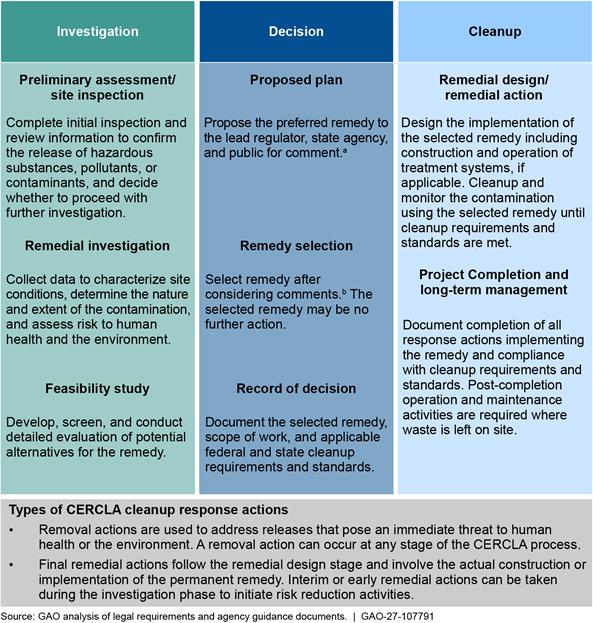
Note: This figure groups the CERCLA cleanup framework for National Priorities List sites into the high-level stages of investigation, decision, and cleanup, as generally set forth in the National Oil and Hazardous Substances Pollution Contingency Plan (National Contingency Plan) at 40 C.F.R. Part 300. The process for the lead agency may vary depending on site-specific conditions. The U.S. Environmental Protection Agency (EPA) defines the “lead agency” as the agency that plans and implements response actions under the National Contingency Plan. 40 C.F.R. § 300.5.
aEPA defines the “lead regulator” as the primary agency (i.e., EPA or the state) that oversees the cleanup. U.S. Environmental Protection Agency, Lead Regulator Policy for Cleanup Activities at Federal Facilities on the National Priorities List (Nov. 6, 1997).
bFor a federal facility on the CERCLA National Priorities List, the remedy must be selected jointly by the lead agency and EPA. If the agencies cannot reach agreement on the remedy, EPA will select the remedy. 42 U.S.C. § 9620(e)(4); 40 C.F.R. § 300.430(f)(4)(iii).
Figure 13: Typical Stages of the Corrective Action Process under the Resource Conservation and Recovery Act, as amended (RCRA)
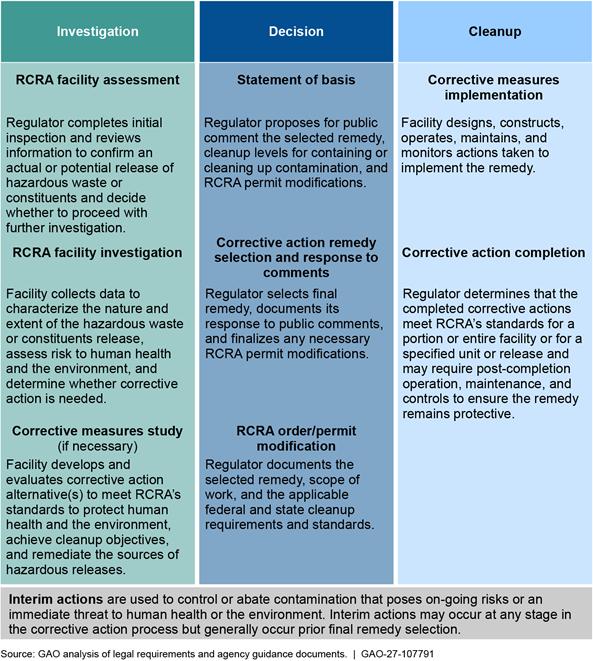
Note: This figure groups the RCRA corrective action cleanup framework into the high-level stages of investigation, decision, and cleanup as generally set forth in U.S. Environmental Protection Agency regulations and guidance documents. The cleanup process may vary depending on site-specific conditions.
Appendix III: Legal and Regulatory Factors That Affect Cleanup Cost and Schedule, According to Experts
On June 24 and 25, 2025, GAO held 2 days of virtual expert meetings convened with the National Academies of Sciences, Engineering, and Medicine to discuss the legal and regulatory factors affecting the Department of Energy’s (DOE) cleanup of nuclear waste, particularly those factors that significantly affect cost and schedule for cleanup projects.[146] (See appendix I for more information on the virtual meetings and other methodologies used to gather evidence on legal and regulatory factors). Specifically, prior to the meetings, we developed a set of five preliminary legal and regulatory factors that we identified through our analysis of literature and other sources.[147] We developed these factors to guide the meetings and provide a framework for expert discussion. Over the course of 2 days, we asked the experts to discuss this initial list of legal and regulatory factors. Following these discussions, we conducted a poll that asked experts to rate the legal and regulatory factors in terms of how they affect cost and schedule outcomes for DOE nuclear waste cleanup projects.[148] On the second day of the virtual meetings, we conducted a separate poll for experts to rank the relative significance of factors discussed at the meetings, in terms of their effect on cost and schedule outcomes.
Following the June meeting, we reviewed the transcript and refined our preliminary list of five factors into seven factors based on expert feedback on the original list. For example, we split the “future resource use” factor into two factors, “future land use decisions” and “future groundwater use decisions.” We also made “implementation of the Resource Conservation and Recovery Act” a separate factor, rather than including this content within the “overlapping legal regimes and compliance agreements” factor. We used this refined list of factors to help guide the discussion at the in-person expert meetings, which occurred in August 2025 (see appendix I for more information on the in-person expert meetings.) For example, at the August meetings, we asked experts to use this revised list of seven factors to provide further input on how these legal and regulatory factors affected cost and schedule or led to other challenges for DOE cleanup.
Table 6 lists the results of polls on these factors and identifies any related report sections.
Table 6: Legal and Regulatory Factors That Affect Cost and Schedule of DOE Nuclear Waste Cleanup and Experts’ Views on the Extent to Which Each Factor Is Significant in Affecting Cost and Schedule
Poll from June 2025 meetings of 12 experts convened by GAO with assistance from the National Academies of Sciences, Engineering, and Medicine.
|
Factor title and brief description (ordered by expert ranking of relative significance)a |
Where factor is discussed in this reportb |
Very significantc |
Moderately significant |
Slightly significant |
Not significant |
|
Overlapping legal regimes and compliance agreementsd Description: The overall legal and regulatory framework for DOE nuclear waste cleanup is governed by various federal and state requirements that can apply to DOE sites, depending on the circumstances. To implement the requirements of these different laws and regulations, DOE has also entered into cleanup agreements with federal and state regulatory agencies that specify legally enforceable requirements and timelines for completing cleanup work at sites. |
· Discussed in section: “Experts Believe Certain State Regulatory Actions Address the Radiological Aspects of DOE’s Nuclear Waste, Which Slows Cleanup.” · Discussed in section: “Statutes and Case Law are Unclear on What Actions That Impact DOE’s Radioactive Waste Cleanup Are Within State Authority.” · Discussed in section: “EPA Has Taken Limited Steps to Evaluate Whether State Actions Under EPA-Authorized RCRA Programs Infringe on Federal Authorities.” · Discussed in section: “Experts Said Other Aspects of Cleanup Can Lead to Disagreement, Higher Costs, and Longer Schedules.” |
10 |
0 |
0 |
0 |
|
Implementation of the Resource Conservation and Recovery Act, as amended (RCRA) Description: Under RCRA, DOE must clean up contamination caused by certain hazardous waste at its sites. EPA, which administers RCRA, may also authorize states to implement their own hazardous waste programs in lieu of the federal RCRA program, and state hazardous waste programs may be broader or more stringent than federal requirements. |
· Discussed in section: “Experts Believe Certain State Regulatory Actions Address the Radiological Aspects of DOE’s Nuclear Waste, Which Slows Cleanup.” · Discussed in section: “Statutes and Case Law are Unclear on What Actions That Impact DOE’s Radioactive Waste Cleanup Are Within State Authority.” · Discussed in section: “EPA Has Taken Limited Steps to Evaluate Whether State Actions Under EPA-Authorized RCRA Programs Infringe on Federal Authorities.” |
8 |
2 |
0 |
0 |
|
Anticipated future land and groundwater use decisionse Description: The extent of DOE cleanup is based, in part, on the anticipated future uses of land and groundwater for an area, which are determined in different ways. The anticipated future land use is generally decided as a part of the cleanup process, while future groundwater use is often established by EPA or state designations outside the context of a particular cleanup. |
Anticipated future land use · Discussed in section: “Experts Believe DOE May Be Using Unrealistic Future Land and Groundwater Use Assumptions.” · Discussed in section: “EPA and DOE May Not Make Realistic Assumptions About Future Land Use Due to Insufficient Guidance.” · Discussed in section: “Congressional Intent Regarding the Role of Future Land Use Assumptions in DOE’s Cleanup Process Is Unclear.” Anticipated future groundwater use · Discussed in section: “Experts Believe DOE May be Using Unrealistic Future Land and Groundwater Use Assumptions.” · Discussed in section: “DOE Has Not Successfully Applied Regulatory Flexibilities to Groundwater Cleanups and Some Standards Applied to Groundwater Cleanups Are Outdated.” |
9 |
1 |
1 |
0 |
|
Risk assessment assumptions, tools, and requirements Description: When conducting cleanup, DOE completes risk assessments to determine cleanup levels to protect human health and the environment. Depending on site circumstances and the applicable laws and regulations for cleanup, the assumptions, tools, and standards for assessing risk can differ among federal and state agencies that regulate DOE sites. |
· Discussed in section: “DOE Has Not Successfully Applied Regulatory Flexibilities to Groundwater Cleanups and Some Standards Applied to Groundwater Cleanups Are Outdated.” · Discussed in section: “Experts Said Other Aspects of Cleanup Can Lead to Disagreement, Higher Costs, and Longer Schedules.” |
8 |
2 |
1 |
0 |
|
Implementation of the National Contingency Plan and criteria for remedy decisions Description: EPA’s National Contingency Plan regulation lays out the steps of the CERCLA cleanup process and includes nine criteria to use in evaluating cleanup alternatives and selecting the final cleanup approach. |
· Discussed in section: “Experts Said Other Aspects of Cleanup Can Lead to Disagreement, Higher Costs, and Longer Schedules.” |
7 |
3 |
1 |
0 |
|
Determination of Applicable or Relevant and Appropriate Requirements (ARARs) Description: CERCLA requires that cleanup actions attain or waive ARARs. ARARs include federal and state environmental standards that a DOE cleanup approach generally must meet or waive upon completion of the cleanup action. |
· Discussed in section: “Experts Said Other Aspects of Cleanup Can Lead to Disagreement, Higher Costs, and Longer Schedules.” |
8 |
2 |
1 |
0 |
Legend:
CERCLA = Comprehensive Environmental Response, Compensation, and Liability Act of 1980, as amended
DOE = Department of Energy
EPA = U.S. Environmental Protection Agency
Source: GAO poll of experts and analysis of expert statements. | GAO‑27‑107791
aWe order the list of factors in the table based on a poll we took at the end of the June 2025 meetings for experts to rank the relative significance of these factors in terms of their effect on cost and schedule outcomes for DOE nuclear waste cleanup sites, from most significant to least significant.
b”Discussed in section” refers to the location in our report where we discuss the factor and findings or other information related to how the factor can affect DOE’s cleanup of nuclear waste, particularly cost and schedule.
cDuring the June 2025 meetings, we used an online polling platform, and the 12 experts independently and anonymously rated each factor from 1 to 4, in terms of the extent to which the factor affects cost and schedule outcomes for DOE and other similar nuclear waste cleanup sites (i.e., very significant, moderately significant, slightly significant, and not significant). We also asked the experts to comparatively rank the factors against each other, in terms of which was the most significant in its impact on DOE cleanup. The list of factors in the table is ordered by this relative ranking. Two experts did not participate in all of the polls because of scheduling reasons; thus, some of the rows do not total to 12 experts.
dIn the final poll of the June 2025 virtual meetings, we included a subset of this factor for polling purposes: “DOE’s implementation of the Atomic Energy Act.” Following the virtual meetings, we did not include this as a separate factor for evidence gathering at our in-person expert meetings (August 2025) because we determined it was adequately covered by the “overlapping legal regimes and compliance agreements” factor.
eAs described above, following the virtual meetings, we split this factor into two factors: “future land use decisions” and “future groundwater use decisions.”
On August 26 and 27, 2025, GAO held 2 days of in-person expert meetings convened with the National Academies of Sciences, Engineering, and Medicine. The experts shared and discussed potential policy options to address the legal and regulatory factors affecting the Department of Energy’s (DOE) cleanup of nuclear waste (discussed in app. III). In total, experts identified 39 policy options. We then conducted a poll where we asked each expert to identify their top 10 policy options from among the 39 total policy options. We then used the results of the poll to identify the top 10 policy options considering their overall frequency of selection among the experts. Experts then discussed these 10 policy options in further depth, including the strengths, limitations, and possible variations of the policy options. At the conclusion of the second day, experts took an online poll indicating the extent to which they recommended each of the 10 options discussed that day. The experts took the poll individually without consulting with each other. In the poll, experts indicated whether they “do not recommend,” “recommend,” or “strongly recommend” each option. In this final polling, we also asked experts to rank each policy option relative to the other policy options.
Table 7 below lists the 10 policy options in order from most recommended to least recommended. In our report, we discuss seven of these 10 policy options. We decided which policy options to discuss in our report based on (1) our analysis of the experts’ discussion of these policy options, including their strengths and limitations, and (2) the policy options’ relation to the topics we focused on in our report. At the meetings, we captured the initial policy options and their description on a whiteboard shared on a screen with all the experts. We then edited the policy options and descriptions according to the experts’ ongoing discussion of each policy option. After the meetings, we made further edits to the policy options and their descriptions for clarity.
Table 7: Top 10 Policy Options Identified by Experts to Address Legal and Regulatory Factors Significantly Affecting the Cost and Schedule of the Department of Energy’s (DOE) Nuclear Waste Cleanup
Poll from August 2025 meetings of 14 experts convened by GAO with assistance from the National Academies of Sciences, Engineering, and Medicine.
|
Relative ranking |
Policy option |
Where policy option is discussed in this report or a brief description (if not discussed) |
Strongly recommend |
Recommend |
Do not recommend |
|
|
1 |
Interagency task force focused on addressing specific, high-priority cleanup decisions, ongoing cleanup processes, and areas of legal or regulatory disagreement in order to achieve more risk-informed and cost-effective cleanup approaches at DOE sitesa |
Discussed in section: “Experts Recommend an Interagency Task Force to Review Specific Cleanup Decisions and Areas of Disagreement.” |
11 |
3 |
0 |
|
|
2 |
Congress should amend the Federal Facility Compliance Act of 1992 as relates to DOE cleanup |
Discussed in section: “EPA Has Taken Limited Steps to Evaluate Whether State Actions Under EPA-Authorized RCRA Programs Infringe on Federal Authorities.” |
8 |
4 |
2 |
|
|
3 |
Congress should endorse DOE’s use of high-level radioactive waste (HLW) interpretation as consistent with its authorities under the Atomic Energy Act of 1954, as amended |
Not discussed in this report; discussed in recent GAO work.b Description: The HLW interpretation is a process DOE can use to classify waste associated with reprocessing as a waste type other than HLW if the waste meets certain criteria. We reported on this topic in March 2026 and found a lack of clarity in the statutory definition of HLW that has left DOE vulnerable to lawsuits when applying the HLW Interpretation tool. We recommended that Congress consider convening a multidisciplinary panel of experts to develop and recommend specific revisions to address statutory ambiguities in the definition of HLW. As of August 2026, Congress has not passed legislation that would address this recommendation. |
11 |
2 |
1 |
|
|
4 |
Improve the framework for making future land use assumptions to help ensure these assumptions about potential future land use are transparent, realistic, and support the selection of cost-effective cleanup approaches |
Discussed in section: “EPA and DOE May Not Make Realistic Assumptions about Future Land Use Due to Insufficient Guidance.” |
10 |
3 |
1 |
|
|
5 |
DOE’s cleanup should primarily operate under the Comprehensive Environmental Response, Compensation, and Liability Act of 1980, as amended (CERCLA)—as opposed to under the Resource Conservation and Recovery Act of 1976, as amended (RCRA) |
Discussed in section: “EPA Has Taken Limited Steps to Evaluate Whether State Actions Under EPA-Authorized RCRA Programs Infringe on Federal Authorities.” |
5 |
7 |
2 |
|
|
6 |
Formalize the U.S. Environmental Protection Agency’s (EPA’s) ability to overrule state regulators in their application of RCRA requirements to DOE’s mixed waste if that state’s application improperly addresses the radiological aspects of the waste |
Discussed in section: “EPA Has Taken Limited Steps to Evaluate Whether State Actions Under EPA-Authorized RCRA Programs Infringe on Federal Authorities.” |
5 |
5 |
4 |
|
|
7 |
DOE should more often use phased decision strategy and adaptive site management |
Not discussed in this report. Description: Experts generally described phased decision strategy as completing some cleanup activities early on and working on addressing any information gaps concurrent with ongoing cleanup rather than waiting to start cleanup until all information is collected and decisions have been made. Similarly, experts generally described adaptive site management as letting decisions be made on a rolling basis and revisiting them as new information is collected. |
4 |
8 |
2 |
|
|
8 (tied) |
Address outdated standards that can apply to groundwater cleanup of iodine-129 and other contaminants that are beta-emitting radionuclides |
Discussed in section: “DOE Has Not Successfully Applied Regulatory Flexibilities to Groundwater Cleanups and Some Standards Applied to Groundwater Cleanups Are Outdated.” |
7 |
5 |
2 |
|
|
8 (tied) |
Risk-informed application and more thorough consideration of relevant regulatory flexibilities for Applicable or Relevant and Appropriate Requirements (ARARs) |
Discussed in section: “Experts Said Other Aspects of Cleanup Can Lead to Disagreement, Higher Costs, and Longer Schedules.” |
6 |
5 |
3 |
|
|
10 |
Unification of federal oversight, such as by harmonizing radiation standards |
Not discussed in this report. Description: DOE, EPA, and the Nuclear Regulatory Commission set standards for radiation protection that are applicable in different situations. This option sought to harmonize varied radiation standards across these three agencies and to better ensure consistency in oversight of DOE cleanup. |
5 |
4 |
5 |
|
Source: GAO poll of experts and analysis of expert statements. | GAO‑27‑107791
Note: Fourteen experts participated in the in-person meetings, with one of the 14 experts attending virtually. We selected 15 experts for the in-person meetings, including the three experts with EPA experience added after the virtual meetings. One expert with international career experience was unable to attend the in-person meetings, and we did not have sufficient time to identify a replacement with international career experience. The other 11 experts previously participated in the virtual meetings.
aIn prior work, we describe risk-informed decision-making as a decision-making approach that helps agencies consider trade-offs among risks to human health and the environment, costs, and other factors in the face of uncertainty and diverse stakeholder and government perspectives. See GAO, Environmental Hazards: A Framework for Risk-Informed Decision-Making, GAO‑24‑107595 (Washington, D.C.: Sept. 23, 2024).
bSee GAO, Nuclear Waste Cleanup: Clarifying Definition of High-Level Radioactive Waste Could Help DOE Save Tens of Billions of Dollars, GAO‑26‑108018 (Washington, D.C.: Mar. 25, 2026).
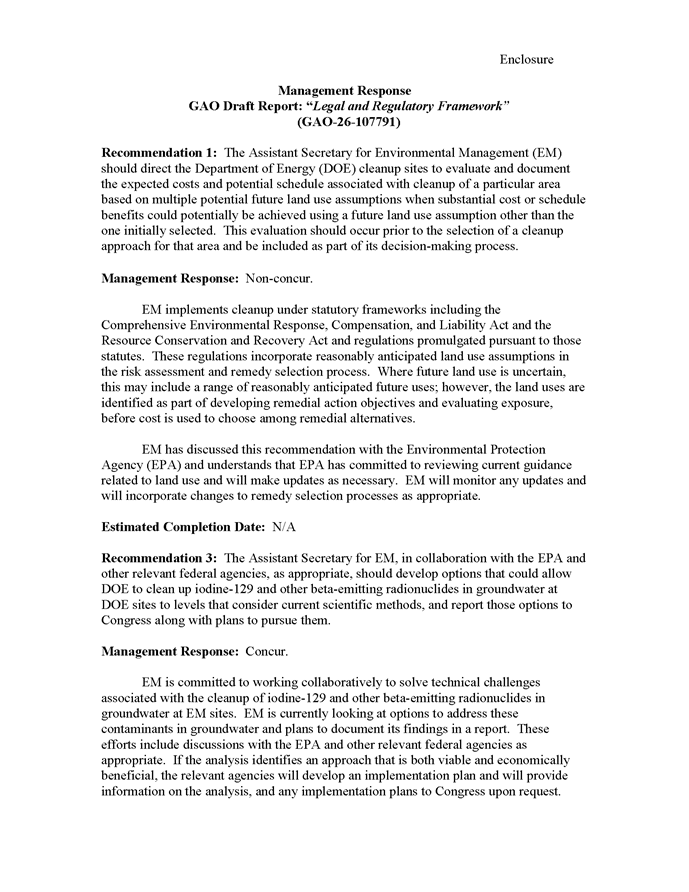
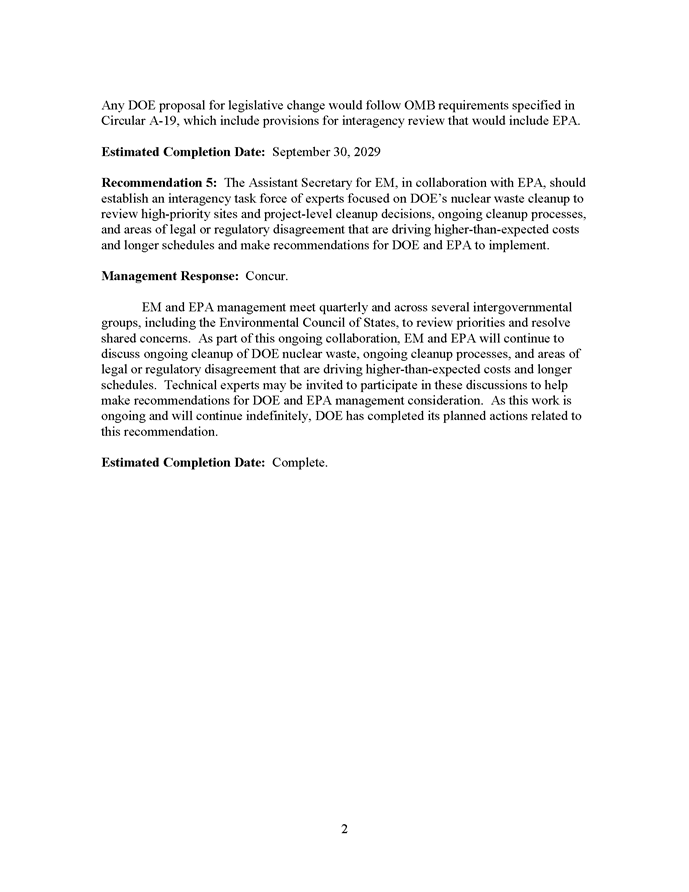
GAO Contact
Nathan J. Anderson, AndersonN@gao.gov
Staff Acknowledgments
In addition to the contact named above, Amanda K. Kolling (Assistant Director), Cory Ryncarz (Analyst in Charge), Kelly Butler, Claudia Hadjigeorgiou, Eli Harpst, and Katherine Killebrew made key contributions to this report. Adrian Apodaca, Justine Augeri, Katherine Chambers, Youjin Chung, Charlotte Hinkle, Mae Jones, Danielle Novak, Katrina Pekar-Carpenter, Edward Rice, Caitlin Scoville, Amber Sinclair, and Walter Vance also contributed to this report.
The Government Accountability Office, the audit, evaluation, and investigative arm of Congress, exists to support Congress in meeting its constitutional responsibilities and to help improve the performance and accountability of the federal government for the American people. GAO examines the use of public funds; evaluates federal programs and policies; and provides analyses, recommendations, and other assistance to help Congress make informed oversight, policy, and funding decisions. GAO’s commitment to good government is reflected in its core values of accountability, integrity, and reliability.
Obtaining Copies of GAO Reports and Testimony
The fastest and easiest way to obtain copies of GAO documents at no cost is through our website. Each weekday afternoon, GAO posts on its website newly released reports, testimony, and correspondence. You can also subscribe to GAO’s email updates to receive notification of newly posted products.
Order by Phone
The price of each GAO publication reflects GAO’s actual cost of production and distribution and depends on the number of pages in the publication and whether the publication is printed in color or black and white. Pricing and ordering information is posted on GAO’s website, https://www.gao.gov/ordering.htm.
Place orders by calling (202) 512-6000, toll free (866) 801-7077,
or
TDD (202) 512-2537.
Orders may be paid for using American Express, Discover Card, MasterCard, Visa, check, or money order. Call for additional information.
Connect with GAO
Connect with GAO on X,
LinkedIn, Instagram, and YouTube.
Subscribe to our Email Updates. Listen to our Podcasts.
Visit GAO on the web at https://www.gao.gov.
To Report Fraud, Waste, and Abuse in Federal Programs
Contact FraudNet:
Website: https://www.gao.gov/about/what-gao-does/fraudnet
Automated answering system: (800) 424-5454
Media Relations
Sarah Kaczmarek, Managing Director, Media@gao.gov
Congressional Relations
David A. Powner, Acting Managing Director, CongRel@gao.gov
General Inquiries
[1]Department of Energy, Fiscal Year 2027 Congressional Justification, Office of Environmental Management, DOE/CF-0227, Vol. 5 (Apr. 2026).
[2]Omnibus Risk Review Committee, A Review of the Use of Risk-Informed Management in the Cleanup Program for Former Defense Nuclear Sites (August 2015).
[3]National Academies of Sciences, Engineering, and Medicine, Low-Level Radioactive Waste Management and Disposition: Proceedings of a Workshop (Washington, D.C.: 2017).
[4]For the purposes of this report, when we refer to “experts,” we are referring to the 15 experts who participated in our meetings convened with the National Academies. Throughout the report, we use language such as “experts generally said,” “experts generally noted,” or “according to experts” to characterize general views from the 15 experts at the meetings we convened with the National Academies. If a comment was made by only one expert and may not reflect the views of other experts or was a direct quote that illustrates a broader point, then we report such a comment as “one expert said” or “according to one expert.” In places where we specify the number of experts who agreed with a statement, this is based on the results of expert polling, and we directly state that as the source. See appendixes III and IV for poll results from expert meetings regarding experts’ views on the significance of these factors and the extent they recommended the policy options discussed.
[5]The case studies included cleanup projects at the following sites: at the Savannah River Site: (1) the Old Radioactive Waste Burial Ground and (2) iodine-129 groundwater contamination within the Mixed Waste Management Facility, at F and H Areas; at the Oak Ridge Reservation: Solid Waste Storage Areas 4, 5, and 6 within the Melton Valley watershed; at the Hanford Site: (1) Burial Grounds 618-10 and 618-11 within the 300-FF-2 operable unit and (2) iodine-129 groundwater contamination within the 200-PO-1, 200-BP-5, 200-UP-1, and 200-ZP-1 operable units; at Idaho National Laboratory: the Subsurface Disposal Area; at Los Alamos National Laboratory: hexavalent chromium groundwater contamination. We also did a case study on the Waste Isolation Pilot Plant: the provision of the Hazardous Waste Facility Permit that prohibits disposal of waste that has ever been managed as high-level radioactive waste and waste from certain specified tanks at the Hanford Site, Idaho National Laboratory, and the Savannah River Site.
[6]As we previously reported, the Nuclear Regulatory Commission has an ongoing rulemaking that, if finalized, may allow DOE to dispose of transuranic waste at near-surface disposal facilities in the future if such facilities receive appropriate regulatory approvals. See GAO, Nuclear Waste: An Integrated Disposal Plan Could Help DOE Complete Its Cleanup Mission and Save Billions, GAO‑25‑107109 (Washington, D.C.: May 29, 2025).
[7]A deep geologic repository is an excavated, underground facility for the safe and secure permanent disposal of HLW. We previously reported that DOE’s estimate for when a deep geologic repository might be available for HLW is 2065, according to DOE Nuclear Energy officials. However, as of May 2025—when that report was issued—DOE had not yet completed a proposal with estimated time frames and costs for such a repository, which they said would accept both HLW and defense and commercial spent nuclear fuel. GAO‑25‑107109.
[8]RCRA defines mixed waste as “waste that contains both hazardous waste and source, special nuclear, or by-product material subject to the [AEA].” 42 U.S.C. § 6903(41).
[9]In 1974, the Atomic Energy Commission was abolished, and, through several subsequent laws, its functions were transferred to the Nuclear Regulatory Commission and DOE. Under the act, as amended, the Nuclear Regulatory Commission has regulatory authority over commercial uses of radioactive materials and licenses commercial facilities that dispose of radioactive waste. With limited exceptions, the commission is not authorized to regulate defense nuclear facilities and wastes, which, pursuant to the act, are generally managed and regulated by DOE.
[10]Department of Energy, Radioactive Waste Management, Order 435.1, Chg 2 (AdminChg) (Washington, D.C.: Jan. 11, 2021); and Radioactive Waste Management Manual, Manual 435.1-1, Chg 3 (LtdChg) (Washington, D.C.: Jan. 11, 2021).
[11]While the agency that administers the facility where there has been a release of hazardous substances will typically be the lead agency to undertake cleanup activities at federal facilities, EPA oversees CERCLA cleanup activities at federal facilities on its National Priorities List. The National Priorities List is the list of sites of national priority among the known releases or threatened releases of hazardous substances, pollutants, or contaminants throughout the United States and its territories. The list is maintained by EPA and intended primarily to guide the agency in determining which sites warrant further investigation. Oversight of DOE’s CERCLA sites is the responsibility of the EPA region in which a site is located. EPA has 10 regional offices, and each one is responsible for executing EPA programs within several states. For federal facilities that are not on the National Priorities List, most cleanups are overseen by state agencies rather than EPA, as allowed by CERCLA.
[12]40 C.F.R. Part 300.
[13]40 C.F.R. § 300.430(e)(9)(iii). The National Contingency Plan provides that the record of decision must explain how the nine criteria were used to select the remedy. 40 C.F.R. § 300.430(f)(5)(i). EPA’s guidance states that sites should evaluate the relative performance of the alternative cleanup approaches with respect to the nine criteria so that the advantages and disadvantages of each are clearly understood.
[14]CERCLA requires that on-site remedial actions attain or waive federal environmental ARARs, or more stringent state environmental ARARs, upon completion of the remedial action. 42 U.S.C. § 9621. Some of the many sources of ARARs include the Clean Water Act, as amended; the Safe Drinking Water Act, as amended; and Clean Air Act, as amended. Identification of ARARs is done on a site-specific basis and involves a two‐part analysis: first, a determination of whether a given requirement is applicable; then, if it is not applicable, a determination of whether it is nevertheless both relevant and appropriate. Applicable requirements include those cleanup standards, standards of control, and other substantive environmental protection requirements, criteria, or limitations promulgated under federal or state law that specifically address a hazardous substance, pollutant, contaminant, remedial action, location, or other circumstance at a CERCLA site. Relevant and appropriate requirements include those cleanup standards, standards of control, and other substantive environmental protection requirements, criteria, or limitations promulgated under federal or state law that, while not “applicable” to a hazardous substance, pollutant, contaminant, remedial action, location, or other circumstance at a CERCLA site, address problems or situations sufficiently similar to those encountered at the CERCLA site that their use is well suited to the particular site.
[15]40 C.F.R. § 300.430(e)(2)(i)(A)(2).
[16]Under the RCRA corrective action process, EPA and authorized states impose remedial measures to clean up releases at individual sites through permits or compliance orders.
[17]There are more detailed cleanup regulations for certain underground storage tanks under RCRA that may apply in some situations, according to EPA officials. See 40 C.F.R §§ 280.50-280.67.
[18]DOE cleanup primarily involves cleaning up Manhattan Project-era and Cold War-era waste related to nuclear weapons production and nuclear energy research. DOE may become responsible for additional cleanup sites in the future as new nuclear waste is generated.
[19]Federal accounting standards require federal agencies responsible for cleaning up environmental contamination to estimate future cleanup and waste disposal costs and to report such costs in their annual financial statements. Agencies refer to these estimated future costs as environmental liabilities. Costs for cleanup work must be included in environmental liabilities estimates when they are both probable (i.e., more likely than not) and reasonably estimable (i.e., the outflow of resources that will be required is reliably quantifiable in monetary terms). See Federal Accounting Standards Advisory Board, FASAB Handbook of Federal Accounting Standards and Other Pronouncements, as Amended (Washington, D.C.: June 30, 2025).
[20]U.S. Environmental Protection Agency, Land Use in the CERCLA Remedy Selection Process, OSWER Directive No. 9355.7-04 (1995); Reuse Assessments: A Tool to Implement the Superfund Land Use Directive, OSWER Directive No. 9355.7-06P (2001); Considering Reasonably Anticipated Future Land Use and Reducing Barriers to Reuse at EPA-lead Superfund Remedial Sites OSWER Directive No. 9355.7-19 (2010).
[21]The cleanup processes also generally include opportunities for public input, and EPA guidance encourages early engagement with the public on the anticipated future uses of a cleanup site, as appropriate.
[22]In some instances, DOE sites are located on lands once held by a Tribe or Tribes. According to DOE officials, Tribes may request that DOE and regulators select cleanup levels protective for future uses as anticipated by Tribes. Officials said tribal uses are often more resource intensive and may require the development of tribal use scenarios to address the potential for increased exposures.
[23]In 1996, EPA also published an advanced notice of proposed rulemaking with additional information on how to consider future land use during the RCRA process, though a proposed rule was never finalized. U.S. Environmental Protection Agency, Corrective Action for Releases From Solid Waste Management Units at Hazardous Waste Management Facilities, 61 Fed. Reg. 19,432 (May 1, 1996).
[24]See 42 U.S.C. § 9621(d)(2)(A); 40 C.F.R. § 300.430(e)(2)(i)(B)-(C). The Safe Drinking Water Act, as amended, authorizes EPA to regulate contaminants in our nation’s drinking water. Under the act, EPA is authorized to set National Primary Drinking Water Regulations that establish legally enforceable standards—known as maximum contaminant levels—to protect public health by limiting the level of contaminants in drinking water delivered by public water systems. See 42 U.S.C. § 300g-1. When EPA determines that it is appropriate to regulate a contaminant in drinking water, the Safe Drinking Water Act, as amended, also generally requires EPA to set a nonenforceable maximum contaminant level goal for drinking water at which no known or anticipated adverse health effects occur and that allows an adequate margin of safety. Id. The Act then generally requires EPA to set an enforceable maximum contaminant level for drinking water as close to the maximum contaminant level goal as is feasible using the best technology or other means available, taking costs into consideration. Id.
[25]Throughout the report, we use language such as “experts generally said,” “experts generally noted,” or “according to experts” to characterize general views from the 15 experts at the meetings we convened with the National Academies. If a comment was made by only one expert and may not reflect the views of other experts or was a direct quote that illustrates a broader point, then we report such a comment as “one expert said” or “according to one expert.” In places where we specify the number of experts who agreed with a statement, this is based on the results of expert polling, and we directly state that as the source.
[26]To classify a given radioactive waste stream under its AEA authority, DOE evaluates the physical and chemical characteristics of the waste—including its volume and other information needed to ensure the waste will meet the specific waste acceptance requirements of a given disposal facility. According to DOE officials, for waste associated with the reprocessing of spent nuclear fuel (like Hanford’s tank waste), DOE typically does not formally classify the waste until it is ready to make a decision about the waste’s treatment and disposal pathway.
[27]Under RCRA’s land disposal requirements, radioactive high-level wastes generated during the reprocessing of fuel rods that exhibit specified hazardous waste characteristics must be vitrified (immobilized in glass) before disposal. 40 C.F.R. §§ 268.40, 268.42(a).
[28]GAO, Nuclear Waste Disposal: Actions Needed to Enable DOE Decision That Could Save Tens of Billions of Dollars, GAO‑22‑104365 (Washington, D.C.: Dec. 9, 2021). At Hanford, DOE retrieves and separates tank waste into two streams, a highly radioactive portion and a portion with lower levels of radioactivity. DOE uses the term “low-activity waste” to mean the waste that remains after as much radioactivity as technically and economically practical has been separated from tank waste that, when solidified, may be disposed of as LLW in a near-surface facility. As we recently reported, DOE has several processes it can use to determine that waste that has been managed as HLW can instead be managed as LLW or transuranic waste if it meets specific criteria. However, some of these processes cannot be used at the Hanford Site. GAO, Nuclear Waste Cleanup: Clarifying Definition of High-Level Radioactive Waste Could Help DOE Save Tens of Billions of Dollars, GAO‑26‑108018 (Washington, D.C.: Mar. 25, 2026).
[29]There is no general RCRA treatment standard for mixed LLW. RCRA regulations specify treatment standards for a few hazardous wastes that are radioactive, but there is no general standard for mixed LLW. Other mixed waste must generally be physically, chemically, or thermally treated to substantially diminish its toxicity or to reduce the mobility of the hazardous constituents according to waste-specific regulatory levels.
[31]GAO‑22‑104365; see also U.S. Environmental Protection Agency, Department of Energy Hanford Mixed Radioactive Waste Land Disposal Restrictions Variance, 89 Fed. Reg. 35008 (May 1, 2024). When EPA proposed granting DOE the treatment variance in November 2023, EPA referenced our reporting on the legal disagreement between DOE and the State of Washington (GAO-22-104365), and noted that “[i[n view of this background—and the importance DOE, Washington and EPA all attach to making progress on the Hanford tank waste mission—EPA proposes to approve a variance clearly allowing the [demonstration project] to proceed . . . regardless of whose interpretation forms the starting point for the variance analysis.” U.S. Environmental Protection Agency, Department of Energy Hanford Mixed Radioactive Waste Land Disposal Restrictions Variance, 88 Fed. Reg. 83065 (Nov. 28, 2023).
[32]According to EPA officials, EPA, DOE, and Washington state officials are actively working to develop approaches like the 2024 treatment variance that could allow DOE to grout other low-activity waste from Hanford tanks despite this legal disagreement.
[33]As we have previously reported, DOE manages all tank waste across its cleanup sites as if it were HLW unless and until it is classified as another waste type. GAO‑25‑107109. This includes the tank waste at the Hanford, Idaho, and Savannah River Sites. DOE officials noted that modification of this prohibition would require a formal permit modification process subject to reviews, public engagement, and final determination, and that DOE’s compliance with this prohibition remains mandatory until the permitting authority grants a permit modification.
[34]GAO, Nuclear Waste Cleanup: DOE Faces Project Management and Disposal Challenges with High-Level Waste at Idaho National Laboratory, GAO‑19‑494 (Washington, D.C.: Sept. 9, 2019). Similarly, we previously reported that DOE is considering disposing of waste from 11 tanks at the Hanford Site at WIPP, instead of vitrifying it for disposal in a deep geologic repository. GAO, Hanford Cleanup: Alternatives for Treating and Disposing of High-Level Waste Could Save Billions of Dollars and Reduce Certain Risks, GAO‑24‑106989 (Washington, D.C.: Sept. 26, 2024).
[35]We previously reported that DOE would need a WIPP permit modification to address this disposal barrier, which must be agreed to by New Mexico regulators. GAO‑25‑107109.
[36]The Energy Technology Engineering Center was established in the early 1960s to conduct research on nuclear energy and liquid metals (primarily sodium, potassium, and mercury). In support of that mission, DOE built and operated 10 small nuclear reactors for various research activities. As a result of operating these reactors and conducting nuclear research, chemicals and radionuclides were released into the soil.
[37]California Environmental Protection Agency, Department of Toxic Substances Control, Administrative Order on Consent for Remedial Action, In the Matter of: Santa Susana Field Laboratory, No. HSA-CO 10/11-037 (Dec. 6, 2010), as amended.
[38]GAO, Nuclear Waste Cleanup: DOE Should Collect Information Specific to Soil and Legacy Landfills to Inform Overall Remediation Efforts, GAO‑25‑107565 (Washington, D.C.: Sept. 26, 2025).
[39]Department of Energy, Final Environmental Impact Statement for Remediation of Area IV and the Northern Buffer Zone of the Santa Susana Field Laboratory (November 2018).
[40]California Department of Toxic Substances Control, Final Program Environmental Impact Report for the Santa Susana Field Laboratory, Ventura County, California (Los Angeles, CA: June 2023). California regulators acknowledged in the report that sources of suitable backfill soil have not yet been fully identified and noted that if identified backfill soils cannot achieve the cleanup standards, the state will determine the best alternative source of backfill that is still protective of human health and the environment.
[41]Pub. L. No. 102-386, § 102, 106 Stat. 1505, 1505-6 (1992). In explaining the need for the Federal Facility Compliance Act, a House Report stated that, “federal facilities present some of the very worst [RCRA] compliance problems” and that “[n]umerous investigations by the GAO have led it to conclude that the federal government has been slow to comply with the hazardous waste management laws.” H.R. Rep. No. 102-111, at 2-3 (1991). The report further noted that some federal facilities, such as DOE’s Rocky Flats and Fernald facilities, had “a long history of environmental violations and concealment of those violations” and pointed to an ongoing criminal investigation of environmental law violations at Rocky Flats. Id. at 4. Accordingly, the report noted Congress’s intent to “reaffirm in more explicit language the original intent of Congress that federal facilities be subject to all of the same substantive and procedural requirements, including enforcement requirements and sanctions, such as civil penalties, that state and local governments and private companies are subject to” under to solid and hazardous waste laws. Id. at 5-6. The Ninth Circuit Court of Appeals further explained that “Congress enacted the Federal Facility Compliance Act [] to make it ‘as clear as humanly possible’ that Congress was waiving federal sovereign immunity and making federal facilities subject to state laws.” United States v. Manning, 527 F.3d 828, 832 (9th Cir. 2008)(quoting 138 Cong. Rec. H9135-02 (daily ed. Sept. 23, 1992) (statement of Rep. Dingell)).
[42]42 U.S.C. § 6929; 40 C.F.R. § 271.1.
[43]42 U.S.C. § 6903(27)(RCRA); Train v. Colorado Public Interest Research Group, Inc., 426 U.S. 1 (1976); 40 C.F.R. § 230.3(j) (Clean Water Act). Under the Clean Water Act, the discharge of pollutants from certain sources, such as industrial facilities, into waters of the U.S. is prohibited without a permit; facilities obtain permits from EPA or authorized states. Wastewater treatment facilities are among the facilities regulated under the Clean Water Act. In May 2017, we reported that the state of South Carolina elected to manage DOE’s tanks at the Savannah River Site as wastewater treatment units under the Clean Water Act, rather than as RCRA units, which gave the state and DOE more flexibility in addressing the tank waste at the site. GAO, Nuclear Waste: Opportunities Exist to Reduce Risks and Costs by Evaluating Different Waste Treatment Approaches at Hanford, GAO‑17‑306 (Washington, D.C.: May. 3, 2017).
[44]See, e.g., An Act to amend the Atomic Energy Act of 1954, as amended, with respect to cooperation with States, P.L. 86-373, 78 Stat. 688 (1959) (codified at 42 U.S.C. § 2021) (clarifying that the federal government has the “authority and responsibility” over the “construction and operation” of certain nuclear facilities and activities, including the “disposal of . . . byproduct, source, or special nuclear material,” but that states and localities retain the right to “regulate activities for purposes other than protection against radiation hazards.”)
[45]U.S. Const., Art. VI, cl. 2. The Supreme Court has recognized three types of preemption: (1) express, (2) field, and (3) conflict. “First, and most obvious, federal law operates exclusively when Congress expressly preempts state law. Second, state law can play no part when Congress has legislated comprehensively to occupy an entire field of regulation, leaving no room for the States to supplement federal law. Third, state law is rendered inoperative when it actually conflicts with federal law. . . .” Virginia Uranium, Inc. v. Warren, 587 U.S. 761, 785 (2019) (Ginsburg, J., concurring) (internal citations and quotations omitted).
[46]Pac. Gas & Elec. Co. v. State Energy Res. Conservation & Dev. Comm’n, 461 U.S. 198 (1983) (hereinafter Pacific Gas); Silkwood v. Kerr-McGee Corporation, 464 U.S. 238 (1984); English v. Gen. Elec. Co., 496 U.S. 72 (1990); Virginia Uranium, Inc. v. Warren, 587 U.S. 761 (2019).
[47]Pacific Gas, 461 U.S. at 205.
[48]42 U.S.C. § 6903(41).
[49]See, e.g., U.S. Environmental Protection Agency, State Authorization To Regulate the Hazardous Components of Radioactive Mixed Wastes Under the Resource Conservation and Recovery Act, 51 Fed. Reg. 24,504 (July 7, 1986) and Clarification of Interim Status Qualification Requirements for the Hazardous Components of Radioactive Mixed Waste, 53 Fed. Reg. 37,045 (Sept. 23, 1988); Department of Energy, Radioactive Waste; Byproduct Material, 52 Fed. Reg. 15,937 (May 1, 1987).
[50]Department of Energy Carlsbad Field Office Acting Manager and Washington TRU Solutions, “LLC General Manager to New Mexico Environment Department Hazardous Waste Bureau” (Jan. 30, 2004).
[51]U.S. Environmental Protection Agency, Department of Energy Hanford Mixed Radioactive Waste Land Disposal Restrictions Variance, 89 Fed. Reg. 35008 (May 1, 2024).
[52]Pacific Gas, 461 U.S. at 222.
[53]The Supreme Court has held that the United States may not be sued in court absent its own express consent. United States v. Mitchell, 445 U.S. 535, 538 (1980); United States Postal Service v. Konan, 146 S. Ct. 736, 740 (2026). This is known as federal sovereign immunity. Congress can, and has, waived the federal government’s sovereign immunity to suit in many contexts, which makes specific laws enforceable against the federal government in court. Such laws that contain statutory waivers of sovereign immunity to specific kinds of suits include CERCLA and RCRA, as amended by the Federal Facility Compliance Act of 1992. However, the Supreme Court has directed that the scope of a statutory waiver of sovereign immunity must be construed strictly and narrowly in favor of the sovereign. Library of Cong. v. Shaw, 478 U.S. 310, 318 (1986); Ruckelshaus v. Sierra Club, 463 U.S. 680, 685-86 (1983). If Congress were to limit the waiver of sovereign immunity in the Federal Facility Compliance Act of 1992, it could alter the extent to which states can hold the United States accountable to failure to comply with federal and state hazardous waste laws.
[54]One expert noted that, prior to intervening regarding a state’s application of its RCRA program, EPA should be required to go through a process for seeking public input, such as a rulemaking.
[55]Experts generally noted that, once EPA has given states authority to administer RCRA, EPA does not take states’ authorization away, even if the state appears to be taking legal or regulatory action that addresses AEA material that is beyond RCRA’s scope.
[56]While RCRA is a federal program, EPA officials emphasized that RCRA is designed to be implemented by authorized state co-regulators. See 42 U.S.C. § 6926.
[57]U.S. Environmental Protection Agency, Department of Energy Hanford Mixed Radioactive Waste Land Disposal Restrictions Variance, 88 Fed. Reg. 83065 (Nov. 28, 2023); Department of Energy Hanford Mixed Radioactive Waste Land Disposal Restrictions Variance, 89 Fed. Reg. 35008 (May 1, 2024).
[58]In January 2025, DOE, EPA, and Washington State finalized an agreement under which DOE plans to grout a portion of the waste from 22 tanks and dispose of it as LLW at facilities off the Hanford Site. DOE’s current deadline for retrieving the relevant waste from the 22 tanks is 2040.
[59]The state’s proposed modification to the WIPP hazardous waste permit would require DOE to prioritize shipment and disposal of “legacy” TRU waste from the Los Alamos National Laboratory site in New Mexico. The proposed modification includes a definition of what New Mexico would consider to be “legacy waste” and would require that DOE ensure that “legacy waste” from the Los Alamos site account for 55 percent of the total disposal volume at WIPP from 2027 through 2031, rising to 75 percent in 2032, among other things.
[60]To support this statement, EPA’s letter cites 40 C.F.R. § 271.22, which includes criteria under which EPA can withdraw its approval of a state RCRA program. DOE officials noted that, under 40 C.F.R. § 271.4, to obtain EPA’s approval, a state RCRA program must be consistent with the federal program and state programs applicable in other states and cannot unreasonably restrict, impede, or operate as a ban on the free movement across the state border of hazardous wastes from or to other states for treatment, storage, or disposal at facilities authorized to operate under the federal or an approved state program.
[61]As we describe below, the legal and regulatory framework sometimes drives toward cleanup based on these unrealistic assumptions about potential future land and groundwater uses.
[62]For example, see: GAO, Nuclear Cleanup: Completion of Standards and Effectiveness of Land Use Planning Are Uncertain, GAO/RCED‑94‑144 (Washington, D.C.: Aug. 26, 1994) and Omnibus Risk Review Committee, A Review of the Use of Risk-Informed Management.
[63]U.S. Environmental Protection Agency Region 10 and Department of Energy Richland Operations Office, Record of Decision for 300-FF-2 and 300-FF-5, and Record of Decision Amendment for 300-FF-1 (November 2013). DOE’s expectation that the area will be used for industrial purposes is consistent with Hanford’s Comprehensive Land Use Plan, which DOE adopted in 1999 using input from local stakeholders and governments. Estimates of the extent of cleanup that would have been required to meet standards for future industrial use, rather than residential use, are not available because DOE did not evaluate cleanup approaches associated with any future land use for this area other than residential.
[64]At federal facilities on the CERCLA National Priorities List, such as the Hanford Site, the remedy must be selected jointly by the lead agency (in this case, DOE) and EPA. If the agencies cannot reach agreement on the remedy, EPA will select the remedy. 42 U.S.C. § 9620(e)(4)(A).
[65]GAO, Nuclear Waste: Future Land Use Planning at Selected DOE Cleanup Sites, GAO‑27‑108063 (Washington, D.C.: Oct. 16, 2026).
[66]Department of Energy, Record of Decision: Hanford Comprehensive Land-Use Plan Environmental Impact Statement, Federal Register Vol. 64, No. 218, p. 61615, Nov. 12, 1999.
[67]Department of Energy Idaho National Engineering Laboratory, Comprehensive Facility and Land Use Plan, DOE/ID-10514 (March 1996).
[68]For example, ongoing, periodic reviews—known as five-year reviews—are generally required under CERCLA when a cleanup remedy results in hazardous substances, pollutants, or contaminants remaining on-site above levels that allow for unlimited use and unrestricted exposure. 40 C.F.R. § 300.430(f)(4)(ii). These reviews typically take place 5 years following the start of a CERCLA response action and are repeated every succeeding 5 years so long as future uses remain restricted. For example, a CERCLA cleanup that allows only for industrial use, as opposed to an unrestricted use, would generally require five-year reviews because contamination remains. The purpose of the reviews is to determine whether the remedy remains protective of human health and the environment.
[69]As noted above, existing EPA or state designations regarding the current and anticipated future use of groundwater can drive groundwater cleanup requirements at DOE sites under the applicable cleanup laws. In some cases, EPA and states established these groundwater use designations decades ago. By comparison, assumptions about potential future lands uses are typically made as a part of the cleanup process for a specific site or area.
[70]See 40 C.F.R. § 300.430(e)(2)(i)(B). Tennessee state regulators told us that applicable or relevant and appropriate requirements (ARARs) for groundwater cleanup in Melton Valley will need to be determined and met in the future, and that these requirements are likely to include drinking water standards.
[71]South Carolina state regulators told us that there may be instances at the Savannah River Site where DOE is not able to clean the groundwater so is instead required to mitigate the source of contamination by covering or removing it.
[72]GAO, Nuclear Waste Cleanup: DOE Should Use Available Information to Measure the Effectiveness of Its Groundwater Efforts, GAO‑25‑106938 (Washington, D.C.: Nov. 19, 2024).
[73]Half-life is the length of time it takes for half of the radioactive atoms of a specific radionuclide, such as iodine-129, to decay.
[74]GAO‑25‑106938. The Savannah River Site also has groundwater contaminated by iodine-129, and it has had success using an innovative treatment approach that involves injecting silver chloride into the contaminated groundwater. Silver chloride, a conventional industrial product, permanently binds to the iodine-129 and forms an immobile solid. Because of the depth of iodine-129 at the Hanford Site (255 feet below ground level, compared to as shallow as 30 feet below ground level at the Savannah River Site) and other factors, the same treatment approach cannot be used at Hanford.
[75]As we discuss in greater detail below, DOE is seeking a technical impracticability waiver from this standard from EPA under CERCLA.
[76]The seven other contaminants are carbon tetrachloride, chromium, hexavalent chromium, uranium (soluble salts), nitrate, technetium-99, and tritium.
[77]U.S. Environmental Protection Agency, Land Use in the CERCLA Remedy Selection Process, OSWER Directive No. 9355.7-04 (1995); Reuse Assessments: A Tool To Implement The Superfund Land Use Directive, OSWER Directive No. 9355.7-06P (2001); Considering Reasonably Anticipated Future Land Use and Reducing Barriers to Reuse at EPA-lead Superfund Remedial Sites, OSWER Directive No. 9355.7-19 (2010).
[78]For example, EPA guidance states that the baseline risk assessment—which is conducted early in the CERCLA process—generally needs only to consider the selected reasonably anticipated future land use, and not additional possible land uses. However, the guidance does provide that it may be valuable in some circumstances to evaluate risks associated with other land uses, especially if there is uncertainty, as we discuss further below. U.S. Environmental Protection Agency, Land Use in the CERCLA Remedy Selection Process (1995).
[79]While EPA guidance encourages considering the reasonably anticipated land use early in the cleanup process, it also notes that, as data becomes available during the remedial investigation and feasibility study, data “may indicate that the remedial alternatives under consideration for achieving a level of cleanup consistent with the reasonably anticipated future land use are not cost-effective nor practicable. If this is the case, the remedial action objective may be revised which may result in different, more reasonable land use(s).” U.S. Environmental Protection Agency, Land Use in the CERCLA Remedy Selection Process (1995).
[80]One of our selected case studies was Idaho National Laboratory’s Subsurface Disposal Area. This cleanup process was informed by a 2008 Agreement to Implement that required DOE to remove certain types and amounts of waste from the area.
[81]EPA guidance on reasonably anticipated future land use does not define the terms “realistic,” “cost-effective,” or “practicable” or describe how to prioritize these characteristics. Thus, these terms are open to interpretation, which may make it harder for DOE to use them to inform its approach. In particular, experts in our meetings generally noted that there can be inherent subjectivity to determining what a “realistic” land use would be without having an objective definition and clear guidance.
[82]U.S. Environmental Protection Agency, National Remedy Review Board Recommendations for the Idaho Chemical Processing Plant Superfund Site (Washington, D.C.: Mar. 18, 1998).
[83]EPA’s clarifications of its guidance could be directed at DOE, federal facilities, or all Superfund cleanups. However, given the focus of our review on DOE cleanup, we limit our discussion to clarifications as they relate to DOE.
[84]U.S. Environmental Protection Agency, Reuse Assessments: A Tool To Implement The Superfund Land Use Directive, OSWER 9355.7-06P (2001).
[85]GAO/RCED‑94‑144. As of August 2026, Congress has not passed legislation that would address this recommendation.
[86]RCRA is similarly silent on how to incorporate future land use assumptions into the corrective action process.
[87]Pub. L. No. 104-201, § 3153, 110 Stat. 2422, 2839 (1996).
[88]H.R. Rep. 104‐563.
[90]Omnibus Risk Review Committee, A Review of the Use of Risk-Informed Management.
[91]U.S. Environmental Protection Agency, Considering Reasonably Anticipated Future Land Use and Reducing Barriers to Reuse at EPA-lead Superfund Remedial Sites and Land Use in the CERCLA Remedy Selection Process, respectively.
[92]U.S. Environmental Protection Agency, Remedy Selection and Land Use at Federal Facilities (Washington, D.C.: August 1996). The report added that the information it used may understate the influence of state regulators on future land use assumptions during the cleanup process.
[93]GAO/RCED‑94‑144 and Consortium for Risk Evaluation With Stakeholder Participation II, “The Role of Risk and Future Land Use In Cleanup at the Department of Energy,” CRESP Report 03-001 (New Brunswick, NJ: March 2003).
[94]See U.S. Environmental Protection Agency, Summary of Key Existing EPA CERCLA Policies for Groundwater Restoration, OSWER Directive 9283.1-33 (Washington, D.C.: June 26, 2009); According to EPA officials, this approach is rooted in CERCLA’s statutory requirements, which establish that a remedial action must “require a level or standard of control which at least attains Maximum Contaminant Level Goals established under the Safe Drinking Water . . . where such goals . . . are relevant and appropriate under the circumstances of the release or threatened release.” 42 U.S.C. § 9621(d)(2)(A). Further, the National Contingency Plan states that “[m]aximum contaminant level goals . . . established under the Safe Drinking Water Act, that are set at levels above zero, shall be attained by remedial actions for ground or surface waters that are current or potential sources of drinking water, where the [maximum contaminant level goals] are relevant and appropriate under the circumstances of the release . . . . If [a maximum contaminant level goal] is determined not to be relevant and appropriate, the corresponding maximum contaminant level . . . shall be attained where relevant and appropriate to the circumstances of the release.” 40 C.F.R. § 300.430(e)(2)(i)(B).
[95]40 C.F.R. § 300.430(a)(iii)(F).
[96]U.S. Environmental Protection Agency Solid Waste and Emergency Response, Handbook of Groundwater Protection and Cleanup Policies for RCRA Corrective Action, EPA530-R-04-030 (April 2004). RCRA-permitted facilities are required to monitor groundwater, to detect and correct releases of hazardous constituents from regulated hazardous waste units, and to institute corrective action as necessary to protect human health and the environment for all releases of hazardous waste or constituents from any solid waste management unit at a permitted facility. 40 C.F.R. Part 264, Subpart F. For RCRA-regulated units, EPA regulations require cleanup of releases of hazardous constituents to groundwater to meet background concentrations, concentrations set by regulation, or alternate concentration limits. 40 C.F.R. §§ 264.94; 264.100. Nonetheless, through guidance, EPA has established the expectation that final cleanup goals for RCRA corrective actions should seek to return contaminated groundwater to its maximum beneficial use.
[98]S.C. Code Regs. § 61-68.H. Similarly, under the State of Washington’s groundwater cleanup regulations, groundwater cleanup levels are to be based on estimates of the highest beneficial use of groundwater, which the state has determined is drinking water in most instances. The regulations provide exceptions from this highest beneficial use if, for example, the quantity of water is insufficient, or if the water is located at a depth that makes recovering it for drinking purposes technically impossible. Wash. Admin. Code § 173-340-720.
[99]U.S. Environmental Protection Agency, Summary of Key Existing EPA CERCLA Policies for Groundwater Restoration.
[100]For the purposes of this report, regulatory flexibilities are actions agencies take, at least in part, to temporarily reduce regulatory burdens or constraints imposed on those affected by the regulations. Regulatory flexibilities can include actions that modify regulatory standards themselves, as well as activities that modify their applicability (e.g., through waivers or exemptions) or enforcement (e.g., by giving inspection staff flexibility on how to address noncompliance). See: GAO, COVID-19: Agencies Increased Use of Some Regulatory Flexibilities and Are Taking Steps to Assess Them, GAO‑22‑105047 (Washington, D.C.: June 23, 2022).
[101]42 U.S.C. § 9621(d)(4)(C); 40 C.F.R. § 300.430(f)(1)(ii)(C)(3). According to EPA guidance, regulators may also make technical impracticability determinations for contaminated groundwater being cleaned up under a RCRA process if achieving groundwater cleanups levels is shown to be not practical from an engineering perspective. U.S. Environmental Protection Agency, Handbook of Groundwater Protection and Cleanup Policies for RCRA Corrective Action.
[102]U.S. Environmental Protection Agency, Guidance for Evaluating the Technical Impracticability of Ground-Water Restoration.
[103]42 U.S.C. § 9621(d)(2)(B)(ii) (CERCLA); 40 C.F.R. §§ 264.94; 264.100 (RCRA).
[104]U.S. Environmental Protection Agency, Memorandum: Use of Alternate Concentration Limits (CLs) in Superfund Cleanups (Washington, D.C.: July 19, 2005).
[105]40 C.F.R. §§ 264.94; 264.100(a).
[106]40 C.F.R. § 264.94(b).
[107]For example, in the Hanford Site’s 200-ZP-1 operable unit, the groundwater cleanup approach selected by DOE and regulators is expected to achieve drinking water standards in 125 years. The selected approach involves pump-and-treat, monitored natural attenuation, flow-path control, and institutional controls. See Department of Energy and U.S. Environmental Protection Agency, Record of Decision, Hanford 200 Area, 200-ZP-1 Superfund Site (Benton County, WA: Sept. 29, 2008).
[108]In November 2024, we found that DOE Office of Environmental Management headquarters did not have strategic objectives or near-term performance goals for its groundwater cleanup program. We recommended that DOE establish such objectives and goals for groundwater cleanup to guide sites’ progress in meeting groundwater cleanup requirements. As of June 2026, DOE had not taken action to implement this recommendation. See: GAO‑25‑106938.
[109]40 C.F.R. § 141.66(d). This regulation covers beta- and photon-emitting radionuclides. The evidence we collected and describe below relates to beta-emitting radionuclides only.
[110]Curies measure the rate of radioactive decay for a radionuclide present in the source. A picocurie is one-trillionth of a curie. EPA has determined that a derived 1 pCi/L concentration limit for iodine-129 corresponds to the 4 mrem/year dose limit in 40 C.F.R. § 141.66.
[111]See 40 C.F.R. § 141.66(d)(2) (“[T]he concentration of man-made radionuclides causing 4 mrem total body or organ dose equivalents must be calculated on the basis of 2 liter per day drinking water intake using the 168 hour data list in ‘Maximum Permissible Body Burdens and Maximum Permissible Concentrations of Radionuclides in Air and in Water for Occupational Exposure,’ NBS (National Bureau of Standards) Handbook 69 as amended August 1963, U.S. Department of Commerce.”). EPA officials told us that the dose conversion methodologies established by the National Bureau Standards Handbook 69 have been superseded with more recent and scientifically robust methodologies that are based on modern risk models that account for whole-body dose exposure criteria, a concept widely accepted by the health physics and radiation protection community.
[112]Pacific Northwest National Laboratory, Evaluation of Dose- and Risk-Based Groundwater Cleanup Levels for Low Energy Beta Radioisotopes, PNNL-30466 (Richland, WA: September 2020).
[113]Pacific Northwest National Laboratory researchers used an updated approach for measuring the dose of iodine-129 and other beta-emitting radionuclides absorbed via consumption of drinking water at average annual rates. Specifically, using a method known as “effective dose equivalent,” the researchers calculated that 13 pCi/L is the concentration of iodine-129 in water that would produce an effective dose equivalent of 4 mrem/year if consumed at average annual rates.
[114]U.S. Environmental Protection Agency, National Primary Drinking Water Regulations; Radionuclides, 56 Fed. Reg. 33050 (July 18, 1991).
[115]U.S. Environmental Protection Agency, National Primary Drinking Water Regulations; Radionuclides; Final Rule, 65 Fed. Reg. 76708 (Dec. 7, 2000). For iodine-129, EPA’s analysis found that increasing the allowable concentration from 1 pCi/L to 21 pCi/L would stay within the agency’s acceptable risk range of between 10-4 and 10-6. See: U.S. Environmental Protection Agency, National Primary Drinking Water Regulations; Radionuclides; Notice of Data Availability, 65 Fed. Reg. 21576 (Apr. 21, 2000).
[116]City of Waukesha vs. EPA, 320 F.3d 228 (D.C. Cir. 2003). The “anti-backsliding rule” requires that any revision to a national primary drinking water regulation “shall maintain, or provide for greater, protection of the health of persons.” 42 U.S.C. § 300g-1(b)(9).
[117]42 U.S.C. § 300g-1(b)(9).
[118]U.S. Environmental Protection Agency, National Primary Drinking Water Regulations; Announcement of the Results of EPA’s Fourth Review of Existing Drinking Water Standards. 89 Fed. Reg. 59623 (July 23, 2024).
[119]Given the scope of our review, experts and DOE officials were focused on the cleanup levels for these contaminants in groundwater. While those levels are often based on the drinking water standards discussed above, experts and DOE officials did not discuss or opine on the benefits or the appropriateness of updating the drinking water standards themselves for beta particle and photon radioactivity from man-made radionuclides, which apply to public water systems.
[120]This protocol broadly establishes requirements and expectations for planning, budgeting, executing, and evaluating the Office of Environmental Management’s work across all DOE cleanup sites and management of the cleanup program. Department of Energy, Environmental Management Program Management Protocol (Washington, D.C.: Oct. 30, 2020).
[121]GAO, Environmental Hazards: A Framework for Risk-Informed Decision-Making, GAO‑24‑107595 (Washington, D.C.: Sept. 23, 2024).
[122]The Nuclear Regulatory Commission—which has regulatory authority over commercial uses of radioactive materials and licenses commercial facilities that dispose of radioactive waste—may also have relevant input on what cleanup levels for iodine-129 and similar radionuclides would reflect the most up-to-date science.
[123]The dispute was resolved in 2020 by the EPA Administrator pursuant to EPA’s authority under CERCLA to select the final remedy at National Priorities List sites. Letter from Andrew R. Wheeler to John A. Mullis II and David. W. Salyers (December 31, 2020) (on file with GAO). That decision and DOE’s related plans to construct the relevant landfill have been challenged in court. See Tennessee Citizens for Wilderness Planning et al. v. U.S. Environmental Protection Agency, et al., No. 25-cv-02218 (D.D.C.).
[124]CERCLA provides six ARAR waivers: (1) use of interim measures (i.e., an interim cleanup action is expected to be followed by a complete measure that will attain all ARARs); (2) the ARAR poses greater risk to health and the environment than alternative options; (3) compliance with the ARAR is technically impracticable; (4) the selected cleanup approach will attain an equivalent standard of performance; (5) inconsistent application of state requirements (i.e., a state ARAR may be waived if the requirement has not been applied to other sites in the state in similar manner); (6) Fund Balancing (i.e., for private sites where EPA funds cleanup, an ARAR may be waived if compliance would be costly relative to the degree of protection or risk reduction likely to be attained and the expenditure would jeopardize remedial actions at other sites due to funding limitations). The Fund Balancing waiver is not applicable to DOE or other federal cleanup sites. 42 U.S.C. § 9621(d)(4).
[125]GAO‑25‑107565. The state’s recommended remedy for Material Disposal Area C involves exhumation of the landfill, whereas DOE’s preferred alternative would cover and contain the waste in place with long-term institutional controls. In June 2025, DOE sought to defer cleanup at Material Disposal Area C because it is associated with active facility operations at Los Alamos National Laboratory. In July 2025, the State of New Mexico disagreed with this action, and New Mexico state officials told us that the state’s position is that DOE does not have the authority to defer cleanup of the site without regulatory approval. As of February 2026, this disagreement remained unresolved.
[126]In 2019, we reported that DOE had entered into 72 cleanup agreements at its then-16 cleanup sites. With the exception of the Moab Cleanup Project in Utah and the Waste Isolation Pilot Plant in New Mexico, as of 2019, each site was governed by at least one agreement. Twelve were governed by multiple agreements (up to as many as 17 at the Savannah River Site, for example), as of 2019. Twelve of the 16 sites signed their first agreement in the 1980s or 1990s. Since the report was issued, DOE finished cleanup at one of the sites and now has 15 sites. See GAO, Nuclear Waste: DOE Should Take Actions to Improve Oversight of Cleanup Milestones, GAO‑19‑207 (Washington, D.C.: Feb. 14, 2019).
[127]This task force of experts would be distinct from existing dispute resolution processes, such as those in a federal facility agreement.
[128]Omnibus Risk Review Committee, A Review of the Use of Risk-Informed Management.
[131]Department of Energy, Environmental Management Program Management Protocol.
[132]For example, we include substantial information about how CERCLA and RCRA apply to DOE’s cleanup efforts, which we verified as accurate and believe is sufficiently detailed to understand our findings. In addition, the case studies we discuss in the report illustrate many of the realities and complexities of environmental remediation as well as EPA’s authorities.
[133]42 U.S.C. § 9621(d)(2)(B)(ii). U.S. Environmental Protection Agency, Memorandum: Use of Alternate Concentration Limits (CLs) in Superfund Cleanups (Washington, D.C.: July 19, 2005).
[134]The National Remedy Review Board was established by EPA to help promote consistent and cost-effective remedy decisions at Superfund sites. To further these goals, the board reviews cleanup decisions for Superfund sites that meet certain criteria, including federal facility sites. After each review, the board prepares a memorandum with its findings and recommendations for the EPA region overseeing the cleanup. The region then responds with a memorandum to address the review’s findings and recommendations. During our background research, we searched the National Remedy Review Board’s database and identified 33 memorandums written by or in response to the board’s review of a DOE cleanup project.
[135]Search term modifiers included: “challenges,” “risk,” “regulatory,” “laws,” “oversight,” “outcomes,” and “approach,” among others.
[136]If we identified particularly relevant articles and reports published before 2000 as part of these cited reference searches or as part of our background research mentioned above, these articles were included based on team judgment.
[137]For the purposes of the discussion at our first virtual meetings, where we discussed factors, “legal and regulatory factors” referred to requirements, challenges, or issues created or imposed by laws, regulations, orders, permits, agreements, and similar binding documents that affect DOE’s ability to achieve consistent, cost-effective, and timely cleanups across similar sites and projects in a manner that is protective of human health and the environment.
[138]See appendices III and IV for poll results from expert meetings regarding experts’ views on the relative significance of these factors and the extent they recommended the options discussed.
[139]We added three additional experts between the June virtual and August in-person meetings. One expert who participated in the virtual meetings became unavailable and was unable to attend the in-person meetings. Another expert participated virtually for both the virtual and in-person meetings.
[140]The poll asked experts to rate each factor on the extent to which the factor affects cost and schedule outcomes for DOE and other similar nuclear waste cleanup sites: “not significant,” “slightly significant,” “moderately significant,” and “very significant.” We also included a separate poll for experts to rank each factor relative to the other factors.
[141]For the final ranking poll, we broke out the “overlapping legal regimes and compliance agreements factor” into three factors to get expert input on the relative significance of the different elements of the factor. For purposes of the final relative ranking poll, those three factors included: (1) overlapping legal regimes and compliance agreements, (2) implementation of RCRA, and (3) DOE’s implementation of the AEA.
[142]Following the June virtual expert meetings, we reviewed the meetings transcript and refined our preliminary list of five factors and descriptions into seven factors based on expert feedback on the original list. For example, we split the “future resource use” factor into “future land use decisions” and “future groundwater use decisions.” We also made “implementation of the Resource Conservation and Recovery Act” a separate factor, as opposed to including this content and category within the “overlapping legal regimes and compliance agreements” factor. The final list of seven factors is as follows: (1) overlapping legal regimes and compliance agreements, (2) implementation of the Resource Conservation and Recovery Act; (3) future land use decisions; (4) future groundwater use decisions; (5) risk assessment assumptions, tools, and requirements; (6) implementation of the National Contingency Plan and criteria for remedy decisions; (7) determination of Applicable or Relevant and Appropriate Requirements.
[143]That ongoing work was published in March 2026. See GAO, Nuclear Waste Cleanup: Clarifying Definition of High-Level Radioactive Waste Could Help DOE Save Tens of Billions of Dollars, GAO‑26‑108018 (Washington, D.C.: Mar. 25, 2026).
[144]A limitation with this sampling strategy is that it excluded projects that may have had a given legal and regulatory factor present but did not have “extreme” outcomes, as well as projects that may not have had a factor present but still experienced “extreme” outcomes. We accepted this limitation because the purpose of the case studies was to illustrate how legal and regulatory factors affected outcomes in specific, selected projects, rather than to provide a generalizable explanation of the relationship between factors and outcomes across all projects.
[145]These illustrative examples include tank waste at the Hanford Site and Savannah River Site, soil cleanup at the Energy Technology Engineering Center, cleanup standards at the Moab Site, and Material Disposal Area C at Los Alamos National Laboratory.
[146]For the purposes of the meetings, “legal and regulatory factors” refers to requirements, challenges, or issues created or imposed by laws, regulations, orders, permits, agreements, and similar binding documents that affect DOE’s ability to achieve consistent, cost-effective, and timely cleanups across similar sites and projects in a manner that is protective of human health and the environment.
[147]We identified these factors based on analysis of literature, GAO’s prior work, and interviews with DOE and EPA officials, industry representatives, and experts. Specifically, we reviewed articles and reports and identified and categorized the information on legal and regulatory factors that affect DOE’s cleanup mission, in particular factors that affect cost and schedule outcomes for cleanup projects. We synthesized the findings by analyzing those factors identified most frequently, organizing and grouping similar factors together, and developing preliminary descriptions of the factors.
[148]The poll asked experts to rate each factor on the extent to which the factor affects cost and schedule outcomes for DOE and other similar nuclear waste cleanup sites: “not significant,” “slightly significant,” “moderately significant,” and “very significant.” We also included a separate poll for experts to rank each factor relative to the other factors.