
Report to Congressional Requesters
United States Government Accountability Office
A report to congressional requesters
Contact: J. Alfredo Gómez at gomezj@gao.gov
What GAO Found
Developing a textile circular economy includes repairing, reusing, and recycling textiles and making them last longer.
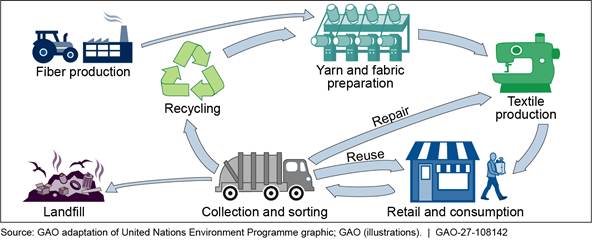
In the U.S., a textile circular economy may create potential benefits and involve challenges, according to reports by federal agencies and organizations and stakeholder interviews. Potential benefits could include creating new jobs and markets related to textile repair and recycling, reducing environmental harm, and changing consumer practices. Challenges could include limited funding and domestic infrastructure for nationwide textile collection and recycling efforts.
GAO identified a number of policy options—based on relevant literature, site visits, and interviews with 49 stakeholders in the public and private sectors—that federal and state policymakers can consider if the U.S. chooses to develop a textile circular economy. Two of the options are:
· Developing a textile extended producer responsibility program: makes companies responsible for what happens to their products after use, along with other requirements.
· Creating tax credits related to a textile circular economy: reduces or offsets the amount of taxes paid by businesses when they contribute to textile circularity efforts, such as reusing textiles or reducing textile waste.
Some U.S. states and other countries are proposing, enacting, or implementing most of the identified policy options that can help develop a textile circular economy. For example, U.S. states, the European Union, and others have proposed or enacted legislation to develop textile extended producer responsibility programs. When discussing policy options, stakeholders shared key observations. For example, several stakeholders, including industry groups, told GAO they prefer a federal approach to develop a textile circular economy. A federal approach may provide for coordination, compliance, and consistent implementation across U.S. states or other countries’ legal requirements, among other reasons, according to these stakeholders. However, this would require additional federal coordination and resources and depend on the government’s legal authority to implement a federal approach.
Why GAO Did This Study
The textile industry is part of a massive, global economic sector—including fiber sourcing, yarn production, and textile manufacturing. Textiles include apparel and other products, such as carpets, footwear, and towels. In response to global increases in the amount of textile consumption and waste, certain U.S. states and other countries have begun to consider and implement policies that can help develop a textile circular economy.
GAO was asked to review aspects of developing a textile circular economy. This report continues GAO’s previous work from December 2024 on federal efforts to address textile waste. This report describes (1) the potential benefits and challenges with developing a textile circular economy in the U.S.; (2) the options that policymakers could consider to develop a textile circular economy; and (3) identified proposed, enacted, or implemented policies, both domestically and internationally, and stakeholders’ key observations.
GAO reviewed legislation, regulations, federal agency documents, and academic reports. GAO also interviewed a range of stakeholder groups, including government entities (international, federal, and state), industry, academia, and other nonfederal stakeholders, such as representatives from nonprofit organizations. These stakeholders were selected because they have, or will have, a role in ongoing or planned efforts related to a textile circular economy or were recommended by knowledgeable officials. GAO also conducted site visits to the states of Washington and Oregon, as well as France and the Netherlands to meet with private sector organizations involved with various aspects of developing a textile circular economy.
|
Abbreviations |
|
|
|
|
|
CalRecycle |
California Department of Resources Recycling and Recovery |
|
EPR |
Extended producer responsibility |
|
EU |
European Union |
|
PFAS |
per- and polyfluoroalkyl substances |
|
PRO |
Producer responsibility organization |
This is a work of the U.S. government and is not subject to copyright protection in the United States. The published product may be reproduced and distributed in its entirety without further permission from GAO. However, because this work may contain copyrighted images or other material, permission from the copyright holder may be necessary if you wish to reproduce this material separately.
October 16, 2026
The Honorable Rosa DeLauro
Ranking Member
Committee on Appropriations
United States House of Representatives
The Honorable Chellie Pingree
Ranking Member
Subcommittee on Interior, Environment, and Related Agencies Committee on
Appropriations
United States House of Representatives
The textile industry is part of a massive, global economic sector, encompassing multiple stages of sourcing and manufacturing, that creates apparel and products such as carpets, footwear, and towels. Global increases in the amount of textile waste continue to raise concerns about environmental impacts, and there has been increased international attention about textile consumption and recycling.[1] For example, units of textile and apparel imports in the U.S. increased by an estimated 182 percent from 2000 through 2023, which likely indicates a rise in textile manufacturing and subsequent waste, according to data collected by the U.S. Department of Commerce’s International Trade Administration.
In response, certain countries and U.S. states have begun to explore policy approaches to develop a textile circular economy. However, the policy approaches currently being used to transition to a textile circular economy are nascent—they are not widely or fully implemented, are fragmented across jurisdictions, or are in a pilot phase. In a textile circular economy, materials and products are in circulation for as long as possible with businesses designing and producing products that last longer and consumers reusing and repairing items. Materials are also recoverable or recyclable, resulting in less waste overall (see fig. 1). This approach uses less raw material and intends to keep products and material within the economy, potentially in different forms.
To develop a textile circular economy in the U.S., multiple stakeholders would need to be involved. These stakeholders may include policymakers (e.g., Congress and state legislatures); producers (e.g., manufacturing and apparel businesses); textile collectors and recyclers; and consumers. Additionally, nongovernmental organizations may work with these entities and consumers to recommend policy options and standards, influence consumer behavior, and build the systems to make the economy function.
You asked us to look at aspects of developing a textile circular economy. This report continues our previous work from December 2024 on federal efforts to address textile waste.[2] This report describes (1) the potential benefits and challenges with developing a textile circular economy in the U.S.; (2) policy options that policymakers could consider; and (3) identified policies proposed, enacted, or implemented, domestically and internationally, and stakeholders’ key observations.
For all three objectives, we interviewed officials and representatives from 49 entities. This included U.S. federal entities and selected state agencies, elected officials from two U.S. states, and international government entities that had ongoing or planned efforts related to a textile circular economy. The federal entities were the U.S. Departments of Agriculture, Commerce, Defense, Energy, and State; the Environmental Protection Agency; the Federal Trade Commission; and the National Science Foundation. The selected state agencies were California’s Department of Resources Recycling and Recovery (CalRecycle) and Rhode Island’s Department of Environmental Management. The elected officials were from the states of Washington and New York, which had introduced legislation related to developing a textile circular economy. Internationally, we interviewed officials from the European Commission (the European Union’s (EU) executive body) and from agencies of the national governments in France, the Netherlands, and Chile, as well as representatives from other countries, including Australia and Canada.
In addition, we interviewed officials and representatives from domestic and international governmental and nonprofit organizations; producer responsibility organizations (PROs); non-profit and private sector collectors, sorters, recyclers; a waste management business; academia; textile repair businesses; secondhand retailers (including an e-commerce company); and brands to obtain their perspectives on developing a textile circular economy. These stakeholders were selected because they have, or will have, a role in ongoing or planned efforts related to a textile circular economy or were recommended by knowledgeable officials.
In addition, we conducted a literature review of selected academic reports, government reports, trade or industry articles, and association and nonprofit publications, among others. The purpose of the literature review was to obtain information and any related data for our three objectives.
To describe the potential benefits and challenges of developing a textile circular economy in the U.S., we analyzed relevant reports and documents identified from the literature search, federal agencies, international government entities, and nonprofit organizations. We analyzed these documents to obtain information on potential benefits and challenges with developing a textile circular economy.
To describe policy options that policymakers could consider, we identified options by reviewing relevant literature (including academic and agency reports), interviewing stakeholders, and conducting site visits. We analyzed the results of the literature search to obtain information on possible policy options. We also analyzed relevant documents and data from U.S. federal agencies, U.S. state agencies (such as CalRecycle), international government entities, and organizations (international and domestic). Based on our review of documents, interviews with stakeholders, and information collected during site visits, we grouped the policy options into six categories, such as maintaining the status quo at the federal level and expanding industry responsibilities.
To describe identified policies proposed or implemented domestically and internationally, as well as stakeholders’ key observations, we analyzed the results of the literature search and relevant documents from U.S. federal agencies, U.S. states, and international government entities and organizations. We also conducted a legal review of U.S. states and other countries that have proposed or enacted laws and regulations related to developing a textile circular economy.
We conducted site visits in Washington State and Oregon, as well as France and the Netherlands to meet with private sector organizations involved with a textile circular economy and tour their facilities. For example, we visited for-profit and non-profit collectors and sorters of discarded textiles, repair businesses, and chemical and mechanical textile recyclers, among others.
We conducted this performance audit from February 2025 to October 2026 in accordance with generally accepted government auditing standards. Those standards require that we plan and perform the audit to obtain sufficient, appropriate evidence to provide a reasonable basis for our findings and conclusions based on our audit objectives. We believe that the evidence obtained provides a reasonable basis for our findings and conclusions based on our audit objectives.
Background
Status Quo for the Textile Economy
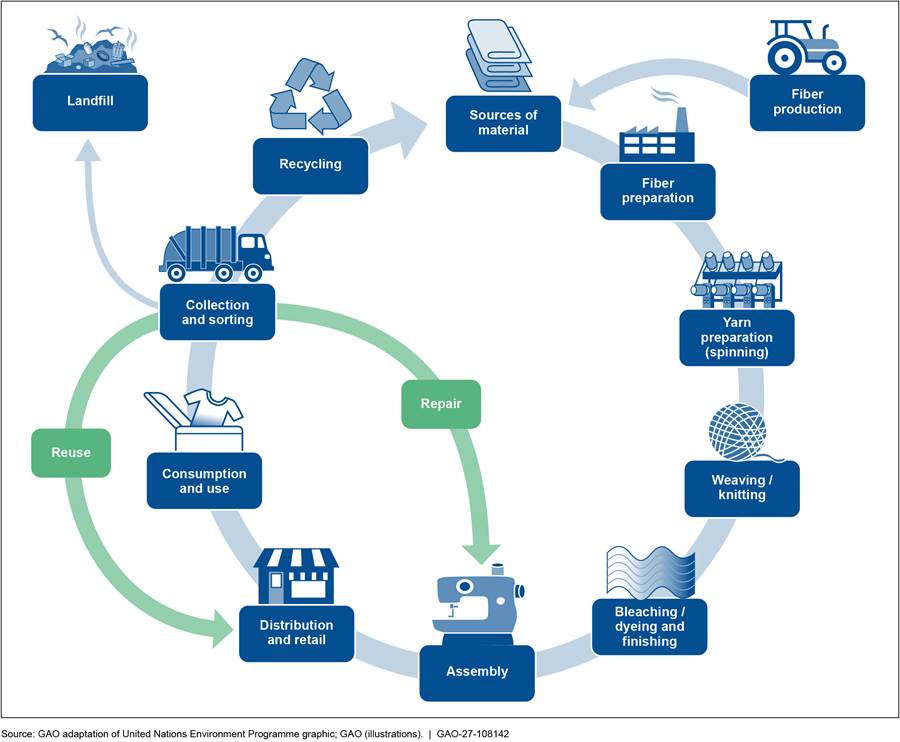
Currently, textiles are produced in a linear economy, where most raw materials are produced, distributed, consumed, and then disposed (see fig. 2). A textile linear economy covers several industries, from agriculture and petrochemicals to manufacturing, distribution, and retail.[3] This economy includes certain limited recycling efforts, but these efforts do not significantly divert textiles from the landfill. Generally, for the U.S., the production phases for textiles occur in other countries while the consumption phases and end-of-life phases (collection and landfilling) happen domestically.
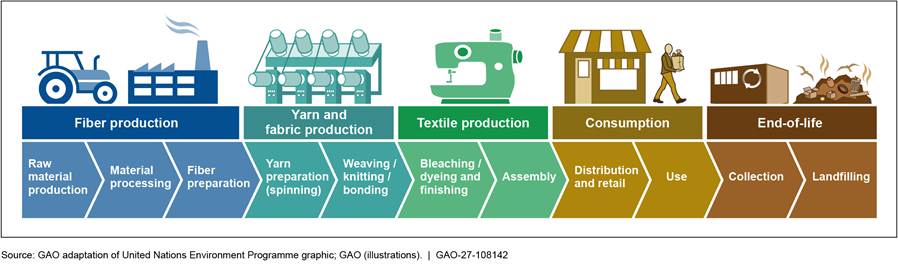
A value chain describes the sequence of activities and stakeholders involved in the producing, consuming, and disposing of textiles. It maps where value is added to the product or economy and can be linear or circular. In a linear economy, materials typically flow in a one-way direction in a value chain—from raw resource extraction to waste. In contrast, a circular economy aims to reuse, repair, and recycle materials to be added back into the value chain.
Stakeholders in a Textile Value Chain
Stakeholders may be involved in one or more phase of the value chain in a linear or circular textile economy (see fig. 3). Further, some stakeholders may interact with each other based on their roles in the value chain. For example, an apparel company may work with a textile recycler to recycle returned products.
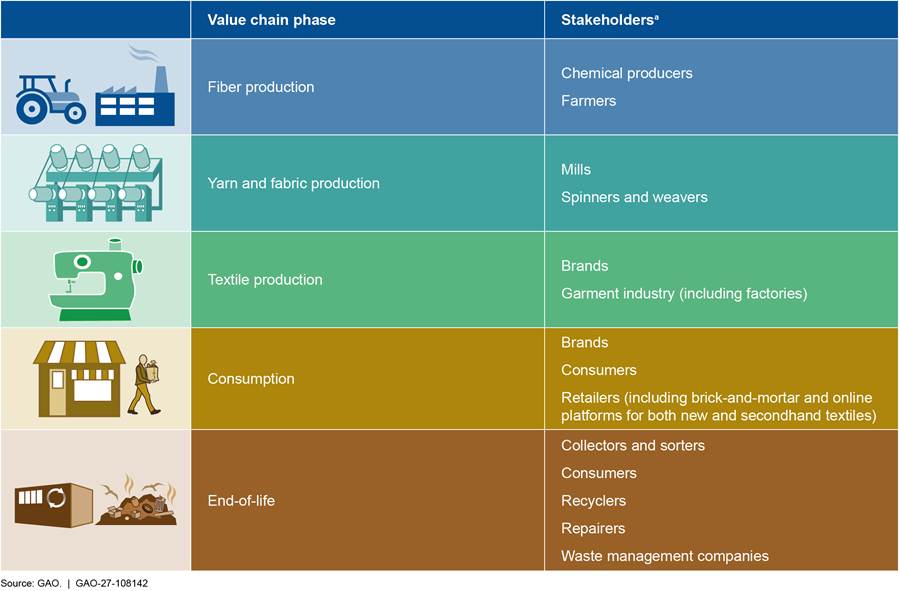
Note: A value chain describes the sequence of activities and stakeholders involved in the producing, consuming, and disposing of textiles. It maps where value is added to the product or economy and can be linear or circular.
aOther stakeholders that are not listed in the figure may be involved in a textile linear or circular economy but not within the listed phases of the value chain. For example, government entities at the U.S. national, state, and local level set policy to determine actions that happen during certain phases. Other stakeholders may include non-governmental organizations, trade groups, academia, and different types of recyclers. For example, “upcyclers” turn discarded textiles into products with higher value, and “downcyclers” convert discarded textiles into lower value items, such as rags.
Other stakeholders are involved in a linear or circular economy but not within specific phases of the value chain. For example, government entities at the U.S. national, state, and local level set policy to determine actions that happen during certain phases.
Impacts of Fast Fashion Textiles
The fast fashion business model produces textiles at a lower cost and quality. Under this model, trends change frequently, consumers buy textiles many times per year, and they dispose of textiles after using them for a short period of time. The amount of fast fashion products in the market has increased because of many drivers, including social media, according to a 2022 journal article.[4] While the fast fashion business model is financially successful, it also creates negative impacts, such as degrading the environment and encouraging overconsumption. Specifically, products that are not designed to last may end up as textile waste in landfills more quickly than products designed for durability. The European Environment Agency also reported in 2025 that increased online sales in textiles has enabled lower prices, greater variety of products, and easier returns via online markets. These easier return policies have also resulted in an increase in returns, of which 22 to 44 percent are not resold to a consumer and become waste.[5]
Textile Recycling Technologies
|
GAO’s Prior Work on Federal Actions to Reduce Textile Waste and Promote Recycling In a December 2024 report, GAO found that agencies were starting to look at textile waste and recycling options, which is one aspect of a textile circular economy. As part of this work, GAO found that U.S. federal agencies are taking individualized actions and not collaborating with one another, in part because no national requirement to address textile waste and advance recycling exists, and agencies face limited resources and staffing, according to federal officials. Further, agencies are not prioritizing work in this area. GAO also found that the agencies’ approach of taking individualized actions increases the risk of fragmentation, duplication, and overlap. Therefore, GAO recommended Congress consider providing direction and delegating authority to an agency to take coordinated action and further highlighted this matter for congressional consideration in GAO’s 2025 Fragmentation, Overlap, and Duplication report. In September 2026, Congress introduced legislation that would implement this matter. GAO also recommended that the U.S. Environmental Protection Agency, the National Institute of Standards and Technology, the Office of Science and Technology Policy, the Department of State, the Department of Energy, and the National Science Foundation establish an interagency mechanism to coordinate federal efforts on textile circularity. As of June 2026, officials from the Office of Science and Technology Policy said that this interagency mechanism had not started because the likely coordinating mechanism, the Office’s National Science and Technology Council, is not focused on the issue of textile waste. Source: GAO‑25‑107165, GAO‑25‑107604, GAO‑24‑107486, and H.R. 10454, 119th Cong. (2026). | GAO‑27‑108142 |
Textile recycling aims to create products that can re-enter the textile value chain. Before the recycling processes start, discarded textiles are collected; sorted based on fabric type and quality, usually done manually through thorough inspections; and cleaned and prepared.
As previously reported, the two types of recycling technologies currently used for textiles are mechanical and chemical (see fig. 4).[6]
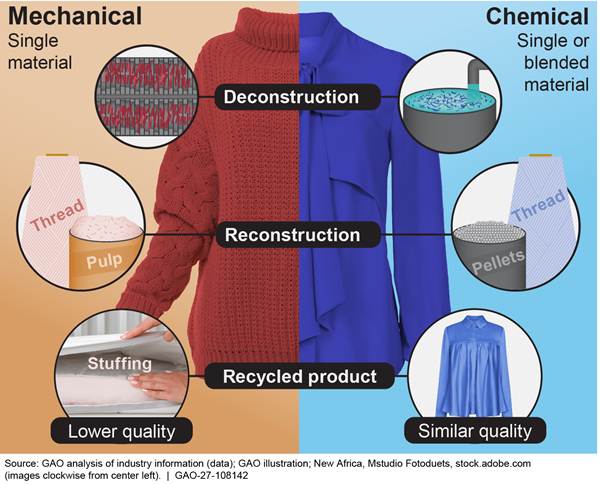
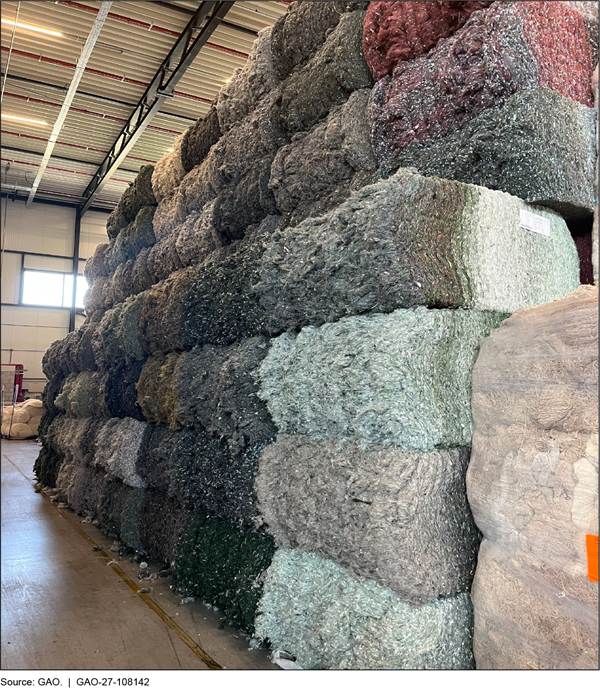
Mechanical recycling involves physically deconstructing fibers through methods such as shredding, crushing, or melting, before reprocessing fibers back into yarn (see fig. 5). This type of recycling is most effective with single materials, such as 100 percent cotton.
Chemical recycling reduces textiles to their basic molecular building blocks using chemical solutions, then rebuilds them to produce fibers of similar quality. The required chemical solution differs based on textile material.
Recycled textiles may not have the same potential useful life or economic value compared with a textile produced with materials that have never been used, processed, or recycled.[7] Specifically, mechanical recycling reduces fiber length and quality, which results in less durable and lower performance products compared with textiles made with new materials. Currently, both textile recycling options face barriers. For example, the extensive use of blended fibers (such as synthetics) in textiles limits mechanical recycling. Further, chemical textile recycling is less mature and not available for widespread use.
Collection and Management of Textile Waste in the U.S.
Options for textile waste disposal in the U.S. include landfilling, combustion with energy recovery, and when available, recycling. EPA’s guidelines to U.S. states recommend that solid waste management plans include recycling and resource conservation whenever technically and economically feasible.[8]
A Textile Circular Economy Could Create New Jobs but Faces Funding Challenges, Among Other Potential Benefits and Challenges
Developing a textile circular economy in the U.S. may create benefits, but challenges may limit implementation, according to our review of selected academic journal articles, reports by industry and other organizations, and interviews with U.S. federal agency officials and other stakeholders. These benefits may be realized at different phases of a textile circular economy’s value chain, depending on various factors, such as advancements in chemical textile recycling and the availability of infrastructure to collect and recycle textiles. In addition, because developing a textile circular economy, or textile circularity, is an emerging area, the benefits and challenges discussed below may not be exhaustive and may evolve as the area develops.[9]
Benefits May Include Job Creation and Less Pollution
Developing a textile circular economy in the U.S. may create economic, environmental, and consumer benefits, according to government documents, our literature review, and stakeholders we spoke with. The possible benefits include the following.
U.S. economy may gain new jobs and markets, such as textile repair and recycling. Economic benefits from the development of a textile circular economy may include the creation of new markets and jobs in certain sectors of the textile value chain. While the overall effects of transitioning to a circular economy are unknown, it may lead to job gains in some sectors, the need for different job skills, and potential job losses in other sectors, particularly in the short term.[10] Specifically, transitioning to a circular economy could lead to job creation in certain sectors (such as recycling and reuse), job substitution within or across sectors (such as among waste management facilities), existing jobs requiring new skills, and job losses in some sectors that are more dependent on the current linear textile economy.
The following are markets that may experience economic growth:
· Secondhand retailers. The secondhand textiles retail market may create jobs, such as for collection, processing, retail, logistics, and technology. This market has the potential to provide reliable jobs (often to marginalized populations) in the U.S. and other countries, according to a 2022 journal article.[11]
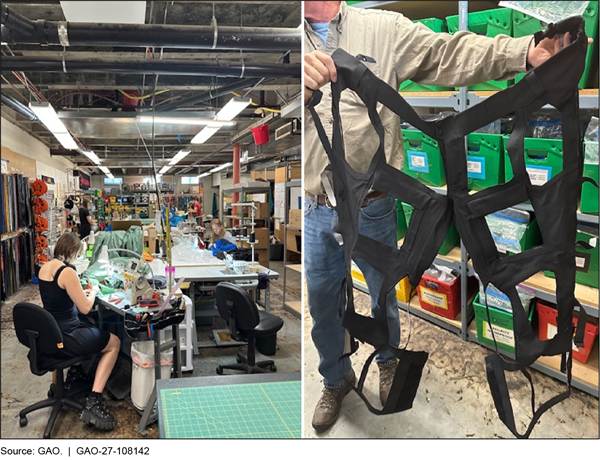
· Repair businesses. The development of a textile circular economy may provide domestic job opportunities for repair businesses, as this work needs skilled and manual labor, according to a textile repair industry stakeholder (see fig. 6).
Left: the workshop of an outdoor gear repair company. Right: Discarded pants that have been used to create patches to repair gear.
· Recycling businesses. As we previously reported, mechanical and chemical textile recycling may create job opportunities, including design and sorting, as it continues to mature.[12] A 2024 case study by organizations and companies within the textile industry also stated that more than half of textile waste could be recycled into new textiles, with the potential to generate up to $1.5 billion in annual market value.[13] Also, officials from a U.S. federal agency said companies that create new materials, such as from recycled textiles, for use in the economy may benefit financially.
|
Role of AI in Sorting of Textiles Most discarded textiles are sorted manually. People assess the quality of a textile, decipher the composition of the textile’s materials through visual inspection, and remove non-fiber elements (like zippers) before mechanical or chemical recycling occurs. Some facilities also use technologies that can identify a textile’s color and fiber content. However, this technology is limited, such as only being able to analyze a textile’s surface and potentially not identify underlying materials. AI has been identified as a way to significantly expedite the time needed to sort textiles and reduce labor costs; whereby, larger amounts of textiles could be more efficiently sorted or the quality and condition of a garment assessed, according to a 2025 academic article. Further, AI could be used to detect stains and other imperfections, which could have two important outcomes to help develop a textile circular economy. First, consumer confidence could increase with regard to purchasing second-hand textile items and could shift consumer behavior toward more sustainable consumption patterns. Second, accurate stain identification can help the textile recycling process by ensuring that clean and usable materials are identified. Source: GAO summary of academic articles. Dannyburn/adobe.stock.com (photo). | GAO‑27‑108142 |
· Infrastructure developers. The development of a circular economy necessitates investing in and building new infrastructure, such as recycling centers and facilities to collect and store textiles. This may promote economic growth by creating jobs in these areas, according to industry and nonfederal stakeholders.
Changes to industry’s practices may reduce harm to the environment. Another benefit of transitioning to a textile circular economy may include a reduction of harm to the environment, according to reports and U.S. federal officials. The extension of a textile product’s life through various reuse, repair, and recycling options[14] can reduce emissions, pollution, and demands on resources compared with the environmental impact of producing new items, according to a journal article.[15] For example, recycling textiles could lessen resource demands associated with creating new polyester, which companies increasingly continue to use, according to U.S. federal officials. Creating new polyester fibers involves the extraction of crude oil, which creates pollution and contributes to greenhouse gas emissions, among other environmental harms, according to academic research.[16]
Consumers may change the ways they purchase and dispose of textiles. A potential benefit of the development of a textile circular economy in the U.S. may include shifts in consumption and disposal behaviors at the individual consumer level. A 2025 journal article stated that within circular economies, consumers may have the ability to consume more responsibly and choose items that align with their personal sustainable values.[17] Various tools may also facilitate these behavior changes. For example, online platforms for secondhand clothing sales and other items have experienced increasing usage and sales, according to a 2024 academic study and the European Environment Agency.[18] In addition, this study stated that with a transition to a textile circular economy, consumers may shift from viewing discarded textiles as “waste” to a “valuable” resource.
Challenges May Include Limited Infrastructure and Funding
Development of a textile circular economy in the U.S. may face several challenges, including limitations related to infrastructure, funding, technology, data, and standardization, according to our review of academic journals, reports by U.S. federal agencies and organizations, and interviews with stakeholders.
Infrastructure related to textile circularity is not scaled to meet the needs of a circular economy. The type of infrastructure—including collection and recycling facilities—to help support the development of a textile circular economy is not established or available to scale in the U.S., according to reports by industry stakeholders and others.[19] Textile products cannot be easily combined with other recycled materials—such as glass and paper—due to contamination issues. Federal officials noted that the U.S. lacks a coordinated national system for textile collection, sorting, and preprocessing that is separate from other waste streams. As a result, supply chains are fragmented and feedstock to create new textiles has inconsistent quality.[20] A 2025 report also described that the current state of limited textile recycling opportunities will likely continue since recycling has received little innovative attention in the U.S.[21]
Funding is limited, and potential investors may be deterred due to uncertain returns. Industry and nonfederal stakeholders identified as a challenge the limited funding currently provided by the private sector, including for building infrastructure for recycling or supporting research and development. Federal agency officials also explained that while recycling technologies are technically viable, market uncertainty and
insufficient demand for recycled fibers can undermine commercial scalability. Potential investors may be deterred from providing funding because their returns are uncertain, and investments are seen as high risk, according to a textile recycling stakeholder. Further, a report from a 2021 workshop held by a U.S. federal agency with stakeholders from across the textile value chain also stated that recyclers are hesitant to invest millions of dollars in large-scale infrastructure before improvements occur in the collection of textiles to consistently provide a reliable feedstock.[22]
Data to support circularity efforts are not being collected. According to agency officials and a journal report, comprehensive data are generally not being collected to support the development of a textile circular economy. This includes data that track how, where, and at what quantity and cost textiles are produced, used, collected, reused, recycled, and discarded.[23] Data collected by companies and organizations are often proprietary, and therefore unavailable publicly, and may not be standardized across industries. We previously reported that EPA officials identified some of the data and sources that the agency would need to collect to develop a textile waste strategy, including identifying current U.S. infrastructure that recovers and reuses textiles. However, no governing law authorizes an entity to collect the data nationwide or authorizes the significant funding required to collect and analyze the data.
No terminology standards exist for key aspects of a textile circular economy. Terminology standards currently do not exist for key aspects of a textile circular economy, according to a 2024 report.[24] For example, terms such as textile, reuse, and downcycling can be unclear. The report stated that clear terminology would create commonality across stakeholders and build standards, markets, and policies. Further, standardization of metrics, methods, tools, and practices that work together under a unified framework supports the development of a textile circular economy and enables consumer confidence.
Policymakers Can Consider a Number of Options, Such as Maintaining the Status Quo or Implementing an Extended Producer Responsibility Program
We identified 22 options that policymakers can consider to help develop a textile circular economy in the U.S.[25] For the purposes of this report, policymakers include Congress, state legislatures, and other stakeholders that are in a position to make decisions on what policy options to implement. We grouped policy options by broad goals and themes, and various options could be implemented individually or in combination.
The listed policy options are not exhaustive but can provide policymakers with a broad base of information for decision-making. Determining the best option is a policy choice and requires complex tradeoff decisions. GAO does not endorse any particular option. We have not assessed these policy options for their feasibility, legality, or effectiveness. We also express no view regarding the extent to which federal or state
governments would have the legal authority to implement them. We do, however, describe the potential opportunities and considerations associated with each option.
Maintaining Status Quo at the Federal Level
Policymakers could consider maintaining the status quo, meaning no policy options would be implemented at the federal level to develop a textile circular economy (see table 1).
|
Federal Status Quo |
|
|
Description: Implements no policy options at a national level to develop a textile circular economy. Some individual states may enact programs or policy options. |
|
|
Opportunities |
Considerations |
|
· States could determine how and if to use their resources to develop a textile circular economy within their jurisdiction. · The federal government continues to allocate federal funding and resources toward other efforts not related to a textile circular economy. · State implementation may be able to inform other levels of government considering policy options. |
· Nonfederal stakeholders, such as states, would lead the development of a textile circular economy for the U.S. · Industry may face inconsistencies without a federal approach as U.S. states may implement their own efforts without federal laws, regulations, standards, or federal funding. · Textile recycling and related markets may face nationwide inefficiency and instability. · Cost disparities may occur for businesses transitioning to a textile circular economy. · Current efforts are unlikely to address, on a nationwide basis, the challenges associated with increasing amounts of textile waste. |
Source: GAO analysis of stakeholder documents and interviews. | GAO‑27‑108142
Note: We identified policy options through our review of relevant literature, site visits, and interviews with stakeholders in the public and private sectors. Policymakers include Congress, state legislatures, and other stakeholders in a position to make decisions on what policy options to implement. This list is not exhaustive but can provide policymakers with a broader base of information for decision-making. We have not assessed these options for their feasibility, legality, or effectiveness. We also express no view regarding the extent to which federal or state governments would have the legal authority to implement them.
Expanding Industry Responsibilities
Policymakers could consider expanding industry responsibilities, meaning industry becomes more responsible for reducing waste and using more recycled material, among other goals, when designing, producing, and disposing of textiles. Specific policy options include extended producer responsibility (EPR), recycled content requirements, sustainability design requirements, and industry standardization (see table 2).
|
Extended producer responsibility (EPR) |
|
|
Description: Creates a mandatory or voluntary fee-based program that requires producers to be responsible for the end-of-life management of textiles. The responsibility, including costs, for collecting, sorting, recycling, and properly disposing of products shifts from consumers and governments to producers. EPR programs often use a producer responsibility organization (PRO) to collect and manage funds related to the program’s costs. This option aims to encourage sustainable product design, reduce waste, and promote a circular economy. |
|
|
Opportunities |
Considerations |
|
· Funding generated from the program may be available, such as for infrastructure projects. · Sustainable design, reuse, and recycling may be incentivized. · Industries for collecting, sorting, repairing, reselling, and recycling textiles may expand. · Transparency for textiles’ end-of-life options may increase for consumers, and accountability may increase for industry. · If legal authority exists to implement nationally, the government can develop a federal strategy and oversee the program. With a nationwide strategy, U.S. states may not need to propose their own legislation, and industry may not have to coordinate compliance with individual states. |
· Infrastructure to collect, sort, and store discarded textiles must be expanded and built. · Producers may incur higher production costs, and consumers may experience higher prices because of program implementation. · Incentives and penalties must be sufficient to encourage all businesses along the value chain to participate in the program. · If a nationwide strategy is not developed, industry would need to coordinate compliance with individual state programs. · Existing technology to create quality recycled content is limited and not to scale. · Level of effort and resources needed from industry sectors and the government may increase. · If policies that often support textile EPR programs, such as sustainable design or recycled content requirements, are missing or underdeveloped from the program, then the program may not function as intended. |
|
Recycled content requirements |
|
|
Description: Requires textile composition to include a percentage of recycled fiber content, either from textiles or other recycled materials, such as plastic bottles. |
|
|
Opportunities |
Considerations |
|
· Recycled content requirements could increase the textile industry’s demand for recycled fibers. · Industries for collecting, sorting, and recycling textiles may expand. |
· Compliance may be difficult if individual jurisdictions implement the policy. For example, businesses may not be willing to produce products to meet the requirements of a single state or country. · Infrastructure to collect and store materials, such as discarded textiles, to produce recycled content is limited and not to scale. · Technology to create quality recycled content is limited and not to scale. · Recycled content is often more expensive to produce than new materials. · Currently, textiles can only be mechanically recycled a few times before needing to be landfilled. · Level of effort and resources needed from textile industry sectors may increase. |
|
|
|
|
Sustainability design requirements |
|
|
Description: Sets design requirements for almost all categories of textiles. Requirements may include making products durable, reuseable, and repairable; removing contaminants (such as per- and polyfluoroalkyl substances, or PFAS) and disruptors (such as zippers and buttons); and using certain materials, such as certain fibers or recycled content. |
|
|
Opportunities |
Considerations |
|
· Industry may produce textiles that are more sustainable in terms of durability and recyclability. |
· Multiple categories and types of textiles could require unique and separate design requirements. For example, requirements may greatly differ for shoes versus t-shirts. · Infrastructure to support reuse, repair, textile collection, and textile recycling is limited and not to scale. · Technology to create quality recycled content is limited and not to scale. · Depending on what types of requirements are established, producers’ costs may increase. · Level of effort and resources needed from textile industry sectors may increase. |
|
Industry standardization |
|
|
Description: Standardizes aspects of the textile industry, including (1) definitions of terms, such as recycling; (2) metrics, such as durability and sustainable design; and (3) certain product elements, such as textile labels. Industry standardization may be a collaborative effort between private organizations, government agencies, and nongovernment organizations. |
|
|
Opportunities |
Considerations |
|
· Collaboration among stakeholders who manage different activities across the value chain may improve. · Sorters, recyclers, and consumers could more easily identify textiles for reuse and recycling. · Increased transparency for consumers and recyclers on composition of textile products. |
· Definitions would need to be established or recognized domestically or internationally to be effective. · Unclear which stakeholders would be responsible for developing standards. · Wider participation in the development of industry standards, such as domestically and internationally, may support adoption and implementation. · Level of effort and resources needed from textile industry sectors and the government may increase. |
Source: GAO analysis of stakeholder documents and interviews. | GAO‑27‑108142
Note: We identified policy options through our review of relevant literature, site visits, and interviews with stakeholders in the public and private sectors. Policymakers include Congress, state legislatures, and other stakeholders in a position to make decisions on what policy options to implement. This list is not exhaustive but can provide policymakers with a broader base of information for decision-making. We have not assessed these options for their feasibility, legality, or effectiveness. We also express no view regarding the extent to which federal or state governments would have the legal authority to implement them.
Incentivizing or Requiring Action to Promote Reuse or Discourage Waste
Policymakers could consider incentivizing or requiring action, such as imposing taxes, that promote using recycled textiles and discourage practices that would otherwise likely lead to increased textile waste, among other goals. Specifically, options include circular duty drawback, tax credits, a fast fashion tax, a sales tax exemption for secondhand textiles, a fast fashion advertising ban, procurement requirements, a funding mechanism, and eco-modulation (see table 3).
|
Circular duty drawback |
|
|
Description: Refunds businesses for duties on imported textiles if the products are reused and recycled, among other recognized circular practices. Businesses would not receive refunds if the products are ultimately disposed of or exported. |
|
|
Opportunities |
Considerations |
|
· Domestic reuse, repair, and recycling industries could expand. · Businesses are incentivized to reduce textile waste. |
· Could require a change in tax code or import policies, as well as the establishment of a third-party verification system. · Infrastructure to support reuse, repair, textile collection, and textile recycling is limited and not to scale. · Level of effort and resources needed from the government may increase. |
|
Tax credits |
|
|
Description: Reduces or offsets the amount of taxes paid by businesses. For example, businesses could receive tax credits when they contribute to textile circularity efforts or reduce textile waste. This could include tax credits for businesses to purchase secondhand products, manage repair programs, use recycled content in products, and improve infrastructure for the industry. |
|
|
Opportunities |
Considerations |
|
· Industries may be incentivized to change business practices, including collaborating with other businesses. |
· Governments could receive less tax revenue.a · Nonprofit organizations may not be able to benefit from tax credits due to tax exempt status. · Level of effort and resources needed from the government may increase. |
|
Fast fashion tax |
|
|
Description: Imposes a tax on fast fashion products or brand owners that produce clothing quickly and cheaply so stores can sell new styles. The tax could result in a cost increase, which may be absorbed by the consumer in the product’s final price. |
|
|
Opportunities |
Considerations |
|
· Tax could deter consumers from purchasing fast fashion products and encourage the purchase of more sustainable products. · Governments would receive revenue from fast fashion product tax. |
· Implementation could be complex because fast fashion does not have a standard definition, and the tax may not be equally applied to all businesses that manufacture or sell these products. · Tax may need to differentiate between brand owners that have both fast fashion and non-fast fashion products. · Tax could disproportionally affect lower-income and younger consumers. · Level of effort and resources needed from the government may increase. |
|
Sales tax exemption for secondhand textiles |
|
|
Description: Exempts sales tax for secondhand textiles sold by retailers. |
|
|
Opportunities |
Considerations |
|
· Consumers may be incentivized to buy secondhand products. |
· Governments would receive less tax revenue from secondhand textile purchases. · Level of effort and resources needed from the government may increase. |
|
|
|
|
Fast fashion advertising ban |
|
|
Description: Places a ban on advertising fast fashion products, such as social media platforms. |
|
|
Opportunities |
Considerations |
|
· Could shift consumer consumption away from fast fashion products. |
· Implementation and enforcement may be complex because fast fashion does not have a standard definition, and the definition may not be equally applied to all businesses that manufacture or sell these products. · Level of effort and resources needed from government may increase. |
|
Procurement requirements |
|
|
Description: Requires that textile products purchased by the government meet certain standards, such as durability requirements, recycled content requirements, or other related textile circularity standards. Examples of these products may include uniforms for government workers, carpets, and furniture. |
|
|
Opportunities |
Considerations |
|
· If implemented at the federal level, lower levels of government may also replicate these federal requirements. · Could lead to industry-wide changes in design and production. |
Depending on what type of requirements are established: · Infrastructure to support reuse, repair, textile collection, and textile recycling is limited and not to scale. · Infrastructure to collect and store materials, such as discarded textiles, to produce recycled content is limited and not to scale. · Technology to create quality recycled content is limited and not to scale. · Level of effort and resources needed from the government may increase. |
|
Funding mechanism |
|
|
Description: Creates a funding mechanism for stakeholders’ projects and efforts, such as building new infrastructure, that supports the development of a textile circular economy. The federal government, state governments, the private sector, or a combination could provide funding. |
|
|
Opportunities |
Considerations |
|
· Funding mechanism can provide new streams of funding for certain industries, such as textile recyclers. · Funding may become available to a wide range of private and nonprofit organizations. · Increased funding could encourage businesses to begin or continue operating in the U.S. |
· To establish a funding mechanism, existing funding streams may need to be adjusted, or new funding may need to be developed. · Level of effort and resources needed from government may increase. |
|
Eco-modulation |
|
|
Description: Promotes sustainable textile production through a fee structure that adjusts based on producer behavior and materials used. An organization oversees and collects fees from producers, with the fees used to fund collection, recycling, and waste management programs. For example, producers pay lower fees if they use materials or implement practices that minimize their environmental impact. Conversely, they may be required to pay higher fees if they use materials or implement practices considered environmentally harmful. |
|
|
Opportunities |
Considerations |
|
· Producers could be incentivized to create more sustainable products or use more sustainable practices. · Eco-modulation could increase demand for sustainable materials, such as recycled content. |
· Eco-modulation fees must be high enough to encourage producer participation. · Criteria may need to be created to help establish fees. |
Source: GAO analysis of stakeholder documents and interviews. | GAO‑27‑108142
Note: We identified policy options through our review of relevant literature, site visits, and interviews with stakeholders in the public and private sectors. Policymakers include Congress, state legislatures, and those in a position to make decisions on what policy options to implement. This list is not exhaustive but can provide policymakers with a broader base of information for decision-making. We have not assessed these options for their feasibility, legality, or effectiveness. We also express no view regarding the extent to which federal or state governments would have the legal authority to implement them.
aGAO previously observed that policymakers should assess tax expenditures—including tax credits—based on several criteria, including whether the expenditure achieves its purpose, whether it is equitable, its consequences for the federal budget, and how it can be evaluated. See GAO, Tax Expenditures: Background and Evaluation Criteria and Questions, GAO‑13‑167SP (Washington, D.C.: Nov. 29, 2012).
Managing Waste
Policymakers could consider options to regulate textile waste within a circular economy to reduce disposal in municipal waste streams or landfills. Options include textile landfill bans, waste collection requirements, export bans on discarded textiles, end-of-life criteria for textiles, and destruction bans (see table 4).
|
Textile landfill ban |
|
|
Description: Bans textiles from being disposed of in municipal waste streams or landfills. |
|
|
Opportunities |
Considerations |
|
· Textiles would be diverted from landfills and could be used in other capacities, such as recycling. · Landfill capacity may be available for other waste streams. |
· Requires effective enforcement mechanisms to prevent landfilling of discarded textiles in other jurisdictions with fewer landfill restrictions. · Landfilling could be the preferred option for certain textile waste, such as textiles containing per- and polyfluoroalkyl substances (PFAS) or other contaminants. · Infrastructure to support reuse, repair, textile collection, and textile recycling is limited and not to scale. · Current market options for textiles, such as secondhand stores and businesses that use recycled textile content, may not be developed enough to keep textiles from being landfilled. · Level of effort and resources needed from the government may increase. |
|
Waste collection requirements |
|
|
Description: Requires discarded textiles to be separately collected from other waste streams or subject to mandatory classification requirements, such as recyclables. Requirements could direct local governments to manage collection and classification by waste types, discarding, collection method, and disposal, among other things. |
|
|
Opportunities |
Considerations |
|
· Textiles could be diverted from landfills and used in other capacities, such as reuse or recycling. |
· Consumers and industry stakeholders would need awareness about collection requirements to prevent discarding textiles inaccurately, such as landfilling textiles that are reusable or recyclable. · Infrastructure and funding to support separate textile collection and storage is limited and not to scale. · Level of effort and resources needed from the government may increase. |
|
|
|
|
Export ban on discarded textiles |
|
|
Description: Prohibits the export of discarded textiles from a country or state. |
|
|
Opportunities |
Considerations |
|
· Increases the amount of available feedstock for domestic textile-to-textile recycling. |
· Organizations or businesses that currently rely on exporting textile waste may need to find alternative solutions. · Reusable products could still be landfilled. · Businesses and governments may be unable to export discarded materials to other countries to resell. · Other countries could experience disruptions in receiving secondhand textiles. · Current market options for textiles, such as secondhand stores and businesses that use recycled textile content, may not be developed enough to prevent textiles from being landfilled. · Infrastructure to support reuse, repair, textile collection, and textile recycling is limited and not to scale. · Level of effort and resources needed from textile industry sectors and the government may increase. |
|
End-of-life criteria for textiles |
|
|
Description: Establishes criteria to determine whether a textile is at end-of-life, which is the last phase of the value chain. The criteria could include if the product can be repaired, reused, or recycled or should be landfilled. These criteria help industry and consumers understand the best option for a used textile based on its current state. |
|
|
Opportunities |
Considerations |
|
· Consumers and industry may gain an understanding of end-of-life options for textiles. · The cost of fiber production could decrease as new sources, like recycled fibers, increase in availability. |
· Unclear which stakeholders would be responsible for creating these criteria. · Level of effort and resources needed from textile industry sectors and the government may increase. |
|
Destruction ban |
|
|
Description: Prohibits the destruction, such as landfilling or incineration, of unsold textiles. Certain textiles would be exempt from the destruction ban. For example, this ban would not apply to textiles with hygiene or safety concerns, which could include personal protective equipment. |
|
|
Opportunities |
Considerations |
|
· Textiles could be diverted from landfills and used in other capacities, such as reuse. |
· Infrastructure to collect and store unsold textiles is limited and not to scale. · Level of effort and resources needed from textile industry sectors may increase. |
Source: GAO analysis of stakeholder documents and interviews. | GAO‑27‑108142
Note: We identified policy options through our review of relevant literature, site visits, and interviews with stakeholders in the public and private sectors. Policymakers include Congress, state legislatures, and other stakeholders in a position to make decisions on what policy options to implement. This list is not exhaustive but can provide policymakers with a broader base of information for decision-making. We have not assessed these options for their feasibility, legality, or effectiveness. We also express no view regarding the extent to which federal or state governments would have the legal authority to implement them.
Obtaining Information to Support a Textile Circular Economy
Policymakers could consider options to obtain information—such as through research and development and data collection—which may ultimately help support future policymaking, program implementation, and the development of a textile circular economy (see table 5).
|
Research and development |
|
|
Description: Encourages entities to innovate, research, and develop new processes for textile products or improve existing ones. Research efforts can be undertaken in various formats in public and private sectors. For example, challenge competitionsa could be used to encourage innovation by industry stakeholders. |
|
|
Opportunities |
Considerations |
|
· Some textile industries, such as chemical textile recycling, could benefit from research and development efforts. · Governments could encourage innovation throughout the textile value chain. |
· Research can be expensive and lengthy. · No guarantee that research will improve products or impact industry practices. · Level of effort and resources needed from industry sectors and the government may increase. |
|
Data collection |
|
|
Description: Collects data related to aspects of developing a textile circular economy, such as the amount of textile waste in the U.S. or analyses of how much textiles cost at the different phases of the value chain. |
|
|
Opportunities |
Considerations |
|
· Data collected and analyzed could inform policy. · Stakeholders could be more supportive of developing and implementing policies after data are collected and analyzed. |
· Uncertainty about who would be responsible for data collection and its analysis. · Level of effort and resources needed from textile industry sectors and the government may increase. |
Source: GAO analysis of stakeholder documents and interviews. | GAO‑27‑108142
Note: We identified policy options through our review of relevant literature, site visits, and interviews with stakeholders in the public and private sectors. Policymakers include Congress, state legislatures, and other stakeholders in a position to make decisions on what policy options to implement. This list is not exhaustive but can provide policymakers with a broader base of information for decision-making. We have not assessed these options for their feasibility, legality, or effectiveness. We also express no view regarding the extent to which federal or state governments would have the legal authority to implement them.
aChallenge competitions are a way for government agencies and others to ask the public for help solving problems. Individuals or teams can submit ideas and win prizes. For example, Patagonia, an apparel business, held competitions related to textiles, including a 2016 competition related to developing water repellent for clothing.
Educating and Engaging the Public
Policymakers could consider educating and engaging the public through public awareness campaigns and consumer participation incentives to achieve textile circularity goals (see table 6).
|
Public awareness campaigns |
|
|
Description: Creates campaigns to educate and raise consumer awareness about textile circularity and textile waste. |
|
|
Opportunities |
Considerations |
|
· Consumers may be able to make more informed choices, such as how to keep textiles out of the waste stream. |
· Public awareness campaigns may be costly relative to their impact. · Unclear who would develop and fund the campaigns. · Level of effort and resources needed from the government may increase. |
|
Consumer participation incentives |
|
|
Description: Uses a variety of financial incentives to encourage consumer participation in the textile circular economy. Examples include consumer refunds or discounts on purchases if products are recycled or repaired instead of disposed in waste streams. |
|
|
Opportunities |
Considerations |
|
· Could incentivize consumers to recycle, repair, and reuse textiles. · Industries for collecting, sorting, repairing, and recycling textiles may expand. |
· Level of effort and resources needed from industry sectors and the government may increase. |
Source: GAO analysis of stakeholder documents and interviews. | GAO‑27‑108142
Note: We identified policy options through our review of relevant literature, site visits, and interviews with stakeholders in the public and private sectors. Policymakers include Congress, state legislatures, and other stakeholders in a position to make decisions on what policy options to implement. This list is not exhaustive but can provide policymakers with a broader base of information for decision-making. We have not assessed these options for their feasibility, legality, or effectiveness. We also express no view regarding the extent to which federal or state governments would have the legal authority to implement them.
U.S. States and Other Countries Have Implemented Several Policies; Stakeholders Noted Need for Mandatory Policies, Data, and Consumer Education
U.S. States and Other Countries Have Proposed or Implemented Several Policies, Such as Textile EPR Programs
We identified several policies that were proposed, enacted, or implemented by U.S. states, other countries, or jurisdictions to support the development of a textile circular economy as of August 2026.[26] In the U.S., nine states have proposed or enacted various policy options. For example, in September 2024, California adopted a mandatory textile EPR program when it enacted the Responsible Textile Recovery Act of 2024.[27] In addition, Maryland and North Dakota have proposed a mandatory sales tax exemption for secondhand textiles; however, neither state has enacted such legislation.
The U.S. Congress has considered various proposed legislation that could help develop a textile circular economy. For example, in 2024, Congress introduced the Americas Act to establish regional trade, domestic programs and partnerships with certain countries in the Western Hemisphere, which would also include programs that could increase textile reuse and recycling in the U.S., among other initiatives.[28] In 2026, Congress introduced the Textile Waste Reduction Act, which would require EPA to develop a National Textile Circularity Strategy and conduct a needs assessment identifying the actions, investments, and policy priorities necessary to implement the strategy, among other provisions.[29]
Internationally, many other countries and jurisdictions have proposed, enacted, or implemented policies related to developing a textile circular economy. For example, the EU required its 27 member countries to establish an EPR program for textiles and footwear in each country by April 2028.[30] In 2025, the Netherlands began requiring that 25 percent of discarded textiles be used as recycled content in new products, with the percentage set to increase to 33 percent by 2030.
Appendix II lists proposed, enacted, and implemented policies by U.S. states and other countries and the status of those policies. Appendix III provides more information on key provisions of the California and EU textile EPR programs.
Stakeholder Observations Include Need for Mandatory Policies, Funding, and Data Collection
Stakeholders we interviewed provided key observations on policy options for developing a textile circular economy.[31] The observations often related to ways stakeholders believe the effectiveness of the policies could increase, including mandatory implementation of certain options and the need to collect data and understand infrastructure capacity.
|
Consumer public awareness campaigns Selected industry and nonfederal stakeholders GAO interviewed said that a nationwide consumer public awareness campaign could help create awareness about a textile circular economy. Examples of campaigns led or financed, in part by federal agencies, include the U.S. Department of Agriculture’s Smokey Bear and got milk® and the U.S. Department of Homeland Security’s If You See Something, Say Something®. A public awareness campaign on textile circularity could highlight end-of-life options for products—such as reuse and repair—for textile products other than throwing them away. GAO previously reported that an effective public media campaign needs to (1) identify and understand the intended audience, (2) create content, select messengers, and decide on delivery methods, and (3) test its messages before deploying the campaign. Source: GAO summary and GAO‑25‑107845; GAO (photo). | GAO‑27‑108142 |
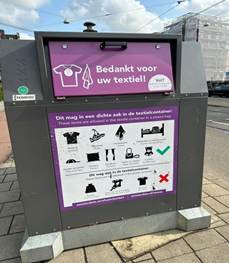
Making policies mandatory, instead of voluntary, is preferred. Several stakeholders we interviewed, including industry groups, stated a preference for making policies mandatory instead of voluntary to develop a textile circular economy. These stakeholders specifically noted that textile EPR programs and recycled content requirements are two policies that should be mandatory. A few stakeholders explained that mandatory policies could increase market demand for recycled content and help a textile circular economy succeed. Specifically, mandatory textile EPR programs “level the playing field” by requiring businesses to participate in a textile circular economy, according to a nonprofit organization that administers a textile EPR program, among other stakeholders. Further, mandatory participation reduces the burden on businesses who voluntarily support a textile circular economy through their current efforts. Additionally, stakeholders cited that phasing in policies gradually would allow industries, infrastructure, and markets to transition and adapt. For example, some stakeholders, including industry businesses and groups, told us recycled content requirements in products should be phased in gradually, such as starting at 5 percent of recycled content across the industry.
Multiple policies can be implemented simultaneously to enhance effectiveness. Implementing multiple policies simultaneously can be more effective, according to domestic and international government agencies and other stakeholders we interviewed. For example, stakeholders suggested the following policy options could be combined: textile EPR programs, eco-modulation, end-of-life criteria, consumer awareness, label standardization, and recycled content requirements. When policies are implemented simultaneously, they may have a larger effect across the textile value chain. For example, a textile EPR program could include eco-modulation and textile-to-textile recycled content requirements. This may increase the participation of stakeholders, such as collectors, recyclers, and producers, in the program.
Consumer education is important to encourage participation in a textile circular economy. Consumer education is critical to help individuals understand the effects of their decisions and change behavior, such as purchasing secondhand or durable textiles, according to domestic and international government agencies, industry businesses, and other stakeholders we interviewed. According to each state’s legislation, California and Rhode Island will develop consumer education efforts, such as educating consumers on how they can recycle textiles.[32] As of August 2026, neither state had finalized their consumer campaign.
Funding is critical to support various initiatives related to a textile circular economy. Most stakeholders stated that funding is critical to help develop a textile circular economy. For example, one international industry stakeholder described how funding from a city government was necessary to start their textile circular business. Additionally, over half of the U.S. federal and state government stakeholders we spoke to told us they would use funding for initiatives related to infrastructure, terminology standards, circularity design, research and development, and public awareness, among other projects. Each of these initiatives could help develop a textile circular economy.
Industry standardization, including for textile labels and definitions, could provide needed consistency. Standardizing industry processes to produce and recycle textiles is critical to provide consistency across the value chain, according to several stakeholders we spoke with, including a nonprofit and an academic. Specifically, stakeholders noted that textile labels; end-of-life criteria; definitions, such as for the term “recycling;” sustainable design; and durability metrics, among other items, need to be standardized. For example, textile labels in the U.S. are generally not required to list textile fibers that compose less than 5 percent of the product’s fiber composition.[33] A textile recycler told us they cannot rely on labels to identify the fiber composition of their feedstock. As a result, their recycled material product, such as recycled cotton, may contain other unintended materials, such as polyester. In addition, textile production may also need to be standardized. For example, federal agency officials stated that without standardized durability metrics or design-for-disassembly guidelines, among other standards, efforts to scale textile-to-textile recycling may be limited.
Collecting data and understanding infrastructure capacity is important for developing a textile circular economy. Data are needed to support and assess progress for developing a textile circular economy. Specifically, several stakeholders, including domestic and international government agencies and industry businesses and groups, said these data could help inform policies and demonstrate their effectiveness; provide insight on the capacity of textile infrastructure, material flows, and consumption patterns; and estimate benefits from a textile circular economy, among other possibilities. Some U.S. states plan to collect data on their textile waste and associated infrastructure. For example, California plans to conduct a needs assessment by 2027 as part of its textile EPR program that will include collecting data on the amount of textile products currently landfilled.[34] Rhode Island also plans to collect data on the estimated total tonnage of textiles collected.[35] Private entities collecting textiles for reuse or recycling will be required to annually report this information beginning in 2028.
Simultaneous industry implementation may be needed. According to industry businesses and groups, and other stakeholders we interviewed, simultaneous industry implementation to develop a textile circular economy may be important for industry viability. For example, a few of these stakeholders said some producers are hesitant to create products with recycled content because of inconsistent supply of recycled fibers. However, recyclers cannot reliably supply recycled fiber without continual demand from producers for such feedstock. Additionally, without market options, such as secondhand and recycling markets, collectors may struggle to sell textiles.
|
Incentivizing Consumers through Repair Funds A few industry stakeholders GAO interviewed noted that policy options that focus on incentivizing consumer behavior should be considered to help develop a textile circular economy in the U.S. For example, France has implemented a repair fund that gives consumers an immediate discount when they repair their clothes and shoes at an approved business. In 2025, over 620,000 products were repaired under the program, according to a report by the organization that oversees France’s extended producer responsibility program. A domestic industry stakeholder that works on textile repairs said a similar program would be helpful in the U.S. Sources: GAO analysis of interviews and report by Re_fashion; Dusko/adobe.stock.com (photo). | GAO‑27‑108142 |

Stakeholders, such as nonprofit organizations, industry businesses and groups, and others we interviewed, told us there is a lack of market options for recycled or reused textiles, or more are needed. Additionally, some stakeholders, including recyclers and an international government
agency, said the industry may not have the resources to wait for policy implementation that supports a textile circular economy and told us implementation would need to occur relatively quickly. To remedy this, stakeholders said funding, such as from the government, and increased demand from recycled content requirements could help.
Federal involvement is preferred to develop a textile circular economy. Several stakeholders we spoke with preferred a federal approach to develop a textile circular economy, including industry businesses and groups, nonprofit organizations, and international government agencies and organizations.[36] A federal approach may provide coordination, compliance, and consistent implementation across U.S. states or other countries’ legal requirements, among other reasons, according to stakeholders. For example, before the EU enacted a directive in 2025 requiring all Member States to establish textile EPR programs, a few Member States in the EU enacted separate textile EPR programs.[37] Businesses that operated in these countries were required to adhere to multiple, unique textile EPR program requirements, including sustainable design, recycled content, and reporting requirements.[38] Some U.S. stakeholders shared that if individual U.S. states develop their own textile EPR programs, businesses will have to adhere to each state’s specific EPR requirements. However, as we previously reported, a federal approach to developing textile circularity would require coordination among federal agencies, including identifying and leveraging resources.[39] Developing a federal approach, such as a national textile EPR program, may depend on the federal government’s legal authority to implement such an approach.
Input from across the value chain may be important for developing a textile circular economy. Some stakeholders, including an international government agency and nonprofit organizations, said it is important to engage with industry stakeholders along the value chain, such as recyclers, sorters, and collectors. Of note, industry groups and others we interviewed said that brands are the main participants involved in developing a textile circular economy, however, these stakeholders wanted more representation from other industries. For example, some of these stakeholders in Europe and the U.S. said it would be beneficial to have an organization, such as an advisory board, that engages with industry stakeholders from across the value chain to support the implementation of policies to develop a textile circular economy. The board would help ensure input is solicited from stakeholders.
Enforcement and monitoring may be needed for policies to be effective. Several stakeholders, including international government agencies and industry businesses and groups, told us policies may need to be monitored and enforced to be effectively implemented. For example, policies could include measures that raise or impose fees to encourage business participation in a program. One industry group said that an existing textile EPR program’s eco-modulation and disposal fees were not large enough to change producer behavior. Because the EPR program textile producer and disposal fees were too low, textiles were exported and landfilled in other countries rather than remaining within the local textile circular economy.
Some stakeholders, including domestic government agencies and a nonprofit organization, said that tracking textiles through a textile circular economy is critical or needed to better understand what happens to textiles once they are discarded, including if they are reused or recycled, among other reasons. Stakeholders suggested one way to enhance tracking, among other things, is to create textile classifications for international trade and tariffs. Specifically, they told us adjusting existing codes and adding new ones in the tariff schedule, such as the schedule maintained by the U.S. International Trade Commission, that are related to recycled content and sustainable products would provide more information on the types of textiles entering and leaving the country.[40]
Agency Comments
We provided a draft of this report to the U.S. Departments of Agriculture, Commerce, Defense, Energy, and State, as well as the U.S. Environmental Protection Agency, the Federal Trade Commission, the Office of Science and Technology Policy, and the National Science Foundation for review and comment. We received technical comments from the Department of State, the U.S. Environmental Protection Agency, and the Federal Trade Commission, which we incorporated as appropriate.
We are sending copies of this report to the appropriate congressional committees; the Administrator for the Environmental Protection Agency; the Secretaries of Agriculture, Commerce, Defense, Energy, and State; the Chairman of the Federal Trade Commission; the Directors of the Office of Science and Technology Policy and the National Science Foundation; and other interested parties. In addition, the report is available at no charge on the GAO website at http://www.gao.gov.
If you or your staff have any questions about this report, please contact me at gomezj@gao.gov. Contact points for our Offices of Congressional Relations and Media Relations may be found on the last page of this report. GAO staff who made key contributions to this report are listed in appendix IV.

J. Alfredo Gómez
Director, Natural Resources and Environment
This report describes (1) the potential benefits and challenges with developing a textile circular economy in the U.S.; (2) policy options that policymakers could consider; and (3) identified policies proposed, enacted, or implemented, domestically and internationally, and stakeholders’ key observations.
For all three objectives, we interviewed officials from federal entities and state agencies, elected officials from two U.S. states, and representatives from international government entities that had ongoing or planned efforts related to a textile circular economy based on recommendations from knowledgeable officials and GAO’s prior work.[41] The federal entities were the U.S. Departments of Agriculture, Commerce, Defense, Energy, and State; the U.S. Environmental Protection Agency; the Federal Trade Commission; and the National Science Foundation. The selected state agencies were California’s Department of Resources Recycling and Recovery (CalRecycle) and Rhode Island’s Department of Environmental Management. We also interviewed elected state officials from the states of New York and Washington. Internationally, we interviewed officials from the European Commission; France’s Ministry in Charge of Ecological Transition; the Netherlands’ Ministry for Infrastructure and Water Management; Chile’s Ministry of the Environment; and the United Nations Environment Programme. We also interviewed representatives from organizations with ongoing textile circular economy efforts in other countries, including Australia and Canada.
We conducted a literature review of selected academic reports; government reports; trade or industry articles; and association and nonprofit publications. The purpose of the literature review was to obtain information and any related data for the three objectives. This review included a search of academic databases using a variety of terms, including “textile circular economy,” “second-hand clothing imports,” “textile circularity,” “textile recycling,” “textile collection”, for articles or publications published within the last 10 years.
For the three objectives, we also interviewed stakeholders about their perspectives on developing a textile circular economy including representatives from domestic and international nonprofit organizations; producer responsibility organizations (PROs); non-profit and private sector collectors, sorters, and recyclers; a waste management business; an academic; textile repair businesses; secondhand retailers (including an e-commerce company); and brands. They were selected because they have, or will have, a role in ongoing or planned efforts related to a textile circular economy or were recommended by knowledgeable officials. The views of these stakeholders cannot be generalized to all stakeholders, but we chose them to reflect a range of perspectives on developing a textile circular economy.
We conducted site visits in Washington State, Oregon, France, and the Netherlands to meet with private sector organizations involved with a textile circular economy and tour their facilities. For example, we visited for-profit and non-profit collectors and sorters of discarded textiles, repair and retail companies, and chemical and mechanical textile recyclers. Our selection of site visits was designed to provide illustrative examples and an in-depth understanding of what may be involved in developing a textile circular economy.
To describe the potential benefits and challenges with developing a textile circular economy in the U.S., we analyzed relevant reports and documents identified from the literature search, federal agencies, international government entities, and nonprofit organizations. The reports and documents we reviewed do not quantitatively estimate the benefits and challenges of developing a textile circular economy in the U.S., as the U.S. has not implemented policies to fully move toward such an economy. However, the reports provide useful information on the potential effects of transitioning to a textile circular economy.
To describe policy options that policymakers could consider, we analyzed the results of the literature search, interviewed stakeholders, and conducted site visits to obtain information on possible policy options. We also reviewed relevant documents and information from selected international government entities, organizations (international and domestic), U.S. federal agencies, and U.S. state agencies, such as CalRecycle. These policy options are not exhaustive but can provide policymakers with a broad base of information for decision-making. We have not assessed these policy options for their feasibility, legality, or effectiveness. We also express no view regarding the extent to which the federal or state governments would have the legal authority to implement them.
We grouped the policy options into six categories. These categories are:
· Maintaining status quo at the federal level—no policy options implemented at a national level to develop a textile circular economy.
· Expanding industry responsibilities—policy options that expand the responsibilities of businesses within the textile value chain. This category includes the following options: extended producer responsibility (EPR), recycled content requirements, sustainability design requirements, and industry standardization.
· Incentivizing or requiring action to promote reuse or discourage waste—policy options that incentivize or require action from stakeholders in the textile value chain, such as using recycled textiles or decreasing textile waste. This category includes the following policy options: circular duty drawback, tax credits, fast fashion tax, sales tax exemption for secondhand textiles, fast fashion advertising ban, procurement requirements, funding mechanism, and eco-modulation.
· Managing waste—policy options to manage the collection and disposal of textiles. This category includes the following policy options: textile landfill ban, waste collection requirements, export ban on discarded textiles, end-of-life criteria for textiles, and destruction ban.
· Obtaining information to support a textile circular economy—policy options to collect data or conduct research and development related to a textile circular economy. This category includes two policy options: research and development and data collection.
· Educating and engaging the public—policy options to educate and engage consumer awareness about a textile circular economy. The category’s policy options are public awareness campaigns and consumer participation incentives.
To describe identified policies proposed, enacted, or implemented domestically and internationally, as well as stakeholders’ key observations, we analyzed the results of the literature search and reviewed relevant documents and information from selected international government entities and organizations, U.S. federal agencies, and U.S. states. We also conducted a legal review of selected U.S. states and other countries that have proposed or enacted laws and regulations related to developing a textile circular economy. Throughout this report, we used modifiers to characterize the selected stakeholders’ views, which we define as follows:
· “few stakeholders” represents five or fewer stakeholders,
· “some stakeholders” represents six to 15,
· “several stakeholders” represents 16 to 25,
· “many stakeholders” represents 26 to 35, and
· “most stakeholders” represents 36 to 45.[42]
We conducted this performance audit from February 2025 to October 2026 in accordance with generally accepted government auditing standards. Those standards require that we plan and perform the audit to obtain sufficient, appropriate evidence to provide a reasonable basis for our findings and conclusions based on our audit objectives. We believe that the evidence obtained provides a reasonable basis for our findings and conclusions based on our audit objectives.
This appendix identifies policies that were proposed, enacted, or implemented by U.S. states, other countries, or jurisdictions[43] to support the development of a textile circular economy as of August 2026. A few policy options listed in tables 1-6 above do not appear in the tables below because our review did not identify U.S. states or other countries proposing or implementing such options. Additionally, information in these tables is not an exhaustive list of proposed, enacted, and implemented policies but can provide policymakers with a broad base of information for decision-making. GAO did not assess the completeness, effectiveness, legality, or enforcement of the countries’ implementation of these policy options.
Expanding Industry Responsibility
Table 7 identifies policies that were proposed, enacted, or implemented by U.S. states, other countries, or jurisdictions to expand industry responsibilities to support the development of a textile circular economy as of August 2026.
Table 7: Status of Policies to Expand Industry Responsibilities to Develop a Textile Circular Economy, by U.S. States and Countries
|
Policy |
U.S. state or countrya |
Status |
Timing and key aspects |
|
Extended producer responsibility (EPR)b |
Californiac |
◑ |
· Mandatory program · Enacted in September 2024 · Implementation planned for 2030 |
|
Minnesota |
○ |
· Mandatory program · Proposed bill in February 2026 · No legislation passed as of August 2026 |
|
|
New York |
○ |
· Mandatory program · Proposed through multiple bills in 2025 · No legislation passed as of August 2026 |
|
|
Washington |
○ |
· Mandatoryd program · Proposed bill in January 2025 · No legislation passed as of August 2026 |
|
|
Australia |
● |
· Voluntary program · Implementation started in July 2024 |
|
|
Chile |
○ |
· Mandatory program · Passed resolution in 2025 to include textiles in existing EPR program · No legislation passed as of August 2026 |
|
|
Colombia |
● |
· Multiple voluntary EPR programs · The Bogotá Secretariat of Environment implemented a pilot program in 2022 |
|
|
European Union (EU)e |
◑ |
· Mandatory federal programf · Enacted in September 2025 · Member State implementation planned for 2028 |
|
|
Franceg |
● |
· Mandatory program · Enacted in December 2006 · Implementation started in January 2007 |
|
|
Hungaryg |
● |
· Mandatory program · Enacted in April 2023 · Implementation started in July 2023 |
|
|
Kenya |
● |
· Mandatory program · Enacted in 2022 · Implementation started in 2024 |
|
|
Latviag |
● |
· Mandatory program · Enacted in 2023 · Implementation started in July 2024 |
|
|
The Netherlandsg |
● |
· Mandatory program · Enacted in April 2023 · Implementation started in July 2023 |
|
|
New Zealand |
● |
· Voluntary program · Launched in 2018 |
|
|
North Macedonia |
● |
· Mandatory program · Existing EPR program expanded to include textiles in 2021 · Implementation started in January 2024 |
|
|
Russian Federation |
● |
· Mandatory program · Existing EPR program expanded to include textiles in 2021 · Implementation started in January 2021 |
|
|
Spaing |
● |
· Mandatory program · Enacted in 2022 · Implementation started in January 2025 |
|
|
Ukraine |
● |
· Mandatory program · Enacted in 2022 · Implementation started in July 2023 |
|
|
United Kingdom |
● |
· Voluntary program · Implementation started in April 2021 |
|
|
Recycled content requirements |
The Netherlandsg |
◑ |
· Mandatory requirement · Part of their textile EPR program · By 2030, 33 percent by weight of discarded textiles will be required to be textile-to-textile recycled |
|
Sustainability design requirements |
EUe |
◑ |
· Mandatory program · Enacted in July 2024 · Design requirements planned for 2027 |
|
Industry standardization |
U.S. |
○ |
· Voluntary program to standardize textile labels · Proposed in February 2025 (H.R. 1239) · No legislation passed as of August 2026 |
|
EUe |
◑ |
· Mandatory requirement to add digital product passports to textiles · Enacted in June 2024 · Implementation is planned to begin in 2027 |
Legend: ○ = proposed; ◑ = enacted; ● = implementation has started
Source: GAO analysis of legal requirements, voluntary programs, proposed policies, and legislation. | GAO‑27‑108142
Notes: GAO did not assess countries’ implementation status for completeness, effectiveness, legality, or enforcement, as of August 2026. Key aspects of the selected proposed or enacted international legislation or programs are based in part on information translated and provided by the Library of Congress. See Library of Congress, U.S. Global Legal Research Directorate, Extended Producer Responsibility for Textiles in Selected Jurisdictions (Washington, D.C.: 2025), https://www.loc.gov/item/2025291257.
aNot all jurisdictions are considered “countries”; however, for the purposes of this report, we refer to them as “countries.”
bFor several enacted state EPR programs for product packaging and other paper products, various stakeholders and regulated entities have challenged the constitutionality, among other legal claims, of these programs. As of September 2026, these legal actions are ongoing. See, e.g., National Ass’n of Wholesaler-Distributors v. Oregon Dep’t of Env’t Quality, No. 3:25-cv-1334 (D. Or. Aug. 27, 2026) (concluded that Oregon’s Plastic Pollution and Recycling Modernization Act, Or. Rev. Stat. §§ 459A.860–459A.975, does not violate either the dormant Commerce Clause or the Due Process Clause of the U.S. Constitution) (appeal filed, No. 26-6404 (9th Cir. Sept. 30, 2026) and Lollicup USA, Inc. v. Feldon, No. 3:26-cv-1287 (D. Or. June 25, 2026) (similar challenge to Oregon’s Plastic Pollution and Recycling Modernization Act); Independent Lubricant Manufacturers Ass’n v. the Colorado Dep’t of Pub. Health and Env’t, No. 26-cv-30902 (Colo. Denver Dist. Mar. 12, 2026) (challenging Colorado’s Producer Responsibility Program for Statewide Recycling Act, Colo. Rev. Stat. §§ 25-17-701–25-17-716); Nebraska v. Heller, No. 2:26-cv-2214 (E.D. Cal. June 22, 2026) (challenging California’s Plastic Pollution Prevention and Packaging Producer Responsibility Act, Cal. Pub. Res. Code. §§ 42040–42084). We express no view on whether a textile EPR program would face similar legal challenges.
cOn February 27, 2026, the California Department of Resources Recycling and Recovery (CalRecycle) selected Landbell USA as the producer responsibility organization (PRO) for the state-enacted textile EPR program, Responsible Textiles Recovery Act of 2024. The PRO is the entity that will implement the EPR program on behalf of the producers. See Cal. Pub. Res. Code § 42984. The American Apparel & Footwear Association is challenging CalRecycle’s selection of Landbell USA as the PRO in state superior court. The association claims that CalRecycle failed to select a PRO that meets the statutory qualification requirements. See American Apparel & Footwear Ass’n, v. California Dep’t of Res. Recycling & Recovery, No. 26WM000091 (Cal. Sacramento Super. Ct. Mar. 27, 2026). As of September 2026, this litigation is ongoing.
dIn the 2025 to 2026 legislative session, Washington State H.B. 1420, as amended, proposed a textile producer-funded needs assessment and reporting process, deferring the policy decision on whether to establish a full EPR textile program to the 2029 legislature. S. 6174 proposed a mandatory EPR scheme for the state. Neither bill passed before the legislature adjourned on March 12, 2026.
eThe European Union (EU) is a group of 27 countries, known as Member States of the EU. See “EU Countries,” European Union, accessed October 5, 2026, https://european‑union.europa.eu/principles‑countries‑history/eu‑countries_en.
fDirective (EU) 2025/1892 requires Member States to establish mandatory EPR schemes for textile and footwear products in their country. See Directive (EU) 2025/1892 of the European Parliament and of the Council of 10 September 2025 amending Directive 2008/98/EC on waste, 2025 O.J. (L 1892).
gEU Member States that have existing EPR schemes in their country will be required to comply with the EPR requirements set forth in Directive (EU) 2025/1892.
Incentivizing or Requiring Action to Promote Reuse or Discourage Waste
Table 8 identifies policies that were proposed, enacted, or implemented by U.S. states, other countries, or jurisdictions to incentivize or require action to promote reuse or discourage waste to support the development of a textile circular economy as of August 2026.
Table 8: Status of Policies to Incentivize or Require Action to Promote Reuse or Discourage Waste to Develop a Textile Circular Economy, by U.S. States and Countries
|
Policy |
U.S. state or countrya |
Status |
Timing and key aspects |
|
Fast fashionb tax |
France |
● |
· Eliminates tax reduction benefit for donations of certain fast-fashion textiles · Enacted in July 2026 · Implementation started in July 2026 |
|
Sales tax exemption for secondhand textiles |
Maryland |
○ |
· Mandatory tax exempted for clothing and footwear priced $20 or less · Proposed bill in January 2023 · No legislation passed as of August 2026 |
|
North Dakota |
○ |
· Mandatory tax exempted for used clothing · Proposed bill in January 2025 · No legislation passed as of August 2026 |
|
|
Tennessee |
● |
· Mandatory tax exempted for used clothing · Enacted in 1994 |
|
|
Fast fashion advertising ban |
France |
◑ |
· Mandatory ban · Enacted in July 2026 · Implementation will start January 2027 |
|
Procurement requirements |
Australia |
● |
· Mandatory requirement for purchasing government uniforms, carpets, bedding, and other textiles over a certain procurement value · Enacted in 2024 · Implementation started in July 2025 |
|
EUc |
◑ |
· Mandatory requirement · Enacted in July 2024 · Implementation planned for 2027 |
|
|
France |
● |
· Mandatory requirement · Enacted January 2021 · Implementation started in March 2021 |
|
|
Funding mechanism |
Australia |
● |
· Voluntary contribution per new item by participating producers and retailers to fund circular design and business models and other textile circular economy initiatives · Implemented in 2024 as part of voluntary textile extended producer responsibility (EPR) program |
|
France |
● |
· Mandatory discounts for consumers repairing their textiles and shoes when using an authorized repair business · Implemented in 2023 |
|
|
Eco-modulation |
California |
◑ |
· Mandatory program · Enacted in December 2024 as part of their textile EPR program · Implementation planned for 2030 |
|
Minnesota |
○ |
· Mandatory program · Proposed bill in February 2026 as part of its textile EPR program · No legislation passed as of August 2026 |
|
|
New York |
○ |
· Mandatory program · Proposed bill in 2025 as part of its textile EPR program · No legislation passed as of August 2026 |
|
|
Washington |
○ |
· Mandatory program · Proposed bill in January 2025 as part of its textile EPR program · No legislation passed as of August 2026 |
|
|
Australia |
● |
· Voluntary contribution by participating producers reduced per new items meeting the program’s criteria · Implemented in 2024 as part of its voluntary textile EPR program |
|
|
EUc |
◑ |
· Mandatory program · Enacted in September 2025 as part of its textile EPR program · Implementation planned for 2028 |
Legend: ○ = proposed; ◑ = enacted; ● = implementation has started
Source: GAO analysis of legal requirements, voluntary programs, proposed policies, and legislation. | GAO‑27‑108142
Notes: GAO did not assess countries’ implementation status for completeness, effectiveness, legality, or enforcement, as of August 2026. Key aspects of the selected proposed or enacted international legislation or programs are based in part on information translated and provided by the Library of Congress. See Library of Congress, U.S. Global Legal Research Directorate, Extended Producer Responsibility for Textiles in Selected Jurisdictions (Washington, D.C.: 2025), https://www.loc.gov/item/2025291257.
aNot all jurisdictions are considered “countries”; however, for the purposes of this report, we refer to them as “countries.”
bThe fast fashion business model produces textiles at lower cost and quality. Under this model, trends change frequently, consumers buy textiles many times per year, and they dispose of textiles after using them for a short period of time. France’s law defines “ultra-express fashion” (mode ultra expresse) or “ultra-fast fashion” to include producers’ industrial and commercial practices that place a large volume of new clothing, footwear, or home textiles on the market, while providing little incentive to repair them. Goods must meet both conditions to be considered ultra-fast fashion. See Louis Gilbert, France: New Fast-Fashion Law Adopted to Limit Textile Waste, Library of Congress, https://www.loc.gov/item/global‑legal‑monitor/2026‑07‑14/france‑new‑fast‑fashion‑law‑adopted‑to‑limit‑textile‑waste/.
cThe European Union (EU) is a group of 27 countries, known as Member States of the EU. See “EU Countries,” European Union, accessed October 5, 2026, https://european‑union.europa.eu/principles‑countries‑history/eu‑countries_en.
Managing Waste
Table 9 identifies policies that were proposed, enacted, or implemented by U.S. states, other countries, or jurisdictions to manage waste to support the development of a textile circular economy as of August 2026.
Table 9: Status of Policies to Manage Waste to Develop a Textile Circular Economy, by U.S. States and Countries
|
Policy |
U.S. state or countrya |
Status |
Timing and key aspects |
|
Textile landfill ban |
Massachusetts |
● |
· Mandatory ban · Implemented as of November 2022 |
|
Waste collection requirementsb |
EUc |
● |
· Mandatory requirements for separate collection of discarded textiles · Enacted in 2018 · Implementation started in 2025 |
|
Croatiad |
● |
· Mandatory requirements for separate collection of textiles and footwear by local authorities · Enacted in 2013 · Implementation started in 2015 |
|
|
Italyd |
● |
· Enacted and implementation started in 2022 |
|
|
Export ban on discarded textiles |
EUc |
◑ |
· Mandatory restriction · Enacted in 2025 · Implementation planned for July 2026 |
|
Destruction ban |
EUc |
◑ |
· Mandatory program · Enacted in 2024 · Phased implementation starting July 2026 |
|
France |
● |
· Mandatory program · Enacted in 2020 · Implementation started in January 2022 |
Legend: ○ = proposed; ◑ = enacted; ● = implementation has started
Source: GAO analysis of legal requirements, voluntary programs, proposed policies, and legislation. | GAO‑27‑108142
Notes: GAO did not assess countries’ implementation status for completeness, effectiveness, legality, or enforcement, as of August 2026. Key aspects of the selected proposed or enacted international legislation or programs are based in part on information translated and provided by the Library of Congress. See Library of Congress, U.S. Global Legal Research Directorate, Extended Producer Responsibility for Textiles in Selected Jurisdictions (Washington, D.C.: 2025), https://www.loc.gov/item/2025291257.
aNot all jurisdictions are considered “countries”; however, for the purposes of this report, we refer to them as “countries.”
bGenerally, proposed and enacted legislation for extended producer responsibility (EPR) programs include textile waste collection requirements. See table 7 for U.S. states and countries with proposed or enacted textile EPR programs.
cThe European Union (EU) is a group of 27 countries, known as Member States of the EU. See “EU Countries,” European Union, accessed October 5, 2026, https://european-union.europa.eu/principles-countries-history/eu-countries_en.
dEU Member States that have existing EPR schemes in their country will be required to comply with the EPR requirements set forth in Directive (EU) 2025/1892. See Directive (EU) 2025/1892 of the European Parliament and of the Council of 10 September 2025 amending Directive 2008/98/EC on waste, 2025 O.J. (L 1892).
Obtaining Information
Table 10 identifies policies that were proposed, enacted, or implemented by U.S. states, other countries, or jurisdictions to obtain information to support the development of a textile circular economy as of August 2026.
Table 10: Status of Policies to Obtain Information to Support Development of a Textile Circular Economy, by U.S. States and Countries
|
Policy |
U.S. state or countrya |
Status |
Timing and key aspects |
|
Data collection |
California |
◑ |
· Initial mandatory needs assessment prepared by the state’s textile extended producer responsibility (EPR) producer responsibility organization (PRO) · Enacted in September 2024 as part of its textile EPR program · Implementation is planned to begin in July 2026 |
|
Rhode Island |
◑ |
· Mandatory requirement for private entities to report annually on the estimated total tonnage of textiles collected · Enacted in June 2025 · Implementation is planned to begin in 2028 |
|
|
Washington |
○ |
· Initial mandatory needs assessment by a nonprofit appointed by producers · Proposed bill in January 2026 · No legislation passed as of August 2026 |
Legend: ○ = proposed; ◑ = enacted; ● = implementation has started
Source: GAO analysis of legal requirements, voluntary programs, proposed policies, and legislation. | GAO‑27‑108142
Notes: GAO did not assess countries’ implementation status for completeness, effectiveness, legality, or enforcement, as of August 2026. Key aspects of the selected proposed or enacted international legislation or programs are based in part on information translated and provided by the Library of Congress. See Library of Congress, U.S. Global Legal Research Directorate, Extended Producer Responsibility for Textiles in Selected Jurisdictions (Washington, D.C.: 2025), https://www.loc.gov/item/2025291257.
aNot all jurisdictions are considered “countries”; however, for the purposes of this report, we refer to them as “countries.”
Educating and Engaging the Public
Table 11 identifies policies that were proposed, enacted, or implemented by U.S. states, other countries, or jurisdictions to educate and engage the public to support the development of a textile circular economy as of August 2026.
Table 11: Status of Policies to Educate and Engage the Public to Develop a Textile Circular Economy, by U.S. States and Countries
|
Policy |
U.S. state or countrya |
Status |
Timing and key aspects |
|
Public awareness campaigns |
California |
◑ |
· Mandatory program · Enacted in September 2024 as part of its textile extended producer responsibility (EPR) program · Implementation planned to begin in 2026 |
|
Rhode Island |
◑ |
· Mandatory campaign · Enacted in 2025 |
|
|
Franceb |
● |
· Mandatory requirements as part of its textile EPR program · Implementation started in January 2023 |
|
|
Consumer participation incentives |
France |
● |
· Mandatory program to incentivize individual consumers to repair items through a repair fund · Enacted in 2020 · Implemented in 2023 |
Legend: ○ = proposed; ◑ = enacted; ● = implementation has started
Source: GAO analysis of legal requirements, voluntary programs, proposed policies, and legislation. | GAO‑27‑108142
Notes: GAO did not assess countries’ implementation status for completeness, effectiveness, legality, or enforcement, as of August 2026. Key aspects of the selected proposed or enacted international legislation or programs are based in part on information translated and provided by the Library of Congress. See Library of Congress, U.S. Global Legal Research Directorate, Extended Producer Responsibility for Textiles in Selected Jurisdictions (Washington, D.C.: 2025), https://www.loc.gov/item/2025291257.
aNot all jurisdictions are considered “countries”; however, for the purposes of this report, we refer to them as “countries.”
bEU Member States that have existing EPR schemes in their country will be required to comply with the EPR requirements set forth in Directive (EU) 2025/1892. See Directive (EU) 2025/1892 of the European Parliament and of the Council of 10 September 2025 amending Directive 2008/98/EC on waste, 2025 O.J. (L 1892).
This appendix describes key provisions of mandatory textile extended producer responsibility (EPR) programs enacted in California and the European Union (EU).[44] In September 2024, California became the first U.S. state to adopt a mandatory textile EPR program when it enacted the Responsible Textile Recovery Act of 2024.[45] About a year later, the EU enacted Directive 2025/1892 requiring its 27 countries, referred to as Member States, to establish an EPR program for textiles and footwear in their state by April 17, 2028.[46]
Regulated Products
Table 12 provides examples of products regulated under the textile EPR programs. The California Responsible Textile Recovery Act refers to “covered products” as apparel and textile articles, including footwear. The EU Directive 2025/1892 classifies regulated “textile, textile-related or footwear products” into two categories (1) clothing and household textiles, and (2) footwear and related apparel composed of various materials.
Table 12: Examples of Products Regulated Under California and the European Union’s (EU) Textile Extended Producer Responsibility (EPR) Programs
|
EPR program |
Examples of regulated products |
|
California |
Product categories regulated: · “Apparel,” including clothing and accessory items (e.g., footwear, handbags, backpacks, knitted and woven accessories, costumes, dancewear, saris, swimwear, bibs, ski pants, work uniforms) “Textile article” category includes only blankets, curtains, fabric window coverings, knitted and woven accessories, towels, tapestries, bedding, tablecloths, napkins, linens, and pillows made entirely or primarily from a natural, artificial, or synthetic fiber, yarn, or fabric Product categories not regulated: · Personal protective equipment · Reusable hygiene products · Single-use products, including paper products and wet or dry wipes · Motorized or battery-operated window coverings · Used mattresses and carpets |
|
EU |
Product categories regulated: · “Textile, textile-related, or footwear products,” including new or worn clothing; household textile products; blankets (except electric blankets); rugs; linens; curtains and interior fabrics; textile furnishing articles; hats and headgear; leather apparel, accessories, and footwear; waterproof, rubber, plastic, and textile footwear Product categories not regulated: · Mattress supports, bedding, and similar furnishings (e.g., mattresses, quilts, cushions, pillows) fitted or stuffed with any material · Footwear, headgear, and equipment related to toys, games, and sports (e.g., shin guards, fencing masks) |
Source: GAO analysis of legislation. | GAO‑27‑108142
Note: See Cal. Pub. Res. Code § Code § 42984.3(a), (ae), (i)(2)) and Consolidated Version of the EU Revised Waste Framework Directive, art. 22a(1), Annex IVc, https://eur‑lex.europa.eu/eli/dir/2008/98.
Regulated Producers
Table 13 describes entities regulated as producers under the textile EPR programs. Entities regulated as producers extend beyond the manufacturers to include various entities that sell or distribute covered products in the jurisdiction.
Table 13: Producers Regulated Under California and the European Union’s (EU) Textile Extended Producer Responsibility (EPR) Programs
|
EPR program |
Entities regulated as producers |
|
California |
Regulated producers are any person who manufactures and is the brand or trademark owner or licensee of a regulated product that is sold, including delivered to a consumer, or distributed in or into the state. If the product has no identified in-state producer, the exclusive brand or trademark licensees, distributors, retailers, and wholesalers who sell or distribute covered products in the state are the regulated entities. Excluded as a regulated producer are sellers of only secondhand covered products and small businesses with less than $1,000,000 in annual aggregate global turnover adjusted annually. |
|
EU |
Regulated producers are any manufacturer, importer, distributor, or other person established in a Member State that (1) manufactures regulated products under their own name or trademark; (2) resells products under their own name; (3) supplies products for the first time from another Member State or third country; or (4) sells directly to end-users. Excluded as a regulated producer are manufacturers, importers, or distributors that supply products (1) assessed as fit for reuse, (2) derived from those used or waste products, or (3) self-employed tailors producing customized products. |
Source: GAO analysis of legislation. | GAO‑27‑108142
Note: Regulated products refer to textiles that are regulated under the EPR program. See Cal. Pub. Res. Code § Code § 42984.3(s) and Consolidated Version of the EU Revised Waste Framework Directive, art. 3, para. 4b, https://eur-lex.europa.eu/eli/dir/2008/98.
Producer Responsibility Organizations
Table 14 describes key qualifications of the producer responsibility organizations (PRO), which fulfill the textile EPR obligations on behalf of regulated producers. Both programs require regulated producers to register with a PRO.
Table 14: Key Qualifications for Producer Responsibility Organizations (PRO) Under California and the European Union’s (EU) Extended Producer Responsibility (EPR) Programs
|
EPR program |
Key qualification criteria |
|
California |
The California Department of Resources Recycling and Recovery (CalRecycle)a must approve as the PRO a nonprofit entity that is (1) formed by regulated producers for the purpose of implementing the state’s EPR plan; (2) has a governing board consisting of producers that are diverse in size, type, and regulated products, and may include ex officio members involved in the collection, sorting, repair, reuse, recycling, or management of products; and (3) demonstrates that it has adequate financial responsibility and financial controls, including fraud prevention measures and an audit schedule. Producers must join the approved PRO by July 1, 2026. After January 1, 2035, CalRecycle may approve additional PROs if it determines that it would benefit compliance with the program requirements. |
|
EU |
Member States must develop qualification criteria for PROs, including requiring the PROs to demonstrate the necessary expertise in waste management and sustainability, unless the Member State has existing and equivalent PRO qualification criteria. Regulated producers must entrust a qualified PRO to fulfil their EPR obligations. If a Member State authorizes multiple PROs, the PROs must provide uniform service quality of the collection system across the territory for products. Member States must designate a competent authority or appoint an independent third party to ensure that the PROs coordinate to fulfil their obligations. |
Source: GAO analysis of legislation. | GAO‑27‑108142
Note: See Cal. Pub. Res. Code § Code §§ 42984.3(t), 42984.4(a)) and Consolidated Version of the EU Revised Waste Framework Directive, art. 22c, para. 1, 3, 4, 16, 17, https://eur‑lex.europa.eu/eli/dir/2008/98.
aCalRecycle is the state agency responsible for administering the Responsible Textiles Recovery Act of 2024. CalRecycle’s selection of Landbell USA as the PRO for the state EPR textile program is being challenged in state court. See American Apparel & Footwear Ass’n, v. California Dep’t of Res. Recycling & Recovery, No. 26WM000091 (Cal. Super. Ct. Mar. 27, 2026). As of September 2026, this litigation is ongoing.
Producer Fees
Table 15 summarizes key criteria used to determine producers’ fees paid to PROs under the textile EPR programs to cover the cost of fulfilling the EPR obligations on the regulated producers’ behalf. Producers pay lower fees if they meet additional criteria related to sustainable production that minimizes environmental impacts, known as eco-modulated fees. EU Directive 2025/1892 refers to the producer fees as the producers’ financial contribution.[47]
Table 15: Key Criteria for Fees Under California and the European Union’s (EU) Extended Producer Responsibility (EPR) Programs
|
EPR program |
Key criteria |
|
California |
The PRO must establish a method in its textile EPR plan for distributing the administrative and operational costs of complying with the EPR program requirements among the regulated producers using a per unit eco-modulated fee that reflects · producers’ California sales; · existing producer collection, repair, reuse, and recycling programs that help achieve the purpose of the textile EPR program; and · the cost of managing, reusing, repairing, and recycling regulated products, including the cost of minimizing environmental and public health impacts along the entire supply chain of covered products or product category. |
|
EU |
Member States must require PROs to ensure that the financial contributions from regulated producers · are based on weight and quantity of regulated products; · are modulated according to requirements adopted pursuant to the EU Ecodesign for Sustainable Products Regulation 2024/1781a · account for revenues from reuse, preparing for reuse, or value of secondary raw materials from recycled textiles; and · ensure equal treatment regardless of the producer’s origin or size, without disproportionate burdens on small and medium-sized enterprises and producers of small quantities of textile. Member States may require the PROs to modulate the financial contribution based on the producer’s fast- or ultra-fashion practices related to product lifespan, use beyond the first user, and contribution to closing the loop of those textiles by turning waste textiles into raw material for new production. The European Commission must adopt fee criteria for the Member States when necessary to avoid EU market distortion and ensure consistency with the ecodesign requirements. |
Source: GAO analysis of legislation. | GAO‑27‑108142
Note: See Cal. Pub. Res. Code § Code §§ 42984.10(b), 42984.13(b), 42984.14(b) and Consolidated Version of the EU Revised Waste Framework Directive, art. 22c, para. 5-7, https://eur lex.europa.eu/eli/dir/2008/98.
aAdopted in June 2024, EU Regulation 2024/1781 authorizes the European Commission to establish requirements through delegated acts for certain commercial products, including textiles, to reduce their environmental impact before being placed on the EU market. See Regulation 2024/1781 of the European Parliament and of the Council of 13 June 2024 establishing a framework for the setting of requirements for sustainable products, amending Directive 2020/1828 and Regulation 2023/1542 and repealing Directive 2009/125/EC, 2024 O.J. (L 1781).
Collection Systems for Products
Table 16 describes key requirements for the PROs’ systems to collect regulated products. The cost of establishing and maintaining the collection system that meets the EPR requirements are considered when determining producer fees.
Table 16: Key Requirements for Product Collection Under California and the European Union’s (EU) Extended Producer Responsibility (EPR) Programs
|
EPR program |
Key requirements for Producer Responsibility Organizations (PROs) |
|
California |
· Ensure each California county has either a minimum of 10 authorized permanent collection sites per county, or one site per 25,000 residents, whichever number is greater. For counties with 18,000 or fewer people, a minimum of three collection sites; from 18,001 to 50,000 people, a minimum of four collection sites; from 50,001 to 100,000 people, a minimum of eight collection sites.a · Provide free collection and containers for regulated products, training, signage, safety guidance, and education materials for the collection sites. · Transport collected products at no cost to an authorized sorter, authorized repair business, or recycling facility. · Develop a process to divert collected products to secondhand markets for reuse. · Prioritize the use of secondhand markets and nonprofit thrift stores when establishing collection sites to meet the minimum collection site thresholds. · Instruct the collection sites on how to identify and reject counterfeit covered products. · Include a local jurisdiction collection site that meets the PRO requirements even if the PRO has met the minimum collection site thresholds. |
|
EU |
· Establish and finance separate systems that collect regulated products regardless of nature, material composition, condition, name, brand, trademark, or origin. · Cover the whole Member State territory, accounting for population size and density, expected volume of the products, accessibility and vicinity to end users, without limiting collection to areas where the collection and subsequent management of those products are profitable. · Adjust the collection frequency from the PRO’s collection sites based on population density and waste volume. · Maintain a sustained and technically feasible increase in separate textile collection while simultaneously reducing textiles found in mixed municipal waste. · Offer free collection of products for social economy entities (e.g., nonprofits, charities, social enterprises), retailers, public authorities, or third parties on behalf of public authorities, and voluntary collectors; and provide free containers and transport the collected products from these entities to the PRO’s collection points. · Allow local public authorities, social economy entities, or other reuse operators to participate in the separate collection system. · Allow social economy entities to operate their own collection points, provide equal or preferential collection location treatment, and have no obligation to surrender collected covered products to PROs. |
Source: GAO analysis of legislation. | GAO‑27‑108142
Note: See Cal. Pub. Res. Code § Code § 42984.10(d)-(e), 42984.7(b) and Consolidated Version of the EU Revised Waste Framework Directive, art. 22c, para. 8(a), 9-11, https://eur‑lex.europa.eu/eli/dir/2008/98.
aThe PRO may include temporary sites and mail-back options for collecting regulated products.
Repair Requirements
Table 17 summarizes key requirements and related definitions for repairing products as part of the reuse or preparation for reuse provisions of the EPR programs.
Table 17: Definitions and Key Repair Requirements Under California and the European Union’s (EU) Extended Producer Responsibility (EPR) Programs
|
EPR program |
Definitions and key requirements |
|
California |
Definition of “repair”: any alteration or improvement of damaged regulated product deemed worth the cost of repair by criteria established by the EPR plan, including redesigning; repurposing; mending; removing and repairing surface damage; securing and reattaching buttons and other fastenings; dyeing, redyeing, overdyeing, or printing of images on regulated products; and preparation for reuse and resale Key requirements for the PRO’s EPR plan: · Evaluate, as part of the initial needs assessment, current services to repair covered products, expanded access and additional repair options needed to meet the EPR program requirements, and consumer behaviors to drive repair · Prioritize the reuse, including repair, of collected products in the EPR plan · Transport collected products free of charge directly to authorized repair businesses · Prioritize, to the extent feasible, the use and development of sorting, repair, and recycling facilities located closer to collection points to minimize transportation-related emissions and increase accountability for the ultimate disposition of the products · Publish information on repair services offered by the PRO and where consumers can purchase repaired and reused products |
|
EU |
Definition of “preparing for reuse”: checking, cleaning, or repairing recovery operations so products can be reused without further pre-processing. Repair and repairing are not separately defined. The EPR program must · Involve relevant actors, including preparing-for-reuse operators such as repair operators in the implementation of the textile EPR scheme · Require textile sorting operations generate products for reuse and preparing for reuse, including repair · Separate items that are fit for direct reuse from those requiring further preparation for reuse operations, such as repair, at sorting-for-reuse operations · Require social economy entities (e.g., nonprofits, charities, social enterprises) operating their own separate collection points report annually the weight of products that will be prepared for reuse, which is defined to include repair · Require PROs provide consumer information on reuse (defined to include repair) arrangements available for textile and footwear · Require PROs publish on their website rates of preparing for reuse, which is defined to include repair |
Source: GAO analysis of legislation. | GAO‑27‑108142
Note: See Cal. Pub. Res. Code § Code §§ 42984.3(w), 42984.6(b)(2); 42984.10(e)(3); 42984.10(f)(1)(A), (B)(v); 42984.10(g)(9) and Consolidated Version of the EU Revised Waste Framework Directive, art. 3, para. 16; art. 22a, para. 7(e); art. 22c, para. 12, 14, 18(a)(iii); art. 22d, para. 5(a)-(b), https://eur‑lex.europa.eu/eli/dir/2008/98.
Reporting Requirements
Table 18 lists key reporting requirements specific to data on covered products sold, collected, reused, repaired, recycled, and exported under each textile EPR program.
Table 18: Key Reporting Requirements Under California and the European Union’s (EU) Extended Producer Responsibility (EPR) Programs
|
EPR program |
Key reporting requirements |
|
California |
Producer responsibility organizations (PRO) must annually report to the state agency and publish on their website information or data on the following: · Participating producers, collection sites, program performance, and PRO operating costs · Regulated products sold in or into the state, by fiber type category and Harmonized Tariff Schedule of the United States numbera · Total weight of collected and reusable products, by category · Total weight of products handled by each authorized sorter; authorized repair business, and PRO’s recycling facility · Total weight of products that were repaired and recycled |
|
EU |
PROs must publish at least annually key information on the following: · Total amount and weight of regulated products placed on the market and collected · Rates of recovery, reuse, preparing for reuse, recycling (including fiber-to-fiber recycling) achieved; disposal; exports of used textiles assessed as fit for reuse, and exports of textile wasteb · Selection procedure for the PROs’ waste management operators |
Source: GAO analysis of legislation | GAO‑27‑108142
Note: See Cal. Pub. Res. Code § Code § 42984.17 and Consolidated Version of the EU Revised Waste Framework Directive, art. 22c, para. 18, https://eur‑lex.europa.eu/eli/dir/2008/98.
aThe Harmonized Tariff Schedule of the United States sets out the tariff rates and statistical categories for all merchandise imported into the U.S. See U.S. International Trade Commission, Harmonized Tariff Schedule, v1.0.13, https://hts.usitc.gov.
bWith certain exceptions, separately collected products are considered “waste” upon collection unless and until they have been sorted and assessed as fit for reuse by a trained operator. Consolidated Version of the EU Revised Waste Framework Directive, art. 22d, para. 2, 3. Products that are considered “waste” are subject to additional requirements and controls, including waste shipment regulations. See, e.g., Regulation 2024/1157 of the European Parliament and of the Council of 11 April 2024 on Shipments of Waste, Amending Regulations 1257/2013 and 2020/1056 and Repealing Regulation 1013/2006, 2024 O.J. (L Series).
Evaluation Requirements
Table 19 summarizes key requirements to evaluate the performance of each EPR program. While the California program requires the use of performance standards and PRO annual reporting to evaluate the program, the EU program directs the EU Commission to evaluate the effectiveness of the textile EPR framework about 1 year after all Member States are required to establish a textile EPR program in their state.
Table 19: Key Requirements for Performance Evaluation Under California and the European Union’s (EU) Extended Producer Responsibility (EPR) Programs
|
EPR program |
Key requirements |
|
California |
Producer responsibility organizations (PRO) requirements: · Establish in its EPR plan quantifiable 5-year and annual performance standards and metrics unless or until the California Department of Resources Recycling and Recovery (CalRecycle) publishes performance standards.a · Include for the preceding year metrics and analysis of the progress toward attaining the performance standards in its annual report to CalRecycle. CalRecycle requirements: · Establish, review, and adjust performance standards and timelines to meet those standards based on the PRO EPR plan, annual reports, other information provided by the PRO, or any other relevant information, after March 1, 2032. |
|
EU |
European Commission requirements: · Evaluate the effectiveness of the EU Waste Framework Directive, as amended, including EPR schemes for regulated products and the potential for future waste prevention collection, preparing for reuse, and recycling targets for waste textile, by December 31, 2029. The evaluation should assess whether the Member State EPR schemes are effectively financed through the producers’ fees, including whether commercial reuse operators could financially contribute, and the possibility of pre-sorting mixed municipal waste to recover reuseable or recyclable textiles. · Submit a report on the evaluation findings to the European Parliament and to the European Council, including a legislative proposal, if appropriate. |
Source: GAO analysis of legislation | GAO‑27‑108142
Note: See Cal. Pub. Res. Code § Code §§ 42984.10(c); 42984.17(m), (s); 42984.19 and Consolidated Version of the EU Revised Waste Framework Directive, art. 41a, https://eur‑lex.europa.eu/eli/dir/2008/98.
aCalRecycle is the agency responsible for administering the Responsible Textiles Recovery Act of 2024.
GAO Contact
J. Alfredo Gómez, gomezj@gao.gov
Staff Acknowledgments
In addition to the individual named above, Barbara Patterson (Assistant Director), Heather Dowey (Analyst in Charge), Monica Alvarez-Scott, Adrian Apodaca, Lilia Chaidez, Jenny Chanley, Caitlin Scoville, Linda Tsang, and Kristen Watts made key contributions to this report.
The Government Accountability Office, the audit, evaluation, and investigative arm of Congress, exists to support Congress in meeting its constitutional responsibilities and to help improve the performance and accountability of the federal government for the American people. GAO examines the use of public funds; evaluates federal programs and policies; and provides analyses, recommendations, and other assistance to help Congress make informed oversight, policy, and funding decisions. GAO’s commitment to good government is reflected in its core values of accountability, integrity, and reliability.
Obtaining Copies of GAO Reports and Testimony
The fastest and easiest way to obtain copies of GAO documents at no cost is through our website. Each weekday, GAO posts on its website newly released reports, testimonies, and correspondence. You can also subscribe to GAO’s email updates to receive notification of newly posted products.
Connect with GAO
Connect with GAO on X,
LinkedIn, Instagram, and YouTube.
Subscribe to our Email Updates. Listen to our Podcasts.
Visit GAO on the web at https://www.gao.gov.
To Report Fraud, Waste, and Abuse in Federal Programs
Contact FraudNet:
Website: https://www.gao.gov/about/what-gao-does/fraudnet
Automated answering system: (800) 424-5454
Media Relations
Sarah Kaczmarek, Managing Director, Media@gao.gov
Congressional Relations
David A. Powner, Acting Managing Director, CongRel@gao.gov
General Inquiries
[1]For purposes of this report, textiles refer to any material involved in the development process, including fibers used during the initial creation of a product to the item, such as clothing, purchased by consumers. For more details on textiles, see Kelsea A. Schumacher and Amanda L. Forster, “Textiles in a Circular Economy: An Assessment of the Current Landscape, Challenges, and Opportunities in the United States,” Frontiers in Sustainability, vol. 3 (2022).
[2]GAO, Textile Waste: Federal Entities Should Collaborate on Reduction and Recycling Efforts, GAO‑25‑107165 (Washington, D.C.: Dec. 12, 2024).
[3]Petrochemicals are derived from oil and gas and are used to make synthetic fibers, among other things.
[4]Schumacher and Forster, “Textiles in a Circular Economy.”
[5]European Environment Agency, Circularity of the EU textiles value chain in numbers, (Mar. 26, 2025) HTML: TH-01-25-003-EN-Q - ISBN: 978-92-9480-707-6 - ISSN: 2467-3196 - DOI: 10.2800/5681501.
[6]GAO, Science & Tech Spotlight: Textile Recycling Technologies, GAO‑24‑107486 (Washington, D.C.: July 9, 2024). Mechanical textile recycling has been used for decades, while textile chemical recycling is considered an emerging technology.
[7]Furthermore, some textiles, such as ones made with synthetic fibers, may contain per- and polyfluoroalkyl substances (PFAS) and other hazardous chemicals that may prevent them from being recycled.
[8]Discarded textiles are classified as nonhazardous solid waste under the Resource Conservation and Recovery Act of 1976, as amended unless mixed with hazardous waste. See 42 U.S.C. § 6903(5), (27); 40 C.F.R. § 261.3(a)(2)(iv).
[9]Developing a textile circular economy may also have costs. These costs could evolve during a transition from a linear to circular economy. While some potential costs are noted for context in this report, a comprehensive review of costs associated with developing a textile circular economy is outside the scope of this review.
[10]See for example, Firthjof Laubinger et al., “Labour market consequences of a transition to a circular economy: a review paper,” Organisation for Economic Co-operation and Development (OECD) Environmental Working Papers, no.162 (2020).
[11]Schumacher and Forster, “Textiles in a Circular Economy.”
[13]The paper stated that this figure does not represent net system gains since it does not account for the significant funding needed to build infrastructure and capacity for textiles in the waste recovery systems. Other savings—up to $400 million—may also be realized from avoided waste disposal tipping. See Fashion for Good, “Sorting for Circularity USA: A Commercial Assessment of Fibre to Fibre Recycling in the U.S.” (May 2024), www.fashionforgood.com/case‑study/sorting‑for‑circularity‑usa.
[14]Chemical textile recycling may also have negative environmental impacts, including potential hazardous chemicals used in the process.
[15]Schumacher and Forster, “Textiles in a Circular Economy.”
[16]Christina Palacios-Mateo et al., “Analysis of the polyester clothing value chain to identify key intervention points for sustainability,” Environmental Sciences Europe, vol. 33, no. 2 (2021).
[17]Md Shamsuzzaman et al., “Fashion and textile waste management in the circular economy: a systematic review,” Cleaner Waste Systems, vol. 11 (2025).
[18]Kedron Thomas et al., “Fundamental Challenges and Opportunities for Textile Circularity” Sustainability, vol. 16, (2024) and European Environment Agency, Circularity of the EU textiles value chain in numbers.
[19]See Resource Recycling Systems, Inc., Textile Recovery in the U.S.: A Roadmap to Circularity (June 2020); and Schumacher and Forster, “Textiles in a Circular Economy.”
[20]Textile feedstocks are materials used to develop fibers, yarns, and fabrics.
[21]National Academies of Sciences, Engineering, and Medicine, Municipal Solid Waste Recycling in the United States: Analysis of Current and Alternative Approaches (Washington, D.C.: 2025): https://doi.org/10.17226/27978.
[22]Kelsea Schumacher and Amanda Forster, Standards Needs for Circular Textiles Workshop Report (West Conshohocken, Pa.: Advancing Standards Transforming Markets, 2024).
[23]Schumacher and Forster, “Textiles in a Circular Economy.”
[24]Schumacher and Forster, Standards Needs for Circular Textiles Workshop Report. In addition, the Textile Fiber Products Identification Act, as amended, defines some textile-related terms, such as “textile fiber” and “household textile articles”, but these definitions are limited to requirements for textile labeling, disclosure, and misbranding. See Pub. L. No. 85-897, 72 Stat. 1717 (1958) (codified as amended at 15 U.S.C. §§ 70-70k).
[25]We identified these policy options through our review of relevant literature, site visits, and interviews with 49 stakeholders in the public and private sectors. A few stakeholders we interviewed also discussed policy options that may have limited applicability to the U.S. For example, a few stakeholders told us that another policy option is an import ban on discarded textiles. However, since the U.S. imports a minimal amount of discarded textiles, this policy option may have greater impact if implemented in countries that import larger amounts of discarded textiles.
[26]Although not all these jurisdictions are considered “countries,” for the purposes of this report, we refer to them as “countries.”
[27]Responsible Textiles Recovery Act of 2024 (codified at Cal. Pub. Res. Code § 42984).
[28]The proposed Americas Act would also (1) direct the U.S. Department of Commerce to establish a $750 million grant program to provide funding for U.S. textile or apparel manufacturers to expand or modernize domestic textile and apparel supply chain capacity; (2) establish a $3 billion grant and loan program to fund new or expanding or retrofitting existing facilities and low-carbon emission transportation for the collection, sorting, processing, reuse, and recycling of certain used textiles; (3) authorize $1 billion to fund research and development for textile reuse and recycling; (4) authorize $100 million for a public awareness program on the “dangers of fast fashion”; and (5) provide tax benefits for certain textile activities, including a 15 percent tax deduction for income derived from the resale, repair, rental, remanufacturing, collection, sorting, processing, and fiber-to-fiber recycling of certain used textiles. See S. 3878, 118th Cong. (2024).
[29]The proposed Textile Waste Reduction Act would also (1) create the Interagency Working Group on Textile Circularity to coordinate federal activities on advancing textile circularity; (2) establish an advisory board to provide recommendations to the Interagency Working Group; (3) require EPA to take actions to advance textile circularity; and (4) direct EPA to publish federal assistance that support textile circularity and updated data on textile waste generation and management. See H.R. 10454, 119th Cong. (2026).
[30]EU Directive 2025/1892 amended Directive 2008/98/EC on waste, commonly referred to as the EU Waste Framework Directive. See Directive (EU) 2025/1892 of the European Parliament and of the Council of 10 September 2025 amending Directive 2008/98/EC on waste, 2025 O.J. (L 1892). EU Directives and any subsequent revisions must be incorporated in the Member States’ national legal framework by a deadline specified in each directive. Transposition of Directives, European Commission, https://ec.europa.eu/implementing-eu-law/transposition-directives/en.
[31]Throughout this report, we use modifiers to characterize the views of the 49 stakeholders we interviewed as follows: “few stakeholders” represents five or less stakeholders, “some stakeholders” represents six to 15, “several stakeholders” represents 16 to 25, “many stakeholders” represents 26 to 35, and “most stakeholders” represents 36 to 45.
[32]See Cal. Pub. Res. Code § 42984.8(g); 23 R.I. Gen. Laws § 23-18.19-2.
[33]See 15 U.S.C. §§ 70b(b)(1)-(2); 16 C.F.R. § 303.3(a).
[34]Cal. Pub. Res. Code § 42984.6.
[35]23 R.I. Gen. Laws § 23-18.19-3(a); 23-18.19-1(3).
[36]For international stakeholders we spoke to, a federal approach included a governing body over multiple countries, such as the EU. We did not assess the extent to which the federal government would have legal authority for a national approach to developing a textile circular economy.
[37]See Directive (EU) 2025/1892 of the European Parliament and of the Council of 10 September 2025 amending Directive 2008/98/EC on waste, 2025 O.J. (L 2025/1892) (hereafter EU Waste Framework Directive, as amended). The EU is a group of 27 countries, known as Member States. See table 7 for EU Member States that enacted separate textile EPR programs before 2025.
[38]The EU’s Waste Framework Directive, as amended, harmonizes many of these EPR program aspects but will still allow for each Member State to have their own unique aspects for their textile EPR program so long as the Member State EPR programs comply with the EPR requirements in EU’s revised Waste Framework Directive, as amended.
[40]The U.S. International Trade Commission publishes and maintains the harmonized tariff schedule, which is part of a global hierarchical nomenclature for the customs tariff rates and statistical nomenclatures of all major trading countries of the world (including the U.S.). A country that is party to the Harmonized System Convention is permitted to adopt in its national tariff system further subdivisions for classifying goods.
[42]We met with 49 stakeholders, including federal and state agencies, during this review.
[43]Although not all these jurisdictions are considered “countries,” for the purposes of this report, we refer to them as “countries.”
[44]Generally, textiles refer to any material involved in the development process, including fibers used during the initial creation of a product to the item, such as clothing, purchased by consumers.
[45]Responsible Textiles Recovery Act of 2024 (codified at Cal. Pub. Res. Code § 42984).
[46]EU Directive 2025/1892 amended Directive 2008/98/EC on waste, commonly referred to as the EU Waste Framework Directive. See Directive (EU) 2025/1892 of the European Parliament and of the Council of 10 September 2025 amending Directive 2008/98/EC on waste, 2025 O.J. (L 1892). For the purposes of this appendix, we refer to the Consolidated Version of the EU Revised Waste Framework Directive, which includes amendments from EU Directive 2025/1892. EU Directives and any subsequent revisions must be incorporated in the Member States’ national legal framework by a deadline specified in each directive. Transposition of Directives, European Commission, https://ec.europa.eu/implementing-eu-law/transposition-directives/en.
[47]Consolidated Version of the EU Revised Framework Directive, art. 22c, para. 5-7, https://eur-lex.europa.eu/legal-content/EN/TXT/?uri=CELEX:02008L0098-20251016.